















Steps That Will
Help You Sell To
MULTIPLE DECISION MAKERS
It’s challenging to sell into large, complex accounts
with multiple decision-makers and influencers
You never really know how
the decision is being made or
who’s making it
• Needs expert or detailed information from others
• Shares the risk by delegating some power to others
• Needs to get buy-in or approvals from others
A multi-level selling situation
arises when decision-maker:
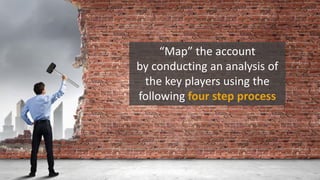
“Map” the account
by conducting an analysis of
the key players using the
following four step process
Identify Decision-Makers’ &
Influencers’ Priorities
1
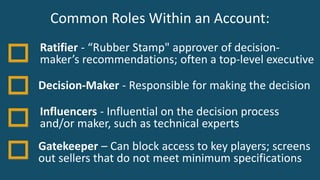
Common Roles Within an Account:
Decision-Maker - Responsible for making the decision
Ratifier - “Rubber Stamp" approver of decision-
maker’s recommendations; often a top-level executive
Influencers - Influential on the decision process
and/or maker, such as technical experts
Gatekeeper – Can block access to key players; screens
out sellers that do not meet minimum specifications
Sell to all decision-makers and
influencers, directly or indirectly,
to avoid taking unnecessary risks
in the selling process
Analyze decision-makers’ priorities to overcome multi-level
obstacles and capitalize on selling opportunities
Determine Degrees
of Influence2
Determine each person's
degree of influence over
the purchase decision
To provide structure to the analysis, rank each person as
having a high, medium, or low degree of influence.
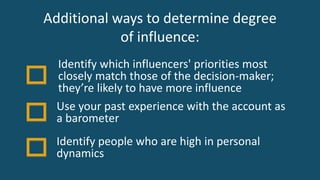
Additional ways to determine degree
of influence:
Use your past experience with the account as
a barometer
Identify which influencers' priorities most
closely match those of the decision-maker;
they’re likely to have more influence
Identify people who are high in personal
dynamics
Establish Connections
Among Key Players
3
Determine who's connected to whom in the account, either
by political, functional, organizational, or personal ties
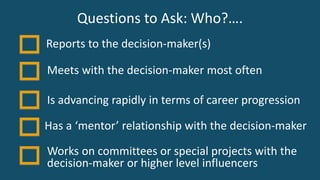
Questions to Ask: Who?….
Is advancing rapidly in terms of career progression
Has a ‘mentor’ relationship with the decision-maker
Works on committees or special projects with the
decision-maker or higher level influencers
Meets with the decision-maker most often
Reports to the decision-maker(s)
Don't forget to consider organizational titles and lines
of authority as guidelines in drawing connections
Identify Commitment
Levels
4
Identifying commitment levels
can be simplified by focusing on
two interacting attributes -
Receptivity and Dynamics
Receptivity is how the decision-
maker or influencer
feels about you, your company,
and what you have to offer
Dynamics refers to his or her ability to
influence or persuade others
To assess a person’s
commitment level in
this way, rate using
High or Low values
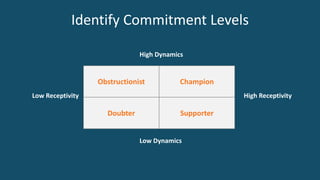
Identify Commitment Levels
Obstructionist Champion
Doubter Supporter
High Dynamics
Low Dynamics
High ReceptivityLow Receptivity
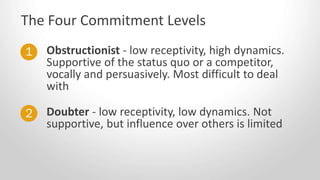
Obstructionist - low receptivity, high dynamics.
Supportive of the status quo or a competitor,
vocally and persuasively. Most difficult to deal
with
The Four Commitment Levels
1
2 Doubter - low receptivity, low dynamics. Not
supportive, but influence over others is limited
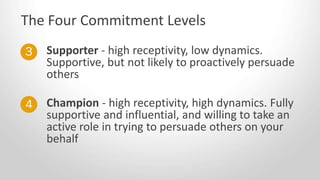
Supporter - high receptivity, low dynamics.
Supportive, but not likely to proactively persuade
others
The Four Commitment Levels
3
4 Champion - high receptivity, high dynamics. Fully
supportive and influential, and willing to take an
active role in trying to persuade others on your
behalf
Summary – When in a multi-selling
situation, map the account and
analyze priorities, degrees of
influence, connections and
commitment levels
This will help you save time from selling to non-supportive
influencers or inaccessible decision-makers
Research Report Reveals
Well-Designed Training
Improves Sales Results
Download Report
COMPLIMENTARY OFFER
By David Jacoby
@DiJacoby

How to Sell to Multiple Decision Makers

  • 1.
    Steps That Will HelpYou Sell To MULTIPLE DECISION MAKERS
  • 2.
    It’s challenging tosell into large, complex accounts with multiple decision-makers and influencers
  • 3.
    You never reallyknow how the decision is being made or who’s making it
  • 4.
    • Needs expertor detailed information from others • Shares the risk by delegating some power to others • Needs to get buy-in or approvals from others A multi-level selling situation arises when decision-maker:
  • 5.
    “Map” the account byconducting an analysis of the key players using the following four step process
  • 6.
  • 7.
    Common Roles Withinan Account: Decision-Maker - Responsible for making the decision Ratifier - “Rubber Stamp" approver of decision- maker’s recommendations; often a top-level executive Influencers - Influential on the decision process and/or maker, such as technical experts Gatekeeper – Can block access to key players; screens out sellers that do not meet minimum specifications
  • 8.
    Sell to alldecision-makers and influencers, directly or indirectly, to avoid taking unnecessary risks in the selling process
  • 9.
    Analyze decision-makers’ prioritiesto overcome multi-level obstacles and capitalize on selling opportunities
  • 10.
  • 11.
    Determine each person's degreeof influence over the purchase decision
  • 12.
    To provide structureto the analysis, rank each person as having a high, medium, or low degree of influence.
  • 13.
    Additional ways todetermine degree of influence: Use your past experience with the account as a barometer Identify which influencers' priorities most closely match those of the decision-maker; they’re likely to have more influence Identify people who are high in personal dynamics
  • 14.
  • 15.
    Determine who's connectedto whom in the account, either by political, functional, organizational, or personal ties
  • 16.
    Questions to Ask:Who?…. Is advancing rapidly in terms of career progression Has a ‘mentor’ relationship with the decision-maker Works on committees or special projects with the decision-maker or higher level influencers Meets with the decision-maker most often Reports to the decision-maker(s)
  • 17.
    Don't forget toconsider organizational titles and lines of authority as guidelines in drawing connections
  • 18.
  • 19.
    Identifying commitment levels canbe simplified by focusing on two interacting attributes - Receptivity and Dynamics
  • 20.
    Receptivity is howthe decision- maker or influencer feels about you, your company, and what you have to offer
  • 21.
    Dynamics refers tohis or her ability to influence or persuade others
  • 22.
    To assess aperson’s commitment level in this way, rate using High or Low values
  • 23.
    Identify Commitment Levels ObstructionistChampion Doubter Supporter High Dynamics Low Dynamics High ReceptivityLow Receptivity
  • 24.
    Obstructionist - lowreceptivity, high dynamics. Supportive of the status quo or a competitor, vocally and persuasively. Most difficult to deal with The Four Commitment Levels 1 2 Doubter - low receptivity, low dynamics. Not supportive, but influence over others is limited
  • 25.
    Supporter - highreceptivity, low dynamics. Supportive, but not likely to proactively persuade others The Four Commitment Levels 3 4 Champion - high receptivity, high dynamics. Fully supportive and influential, and willing to take an active role in trying to persuade others on your behalf
  • 26.
    Summary – Whenin a multi-selling situation, map the account and analyze priorities, degrees of influence, connections and commitment levels
  • 27.
    This will helpyou save time from selling to non-supportive influencers or inaccessible decision-makers
  • 28.
    Research Report Reveals Well-DesignedTraining Improves Sales Results Download Report COMPLIMENTARY OFFER
  • 29.