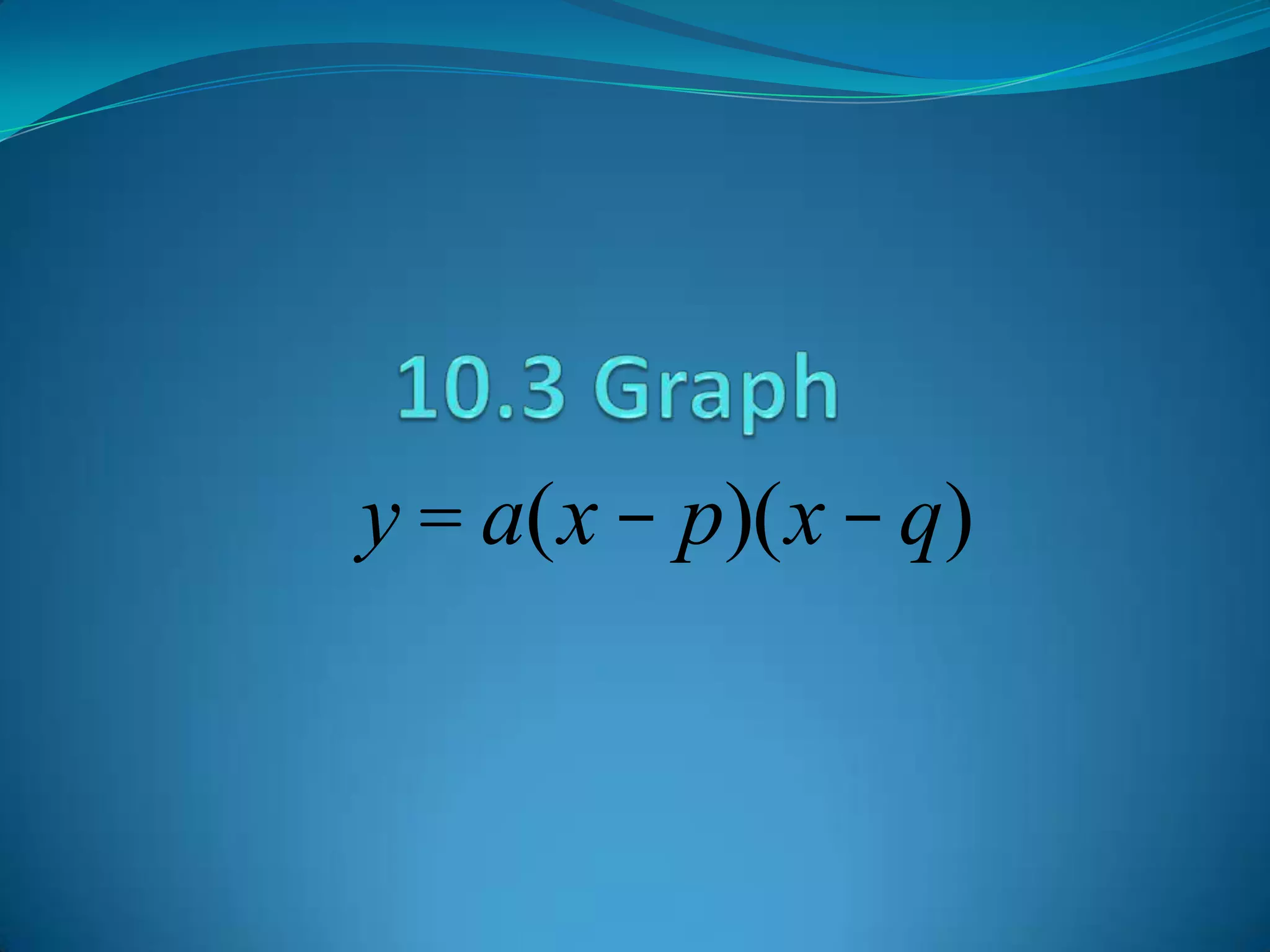
y = a(x - p)(x-q)
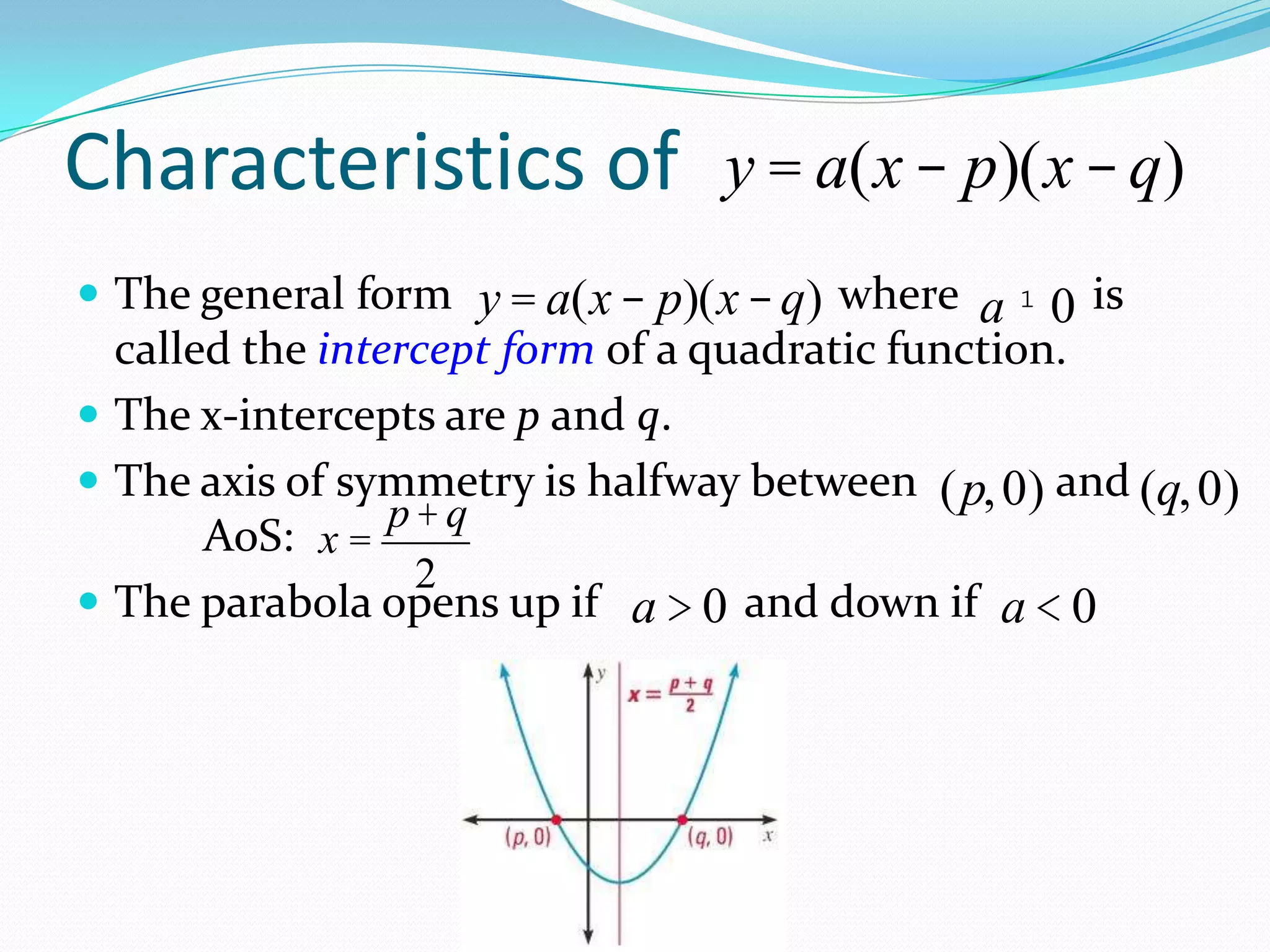
Characteristics of
 The general form where is
called the intercept form of a quadratic function.
 The x-intercepts are p and q.
 The axis of symmetry is halfway between and
AoS:
 The parabola opens up if and down if
y = a(x- p)(x-q) a ¹ 0
y = a(x - p)(x-q)
(p,0) (q,0)
x =
p+q
2
a > 0 a < 0
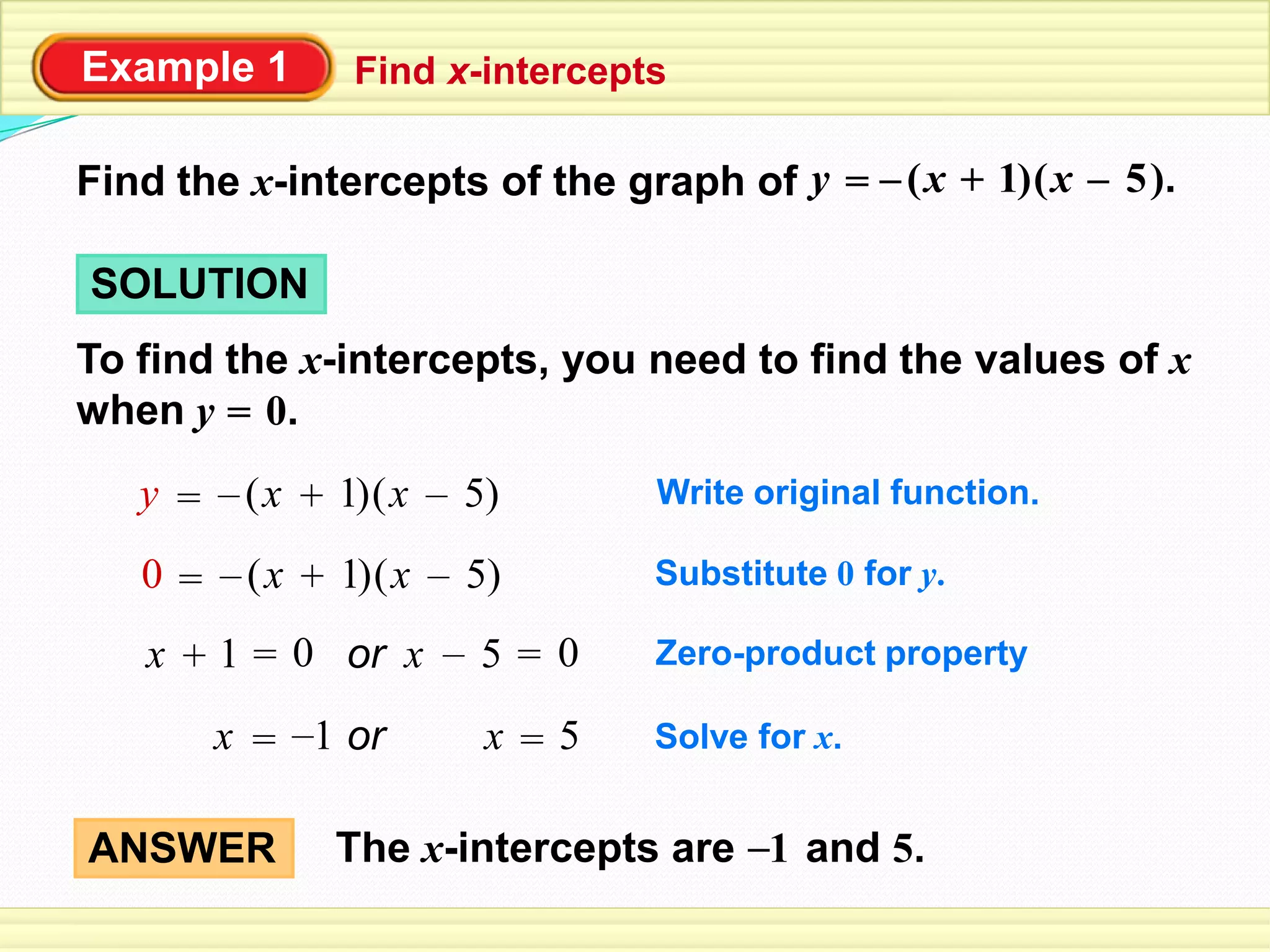
Example 1 Find x-intercepts
Find the x-intercepts of the graph of ( )1+x= ( ).5x–y –
SOLUTION
To find the x-intercepts, you need to find the values of x
when y = 0.
Write original function.=y ( )1+x ( )5x– –
Substitute 0 for y.=0 ( )1+x ( )5x– –
Zero-product property1+x 5x – = 0= 0 or
Solve for x.x 5x == or1–
The x-intercepts are and 5.1–ANSWER
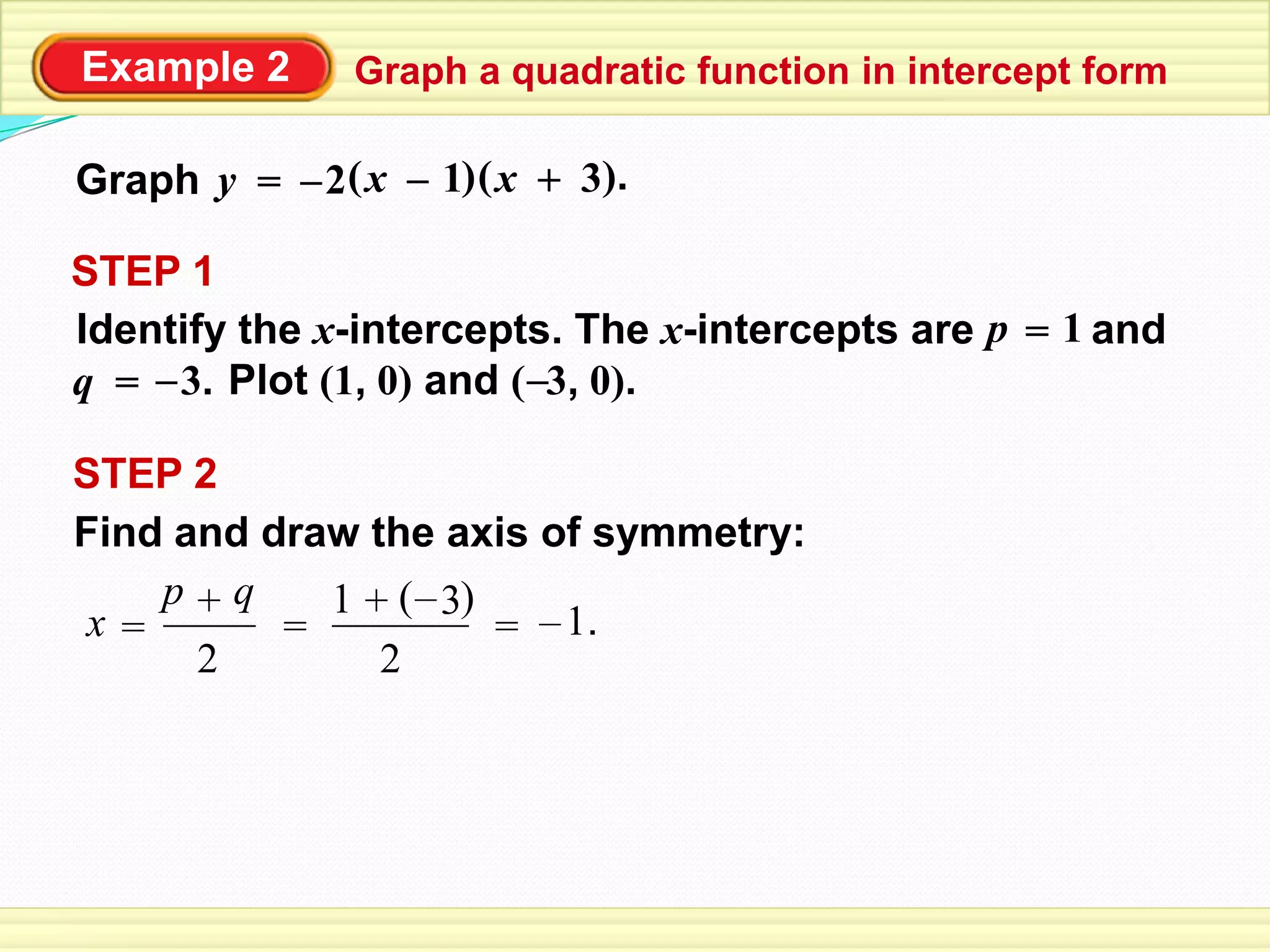
Example 2 Graph a quadratic function in intercept form
Graph ( )1 +x= ( ).3x–y –2
STEP 2
Find and draw the axis of symmetry:
2
q+p
x = =
2
+1 ( )3–
= 1.–
STEP 1
Identify the x-intercepts. The x-intercepts are and
Plot (1, 0) and ( 3, 0).
p = 1
q = –3. –
Example 2 Graph a quadratic function in intercept form
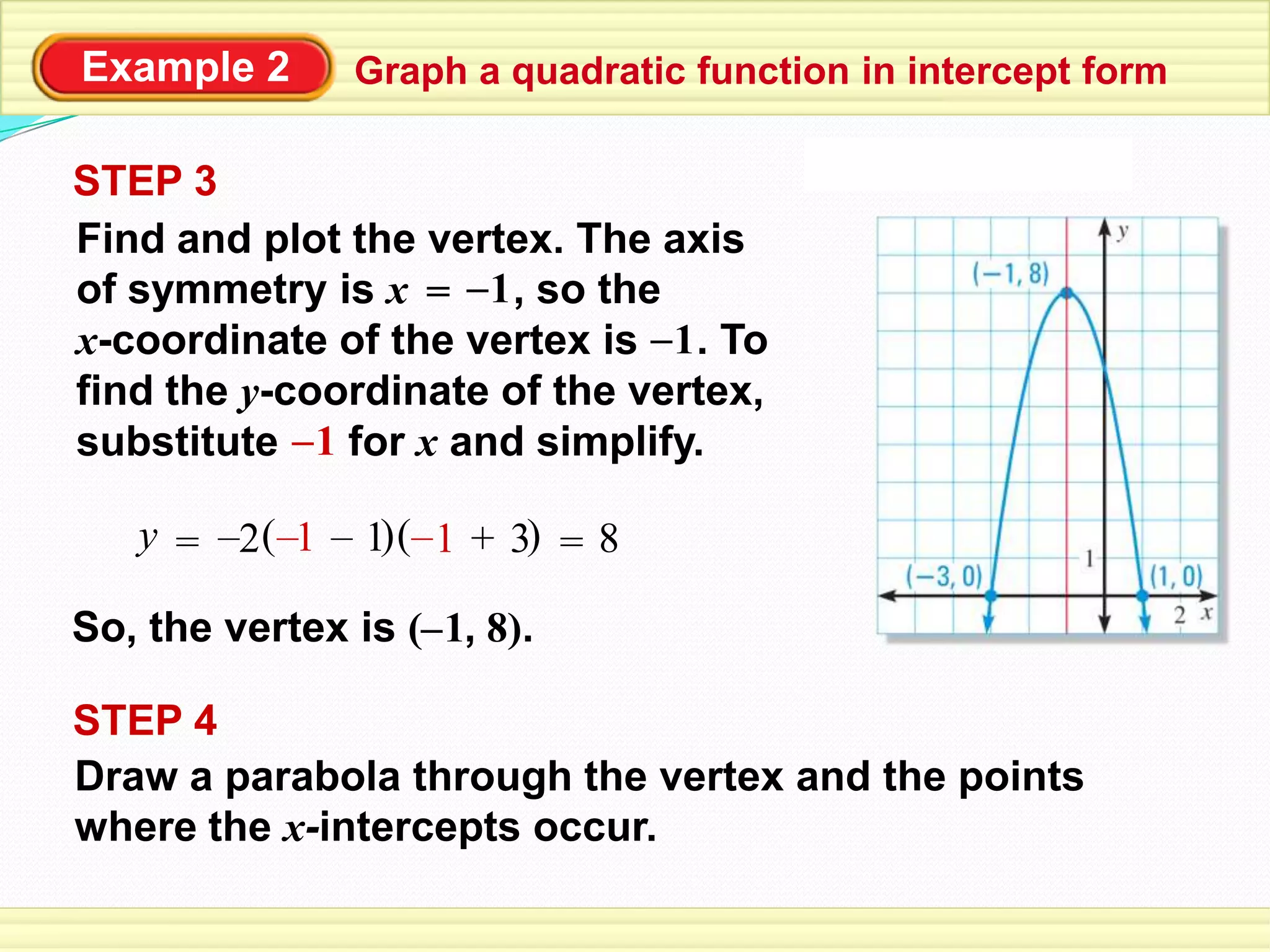
STEP 4
Draw a parabola through the vertex and the points
where the x-intercepts occur.
So, the vertex is ( , 8).–1
STEP 3
Find and plot the vertex. The axis
of symmetry is x , so the
x-coordinate of the vertex is . To
find the y-coordinate of the vertex,
substitute for x and simplify.
= –1
–1
–1
( )1 += ( )3–y –2 1– 1– 8=
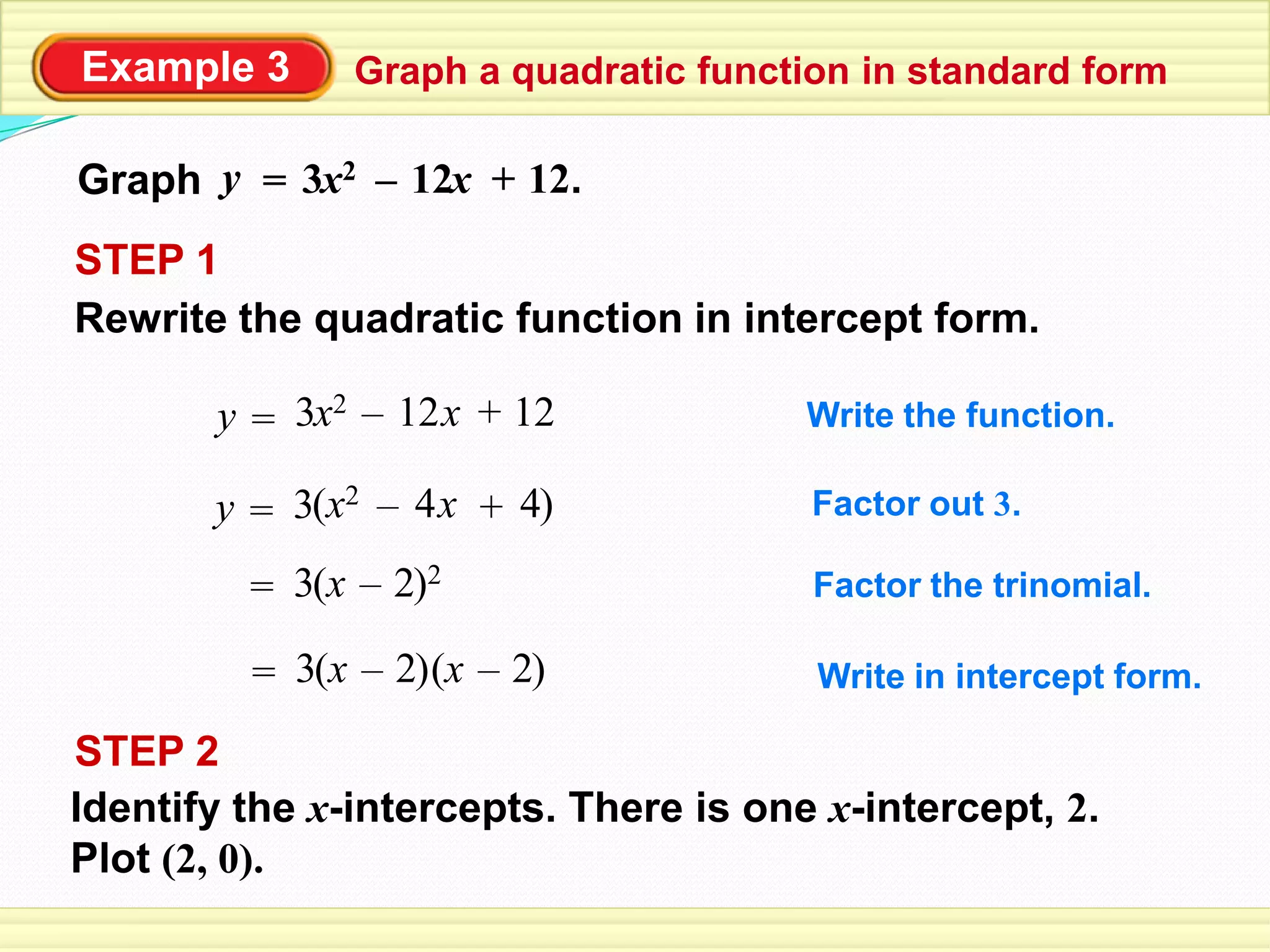
Example 3 Graph a quadratic function in standard form
Graph y = 12 +x2 12.x–3
Rewrite the quadratic function in intercept form.
STEP 1
Write the function.=y 12 +x2 12x–3
Factor out 3.=y 4 +x2 4x–3( )
= x 2–3( )2 Factor the trinomial.
Write in intercept form.= x 2–3( ) x 2–( )
STEP 2
Identify the x-intercepts. There is one x-intercept, 2.
Plot (2, 0).
Example 3
STEP 3
Find and draw the axis of symmetry:
2
q+p
x = = = 2.
2
2+2
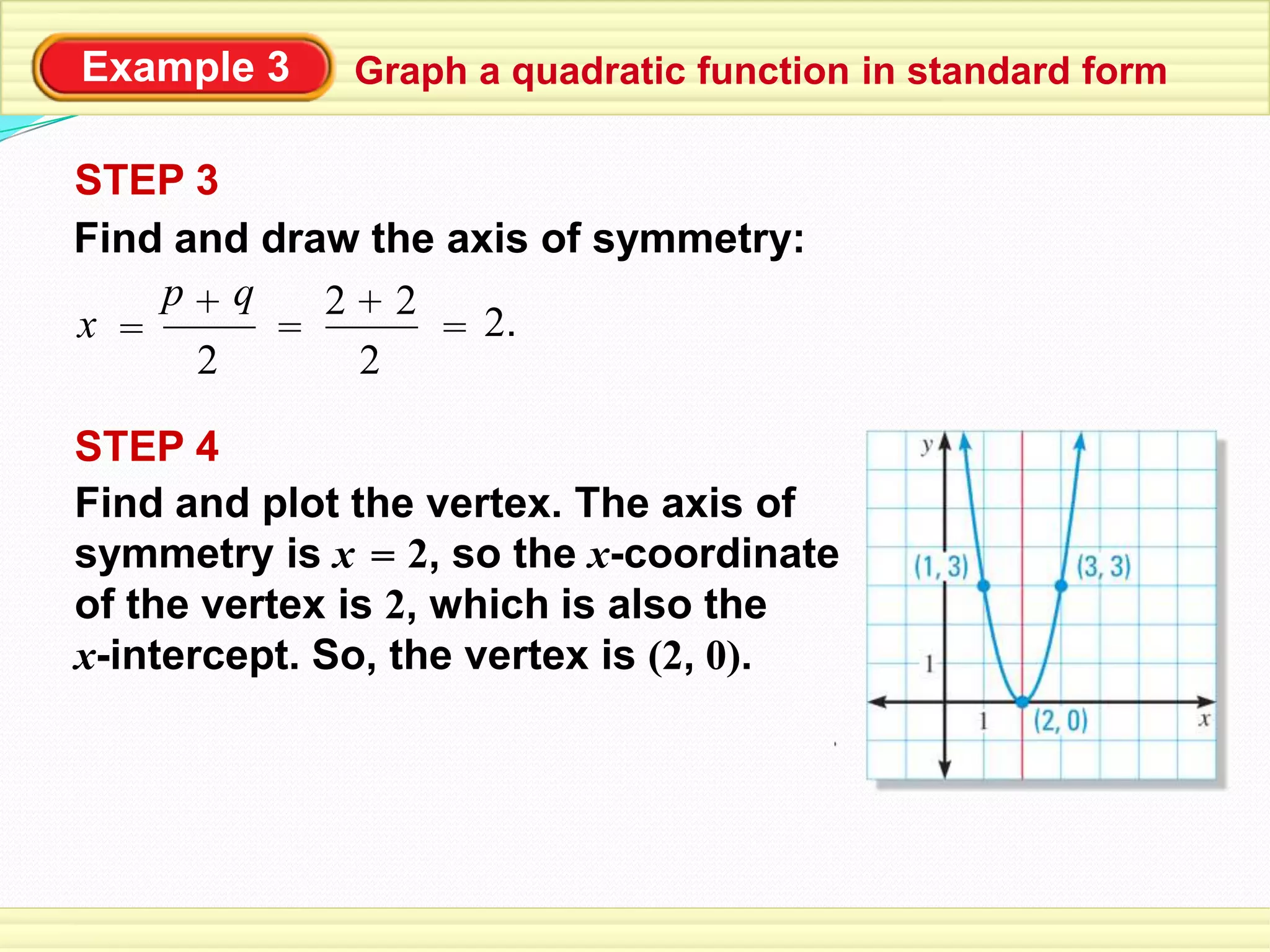
STEP 4
Find and plot the vertex. The axis of
symmetry is x 2, so the x-coordinate
of the vertex is 2, which is also the
x-intercept. So, the vertex is (2, 0).
=
Graph a quadratic function in standard form
Example 3
Draw a parabola through the points.
STEP 6
STEP 5
Plot a point and its reflection. Choose a value for x, say
x 1. When x 1, y 3. Plot (1, 3). By reflecting the
point in the axis of symmetry, you can also plot (3, 3).
= = =
Graph a quadratic function in standard form
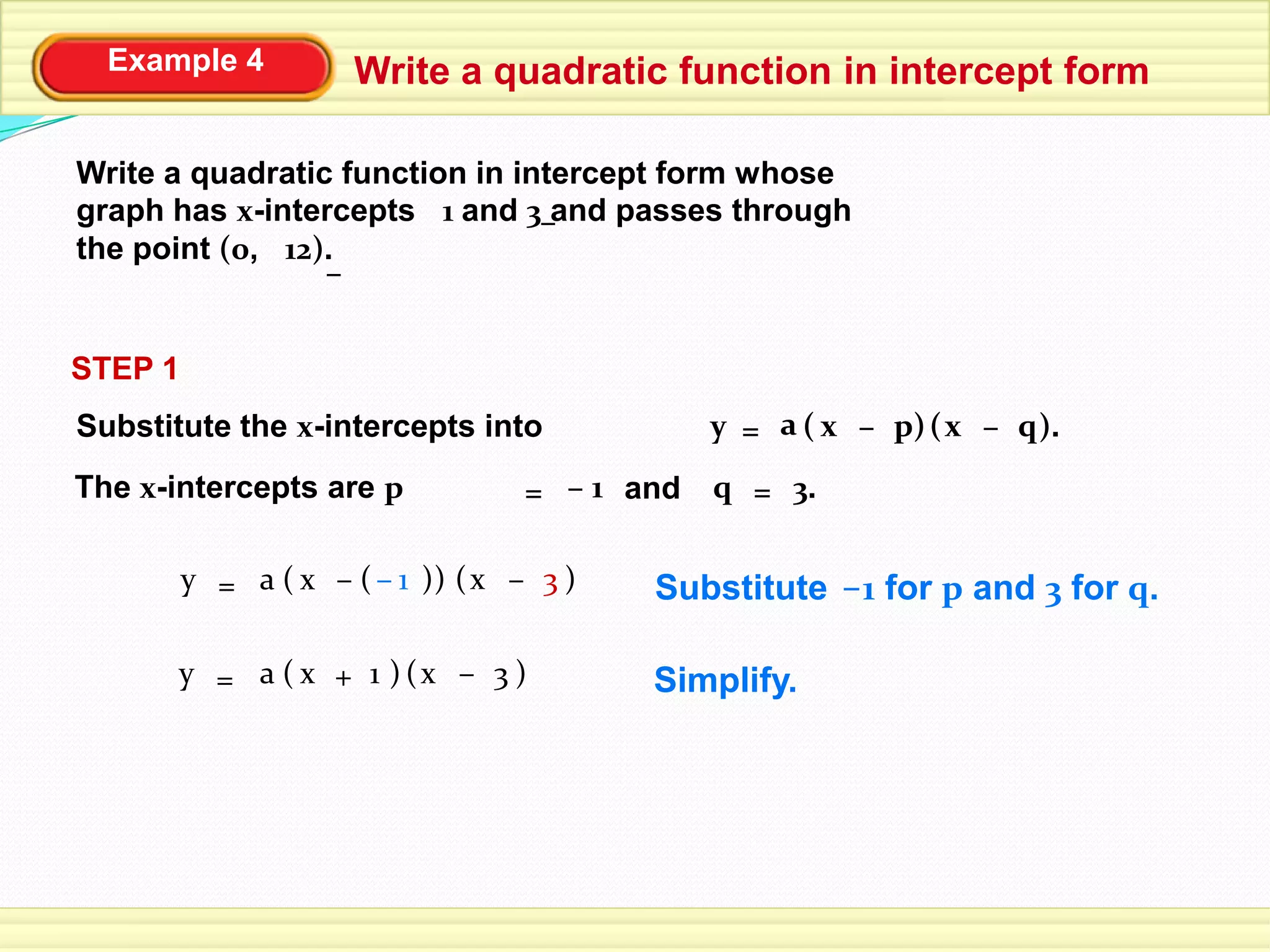
Example 4 Write a quadratic function in intercept form
Write a quadratic function in intercept form whose
graph has x-intercepts 1 and 3 and passes through
the point (0, 12).
–
–
STEP 1
Substitute the x-intercepts into
The x-intercepts are p
( )px= ( ).y –a qx –
and= 1– q 3.=
( )1x= ( )y +a 3x – Simplify.
–Substitute 1 for p and 3 for q.( x= ( )y –a 3x –( )1– )
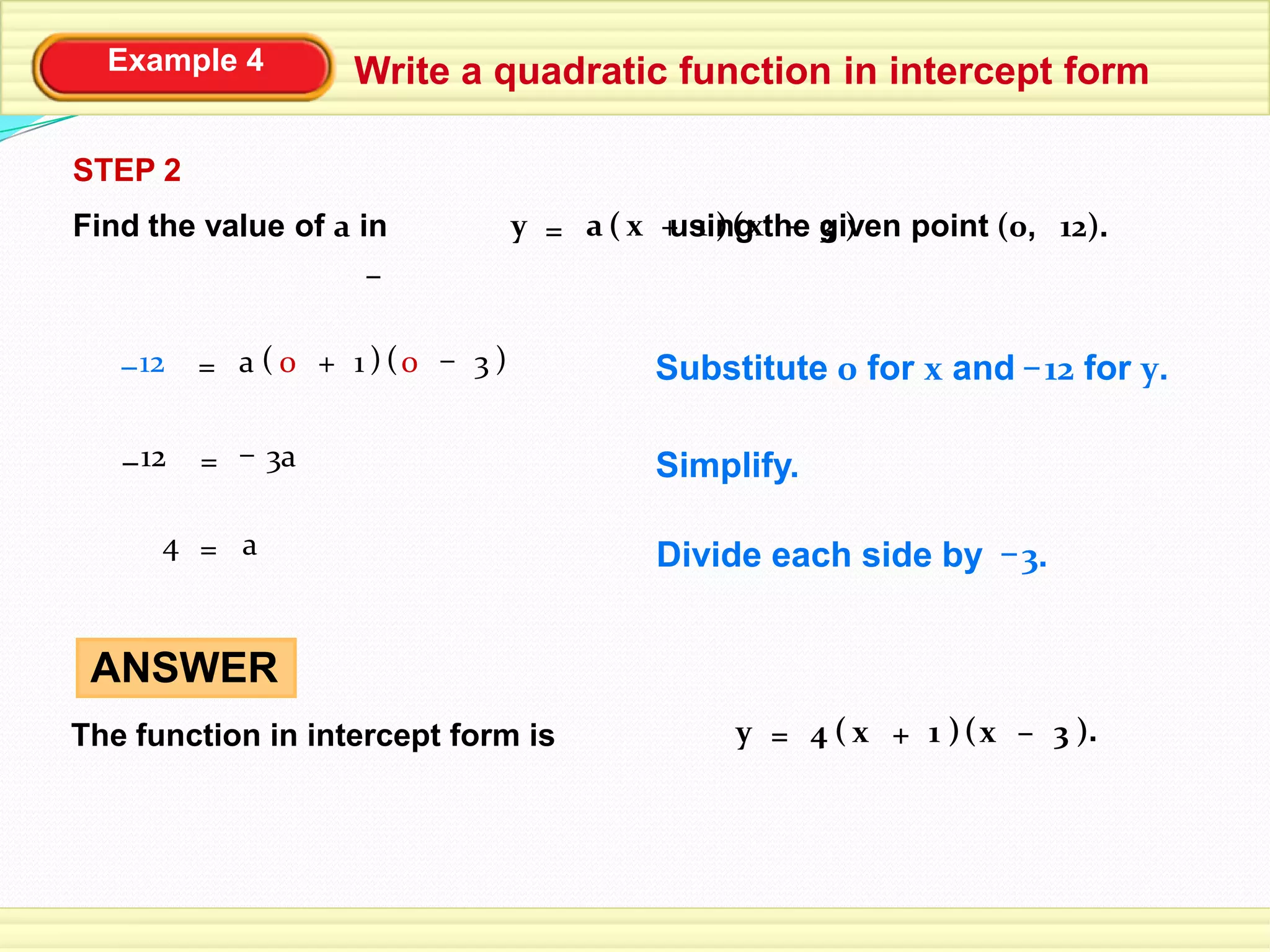
Example 4 Write a quadratic function in intercept form
Find the value of a in using the given point (0, 12).
STEP 2
( )1x= (y +a 3x – )
–
Simplify.12– = 3a–
Divide each side by 3.–4 = a
ANSWER
y =The function in intercept form is ( )1x (+4 3x – ).
Substitute 0 for x and 12 for y.–( )10= ( )+ 30 –12– a
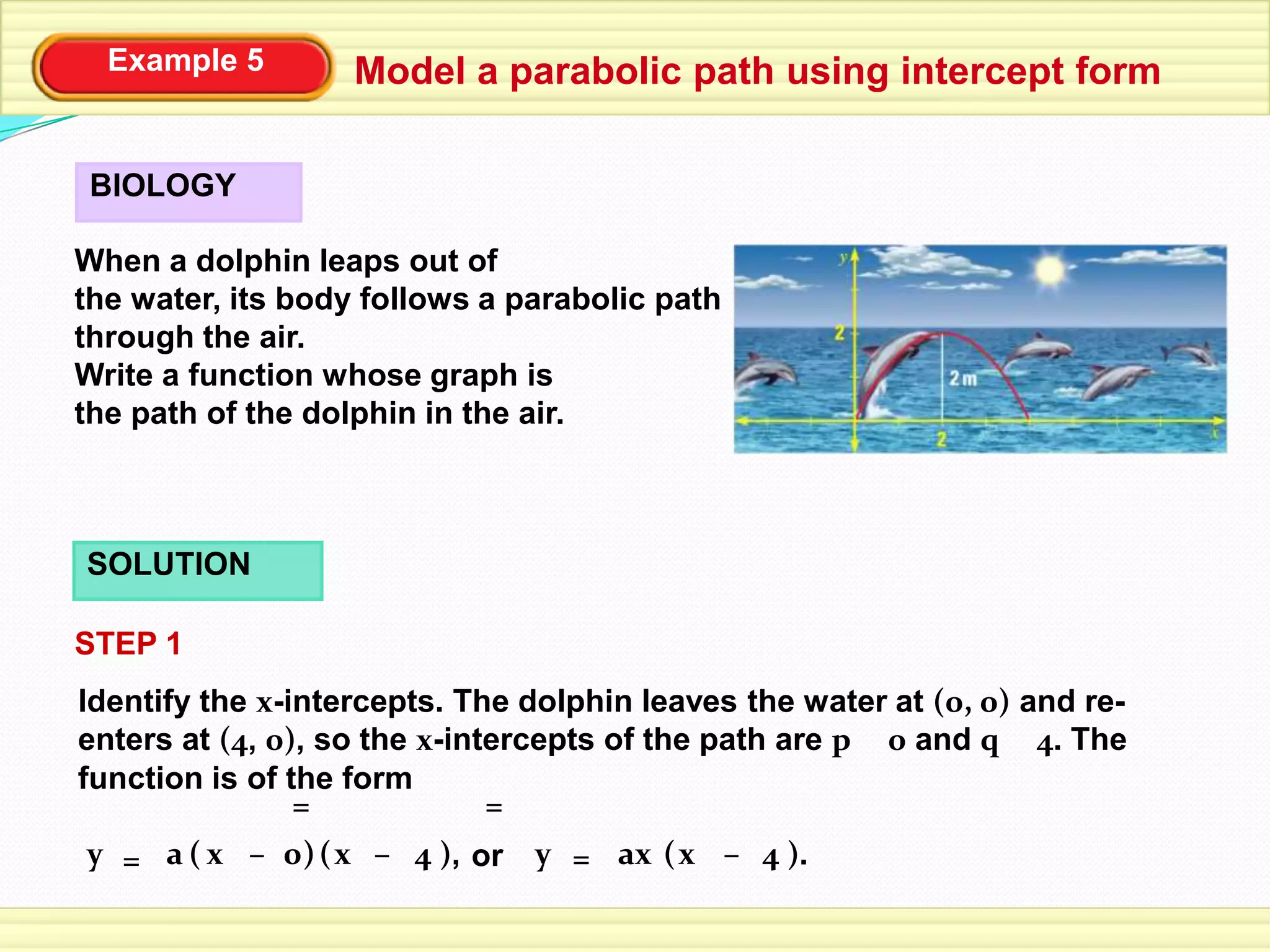
Example 5 Model a parabolic path using intercept form
BIOLOGY
When a dolphin leaps out of
the water, its body follows a parabolic path
through the air.
Write a function whose graph is
the path of the dolphin in the air.
SOLUTION
STEP 1
( )0x= (y a 4x – ),– = (y ax 4x – ).or
Identify the x-intercepts. The dolphin leaves the water at (0, 0) and re-
enters at (4, 0), so the x-intercepts of the path are p 0 and q 4. The
function is of the form
= =
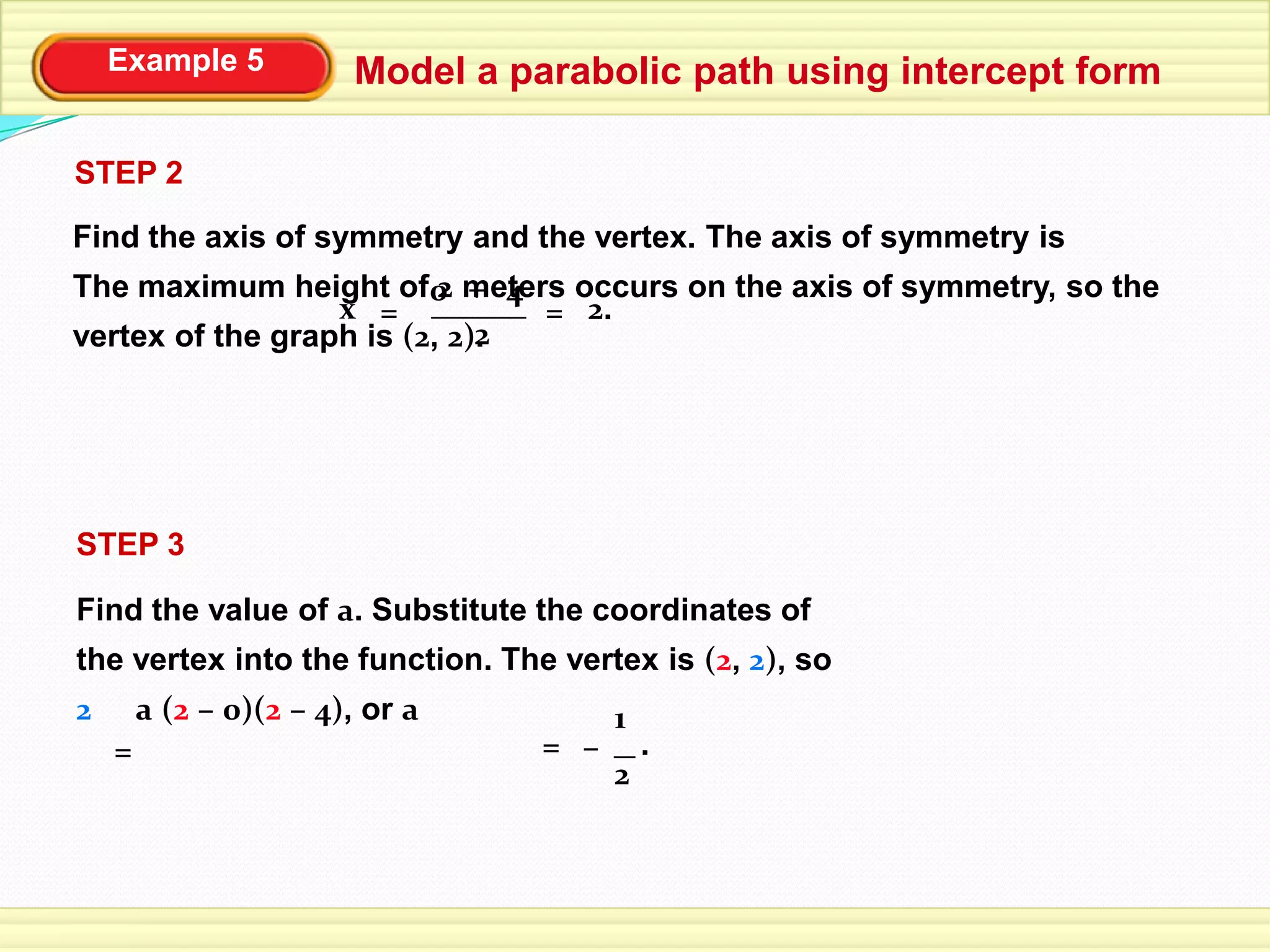
Example 5 Model a parabolic path using intercept form
STEP 2
Find the axis of symmetry and the vertex. The axis of symmetry is
The maximum height of 2 meters occurs on the axis of symmetry, so the
vertex of the graph is (2, 2).2
4+0
x = 2.=
Find the value of a. Substitute the coordinates of
the vertex into the function. The vertex is (2, 2), so
2 a (2 – 0)(2 – 4), or a
STEP 3
= =
2
1
– .
Example 5 Model a parabolic path using intercept form
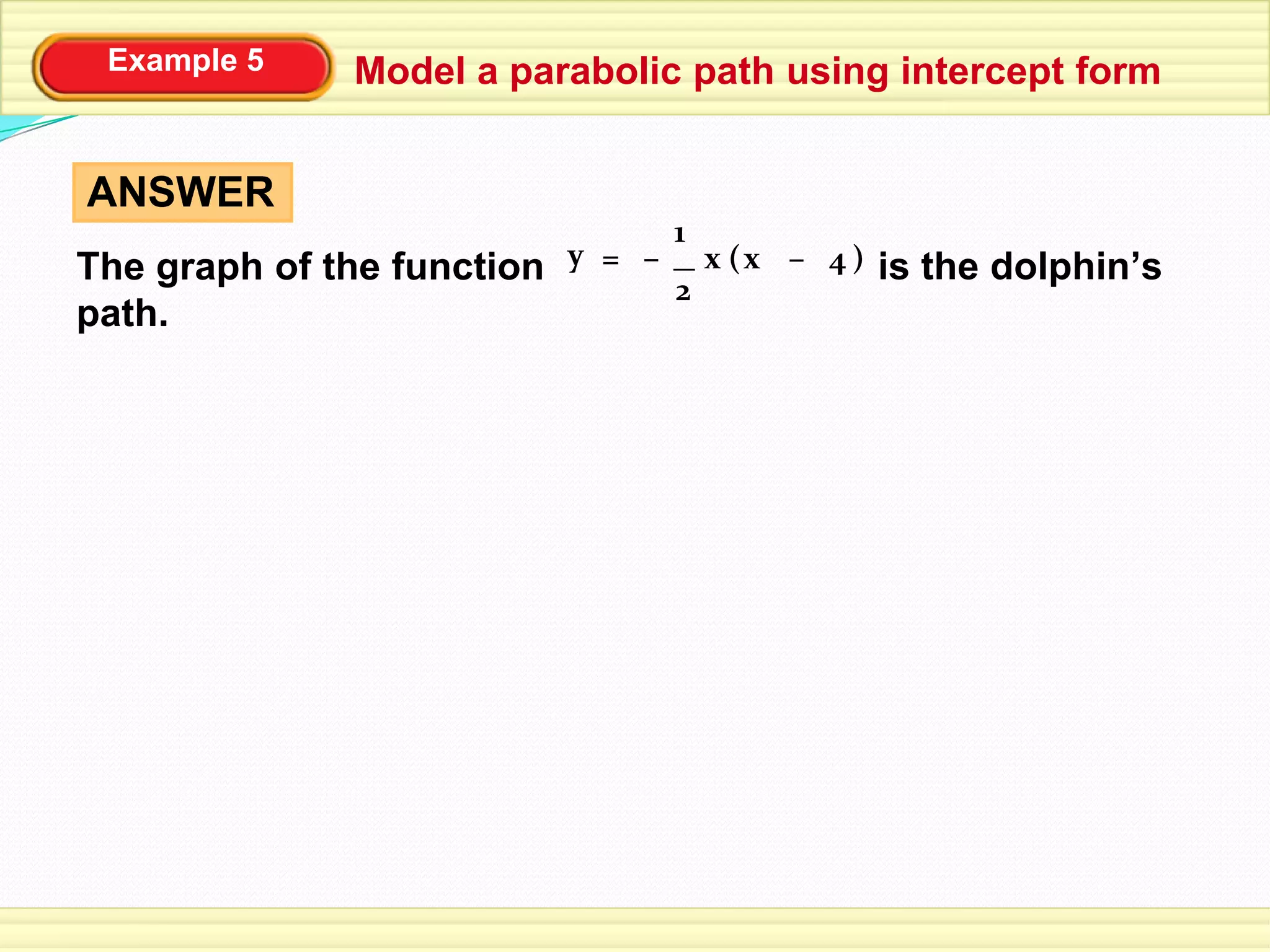
ANSWER
The graph of the function
path.
is the dolphin’s
2
1
= – (x 4x – )y
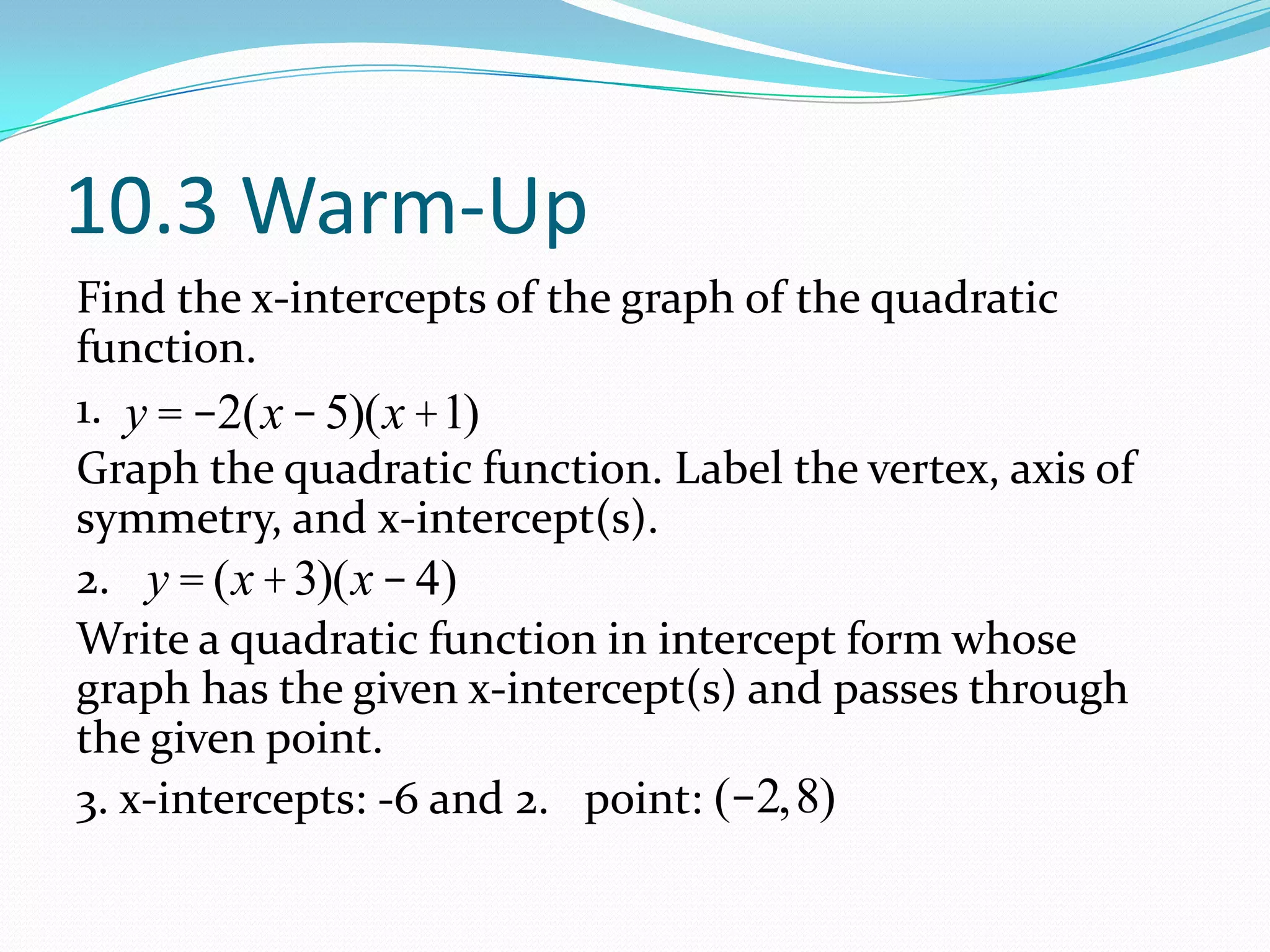
10.3 Warm-Up
Find the x-intercepts of the graph of the quadratic
function.
1.
Graph the quadratic function. Label the vertex, axis of
symmetry, and x-intercept(s).
2.
Write a quadratic function in intercept form whose
graph has the given x-intercept(s) and passes through
the given point.
3. x-intercepts: -6 and 2. point:
y = -2(x -5)(x +1)
y = (x+3)(x-4)
(-2,8)

10.3

  • 1.
    y = a(x- p)(x-q)
  • 2.
    Characteristics of  Thegeneral form where is called the intercept form of a quadratic function.  The x-intercepts are p and q.  The axis of symmetry is halfway between and AoS:  The parabola opens up if and down if y = a(x- p)(x-q) a ¹ 0 y = a(x - p)(x-q) (p,0) (q,0) x = p+q 2 a > 0 a < 0
  • 3.
    Example 1 Findx-intercepts Find the x-intercepts of the graph of ( )1+x= ( ).5x–y – SOLUTION To find the x-intercepts, you need to find the values of x when y = 0. Write original function.=y ( )1+x ( )5x– – Substitute 0 for y.=0 ( )1+x ( )5x– – Zero-product property1+x 5x – = 0= 0 or Solve for x.x 5x == or1– The x-intercepts are and 5.1–ANSWER
  • 4.
    Example 2 Grapha quadratic function in intercept form Graph ( )1 +x= ( ).3x–y –2 STEP 2 Find and draw the axis of symmetry: 2 q+p x = = 2 +1 ( )3– = 1.– STEP 1 Identify the x-intercepts. The x-intercepts are and Plot (1, 0) and ( 3, 0). p = 1 q = –3. –
  • 5.
    Example 2 Grapha quadratic function in intercept form STEP 4 Draw a parabola through the vertex and the points where the x-intercepts occur. So, the vertex is ( , 8).–1 STEP 3 Find and plot the vertex. The axis of symmetry is x , so the x-coordinate of the vertex is . To find the y-coordinate of the vertex, substitute for x and simplify. = –1 –1 –1 ( )1 += ( )3–y –2 1– 1– 8=
  • 6.
    Example 3 Grapha quadratic function in standard form Graph y = 12 +x2 12.x–3 Rewrite the quadratic function in intercept form. STEP 1 Write the function.=y 12 +x2 12x–3 Factor out 3.=y 4 +x2 4x–3( ) = x 2–3( )2 Factor the trinomial. Write in intercept form.= x 2–3( ) x 2–( ) STEP 2 Identify the x-intercepts. There is one x-intercept, 2. Plot (2, 0).
  • 7.
    Example 3 STEP 3 Findand draw the axis of symmetry: 2 q+p x = = = 2. 2 2+2 STEP 4 Find and plot the vertex. The axis of symmetry is x 2, so the x-coordinate of the vertex is 2, which is also the x-intercept. So, the vertex is (2, 0). = Graph a quadratic function in standard form
  • 8.
    Example 3 Draw aparabola through the points. STEP 6 STEP 5 Plot a point and its reflection. Choose a value for x, say x 1. When x 1, y 3. Plot (1, 3). By reflecting the point in the axis of symmetry, you can also plot (3, 3). = = = Graph a quadratic function in standard form
  • 9.
    Example 4 Writea quadratic function in intercept form Write a quadratic function in intercept form whose graph has x-intercepts 1 and 3 and passes through the point (0, 12). – – STEP 1 Substitute the x-intercepts into The x-intercepts are p ( )px= ( ).y –a qx – and= 1– q 3.= ( )1x= ( )y +a 3x – Simplify. –Substitute 1 for p and 3 for q.( x= ( )y –a 3x –( )1– )
  • 10.
    Example 4 Writea quadratic function in intercept form Find the value of a in using the given point (0, 12). STEP 2 ( )1x= (y +a 3x – ) – Simplify.12– = 3a– Divide each side by 3.–4 = a ANSWER y =The function in intercept form is ( )1x (+4 3x – ). Substitute 0 for x and 12 for y.–( )10= ( )+ 30 –12– a
  • 11.
    Example 5 Modela parabolic path using intercept form BIOLOGY When a dolphin leaps out of the water, its body follows a parabolic path through the air. Write a function whose graph is the path of the dolphin in the air. SOLUTION STEP 1 ( )0x= (y a 4x – ),– = (y ax 4x – ).or Identify the x-intercepts. The dolphin leaves the water at (0, 0) and re- enters at (4, 0), so the x-intercepts of the path are p 0 and q 4. The function is of the form = =
  • 12.
    Example 5 Modela parabolic path using intercept form STEP 2 Find the axis of symmetry and the vertex. The axis of symmetry is The maximum height of 2 meters occurs on the axis of symmetry, so the vertex of the graph is (2, 2).2 4+0 x = 2.= Find the value of a. Substitute the coordinates of the vertex into the function. The vertex is (2, 2), so 2 a (2 – 0)(2 – 4), or a STEP 3 = = 2 1 – .
  • 13.
    Example 5 Modela parabolic path using intercept form ANSWER The graph of the function path. is the dolphin’s 2 1 = – (x 4x – )y
  • 14.
    10.3 Warm-Up Find thex-intercepts of the graph of the quadratic function. 1. Graph the quadratic function. Label the vertex, axis of symmetry, and x-intercept(s). 2. Write a quadratic function in intercept form whose graph has the given x-intercept(s) and passes through the given point. 3. x-intercepts: -6 and 2. point: y = -2(x -5)(x +1) y = (x+3)(x-4) (-2,8)

Editor's Notes

  • #15 1. 5, -1 2. 3. y=-1/2(x+6)(x-2)