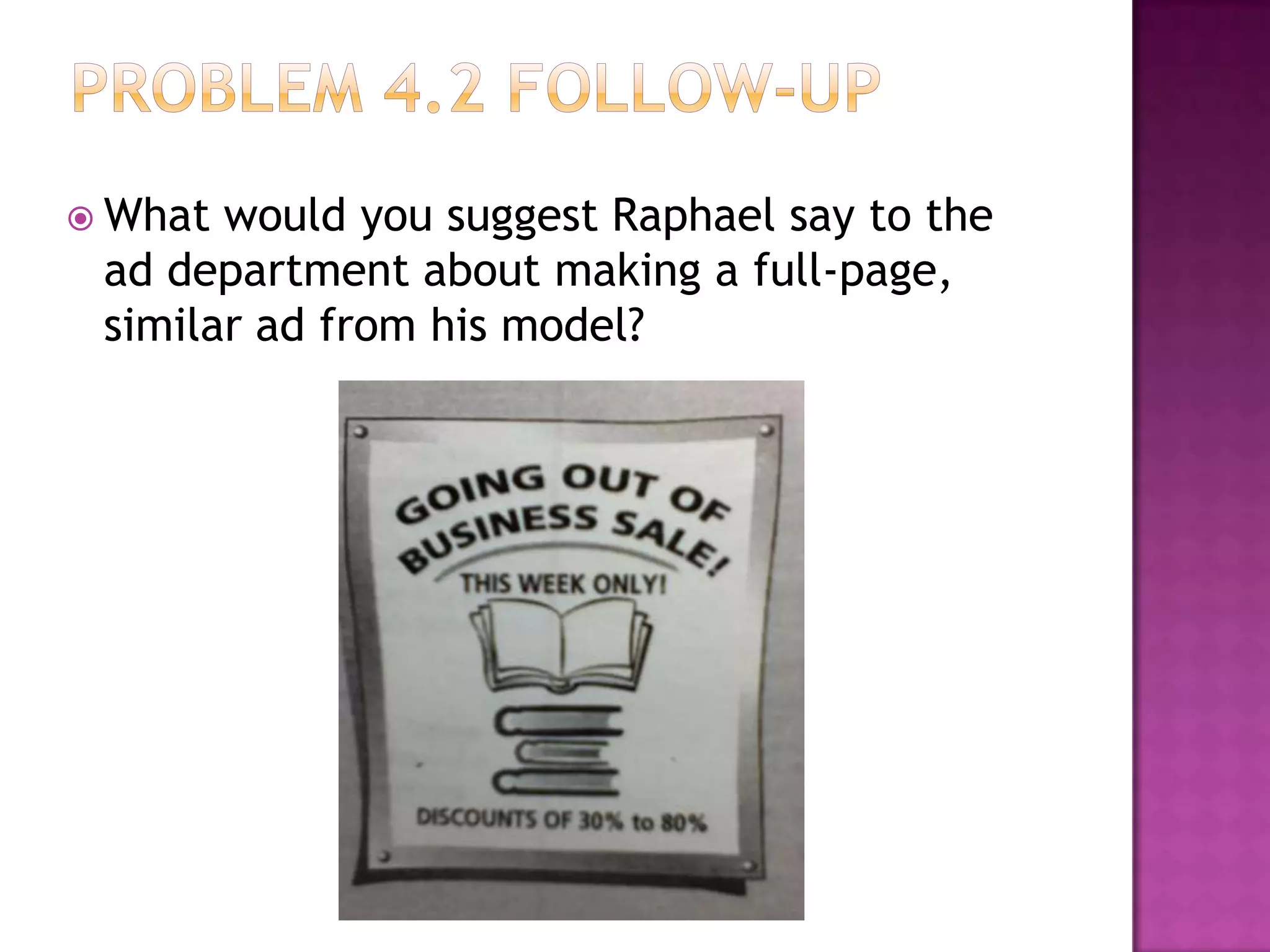
 What

would you suggest Raphael say to the
ad department about making a full-page,
similar ad from his model?
Welcome to Pre-Algebra Monday!
1. Please have your homework on your desk
and complete the warm up.
2. Discuss 4.2
– Problem and Follow up

3. Please have your journal ready for notes
– Changing percents to decimals and decimals to
percents

4. Today’s Assignment
– Facing Math Lesson 16
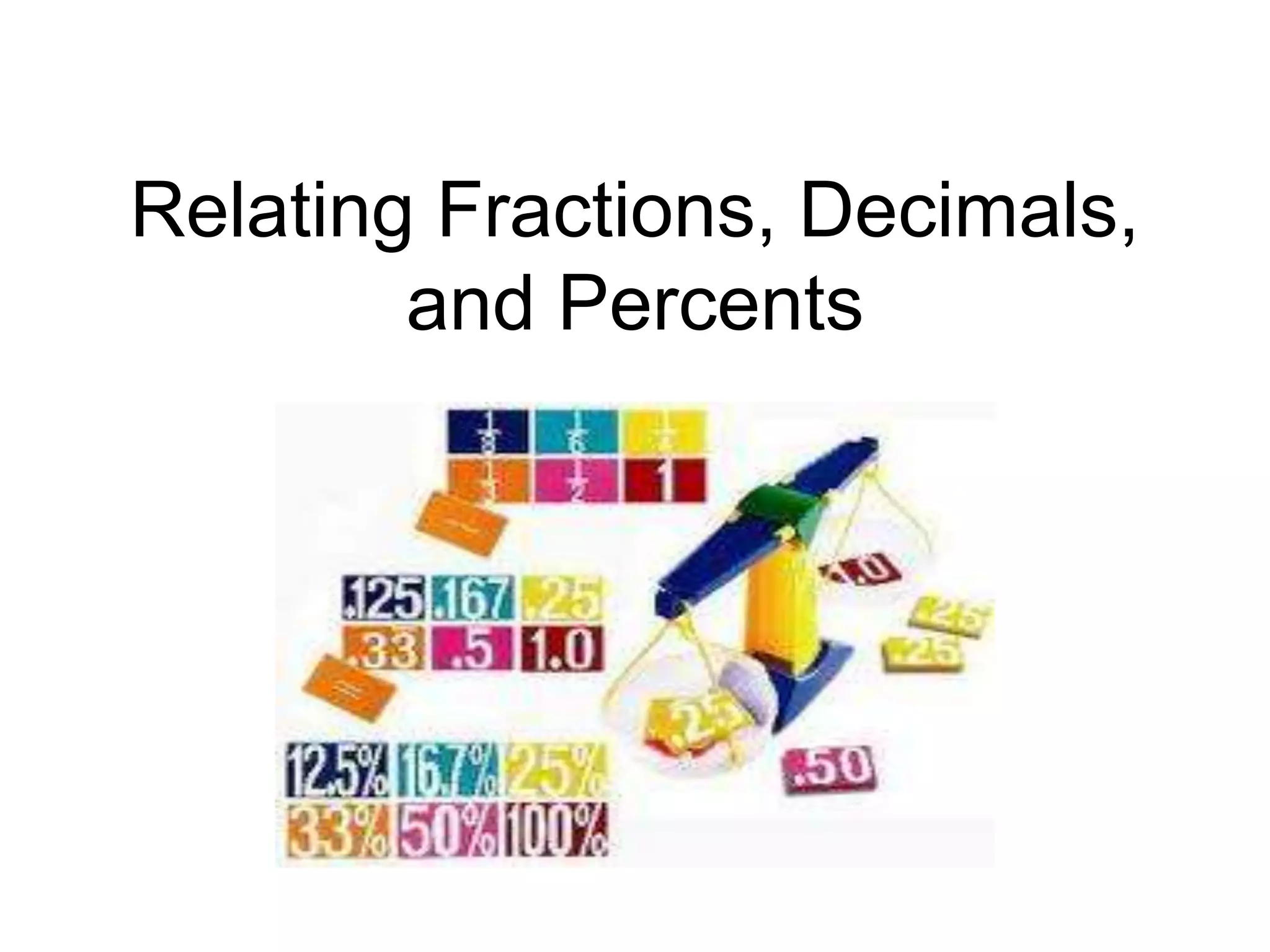
Relating Fractions, Decimals,
and Percents
Percents are ratios that compare a number
to 100.
Ratio

30
3
=
100
10
50
1
= 100
2
3
75
=
4 100

Decimal

Percent

0.30

30%

0.50

50%

0.75

75%
Reading Math
Think of the % symbol as meaning per 100
or /100. 75% = 75/100 = 0.75
To convert a fraction to a decimal, divide
the numerator by the denominator.
1
= 1 ÷ 8 = 0.125
8

To convert a decimal to a percent, multiply by
100 and insert the percent symbol.
0.125



100  12.5%
Warm-up: Tuesday
• Change the decimal to a percent
1. 7.62
2. 85.7322
3. 8.757
4. .25
5. .024
Welcome to Pre-Algebra Tuesday!
1. Please have your homework on your
desk and complete the warm up.
2. Correct the Facing Math with a red
pen
– Lesson 16

3. Please get out your journals
– 4.3 Making Copies

4. Tonight’s Assignment
– Finish Follow-up 4.3
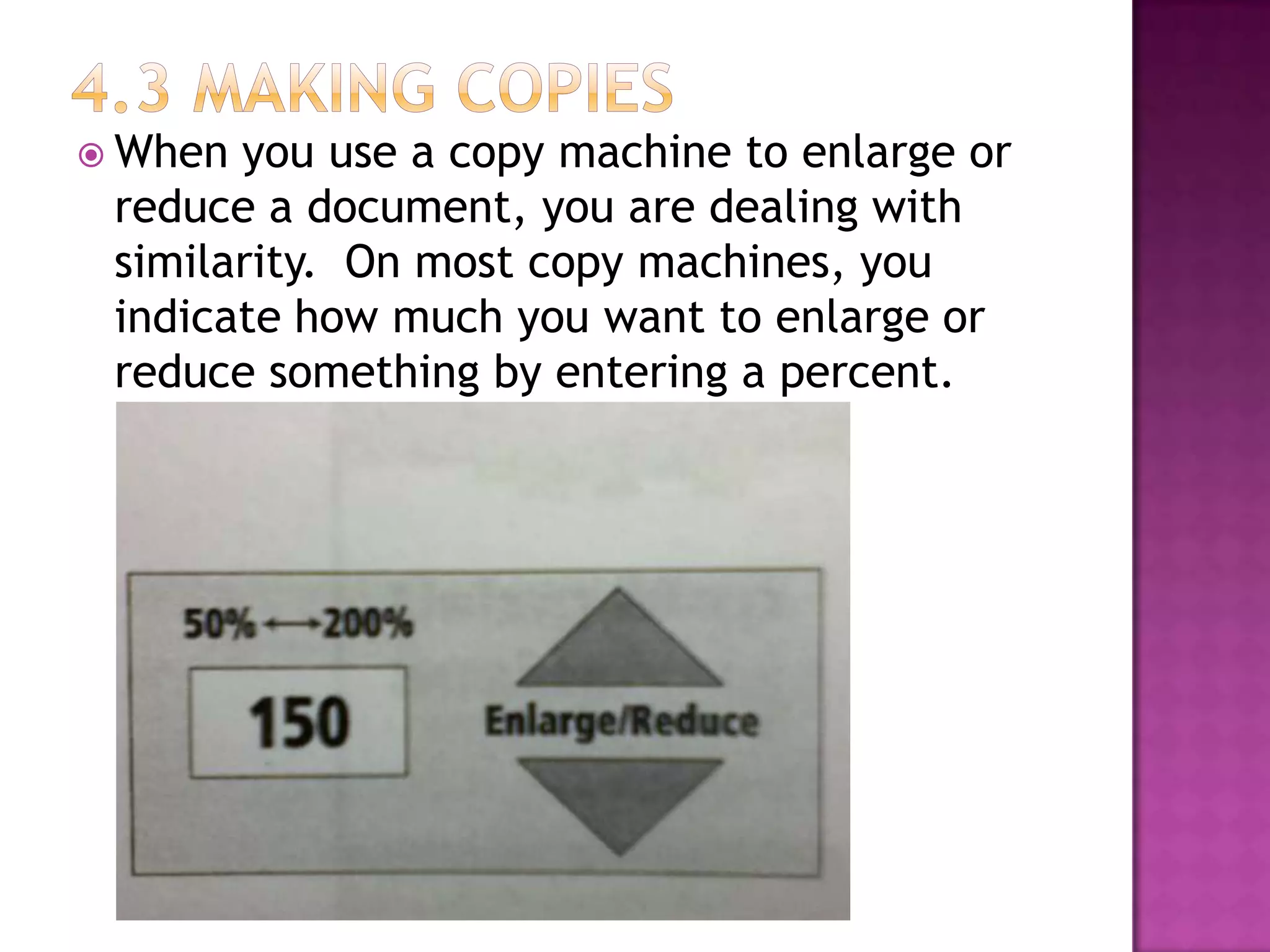
 When

you use a copy machine to enlarge or
reduce a document, you are dealing with
similarity. On most copy machines, you
indicate how much you want to enlarge or
reduce something by entering a percent.
Raphael wants to make posters for his sale by enlarging his
8 ½" by 11" ad. Raphael thinks big posters will get more
attention, so he wants to enlarge his ad as much as
possible.
 The copy machines at the copy shop have cartridges for
three paper sizes: 8 ½" by 11", 11" by 14", and 11" by 17".
The machines allow users to enlarge or reduce documents
by specifying a percent between 50% and 200%. For
example, to enlarge a document by a scale factor of 1.5, a
user would enter 150%. This tells the machine to enlarge
the document to 150% of its current size.
 A. Can Raphael make a poster that is similar to his original
ad on any of the three paper sizes-without having to trim off
part of the paper? Why or why not?
 B. If you were Raphael, what paper size would you use to
make a larger, similar poster on the copy machine? What
scale factor-expressed as a percent- would you enter into
the machine?

1.

Please write your homework down in your agenda
book and complete the warm up.

2.

Please have your spiral notebooks out


3.

4.4 Using Map Scales

Tonight’s assignment


Workbook p. 189 - 191
1.

How would you use the copy machines
described in the problem to reduce a
drawing to 25% of its original size?
Remember, the copy machines only accept
values between 50% and 200%.

2.

How would you use the copy machines to
reduce a drawing to 12½ % of its original
size?

3.

How would you use the copy machines to
reduce a drawing to 36% of its original size?
 We

use maps to help us find our way in
unfamiliar places, to plan vacations, and to
learn about other parts of the world.
 Maps are like scale drawings: they show a
large area of land at a reduced size. To get a
sense of the size of the place a map
represents, you must know to what scale the
map was drawn.

Arches National Park in Utah
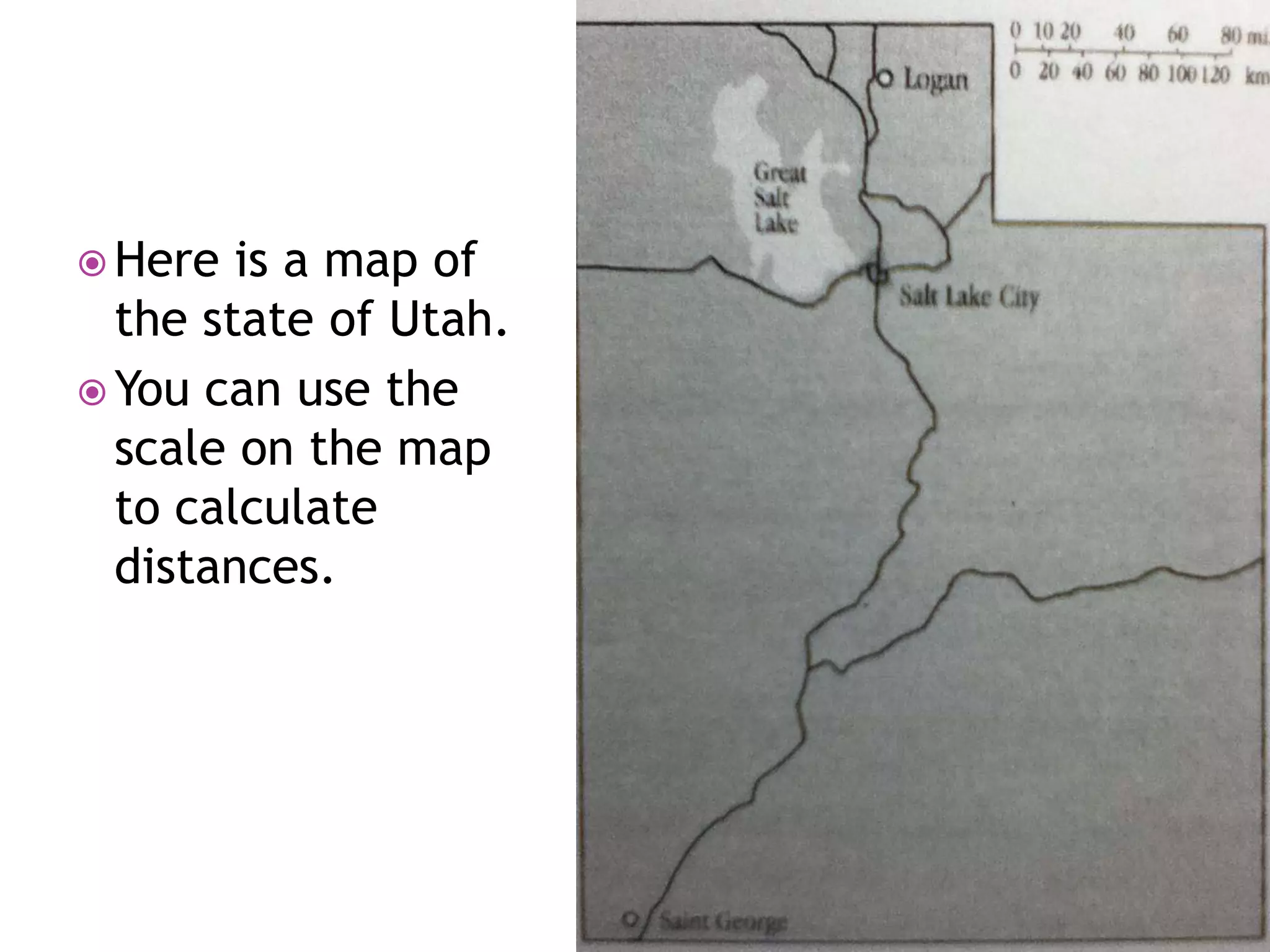
 Here

is a map of
the state of Utah.
 You can use the
scale on the map
to calculate
distances.
A.

How can you use the scale on the map to
calculate the scale factor between the map
and the real state? What is the scale
factor?

B.

How many miles of fencing would it take to
surround the state of Utah?

C.

Use the scale to estimate the area of Utah.
Explain your work.

D.

If you drove at a steady speed of 55 miles
per hour, about how long would it take you
to travel from Logan to Saint George?
 The

total land and water area of the United
States is about 3,717,522 square miles. What
percent of this total area is the area of Utah?
Quarter 2: Week 7

A

rectangle has dimensions of 1 and 6.
Another rectangle was drawn from it using a
scale factor of 1.5.

1.

The area of the large rectangle is how
many times the area of the small rectangle?

2.

The perimeter of the large rectangle is how
many times the perimeter of the small
rectangle?

New week 8

  • 1.
     What would yousuggest Raphael say to the ad department about making a full-page, similar ad from his model?
  • 2.
    Welcome to Pre-AlgebraMonday! 1. Please have your homework on your desk and complete the warm up. 2. Discuss 4.2 – Problem and Follow up 3. Please have your journal ready for notes – Changing percents to decimals and decimals to percents 4. Today’s Assignment – Facing Math Lesson 16
  • 3.
  • 5.
    Percents are ratiosthat compare a number to 100. Ratio 30 3 = 100 10 50 1 = 100 2 3 75 = 4 100 Decimal Percent 0.30 30% 0.50 50% 0.75 75%
  • 6.
    Reading Math Think ofthe % symbol as meaning per 100 or /100. 75% = 75/100 = 0.75
  • 7.
    To convert afraction to a decimal, divide the numerator by the denominator. 1 = 1 ÷ 8 = 0.125 8 To convert a decimal to a percent, multiply by 100 and insert the percent symbol. 0.125  100  12.5%
  • 8.
    Warm-up: Tuesday • Changethe decimal to a percent 1. 7.62 2. 85.7322 3. 8.757 4. .25 5. .024
  • 9.
    Welcome to Pre-AlgebraTuesday! 1. Please have your homework on your desk and complete the warm up. 2. Correct the Facing Math with a red pen – Lesson 16 3. Please get out your journals – 4.3 Making Copies 4. Tonight’s Assignment – Finish Follow-up 4.3
  • 10.
     When you usea copy machine to enlarge or reduce a document, you are dealing with similarity. On most copy machines, you indicate how much you want to enlarge or reduce something by entering a percent.
  • 11.
    Raphael wants tomake posters for his sale by enlarging his 8 ½" by 11" ad. Raphael thinks big posters will get more attention, so he wants to enlarge his ad as much as possible.  The copy machines at the copy shop have cartridges for three paper sizes: 8 ½" by 11", 11" by 14", and 11" by 17". The machines allow users to enlarge or reduce documents by specifying a percent between 50% and 200%. For example, to enlarge a document by a scale factor of 1.5, a user would enter 150%. This tells the machine to enlarge the document to 150% of its current size.  A. Can Raphael make a poster that is similar to his original ad on any of the three paper sizes-without having to trim off part of the paper? Why or why not?  B. If you were Raphael, what paper size would you use to make a larger, similar poster on the copy machine? What scale factor-expressed as a percent- would you enter into the machine? 
  • 12.
    1. Please write yourhomework down in your agenda book and complete the warm up. 2. Please have your spiral notebooks out  3. 4.4 Using Map Scales Tonight’s assignment  Workbook p. 189 - 191
  • 13.
    1. How would youuse the copy machines described in the problem to reduce a drawing to 25% of its original size? Remember, the copy machines only accept values between 50% and 200%. 2. How would you use the copy machines to reduce a drawing to 12½ % of its original size? 3. How would you use the copy machines to reduce a drawing to 36% of its original size?
  • 14.
     We use mapsto help us find our way in unfamiliar places, to plan vacations, and to learn about other parts of the world.  Maps are like scale drawings: they show a large area of land at a reduced size. To get a sense of the size of the place a map represents, you must know to what scale the map was drawn. Arches National Park in Utah
  • 15.
     Here is amap of the state of Utah.  You can use the scale on the map to calculate distances.
  • 16.
    A. How can youuse the scale on the map to calculate the scale factor between the map and the real state? What is the scale factor? B. How many miles of fencing would it take to surround the state of Utah? C. Use the scale to estimate the area of Utah. Explain your work. D. If you drove at a steady speed of 55 miles per hour, about how long would it take you to travel from Logan to Saint George?
  • 17.
     The total landand water area of the United States is about 3,717,522 square miles. What percent of this total area is the area of Utah?
  • 18.
    Quarter 2: Week7 A rectangle has dimensions of 1 and 6. Another rectangle was drawn from it using a scale factor of 1.5. 1. The area of the large rectangle is how many times the area of the small rectangle? 2. The perimeter of the large rectangle is how many times the perimeter of the small rectangle?