Managing the Heart
Valve
“ Oral Anticoagulation Therapy”
Dr. Atul A. Maslekar (AIIMS) FICS, FIACS
Sr. Consultant – Cardiothoracic Surgeon
Narayana Multispecialty Hospital -
Ahmedabad
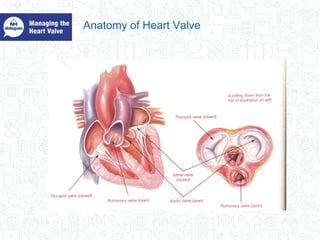
Anatomy of Heart Valve
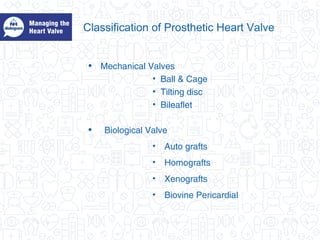
Classification of Prosthetic Heart Valve
• Mechanical Valves
• Ball & Cage
• Tilting disc
• Bileaflet
• Biological Valve
• Auto grafts
• Homografts
• Xenografts
• Biovine Pericardial
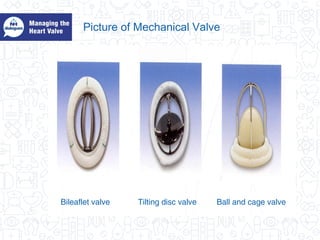
Picture of Mechanical Valve
Tilting disc valve Ball and cage valveBileaflet valve
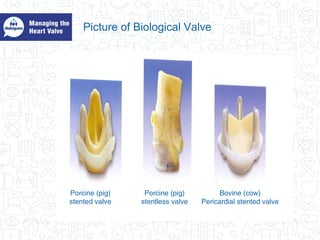
Picture of Biological Valve
Porcine (pig)
stentless valve
Porcine (pig)
stented valve
Bovine (cow)
Pericardial stented valve
Management of Patients with Prosthetic Heart
valve
Antithrombotic therapy:
• Fewer complications of Valvular Heart Disease can be more
devastating than systemic embolic.
• Patients with mechanical heart valve receive life long, high
intensity oral anticoagulation therapy to prevent thromboembolic
complications.
• Antithrombotic therapy can reduce although not eliminate the
likelihood of the catastrophe.
• Unfortunately, antithrombotic therapy carries a substantial risk of
bleeding depending upon
– Drugs used
– Intensity of anticoagulation
– Individual
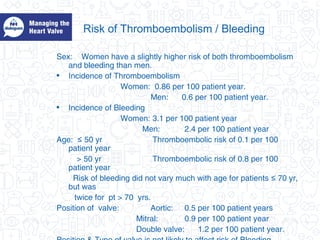
Risk of Thromboembolism / Bleeding
Sex: Women have a slightly higher risk of both thromboembolism
and bleeding than men.
• Incidence of Thromboembolism
Women: 0.86 per 100 patient year.
Men: 0.6 per 100 patient year.
• Incidence of Bleeding
Women: 3.1 per 100 patient year
Men: 2.4 per 100 patient year
Age: 50 yr≤ Thromboembolic risk of 0.1 per 100
patient year
> 50 yr Thromboembolic risk of 0.8 per 100
patient year
Risk of bleeding did not vary much with age for patients 70 yr,≤
but was
twice for pt > 70 yrs.
Position of valve: Aortic: 0.5 per 100 patient years
Mitral: 0.9 per 100 patient year
Double valve: 1.2 per 100 patient year.
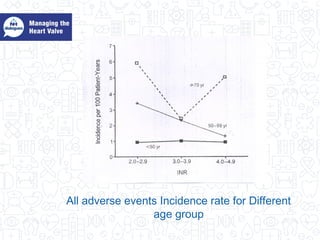
All adverse events Incidence rate for Different
age group
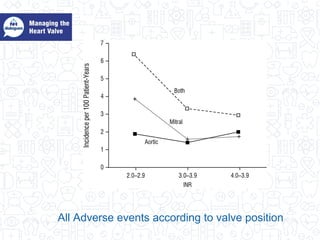
All Adverse events according to valve position
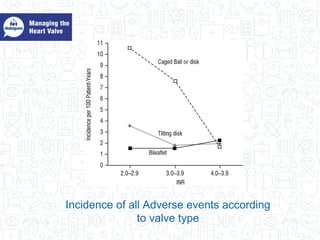
Incidence of all Adverse events according
to valve type
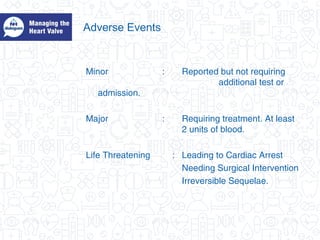
Adverse Events
Minor : Reported but not requiring
additional test or
admission.
Major : Requiring treatment. At least
2 units of blood.
Life Threatening : Leading to Cardiac Arrest
Needing Surgical Intervention
Irreversible Sequelae.
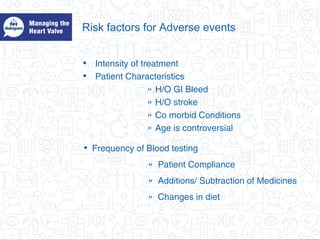
Risk factors for Adverse events
• Intensity of treatment
• Patient Characteristics
» H/O GI Bleed
» H/O stroke
» Co morbid Conditions
» Age is controversial
• Frequency of Blood testing
» Patient Compliance
» Additions/ Subtraction of Medicines
» Changes in diet
Blood Test for Optimal Anticoagulation
• PT: Traditional method of determining efficacy of
anticoagulation
• INR: A mathematical calculation that corrects for the
results attributable to the variable sensitivities of
thromboplastic agents
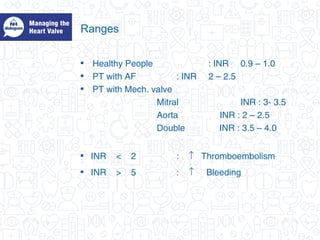
Ranges
• Healthy People : INR 0.9 – 1.0
• PT with AF : INR 2 – 2.5
• PT with Mech. valve
Mitral INR : 3- 3.5
Aorta INR : 2 – 2.5
Double INR : 3.5 – 4.0
• INR < 2 : ↑ Thromboembolism
• INR > 5 : ↑ Bleeding
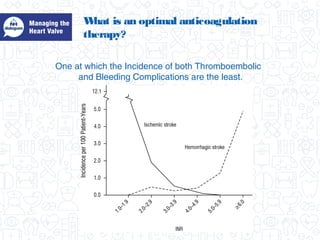
What is an optimal anticoagulation
therapy?
One at which the Incidence of both Thromboembolic
and Bleeding Complications are the least.
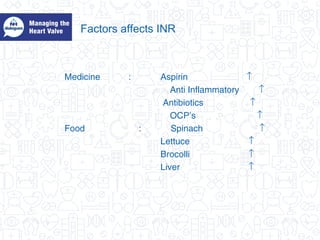
Factors affects INR
Medicine : Aspirin ↑
Anti Inflammatory ↑
Antibiotics ↑
OCP’s ↑
Food : Spinach ↑
Lettuce ↑
Brocolli ↑
Liver ↑
Management of Adverse Events
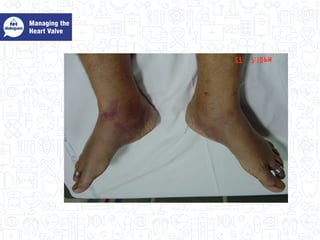
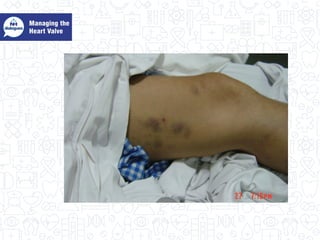
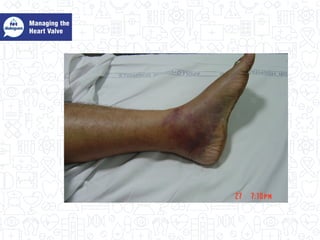
Bleeding: 2 general principle
1. attempt to Identify
2. Is there a possibility to lower the
anticoagulation
Minor: > Observe & record
> Repeat PT / INR
> Reassurance
Major: > Admission
> Attempts to Identify the source
> Repeat PT/ INR
> FFP / Fresh blood / Vit K
Life Threatening: > Admission (urgent)
> Urgent Blood transfusion(Blood /
FFP)
> Special Investigation
> Surgical (Invasive) Intervention
Management of Adverse efforts –
Thrombosis
Prosthetic valve obstruction may be caused by
– Thrombus
– Pannus
– Combination
Knowledge of clinical presentation & special Investigation (TOE) is
essential as treatment varies,
Pannus: Thrombolytic therapy ineffective
valve thrombectory / replacement
Thrombus: Thrombolysis therapy - Streptokinase
- Urolinase
Duration depends upon resolution of Pressure gradient, valve area +
disc movements
Aspirin in Combination with
anticoagulants
• Met analysis supports the concept that the rate of
thromboemboli is diminished with aspirin in Combination with
VIT K antagonist.
• Aspirin in Combination with anticoagulants (INR 2.0-3.5) was
associated with bleeding (minor) incidence of 1.1 – 5.1 % per
patient year.
• Indian senario where INR control is poor due to Poor Patient
Compliance, in addition of aspirin in dosage (75mg – 150 mg)
may be beneficial)
Thromboleytic Therapy
• Thrombolytic therapy should be stopped at 24 hrs there
is no hemodynamic improvement or after 72 hrs if
recovery is incomplete.
• If successful → IV heparin until OAC achieves INR 3-4
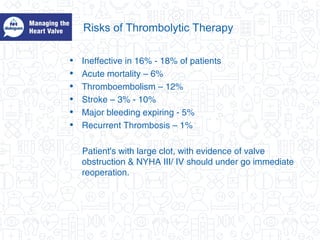
Risks of Thrombolytic Therapy
• Ineffective in 16% - 18% of patients
• Acute mortality – 6%
• Thromboembolism – 12%
• Stroke – 3% - 10%
• Major bleeding expiring - 5%
• Recurrent Thrombosis – 1%
Patient's with large clot, with evidence of valve
obstruction & NYHA III/ IV should under go immediate
reoperation.
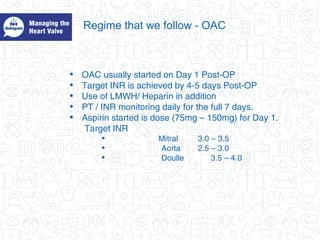
Regime that we follow - OAC
• OAC usually started on Day 1 Post-OP
• Target INR is achieved by 4-5 days Post-OP
• Use of LMWH/ Heparin in addition
• PT / INR monitoring daily for the full 7 days.
• Aspirin started is dose (75mg – 150mg) for Day 1.
Target INR
• Mitral 3.0 – 3.5
• Aorta 2.5 – 3.0
• Doulle 3.5 – 4.0
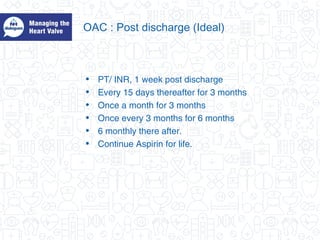
OAC : Post discharge (Ideal)
• PT/ INR, 1 week post discharge
• Every 15 days thereafter for 3 months
• Once a month for 3 months
• Once every 3 months for 6 months
• 6 monthly there after.
• Continue Aspirin for life.
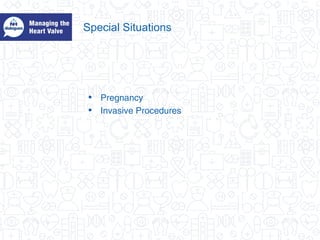
Special Situations
• Pregnancy
• Invasive Procedures
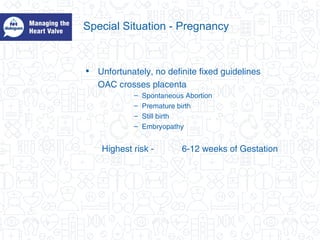
Special Situation - Pregnancy
• Unfortunately, no definite fixed guidelines
OAC crosses placenta
– Spontaneous Abortion
– Premature birth
– Still birth
– Embryopathy
Highest risk - 6-12 weeks of Gestation
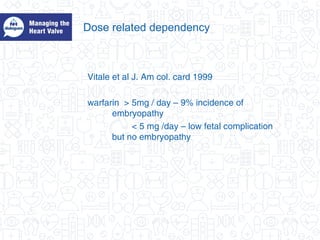
Dose related dependency
Vitale et al J. Am col. card 1999
warfarin > 5mg / day – 9% incidence of
embryopathy
< 5 mg /day – low fetal complication
but no embryopathy
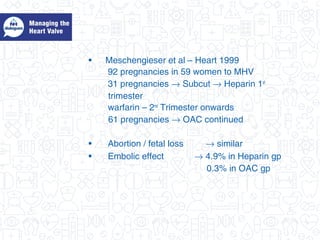
• Meschengieser et al – Heart 1999
92 pregnancies in 59 women to MHV
31 pregnancies → Subcut → Heparin 1st
trimester
warfarin – 2nd
Trimester onwards
61 pregnancies → OAC continued
• Abortion / fetal loss → similar
• Embolic effect → 4.9% in Heparin gp
0.3% in OAC gp
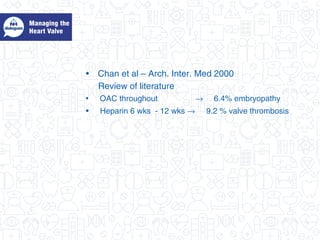
• Chan et al – Arch. Inter. Med 2000
Review of literature
• OAC throughout → 6.4% embryopathy
• Heparin 6 wks - 12 wks → 9.2 % valve thrombosis
LMWH
• More promising
– Does not cross placenta
– No need for frequent patient.
– Lower ½ life
– Lower incidence of thrombocytopenia & osteoporosis
No major recorded data.
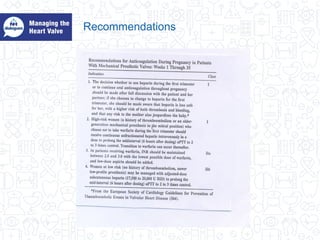
Recommendations
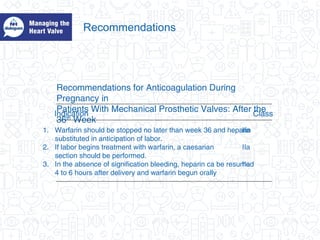
Recommendations
Recommendations for Anticoagulation During
Pregnancy in
Patients With Mechanical Prosthetic Valves: After the
36th
Week
Indication Class
1. Warfarin should be stopped no later than week 36 and heparin
substituted in anticipation of labor.
2. If labor begins treatment with warfarin, a caesarian
section should be performed.
3. In the absence of signification bleeding, heparin ca be resumed
4 to 6 hours after delivery and warfarin begun orally
IIa
IIa
IIa
Management of OAC during Invasive
Procedure
• Assess the risk of bleeding v/s risk of Thrombosis
• Elective Procedures
Minor :
– Stop OAC for 1-2 days
– Safely done if INR< 2.0
– Restart OAC immediately.
– Dose of Heparin / LMWH
Major:
– Stop OAC 4-5 days prior
– Switch to LMWH / Heparin
– VIT K 24 hrs prior
– Adequate reserve of FFP / Blood
– Restart OAC as soon as possible.
Managing the heart value

Managing the heart value

  • 1.
    Managing the Heart Valve “Oral Anticoagulation Therapy” Dr. Atul A. Maslekar (AIIMS) FICS, FIACS Sr. Consultant – Cardiothoracic Surgeon Narayana Multispecialty Hospital - Ahmedabad
  • 2.
  • 3.
    Classification of ProstheticHeart Valve • Mechanical Valves • Ball & Cage • Tilting disc • Bileaflet • Biological Valve • Auto grafts • Homografts • Xenografts • Biovine Pericardial
  • 4.
    Picture of MechanicalValve Tilting disc valve Ball and cage valveBileaflet valve
  • 5.
    Picture of BiologicalValve Porcine (pig) stentless valve Porcine (pig) stented valve Bovine (cow) Pericardial stented valve
  • 6.
    Management of Patientswith Prosthetic Heart valve Antithrombotic therapy: • Fewer complications of Valvular Heart Disease can be more devastating than systemic embolic. • Patients with mechanical heart valve receive life long, high intensity oral anticoagulation therapy to prevent thromboembolic complications. • Antithrombotic therapy can reduce although not eliminate the likelihood of the catastrophe. • Unfortunately, antithrombotic therapy carries a substantial risk of bleeding depending upon – Drugs used – Intensity of anticoagulation – Individual
  • 7.
    Risk of Thromboembolism/ Bleeding Sex: Women have a slightly higher risk of both thromboembolism and bleeding than men. • Incidence of Thromboembolism Women: 0.86 per 100 patient year. Men: 0.6 per 100 patient year. • Incidence of Bleeding Women: 3.1 per 100 patient year Men: 2.4 per 100 patient year Age: 50 yr≤ Thromboembolic risk of 0.1 per 100 patient year > 50 yr Thromboembolic risk of 0.8 per 100 patient year Risk of bleeding did not vary much with age for patients 70 yr,≤ but was twice for pt > 70 yrs. Position of valve: Aortic: 0.5 per 100 patient years Mitral: 0.9 per 100 patient year Double valve: 1.2 per 100 patient year.
  • 8.
    All adverse eventsIncidence rate for Different age group
  • 9.
    All Adverse eventsaccording to valve position
  • 10.
    Incidence of allAdverse events according to valve type
  • 11.
    Adverse Events Minor :Reported but not requiring additional test or admission. Major : Requiring treatment. At least 2 units of blood. Life Threatening : Leading to Cardiac Arrest Needing Surgical Intervention Irreversible Sequelae.
  • 12.
    Risk factors forAdverse events • Intensity of treatment • Patient Characteristics » H/O GI Bleed » H/O stroke » Co morbid Conditions » Age is controversial • Frequency of Blood testing » Patient Compliance » Additions/ Subtraction of Medicines » Changes in diet
  • 13.
    Blood Test forOptimal Anticoagulation • PT: Traditional method of determining efficacy of anticoagulation • INR: A mathematical calculation that corrects for the results attributable to the variable sensitivities of thromboplastic agents
  • 14.
    Ranges • Healthy People: INR 0.9 – 1.0 • PT with AF : INR 2 – 2.5 • PT with Mech. valve Mitral INR : 3- 3.5 Aorta INR : 2 – 2.5 Double INR : 3.5 – 4.0 • INR < 2 : ↑ Thromboembolism • INR > 5 : ↑ Bleeding
  • 15.
    What is anoptimal anticoagulation therapy? One at which the Incidence of both Thromboembolic and Bleeding Complications are the least.
  • 16.
    Factors affects INR Medicine: Aspirin ↑ Anti Inflammatory ↑ Antibiotics ↑ OCP’s ↑ Food : Spinach ↑ Lettuce ↑ Brocolli ↑ Liver ↑
  • 17.
    Management of AdverseEvents Bleeding: 2 general principle 1. attempt to Identify 2. Is there a possibility to lower the anticoagulation Minor: > Observe & record > Repeat PT / INR > Reassurance Major: > Admission > Attempts to Identify the source > Repeat PT/ INR > FFP / Fresh blood / Vit K Life Threatening: > Admission (urgent) > Urgent Blood transfusion(Blood / FFP) > Special Investigation > Surgical (Invasive) Intervention
  • 18.
    Management of Adverseefforts – Thrombosis Prosthetic valve obstruction may be caused by – Thrombus – Pannus – Combination Knowledge of clinical presentation & special Investigation (TOE) is essential as treatment varies, Pannus: Thrombolytic therapy ineffective valve thrombectory / replacement Thrombus: Thrombolysis therapy - Streptokinase - Urolinase Duration depends upon resolution of Pressure gradient, valve area + disc movements
  • 19.
    Aspirin in Combinationwith anticoagulants • Met analysis supports the concept that the rate of thromboemboli is diminished with aspirin in Combination with VIT K antagonist. • Aspirin in Combination with anticoagulants (INR 2.0-3.5) was associated with bleeding (minor) incidence of 1.1 – 5.1 % per patient year. • Indian senario where INR control is poor due to Poor Patient Compliance, in addition of aspirin in dosage (75mg – 150 mg) may be beneficial)
  • 20.
    Thromboleytic Therapy • Thrombolytictherapy should be stopped at 24 hrs there is no hemodynamic improvement or after 72 hrs if recovery is incomplete. • If successful → IV heparin until OAC achieves INR 3-4
  • 21.
    Risks of ThrombolyticTherapy • Ineffective in 16% - 18% of patients • Acute mortality – 6% • Thromboembolism – 12% • Stroke – 3% - 10% • Major bleeding expiring - 5% • Recurrent Thrombosis – 1% Patient's with large clot, with evidence of valve obstruction & NYHA III/ IV should under go immediate reoperation.
  • 22.
    Regime that wefollow - OAC • OAC usually started on Day 1 Post-OP • Target INR is achieved by 4-5 days Post-OP • Use of LMWH/ Heparin in addition • PT / INR monitoring daily for the full 7 days. • Aspirin started is dose (75mg – 150mg) for Day 1. Target INR • Mitral 3.0 – 3.5 • Aorta 2.5 – 3.0 • Doulle 3.5 – 4.0
  • 23.
    OAC : Postdischarge (Ideal) • PT/ INR, 1 week post discharge • Every 15 days thereafter for 3 months • Once a month for 3 months • Once every 3 months for 6 months • 6 monthly there after. • Continue Aspirin for life.
  • 24.
  • 25.
    Special Situation -Pregnancy • Unfortunately, no definite fixed guidelines OAC crosses placenta – Spontaneous Abortion – Premature birth – Still birth – Embryopathy Highest risk - 6-12 weeks of Gestation
  • 26.
    Dose related dependency Vitaleet al J. Am col. card 1999 warfarin > 5mg / day – 9% incidence of embryopathy < 5 mg /day – low fetal complication but no embryopathy
  • 27.
    • Meschengieser etal – Heart 1999 92 pregnancies in 59 women to MHV 31 pregnancies → Subcut → Heparin 1st trimester warfarin – 2nd Trimester onwards 61 pregnancies → OAC continued • Abortion / fetal loss → similar • Embolic effect → 4.9% in Heparin gp 0.3% in OAC gp
  • 28.
    • Chan etal – Arch. Inter. Med 2000 Review of literature • OAC throughout → 6.4% embryopathy • Heparin 6 wks - 12 wks → 9.2 % valve thrombosis
  • 29.
    LMWH • More promising –Does not cross placenta – No need for frequent patient. – Lower ½ life – Lower incidence of thrombocytopenia & osteoporosis No major recorded data.
  • 30.
  • 31.
    Recommendations Recommendations for AnticoagulationDuring Pregnancy in Patients With Mechanical Prosthetic Valves: After the 36th Week Indication Class 1. Warfarin should be stopped no later than week 36 and heparin substituted in anticipation of labor. 2. If labor begins treatment with warfarin, a caesarian section should be performed. 3. In the absence of signification bleeding, heparin ca be resumed 4 to 6 hours after delivery and warfarin begun orally IIa IIa IIa
  • 32.
    Management of OACduring Invasive Procedure • Assess the risk of bleeding v/s risk of Thrombosis • Elective Procedures Minor : – Stop OAC for 1-2 days – Safely done if INR< 2.0 – Restart OAC immediately. – Dose of Heparin / LMWH Major: – Stop OAC 4-5 days prior – Switch to LMWH / Heparin – VIT K 24 hrs prior – Adequate reserve of FFP / Blood – Restart OAC as soon as possible.