Submitted to
Dr.Veeresh Kumar.B
Head of the Department
Dept. Of Pharmacology
Submitted by
Anjana Sushma Dixit
170117887001
M.Pharmacy Iyr II sem
HISTORY AND PROGRESS OF
PHARMACOVIGILANCE
Pharmakon-------inGreek----drug
Vigilare -----------in Latin------to keep watch
Pharmacovigilance (PV) →Drug Safety
Pharmacovigilance is the pharmacological science that aims at
the detection, assessment, monitoring, understanding and
prevention of adverse effects, particularly long term and short
term side effects of medicines to ensure drug safety.
PHARMACOVIGILANCE
• Improve patient care and safety
• Improve public health and safety
• Early detection of unknown safety problems
• Identification of risk factors
• Quantifying risks
AIMS OF
PHARMACOVIGILANCE
1902 • BIOLOGICS CONTROLACT
(following the death of children caused
by contaminated diphtheria antitoxin vaccines)
1906 PURE FOOD AND DRUG ACT >>>FDA
1937 ELIXIR OF SULFANILAMIDE (Contained
the poisonous solvent diethylene glycol, no toxicity tests,
killed 100 people) - need to establish drug
safety before marketing.
HISTORY
1938 • FEDERAL FOOD, DRUGS AND
COSMETICS ACT.
1949 • COUNCIL for INTERNATIONAL
ORGANIZATIONS of MEDICAL
SCIENCES (CIOMS). By WHO and UNECO.
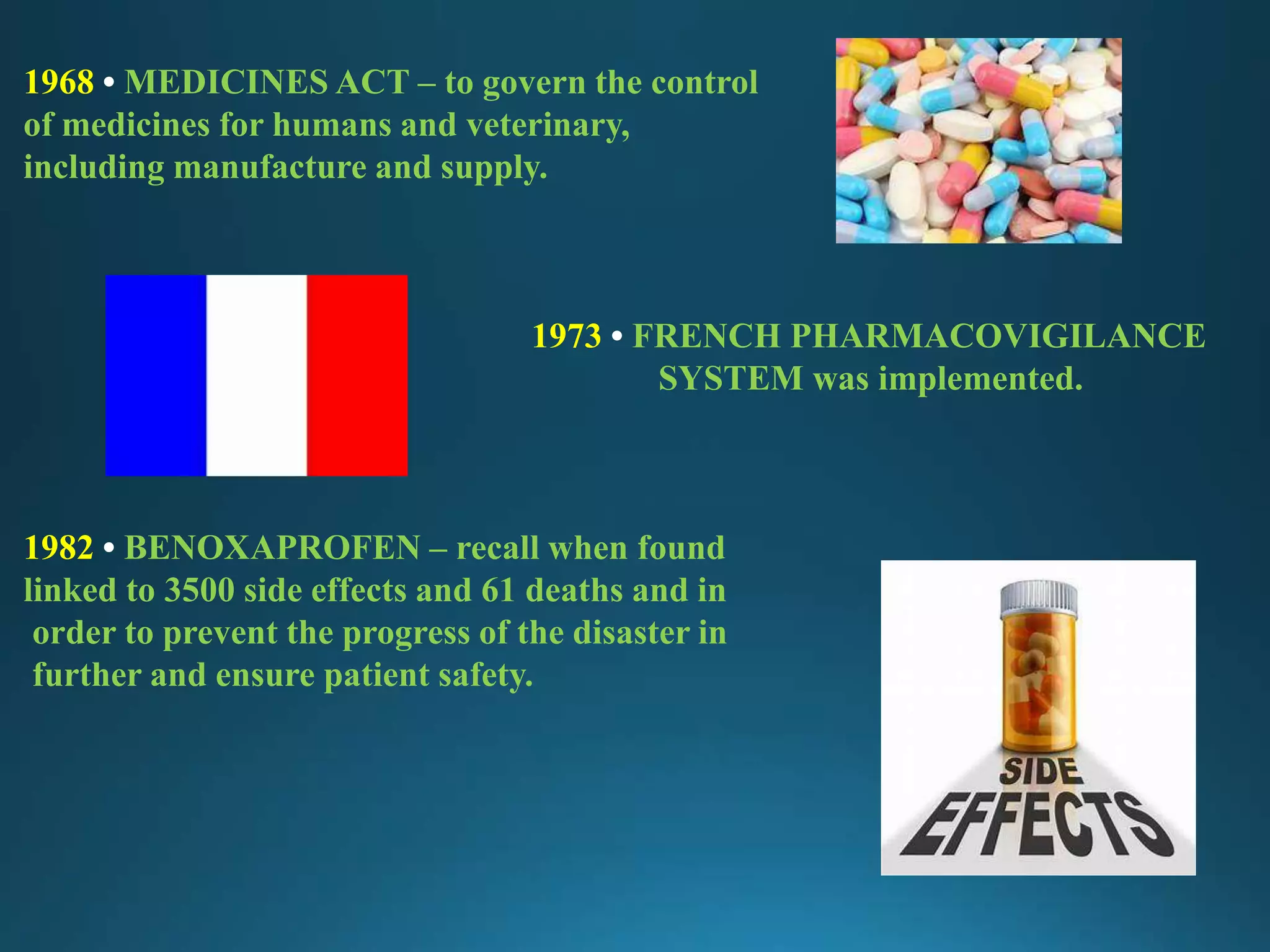
1961 • THALIDOMIDE (over 10,000 children in
46 countries were born with birth defects) – rules
for testing and licensing of drugs
( clinical trials were also introduced.)
1962 • KEFAUVER-HARRIS Amendments
passed which required evidence of
drug efficacy and safety before
marketing. (US)
1964 • YELLOW CARD SCHEME – for collecting
information on suspected adverse drug reactions
(ADRs) of medicines to provide an early warning
of possible hazards. (UK)
1964 • DECLARATION OF HELSINKI – World’s
Medical Association best-known policy and was
first adopted as a set ethical principles regarding
human experimentation.
1967 • WORLD HEALTH ORGANIZATION (WHO)
– It’s resolution 20.51 laid basis for the International
System of Monitoring ADRs.
1968 • MEDICINES ACT – to govern the control
of medicines for humans and veterinary,
including manufacture and supply.
1973 • FRENCH PHARMACOVIGILANCE
SYSTEM was implemented.
1982 • BENOXAPROFEN – recall when found
linked to 3500 side effects and 61 deaths and in
order to prevent the progress of the disaster in
further and ensure patient safety.
1991 • EUROPEAN RAPID ALERT SYSTEM –
to facilitate early exchange of information concerning
possible safety hazards relating to marketing
medicinal products.
2001 • EU Clinical Trial Directive was introduced
measures on the safe conduct of the clinical trials.
Volume 9A introduced to standardise
post-marketing PV systems in EU
2009 • MHRA BLACK TRIANGLE scheme to
report ALL suspected adverse reaction to
designated black triangle drugs.
2012 • Release of GOOD PHARMACOVIGILANCE
PRACTICES (GVPs) to replace Volume 9A.
They expand on the clarity the PV responsibility
of marketing authorization holders
2014 • NEW CLINICAL TRIAL REGULATION
signed into force to replace the EU Clinical
Trial Directives 2001 .
• Standardized implementation across member states.
2017 • GVP > New modules on Risk
Management and Risk Minimization
measures.
1986 ADR monitoring system for India
proposed (12 regional centres)
1997-India joined WHO-ADRmonitoring
programme-(3 centresAIIMS,KEM,JLN)
2004-2008- National PV prog.(2 Zonal,5 Regional,
24 peripheral) overseen by CDCSCO
2010- Pharmacovigilance programme of
India (PVPI)
History of Pharmacovigilance in India
• The PV programme was launched in India by the Union health ministry in July
2010 to capture adverse drug reactions of drugs already in the market from the
Indian population in a systematic manner.
• Regular monitoring of clinical data of patients taking both old and newly
approved drugs is considered necessary to determine their safety and efficacy
as the 3 phase clinical trials usually cover only a few thousands of subjects.
• In India, pharmacovigilance or ADR monitoring was not in existence until 2010
and decision to withdraw any harmful drug from the market use to be taken on
the basis of data available from the US and Europe.
PROGRESS OF PHARMACOLOVIGILANCE
• India is recognized for its high quality and timely delivery of pharmaceutical
products with drug data for the US and European companies and hospitals.
• The health ministry’s decision to develop India’s own clinical data before
recalling a drug from the market was taken in the context of variations in ADRs
among different patient populations.
• The country has over one lakh formulations in the domestic market and many of
them could be irrational and harmful combinations calling for stringent scrutiny
and follow up action.
• The health ministry does not have any ADR data of most of these combination
drugs ever since they were launched. This calls for developing a national
pharmacovigilance database consisting of all suspected adverse drug reactions
to medicines observed in India.
• Even after launching the pharmacovigilance programme two years ago, the
progress of setting up adequate number of centres to collect clinical data is far
from satisfactory. In the first phase of the programme, the target was to set up
40 ADR centres, but just 22 were set up.
• Although 60 more centres were planned last year at an investment of Rs.60 crore, only
40 more added subsequently. There is no doubt that the country requires a massive
capacity building for this programme and the number of centres should have been
expanded to at least 100 by now.
• The union health ministry has sought a financial allocation of Rs.250 crore for the
national pharmacovigilance programme mainly to set up more ADR centres and
increasing the manpower during plan period.
• Funding may not be a constraint for the government considering the seriousness of the
project but the question is how seriously the programme will be implemented in the
coming years.
History n progress of pv

History n progress of pv

  • 1.
    Submitted to Dr.Veeresh Kumar.B Headof the Department Dept. Of Pharmacology Submitted by Anjana Sushma Dixit 170117887001 M.Pharmacy Iyr II sem HISTORY AND PROGRESS OF PHARMACOVIGILANCE
  • 2.
    Pharmakon-------inGreek----drug Vigilare -----------in Latin------tokeep watch Pharmacovigilance (PV) →Drug Safety Pharmacovigilance is the pharmacological science that aims at the detection, assessment, monitoring, understanding and prevention of adverse effects, particularly long term and short term side effects of medicines to ensure drug safety. PHARMACOVIGILANCE
  • 3.
    • Improve patientcare and safety • Improve public health and safety • Early detection of unknown safety problems • Identification of risk factors • Quantifying risks AIMS OF PHARMACOVIGILANCE
  • 4.
    1902 • BIOLOGICSCONTROLACT (following the death of children caused by contaminated diphtheria antitoxin vaccines) 1906 PURE FOOD AND DRUG ACT >>>FDA 1937 ELIXIR OF SULFANILAMIDE (Contained the poisonous solvent diethylene glycol, no toxicity tests, killed 100 people) - need to establish drug safety before marketing. HISTORY
  • 5.
    1938 • FEDERALFOOD, DRUGS AND COSMETICS ACT. 1949 • COUNCIL for INTERNATIONAL ORGANIZATIONS of MEDICAL SCIENCES (CIOMS). By WHO and UNECO. 1961 • THALIDOMIDE (over 10,000 children in 46 countries were born with birth defects) – rules for testing and licensing of drugs ( clinical trials were also introduced.) 1962 • KEFAUVER-HARRIS Amendments passed which required evidence of drug efficacy and safety before marketing. (US)
  • 6.
    1964 • YELLOWCARD SCHEME – for collecting information on suspected adverse drug reactions (ADRs) of medicines to provide an early warning of possible hazards. (UK) 1964 • DECLARATION OF HELSINKI – World’s Medical Association best-known policy and was first adopted as a set ethical principles regarding human experimentation. 1967 • WORLD HEALTH ORGANIZATION (WHO) – It’s resolution 20.51 laid basis for the International System of Monitoring ADRs.
  • 7.
    1968 • MEDICINESACT – to govern the control of medicines for humans and veterinary, including manufacture and supply. 1973 • FRENCH PHARMACOVIGILANCE SYSTEM was implemented. 1982 • BENOXAPROFEN – recall when found linked to 3500 side effects and 61 deaths and in order to prevent the progress of the disaster in further and ensure patient safety.
  • 8.
    1991 • EUROPEANRAPID ALERT SYSTEM – to facilitate early exchange of information concerning possible safety hazards relating to marketing medicinal products. 2001 • EU Clinical Trial Directive was introduced measures on the safe conduct of the clinical trials. Volume 9A introduced to standardise post-marketing PV systems in EU 2009 • MHRA BLACK TRIANGLE scheme to report ALL suspected adverse reaction to designated black triangle drugs.
  • 9.
    2012 • Releaseof GOOD PHARMACOVIGILANCE PRACTICES (GVPs) to replace Volume 9A. They expand on the clarity the PV responsibility of marketing authorization holders 2014 • NEW CLINICAL TRIAL REGULATION signed into force to replace the EU Clinical Trial Directives 2001 . • Standardized implementation across member states. 2017 • GVP > New modules on Risk Management and Risk Minimization measures.
  • 10.
    1986 ADR monitoringsystem for India proposed (12 regional centres) 1997-India joined WHO-ADRmonitoring programme-(3 centresAIIMS,KEM,JLN) 2004-2008- National PV prog.(2 Zonal,5 Regional, 24 peripheral) overseen by CDCSCO 2010- Pharmacovigilance programme of India (PVPI) History of Pharmacovigilance in India
  • 11.
    • The PVprogramme was launched in India by the Union health ministry in July 2010 to capture adverse drug reactions of drugs already in the market from the Indian population in a systematic manner. • Regular monitoring of clinical data of patients taking both old and newly approved drugs is considered necessary to determine their safety and efficacy as the 3 phase clinical trials usually cover only a few thousands of subjects. • In India, pharmacovigilance or ADR monitoring was not in existence until 2010 and decision to withdraw any harmful drug from the market use to be taken on the basis of data available from the US and Europe. PROGRESS OF PHARMACOLOVIGILANCE
  • 12.
    • India isrecognized for its high quality and timely delivery of pharmaceutical products with drug data for the US and European companies and hospitals. • The health ministry’s decision to develop India’s own clinical data before recalling a drug from the market was taken in the context of variations in ADRs among different patient populations. • The country has over one lakh formulations in the domestic market and many of them could be irrational and harmful combinations calling for stringent scrutiny and follow up action.
  • 13.
    • The healthministry does not have any ADR data of most of these combination drugs ever since they were launched. This calls for developing a national pharmacovigilance database consisting of all suspected adverse drug reactions to medicines observed in India. • Even after launching the pharmacovigilance programme two years ago, the progress of setting up adequate number of centres to collect clinical data is far from satisfactory. In the first phase of the programme, the target was to set up 40 ADR centres, but just 22 were set up.
  • 14.
    • Although 60more centres were planned last year at an investment of Rs.60 crore, only 40 more added subsequently. There is no doubt that the country requires a massive capacity building for this programme and the number of centres should have been expanded to at least 100 by now. • The union health ministry has sought a financial allocation of Rs.250 crore for the national pharmacovigilance programme mainly to set up more ADR centres and increasing the manpower during plan period. • Funding may not be a constraint for the government considering the seriousness of the project but the question is how seriously the programme will be implemented in the coming years.