Complement
• The complement system consists of about
20 proteins in normal human serum
• They are synthesized mainly by the liver
• Complement is heat labile i.e. it is
inactivated at 56o
C for 30 minutes
• Immunoglobulins are not inactivated at this
temperature
Main Functions of Complement
• Lysis of cell
– Bacteria
• Generation of mediators
– Participation in inflammation and attract
neutrophils
• Opsonization
– Enhancement of phagocytosis
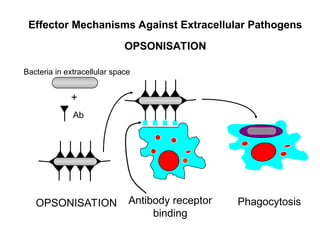
Antibody receptor
binding
Effector Mechanisms Against Extracellular Pathogens
OPSONISATION
OPSONISATION Phagocytosis
Bacteria in extracellular space
Ab
+
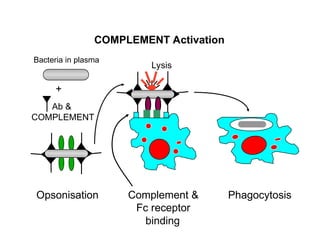
Effector Mechanisms Against Extracellular Pathogens
COMPLEMENT Activation
Bacteria in plasma
Ab &
COMPLEMENT
+
Phagocytosis
binding
Complement &
Fc receptor
Lysis
Opsonisation
Complement Activation
• Several complement components are pro-
enzymes and required cleavage to form
active enzymes
• Activation of complement is initiated either
by antigen-antibody complexes or by non-
immunologic molecules such as endotoxin
Complement Activation
• Pathways of activation
– Classic Pathway
– The Lectin Pathway
– The Alternative Pathway
• Lectin and alternative pathways are
activated with the first encounter with
bacteria since the antibody required to
trigger classic pathway is not present
• Classic Pathway
– Antigen-antibody complexes activate C1 to form
protease which cleaves C2 and C4 to form C4b,C2b
complex
• The Lectin Pathway
– Mannan-binding lectin (MBL) binds mannan present
on the surface of bacteria and cleaves C2 and C4 to
activate classic pathway without the help of an
antibody
• Alternative Pathway
– Cell surface substances such as bacterial
lipoploysaccharides (endotoxin), fungal cell walls and
viral envelopes can activate complement system
directly by cleaving C3 into C3a and C3b
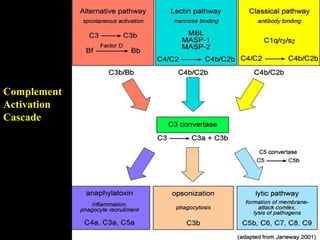
Complement
Activation
Cascade
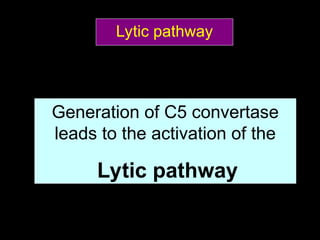
Generation of C5 convertase
leads to the activation of the
Lytic pathway
Lytic pathway
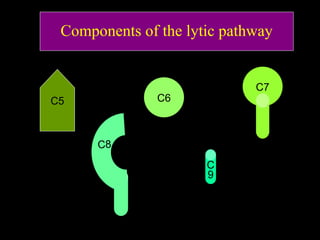
Components of the lytic pathway
C6
C
9
C8
C7
C5
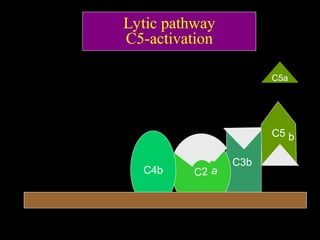
Lytic pathway
C5-activation
C3b
C2 a
C4b
C5 b
C5a
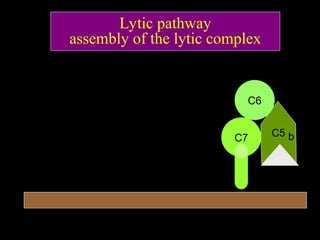
Lytic pathway
assembly of the lytic complex
C5 b
C6
C7
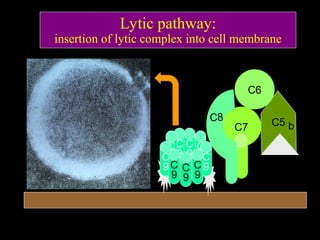
Lytic pathway:
insertion of lytic complex into cell membrane
C5 b
C6
C7
C8
C
9
C
9
C
9
C
9C
9
C
9 C
9
C
9
C
9
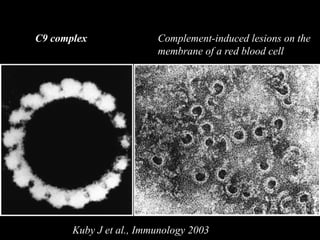
C9 complex Complement-induced lesions on the
membrane of a red blood cell
Kuby J et al., Immunology 2003
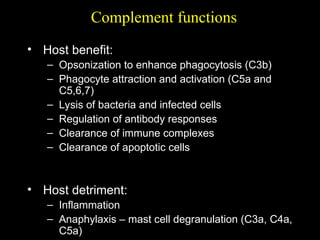
Complement functions
• Host benefit:
– Opsonization to enhance phagocytosis (C3b)
– Phagocyte attraction and activation (C5a and
C5,6,7)
– Lysis of bacteria and infected cells
– Regulation of antibody responses
– Clearance of immune complexes
– Clearance of apoptotic cells
• Host detriment:
– Inflammation
– Anaphylaxis – mast cell degranulation (C3a, C4a,
C5a)
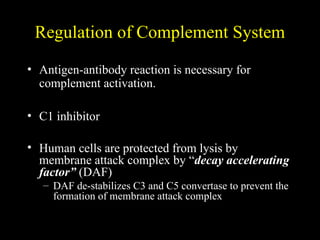
Regulation of Complement System
• Antigen-antibody reaction is necessary for
complement activation.
• C1 inhibitor
• Human cells are protected from lysis by
membrane attack complex by “decay accelerating
factor” (DAF)
– DAF de-stabilizes C3 and C5 convertase to prevent the
formation of membrane attack complex
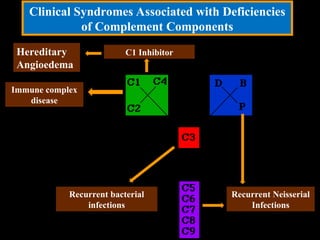
Hereditary
Angioedema
Immune complex
disease
Recurrent bacterial
infections
Recurrent Neisserial
Infections
Clinical Syndromes Associated with Deficiencies
of Complement Components
C1 Inhibitor
Cytokines
Cytokines
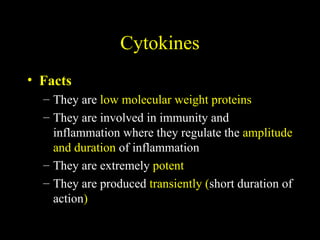
• Facts
– They are low molecular weight proteins
– They are involved in immunity and
inflammation where they regulate the amplitude
and duration of inflammation
– They are extremely potent
– They are produced transiently (short duration of
action)
Cytokines
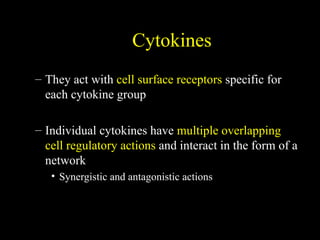
– They act with cell surface receptors specific for
each cytokine group
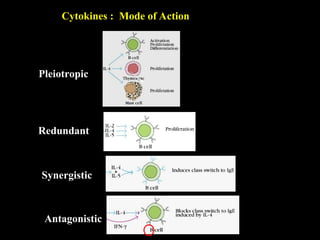
– Individual cytokines have multiple overlapping
cell regulatory actions and interact in the form of a
network
• Synergistic and antagonistic actions
Pleiotropic
Redundant
Synergistic
Antagonistic
-
Cytokines : Mode of Action
General Properties of Cytokines
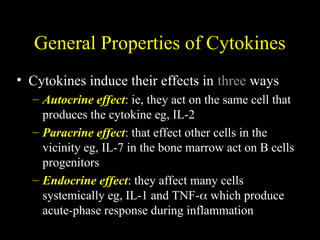
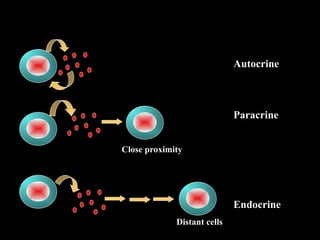
• Cytokines induce their effects in three ways
– Autocrine effect: ie, they act on the same cell that
produces the cytokine eg, IL-2
– Paracrine effect: that effect other cells in the
vicinity eg, IL-7 in the bone marrow act on B cells
progenitors
– Endocrine effect: they affect many cells
systemically eg, IL-1 and TNF- which produce
acute-phase response during inflammation
Autocrine
Paracrine
Endocrine
General Properties of Cytokines
Mode of Action
Close proximity
Distant cells
Working Classification of Cytokines
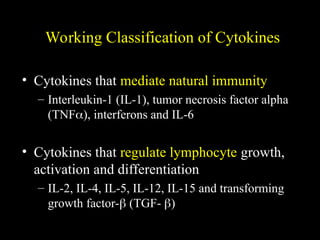
• Cytokines that mediate natural immunity
– Interleukin-1 (IL-1), tumor necrosis factor alpha
(TNF), interferons and IL-6
• Cytokines that regulate lymphocyte growth,
activation and differentiation
– IL-2, IL-4, IL-5, IL-12, IL-15 and transforming
growth factor- (TGF- )
Working Classification of Cytokines
• Cytokines that activate inflammatory cells
– IFN-, TNF, lymphotoxin (TNF-) and
migratory inhibitory factor
• Cytokines that affect leukocyte movements
also called “chemokines”
– IL-8, Macrophage Inflammatory Protein
(MIP), Macrophage Chemotactic Protein
(MCP) etc.
Working Classification of Cytokines
• Cytokines that stimulate hematopoiesis
– Stimulate the production of blood cells by acting
on hematopoietic progenitor cells.
– The members of this family are called “colony-
stimulating factors” (CSFs) eg, granulocyte-
monocyte colony stimulating factor (GM-CSF),
granulocyte-colony stimulating factor (G-CSF)
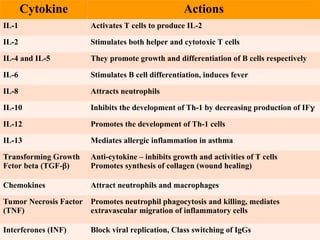
Cytokine Actions
IL-1 Activates T cells to produce IL-2
IL-2 Stimulates both helper and cytotoxic T cells
IL-4 and IL-5 They promote growth and differentiation of B cells respectively
IL-6 Stimulates B cell differentiation, induces fever
IL-8 Attracts neutrophils
IL-10 Inhibits the development of Th-1 by decreasing production of IF
IL-12 Promotes the development of Th-1 cells
IL-13 Mediates allergic inflammation in asthma
Transforming Growth
Fctor beta (TGF-)
Anti-cytokine – inhibits growth and activities of T cells
Promotes synthesis of collagen (wound healing)
Chemokines Attract neutrophils and macrophages
Tumor Necrosis Factor
(TNF)
Promotes neutrophil phagocytosis and killing, mediates
extravascular migration of inflammatory cells
Interferones (INF) Block viral replication, Class switching of IgGs
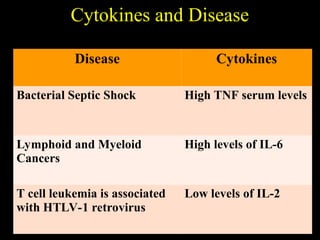
Disease Cytokines
Bacterial Septic Shock High TNF serum levels
Lymphoid and Myeloid
Cancers
High levels of IL-6
T cell leukemia is associated
with HTLV-1 retrovirus
Low levels of IL-2
Cytokines and Disease
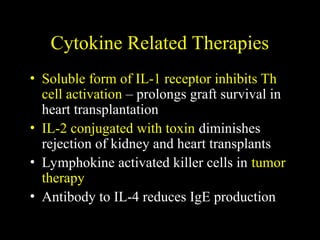
Cytokine Related Therapies
• Soluble form of IL-1 receptor inhibits Th
cell activation – prolongs graft survival in
heart transplantation
• IL-2 conjugated with toxin diminishes
rejection of kidney and heart transplants
• Lymphokine activated killer cells in tumor
therapy
• Antibody to IL-4 reduces IgE production
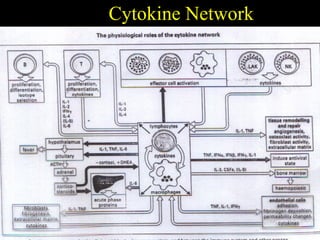
Cytokine Network
• Targets
Thank you

unit 3. the human Complement system.ppt

  • 2.
    Complement • The complementsystem consists of about 20 proteins in normal human serum • They are synthesized mainly by the liver • Complement is heat labile i.e. it is inactivated at 56o C for 30 minutes • Immunoglobulins are not inactivated at this temperature
  • 3.
    Main Functions ofComplement • Lysis of cell – Bacteria • Generation of mediators – Participation in inflammation and attract neutrophils • Opsonization – Enhancement of phagocytosis
  • 4.
    Antibody receptor binding Effector MechanismsAgainst Extracellular Pathogens OPSONISATION OPSONISATION Phagocytosis Bacteria in extracellular space Ab +
  • 5.
    Effector Mechanisms AgainstExtracellular Pathogens COMPLEMENT Activation Bacteria in plasma Ab & COMPLEMENT + Phagocytosis binding Complement & Fc receptor Lysis Opsonisation
  • 6.
    Complement Activation • Severalcomplement components are pro- enzymes and required cleavage to form active enzymes • Activation of complement is initiated either by antigen-antibody complexes or by non- immunologic molecules such as endotoxin
  • 7.
    Complement Activation • Pathwaysof activation – Classic Pathway – The Lectin Pathway – The Alternative Pathway • Lectin and alternative pathways are activated with the first encounter with bacteria since the antibody required to trigger classic pathway is not present
  • 8.
    • Classic Pathway –Antigen-antibody complexes activate C1 to form protease which cleaves C2 and C4 to form C4b,C2b complex • The Lectin Pathway – Mannan-binding lectin (MBL) binds mannan present on the surface of bacteria and cleaves C2 and C4 to activate classic pathway without the help of an antibody • Alternative Pathway – Cell surface substances such as bacterial lipoploysaccharides (endotoxin), fungal cell walls and viral envelopes can activate complement system directly by cleaving C3 into C3a and C3b
  • 9.
  • 10.
    Generation of C5convertase leads to the activation of the Lytic pathway Lytic pathway
  • 11.
    Components of thelytic pathway C6 C 9 C8 C7 C5
  • 12.
  • 13.
    Lytic pathway assembly ofthe lytic complex C5 b C6 C7
  • 14.
    Lytic pathway: insertion oflytic complex into cell membrane C5 b C6 C7 C8 C 9 C 9 C 9 C 9C 9 C 9 C 9 C 9 C 9
  • 15.
    C9 complex Complement-inducedlesions on the membrane of a red blood cell Kuby J et al., Immunology 2003
  • 16.
    Complement functions • Hostbenefit: – Opsonization to enhance phagocytosis (C3b) – Phagocyte attraction and activation (C5a and C5,6,7) – Lysis of bacteria and infected cells – Regulation of antibody responses – Clearance of immune complexes – Clearance of apoptotic cells • Host detriment: – Inflammation – Anaphylaxis – mast cell degranulation (C3a, C4a, C5a)
  • 17.
    Regulation of ComplementSystem • Antigen-antibody reaction is necessary for complement activation. • C1 inhibitor • Human cells are protected from lysis by membrane attack complex by “decay accelerating factor” (DAF) – DAF de-stabilizes C3 and C5 convertase to prevent the formation of membrane attack complex
  • 18.
    Hereditary Angioedema Immune complex disease Recurrent bacterial infections RecurrentNeisserial Infections Clinical Syndromes Associated with Deficiencies of Complement Components C1 Inhibitor
  • 19.
  • 20.
    Cytokines • Facts – Theyare low molecular weight proteins – They are involved in immunity and inflammation where they regulate the amplitude and duration of inflammation – They are extremely potent – They are produced transiently (short duration of action)
  • 21.
    Cytokines – They actwith cell surface receptors specific for each cytokine group – Individual cytokines have multiple overlapping cell regulatory actions and interact in the form of a network • Synergistic and antagonistic actions
  • 22.
  • 23.
    General Properties ofCytokines • Cytokines induce their effects in three ways – Autocrine effect: ie, they act on the same cell that produces the cytokine eg, IL-2 – Paracrine effect: that effect other cells in the vicinity eg, IL-7 in the bone marrow act on B cells progenitors – Endocrine effect: they affect many cells systemically eg, IL-1 and TNF- which produce acute-phase response during inflammation
  • 24.
    Autocrine Paracrine Endocrine General Properties ofCytokines Mode of Action Close proximity Distant cells
  • 25.
    Working Classification ofCytokines • Cytokines that mediate natural immunity – Interleukin-1 (IL-1), tumor necrosis factor alpha (TNF), interferons and IL-6 • Cytokines that regulate lymphocyte growth, activation and differentiation – IL-2, IL-4, IL-5, IL-12, IL-15 and transforming growth factor- (TGF- )
  • 26.
    Working Classification ofCytokines • Cytokines that activate inflammatory cells – IFN-, TNF, lymphotoxin (TNF-) and migratory inhibitory factor • Cytokines that affect leukocyte movements also called “chemokines” – IL-8, Macrophage Inflammatory Protein (MIP), Macrophage Chemotactic Protein (MCP) etc.
  • 27.
    Working Classification ofCytokines • Cytokines that stimulate hematopoiesis – Stimulate the production of blood cells by acting on hematopoietic progenitor cells. – The members of this family are called “colony- stimulating factors” (CSFs) eg, granulocyte- monocyte colony stimulating factor (GM-CSF), granulocyte-colony stimulating factor (G-CSF)
  • 28.
    Cytokine Actions IL-1 ActivatesT cells to produce IL-2 IL-2 Stimulates both helper and cytotoxic T cells IL-4 and IL-5 They promote growth and differentiation of B cells respectively IL-6 Stimulates B cell differentiation, induces fever IL-8 Attracts neutrophils IL-10 Inhibits the development of Th-1 by decreasing production of IF IL-12 Promotes the development of Th-1 cells IL-13 Mediates allergic inflammation in asthma Transforming Growth Fctor beta (TGF-) Anti-cytokine – inhibits growth and activities of T cells Promotes synthesis of collagen (wound healing) Chemokines Attract neutrophils and macrophages Tumor Necrosis Factor (TNF) Promotes neutrophil phagocytosis and killing, mediates extravascular migration of inflammatory cells Interferones (INF) Block viral replication, Class switching of IgGs
  • 29.
    Disease Cytokines Bacterial SepticShock High TNF serum levels Lymphoid and Myeloid Cancers High levels of IL-6 T cell leukemia is associated with HTLV-1 retrovirus Low levels of IL-2 Cytokines and Disease
  • 30.
    Cytokine Related Therapies •Soluble form of IL-1 receptor inhibits Th cell activation – prolongs graft survival in heart transplantation • IL-2 conjugated with toxin diminishes rejection of kidney and heart transplants • Lymphokine activated killer cells in tumor therapy • Antibody to IL-4 reduces IgE production
  • 31.
  • 32.