TISSUE HEALING AND
REPAIR
Overview
Tissue repair is the response of organisms to
overcome the damage caused by toxic insults,
inflammation and trauma.
Inflammatory response does not only the first to
deal with any type of tissue injury, but also initiates
the process of repair which consists of the
restoration of tissue architecture and function.
CELL PROLIFERATION AND
REGENERATION
Tissue repair involves the proliferation of cells
from:
a) the remnants of the injured tissue
b) vascular endothelial cells to form new blood
vessels
c) fibroblasts which provide fibrous tissue for
the formation of scars.
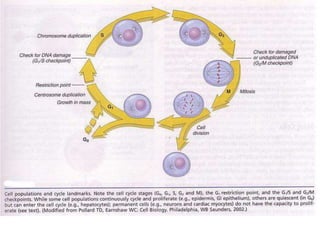
• The main steps in the proliferation of cells are
DNA replication and mitosis and this sequence of
events is known as the cell cycle.
• The cell cycle consists of several steps in order
to check the accuracy of cell division.
Non-dividing cells are either in cell cycle arrest in
G1 or they exit the cycle (G0).
Checkpoint controls prevent DNA replication or
mitosis of damaged cells or eliminate damaged
cells by apoptosis.
A. Tissue Repair
The ability of tissues to repair themselves depends on
their intrinsic proliferative capacity.
Based on this principle, the tissues of the body can be
divided into three groups:
a) Continuously dividing tissues (labile tissues)
– hematopoietic cells of the bone marrow
– stratified squamous epithelium
– cuboidal epithelium of excretory ducts
– gastrointestinal tract.
These tissues can easily regenerate after injury as
long as stem cells are intact.
b) stable tissues – cells of these tissues are quiescent
and have minimal replicate activity. However, cells are
able to replicate in response to injury or loss of tissue
mass.
– parenchyma of most solid organs such as;
– Liver
– Kidney
– Pancreas
– As well as endothelial cells, fibroblasts, and smooth
muscle cells.
With the exception of the liver, stable tissues have a
limited capacity to regenerate.
The liver has a great regenerative capacity that occurs
after surgical removal or injury of hepatic tissue.
As much as 40% to 60% of the liver may be removed in a
procedure called living-donor transplantation. In this
situation, replication after partial hepatectomy is
initiated by the cytokines TNF and IL6 that trigger the
transition of hepatocytes from stages g0 to g1 in the cell
cycle.
c) Permanent tissues. The cells of these tissues are
terminally differentiated in post-natal life.
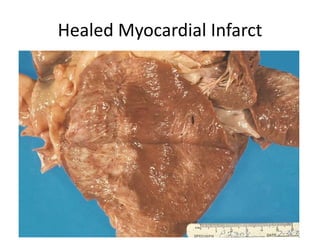
Brain and heart muscle: Results in liquefaction, necrosis
and scar formation.
Healed Myocardial Infarct
B. Growth Factors
Cell proliferation is triggered by many chemical
mediators such as growth factors, hormones
and cytokines.
Growth factors are polypeptide molecules
causing an expansion of cell populations which
include an increase in cell size, mitotic activity
and protection from apoptotic death (survival).
In addition to stimulating cellular proliferation,
they promote cellular migration, differentiation,
contractibility, as well as enhancing the
synthesis of special proteins such as collagen by
fibroblasts.
C. Repair by Connective Tissue
If extensive tissue surgery is performed or if a
chronic inflammatory process causes damage to
parenchymal cells, epithelia and stromal network,
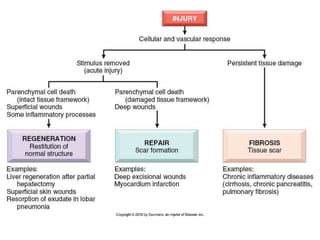
repair cannot take place by regeneration alone.
The same thing happens when non-dividing cells are
injured. In this situation, repair occurs by replacing
the necrotic tissue with connective tissue or by the
combination of regeneration of some cells and scar
formation.
The extracellular matrix (ECM) is an essential
participant of the repair process.
D THE EXTRACELLULAR MATRIX
Divided in two basic forms: interstitial matrix, and basement
membrane.
The interstitial matrix is present in connective tissue
between epithelium and supportive vascular and smooth
muscle structures.
It is synthesized by mesenchymal cells (fibroblasts) and
tends to forms a three-dimensional amorphous gel.
The basement membrane lies beneath the epithelium and
is synthesized by overlying epithelium and underlying
mesenchymal cells. It is a highly organized ECM around
epithelial, endothelial, and smooth muscle cells.
The ECM has three basic
components:
a) fibrous structural proteins such
as collagens and elastins
b) water hydrated gels,
hyaluronan and proteoglycans
c) adhesive glycoproteins and
adhesion receptors
Summary of the roles of the ECM
In addition to filling spaces around cells, the ECM does
the following:
a) Provide mechanical support for cell anchorage,
migration and maintenance of cell polarity.
b) Control of cell growth by signaling through link with
intracellular integrins.
c) Affect the degree of differentiation of the cells in a
given tissue via cell surface integrins.
d) Provide scaffolding for the basement membrane and
interstitial cellular matrix. The integrity of the ECM is
critical for the organized regeneration of
parenchymal cells.
e) Establishment of tissue microenvironments. The
basement membrane acts as a boundary between
epithelium and underlying connective tissue.
f) Storage and presentation of regulatory molecules like
growth factors FGF and HGF, synthesize by epithelial
and stromal cells, allowing for rapid deployment of
growth factors after local injury or during
regeneration.
Repair by Connective Tissue
It involves the replacement of dead cells and tissues with
connective tissue leading to scar formation. The
sequence of this process is as follows:
1) Repair begins within 24 hours of the time of injury by
the emigration of fibroblasts and the induction of
fibroblast and endothelial cell proliferation.
2) After 3 to 5 days, it begins the formation of granulation
tissue which is pink and soft, with a granular appearance
such as seen underneath the scab of an injured skin.
Histologically, it is composed of proliferating fibroblasts,
newly formed thin capillaries and loose ECM.
E. Angiogenesis.
Blood vessels are formed by
vasculogenesis originated by
angioblasts (endothelial precursor
cells (EPCs)) present in the bone
marrow or by neovascularization,
where preexisting blood vessels send
out capillary sprouts to produce new
vessels.
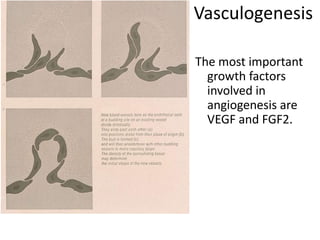
Vasculogenesis
The most important
growth factors
involved in
angiogenesis are
VEGF and FGF2.
Migration of fibroblasts and ECM
deposition (scar formation).
Scar formation takes place on the
network of the newly formed
granulation tissue and loose ECM. The
scar develops in two steps:
a) Migration and proliferation of
fibroblasts at the injury site, and
b) deposition of ECM by fibroblasts.
The fibroblast migration starts early in
wound healing, and continues for several
weeks, depending on the size of the
wound.
As the healing progresses, there is a
decrease of the number of proliferating
fibroblasts and newly formed blood cells
but there is an increase in the deposition
of ECM, particularly collagen.
ECM tissue remodeling.
After scar deposition, the ECM continues
to be modified and remodeled. The
outcome of the repair process depends
on the balance between ECM synthesis
and degradation.
The degradation of collagen and ECM is
done by matrix metalloproteinases
(MMPs) which are zinc dependent.
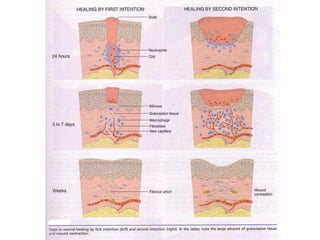
Healing by first intention or primary union takes place
on wounds with;
focal damage of the basement membrane
death of few epithelial and connective tissue cells.
Here, epithelial regeneration predominates over
fibrosis.
A small scar is formed with minimal wound
contraction.
The whole process is usually completed in two
weeks, with the formation of a thin scar which is
covered by normal epidermis in approximately
one month.
Healing by second intention takes place when;
cell and tissue loss is extensive, such as large wounds,
abscesses, ulcerations, or ischemic lesions of solid organs.
This healing process is also called secondary union.
a large clot or scab rich in fibrin and plasma fibronectin forms
at the surface of the wound.
The inflammatory response is severe, because large tissue
defects have a great volume of necrotic debris that must
be removed.
A large amount of granulation tissue is formed in order to fill
the gap and to allow regrowth of epithelium and formation
of a usually large scar.
At the end of the process, there is contraction of the wound
(5 to 10% of the original size, brought about by
myofibroblasts).
Pathologic aspects of repair
Several conditions may alter the
process of repair, causing either
inadequate scar formation, or an
exuberant deposition of collagen and
ECM, leading to the formation of a
prominent raised scar.
Production of an inadequate scar or delay in scar formation
may be due to the following:
1) Infection is the most common cause of delay in healing,
by prolonging the inflammatory response and by
increasing local tissue injury.
2) Poor nutrition and specially Vitamin C deficiency
inhibits collagen synthesis and retards healing.
3) Glucocorticoids have a known anti-inflammatory effect
and their administration results in poor wound strength
due to diminished fibrosis.
4) Mechanical variables such as local pressure or torsion
may cause wounds to pull apart or dehisce.
5) Poor perfusion secondary to arteriosclerosis,
diabetes, or obstructive venous drainage also
impairs healing.
6) Foreign bodies like glass fragments, steel fragments,
or bone may disturb healing.
Aberrations of cell growth may be due to a genetic
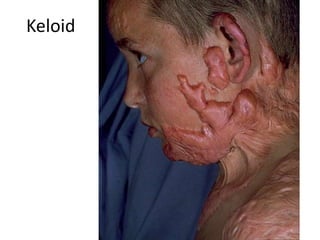
predisposition (Keloid formation). This condition is
more common in African American patients.
Complications of Repair
Insufficient fibrosis:
Wound dehiscence; hernia; ulceration
Excessive fibrosis:
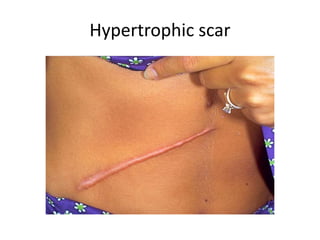
Cosmetic scarring; hypertrophic scars; keloid
Excessive contraction:
Limitation of joint movement (Contractures); obstruction
of tubes & channels (Strictures
Hypertrophic scar
Keloid
unit 5 Tissue Healing and Repair notes.ppt

unit 5 Tissue Healing and Repair notes.ppt

  • 1.
  • 2.
    Overview Tissue repair isthe response of organisms to overcome the damage caused by toxic insults, inflammation and trauma. Inflammatory response does not only the first to deal with any type of tissue injury, but also initiates the process of repair which consists of the restoration of tissue architecture and function.
  • 3.
    CELL PROLIFERATION AND REGENERATION Tissuerepair involves the proliferation of cells from: a) the remnants of the injured tissue b) vascular endothelial cells to form new blood vessels c) fibroblasts which provide fibrous tissue for the formation of scars.
  • 4.
    • The mainsteps in the proliferation of cells are DNA replication and mitosis and this sequence of events is known as the cell cycle. • The cell cycle consists of several steps in order to check the accuracy of cell division. Non-dividing cells are either in cell cycle arrest in G1 or they exit the cycle (G0). Checkpoint controls prevent DNA replication or mitosis of damaged cells or eliminate damaged cells by apoptosis.
  • 6.
    A. Tissue Repair Theability of tissues to repair themselves depends on their intrinsic proliferative capacity. Based on this principle, the tissues of the body can be divided into three groups: a) Continuously dividing tissues (labile tissues) – hematopoietic cells of the bone marrow – stratified squamous epithelium – cuboidal epithelium of excretory ducts – gastrointestinal tract. These tissues can easily regenerate after injury as long as stem cells are intact.
  • 7.
    b) stable tissues– cells of these tissues are quiescent and have minimal replicate activity. However, cells are able to replicate in response to injury or loss of tissue mass. – parenchyma of most solid organs such as; – Liver – Kidney – Pancreas – As well as endothelial cells, fibroblasts, and smooth muscle cells. With the exception of the liver, stable tissues have a limited capacity to regenerate.
  • 8.
    The liver hasa great regenerative capacity that occurs after surgical removal or injury of hepatic tissue. As much as 40% to 60% of the liver may be removed in a procedure called living-donor transplantation. In this situation, replication after partial hepatectomy is initiated by the cytokines TNF and IL6 that trigger the transition of hepatocytes from stages g0 to g1 in the cell cycle. c) Permanent tissues. The cells of these tissues are terminally differentiated in post-natal life. Brain and heart muscle: Results in liquefaction, necrosis and scar formation.
  • 9.
  • 10.
    B. Growth Factors Cellproliferation is triggered by many chemical mediators such as growth factors, hormones and cytokines. Growth factors are polypeptide molecules causing an expansion of cell populations which include an increase in cell size, mitotic activity and protection from apoptotic death (survival). In addition to stimulating cellular proliferation, they promote cellular migration, differentiation, contractibility, as well as enhancing the synthesis of special proteins such as collagen by fibroblasts.
  • 11.
    C. Repair byConnective Tissue If extensive tissue surgery is performed or if a chronic inflammatory process causes damage to parenchymal cells, epithelia and stromal network, repair cannot take place by regeneration alone. The same thing happens when non-dividing cells are injured. In this situation, repair occurs by replacing the necrotic tissue with connective tissue or by the combination of regeneration of some cells and scar formation. The extracellular matrix (ECM) is an essential participant of the repair process.
  • 12.
    D THE EXTRACELLULARMATRIX Divided in two basic forms: interstitial matrix, and basement membrane. The interstitial matrix is present in connective tissue between epithelium and supportive vascular and smooth muscle structures. It is synthesized by mesenchymal cells (fibroblasts) and tends to forms a three-dimensional amorphous gel. The basement membrane lies beneath the epithelium and is synthesized by overlying epithelium and underlying mesenchymal cells. It is a highly organized ECM around epithelial, endothelial, and smooth muscle cells.
  • 13.
    The ECM hasthree basic components: a) fibrous structural proteins such as collagens and elastins b) water hydrated gels, hyaluronan and proteoglycans c) adhesive glycoproteins and adhesion receptors
  • 14.
    Summary of theroles of the ECM In addition to filling spaces around cells, the ECM does the following: a) Provide mechanical support for cell anchorage, migration and maintenance of cell polarity. b) Control of cell growth by signaling through link with intracellular integrins. c) Affect the degree of differentiation of the cells in a given tissue via cell surface integrins. d) Provide scaffolding for the basement membrane and interstitial cellular matrix. The integrity of the ECM is critical for the organized regeneration of parenchymal cells.
  • 15.
    e) Establishment oftissue microenvironments. The basement membrane acts as a boundary between epithelium and underlying connective tissue. f) Storage and presentation of regulatory molecules like growth factors FGF and HGF, synthesize by epithelial and stromal cells, allowing for rapid deployment of growth factors after local injury or during regeneration.
  • 16.
    Repair by ConnectiveTissue It involves the replacement of dead cells and tissues with connective tissue leading to scar formation. The sequence of this process is as follows: 1) Repair begins within 24 hours of the time of injury by the emigration of fibroblasts and the induction of fibroblast and endothelial cell proliferation. 2) After 3 to 5 days, it begins the formation of granulation tissue which is pink and soft, with a granular appearance such as seen underneath the scab of an injured skin. Histologically, it is composed of proliferating fibroblasts, newly formed thin capillaries and loose ECM.
  • 17.
    E. Angiogenesis. Blood vesselsare formed by vasculogenesis originated by angioblasts (endothelial precursor cells (EPCs)) present in the bone marrow or by neovascularization, where preexisting blood vessels send out capillary sprouts to produce new vessels.
  • 18.
    Vasculogenesis The most important growthfactors involved in angiogenesis are VEGF and FGF2.
  • 19.
    Migration of fibroblastsand ECM deposition (scar formation). Scar formation takes place on the network of the newly formed granulation tissue and loose ECM. The scar develops in two steps: a) Migration and proliferation of fibroblasts at the injury site, and b) deposition of ECM by fibroblasts.
  • 20.
    The fibroblast migrationstarts early in wound healing, and continues for several weeks, depending on the size of the wound. As the healing progresses, there is a decrease of the number of proliferating fibroblasts and newly formed blood cells but there is an increase in the deposition of ECM, particularly collagen.
  • 21.
    ECM tissue remodeling. Afterscar deposition, the ECM continues to be modified and remodeled. The outcome of the repair process depends on the balance between ECM synthesis and degradation. The degradation of collagen and ECM is done by matrix metalloproteinases (MMPs) which are zinc dependent.
  • 22.
    Healing by firstintention or primary union takes place on wounds with; focal damage of the basement membrane death of few epithelial and connective tissue cells. Here, epithelial regeneration predominates over fibrosis. A small scar is formed with minimal wound contraction. The whole process is usually completed in two weeks, with the formation of a thin scar which is covered by normal epidermis in approximately one month.
  • 23.
    Healing by secondintention takes place when; cell and tissue loss is extensive, such as large wounds, abscesses, ulcerations, or ischemic lesions of solid organs. This healing process is also called secondary union. a large clot or scab rich in fibrin and plasma fibronectin forms at the surface of the wound. The inflammatory response is severe, because large tissue defects have a great volume of necrotic debris that must be removed. A large amount of granulation tissue is formed in order to fill the gap and to allow regrowth of epithelium and formation of a usually large scar. At the end of the process, there is contraction of the wound (5 to 10% of the original size, brought about by myofibroblasts).
  • 25.
    Pathologic aspects ofrepair Several conditions may alter the process of repair, causing either inadequate scar formation, or an exuberant deposition of collagen and ECM, leading to the formation of a prominent raised scar.
  • 26.
    Production of aninadequate scar or delay in scar formation may be due to the following: 1) Infection is the most common cause of delay in healing, by prolonging the inflammatory response and by increasing local tissue injury. 2) Poor nutrition and specially Vitamin C deficiency inhibits collagen synthesis and retards healing. 3) Glucocorticoids have a known anti-inflammatory effect and their administration results in poor wound strength due to diminished fibrosis. 4) Mechanical variables such as local pressure or torsion may cause wounds to pull apart or dehisce.
  • 27.
    5) Poor perfusionsecondary to arteriosclerosis, diabetes, or obstructive venous drainage also impairs healing. 6) Foreign bodies like glass fragments, steel fragments, or bone may disturb healing. Aberrations of cell growth may be due to a genetic predisposition (Keloid formation). This condition is more common in African American patients.
  • 28.
    Complications of Repair Insufficientfibrosis: Wound dehiscence; hernia; ulceration Excessive fibrosis: Cosmetic scarring; hypertrophic scars; keloid Excessive contraction: Limitation of joint movement (Contractures); obstruction of tubes & channels (Strictures
  • 29.
  • 30.