Drugs and its Effect on One’s Behavior  Alberca, Mary Cris Binag, Vieje Lois Eunice Capistrano, Abigail Lagumen, Kimberly Macapagal, Paola Zabat, Gia
Neurons Neurotransmitters  are endogenous chemicals which transmit signals from a neuron to a target cell across the synapse.  Major neurotransmitters: glutamate, aspartame Monoamines: dopamine (DA), epinephrine (adrenaline), serotonin, acetylcholine, adenosine, nitric oxide.

Neurons Drugs targeting the neurotransmitter of such systems affect the whole system; this fact explains the complexity of action of some drugs.
Neurotransmitters Acetylcholine It is responsible for much of the stimulation of muscles, including the muscles of the gastro-intestinal system.  It is also found in sensory neurons and in the autonomic nervous system, and has a part in scheduling  REM (dream) sleep. Dopamine Dopamine has been found to have relatively little to do with the pleasures of eating.   Drugs like cocaine, opium, heroin, and alcohol increase the levels of dopamine, as does nicotine .  Endorphin It is involved in  pain reduction and pleasure , and the opioid drugs work by attaching to endorphin's receptor sites.  It is also the neurotransmitter that allows bears and other animals to hibernate.
Serotonin Serotonin is an inhibitory neurotransmitter that has been found to be intimately involved in  emotion and mood.   Too little serotonin has been shown to lead to depression, problems with anger control, obsessive-compulsive disorder, and suicide.  Too little also leads to an increased appetite for carbohydrates (starchy foods) and trouble sleeping, which are also associated with depression and other emotional disorders.   Serotonin also plays a role in perception .
Kinds of Drugs and its Effects: COCAINE SHORT TERM EFFECTS: Increased blood pressure Constricted blood vessels Dilated pupils Mental alertness Increased energy Increased heart rate Decreased appetite Increased temperature
LONG TERM EFFECTS  (Physiological): heart disease  heart attacks  respiratory failure stroke seizures gastrointestinal problems PHYSICAL SYMPTOMS: convulsions, nausea, blurred vision, chest pain, fever, muscle spasms, and coma. Kinds of Drugs and its Effects: COCAINE
LONG TERM EFFECTS  (Psychological): Addiction Paranoia Irritability Restlessness Auditory hallucinations Mood disturbances Kinds of Drugs and its Effects: COCAINE
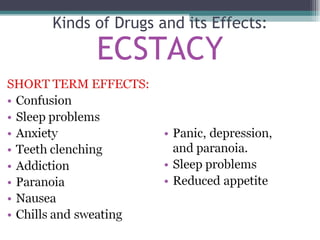
Kinds of Drugs and its Effects: ECSTACY
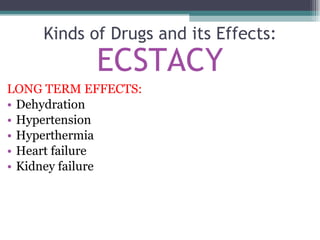
LONG TERM EFFECTS: Dehydration Hypertension Hyperthermia Heart failure  Kidney failure Kinds of Drugs and its Effects: ECSTACY
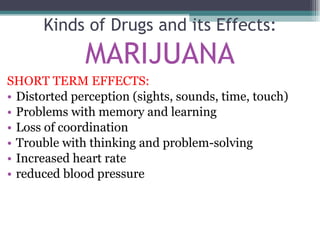
SHORT TERM EFFECTS: Distorted perception (sights, sounds, time, touch) Problems with memory and learning Loss of coordination Trouble with thinking and problem-solving Increased heart rate reduced blood pressure Kinds of Drugs and its Effects: MARIJUANA
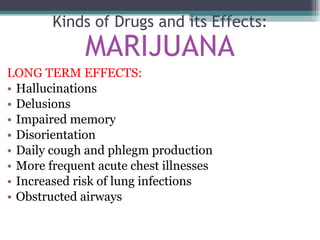
LONG TERM EFFECTS: Hallucinations Delusions Impaired memory Disorientation Daily cough and phlegm production More frequent acute chest illnesses Increased risk of lung infections Obstructed airways Kinds of Drugs and its Effects: MARIJUANA
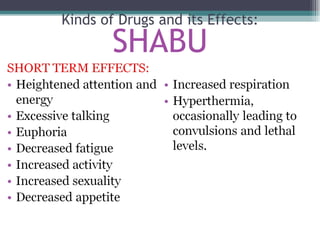
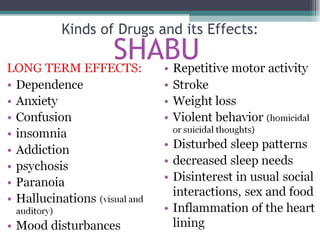
Kinds of Drugs and its Effects: SHABU
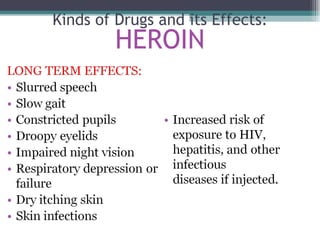
Kinds of Drugs and its Effects: HEROIN
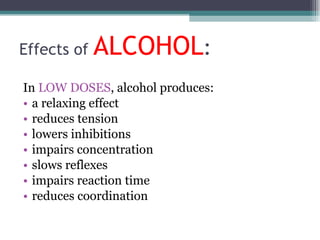
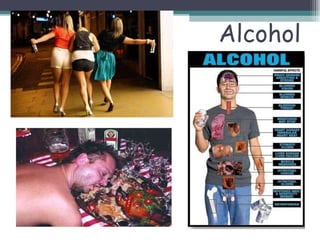
Effects of  ALCOHOL : In  LOW DOSES , alcohol produces: a relaxing effect reduces tension lowers inhibitions impairs concentration slows reflexes impairs reaction time reduces coordination
Effects of  ALCOHOL: In  MEDIUM DOSES , alcohol produces: slur speech cause drowsiness alter emotions In  HIGH DOSES , alcohol produces: vomiting breathing difficulties unconsciousness coma
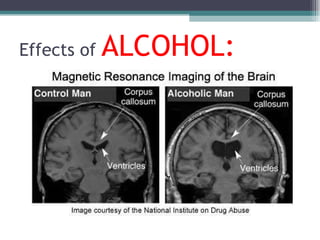
Effects of  ALCOHOL:
Effects of  CAFFEINE: Caffeine is a central nervous system stimulant. In moderate doses, caffeine can: increase alertness reduce fine motor coordination cause insomnia cause headaches, nervousness and dizziness
Effects of  CAFFEINE: Some studies show that caffeine causes physical dependence. One way to tell if someone "needs" that cup of coffee or bottle of Coke is to take it away from them and then see if they have any withdrawal symptoms. Typical withdrawal symptoms associated with caffeine are headache, fatigue and muscle pain. These symptoms can occur within 24 hours after the last dose of caffeine.  One study has stated that the minimum consumption of caffeine for physical dependence is 4 cups of coffee per day. Other studies say that a few more cups of coffee are needed to develop dependence.
Effects of  NICOTINE: Tobacco contains nicotine. Nicotine is a drug. Therefore, when people smoke or chew tobacco, they are using a  drug . Smoking can be stimulating or relaxing - it depends on a person's mood and dosage of nicotine.  The rapid effects of nicotine include: Increases in blood pressure and heart rate Faster respiration Constriction of arteries Stimulation of the central nervous system.
Effects of  NICOTINE: Long Term Effects: increases the chances of cancer and results in addiction and dependence.  It is clear though, that nicotine is one of the most addicting substances known...just ask anyone who has tried to quit smoking.  Common withdrawal symptoms in people who are trying to "kick the habit" of tobacco include: Anxiety Depression Headaches Fatigue
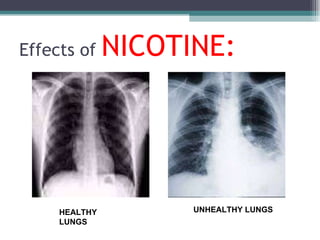
Effects of  NICOTINE: HEALTHY LUNGS UNHEALTHY LUNGS
Ingredients of Drugs: Methamphetamine
Marijuana Delta-9 TetraHydroCannabinol (THC ) -extracted from the Cannabis Sativa plant
Inhalants Volatile Solvents -paint thinner, dry-cleaning fluids, degreasers, gasoline, glue, correction fluid, and felt-tip marker fluid. Aerosol -spray paint, deodorant, hair spray, vegetable oil spray for cooking,  and fabric protector spray. Gases - ether, chloroform, halothane, and nitrous oxide, commonly called "laughing gas.“ Nitrites - cyclohexyl nitrite, isoamyl (amyl) nitrite, and isobutyl (butyl) nitrite.
Cocaine Coca leaf -cocaine hydrochloride Cement Ammonia Calcium oxide Sulphuric acid Petrol
Other chemicals that are mixed together to process the coca leaves: - Succindialdehyde, sulfuric acid, sodium nitrite, Ba carbonate, lots of ethanol, distilled pyrrole, hydroxylamine hydrochloride, anhydrous sodium carbonate, sodium methoxide, dimethylcarbonate, ammonium chloride, chloroform, potassium carbonate, methyl acetate, NaOH solution, HCl acid, benzoic anhydride.
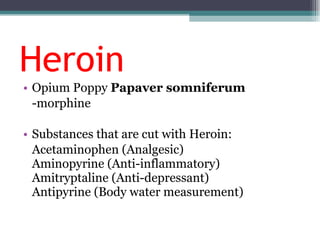
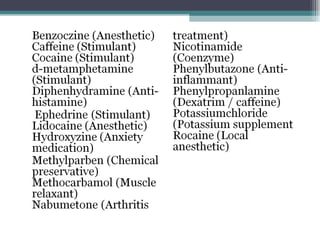
Heroin Opium Poppy  Papaver somniferum -morphine Substances that are cut with Heroin: Acetaminophen (Analgesic) Aminopyrine (Anti-inflammatory) Amitryptaline (Anti-depressant) Antipyrine (Body water measurement)
 
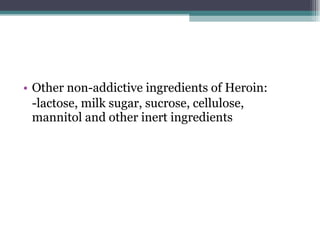
Other non-addictive ingredients of Heroin: -lactose, milk sugar, sucrose, cellulose,  mannitol and other inert ingredients
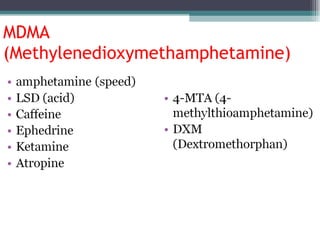
MDMA (Methylenedioxymethamphetamine)
How we get addicted to drugs: The master brain chemical of addiction Dopamine  -transmits all of the pleasure signals Drugs modify activity of various brain chemicals that cross pathways in the brain; dopamine could be the end result of all the pathways Dopamine overload (esp. feelings of euphoria and bliss )
Craving behavior response can motivate substance abuse When drug addict attempts to stop using the drugs will demand more of the drug to produce  metabolites Drug addict is caught in a trap Appears inescapable unless an effective drug addiction treatment handles the condition.
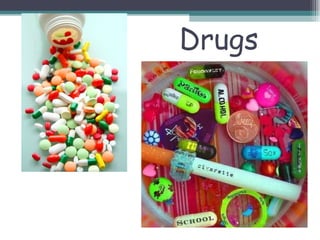
Drugs
 
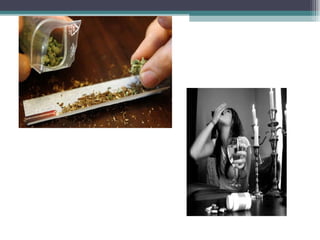
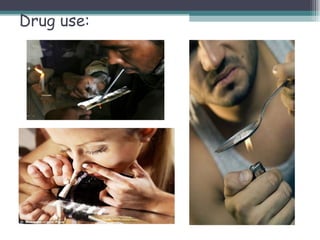
Drug use:
 
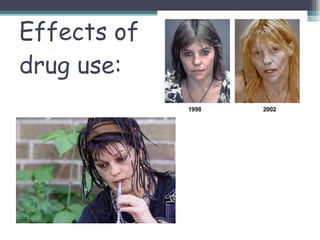
Effects of  drug use:
Smoking
Alcohol
 
Prevent Drug Usage YES, YOU CAN!
 
F amily Be involved and open with your family! Though adolescence stage can be a shaky stage between teens and their parents, it's very important to maintain your communication and connection with them.
Family involvement can help you handle temptations to use alcohol, cigarettes and drugs that you might encounter. How’s your relationship with your family?
F riends Now, think of your friends.  Think of the activities that you do together. Are these activities beneficial to you or not? What kind of friends do you have?
Teens would most likely try using drugs when they're around other teens who take drugs. Peer pressure; but with the right kind of friends, it's most likely that you will not encounter such. Our friends can have the greatest influence in our choices, the way we think and in our activities. Choose your friends!
P assion Be active. Know your passions and do them! Find alternatives. Some teens use drugs because of boredom and it's something to do. Think of your talents, skills and abilities. Are they being used and developed? What can you do to improve on your abilities?
Get involved in other activities. -Join co-curricular organizations. -Varsity teams, extra-curricular organizations (dance, singing and theater organizations) Involvement in these organizations will not only keep you busy but will also help you develop your personality, talents and skills. Find your passion and do it!
G oals Set your GOALS! -Do you have goals in your life? -(Family, Academics, Others..) -What are they? -Write them down!
Goals can serve as motivations to be busy and to stay committed towards their accomplishment! Goals will keep you focused in attaining them, minimizing the possibilities of being distracted along the way. Set your goals, move and work for them!
A wareness The key is awareness! Research more on the effects of drug addiction on your physical and mental state. You'll gain knowledge that will help you decide about this matter in the future. Be aware and keep learning!
S hare SHARE WHAT YOU'VE LEARNED! Talk and discuss the information that you have gained to your classmates and friends! Form a group among your peers which will aim to educate people about drugs, drug addiction and its effects. Be concerned and responsible. Be an agent of drug usage prevention.  Share your knowledge, time and talents!
FF P GAS F AMILY F RIENDS P ASSIONS G OALS A WARENESS S HARE
Prevent Drug Usage Yes, You CAN SAY IT!
http://www.scribd.com/doc/95251/Classification-of-Drugs-and-Their-Effects http://www.cocaine-effects.com/ http://alcoholism.about.com/od/coke/a/effects.htm http://www.ecstasy-effects.com/ http://www.thegooddrugsguide.com/ecstasy/effects.htm http://alcoholism.about.com/od/pot/a/effects.-Lya.htm http://www.scribd.com/doc/95251/Classification-of-Drugs-and-Their-Effects REFERENCES
http://www.houstoncriminallawjournal.com/uploads/image/drugs2.jpg http://www.softchalk.com/lessonchallenge/lesson/Pharmacology/prescription_drugs.jpg http://www.extremesportstrader.co.uk/shots/wp-content/uploads/2010/06/drugs-are-bad.jpg http://kevinbeirne.webs.com/Drug%20graphic.jpg http://static.guim.co.uk/sys-images/Guardian/Science/pix/2007/07/27/cannabis_2.jpg http://health.idahostatesman.com/storyImages/1024-ih-addiction-700.jpg
http://i.dailymail.co.uk/i/pix/2008/10/30/article-1081882-0435FE090000044D-578_468x377.jpg http://4.bp.blogspot.com/_MkwLbvvXgIU/TCCRadpQUtI/AAAAAAAAAPI/XNAvPvH-NIs/s1600/drug+addict.jpg http://iciesworld.files.wordpress.com/2010/01/drug-addict.jpg http://scrapetv.com/News/News%20Pages/Entertainment/images-5/drug-addict.jpg http://www.aoco.net/wp-content/uploads/drug-addiction1.jpg http://gdb.rferl.org/C9C0ED06-A2B0-4C5F-B01A-95A6EC219A7C_mw800_mh600.jpg
http://www.strangepolice.com/images/content/109568.jpg http://www.abc.net.au/reslib/200710/r195887_745004.jpg http://www.modernguidetohealth.com/wp-content/uploads/2008/11/alcoholic-intoxication.jpg http://www.thelivercentre.com.au/development/images/alcohol-Effects.jpg http://blogs.monografias.com/sistema-limbico-neurociencias/files/2010/04/drinking_teenagers_1107904c.jpg http://anti-smoker.tripod.com/sitebuildercontent/sitebuilderpictures/.pond/poster-child-fullsize.jpg.w300h648.jpg
http://www.youtube.com/watch?v=CM1lDp_3uxQ http://www.youtube.com/watch?v=9EMpPJM1U-s http://www.youtube.com/watch?v=pVRO_a6pQB8 http://www.youtube.com/watch?v=giGkt5oAhT0&feature=PlayList&p=9FAB81F94AC10BDF&playnext_from=PL&playnext=1&index=8 http://www.youtube.com/watch?v=3FtNm9CgA6U http://www.youtube.com/watch?v=rft2BTF1RdY
http://www.ehow.com/how_5083270_prevent-teen-drug-use.html http://www.ehow.com/how_2103856_prevent-teenage-drug-use.html http://www.google.com.ph/imglanding?q=i%20can%20do%20it&imgurl http://en.wikipedia.org/wiki/Neurotransmitter http://webspace.ship.edu/cgboer/genpsyneurotransmitters.html
http://en.wikipedia.org/wiki/Neurotransmitter http://webspace.ship.edu/cgboer/genpsyneurotransmitters.html http://faculty.washington.edu/chudler/mari.html http://faculty.washington.edu/chudler/introb.html http://faculty.washington.edu/chudler/coca.html http://faculty.washington.edu/chudler/mdma.html http://faculty.washington.edu/chudler/nic.html http://faculty.washington.edu/chudler/caff.html http://www.encognitive.com/files/How%20We%20Become%20Addicted.pdf http://www.drugsno.com/drug-addiction/

Drug Addiction Ppt

  • 1.
    Drugsand its Effect on One’s Behavior Alberca, Mary Cris Binag, Vieje Lois Eunice Capistrano, Abigail Lagumen, Kimberly Macapagal, Paola Zabat, Gia
  • 2.
    Neurons Neurotransmitters  are endogenous chemicals whichtransmit signals from a neuron to a target cell across the synapse. Major neurotransmitters: glutamate, aspartame Monoamines: dopamine (DA), epinephrine (adrenaline), serotonin, acetylcholine, adenosine, nitric oxide.
  • 3.
    Neurons Drugs targetingthe neurotransmitter of such systems affect the whole system; this fact explains the complexity of action of some drugs.
  • 4.
    Neurotransmitters Acetylcholine Itis responsible for much of the stimulation of muscles, including the muscles of the gastro-intestinal system.  It is also found in sensory neurons and in the autonomic nervous system, and has a part in scheduling REM (dream) sleep. Dopamine Dopamine has been found to have relatively little to do with the pleasures of eating. Drugs like cocaine, opium, heroin, and alcohol increase the levels of dopamine, as does nicotine .  Endorphin It is involved in pain reduction and pleasure , and the opioid drugs work by attaching to endorphin's receptor sites.  It is also the neurotransmitter that allows bears and other animals to hibernate.
  • 5.
    Serotonin Serotonin isan inhibitory neurotransmitter that has been found to be intimately involved in emotion and mood.   Too little serotonin has been shown to lead to depression, problems with anger control, obsessive-compulsive disorder, and suicide.  Too little also leads to an increased appetite for carbohydrates (starchy foods) and trouble sleeping, which are also associated with depression and other emotional disorders. Serotonin also plays a role in perception .
  • 6.
    Kinds of Drugsand its Effects: COCAINE SHORT TERM EFFECTS: Increased blood pressure Constricted blood vessels Dilated pupils Mental alertness Increased energy Increased heart rate Decreased appetite Increased temperature
  • 7.
    LONG TERM EFFECTS (Physiological): heart disease heart attacks respiratory failure stroke seizures gastrointestinal problems PHYSICAL SYMPTOMS: convulsions, nausea, blurred vision, chest pain, fever, muscle spasms, and coma. Kinds of Drugs and its Effects: COCAINE
  • 8.
    LONG TERM EFFECTS (Psychological): Addiction Paranoia Irritability Restlessness Auditory hallucinations Mood disturbances Kinds of Drugs and its Effects: COCAINE
  • 9.
    Kinds of Drugsand its Effects: ECSTACY
  • 10.
    LONG TERM EFFECTS:Dehydration Hypertension Hyperthermia Heart failure Kidney failure Kinds of Drugs and its Effects: ECSTACY
  • 11.
    SHORT TERM EFFECTS:Distorted perception (sights, sounds, time, touch) Problems with memory and learning Loss of coordination Trouble with thinking and problem-solving Increased heart rate reduced blood pressure Kinds of Drugs and its Effects: MARIJUANA
  • 12.
    LONG TERM EFFECTS:Hallucinations Delusions Impaired memory Disorientation Daily cough and phlegm production More frequent acute chest illnesses Increased risk of lung infections Obstructed airways Kinds of Drugs and its Effects: MARIJUANA
  • 13.
    Kinds of Drugsand its Effects: SHABU
  • 14.
    Kinds of Drugsand its Effects: SHABU
  • 15.
    Kinds of Drugsand its Effects: HEROIN
  • 16.
    Effects of ALCOHOL : In LOW DOSES , alcohol produces: a relaxing effect reduces tension lowers inhibitions impairs concentration slows reflexes impairs reaction time reduces coordination
  • 17.
    Effects of ALCOHOL: In MEDIUM DOSES , alcohol produces: slur speech cause drowsiness alter emotions In HIGH DOSES , alcohol produces: vomiting breathing difficulties unconsciousness coma
  • 18.
    Effects of ALCOHOL:
  • 19.
    Effects of CAFFEINE: Caffeine is a central nervous system stimulant. In moderate doses, caffeine can: increase alertness reduce fine motor coordination cause insomnia cause headaches, nervousness and dizziness
  • 20.
    Effects of CAFFEINE: Some studies show that caffeine causes physical dependence. One way to tell if someone "needs" that cup of coffee or bottle of Coke is to take it away from them and then see if they have any withdrawal symptoms. Typical withdrawal symptoms associated with caffeine are headache, fatigue and muscle pain. These symptoms can occur within 24 hours after the last dose of caffeine. One study has stated that the minimum consumption of caffeine for physical dependence is 4 cups of coffee per day. Other studies say that a few more cups of coffee are needed to develop dependence.
  • 21.
    Effects of NICOTINE: Tobacco contains nicotine. Nicotine is a drug. Therefore, when people smoke or chew tobacco, they are using a  drug . Smoking can be stimulating or relaxing - it depends on a person's mood and dosage of nicotine. The rapid effects of nicotine include: Increases in blood pressure and heart rate Faster respiration Constriction of arteries Stimulation of the central nervous system.
  • 22.
    Effects of NICOTINE: Long Term Effects: increases the chances of cancer and results in addiction and dependence. It is clear though, that nicotine is one of the most addicting substances known...just ask anyone who has tried to quit smoking. Common withdrawal symptoms in people who are trying to "kick the habit" of tobacco include: Anxiety Depression Headaches Fatigue
  • 23.
    Effects of NICOTINE: HEALTHY LUNGS UNHEALTHY LUNGS
  • 24.
    Ingredients of Drugs:Methamphetamine
  • 25.
    Marijuana Delta-9 TetraHydroCannabinol(THC ) -extracted from the Cannabis Sativa plant
  • 26.
    Inhalants Volatile Solvents-paint thinner, dry-cleaning fluids, degreasers, gasoline, glue, correction fluid, and felt-tip marker fluid. Aerosol -spray paint, deodorant, hair spray, vegetable oil spray for cooking, and fabric protector spray. Gases - ether, chloroform, halothane, and nitrous oxide, commonly called "laughing gas.“ Nitrites - cyclohexyl nitrite, isoamyl (amyl) nitrite, and isobutyl (butyl) nitrite.
  • 27.
    Cocaine Coca leaf-cocaine hydrochloride Cement Ammonia Calcium oxide Sulphuric acid Petrol
  • 28.
    Other chemicals thatare mixed together to process the coca leaves: - Succindialdehyde, sulfuric acid, sodium nitrite, Ba carbonate, lots of ethanol, distilled pyrrole, hydroxylamine hydrochloride, anhydrous sodium carbonate, sodium methoxide, dimethylcarbonate, ammonium chloride, chloroform, potassium carbonate, methyl acetate, NaOH solution, HCl acid, benzoic anhydride.
  • 29.
    Heroin Opium Poppy Papaver somniferum -morphine Substances that are cut with Heroin: Acetaminophen (Analgesic) Aminopyrine (Anti-inflammatory) Amitryptaline (Anti-depressant) Antipyrine (Body water measurement)
  • 30.
  • 31.
    Other non-addictive ingredientsof Heroin: -lactose, milk sugar, sucrose, cellulose, mannitol and other inert ingredients
  • 32.
  • 33.
    How we getaddicted to drugs: The master brain chemical of addiction Dopamine -transmits all of the pleasure signals Drugs modify activity of various brain chemicals that cross pathways in the brain; dopamine could be the end result of all the pathways Dopamine overload (esp. feelings of euphoria and bliss )
  • 34.
    Craving behavior responsecan motivate substance abuse When drug addict attempts to stop using the drugs will demand more of the drug to produce metabolites Drug addict is caught in a trap Appears inescapable unless an effective drug addiction treatment handles the condition.
  • 35.
  • 36.
  • 37.
  • 38.
  • 39.
    Effects of drug use:
  • 40.
  • 41.
  • 42.
  • 43.
    Prevent Drug UsageYES, YOU CAN!
  • 44.
  • 45.
    F amily Beinvolved and open with your family! Though adolescence stage can be a shaky stage between teens and their parents, it's very important to maintain your communication and connection with them.
  • 46.
    Family involvement canhelp you handle temptations to use alcohol, cigarettes and drugs that you might encounter. How’s your relationship with your family?
  • 47.
    F riends Now,think of your friends. Think of the activities that you do together. Are these activities beneficial to you or not? What kind of friends do you have?
  • 48.
    Teens would mostlikely try using drugs when they're around other teens who take drugs. Peer pressure; but with the right kind of friends, it's most likely that you will not encounter such. Our friends can have the greatest influence in our choices, the way we think and in our activities. Choose your friends!
  • 49.
    P assion Beactive. Know your passions and do them! Find alternatives. Some teens use drugs because of boredom and it's something to do. Think of your talents, skills and abilities. Are they being used and developed? What can you do to improve on your abilities?
  • 50.
    Get involved inother activities. -Join co-curricular organizations. -Varsity teams, extra-curricular organizations (dance, singing and theater organizations) Involvement in these organizations will not only keep you busy but will also help you develop your personality, talents and skills. Find your passion and do it!
  • 51.
    G oals Setyour GOALS! -Do you have goals in your life? -(Family, Academics, Others..) -What are they? -Write them down!
  • 52.
    Goals can serveas motivations to be busy and to stay committed towards their accomplishment! Goals will keep you focused in attaining them, minimizing the possibilities of being distracted along the way. Set your goals, move and work for them!
  • 53.
    A wareness Thekey is awareness! Research more on the effects of drug addiction on your physical and mental state. You'll gain knowledge that will help you decide about this matter in the future. Be aware and keep learning!
  • 54.
    S hare SHAREWHAT YOU'VE LEARNED! Talk and discuss the information that you have gained to your classmates and friends! Form a group among your peers which will aim to educate people about drugs, drug addiction and its effects. Be concerned and responsible. Be an agent of drug usage prevention. Share your knowledge, time and talents!
  • 55.
    FF P GASF AMILY F RIENDS P ASSIONS G OALS A WARENESS S HARE
  • 56.
    Prevent Drug UsageYes, You CAN SAY IT!
  • 57.
    http://www.scribd.com/doc/95251/Classification-of-Drugs-and-Their-Effects http://www.cocaine-effects.com/ http://alcoholism.about.com/od/coke/a/effects.htmhttp://www.ecstasy-effects.com/ http://www.thegooddrugsguide.com/ecstasy/effects.htm http://alcoholism.about.com/od/pot/a/effects.-Lya.htm http://www.scribd.com/doc/95251/Classification-of-Drugs-and-Their-Effects REFERENCES
  • 58.
    http://www.houstoncriminallawjournal.com/uploads/image/drugs2.jpg http://www.softchalk.com/lessonchallenge/lesson/Pharmacology/prescription_drugs.jpg http://www.extremesportstrader.co.uk/shots/wp-content/uploads/2010/06/drugs-are-bad.jpghttp://kevinbeirne.webs.com/Drug%20graphic.jpg http://static.guim.co.uk/sys-images/Guardian/Science/pix/2007/07/27/cannabis_2.jpg http://health.idahostatesman.com/storyImages/1024-ih-addiction-700.jpg
  • 59.
    http://i.dailymail.co.uk/i/pix/2008/10/30/article-1081882-0435FE090000044D-578_468x377.jpg http://4.bp.blogspot.com/_MkwLbvvXgIU/TCCRadpQUtI/AAAAAAAAAPI/XNAvPvH-NIs/s1600/drug+addict.jpg http://iciesworld.files.wordpress.com/2010/01/drug-addict.jpghttp://scrapetv.com/News/News%20Pages/Entertainment/images-5/drug-addict.jpg http://www.aoco.net/wp-content/uploads/drug-addiction1.jpg http://gdb.rferl.org/C9C0ED06-A2B0-4C5F-B01A-95A6EC219A7C_mw800_mh600.jpg
  • 60.
    http://www.strangepolice.com/images/content/109568.jpg http://www.abc.net.au/reslib/200710/r195887_745004.jpg http://www.modernguidetohealth.com/wp-content/uploads/2008/11/alcoholic-intoxication.jpghttp://www.thelivercentre.com.au/development/images/alcohol-Effects.jpg http://blogs.monografias.com/sistema-limbico-neurociencias/files/2010/04/drinking_teenagers_1107904c.jpg http://anti-smoker.tripod.com/sitebuildercontent/sitebuilderpictures/.pond/poster-child-fullsize.jpg.w300h648.jpg
  • 61.
    http://www.youtube.com/watch?v=CM1lDp_3uxQ http://www.youtube.com/watch?v=9EMpPJM1U-s http://www.youtube.com/watch?v=pVRO_a6pQB8http://www.youtube.com/watch?v=giGkt5oAhT0&feature=PlayList&p=9FAB81F94AC10BDF&playnext_from=PL&playnext=1&index=8 http://www.youtube.com/watch?v=3FtNm9CgA6U http://www.youtube.com/watch?v=rft2BTF1RdY
  • 62.
  • 63.
    http://en.wikipedia.org/wiki/Neurotransmitter http://webspace.ship.edu/cgboer/genpsyneurotransmitters.html http://faculty.washington.edu/chudler/mari.htmlhttp://faculty.washington.edu/chudler/introb.html http://faculty.washington.edu/chudler/coca.html http://faculty.washington.edu/chudler/mdma.html http://faculty.washington.edu/chudler/nic.html http://faculty.washington.edu/chudler/caff.html http://www.encognitive.com/files/How%20We%20Become%20Addicted.pdf http://www.drugsno.com/drug-addiction/