Middle Adulthood Physical and Cognitive Development  PSYC290 Dr. Debi Smith Azusa Pacific University
Physical and Cognitive Development Development in Middle Adulthood Physical Continuity and Change Disease and Health Cognitive Continuity and Change
Development in  Middle Adulthood Middle adulthood is usually defined as the ages of 40 to 60 or 65. People enter at different ages, depending on different cues: social and family status physical and biological status psychological state job or career path economic and historical events
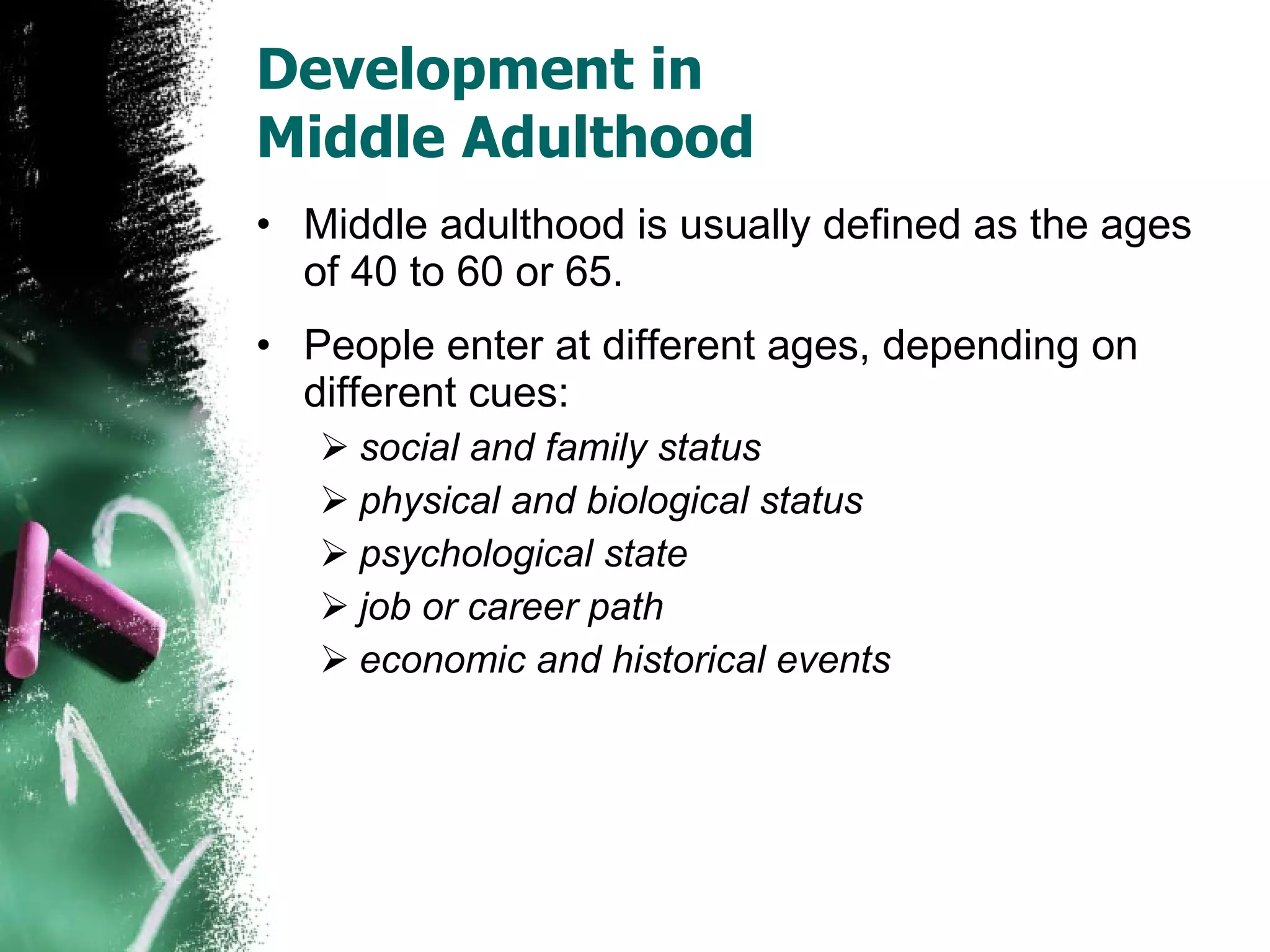
Development in  Middle Adulthood Prime Time or the Beginning of the End? Most adults are at their peak productivity during middle age. They are the command generation, making policy decisions that affect us all. For some, of course, middle age is a time of ambivalence.
Development in Middle Age Midlife Crisis: Is It Real? The crisis model of Levinson argues that men experience midlife crisis between the ages of 40 and 45.  The transition model rejects the idea that midlife crisis is the norm. Crises are event-related, not age-related, this theory maintains. Most adults do not experience a midlife crisis, but people do adapt to being middle-aged in different ways.
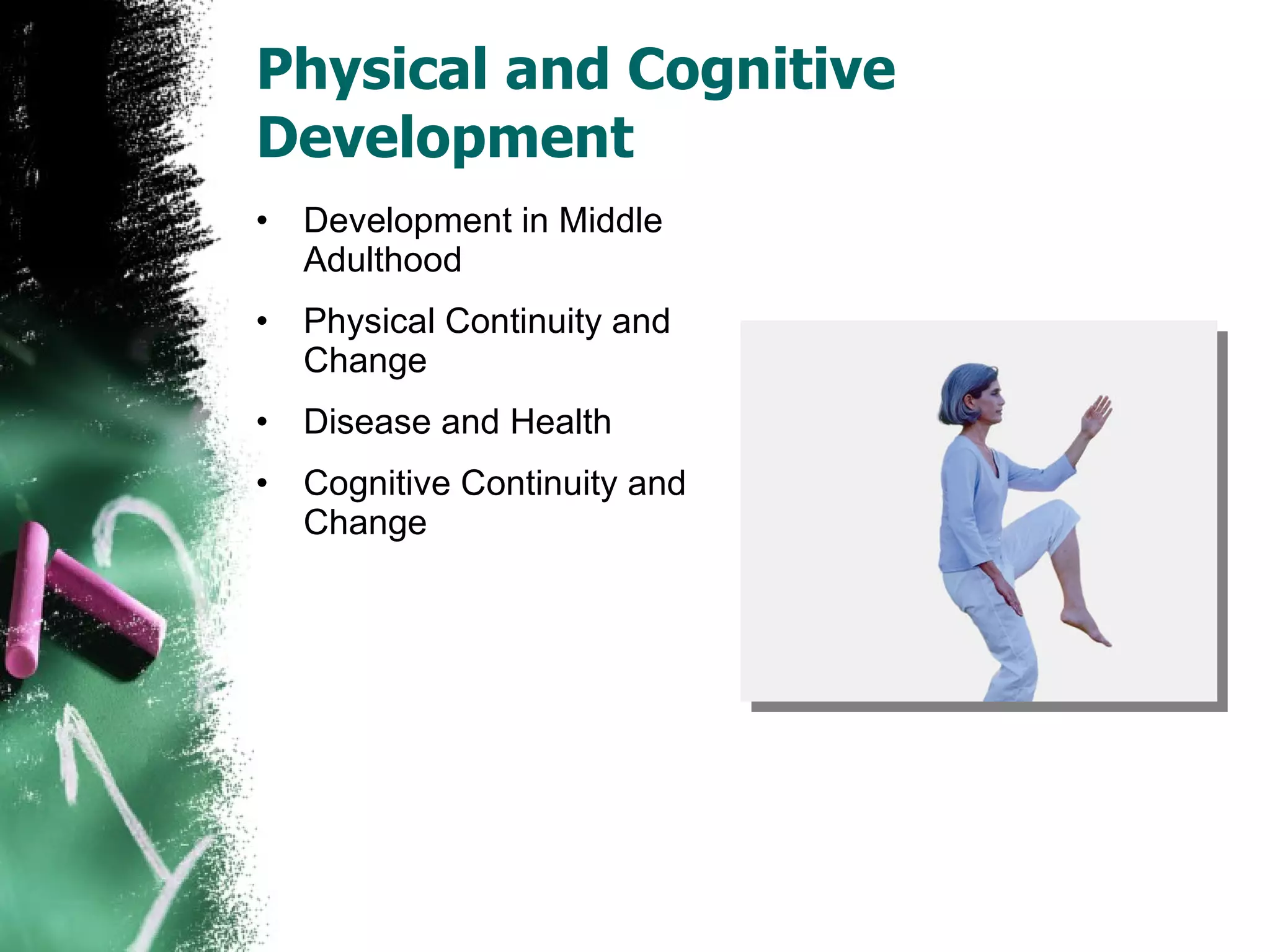
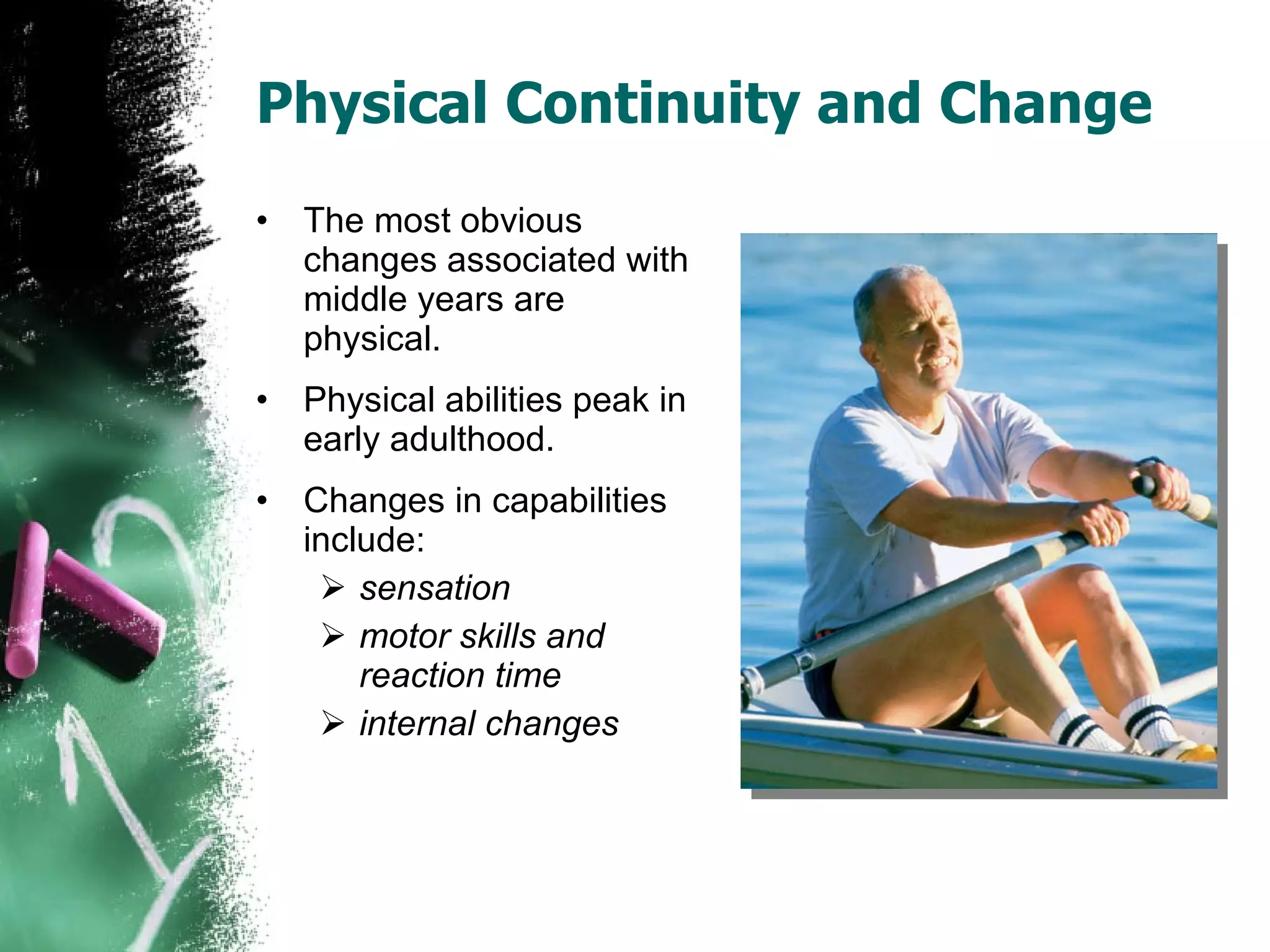
Physical Continuity and Change The most obvious changes associated with middle years are physical. Physical abilities peak in early adulthood. Changes in capabilities include: sensation motor skills and reaction time internal changes
Physical Changes The Climacteric Men and women experience physical and emotional changes that are related to hormonal changes. In women, the most dramatic aspect is menopause. Menopause involves: physical changes and symptoms and emotion effects
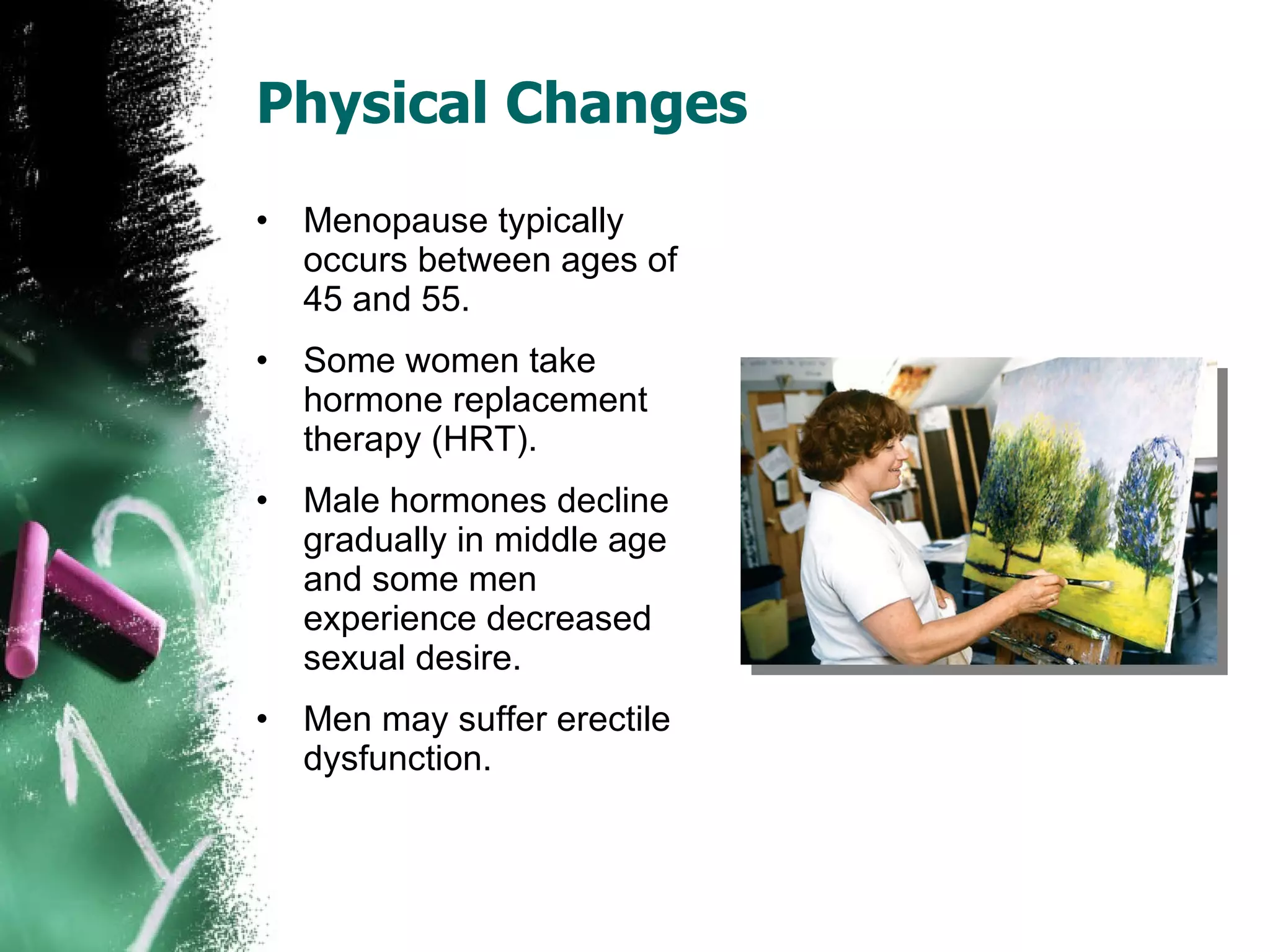
Physical Changes Menopause typically occurs between ages of 45 and 55. Some women take hormone replacement therapy (HRT). Male hormones decline gradually in middle age and some men experience decreased sexual desire. Men may suffer erectile dysfunction.
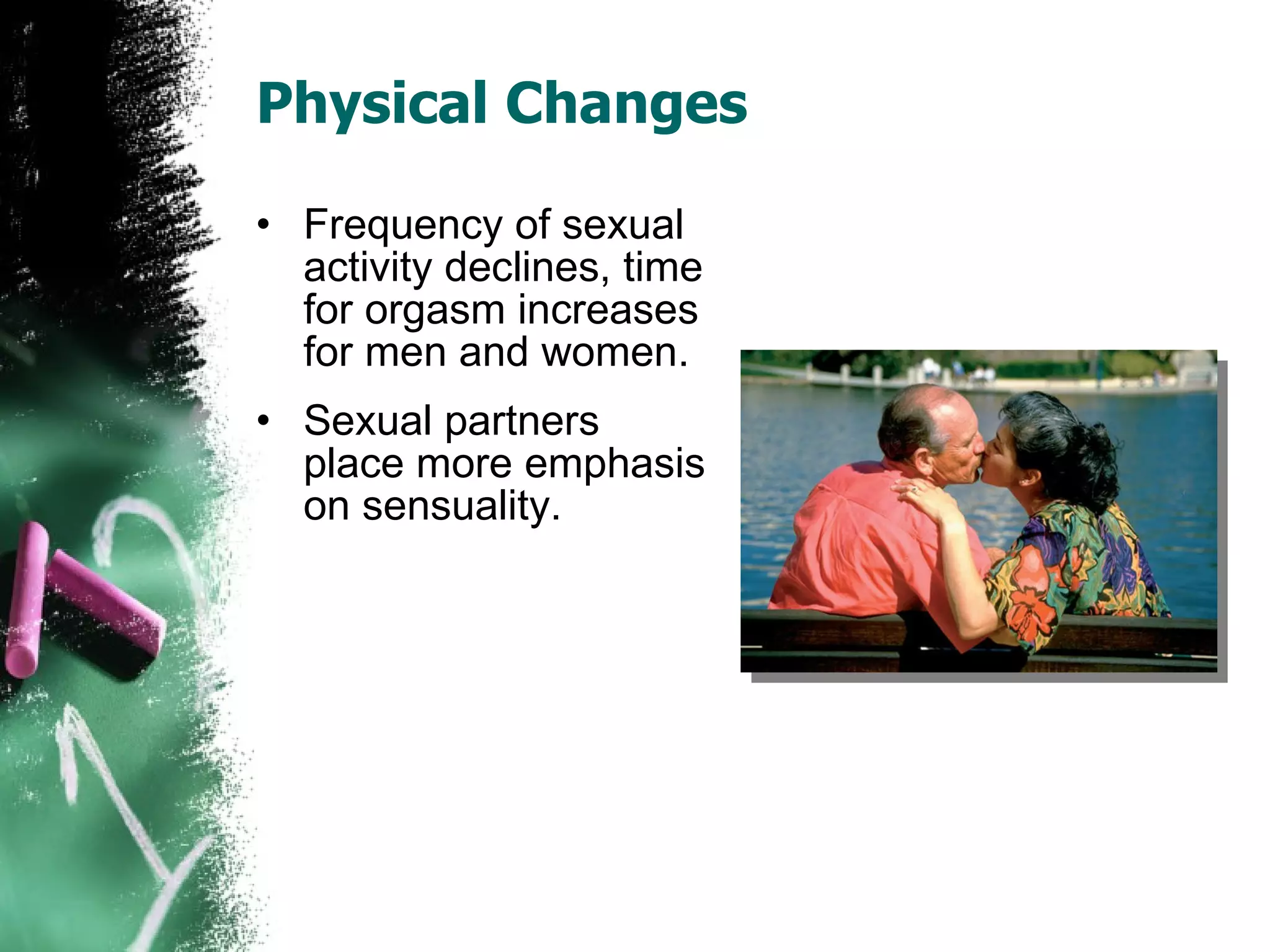
Physical Changes Frequency of sexual activity declines, time for orgasm increases for men and women. Sexual partners place more emphasis on sensuality.
Disease and Health As people age, they become more vulnerable to disease. Most deaths in middle age are from cancer and heart attacks. Women are generally more healthy than men. People who are better educated are also healthier. Longevity is related to good health habits. Poor habits—especially smoking and over eating—take their toll in middle age.
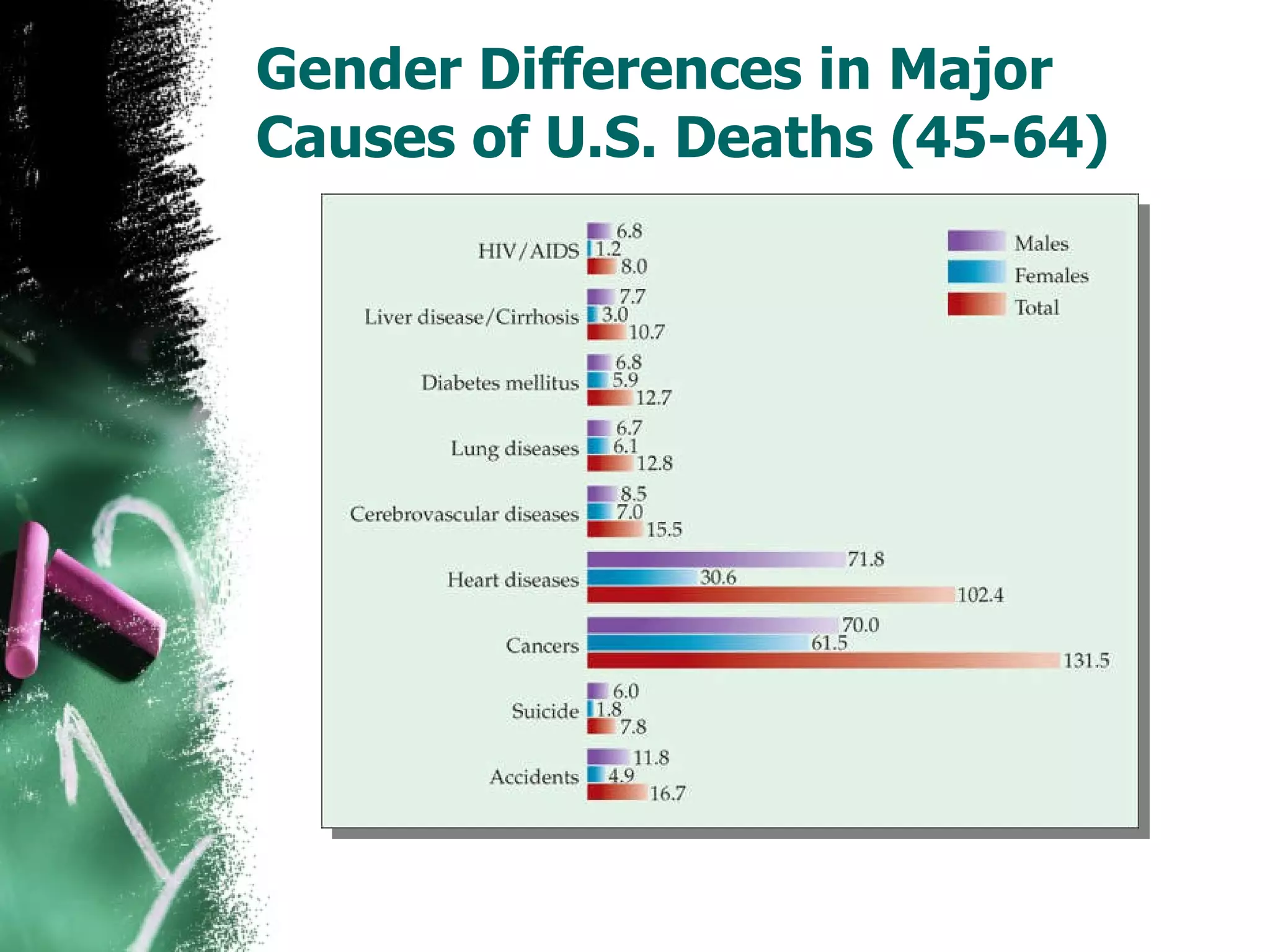
Gender Differences in Major Causes of U.S. Deaths (45-64)
Major Causes of U.S. Deaths  (Adults, 45-64)
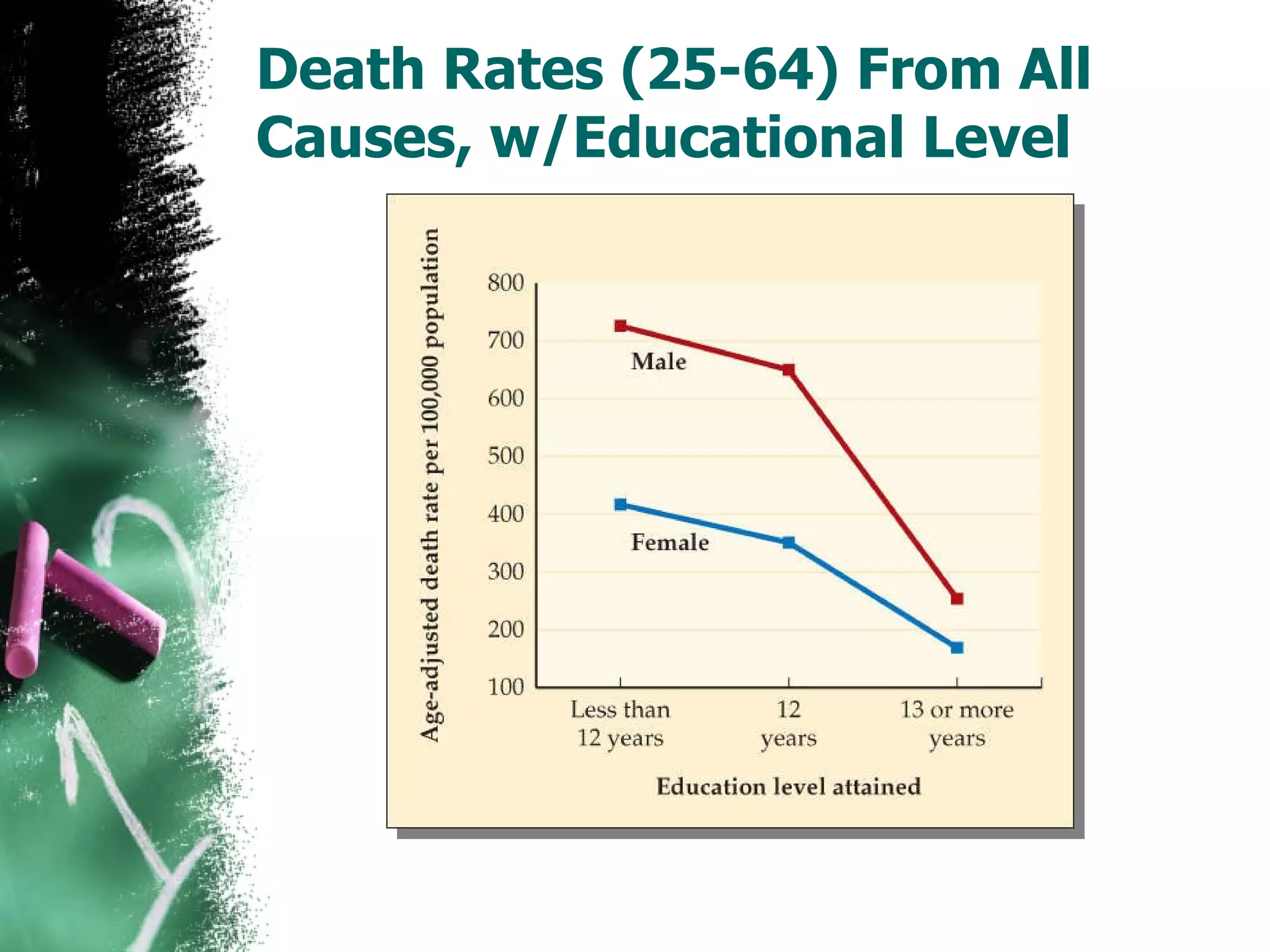
Death Rates (25-64) From All Causes, w/Educational Level
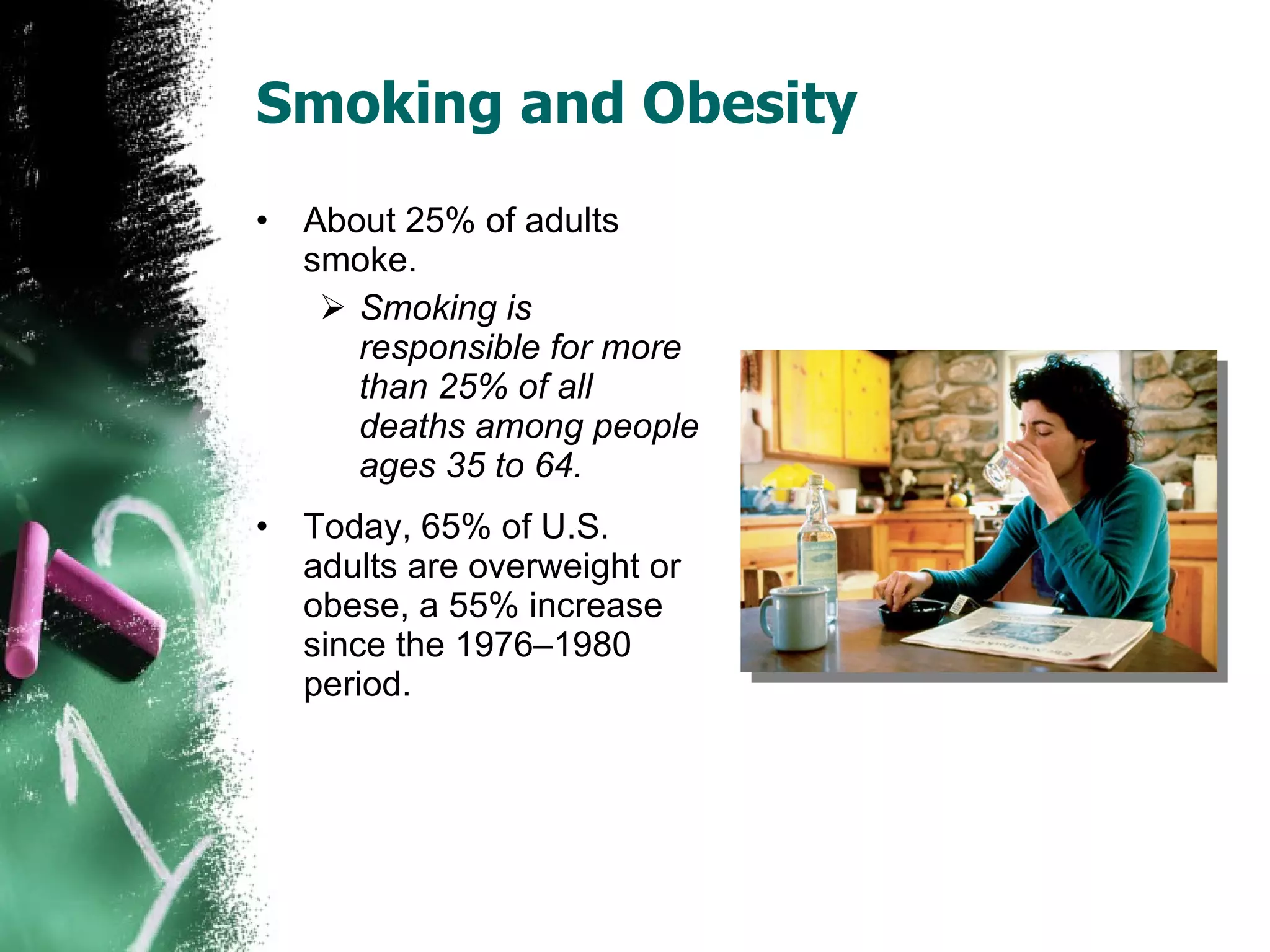
Smoking and Obesity About 25% of adults smoke. Smoking is responsible for more than 25% of all deaths among people ages 35 to 64. Today, 65% of U.S. adults are overweight or obese, a 55% increase since the 1976–1980 period.
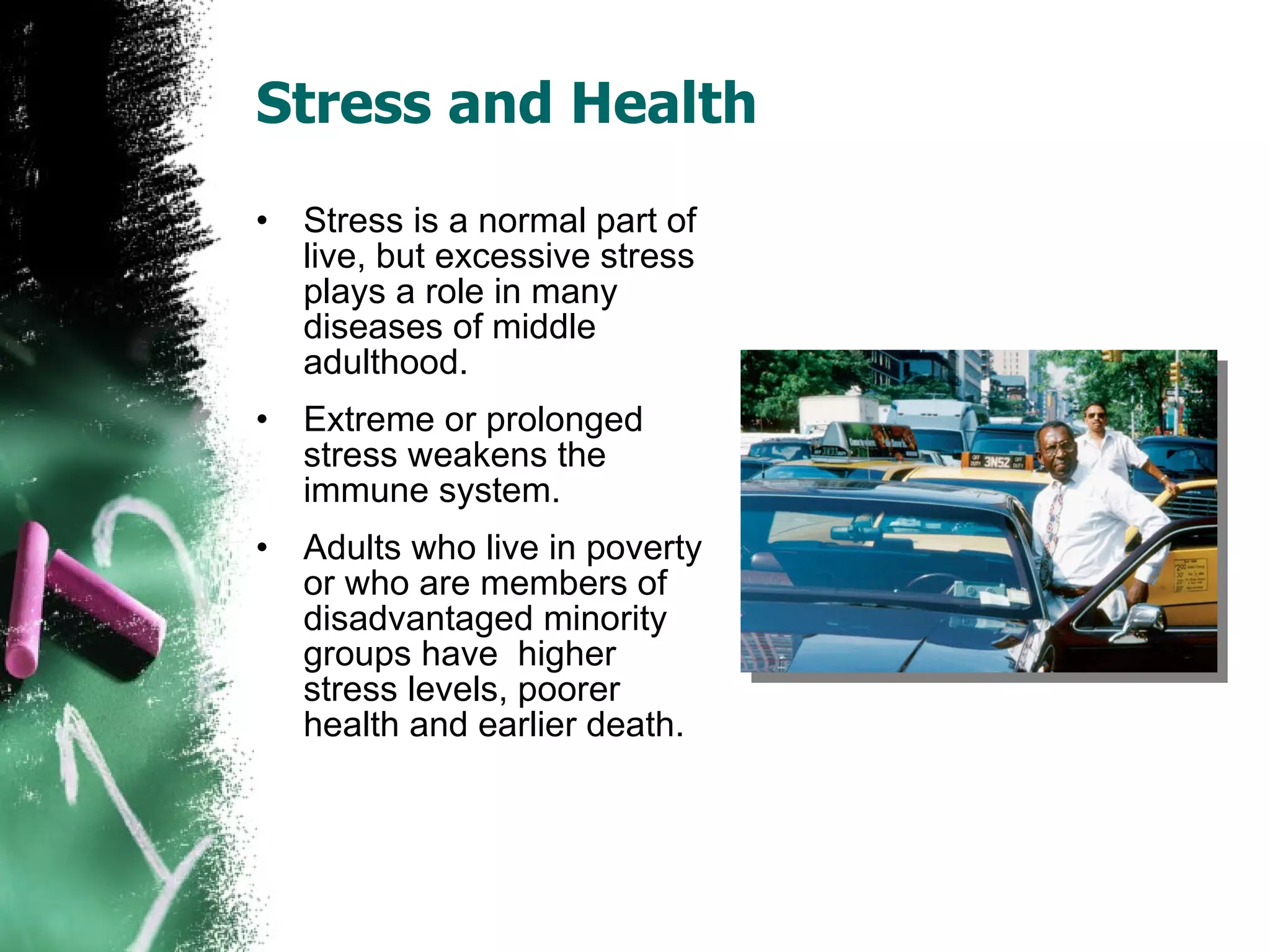
Stress and Health Stress is a normal part of live, but excessive stress plays a role in many diseases of middle adulthood. Extreme or prolonged stress weakens the immune system. Adults who live in poverty or who are members of disadvantaged minority groups have  higher stress levels, poorer health and earlier death.
Stress Scale for  Selected Life Events Highly stressful Death of a spouse Divorce Marital separation Jail term Death of a close family member Moderately stressful Pregancy Death of a close friend Change to different line of work Change in work responsibility Son or daughter leaving home Mildly stressful Change in social activities Change in sleeping habits Change in eating habits Vacations Monor violation of the law
Disease and Health Low-income and minority adults are more likely to have poor health habits less access to health care lower levels of educational attainment All of these factors are linked to higher rates of chronic disease and early death.
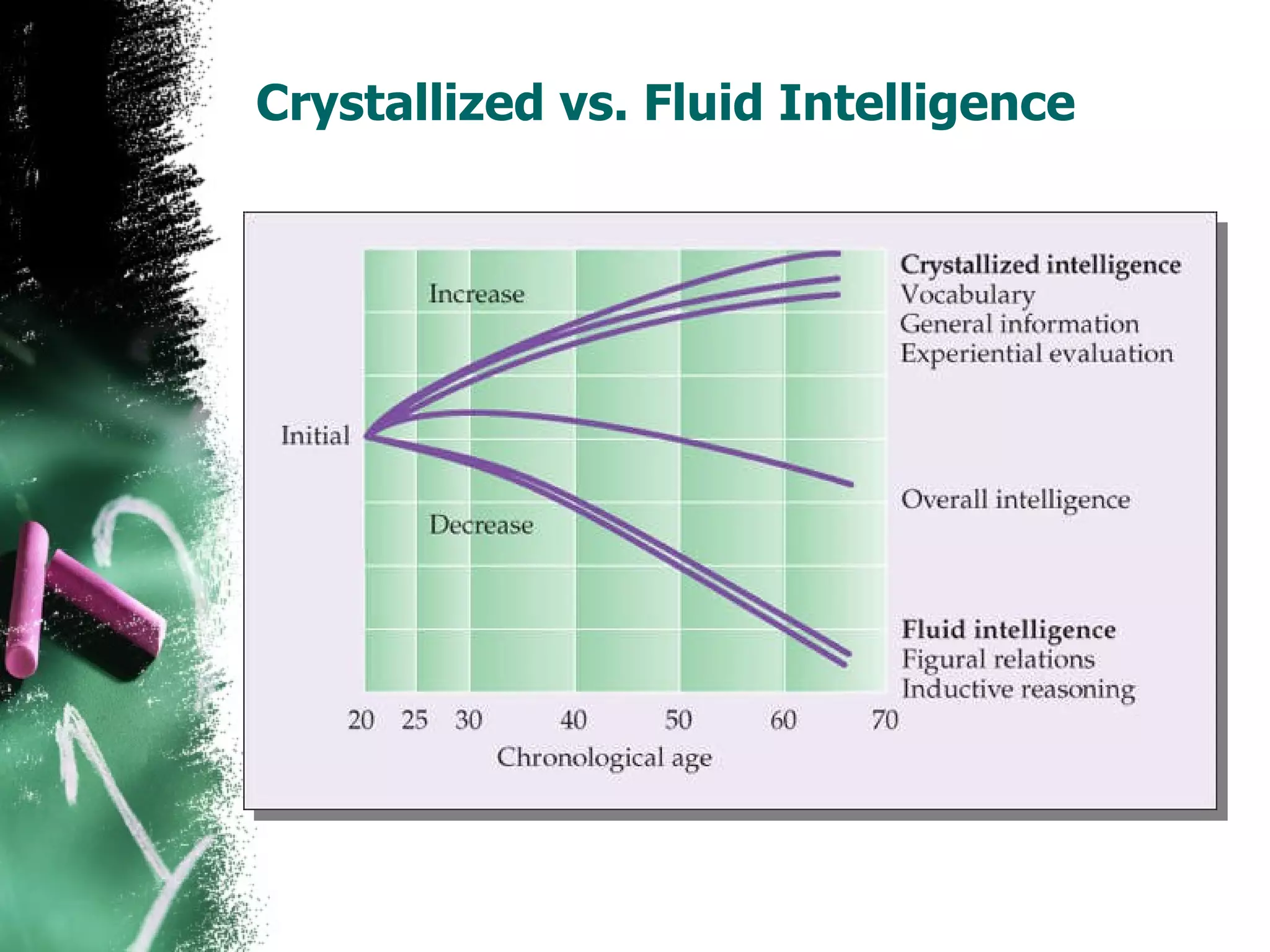
Cognitive Continuity and Change Cognitive function declines with age, though in middle adulthood it is not serious nor universal. Fluid vs. Crystallized Intelligence Fluid – abilities involved in acquiring new knowledge and skills Crystallized – cognitive pragmatics, accumulated knowledge Generally speaking, over time, fluid intelligence decreases and crystallized intelligence increases.
Crystallized vs. Fluid Intelligence
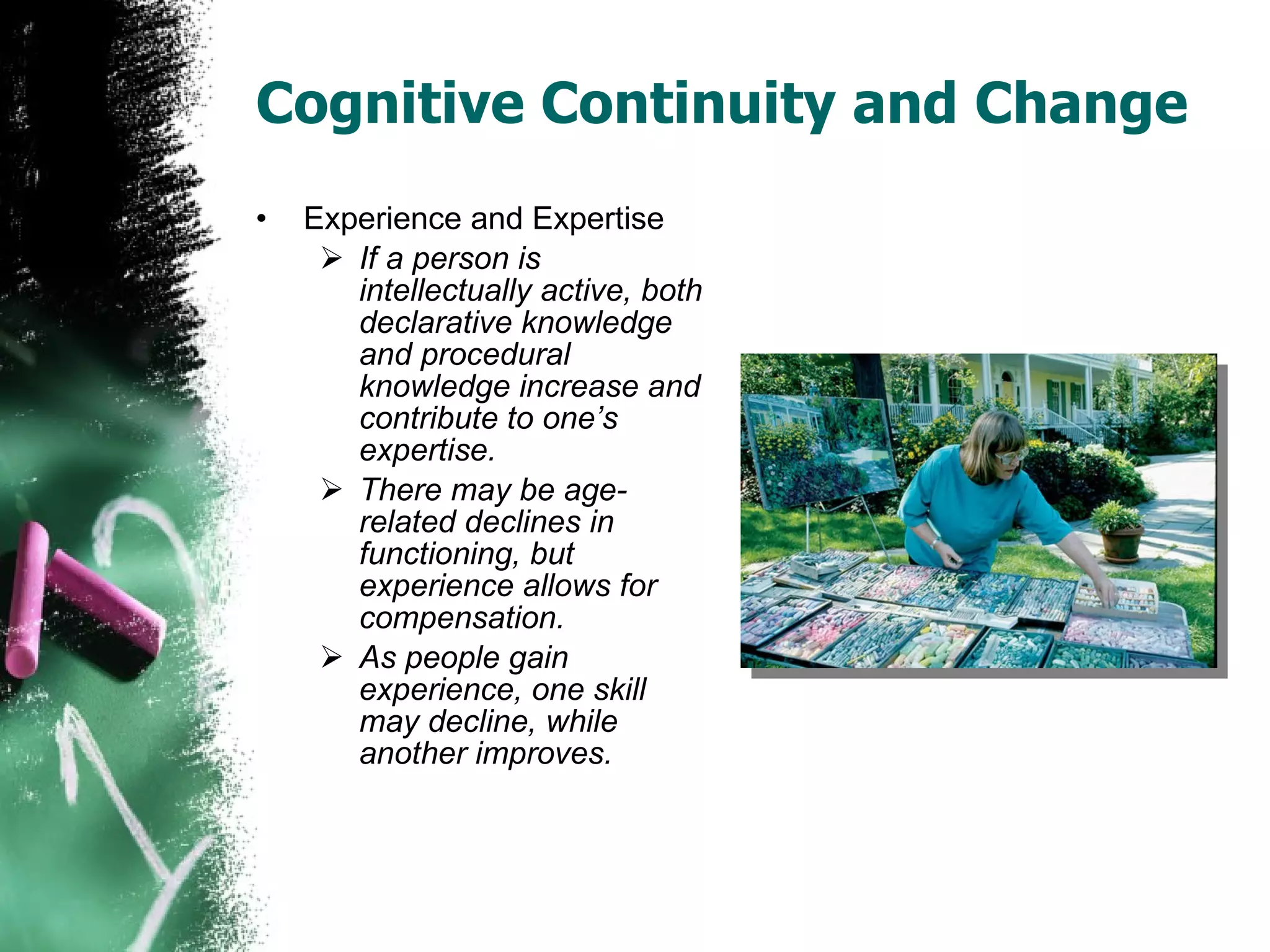
Cognitive Continuity and Change Experience and Expertise If a person is intellectually active, both declarative knowledge and procedural knowledge increase and contribute to one’s expertise. There may be age-related declines in functioning, but experience allows for compensation. As people gain experience, one skill may decline, while another improves.
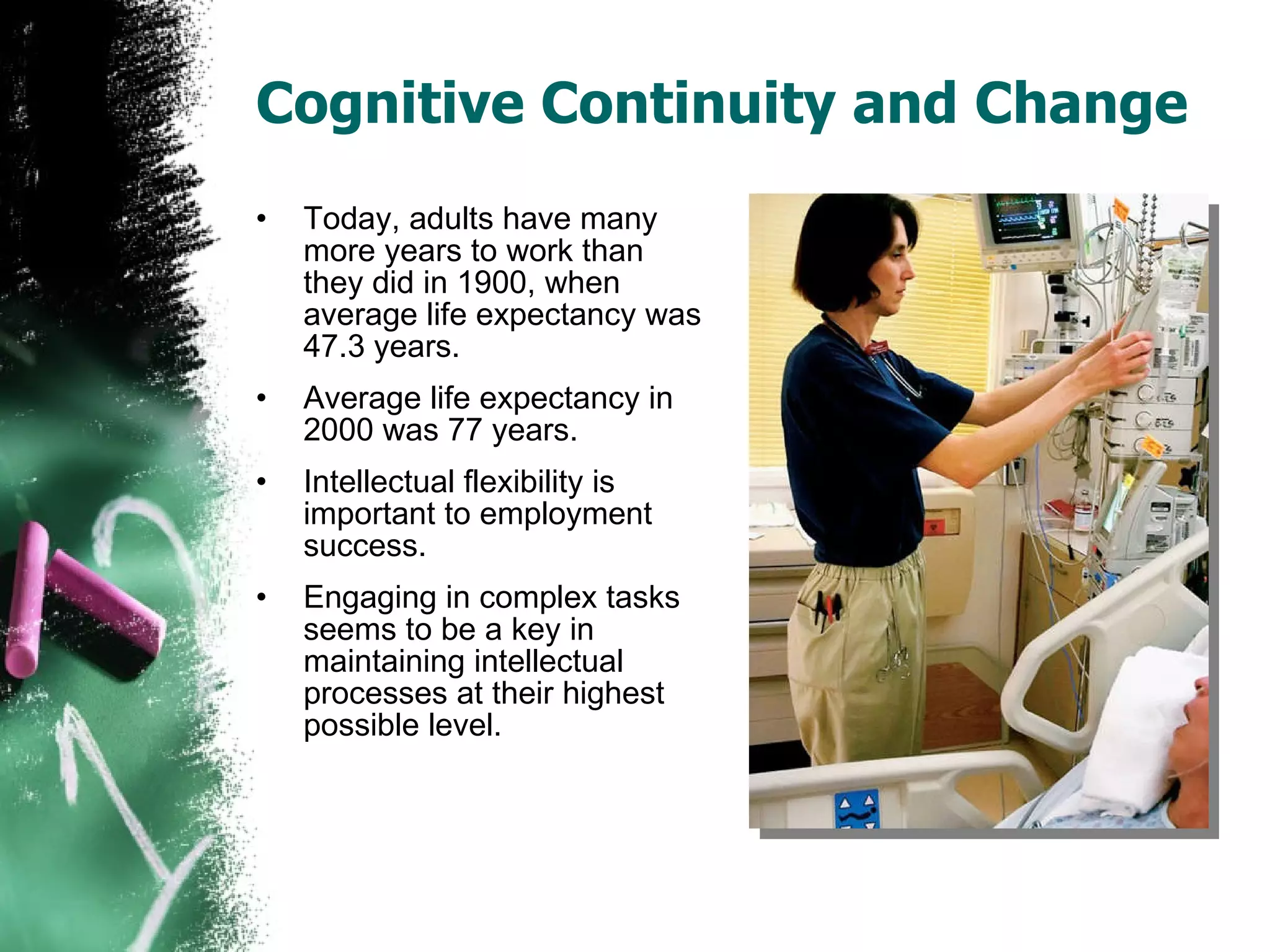
Cognitive Continuity and Change Today, adults have many more years to work than they did in 1900, when average life expectancy was 47.3 years. Average life expectancy in 2000 was 77 years. Intellectual flexibility is important to employment success. Engaging in complex tasks seems to be a key in maintaining intellectual processes at their highest possible level.
Summary Middle adulthood constitutes a substantial portion of a person’s normal life span. This is the age of peak production.  Some adults experience a midlife crisis, but not all do. The most obvious changes during this period are physical ones. Physical abilities begin to decline around the age of 50 Women experience menopause; men may face impotence, and the frequency of sexual activity declines.
Summary Most death during this stage is from cancer and heart-attacks.  Women are generally healthier than men. Poor health habits begin to take their toll here, with smoking, obesity, and exessive alcohol consumption being the three leading preventable causes of death. Some adults at this stage experience excessive stress due to life events. Cognitive functioning may decline, but age may bring with it expert knowledge.
Summary The average life expectancy today is 77 years, increasing the time adults are on the job. Intellectual flexibility is becoming more important in this age of technology. Engaging in complex tasks will help adults maintain a  high level of intellectual functioning.
Middle Adulthood Personality and Sociocultural Development
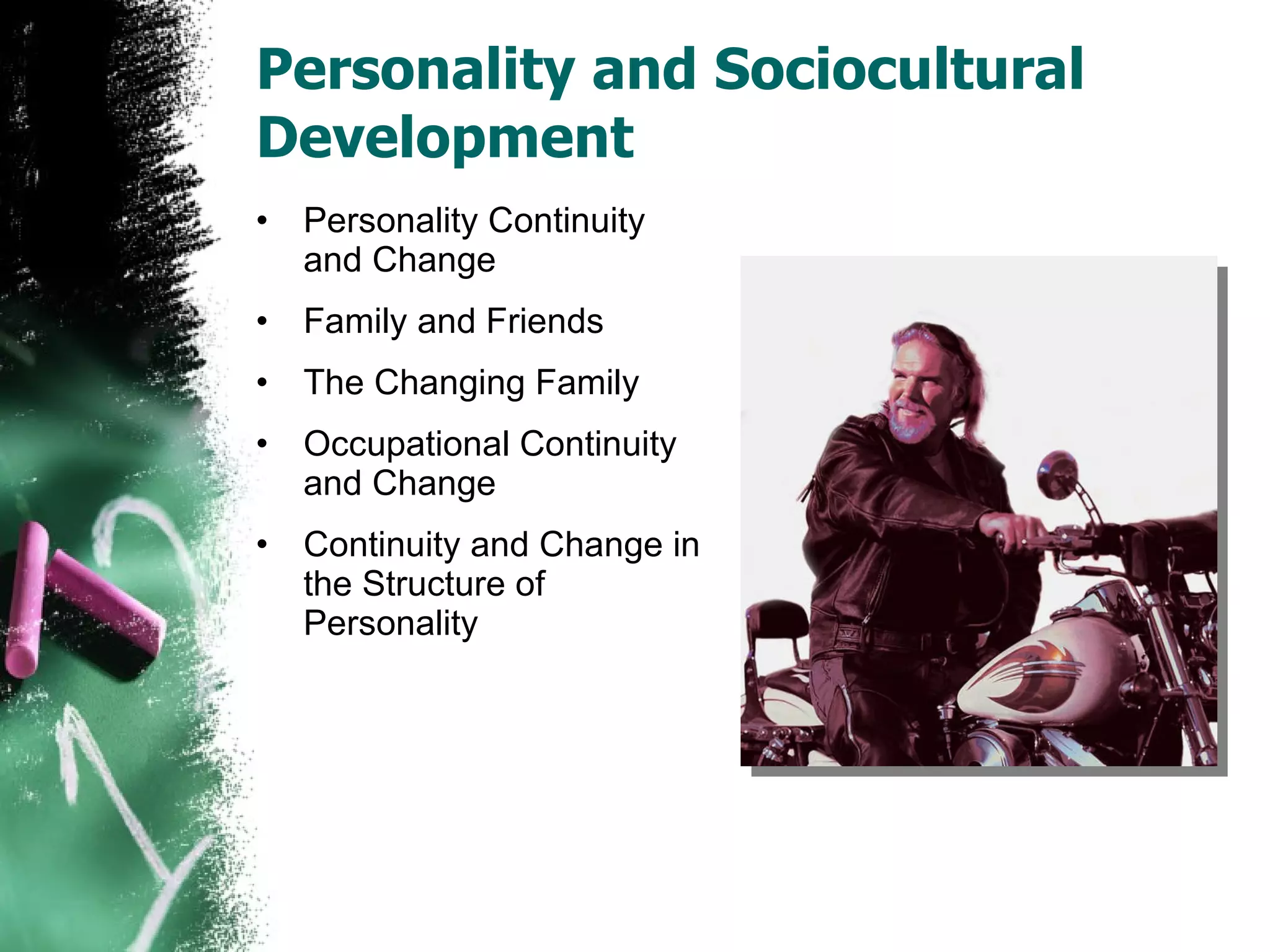
Personality and Sociocultural Development Personality Continuity and Change Family and Friends The Changing Family Occupational Continuity and Change Continuity and Change in the Structure of Personality
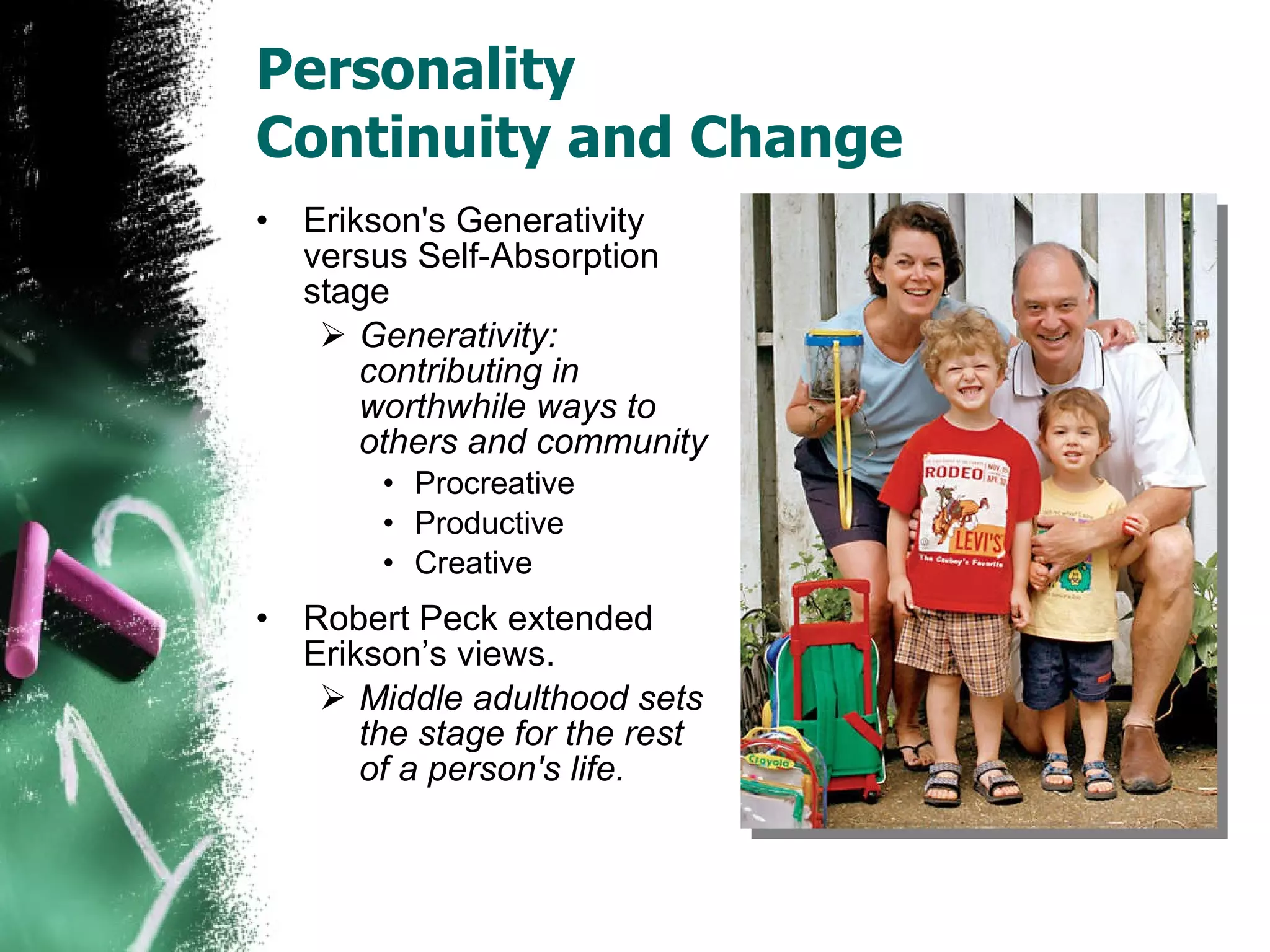
Personality  Continuity and Change Erikson's Generativity versus Self-Absorption stage Generativity: contributing in worthwhile ways to others and community  Procreative Productive Creative Robert Peck extended Erikson’s views. Middle adulthood sets the stage for the rest of a person's life.
Peck’s Issues of Adult Development Middle Adulthood valuing wisdom versus physical powers socializing versus sexualizing in human relationships emotional flexibility versus cathectic impoverishment mental flexibility versus mental rigidity Older Adulthood ego differentiation versus work-role preoccupation body transcendence versus body preoccupation ego transcendence versus ego preoccupation
Personal Reactions to Middle Adulthood Men and women have different experiences, but they share some patterns of middle adulthood development. Men traditionally focus on work, but family is also important. For women, family is more significant than work, but they have to balance the needs of work and family. Men and women experience role strain and role conflict  from overload of demands within a given role. Men and women may reassess their lives at midlife and shift their attention to other goals and choices.
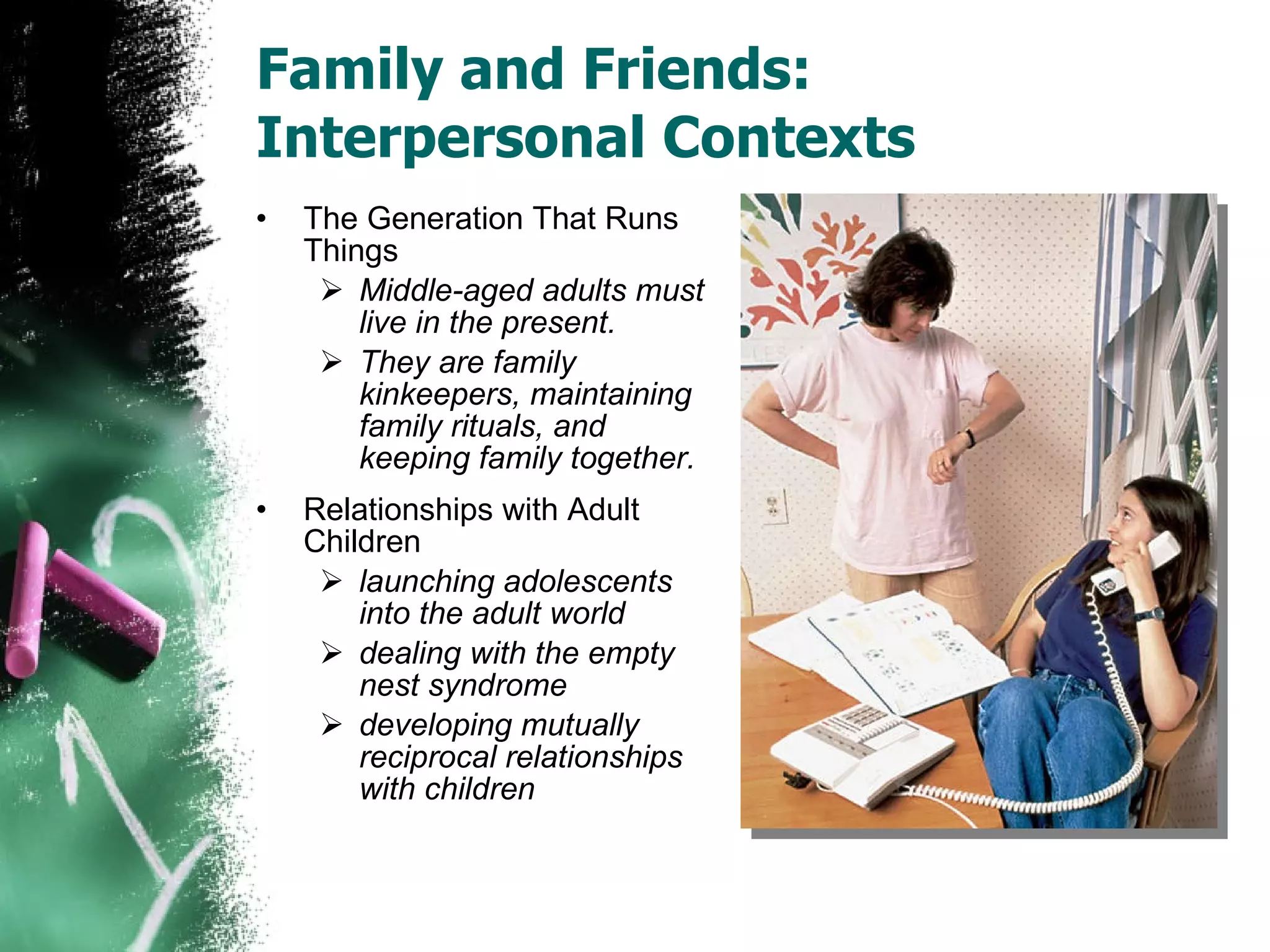
Family and Friends: Interpersonal Contexts The Generation That Runs Things Middle-aged adults must live in the present. They are family kinkeepers, maintaining family rituals, and keeping family together. Relationships with Adult Children launching adolescents into the adult world dealing with the empty nest syndrome developing mutually reciprocal relationships with children
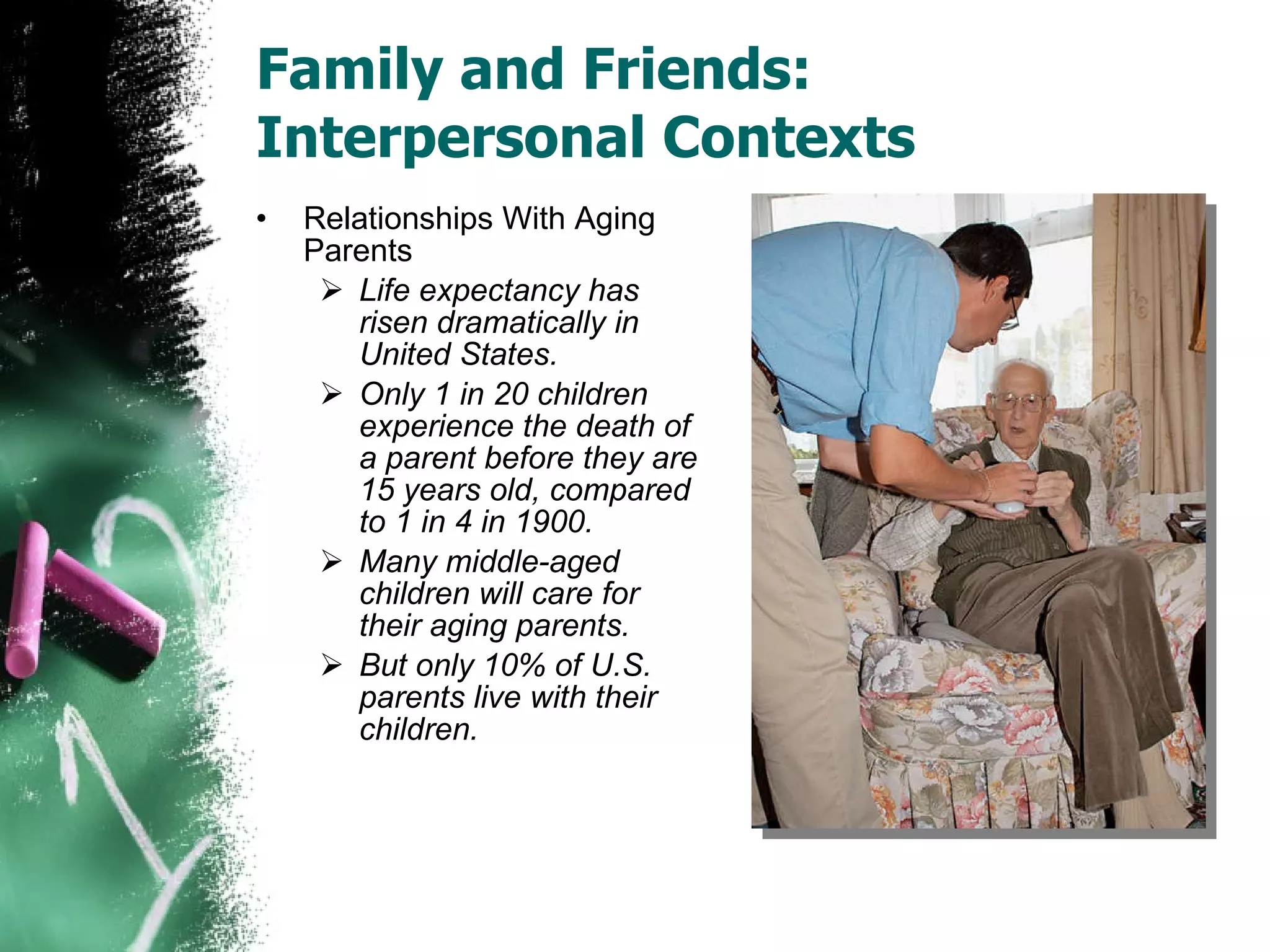
Family and Friends: Interpersonal Contexts Relationships With Aging Parents Life expectancy has risen dramatically in United States. Only 1 in 20 children experience the death of a parent before they are 15 years old, compared to 1 in 4 in 1900. Many middle-aged children will care for their aging parents. But only 10% of U.S. parents live with their children.
Life Expectancy for  U.S. Men and Women 1900 Men: 46.3 Women: 48.3 1950 Men: 65.6 Women: 71.1 1975 Men: 68.8 Women: 76.6 2004 Men: 74.6 Women: 80.4
Relationship With Aging Parents Reciprocal Exchange of Assistance Role Reversals Daughters and daughters-in-law are the primary caregivers for aging adults. Caring for Elderly Parents Ten percent of aging adults live in nursing homes or other care facilities, the rest are cared for mainly in their homes.
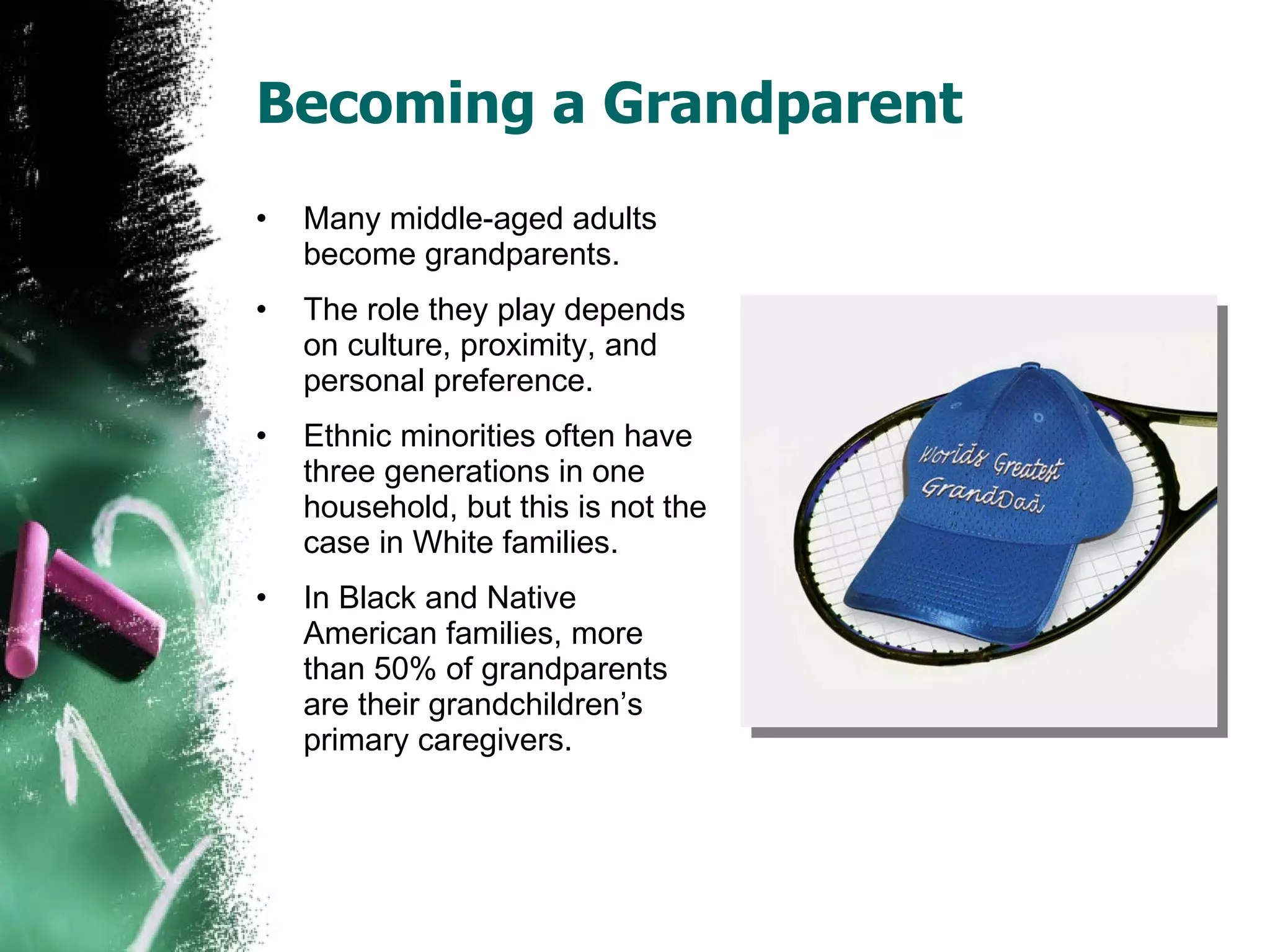
Becoming a Grandparent Many middle-aged adults become grandparents. The role they play depends on culture, proximity, and personal preference. Ethnic minorities often have three generations in one household, but this is not the case in White families. In Black and Native American families, more than 50% of grandparents are their grandchildren’s primary caregivers.
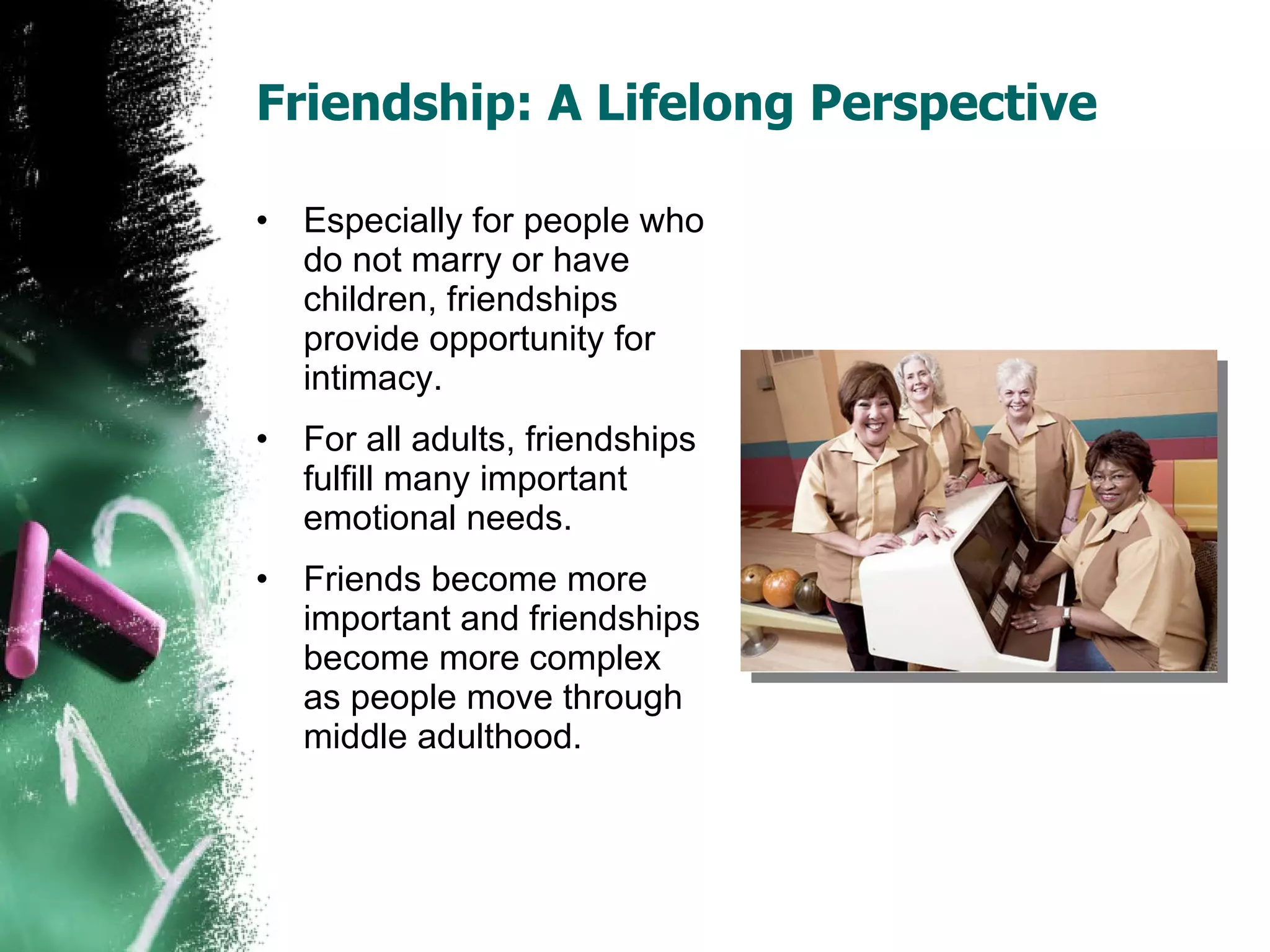
Friendship: A Lifelong Perspective Especially for people who do not marry or have children, friendships provide opportunity for intimacy. For all adults, friendships fulfill many important emotional needs. Friends become more important and friendships become more complex as people move through middle adulthood.
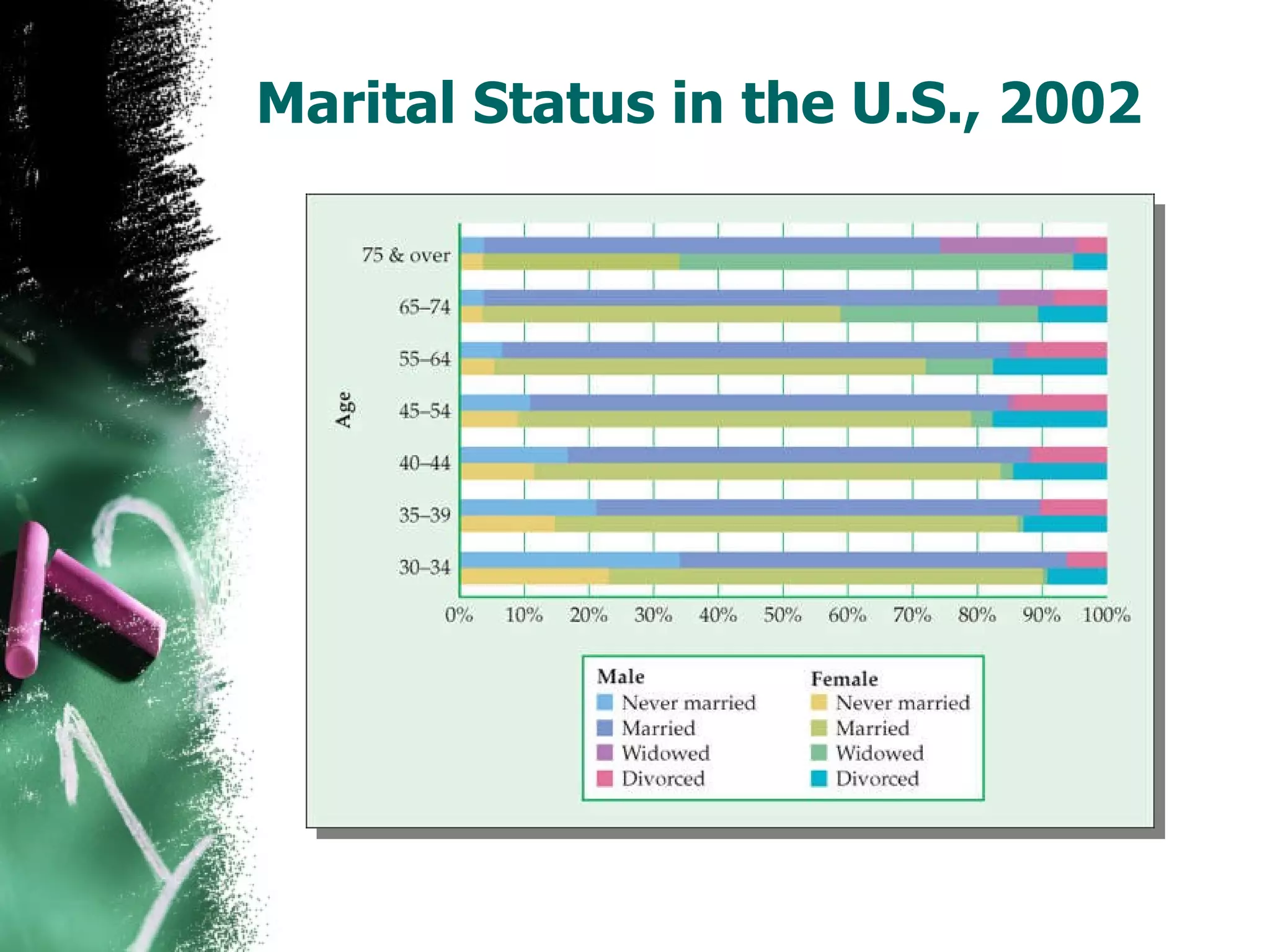
Marital Status in the U.S., 2002
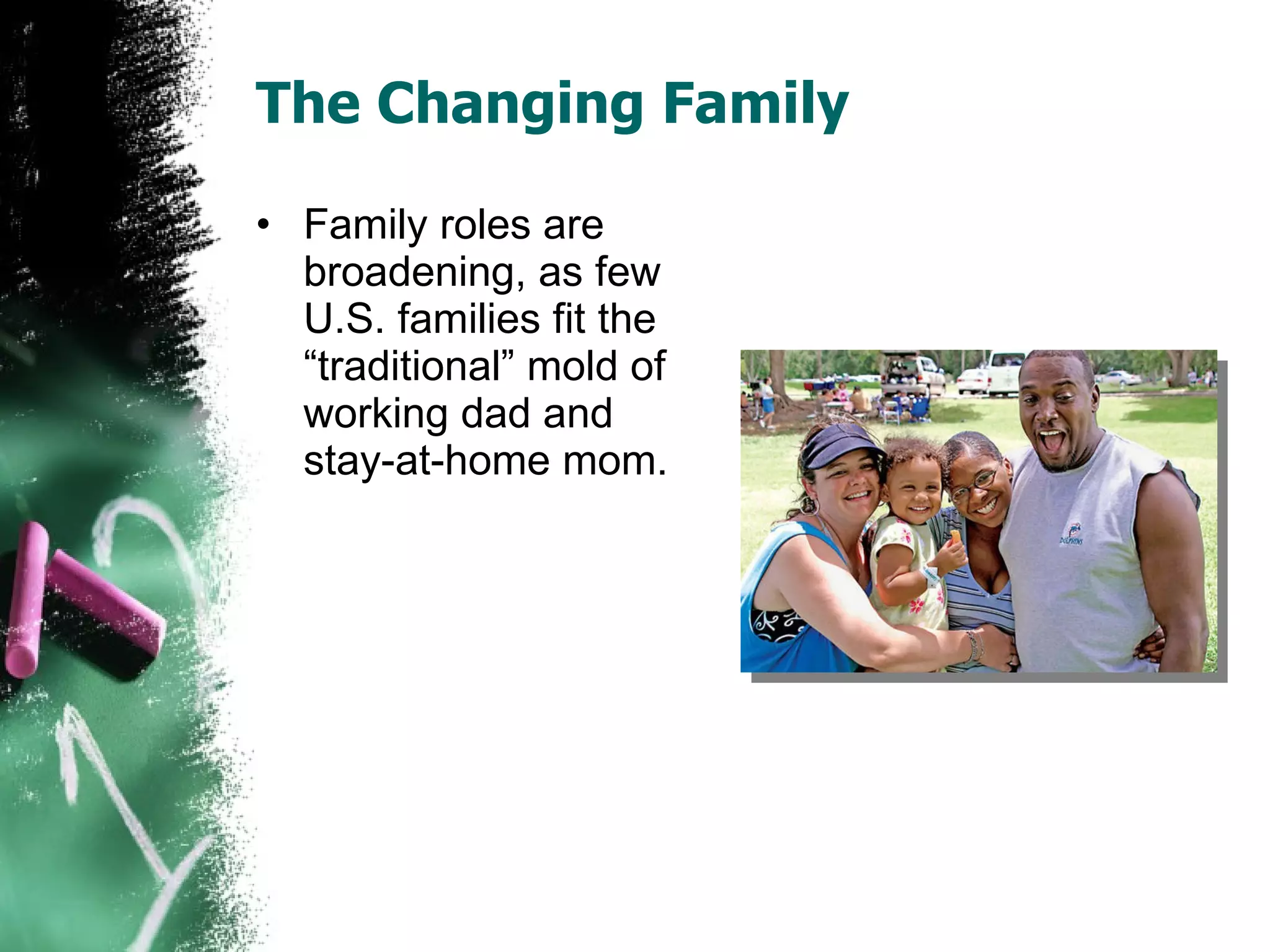
The Changing Family Family roles are broadening, as few U.S. families fit the “traditional” mold of working dad and stay-at-home mom.
Divorce and Remarriage Nearly 50% of all first marriages end in divorce. In 75% of marriages, however, at least one partner remarries. Divorced men are 3 times more likely to remarry than are divorced women. But 50% of remarriages end in divorce. Wives more often initiate the divorce. Recently divorced men and women experience higher rates of alcoholism, physical illness, and depression. Most people adjust to divorce within 2 to 3 years.
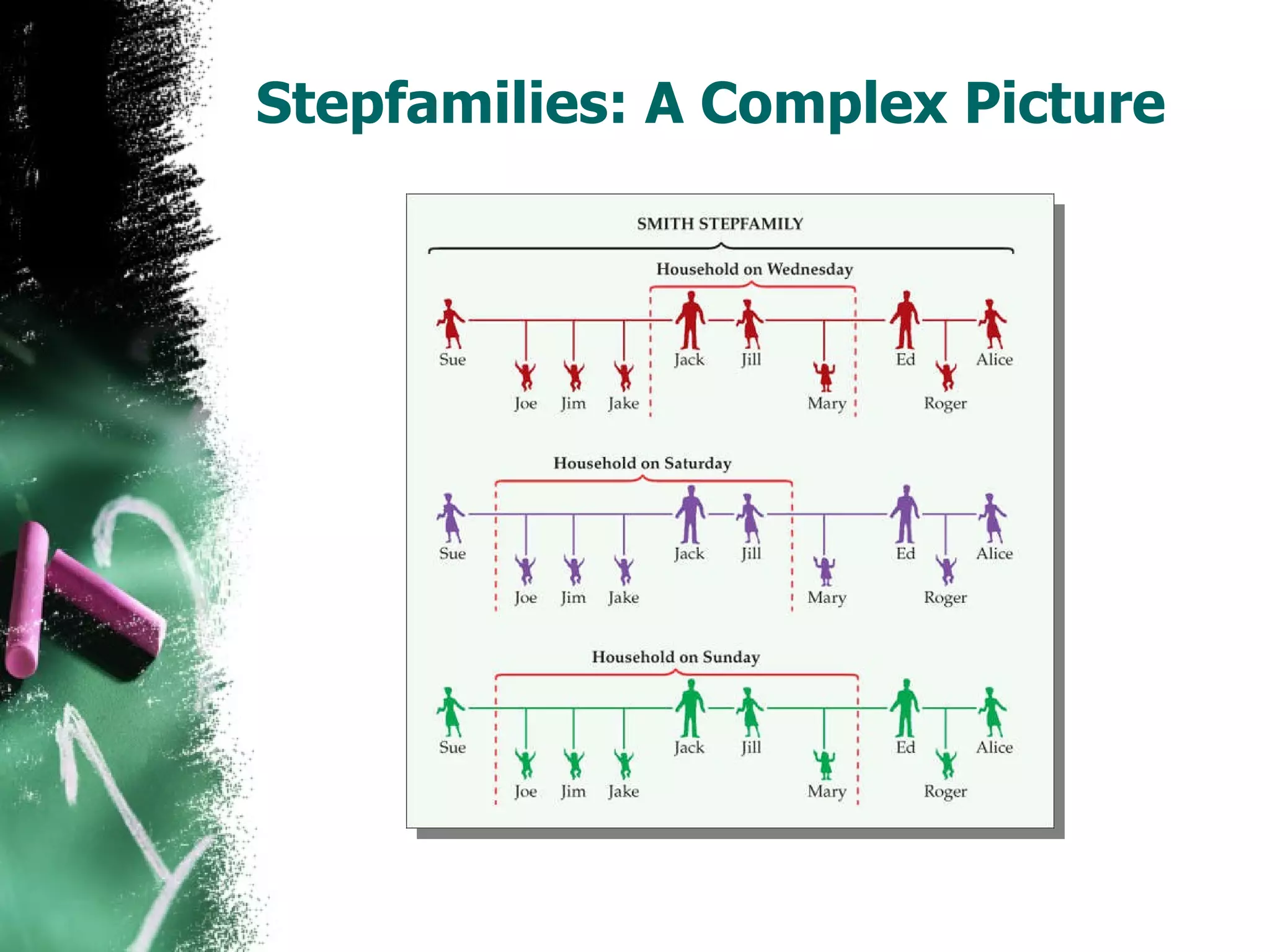
Divorce and Remarriage Reconstituted or blended families (stepfamilies) When parents remarry, family structures often become complex. For stepparents, discipline, gaining stepchildren’s acceptance, and adjusting to their habits is difficult. Stepmothers often have more difficulty than do stepfathers in making adjustment. Relationships between girls and stepfathers and between boys and stepmothers tend to be most difficult. For best results, the reconstituted family needs to create a new social unit.
Stepfamilies: A Complex Picture
Occupational  Continuity and Change Job Change and Stress Job loss, either through choice, or being fired or laid off, is more difficult for middle-aged adults than for young adults. Job burnout, characterized by emotional exhaustion due to working in high-stress professions, is prevalent among the helping professions. People now live and work longer, and social expectations about work are more flexible.
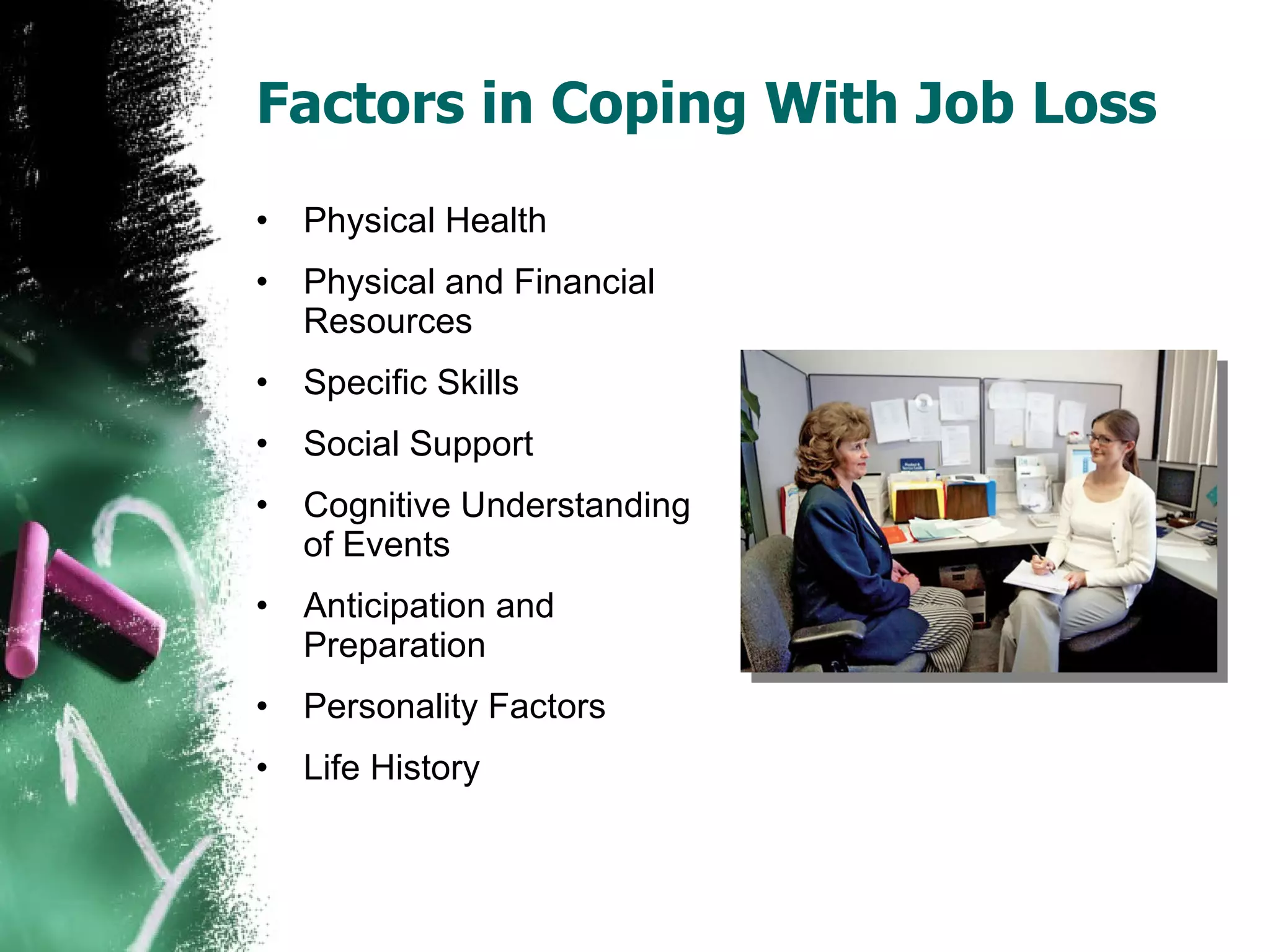
Factors in Coping With Job Loss Physical Health Physical and Financial Resources Specific Skills Social Support Cognitive Understanding of Events Anticipation and Preparation Personality Factors Life History
Continuity and Change in Personality Structure The Five Factor Model provides a useful vocabulary to describe how personality might change across the lifespan consists of five traits (see next slide) Stability or Change? For many, basic personality is established by age of 30 and is relatively stable.  Some people experience key life events that can change personality. Agreeableness and conscientiousness increase through adulthood. Emotional stability increases more for women than it does for men. Personality can be shaped by life events.
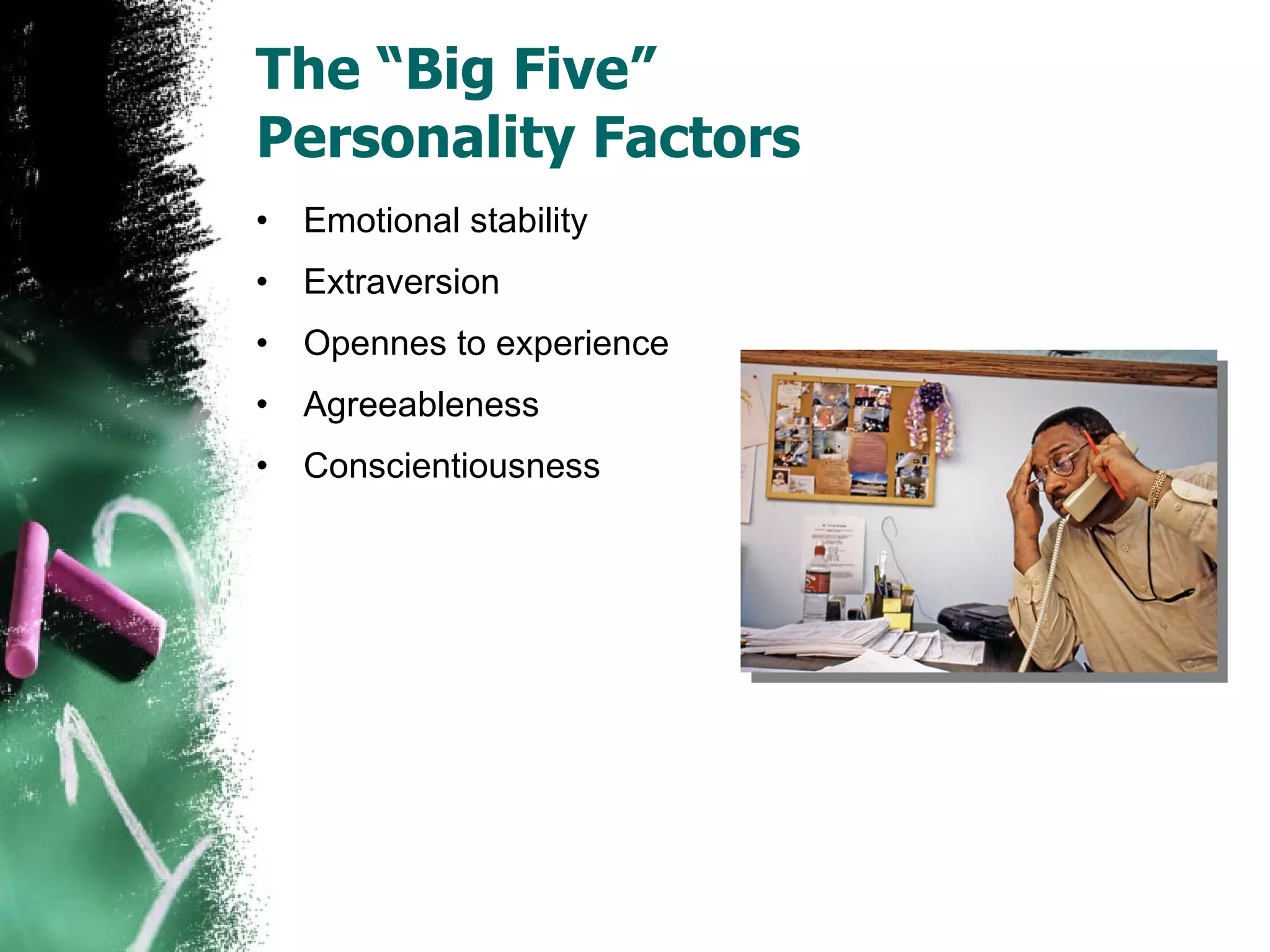
The “Big Five”  Personality Factors Emotional stability Extraversion Opennes to experience Agreeableness Conscientiousness
Summary Personality and sociocultural development in middle adulthood focuses on interpersonal relationshps and work. Change is a constant of middle adulthood, including children leaving home and retirement. Erikson saw the task of middle adulthood as one of generativity versus self-absorption. Peck argued that adults face seven major issues of conflict and middle adulthood sets the stage for the rest of one’s life. Men and women may reassess their lives at midlife and may shift their attention to other goals and choices.
Summary Interpersonal relationships are crucial during middle adulthood. Children leave home, and parents may experience the empty nest syndrome. But children may come back home to live and that creates its own problems. Many middle-age adults become grandparents, but they also may have to take care of their own parents.
Summary Since 50% of first marriages end in divorce, many middle-aged adults will divorce. Seventy-five percent of them will remarry. Compared to those who are single, married people are happier. Blended, or stepfamiles, can create emotional and financial challenges. Many of today’s adults will have several jobs. Career reassessment during middle adulthood is becoming more common.
Summary For most people, personality is established by age 30 and is relatively stable throughout adulthood. However, key life events may affect personality traits. Agreeableness and conscientiousness increase through adulthood, as does emotional stability.

14 Middle Adulthood

  • 1.
    Middle Adulthood Physicaland Cognitive Development PSYC290 Dr. Debi Smith Azusa Pacific University
  • 2.
    Physical and CognitiveDevelopment Development in Middle Adulthood Physical Continuity and Change Disease and Health Cognitive Continuity and Change
  • 3.
    Development in Middle Adulthood Middle adulthood is usually defined as the ages of 40 to 60 or 65. People enter at different ages, depending on different cues: social and family status physical and biological status psychological state job or career path economic and historical events
  • 4.
    Development in Middle Adulthood Prime Time or the Beginning of the End? Most adults are at their peak productivity during middle age. They are the command generation, making policy decisions that affect us all. For some, of course, middle age is a time of ambivalence.
  • 5.
    Development in MiddleAge Midlife Crisis: Is It Real? The crisis model of Levinson argues that men experience midlife crisis between the ages of 40 and 45. The transition model rejects the idea that midlife crisis is the norm. Crises are event-related, not age-related, this theory maintains. Most adults do not experience a midlife crisis, but people do adapt to being middle-aged in different ways.
  • 6.
    Physical Continuity andChange The most obvious changes associated with middle years are physical. Physical abilities peak in early adulthood. Changes in capabilities include: sensation motor skills and reaction time internal changes
  • 7.
    Physical Changes TheClimacteric Men and women experience physical and emotional changes that are related to hormonal changes. In women, the most dramatic aspect is menopause. Menopause involves: physical changes and symptoms and emotion effects
  • 8.
    Physical Changes Menopausetypically occurs between ages of 45 and 55. Some women take hormone replacement therapy (HRT). Male hormones decline gradually in middle age and some men experience decreased sexual desire. Men may suffer erectile dysfunction.
  • 9.
    Physical Changes Frequencyof sexual activity declines, time for orgasm increases for men and women. Sexual partners place more emphasis on sensuality.
  • 10.
    Disease and HealthAs people age, they become more vulnerable to disease. Most deaths in middle age are from cancer and heart attacks. Women are generally more healthy than men. People who are better educated are also healthier. Longevity is related to good health habits. Poor habits—especially smoking and over eating—take their toll in middle age.
  • 11.
    Gender Differences inMajor Causes of U.S. Deaths (45-64)
  • 12.
    Major Causes ofU.S. Deaths (Adults, 45-64)
  • 13.
    Death Rates (25-64)From All Causes, w/Educational Level
  • 14.
    Smoking and ObesityAbout 25% of adults smoke. Smoking is responsible for more than 25% of all deaths among people ages 35 to 64. Today, 65% of U.S. adults are overweight or obese, a 55% increase since the 1976–1980 period.
  • 15.
    Stress and HealthStress is a normal part of live, but excessive stress plays a role in many diseases of middle adulthood. Extreme or prolonged stress weakens the immune system. Adults who live in poverty or who are members of disadvantaged minority groups have higher stress levels, poorer health and earlier death.
  • 16.
    Stress Scale for Selected Life Events Highly stressful Death of a spouse Divorce Marital separation Jail term Death of a close family member Moderately stressful Pregancy Death of a close friend Change to different line of work Change in work responsibility Son or daughter leaving home Mildly stressful Change in social activities Change in sleeping habits Change in eating habits Vacations Monor violation of the law
  • 17.
    Disease and HealthLow-income and minority adults are more likely to have poor health habits less access to health care lower levels of educational attainment All of these factors are linked to higher rates of chronic disease and early death.
  • 18.
    Cognitive Continuity andChange Cognitive function declines with age, though in middle adulthood it is not serious nor universal. Fluid vs. Crystallized Intelligence Fluid – abilities involved in acquiring new knowledge and skills Crystallized – cognitive pragmatics, accumulated knowledge Generally speaking, over time, fluid intelligence decreases and crystallized intelligence increases.
  • 19.
  • 20.
    Cognitive Continuity andChange Experience and Expertise If a person is intellectually active, both declarative knowledge and procedural knowledge increase and contribute to one’s expertise. There may be age-related declines in functioning, but experience allows for compensation. As people gain experience, one skill may decline, while another improves.
  • 21.
    Cognitive Continuity andChange Today, adults have many more years to work than they did in 1900, when average life expectancy was 47.3 years. Average life expectancy in 2000 was 77 years. Intellectual flexibility is important to employment success. Engaging in complex tasks seems to be a key in maintaining intellectual processes at their highest possible level.
  • 22.
    Summary Middle adulthoodconstitutes a substantial portion of a person’s normal life span. This is the age of peak production. Some adults experience a midlife crisis, but not all do. The most obvious changes during this period are physical ones. Physical abilities begin to decline around the age of 50 Women experience menopause; men may face impotence, and the frequency of sexual activity declines.
  • 23.
    Summary Most deathduring this stage is from cancer and heart-attacks. Women are generally healthier than men. Poor health habits begin to take their toll here, with smoking, obesity, and exessive alcohol consumption being the three leading preventable causes of death. Some adults at this stage experience excessive stress due to life events. Cognitive functioning may decline, but age may bring with it expert knowledge.
  • 24.
    Summary The averagelife expectancy today is 77 years, increasing the time adults are on the job. Intellectual flexibility is becoming more important in this age of technology. Engaging in complex tasks will help adults maintain a high level of intellectual functioning.
  • 25.
    Middle Adulthood Personalityand Sociocultural Development
  • 26.
    Personality and SocioculturalDevelopment Personality Continuity and Change Family and Friends The Changing Family Occupational Continuity and Change Continuity and Change in the Structure of Personality
  • 27.
    Personality Continuityand Change Erikson's Generativity versus Self-Absorption stage Generativity: contributing in worthwhile ways to others and community Procreative Productive Creative Robert Peck extended Erikson’s views. Middle adulthood sets the stage for the rest of a person's life.
  • 28.
    Peck’s Issues ofAdult Development Middle Adulthood valuing wisdom versus physical powers socializing versus sexualizing in human relationships emotional flexibility versus cathectic impoverishment mental flexibility versus mental rigidity Older Adulthood ego differentiation versus work-role preoccupation body transcendence versus body preoccupation ego transcendence versus ego preoccupation
  • 29.
    Personal Reactions toMiddle Adulthood Men and women have different experiences, but they share some patterns of middle adulthood development. Men traditionally focus on work, but family is also important. For women, family is more significant than work, but they have to balance the needs of work and family. Men and women experience role strain and role conflict from overload of demands within a given role. Men and women may reassess their lives at midlife and shift their attention to other goals and choices.
  • 30.
    Family and Friends:Interpersonal Contexts The Generation That Runs Things Middle-aged adults must live in the present. They are family kinkeepers, maintaining family rituals, and keeping family together. Relationships with Adult Children launching adolescents into the adult world dealing with the empty nest syndrome developing mutually reciprocal relationships with children
  • 31.
    Family and Friends:Interpersonal Contexts Relationships With Aging Parents Life expectancy has risen dramatically in United States. Only 1 in 20 children experience the death of a parent before they are 15 years old, compared to 1 in 4 in 1900. Many middle-aged children will care for their aging parents. But only 10% of U.S. parents live with their children.
  • 32.
    Life Expectancy for U.S. Men and Women 1900 Men: 46.3 Women: 48.3 1950 Men: 65.6 Women: 71.1 1975 Men: 68.8 Women: 76.6 2004 Men: 74.6 Women: 80.4
  • 33.
    Relationship With AgingParents Reciprocal Exchange of Assistance Role Reversals Daughters and daughters-in-law are the primary caregivers for aging adults. Caring for Elderly Parents Ten percent of aging adults live in nursing homes or other care facilities, the rest are cared for mainly in their homes.
  • 34.
    Becoming a GrandparentMany middle-aged adults become grandparents. The role they play depends on culture, proximity, and personal preference. Ethnic minorities often have three generations in one household, but this is not the case in White families. In Black and Native American families, more than 50% of grandparents are their grandchildren’s primary caregivers.
  • 35.
    Friendship: A LifelongPerspective Especially for people who do not marry or have children, friendships provide opportunity for intimacy. For all adults, friendships fulfill many important emotional needs. Friends become more important and friendships become more complex as people move through middle adulthood.
  • 36.
    Marital Status inthe U.S., 2002
  • 37.
    The Changing FamilyFamily roles are broadening, as few U.S. families fit the “traditional” mold of working dad and stay-at-home mom.
  • 38.
    Divorce and RemarriageNearly 50% of all first marriages end in divorce. In 75% of marriages, however, at least one partner remarries. Divorced men are 3 times more likely to remarry than are divorced women. But 50% of remarriages end in divorce. Wives more often initiate the divorce. Recently divorced men and women experience higher rates of alcoholism, physical illness, and depression. Most people adjust to divorce within 2 to 3 years.
  • 39.
    Divorce and RemarriageReconstituted or blended families (stepfamilies) When parents remarry, family structures often become complex. For stepparents, discipline, gaining stepchildren’s acceptance, and adjusting to their habits is difficult. Stepmothers often have more difficulty than do stepfathers in making adjustment. Relationships between girls and stepfathers and between boys and stepmothers tend to be most difficult. For best results, the reconstituted family needs to create a new social unit.
  • 40.
  • 41.
    Occupational Continuityand Change Job Change and Stress Job loss, either through choice, or being fired or laid off, is more difficult for middle-aged adults than for young adults. Job burnout, characterized by emotional exhaustion due to working in high-stress professions, is prevalent among the helping professions. People now live and work longer, and social expectations about work are more flexible.
  • 42.
    Factors in CopingWith Job Loss Physical Health Physical and Financial Resources Specific Skills Social Support Cognitive Understanding of Events Anticipation and Preparation Personality Factors Life History
  • 43.
    Continuity and Changein Personality Structure The Five Factor Model provides a useful vocabulary to describe how personality might change across the lifespan consists of five traits (see next slide) Stability or Change? For many, basic personality is established by age of 30 and is relatively stable. Some people experience key life events that can change personality. Agreeableness and conscientiousness increase through adulthood. Emotional stability increases more for women than it does for men. Personality can be shaped by life events.
  • 44.
    The “Big Five” Personality Factors Emotional stability Extraversion Opennes to experience Agreeableness Conscientiousness
  • 45.
    Summary Personality andsociocultural development in middle adulthood focuses on interpersonal relationshps and work. Change is a constant of middle adulthood, including children leaving home and retirement. Erikson saw the task of middle adulthood as one of generativity versus self-absorption. Peck argued that adults face seven major issues of conflict and middle adulthood sets the stage for the rest of one’s life. Men and women may reassess their lives at midlife and may shift their attention to other goals and choices.
  • 46.
    Summary Interpersonal relationshipsare crucial during middle adulthood. Children leave home, and parents may experience the empty nest syndrome. But children may come back home to live and that creates its own problems. Many middle-age adults become grandparents, but they also may have to take care of their own parents.
  • 47.
    Summary Since 50%of first marriages end in divorce, many middle-aged adults will divorce. Seventy-five percent of them will remarry. Compared to those who are single, married people are happier. Blended, or stepfamiles, can create emotional and financial challenges. Many of today’s adults will have several jobs. Career reassessment during middle adulthood is becoming more common.
  • 48.
    Summary For mostpeople, personality is established by age 30 and is relatively stable throughout adulthood. However, key life events may affect personality traits. Agreeableness and conscientiousness increase through adulthood, as does emotional stability.