Nitrogen Cycle Term: Legume
www.sciencedaily.com/releases/2009/04/090414110818.htm Go to sciencedaily.com & search for soybeans & aphids Read the Article from April 20 th Are rhizobia specific to legume species Do naturally occurring rhizobia or commercially inoculated rhizobia provide better resistance? Does the source of the rhizobia influence the effectiveness of nitrogen fixation?
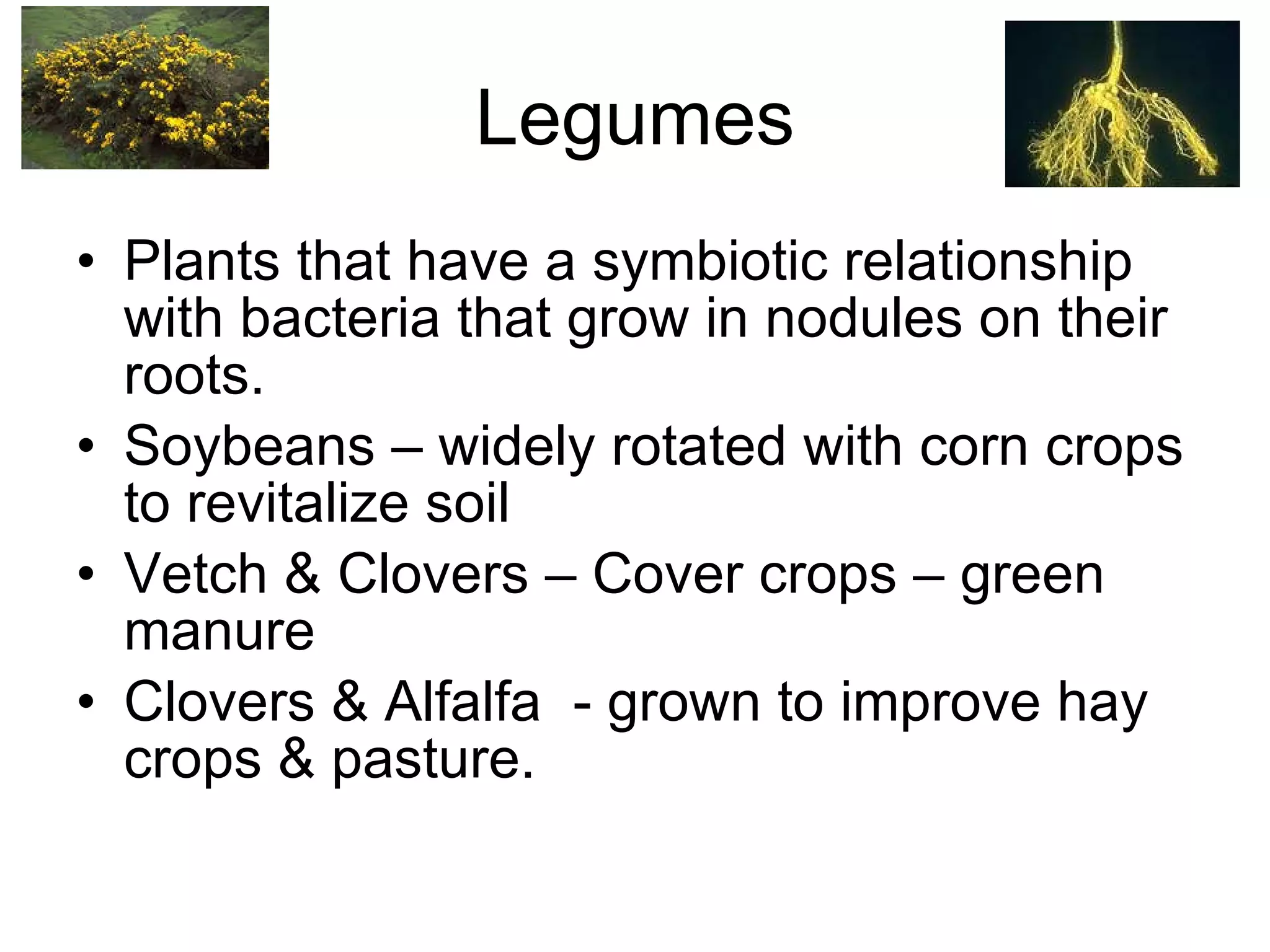
Legumes Plants that have a symbiotic relationship with bacteria that grow in nodules on their roots. Soybeans – widely rotated with corn crops to revitalize soil Vetch & Clovers – Cover crops – green manure Clovers & Alfalfa  - grown to improve hay crops & pasture.
Other Legumes Red bud trees Locust Trees Beans Peas Most plants that form Pods
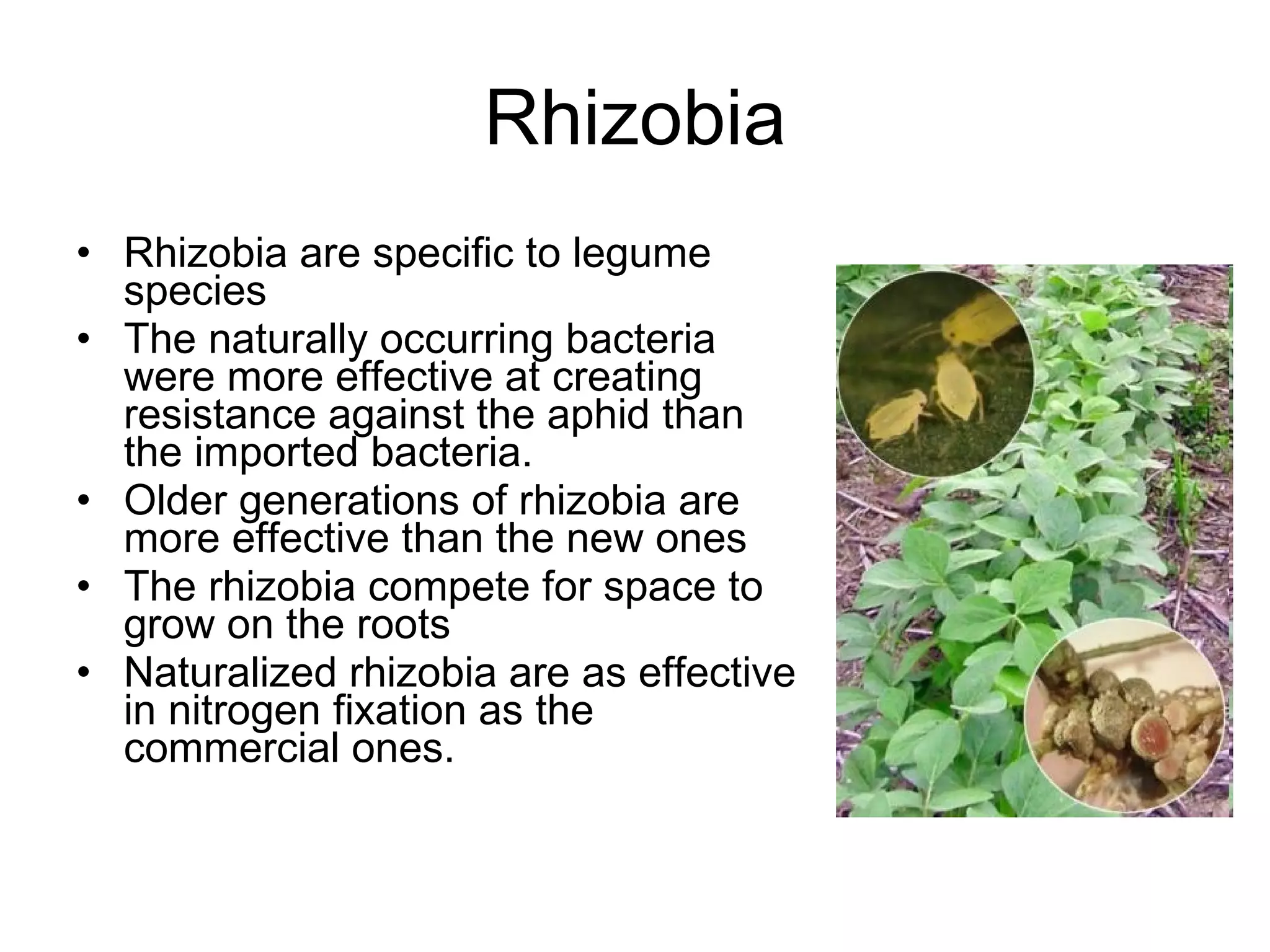
Rhizobia Rhizobia are specific to legume species The naturally occurring bacteria were more effective at creating resistance against the aphid than the imported bacteria. Older generations of rhizobia are more effective than the new ones The rhizobia compete for space to grow on the roots Naturalized rhizobia are as effective in nitrogen fixation as the commercial ones.
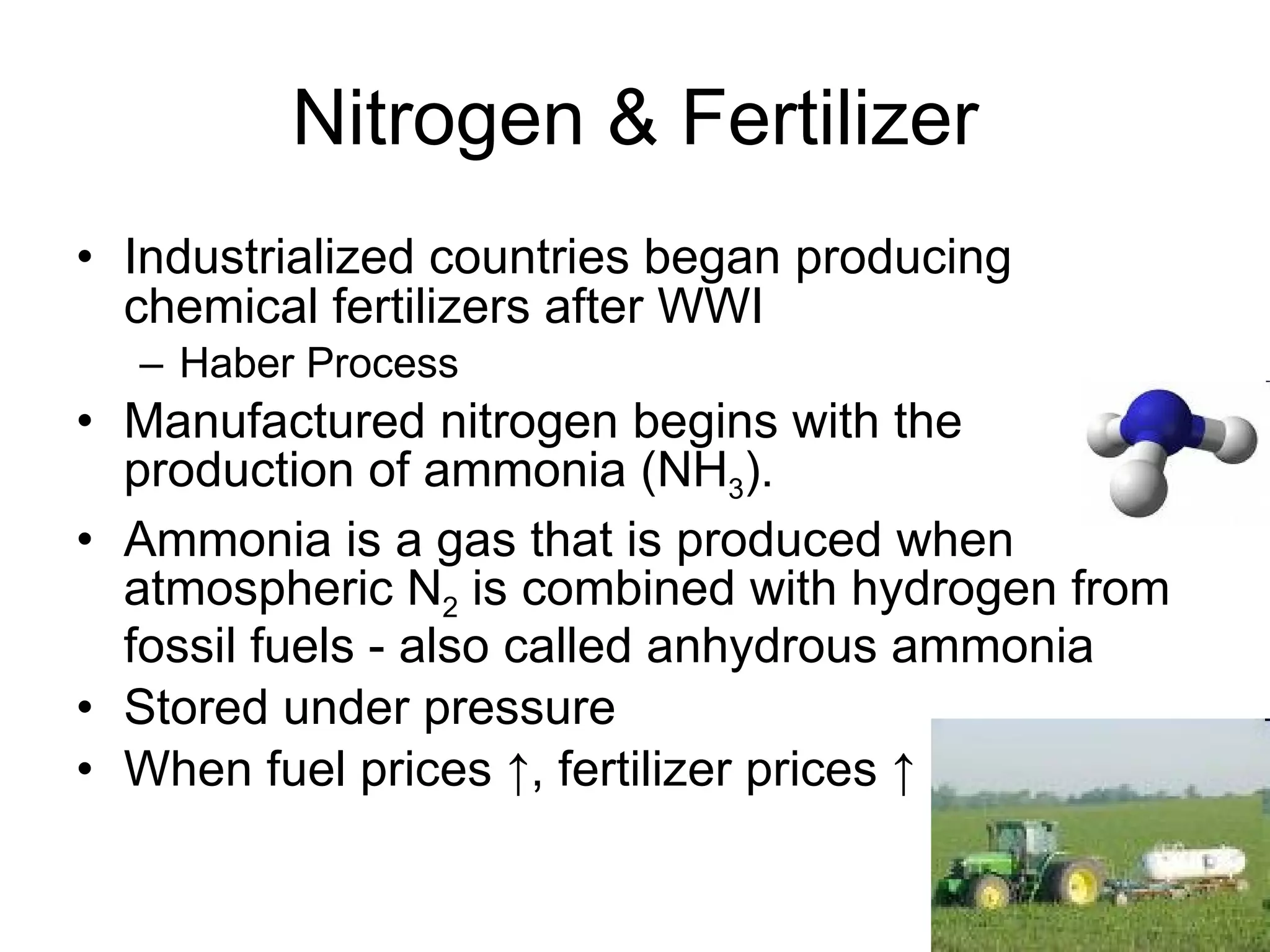
Nitrogen & Fertilizer Industrialized countries began producing chemical fertilizers after WWI Haber Process Manufactured nitrogen begins with the production of ammonia (NH 3 ). Ammonia is a gas that is produced when atmospheric N 2  is combined with hydrogen from fossil fuels - also called anhydrous ammonia Stored under pressure When fuel prices ↑, fertilizer prices ↑
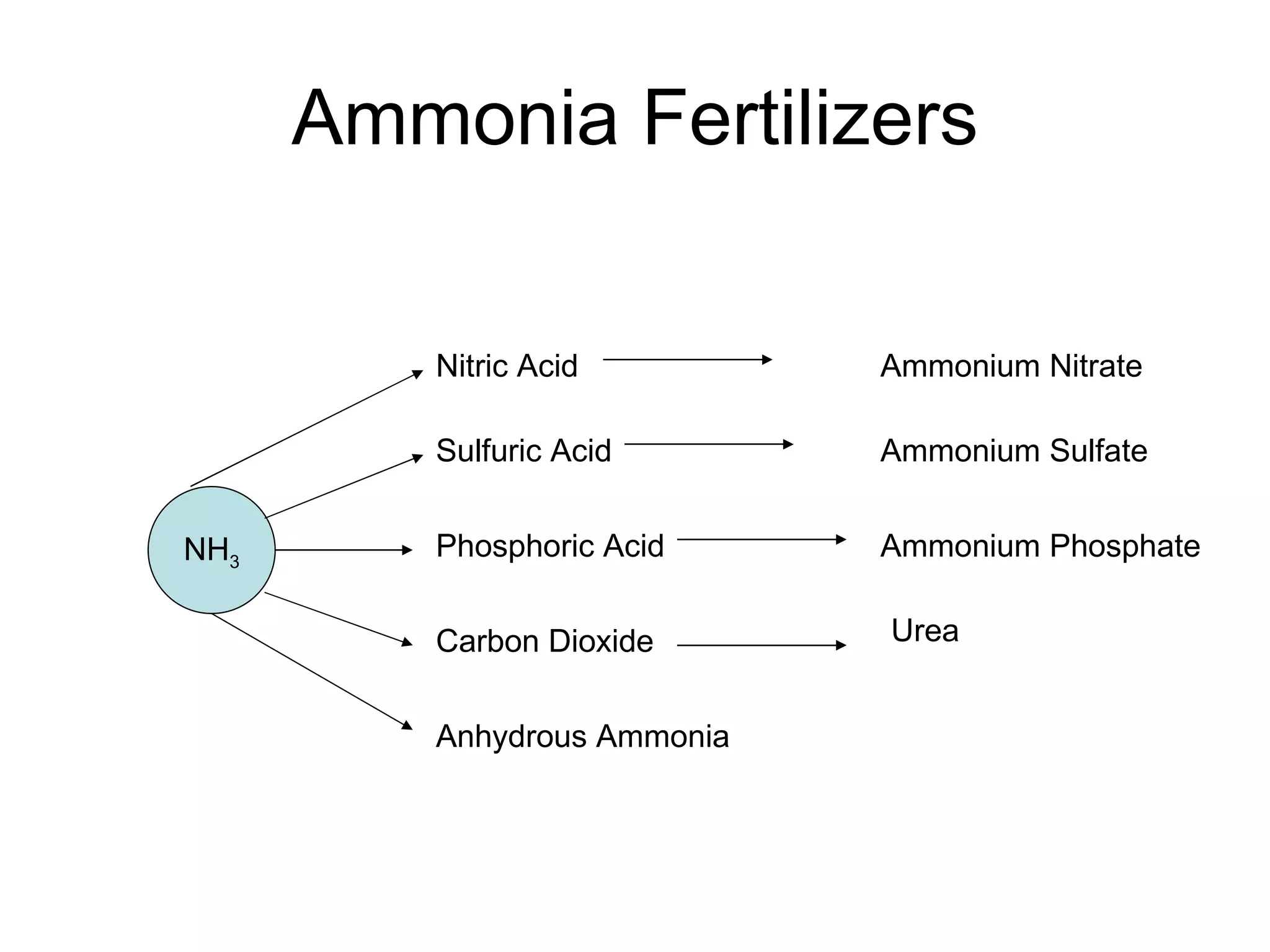
Ammonia Fertilizers NH 3 Nitric Acid Sulfuric Acid Phosphoric Acid Carbon Dioxide Anhydrous Ammonia Ammonium Nitrate Ammonium Sulfate Ammonium Phosphate Urea
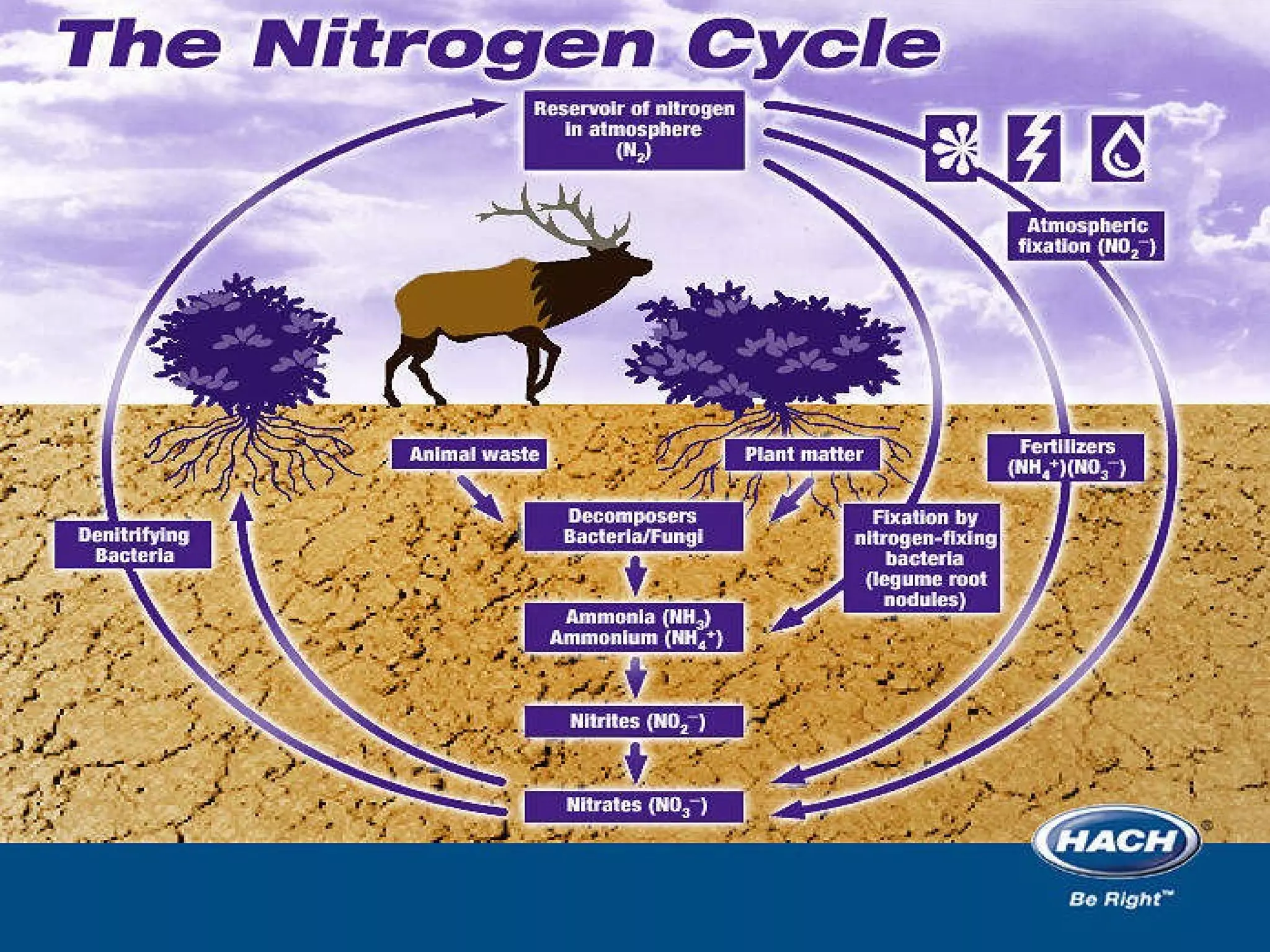
Nitrogen Fixation Conversion of Inert N 2  into bio-usable forms  atmospheric fixation  by lightning  biological fixation  by certain microbes alone symbiotic relationship with some plants and animals  industrial fixation –  Haber Process
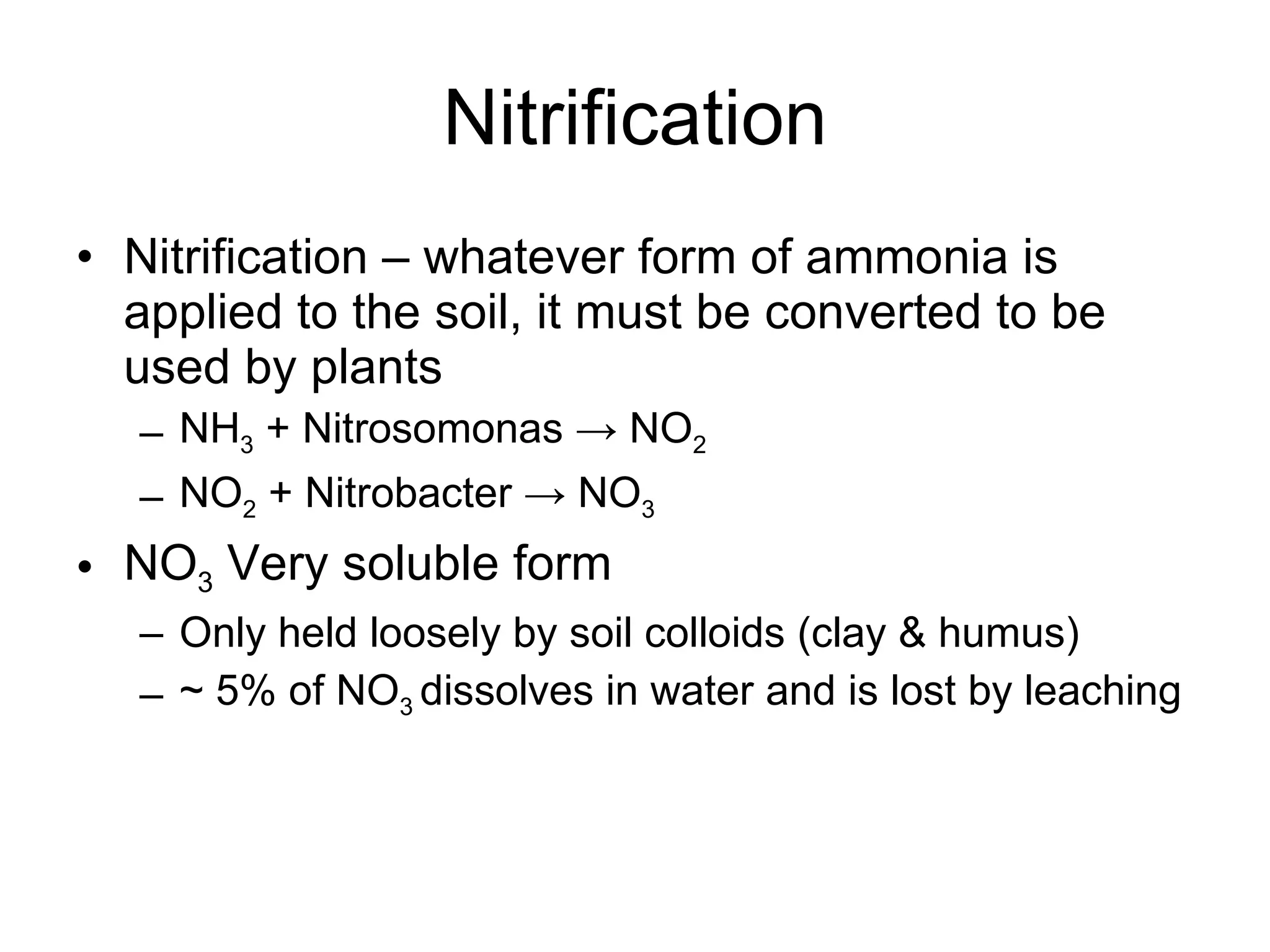
Nitrification Nitrification – whatever form of ammonia is applied to the soil, it must be converted to be used by plants NH 3  + Nitrosomonas -> NO 2 NO 2  + Nitrobacter -> NO 3 NO 3  Very soluble form Only held loosely by soil colloids (clay & humus) ~ 5% of NO 3  dissolves in water and is lost by leaching
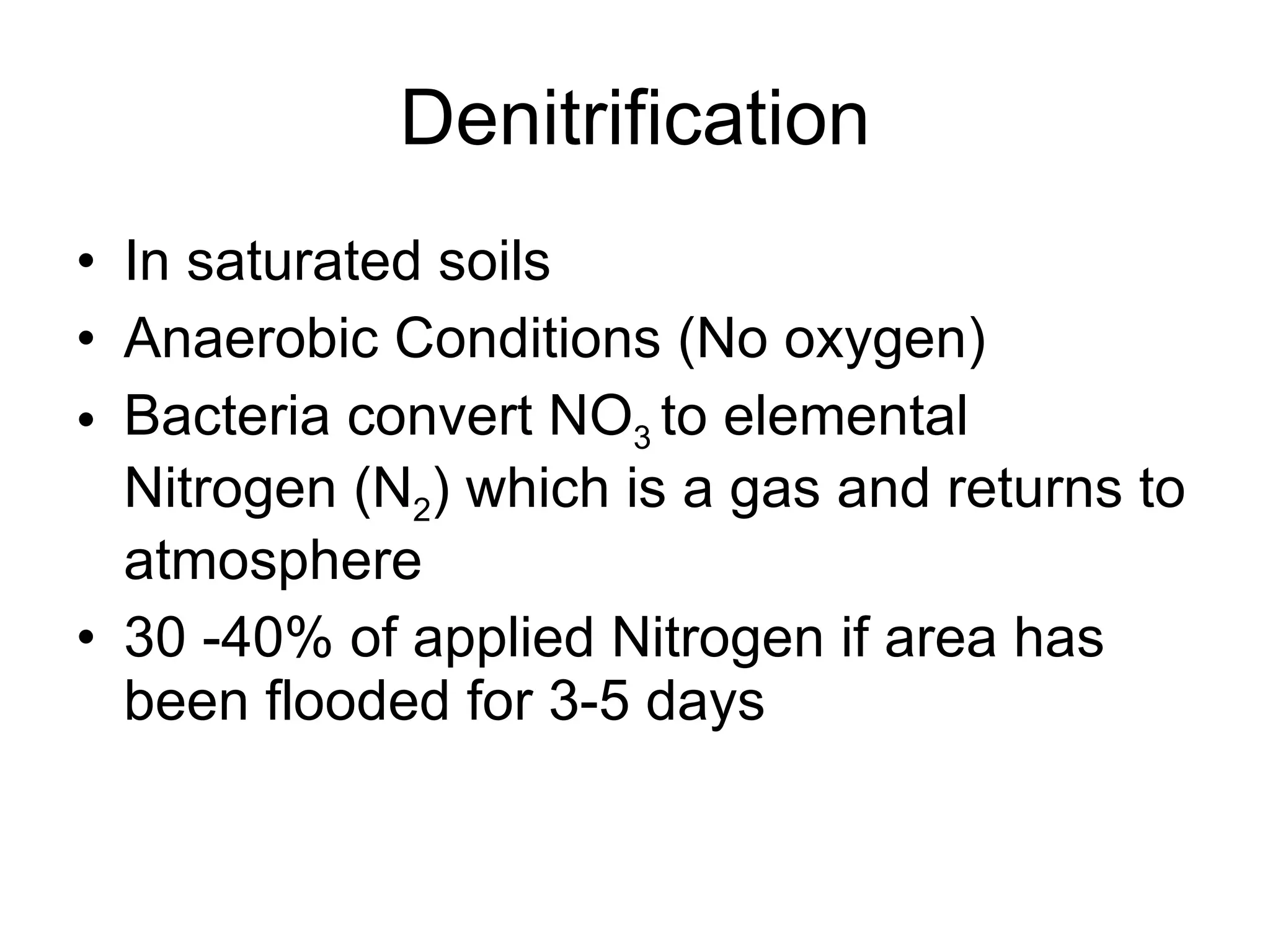
Denitrification In saturated soils Anaerobic Conditions (No oxygen) Bacteria convert NO 3  to elemental Nitrogen (N 2 ) which is a gas and returns to atmosphere 30 -40% of applied Nitrogen if area has been flooded for 3-5 days
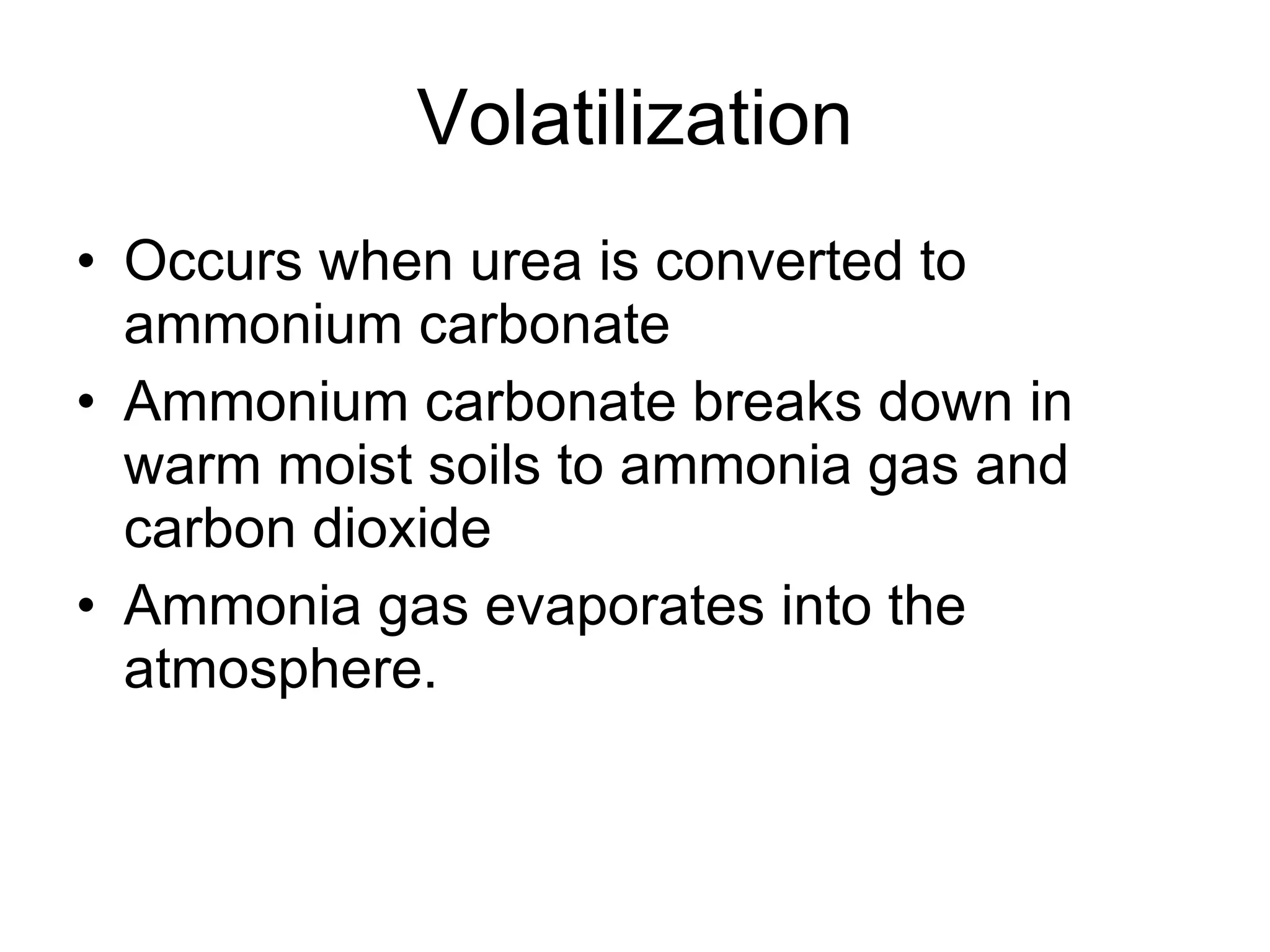
Volatilization Occurs when urea is converted to ammonium carbonate Ammonium carbonate breaks down in warm moist soils to ammonia gas and carbon dioxide Ammonia gas evaporates into the atmosphere.
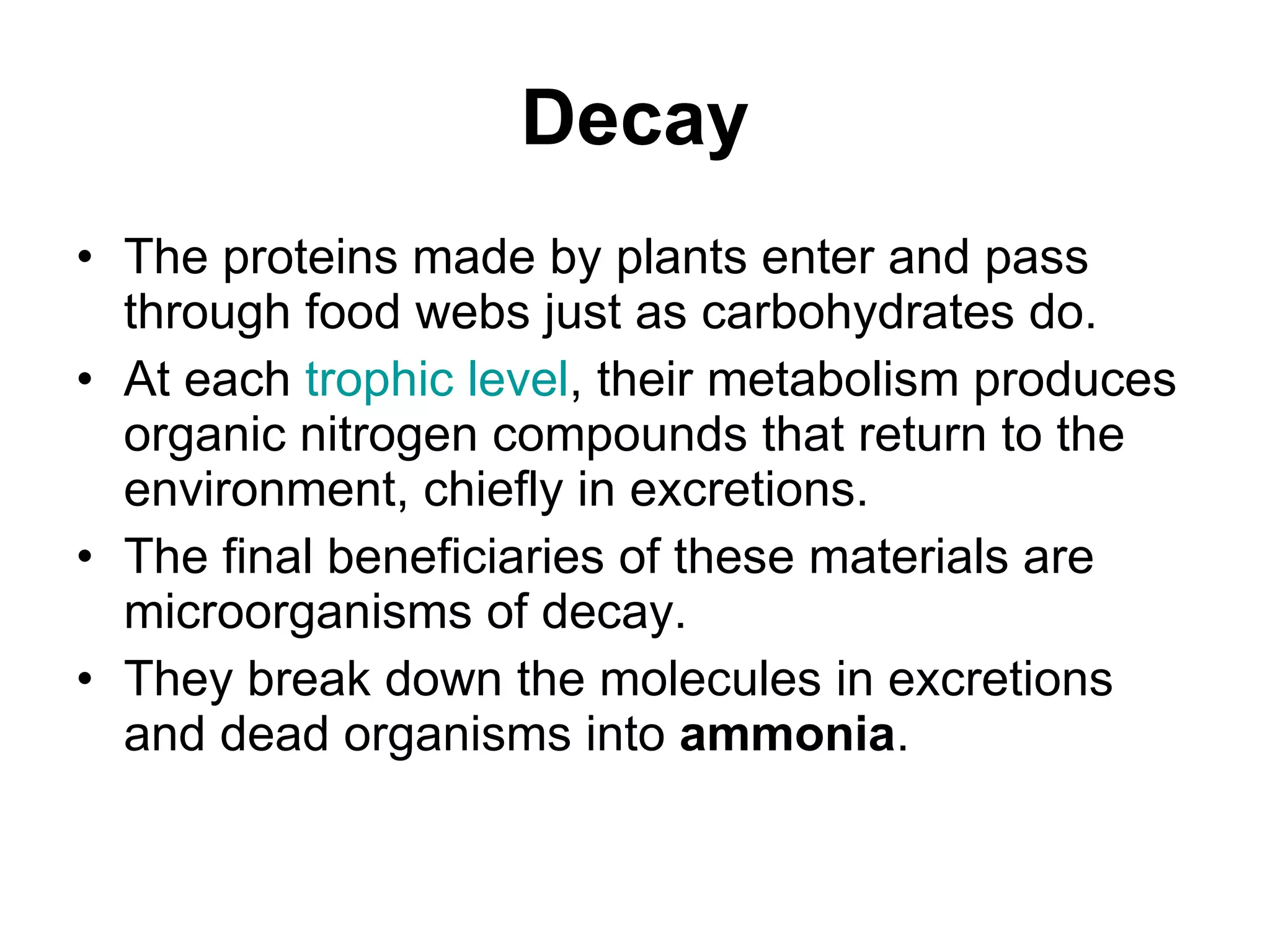
Decay The proteins made by plants enter and pass through food webs just as carbohydrates do.  At each  trophic  level , their metabolism produces organic nitrogen compounds that return to the environment, chiefly in excretions.  The final beneficiaries of these materials are microorganisms of decay.  They break down the molecules in excretions and dead organisms into  ammonia .
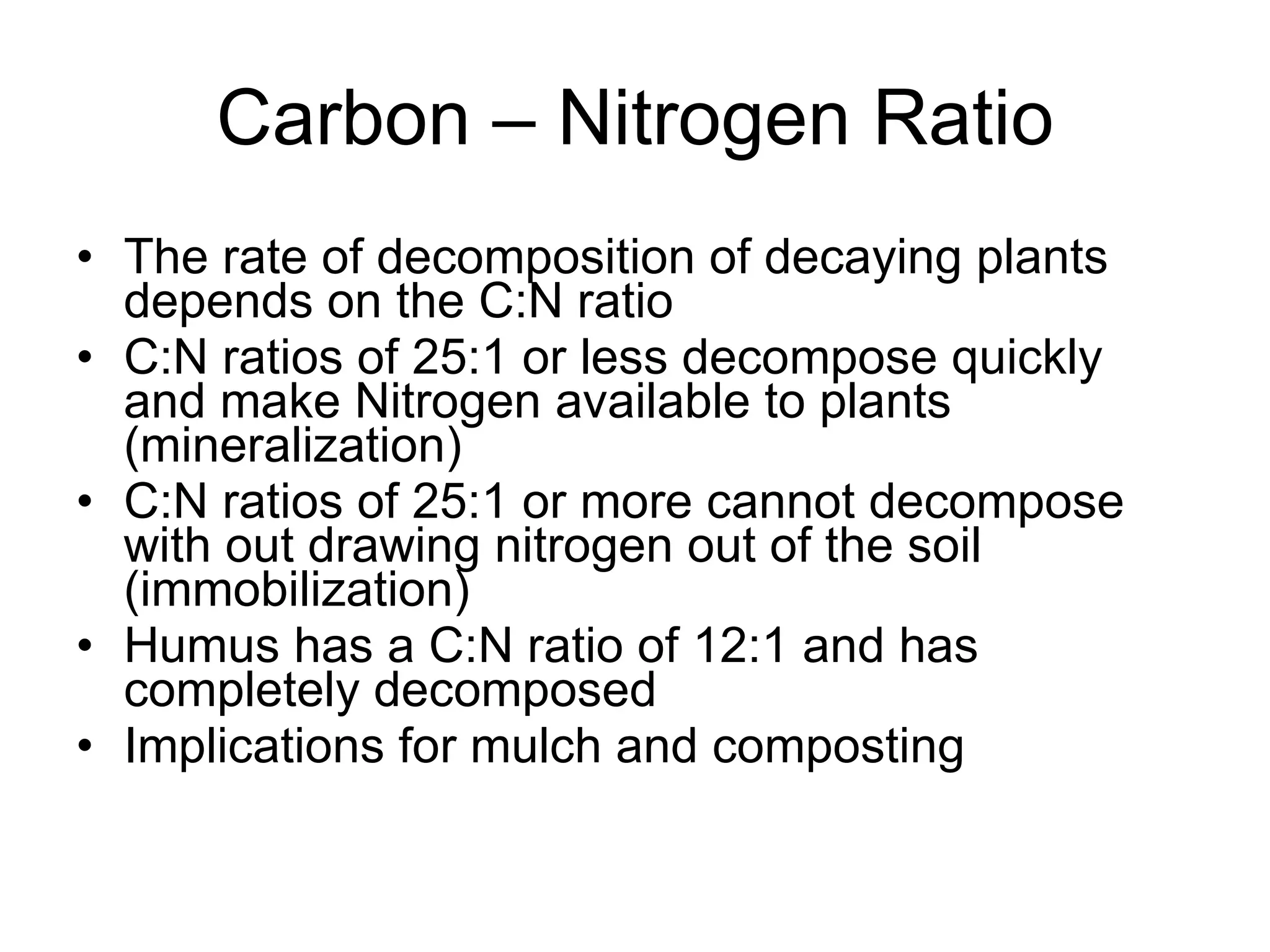
Carbon – Nitrogen Ratio The rate of decomposition of decaying plants depends on the C:N ratio C:N ratios of 25:1 or less decompose quickly and make Nitrogen available to plants (mineralization) C:N ratios of 25:1 or more cannot decompose with out drawing nitrogen out of the soil (immobilization) Humus has a C:N ratio of 12:1 and has completely decomposed Implications for mulch and composting
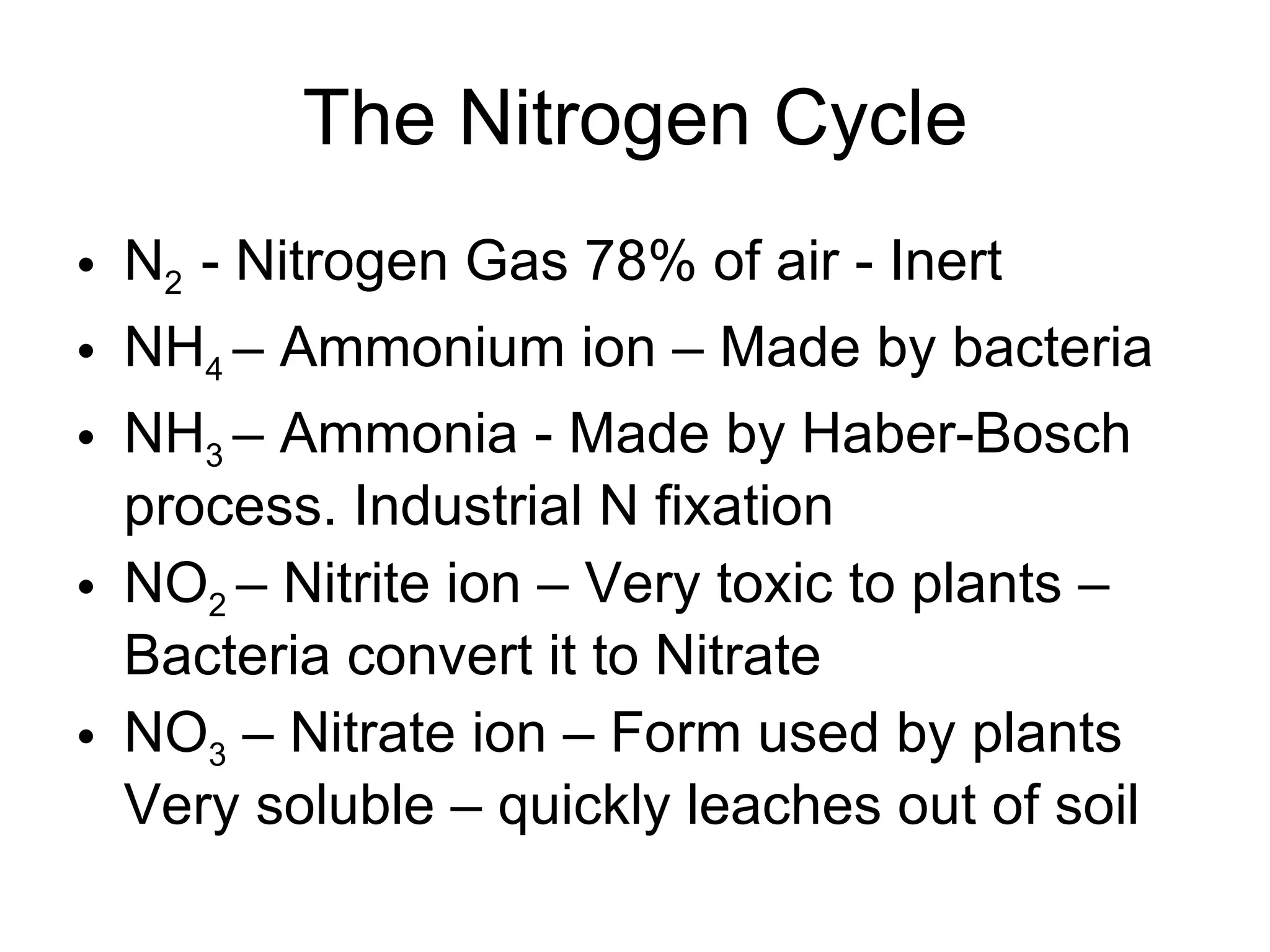
The Nitrogen Cycle N 2  - Nitrogen Gas 78% of air - Inert NH 4  – Ammonium ion – Made by bacteria NH 3  – Ammonia - Made by Haber-Bosch process. Industrial N fixation NO 2  – Nitrite ion – Very toxic to plants – Bacteria convert it to Nitrate NO 3  – Nitrate ion – Form used by plants Very soluble – quickly leaches out of soil
 
Video

10 21 Nitrogen Cycle2

  • 1.
  • 2.
    www.sciencedaily.com/releases/2009/04/090414110818.htm Go tosciencedaily.com & search for soybeans & aphids Read the Article from April 20 th Are rhizobia specific to legume species Do naturally occurring rhizobia or commercially inoculated rhizobia provide better resistance? Does the source of the rhizobia influence the effectiveness of nitrogen fixation?
  • 3.
    Legumes Plants thathave a symbiotic relationship with bacteria that grow in nodules on their roots. Soybeans – widely rotated with corn crops to revitalize soil Vetch & Clovers – Cover crops – green manure Clovers & Alfalfa - grown to improve hay crops & pasture.
  • 4.
    Other Legumes Redbud trees Locust Trees Beans Peas Most plants that form Pods
  • 5.
    Rhizobia Rhizobia arespecific to legume species The naturally occurring bacteria were more effective at creating resistance against the aphid than the imported bacteria. Older generations of rhizobia are more effective than the new ones The rhizobia compete for space to grow on the roots Naturalized rhizobia are as effective in nitrogen fixation as the commercial ones.
  • 6.
    Nitrogen & FertilizerIndustrialized countries began producing chemical fertilizers after WWI Haber Process Manufactured nitrogen begins with the production of ammonia (NH 3 ). Ammonia is a gas that is produced when atmospheric N 2 is combined with hydrogen from fossil fuels - also called anhydrous ammonia Stored under pressure When fuel prices ↑, fertilizer prices ↑
  • 7.
    Ammonia Fertilizers NH3 Nitric Acid Sulfuric Acid Phosphoric Acid Carbon Dioxide Anhydrous Ammonia Ammonium Nitrate Ammonium Sulfate Ammonium Phosphate Urea
  • 8.
    Nitrogen Fixation Conversionof Inert N 2 into bio-usable forms atmospheric fixation by lightning biological fixation by certain microbes alone symbiotic relationship with some plants and animals industrial fixation – Haber Process
  • 9.
    Nitrification Nitrification –whatever form of ammonia is applied to the soil, it must be converted to be used by plants NH 3 + Nitrosomonas -> NO 2 NO 2 + Nitrobacter -> NO 3 NO 3 Very soluble form Only held loosely by soil colloids (clay & humus) ~ 5% of NO 3 dissolves in water and is lost by leaching
  • 10.
    Denitrification In saturatedsoils Anaerobic Conditions (No oxygen) Bacteria convert NO 3 to elemental Nitrogen (N 2 ) which is a gas and returns to atmosphere 30 -40% of applied Nitrogen if area has been flooded for 3-5 days
  • 11.
    Volatilization Occurs whenurea is converted to ammonium carbonate Ammonium carbonate breaks down in warm moist soils to ammonia gas and carbon dioxide Ammonia gas evaporates into the atmosphere.
  • 12.
    Decay The proteinsmade by plants enter and pass through food webs just as carbohydrates do. At each trophic level , their metabolism produces organic nitrogen compounds that return to the environment, chiefly in excretions. The final beneficiaries of these materials are microorganisms of decay. They break down the molecules in excretions and dead organisms into ammonia .
  • 13.
    Carbon – NitrogenRatio The rate of decomposition of decaying plants depends on the C:N ratio C:N ratios of 25:1 or less decompose quickly and make Nitrogen available to plants (mineralization) C:N ratios of 25:1 or more cannot decompose with out drawing nitrogen out of the soil (immobilization) Humus has a C:N ratio of 12:1 and has completely decomposed Implications for mulch and composting
  • 14.
    The Nitrogen CycleN 2 - Nitrogen Gas 78% of air - Inert NH 4 – Ammonium ion – Made by bacteria NH 3 – Ammonia - Made by Haber-Bosch process. Industrial N fixation NO 2 – Nitrite ion – Very toxic to plants – Bacteria convert it to Nitrate NO 3 – Nitrate ion – Form used by plants Very soluble – quickly leaches out of soil
  • 15.
  • 16.