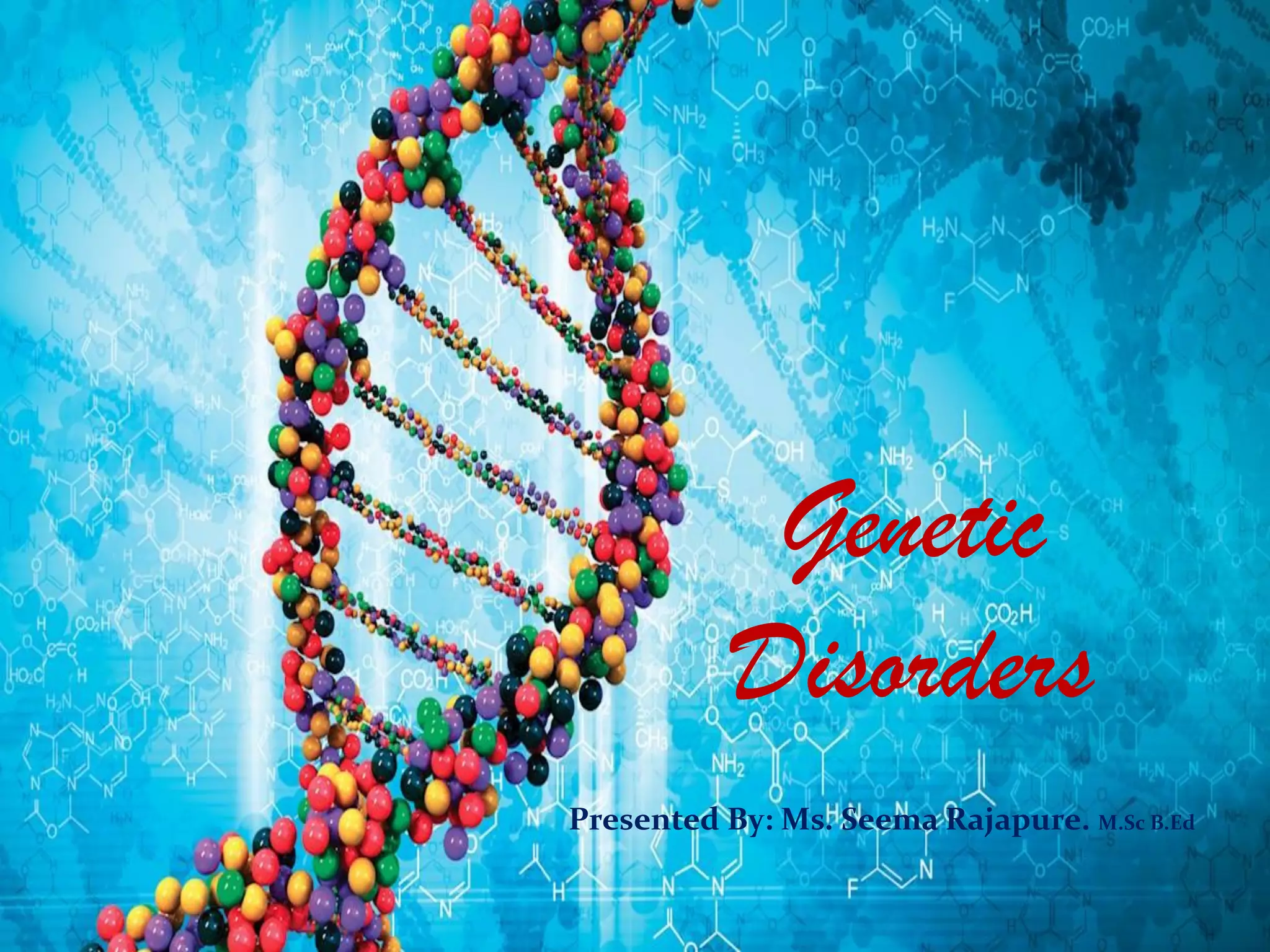
Genetic
Disorders
Presented By: Ms. Seema Rajapure. M.Sc B.Ed
Contents
 Introduction
 History
 Types
o Discussion
o Examples
Introduction
 A genetic disorder is an illness caused by one or more
abnormalities in the genome, especially a condition
that is present from birth (congenital).
 It can also be defined as an inborn disease caused by
defective genes.
 Most genetic disorders are quite rare and affect one
person in every several thousands or millions.
 Genetic disorders may or may not be heritable, i.e.,
passed down from the parents' genes.
Cont…
 In non-heritable genetic disorders, defects may be
caused by new mutations or changes to the DNA.
 The defect will only be heritable if genetic disorder
occurs in the germ line.
History
 1866 - First there was Gregor Mendel, who studied
inherited characteristics.
 This was followed by Francis crick and James Watson
who unraveled the DNA molecule.
 This has led us to understanding the human genome
sequence.
 1950’s - Maurice Wilkins, Rosalind Franklin, Francis H.
C. Crick of Britain and James D. Watson of the U.S.
discover chemical structure of DNA, starting a new
branch of science - molecular biology.
Cont…
 1957- Arthur Kornberg of the U.S. produced DNA in a
test tube.
 1966 - The Genetic code was discovered.
 1983 – “Genes are able to change position on
chromosomes” - Barbara McClintock
 Late 1980's - An international team of scientists began
the project to map the human genome.
 1990 - Gene therapy, first used for patient
Types
1. Single Gene:
Disorders caused by abnormality or mutation in the
sequence of one gene.
2. Multifactorial:
Caused by a combination of environmental as well as
mutations in multiple genes.
3. Chromosomal:
Abnormalities in chromosome structure such as missing
or extra copies.
4. Mitochondrial:
Caused by a mutation in the non chromosomal DNA of
the mitochondria.
Single Gene Disorders
 These disorders involve mutations in the DNA sequences of
single genes.
 As a result, the protein the gene codes for is either altered or
missing.
 Over 4000 human diseases caused by single gene defects.
 Example :
 Adenosine deaminase deficiency
 Alpha-1 Antitrypsine deficiency
 Cystic fibrosis
 Galatosemia
 Huntington’s disease
 Maple syrup urine disease
 Phenylketonuria
 Severe combined immunodeficiency (SCID)
 Sickle cell disease
 Smith-Lemil-Optiz Syndrome
Cystic fibrosis
 CF is a genetic disease that mainly affects the lungs and digestive
system.
 People with cystic fibrosis inherit a defective gene on
chromosome 7 called CFTR (cystic fibrosis transmembrane
conductance regulator).
 The protein produced by this gene normally helps salt (sodium
chloride) move in and out of cells. If the protein doesn't work
correctly, that movement is blocked and an abnormally thick
sticky mucus is produced on the outside of the cell.
 The cells most seriously affected by this are the lung cells. This
mucus clogs the airways in the lungs, and increases the risk of
infection by bacteria.
 The thick mucus also blocks ducts in the pancreas, so digestive
enzymes cant get into the intestine.
 Symptoms
 salty-tasting skin
 persistent coughing
 shortness of breath
 wheezing
 poor weight gain in spite of excessive appetite
 greasy, bulky stools
 Nasal polyps, or small, fleshy growths found in the nose
Huntington’s Disease
 Huntington’s Disease results from genetically
programmed degeneration of nerve cells in certain
areas of the brain.
 This degeneration causes uncontrolled movements,
loss of intellectual faculties, and emotional
disturbance.
 Early signs:
 mood swings and irritability
 depression
 loss of memory
 uncontrolled movements
 walking and speech become more difficult
 memory and intellectual functions continue to decline.
Phenylketonuria (PKU)
 Rare metabolic autosomal recessive disorder.
 Affects protein breakdown in the liver resulting in mental retardation
& genetic Mutation occurs on Chromosome 12.
 The mutated gene is supposed to code for a protein which produces
phenylalanine hydroxylase.
 Without phenylalanine hydroxylase, phenylalanine (found in protein
rich foods) cannot be converted to tyrosine.
 Excess phenylalanine in the body will result in mass production of
phenylpyruvic acid.
 Phenylpyruvic acid cannot be absorbed by the kidney and thus excess
phenylalanine and phenylpyruvic acid enters cerebrospinal fluid and
then the brain causing severe mental retardation.
 Unable to metabolize phenylalanine.
 Symptoms:
 Severe brain damage
 Epilepsy
 Behavioral Problems
 Stunted growth
 Musty body odor
 Increased muscle tone
 Fair skin
 Vomiting
 Active muscle tendon reflexes
Sickle Cell Disease
 It affects the red blood cells, which use a protein called
hemoglobin to transport oxygen from the lungs to the rest
of the body.
 Normally, red blood cells are round and flexible so they can
travel freely through the narrow blood vessels.
 The normal hemoglobin 4 polypeptide chains: 2 alpha
chains having 141 amino acids and 2 beta chains having 146
amino acids .
 Patients with sickle cell disease have a mutation in a gene
on chromosome 11 that codes for the beta subunit (6th
amino acid in the beta chain)of the hemoglobin protein.
 As a result, glutamic acid is replaced by valine. Due to this
the RBC’s become elongate and sickel shaped.
 Symptoms
 Fatigue
 Pain Crisis
 Dactylitis and Arthritis
 Bacterial Infections
 Splenic Sequestration
 Lung and Heart Damage
 Leg Ulcers
 Aseptic Necrosis and Bone Infarcts
 Eye Damage
 Jaundice
 Acute Chest Syndrome
 Treatments
 Antibiotics
 Pain-relieving Medications
 Supplemental Oxygen
 Blood Transfusions
 Health maintenance starts with early diagnosis
Severe Combined Immunodeficiency(SCID)
 SCID is a group of very rare-and potentially fatal-inherited
disorders related to the immune system.
 Defect in their immune system that leaves them vulnerable to
potentially deadly infections.
 The most common form is caused by a mutation in the SCIDX1
gene located on the X chromosome.
 This gene encodes a protein that is used to construct a receptor
called IL2RG (interleukin-2 receptor).
 Their job is to allow two types of immune cells - T cells and B
cells - to communicate.
 When the gene is mutated,
the receptors cannot form
and are absent from immune
cells.
 As a result, the immune cells
can't communicate with one
another about invaders in the
environment. Not enough T
and B cells are produced to
fight off the infection, and
the body is left defenseless.
 Some of infections including
pneumonia (lung infection),
meningitis (brain infection),
and sepsis (blood infection).
Hemophilia
 Hemophilia is the oldest known bleeding disorder.
 It is a sex-linked disorder, which is why it appears
mostly in males.
 Hemophilia is like any other sex-linked disorder,
because the “hemophilia” gene is on the X
chromosome.
 2 types of Hemophilia:
 Hemophilia A: Lack the blood clotting protein factor VIII
 Hemophilia B: Lack the blood clotting protein factor IX.
 Treatment
 Clotting factors: Given in differing doses according to the
weight of the individual and the severity of the bleeding.
 Recombinant DNA Techniques: Clotting factor genes are
grown synthetically.
Chromosomal Genetic Disorder
 In these disorders, entire chromosomes, or large
segments of them, are missing, duplicated, or
otherwise altered.
 It can be organized into two basic groups:
1. Numerical Abnormalities:
When an individual is missing either a
chromosome from a pair (monosomy) or has
more than two chromosomes of a pair (trisomy)
2. Structural Abnormalities:
When the chromosome's structure is altered.
 Examples:
 Cri-Du-Chat Syndrome
 Down Syndrome
 Klinefelter Syndrome
 Turner Syndrome (Monosomy)
 William Syndrome
Cri-du-cat Syndrome
 The name of this syndrome is French for "cry of the cat," referring to
the distinctive cry of children with this disorder.
 The cry is caused by abnormal larynx development, one of the many
symptoms associated with this disorder.
 Cri-du-chat is caused by a deletion (the length of which may vary) on
the short arm of chromosome 5.
 Multiple genes are missing as a result of this deletion, and each may
contribute to the symptoms of the disorder.
 Babies with cri-duchat are usually small at birth, and may have
respiratory problems.
 Often, the larynx doesn't develop correctly, which causes the signature
cat-like cry.
Down Syndrome
 Down syndrome is a developmental disorder caused by an extra copy of
chromosome 21 (which is why the disorder is also called "trisomy 21").
 Having an extra copy of this chromosome means that individuals have
three copies of each of its genes instead of two, making it difficult for
cells to properly control how much protein is made.
 Producing too much or too little protein can have serious
consequences.
 No cure exists for Down syndrome.
 But physical therapy and/or speech therapy can help people with the
disorder develop more normally.
Cont…
 Distinct facial features:
o a flat face,
o a small broad nose,
o abnormally shaped ears,
o a large tongue, and
o upward slanting eyes with small folds of skin in the corners.
• Medical problems:
o respiratory infections,
o gastrointestinal tract obstruction,
o leukemia,
o heart defects,
o hearing loss,
o hypothyroidism, and
o various eye abnormalities.
Klinefelter syndrome
 47, XXY (or XXY) is a genetic condition caused when someone has two
X chromosomes and one Y chromosome.
 Most XXY individuals develop as males, often not knowing they have
an extra chromosome.
 XXY is usually caused by what is called nondisjunction.
 Nondisjunction happens when a pair of sex chromosomes fails to
separate during egg (or sperm) formation.
 The XXY chromosome arrangement affects primarily sexual
development.
 Typically, testes don't fully develop, and the levels of the hormone
testosterone (important for male sexual development) are lower than
average.
 Changes that appear at puberty can include low growth of facial and
body hair, development of breast tissue, and small testes.
Turner Syndrome
 Turner syndrome is caused by a missing or incomplete X chromosome.
 People who have Turner syndrome develop as females.
 Loss of chromosome because of the nondisjunction during meiosis.
 It may occur during spermatogenesis in the male.
 The genes affected are involved in growth and sexual development,
which is why girls with the disorder are shorter than normal and have
abnormal sexual characteristics.
Williams Syndrome
 People who have Williams syndrome are missing genetic material from
chromosome 7, including the gene elastin.
 Mutated genes are located on the X chromosome (for red/green color
blindness) or both the X and Y chromosomes (for total color
blindness).
 Williams syndrome is a rare genetic disorder that affects a child's
growth, physical appearance, and cognitive development.
Multifactorial Disorder
 These disorders involve variations in multiple genes, often coupled
with environmental causes.
 Example: Alzheimer's Disease, Breast/Ovarian Cancer, Colon Cancer,
Hypothyroidism. Asthma, cancers, cleft palate, diabetes, heart disease,
hypertension, inflammatory bowel disease, mood disorder, obesity,
refractive error, infertility
Alzheimer's Disease
 Alzheimer's is a disease that causes dementia, or loss of brain function.
 It affects the parts of the brain that deal with memory, thought, and
language.
 The brain of a person with Alzheimer's contains abnormal clumps of
cellular debris and protein(plaques) and collapsed microtubules
(support structures of the cell.)
 Microtubule disintegration is caused by a malfunctioning protein
called tau, which normally stabilizes the microtubules.
 In Alzheimer's patients, tau proteins instead cluster together to form
disabling tangles.
 These plaques and tangles damage the healthy cells around them.
Because Alzheimer's destroys brain cells, people who have the disorder
slowly lose their ability to think clearly.
 At first, they may forget words or names, or have trouble finding
things.
 As the disorder worsens, they may forget how to do simple tasks.
Other
diseases
Parkinson’ s disease
 Parkinson’ s disease is a neurological condition that has a genetic
component next to Alzheimer’s.
 The chance of getting or developing Parkinson’s gets higher as age
increases.
 DOPAMINE: Chemical produced in the middle part of the brain that is
responsible for organizing coordinated movements and to send this
signal to the control centers of the brain.
 In Parkinson’s disease, this chemical is not produced enough and
functioning starts to shut down slowly & patient begins to lose control
over many vital voluntary movements from swallowing to walking.
 SYMPTOMS: hand tremor, muscle spasms, rigidity, lack of postural
stability, memory loss, blurriness, drooling, and difficulty in voluntary
movements.
Achondroplasia
 Defined as a bone growth disorder characterized by abnormal body
proportions.
Autism
 Severe disorder from an array of the Autism Spectrum Disorders (ASD)
 Another common form of ASD is Asperger Syndrome
 Developmental disorder affects parts of brain, notably the amygdala
{are almond-shaped groups of nuclei located deep and medially within
the temporal lobes of the brain}, hippocampus{plays important roles in
the consolidation of information from short-term memory to long-
term memory},and cerebellum › immune system, and gastrointestinal
tract
 1 out of 150 people are affected
 More prevalent in males than in females.
Cont…
 difficulties with social interaction
 problems with verbal and nonverbal communication
 repetitive behaviors or narrow, obsessive interests
 behaviors can range in impact from mild to disabling.
Causes
 Complex,polygenic and multifactoral
 Highly heritable
 Gene-environment interaction
Gaucher disease
 Gaucher disease is a genetic disorder handed down from generation to
generation.
 It is the most common of the lipid storage diseases.
 It is caused by deficiency of the enzyme, β-glucocerebrosidase.
 When there is not enough of the enzyme, the fat cannot be broken
down and is stored primarily in the liver and spleen
 Other body tissues, bones and organs may also be affected. In rare
cases, it may also accumulate in the brain.
Cont…
Symptoms
 bone pain and fractures
 easy bruising
 fatigue
 seizures
 Liver and spleen enlargement
Treatment
 Removal of the spleen (splenectomy).
 This has given way to injections of a replacement synthetic enzyme
(Cerezyme/Ceredase).
 Gene therapy is an experimental approach.
 A novel oral treatment has recently been evaluated. This drug is known as
N-butyldeoxynojirimycin (OGT 918).
 The mechanism of action is by inhibiting the formation of
glucocerebroside ( important components in animal muscle and nerve cell
membranes.)
World’s rarest diseases (Its a
genetic disease)
 Fibrodysplasia Ossificans Progressiva (FOP) :Sometimes called “stone
man” syndrome, is extremely rare genetic disease causes soft tissue to
turn into bone.
Genetic disorders pdf

Genetic disorders pdf

  • 1.
    Genetic Disorders Presented By: Ms.Seema Rajapure. M.Sc B.Ed
  • 2.
    Contents  Introduction  History Types o Discussion o Examples
  • 3.
    Introduction  A geneticdisorder is an illness caused by one or more abnormalities in the genome, especially a condition that is present from birth (congenital).  It can also be defined as an inborn disease caused by defective genes.  Most genetic disorders are quite rare and affect one person in every several thousands or millions.  Genetic disorders may or may not be heritable, i.e., passed down from the parents' genes.
  • 4.
    Cont…  In non-heritablegenetic disorders, defects may be caused by new mutations or changes to the DNA.  The defect will only be heritable if genetic disorder occurs in the germ line.
  • 5.
    History  1866 -First there was Gregor Mendel, who studied inherited characteristics.  This was followed by Francis crick and James Watson who unraveled the DNA molecule.  This has led us to understanding the human genome sequence.  1950’s - Maurice Wilkins, Rosalind Franklin, Francis H. C. Crick of Britain and James D. Watson of the U.S. discover chemical structure of DNA, starting a new branch of science - molecular biology.
  • 6.
    Cont…  1957- ArthurKornberg of the U.S. produced DNA in a test tube.  1966 - The Genetic code was discovered.  1983 – “Genes are able to change position on chromosomes” - Barbara McClintock  Late 1980's - An international team of scientists began the project to map the human genome.  1990 - Gene therapy, first used for patient
  • 7.
    Types 1. Single Gene: Disorderscaused by abnormality or mutation in the sequence of one gene. 2. Multifactorial: Caused by a combination of environmental as well as mutations in multiple genes. 3. Chromosomal: Abnormalities in chromosome structure such as missing or extra copies. 4. Mitochondrial: Caused by a mutation in the non chromosomal DNA of the mitochondria.
  • 8.
    Single Gene Disorders These disorders involve mutations in the DNA sequences of single genes.  As a result, the protein the gene codes for is either altered or missing.  Over 4000 human diseases caused by single gene defects.  Example :  Adenosine deaminase deficiency  Alpha-1 Antitrypsine deficiency  Cystic fibrosis  Galatosemia  Huntington’s disease  Maple syrup urine disease  Phenylketonuria  Severe combined immunodeficiency (SCID)  Sickle cell disease  Smith-Lemil-Optiz Syndrome
  • 9.
    Cystic fibrosis  CFis a genetic disease that mainly affects the lungs and digestive system.  People with cystic fibrosis inherit a defective gene on chromosome 7 called CFTR (cystic fibrosis transmembrane conductance regulator).  The protein produced by this gene normally helps salt (sodium chloride) move in and out of cells. If the protein doesn't work correctly, that movement is blocked and an abnormally thick sticky mucus is produced on the outside of the cell.  The cells most seriously affected by this are the lung cells. This mucus clogs the airways in the lungs, and increases the risk of infection by bacteria.  The thick mucus also blocks ducts in the pancreas, so digestive enzymes cant get into the intestine.
  • 10.
     Symptoms  salty-tastingskin  persistent coughing  shortness of breath  wheezing  poor weight gain in spite of excessive appetite  greasy, bulky stools  Nasal polyps, or small, fleshy growths found in the nose
  • 11.
    Huntington’s Disease  Huntington’sDisease results from genetically programmed degeneration of nerve cells in certain areas of the brain.  This degeneration causes uncontrolled movements, loss of intellectual faculties, and emotional disturbance.  Early signs:  mood swings and irritability  depression  loss of memory  uncontrolled movements  walking and speech become more difficult  memory and intellectual functions continue to decline.
  • 13.
    Phenylketonuria (PKU)  Raremetabolic autosomal recessive disorder.  Affects protein breakdown in the liver resulting in mental retardation & genetic Mutation occurs on Chromosome 12.  The mutated gene is supposed to code for a protein which produces phenylalanine hydroxylase.  Without phenylalanine hydroxylase, phenylalanine (found in protein rich foods) cannot be converted to tyrosine.  Excess phenylalanine in the body will result in mass production of phenylpyruvic acid.  Phenylpyruvic acid cannot be absorbed by the kidney and thus excess phenylalanine and phenylpyruvic acid enters cerebrospinal fluid and then the brain causing severe mental retardation.  Unable to metabolize phenylalanine.
  • 14.
     Symptoms:  Severebrain damage  Epilepsy  Behavioral Problems  Stunted growth  Musty body odor  Increased muscle tone  Fair skin  Vomiting  Active muscle tendon reflexes
  • 15.
    Sickle Cell Disease It affects the red blood cells, which use a protein called hemoglobin to transport oxygen from the lungs to the rest of the body.  Normally, red blood cells are round and flexible so they can travel freely through the narrow blood vessels.  The normal hemoglobin 4 polypeptide chains: 2 alpha chains having 141 amino acids and 2 beta chains having 146 amino acids .  Patients with sickle cell disease have a mutation in a gene on chromosome 11 that codes for the beta subunit (6th amino acid in the beta chain)of the hemoglobin protein.  As a result, glutamic acid is replaced by valine. Due to this the RBC’s become elongate and sickel shaped.
  • 16.
     Symptoms  Fatigue Pain Crisis  Dactylitis and Arthritis  Bacterial Infections  Splenic Sequestration  Lung and Heart Damage  Leg Ulcers  Aseptic Necrosis and Bone Infarcts  Eye Damage  Jaundice  Acute Chest Syndrome  Treatments  Antibiotics  Pain-relieving Medications  Supplemental Oxygen  Blood Transfusions  Health maintenance starts with early diagnosis
  • 17.
    Severe Combined Immunodeficiency(SCID) SCID is a group of very rare-and potentially fatal-inherited disorders related to the immune system.  Defect in their immune system that leaves them vulnerable to potentially deadly infections.  The most common form is caused by a mutation in the SCIDX1 gene located on the X chromosome.  This gene encodes a protein that is used to construct a receptor called IL2RG (interleukin-2 receptor).  Their job is to allow two types of immune cells - T cells and B cells - to communicate.
  • 18.
     When thegene is mutated, the receptors cannot form and are absent from immune cells.  As a result, the immune cells can't communicate with one another about invaders in the environment. Not enough T and B cells are produced to fight off the infection, and the body is left defenseless.  Some of infections including pneumonia (lung infection), meningitis (brain infection), and sepsis (blood infection).
  • 19.
    Hemophilia  Hemophilia isthe oldest known bleeding disorder.  It is a sex-linked disorder, which is why it appears mostly in males.  Hemophilia is like any other sex-linked disorder, because the “hemophilia” gene is on the X chromosome.  2 types of Hemophilia:  Hemophilia A: Lack the blood clotting protein factor VIII  Hemophilia B: Lack the blood clotting protein factor IX.
  • 20.
     Treatment  Clottingfactors: Given in differing doses according to the weight of the individual and the severity of the bleeding.  Recombinant DNA Techniques: Clotting factor genes are grown synthetically.
  • 21.
    Chromosomal Genetic Disorder In these disorders, entire chromosomes, or large segments of them, are missing, duplicated, or otherwise altered.  It can be organized into two basic groups: 1. Numerical Abnormalities: When an individual is missing either a chromosome from a pair (monosomy) or has more than two chromosomes of a pair (trisomy) 2. Structural Abnormalities: When the chromosome's structure is altered.
  • 22.
     Examples:  Cri-Du-ChatSyndrome  Down Syndrome  Klinefelter Syndrome  Turner Syndrome (Monosomy)  William Syndrome
  • 23.
    Cri-du-cat Syndrome  Thename of this syndrome is French for "cry of the cat," referring to the distinctive cry of children with this disorder.  The cry is caused by abnormal larynx development, one of the many symptoms associated with this disorder.  Cri-du-chat is caused by a deletion (the length of which may vary) on the short arm of chromosome 5.  Multiple genes are missing as a result of this deletion, and each may contribute to the symptoms of the disorder.  Babies with cri-duchat are usually small at birth, and may have respiratory problems.  Often, the larynx doesn't develop correctly, which causes the signature cat-like cry.
  • 25.
    Down Syndrome  Downsyndrome is a developmental disorder caused by an extra copy of chromosome 21 (which is why the disorder is also called "trisomy 21").  Having an extra copy of this chromosome means that individuals have three copies of each of its genes instead of two, making it difficult for cells to properly control how much protein is made.  Producing too much or too little protein can have serious consequences.  No cure exists for Down syndrome.  But physical therapy and/or speech therapy can help people with the disorder develop more normally.
  • 26.
    Cont…  Distinct facialfeatures: o a flat face, o a small broad nose, o abnormally shaped ears, o a large tongue, and o upward slanting eyes with small folds of skin in the corners. • Medical problems: o respiratory infections, o gastrointestinal tract obstruction, o leukemia, o heart defects, o hearing loss, o hypothyroidism, and o various eye abnormalities.
  • 28.
    Klinefelter syndrome  47,XXY (or XXY) is a genetic condition caused when someone has two X chromosomes and one Y chromosome.  Most XXY individuals develop as males, often not knowing they have an extra chromosome.  XXY is usually caused by what is called nondisjunction.  Nondisjunction happens when a pair of sex chromosomes fails to separate during egg (or sperm) formation.  The XXY chromosome arrangement affects primarily sexual development.  Typically, testes don't fully develop, and the levels of the hormone testosterone (important for male sexual development) are lower than average.  Changes that appear at puberty can include low growth of facial and body hair, development of breast tissue, and small testes.
  • 30.
    Turner Syndrome  Turnersyndrome is caused by a missing or incomplete X chromosome.  People who have Turner syndrome develop as females.  Loss of chromosome because of the nondisjunction during meiosis.  It may occur during spermatogenesis in the male.  The genes affected are involved in growth and sexual development, which is why girls with the disorder are shorter than normal and have abnormal sexual characteristics.
  • 32.
    Williams Syndrome  Peoplewho have Williams syndrome are missing genetic material from chromosome 7, including the gene elastin.  Mutated genes are located on the X chromosome (for red/green color blindness) or both the X and Y chromosomes (for total color blindness).  Williams syndrome is a rare genetic disorder that affects a child's growth, physical appearance, and cognitive development.
  • 34.
    Multifactorial Disorder  Thesedisorders involve variations in multiple genes, often coupled with environmental causes.  Example: Alzheimer's Disease, Breast/Ovarian Cancer, Colon Cancer, Hypothyroidism. Asthma, cancers, cleft palate, diabetes, heart disease, hypertension, inflammatory bowel disease, mood disorder, obesity, refractive error, infertility
  • 35.
    Alzheimer's Disease  Alzheimer'sis a disease that causes dementia, or loss of brain function.  It affects the parts of the brain that deal with memory, thought, and language.  The brain of a person with Alzheimer's contains abnormal clumps of cellular debris and protein(plaques) and collapsed microtubules (support structures of the cell.)  Microtubule disintegration is caused by a malfunctioning protein called tau, which normally stabilizes the microtubules.  In Alzheimer's patients, tau proteins instead cluster together to form disabling tangles.  These plaques and tangles damage the healthy cells around them. Because Alzheimer's destroys brain cells, people who have the disorder slowly lose their ability to think clearly.  At first, they may forget words or names, or have trouble finding things.  As the disorder worsens, they may forget how to do simple tasks.
  • 37.
  • 38.
    Parkinson’ s disease Parkinson’ s disease is a neurological condition that has a genetic component next to Alzheimer’s.  The chance of getting or developing Parkinson’s gets higher as age increases.  DOPAMINE: Chemical produced in the middle part of the brain that is responsible for organizing coordinated movements and to send this signal to the control centers of the brain.  In Parkinson’s disease, this chemical is not produced enough and functioning starts to shut down slowly & patient begins to lose control over many vital voluntary movements from swallowing to walking.  SYMPTOMS: hand tremor, muscle spasms, rigidity, lack of postural stability, memory loss, blurriness, drooling, and difficulty in voluntary movements.
  • 40.
    Achondroplasia  Defined asa bone growth disorder characterized by abnormal body proportions.
  • 41.
    Autism  Severe disorderfrom an array of the Autism Spectrum Disorders (ASD)  Another common form of ASD is Asperger Syndrome  Developmental disorder affects parts of brain, notably the amygdala {are almond-shaped groups of nuclei located deep and medially within the temporal lobes of the brain}, hippocampus{plays important roles in the consolidation of information from short-term memory to long- term memory},and cerebellum › immune system, and gastrointestinal tract  1 out of 150 people are affected  More prevalent in males than in females.
  • 42.
    Cont…  difficulties withsocial interaction  problems with verbal and nonverbal communication  repetitive behaviors or narrow, obsessive interests  behaviors can range in impact from mild to disabling. Causes  Complex,polygenic and multifactoral  Highly heritable  Gene-environment interaction
  • 43.
    Gaucher disease  Gaucherdisease is a genetic disorder handed down from generation to generation.  It is the most common of the lipid storage diseases.  It is caused by deficiency of the enzyme, β-glucocerebrosidase.  When there is not enough of the enzyme, the fat cannot be broken down and is stored primarily in the liver and spleen  Other body tissues, bones and organs may also be affected. In rare cases, it may also accumulate in the brain.
  • 44.
    Cont… Symptoms  bone painand fractures  easy bruising  fatigue  seizures  Liver and spleen enlargement Treatment  Removal of the spleen (splenectomy).  This has given way to injections of a replacement synthetic enzyme (Cerezyme/Ceredase).  Gene therapy is an experimental approach.  A novel oral treatment has recently been evaluated. This drug is known as N-butyldeoxynojirimycin (OGT 918).  The mechanism of action is by inhibiting the formation of glucocerebroside ( important components in animal muscle and nerve cell membranes.)
  • 45.
    World’s rarest diseases(Its a genetic disease)  Fibrodysplasia Ossificans Progressiva (FOP) :Sometimes called “stone man” syndrome, is extremely rare genetic disease causes soft tissue to turn into bone.