SIMPLE PRESENT
TENSE
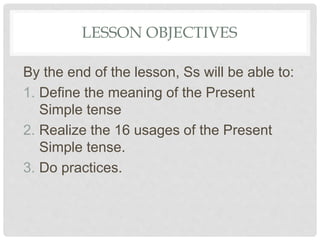
LESSON OBJECTIVES
By the end of the lesson, Ss will be able to:
1. Define the meaning of the Present
Simple tense
2. Realize the 16 usages of the Present
Simple tense.
3. Do practices.
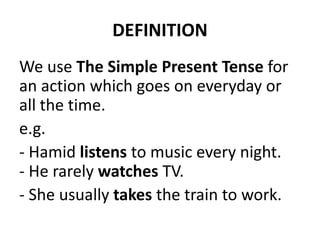
DEFINITION
We use The Simple Present Tense for
an action which goes on everyday or
all the time.
e.g.
- Hamid listens to music every night.
- He rarely watches TV.
- She usually takes the train to work.
The Use of Simple Present Tense
1. Habitual actions
Uses to refer to the actions happening as
the habit, and it’s usually used with frequency
adverbs and time expressions
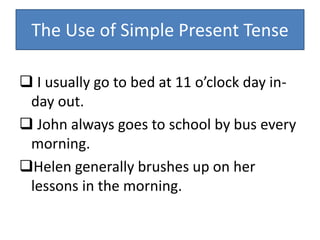
The Use of Simple Present Tense
 I usually go to bed at 11 o’clock day in-
day out.
 John always goes to school by bus every
morning.
Helen generally brushes up on her
lessons in the morning.
The Use of Simple Present Tense
2. In Giving Definition
Example:
Q: Could you tell me the definition of
the Present Simple?
A: Yes, I could. Please listen to me
carefully.
The Use of Simple Present Tense
3. General Truth/Fact
The Present Simple is used to express a fact,
which is usually true.
Example:
- My daughter has brown eyes.
- The earth goes around the sun.
- Some birds fly south in winter.
- The earth has round shape.
- The sun rises in the east.
The Use of Simple Present Tense
4. Permanent Actions
Example:
- I work at BIU.
- She lives in Phnom Penh.
- My younger brother has one son.
- They sell vegetable at the market.
The Use of Simple Present Tense
5. Present Actions
Used with Stative Verbs
Example:
- What religion do you believe in?
- I believe in Buddhism.
- Do you understand what I’m saying?
- I don’t suppose that you become rich soon.
- Does she agree to marry you?
- Why do you doubt her? She is an innocent girl.
The Use of Simple Present Tense
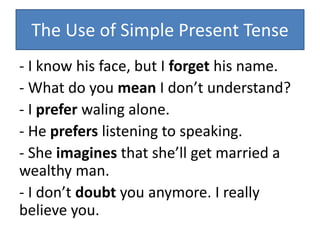
- I know his face, but I forget his name.
- What do you mean I don’t understand?
- I prefer waling alone.
- He prefers listening to speaking.
- She imagines that she’ll get married a
wealthy man.
- I don’t doubt you anymore. I really
believe you.
The Use of Simple Present Tense
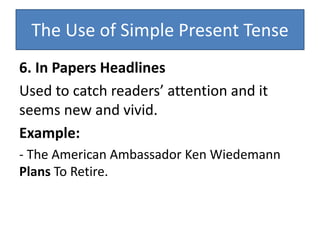
6. In Papers Headlines
Used to catch readers’ attention and it
seems new and vivid.
Example:
- The American Ambassador Ken Wiedemann
Plans To Retire.
The Use of Simple Present Tense
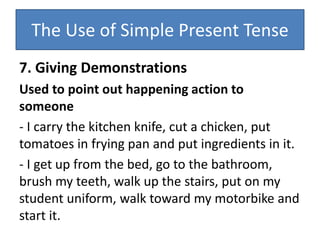
7. Giving Demonstrations
Used to point out happening action to
someone
- I carry the kitchen knife, cut a chicken, put
tomatoes in frying pan and put ingredients in it.
- I get up from the bed, go to the bathroom,
brush my teeth, walk up the stairs, put on my
student uniform, walk toward my motorbike and
start it.
The Use of Simple Present Tense
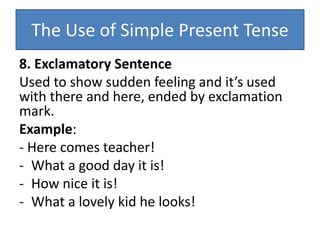
8. Exclamatory Sentence
Used to show sudden feeling and it’s used
with there and here, ended by exclamation
mark.
Example:
- Here comes teacher!
- What a good day it is!
- How nice it is!
- What a lovely kid he looks!
The Use of Simple Present Tense
9. Giving Direction
Used to tell the way or to give directions
to someone to get to someplace
Example:
- To reach the Royal Palace, you go
straight along Norodom Boulevard; first
you turn right when you get Independent
Monument, second turn left.
The Use of Simple Present Tense
10. Vivid Narration
Used to show that the past action seems to
still happen vividly, instead of Past Simple
Example:
- There is a loud explosion behind us, and
then I see the man coming out from the
building. The tall lady sits down at her desk,
reaches for the gun and shoots herself.
The Use of Simple Present Tense
11. Instantaneous Actions
We use it to refer to the two situations
are happening at the same time, LIVE
Action.
Example:
- The red corner kicks the blue corner
seriously.
The Use of Simple Present Tense
12. Conditional Type 1 (Real or Unreal
Future)
We use the Present Simple to refer to the
future action that is not clear.
Form: Future Simple if Present Simple
Example:
- I will pay you all the money if you help
me in advance.
The Use of Simple Present Tense
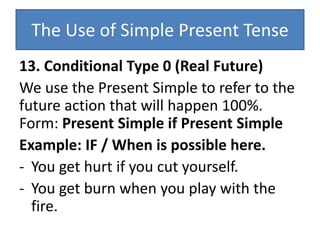
13. Conditional Type 0 (Real Future)
We use the Present Simple to refer to the
future action that will happen 100%.
Form: Present Simple if Present Simple
Example: IF / When is possible here.
- You get hurt if you cut yourself.
- You get burn when you play with the
fire.
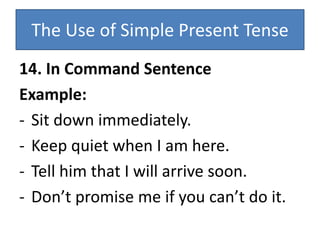
The Use of Simple Present Tense
14. In Command Sentence
Example:
- Sit down immediately.
- Keep quiet when I am here.
- Tell him that I will arrive soon.
- Don’t promise me if you can’t do it.
The Use of Simple Present Tense
15. Timetable / Schedule Actions
Example:
- The train leaves at 8: 30 a.m.
- The plane arrives at 10 p.m.
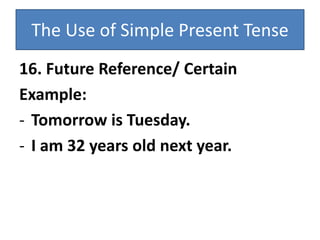
The Use of Simple Present Tense
16. Future Reference/ Certain
Example:
- Tomorrow is Tuesday.
- I am 32 years old next year.
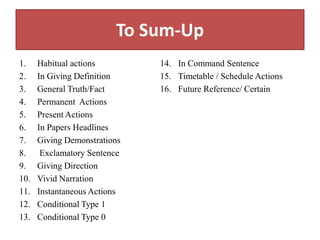
To Sum-Up
1. Habitual actions
2. In Giving Definition
3. General Truth/Fact
4. Permanent Actions
5. Present Actions
6. In Papers Headlines
7. Giving Demonstrations
8. Exclamatory Sentence
9. Giving Direction
10. Vivid Narration
11. Instantaneous Actions
12. Conditional Type 1
13. Conditional Type 0
14. In Command Sentence
15. Timetable / Schedule Actions
16. Future Reference/ Certain
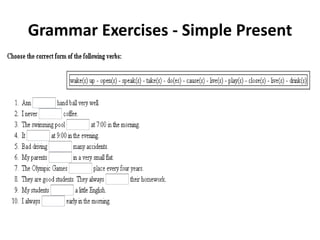
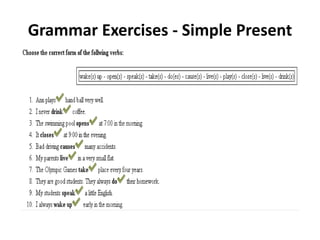
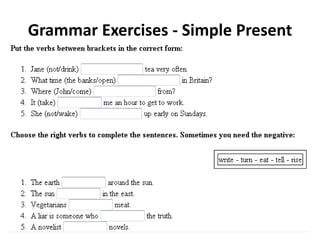
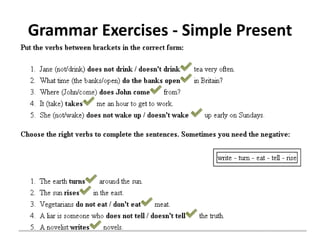
Grammar Exercises - Simple Present
Text Book Practice!
Please go to your text book on
page 4, Activity 2&3.

2. present simple tense

  • 1.
  • 2.
    LESSON OBJECTIVES By theend of the lesson, Ss will be able to: 1. Define the meaning of the Present Simple tense 2. Realize the 16 usages of the Present Simple tense. 3. Do practices.
  • 3.
    DEFINITION We use TheSimple Present Tense for an action which goes on everyday or all the time. e.g. - Hamid listens to music every night. - He rarely watches TV. - She usually takes the train to work.
  • 4.
    The Use ofSimple Present Tense 1. Habitual actions Uses to refer to the actions happening as the habit, and it’s usually used with frequency adverbs and time expressions
  • 5.
    The Use ofSimple Present Tense  I usually go to bed at 11 o’clock day in- day out.  John always goes to school by bus every morning. Helen generally brushes up on her lessons in the morning.
  • 6.
    The Use ofSimple Present Tense 2. In Giving Definition Example: Q: Could you tell me the definition of the Present Simple? A: Yes, I could. Please listen to me carefully.
  • 7.
    The Use ofSimple Present Tense 3. General Truth/Fact The Present Simple is used to express a fact, which is usually true. Example: - My daughter has brown eyes. - The earth goes around the sun. - Some birds fly south in winter. - The earth has round shape. - The sun rises in the east.
  • 8.
    The Use ofSimple Present Tense 4. Permanent Actions Example: - I work at BIU. - She lives in Phnom Penh. - My younger brother has one son. - They sell vegetable at the market.
  • 9.
    The Use ofSimple Present Tense 5. Present Actions Used with Stative Verbs Example: - What religion do you believe in? - I believe in Buddhism. - Do you understand what I’m saying? - I don’t suppose that you become rich soon. - Does she agree to marry you? - Why do you doubt her? She is an innocent girl.
  • 10.
    The Use ofSimple Present Tense - I know his face, but I forget his name. - What do you mean I don’t understand? - I prefer waling alone. - He prefers listening to speaking. - She imagines that she’ll get married a wealthy man. - I don’t doubt you anymore. I really believe you.
  • 11.
    The Use ofSimple Present Tense 6. In Papers Headlines Used to catch readers’ attention and it seems new and vivid. Example: - The American Ambassador Ken Wiedemann Plans To Retire.
  • 12.
    The Use ofSimple Present Tense 7. Giving Demonstrations Used to point out happening action to someone - I carry the kitchen knife, cut a chicken, put tomatoes in frying pan and put ingredients in it. - I get up from the bed, go to the bathroom, brush my teeth, walk up the stairs, put on my student uniform, walk toward my motorbike and start it.
  • 13.
    The Use ofSimple Present Tense 8. Exclamatory Sentence Used to show sudden feeling and it’s used with there and here, ended by exclamation mark. Example: - Here comes teacher! - What a good day it is! - How nice it is! - What a lovely kid he looks!
  • 14.
    The Use ofSimple Present Tense 9. Giving Direction Used to tell the way or to give directions to someone to get to someplace Example: - To reach the Royal Palace, you go straight along Norodom Boulevard; first you turn right when you get Independent Monument, second turn left.
  • 15.
    The Use ofSimple Present Tense 10. Vivid Narration Used to show that the past action seems to still happen vividly, instead of Past Simple Example: - There is a loud explosion behind us, and then I see the man coming out from the building. The tall lady sits down at her desk, reaches for the gun and shoots herself.
  • 16.
    The Use ofSimple Present Tense 11. Instantaneous Actions We use it to refer to the two situations are happening at the same time, LIVE Action. Example: - The red corner kicks the blue corner seriously.
  • 17.
    The Use ofSimple Present Tense 12. Conditional Type 1 (Real or Unreal Future) We use the Present Simple to refer to the future action that is not clear. Form: Future Simple if Present Simple Example: - I will pay you all the money if you help me in advance.
  • 18.
    The Use ofSimple Present Tense 13. Conditional Type 0 (Real Future) We use the Present Simple to refer to the future action that will happen 100%. Form: Present Simple if Present Simple Example: IF / When is possible here. - You get hurt if you cut yourself. - You get burn when you play with the fire.
  • 19.
    The Use ofSimple Present Tense 14. In Command Sentence Example: - Sit down immediately. - Keep quiet when I am here. - Tell him that I will arrive soon. - Don’t promise me if you can’t do it.
  • 20.
    The Use ofSimple Present Tense 15. Timetable / Schedule Actions Example: - The train leaves at 8: 30 a.m. - The plane arrives at 10 p.m.
  • 21.
    The Use ofSimple Present Tense 16. Future Reference/ Certain Example: - Tomorrow is Tuesday. - I am 32 years old next year.
  • 22.
    To Sum-Up 1. Habitualactions 2. In Giving Definition 3. General Truth/Fact 4. Permanent Actions 5. Present Actions 6. In Papers Headlines 7. Giving Demonstrations 8. Exclamatory Sentence 9. Giving Direction 10. Vivid Narration 11. Instantaneous Actions 12. Conditional Type 1 13. Conditional Type 0 14. In Command Sentence 15. Timetable / Schedule Actions 16. Future Reference/ Certain
  • 23.
    Grammar Exercises -Simple Present
  • 24.
    Grammar Exercises -Simple Present
  • 25.
    Grammar Exercises -Simple Present
  • 26.
    Grammar Exercises -Simple Present
  • 27.
    Text Book Practice! Pleasego to your text book on page 4, Activity 2&3.