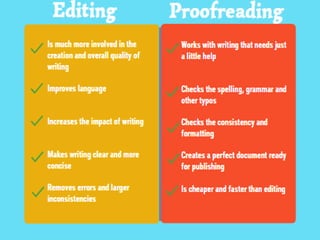
What is Editing?
A transformative process that elevates the quality of a piece of inf.
Furthermore, it harnesses and shapes the content in a text to
resonate with the readers.
Improves content and structure.
Focus on clarity, flow, and organization.
Example: The essay has good points. They are not connected well.
The essay presents strong arguments with smooth transitions.
→
6.
Step 1: Contentand Development Edit/Structural Editing
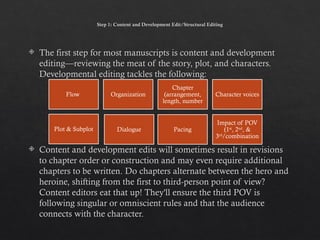
The first step for most manuscripts is content and development
editing—reviewing the meat of the story, plot, and characters.
Developmental editing tackles the following:
Content and development edits will sometimes result in revisions
to chapter order or construction and may even require additional
chapters to be written. Do chapters alternate between the hero and
heroine, shifting from the first to third-person point of view?
Content editors eat that up! They'll ensure the third POV is
following singular or omniscient rules and that the audience
connects with the character.
Flow Organization
Chapter
(arrangement,
length, number
Character voices
Plot & Subplot Pacing
Impact of POV
(1st
, 2nd
, &
3rd
/combination
Dialogue
7.
Step 2: LineEdit/Stylistic editing
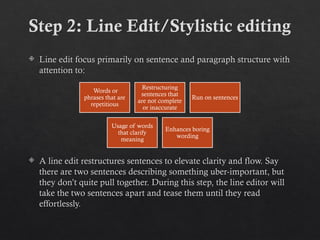
Line edit focus primarily on sentence and paragraph structure with
attention to:
A line edit restructures sentences to elevate clarity and flow. Say
there are two sentences describing something uber-important, but
they don’t quite pull together. During this step, the line editor will
take the two sentences apart and tease them until they read
effortlessly.
Words or
phrases that are
repetitious
Restructuring
sentences that
are not complete
or inaccurate
Run on sentences
Usage of words
that clarify
meaning
Enhances boring
wording
8.
Step 3: CopyEdit
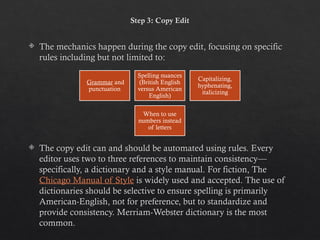
The mechanics happen during the copy edit, focusing on specific
rules including but not limited to:
The copy edit can and should be automated using rules. Every
editor uses two to three references to maintain consistency—
specifically, a dictionary and a style manual. For fiction, The
Chicago Manual of Style is widely used and accepted. The use of
dictionaries should be selective to ensure spelling is primarily
American-English, not for preference, but to standardize and
provide consistency. Merriam-Webster dictionary is the most
common.
Grammar and
punctuation
Spelling nuances
(British English
versus American
English)
Capitalizing,
hyphenating,
italicizing
When to use
numbers instead
of letters
9.
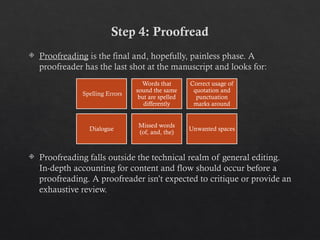
Step 4: Proofread
Proofreading is the final and, hopefully, painless phase. A
proofreader has the last shot at the manuscript and looks for:
Proofreading falls outside the technical realm of general editing.
In-depth accounting for content and flow should occur before a
proofreading. A proofreader isn’t expected to critique or provide an
exhaustive review.
Spelling Errors
Words that
sound the same
but are spelled
differently
Correct usage of
quotation and
punctuation
marks around
Dialogue
Missed words
(of, and, the)
Unwanted spaces
10.
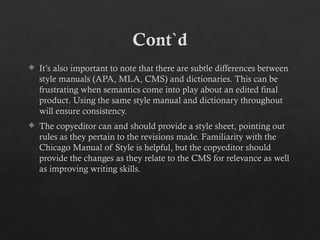
Cont`d
It’s alsoimportant to note that there are subtle differences between
style manuals (APA, MLA, CMS) and dictionaries. This can be
frustrating when semantics come into play about an edited final
product. Using the same style manual and dictionary throughout
will ensure consistency.
The copyeditor can and should provide a style sheet, pointing out
rules as they pertain to the revisions made. Familiarity with the
Chicago Manual of Style is helpful, but the copyeditor should
provide the changes as they relate to the CMS for relevance as well
as improving writing skills.
12.
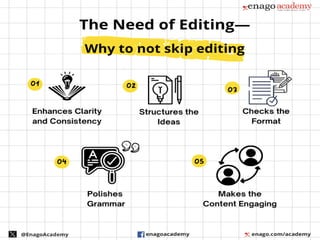
Enhances Clarity andConsistency
One of the primary functions of editing is to enhance the clarity
and coherence of a work.
Oftentimes, ideas flow freely during the creative process, resulting
in redundancies and inconsistencies in the preliminary draft.
However, editing can help the writers to rectify these issues.
Additionally, it ensures that the intended message is conveyed
clearly. It also introduces consistency in tone, style, and formatting.
Thus, it fosters a sense of professionalism and coherence that
captivates the readers.
13.
Structures the Ideas
Editing can help writers to refine their sentences and
improve the overall structure.
It helps in the arrangement of ideas and remove the
unnecessary elements that might be a deviation from
the central theme.
14.
Checks the Format
Editing revises the format of the entire text.
It checks for aspects like font, font size, bullets,
numbering, etc.
Additionally, it ensures that the number of words in the
text does not surpass the limit.
15.
Polishes Grammar
Editingpolishes the written material and avoids grammatical errors
in the final document.
Proper grammar, punctuation, and syntax showcase the true worth
of a content.
A misplaced comma or an incorrectly used word can drastically alter
the meaning of a sentence, leading to misinterpretations and
unintended consequences.
Therefore, it ensures that the final product is seamless, and conveys
the content in a right manner.
16.
Makes the ContentEngaging
Editing filters the content and trims off the excess
details.
By removing redundancies and irrelevant details, editors
streamline the narrative, thereby making it more
engaging and comprehendible.
17.
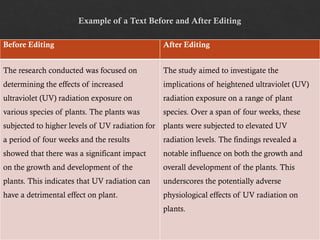
Example of aText Before and After Editing
Before Editing After Editing
The research conducted was focused on
determining the effects of increased
ultraviolet (UV) radiation exposure on
various species of plants. The plants was
subjected to higher levels of UV radiation for
a period of four weeks and the results
showed that there was a significant impact
on the growth and development of the
plants. This indicates that UV radiation can
have a detrimental effect on plant.
The study aimed to investigate the
implications of heightened ultraviolet (UV)
radiation exposure on a range of plant
species. Over a span of four weeks, these
plants were subjected to elevated UV
radiation levels. The findings revealed a
notable influence on both the growth and
overall development of the plants. This
underscores the potentially adverse
physiological effects of UV radiation on
plants.
18.
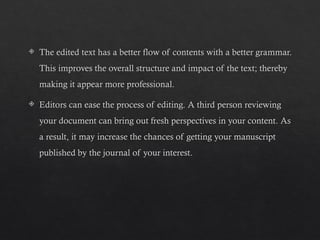
The editedtext has a better flow of contents with a better grammar.
This improves the overall structure and impact of the text; thereby
making it appear more professional.
Editors can ease the process of editing. A third person reviewing
your document can bring out fresh perspectives in your content. As
a result, it may increase the chances of getting your manuscript
published by the journal of your interest.
22.
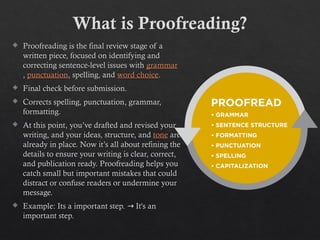
What is Proofreading?
Proofreading is the final review stage of a
written piece, focused on identifying and
correcting sentence-level issues with grammar
, punctuation, spelling, and word choice.
Final check before submission.
Corrects spelling, punctuation, grammar,
formatting.
At this point, you’ve drafted and revised your
writing, and your ideas, structure, and tone are
already in place. Now it’s all about refining the
details to ensure your writing is clear, correct,
and publication ready. Proofreading helps you
catch small but important mistakes that could
distract or confuse readers or undermine your
message.
Example: Its a important step. It's an
→
important step.
23.
Why Proofreading isessential?
Proofreading is essential for any text that will be shared with an
audience, whether it’s an academic paper, a job application, an
online article, or a print flyer. Depending on your skills and budget,
you can choose to proofread the text yourself, use an
online grammar checker, an AI proofreader, or hire a
professional editor.
24.
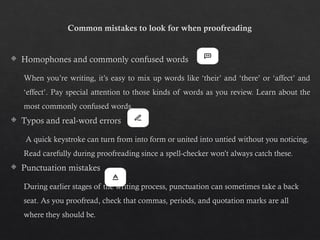
Common mistakes tolook for when proofreading
Homophones and commonly confused words
When you’re writing, it’s easy to mix up words like ‘their’ and ‘there’ or ‘affect’ and
‘effect’. Pay special attention to those kinds of words as you review. Learn about the
most commonly confused words.
Typos and real-word errors
A quick keystroke can turn from into form or united into untied without you noticing.
Read carefully during proofreading since a spell-checker won’t always catch these.
Punctuation mistakes
During earlier stages of the writing process, punctuation can sometimes take a back
seat. As you proofread, check that commas, periods, and quotation marks are all
where they should be.
25.
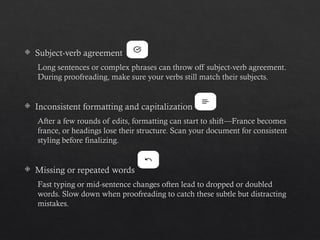
Subject-verb agreement
Longsentences or complex phrases can throw off subject-verb agreement.
During proofreading, make sure your verbs still match their subjects.
Inconsistent formatting and capitalization
After a few rounds of edits, formatting can start to shift—France becomes
france, or headings lose their structure. Scan your document for consistent
styling before finalizing.
Missing or repeated words
Fast typing or mid-sentence changes often lead to dropped or doubled
words. Slow down when proofreading to catch these subtle but distracting
mistakes.
26.
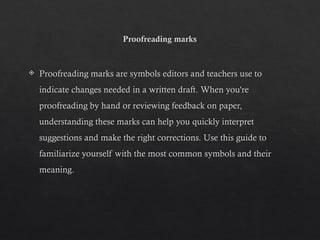
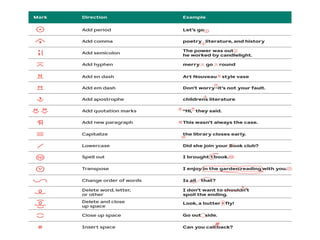
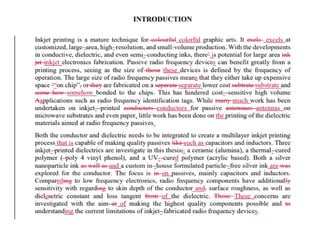
Proofreading marks
Proofreadingmarks are symbols editors and teachers use to
indicate changes needed in a written draft. When you're
proofreading by hand or reviewing feedback on paper,
understanding these marks can help you quickly interpret
suggestions and make the right corrections. Use this guide to
familiarize yourself with the most common symbols and their
meaning.
28.
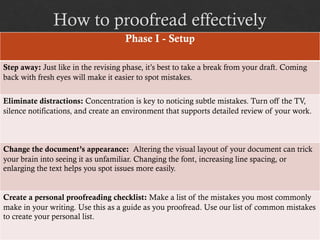
How to proofreadeffectively
Phase I - Setup
Step away: Just like in the revising phase, it’s best to take a break from your draft. Coming
back with fresh eyes will make it easier to spot mistakes.
Eliminate distractions: Concentration is key to noticing subtle mistakes. Turn off the TV,
silence notifications, and create an environment that supports detailed review of your work.
Change the document’s appearance: Altering the visual layout of your document can trick
your brain into seeing it as unfamiliar. Changing the font, increasing line spacing, or
enlarging the text helps you spot issues more easily.
Create a personal proofreading checklist: Make a list of the mistakes you most commonly
make in your writing. Use this as a guide as you proofread. Use our list of common mistakes
to create your personal list.
29.
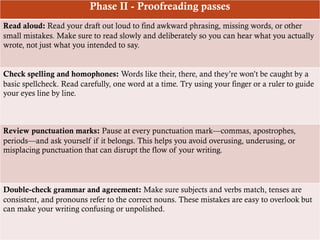
Phase II -Proofreading passes
Read aloud: Read your draft out loud to find awkward phrasing, missing words, or other
small mistakes. Make sure to read slowly and deliberately so you can hear what you actually
wrote, not just what you intended to say.
Check spelling and homophones: Words like their, there, and they’re won’t be caught by a
basic spellcheck. Read carefully, one word at a time. Try using your finger or a ruler to guide
your eyes line by line.
Review punctuation marks: Pause at every punctuation mark—commas, apostrophes,
periods—and ask yourself if it belongs. This helps you avoid overusing, underusing, or
misplacing punctuation that can disrupt the flow of your writing.
Double-check grammar and agreement: Make sure subjects and verbs match, tenses are
consistent, and pronouns refer to the correct nouns. These mistakes are easy to overlook but
can make your writing confusing or unpolished.
30.
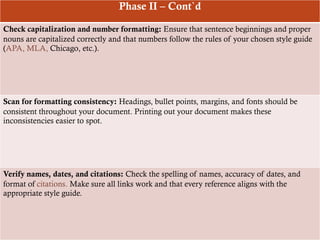
Phase II –Cont`d
Check capitalization and number formatting: Ensure that sentence beginnings and proper
nouns are capitalized correctly and that numbers follow the rules of your chosen style guide
(APA, MLA, Chicago, etc.).
Scan for formatting consistency: Headings, bullet points, margins, and fonts should be
consistent throughout your document. Printing out your document makes these
inconsistencies easier to spot.
Verify names, dates, and citations: Check the spelling of names, accuracy of dates, and
format of citations. Make sure all links work and that every reference aligns with the
appropriate style guide.
33.
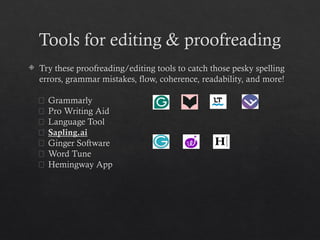
Tools for editing& proofreading
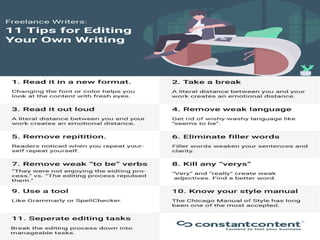
Try these proofreading/editing tools to catch those pesky spelling
errors, grammar mistakes, flow, coherence, readability, and more!
✅ Grammarly
✅ Pro Writing Aid
✅ Language Tool
✅ Sapling.ai
✅ Ginger Software
✅ Word Tune
✅ Hemingway App
36.
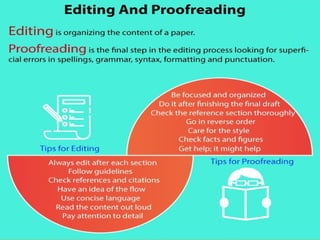
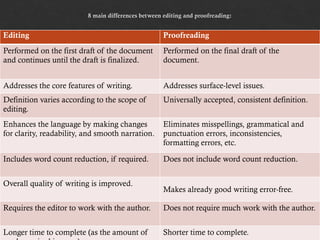
8 main differencesbetween editing and proofreading:
Editing Proofreading
Performed on the first draft of the document
and continues until the draft is finalized.
Performed on the final draft of the
document.
Addresses the core features of writing. Addresses surface-level issues.
Definition varies according to the scope of
editing.
Universally accepted, consistent definition.
Enhances the language by making changes
for clarity, readability, and smooth narration.
Eliminates misspellings, grammatical and
punctuation errors, inconsistencies,
formatting errors, etc.
Includes word count reduction, if required. Does not include word count reduction.
Overall quality of writing is improved.
Makes already good writing error-free.
Requires the editor to work with the author. Does not require much work with the author.
Longer time to complete (as the amount of Shorter time to complete.
37.
Final Checklist
✅Structure flows logically?
✅ Tone academic and consistent?
✅ Grammar, spelling, punctuation correct?
✅ Document neat and professional?
38.
Closing Thought
Editing= polishing ideas.
Proofreading = polishing language.
Together they ensure writing is clear, professional, and credible.
Tip: Always take a break before proofreading to spot mistakes
easily.
Editor's Notes
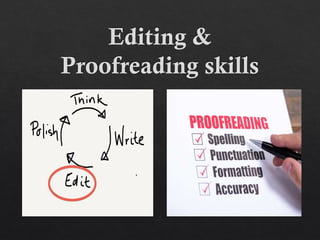
#1 "Good morning/afternoon, everyone. Welcome to our session on Editing and Proofreading Skills. These are the final, crucial steps in the writing process that transform a good piece of text into a great one. Today, we'll explore what they are, how they differ, and how you can apply these skills to your own work. Think of this as the polish that makes your ideas shine."
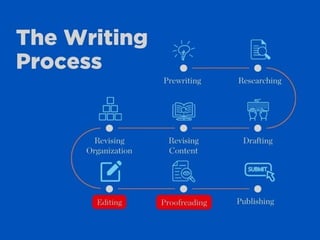
#2 The first step is "Writing," the second is "Revising" (misspelled as "Rewising"), and the third is "Proofreading" (misspelled as "Provreading").
Speaker Notes:
"This image provides a simplified, high-level overview of the writing process, breaking it down into three key stages.
The first stage is 'Writing.' This is the initial drafting phase, where the primary goal is to get your ideas out of your head and onto the page. At this point, don't worry about perfection—focus on creativity and content creation.
The second stage is 'Revising.' Now, you move from the 'writer' hat to the 'editor' hat. This is where you look at the big picture: reorganizing paragraphs for better flow, strengthening arguments, clarifying ideas, and cutting unnecessary content. It's about shaping and refining your draft.
The final stage is 'Proofreading.' This is the last line of defense, where you do a meticulous check for surface errors in grammar, spelling, punctuation, and formatting.
Now, here's a critical learning point from this very image: you'll notice that the words "Revising" and "Proofreading" are actually misspelled in the diagram. This perfectly illustrates why the process is so important! It's very easy for these kinds of small, typographical errors to slip through, even in a document about the writing process. It underscores that proofreading is a separate, essential step that requires a focused and careful eye, because our brains often auto-correct these mistakes when we read quickly."
#3 "So, what exactly is editing? It's not just fixing commas. Editing is a transformative process. It's about elevating the entire quality of your work—shaping the content, structure, and language to ensure it resonates with your readers. As the example shows, it turns disconnected points into a fluid and persuasive argument. It’s about improving clarity, flow, and overall organization."
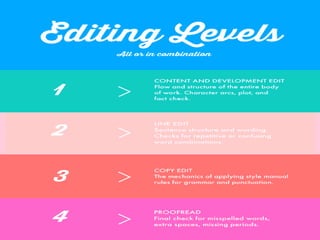
#5 Editing happens in stages. The first and most fundamental step is the Content or Structural Edit. This is the 'big picture' stage. Here, we're not looking at grammar; we're looking at the meat of the content: the plot, the arguments, the character development. An editor at this stage might suggest rearranging chapters, changing point of view, or even writing entirely new sections to strengthen the narrative. It's all about ensuring the core structure is sound and engaging for the audience."
#7 Once the structure is solid, we move to the Line Edit. This focuses on the sentence and paragraph level. The goal here is clarity and flow. A line editor takes apart clunky sentences and re-weaves them so the language reads effortlessly. As the text on the slide says, if two important sentences aren't pulling together, the line editor will tease them apart and restructure them until they do."
#8 The next stage is the Copy Edit. This is where we get into the mechanics and rules of language—grammar, spelling, punctuation, and consistency in style. This step can and should be aided by tools, but a human eye is essential. We use specific references, like a dictionary and a style manual—Chicago for fiction, APA or MLA for academia—to ensure every detail is standardized. This creates a consistent reading experience."
#9 Finally, we have Proofreading. This is the last quality check after all editing is complete. The proofreader is the last set of eyes, looking for any lingering typos, missed punctuation, or minor formatting errors. It's a painless, final polish. As noted, a proofreader isn't expected to critique content; their job is to catch the small mistakes that everyone else might have missed."
#10 A quick but important note on consistency. Different style guides have different rules, which can be frustrating. The key is to pick one—like the Chicago Manual for fiction—and stick with it throughout the entire document. A good copyeditor will provide a 'style sheet' to track these decisions. This familiarity not only ensures a consistent manuscript but also helps improve your own writing skills over time."
#12 "So, why go through all these steps? First and foremost, editing enhances clarity and consistency. Early drafts are often full of freely flowing ideas, which can lead to redundancies and inconsistencies. Editing rectifies this, ensuring your message is clear and your tone, style, and formatting are uniform. This professionalism is what captivates and retains readers."
#13 Editing also helps you structure your ideas. It refines sentences and improves the overall architecture of your text. It helps you arrange your arguments logically and strip away any unnecessary elements that deviate from your central theme, making your core message stronger."
#14 "A less glamorous but vital part of editing is checking the format. This includes verifying font, font size, margins, bullets, numbering, and adherence to word count limits. A professionally formatted document is much more credible and easier to read."
#15 Of course, editing polishes grammar. Proper grammar, punctuation, and syntax are the foundation of credible writing. A single misplaced comma can completely alter your meaning, leading to misinterpretation. Editing ensures your final product is seamless and communicates your content correctly."
#16 Finally, editing makes your content engaging. It acts as a filter, trimming off excess details, redundancies, and irrelevant tangents. By streamlining the narrative, editors help you maintain the reader's interest and make your text more comprehensible."
#17 Here's a concrete example. On the left, you see the original text—it has good points but the flow is choppy and the grammar is weak. On the right, after editing, the flow is smoother, the grammar is corrected, and the overall impact is far more professional. This demonstrates the transformative power of editing. Having a third-party editor can bring fresh perspectives and significantly increase your chances of publication."
#21 Now, let's turn specifically to Proofreading. If editing is about transforming the content, proofreading is about perfecting the language at a sentence level. It's the final check before submission or publication, focusing on grammar, punctuation, spelling, and word choice. At this stage, your ideas and structure are already in place; this is just about refining the details to be publication-ready."
#23 Why is it essential? Because any text shared with an audience needs to be error-free to be taken seriously, whether it's an academic paper, a job application, or a blog post. Depending on your needs, you can proofread it yourself, use an online tool, or hire a professional. The important thing is that it gets done."
#24 When you proofread, here are the common mistakes to hunt for. Homophones like 'their/there,' typos that create real words like 'form' instead of 'from,' punctuation mistakes, subject-verb agreement in long sentences, inconsistent formatting, and missing or repeated words. These are small errors that spell-checkers often miss, so a careful, human read is crucial."
#26 "If you're proofreading on paper, you'll need to know the standard proofreading marks. These are universal symbols that editors use to indicate changes. For example, this symbol means 'delete,' this one means 'insert a comma,' and this one means 'close up space.' Familiarizing yourself with these will help you interpret feedback quickly and accurately."
#28 How can you proofread effectively? First, take a break after writing so you can see the text with fresh eyes. Read slowly and out loud to catch awkward phrasing. Read backwards to focus on individual words. And finally, focus on one type of error at a time—for one pass, just check spelling; for the next, just check commas.
#33 You don't have to do it all alone. There are many excellent digital tools to assist you. Grammarly and ProWritingAid are great all-in-one options. The Hemingway App helps you improve readability. Tools like Sapling.ai and WordTune can even help with rewriting. Use these as assistants, not replacements, for your own critical eye."
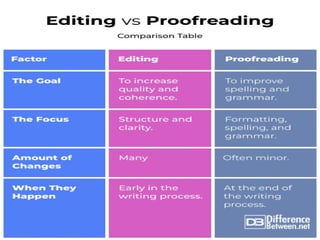
#36 Let's recap the key differences. Editing is holistic and happens in multiple stages throughout the revision process—it's about content, structure, and style. Proofreading is a final, surface-level check for errors. Editing asks 'Is this the best way to say this?'. Proofreading asks 'Is this sentence correct?'. Understanding this distinction is vital for an effective writing process."
#37 Before you submit any document, run through this final checklist. Is the structure logical? Is the tone consistent and appropriate? Are grammar, spelling, and punctuation correct? And finally, does the overall document look neat and professional? If you can answer 'yes' to all of these, you're ready to go."
#38 In closing, remember this: Editing is about polishing your ideas, while proofreading is about polishing your language. Together, they are a non-negotiable partnership that ensures your writing is clear, professional, and credible. And my final tip: always, always take a break before you start proofreading—it's the easiest way to spot those hidden mistakes. Thank you."