NEED OF SUSPENSION
& TYPES OF SPRINGS
SUBMITTED BY:- SUBMITTED TO:-
Shahfaiz Fayaz ER SUMIT KANCHANA
Roll no:- 11800730
What is Suspension
• Suspension is the system of tires, tire air, springs, shock
absorbers and linkages that connects a vehicle to its wheels
and allows relative motion between the two.
• Suspension System can also be defined as a springing system
which separates the Automobile Body from the Wheels thus
Isolating the body from the shocks and Vibrations
encountered on a Irregular road surface.
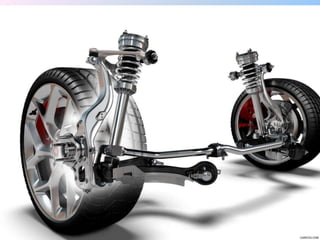
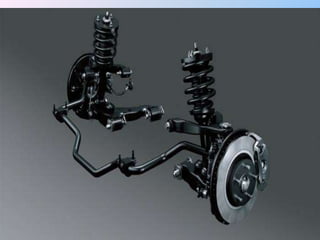
Main Parts of Suspensions System
• Wheels and tires.
• Springs & dampers.
• Shock absorbers and struts.
• Linkages.
• Bushings, bearings, and joints.
• Steering system — all types.
Hydraulic power steering & Electric power steering.
Functions of Suspension System
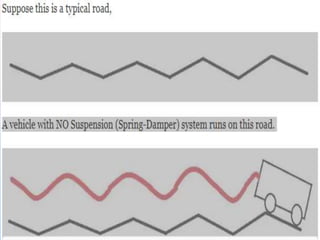
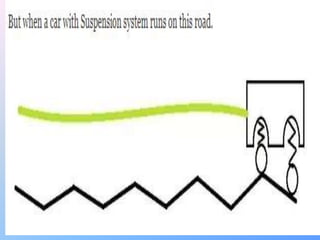
• It is used to absorb and dampen road shock by isolating the
chassis from the shocks due to bumps.
• Preserve the Stability of vehicle during Pitching and Rolling.
• To maintain proper Steering Geometry.
• A suspension system makes the wheel to have uniform
contact patch on the tire else the tire will suffer tread wear (
inside or outside ).
• The suspension system must not be soft it affects the
dynamics of the car as there will be too much body roll while
cornering. If its too soft the car suspension will react too
much for even small bumps
Different Loads Acting on suspension
system.
• Vertical loading
• Rolling load
• Pitch of the vehicles
Brake dip Squat
• Sprung & Unsprung weight
• Side Thrust
Types Of Springs
• A. Coil spring
• B. Leaf spring
• C. Air spring
• D. Torsion bar
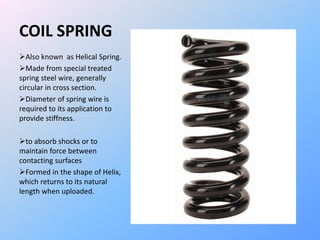
COIL SPRING
Also known as Helical Spring.
Made from special treated
spring steel wire, generally
circular in cross section.
Diameter of spring wire is
required to its application to
provide stiffness.
to absorb shocks or to
maintain force between
contacting surfaces
Formed in the shape of Helix,
which returns to its natural
length when uploaded.
Advantages
• Coil springs are used mainly with independent
suspension
• Requires less space and lighter in weight
• Energy stored per unit volume is double than
leaf spring
• Can take bending and shear stresses only but
cannot take torque reaction and side thrust
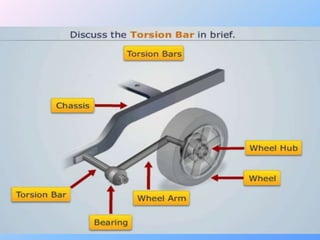
Torsion Bars
• It is also a form of helical spring, but it rotates about an axis
to create load.
• Its is a cylindrical rod which acts in torsion and take shear
stress only
• One end is attached to the frame and the other to the lower
control arm
• Made of heat treated alloy spring steel.
• When a wheel crosses a bump its moves up torsion gets
slightly twisted, thus absorbing the wheel vibration, as wheel
passes the bump, torsion bar reaches its original position and
released absorbed energy.
Advantages
• Requires less space & lighter in weight.
• Energy stored per unit weight is nearly same
as coil spring
Leaf Spring
 Sometimes it is also called as a semi-elliptical spring, as it
takes the form of a slender arc shaped length of spring steel
of rectangular cross section.
 The center of the arc provides the location for the axle,
while the tie holes are provided at either end for attaching to
the vehicle body.
 Heavy vehicles, leaves are stacked one upon the other to
ensure rigidity and strength.
 It provides dampness and springing function.
Leaf Spring
 Used in many early applications
 Internal friction provides damping
 Provide Lateral location for the axle
 Heavy & Prone to weaken over time
 Leaf springs are now limited to the rear of some cars

need of suspension

  • 1.
    NEED OF SUSPENSION &TYPES OF SPRINGS SUBMITTED BY:- SUBMITTED TO:- Shahfaiz Fayaz ER SUMIT KANCHANA Roll no:- 11800730
  • 2.
    What is Suspension •Suspension is the system of tires, tire air, springs, shock absorbers and linkages that connects a vehicle to its wheels and allows relative motion between the two. • Suspension System can also be defined as a springing system which separates the Automobile Body from the Wheels thus Isolating the body from the shocks and Vibrations encountered on a Irregular road surface.
  • 3.
    Main Parts ofSuspensions System • Wheels and tires. • Springs & dampers. • Shock absorbers and struts. • Linkages. • Bushings, bearings, and joints. • Steering system — all types. Hydraulic power steering & Electric power steering.
  • 6.
    Functions of SuspensionSystem • It is used to absorb and dampen road shock by isolating the chassis from the shocks due to bumps. • Preserve the Stability of vehicle during Pitching and Rolling. • To maintain proper Steering Geometry. • A suspension system makes the wheel to have uniform contact patch on the tire else the tire will suffer tread wear ( inside or outside ). • The suspension system must not be soft it affects the dynamics of the car as there will be too much body roll while cornering. If its too soft the car suspension will react too much for even small bumps
  • 7.
    Different Loads Actingon suspension system. • Vertical loading • Rolling load • Pitch of the vehicles Brake dip Squat • Sprung & Unsprung weight • Side Thrust
  • 10.
    Types Of Springs •A. Coil spring • B. Leaf spring • C. Air spring • D. Torsion bar
  • 11.
    COIL SPRING Also knownas Helical Spring. Made from special treated spring steel wire, generally circular in cross section. Diameter of spring wire is required to its application to provide stiffness. to absorb shocks or to maintain force between contacting surfaces Formed in the shape of Helix, which returns to its natural length when uploaded.
  • 12.
    Advantages • Coil springsare used mainly with independent suspension • Requires less space and lighter in weight • Energy stored per unit volume is double than leaf spring • Can take bending and shear stresses only but cannot take torque reaction and side thrust
  • 13.
    Torsion Bars • Itis also a form of helical spring, but it rotates about an axis to create load. • Its is a cylindrical rod which acts in torsion and take shear stress only • One end is attached to the frame and the other to the lower control arm • Made of heat treated alloy spring steel. • When a wheel crosses a bump its moves up torsion gets slightly twisted, thus absorbing the wheel vibration, as wheel passes the bump, torsion bar reaches its original position and released absorbed energy.
  • 15.
    Advantages • Requires lessspace & lighter in weight. • Energy stored per unit weight is nearly same as coil spring
  • 16.
    Leaf Spring  Sometimesit is also called as a semi-elliptical spring, as it takes the form of a slender arc shaped length of spring steel of rectangular cross section.  The center of the arc provides the location for the axle, while the tie holes are provided at either end for attaching to the vehicle body.  Heavy vehicles, leaves are stacked one upon the other to ensure rigidity and strength.  It provides dampness and springing function.
  • 17.
    Leaf Spring  Usedin many early applications  Internal friction provides damping  Provide Lateral location for the axle  Heavy & Prone to weaken over time  Leaf springs are now limited to the rear of some cars