Define the following word: Cell
1.1  Animal Cells Today’s Learning Objectives: State what cells are Distinguish between unicellular and  multicellular organisms Name three structures in animal cells Labelled diagram of animal cell  Main features and function of animal cell  structures The need for using stains when looking at  cells with a microscope
Typical Animal Cell Cytoplasm Nucleus Cell membrane
Unicellular Amoeba Unicellular animal found in pools  and puddles -Nucleus contains all genetic information -Numerous ‘feet’ extensions (pseudopodia) which allow movement, and catch food
Cells forming tissues Bone cells Nerve cells Cardiac muscle cells
Looking at Animal Cells Examine prepared slides of animal cells using the procedure outlined in the booklet. Draw an accurate biological drawing of a few cells. Prepare and examine a slide of your own cheek cells. Draw an accurate biological drawing of a few of your cells.
1.2  Plant Cells Today’s Learning Objectives: Name six structures present in plant cells Draw a plant cell with these structures  labelled Describe the features and functions of  these structures Name a stain used to examine plant cells  by microscope
Typical Plant Cell Cytoplasm Nucleus Cell membrane Sap vacuole Cell Wall Chloroplast
Cell Structure and Function Contains a green chemical called chlorophyll. This green chemical absorbs sunlight to carry out photosynthesis to make food Chloroplast Controls the water content of the plant cell Sap Vacuole Rigid firm coating around the plant cell. It helps to keep the cell shape Cell wall Controls substances that  enter   and   exit  the cell, e.g. oxygen, carbon dioxide and food Membrane Jelly like fluid which is the site of chemical reactions in the cell Cytoplasm Control centre of the cell. Contains information which controls everything that goes on in the cell Nucleus Function Structure
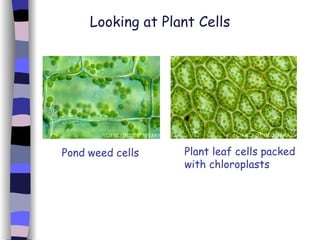
Looking at Plant Cells Pond weed cells Plant leaf cells packed with chloroplasts
1.3  Cell Variety Today’s Learning Objectives: Name three main types of cell State similarities and differences  between animal and plant cells Define the term microbe Calculate microbial cell reproduction rates Give three examples of microbial cells State the power of microscope needed to  see bacterial cells
Microbes are microscopic unicellular organisms Some can be harmful and cause disease  (bacteria, viruses and parasites Others can be useful and used to make products  in the biotechnology industries: -Yeast: brewing, breadmaking -Fungi: Antibiotics -Bacteria: cheese and yoghurt  production
Paramecium Unicellular animals found in fresh water pools Feed on bacteria Covered in cilia which beat in a wave for movement Cell division Tiny hairs (cilia)
Vorticella Bell shaped heads have tiny hairs (cilia) which waft food towards them - Cilia are also used for movement Each head is attached to a stalk which anchors to a surface -When disturbed it can contract the stalk for protection
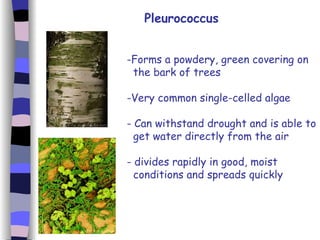
Pleurococcus Forms a powdery, green covering on  the bark of trees Very common single-celled algae Can withstand drought and is able to  get water directly from the air divides rapidly in good, moist  conditions and spreads quickly
Amoeba Unicellular animal found in pools  and puddles -Nucleus contains all genetic information -Numerous ‘feet’ extensions (pseudopodia) which allow movement, and catch food An amoeba on a wash cloth These little things are bacteria!
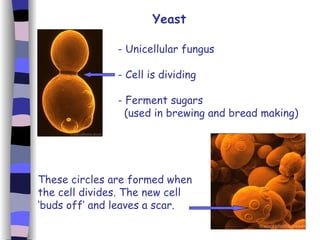
Yeast - Unicellular fungus  - Cell is dividing - Ferment sugars  (used in brewing and bread making) These circles are formed when  the cell divides. The new cell  ‘ buds off’ and leaves a scar.
1.4  Cells and Biotechnology Today’s Learning Objectives: Describe the fermentation process in yeast Name three industries in which yeast is used State the source of sugar in each of these  industries Describe how antibiotics are produced Give a use for antibiotics Name the microbe type used in yoghurt  making Write the word equation for lactic acid  production by yoghurt bacteria
Sugar Alcohol  + Carbon Dioxide Fermentation by Yeast Biotechnology involves putting cells  to work Fermentation is a biological process in which microbes (e.g. yeast cells), convert sugar into alcohol and carbon dioxide.
The discovery of Sir Alexander Fleming! ANTIBIOTICS Fungus Bacteria
Antibiotics are antibacterial (bacteria killing)  chemicals, produced by fungus Obtained industrially by growing yeast in large  fermentation vessels, provided with food. Liquid  produced is filtered out and antibiotics purified Antibiotics only work against bacteria, so not  used against viruses such as the cold or flu Problems arise when bacteria built up resistance  to antibiotics and they no longer kill them e.g. hospital ‘superbugs’ that are always in the news MRSA= Methicillin Resistant Staphylococcus Aureus
Yoghurt Making Lactose Lactic acid Bacteria Sugar found in milk Reduces pH of milk causing it to clot (thicken) Bacteria convert lactose into lactic acid
What substances need to get into and out of cells? How do they do this?
1.5  Cells and Diffusion Today’s Learning Objectives: Name the method by which substances move in  and out of cells Define diffusion State when diffusion will stop From diagrams, predict the direction of  movement of substances by diffusion State which substances enter and leave living  cells by diffusion Give one reason why diffusion is important to  whole organisms
Substances have to pass into and out of cells These movements most commonly occur by diffusion Diffusion is the movement of molecules from an area of  HIGH  concentration to an area of  LOW  concentration until they are  EVENLY  spread
http://highered.mcgraw-hill.com/sites/0072495855/student_view0/chapter2/animation__how_diffusion_works.html Animation of diffusion Click on address to view
Food molecules Oxygen molecules Carbon dioxide  molecules Diffusion in or out of a living cell
1.6  Cells and Osmosis Today’s Learning Objectives: Name the method by which water passes in  and out of cells Explain what a selectively permeable membrane is State what osmosis is using the terms  selectively permeable membrane and concentration  gradient Identify water concentration gradients when  given solute concentrations Predict the direction of water movement between  two solutions of know concentration Describe and predict a visking tubing experiment
OSMOSIS  is the special diffusion of  WATER  from a  HIGH WATER  concentration to a  LOW WATER  concentration through a  SELECTIVELY PERMEABLE MEMBRANE A membrane which is  selectively permeable  allows certain molecules to pass through but not others.
Membrane fully permeable to small molecules e.g. water Membrane slowly permeable to larger molecules e.g. sugar Membrane is not permeable to huge molecules e.g. starch Selectively permeable membrane Nucleus Cytoplasm
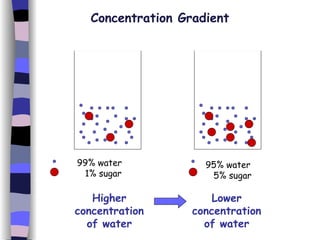
Concentration Gradient 99% water 1% sugar 95% water 5% sugar Higher concentration of water Lower concentration of water
Water moves down a concentration gradient by  OSMOSIS  from  high to low  concentration Lower concentration of water Higher concentration of water Water molecule Sugar molecule Selectively permeable membrane
http://highered.mcgraw-hill.com/sites/0072495855/student_view0/chapter2/animation__how_osmosis_works.html Osmosis Animation Click on address to view
1.7  Osmotic Effects on Cells Today’s Learning Objectives: Explain why osmotic effects are different on  plant and animal cells State the meaning of isotonic, hypertonic and  hypotonic Describe the effect on plant cells of emmersion  in different solutions State the meanings of flaccid, turgid, plasmolysed Predict the effect of different solutions on plant cells and label diagrams Recognise and label plant cells in various  conditions Describe and predict the effect of animal cells on emmersion in different solutions
Water Concentrations A  dilute  sugar solution has a  high water  concentration A  concentrated  solutions has a  low water  concentration Water moves in or out of a cell depending on whether the water concentration outside the cell is higher or lower than the water concentration inside the cell
A  HYPOTONIC  solution has a  higher water concentration  than inside the cell A  HYPERTONIC  solution has a  lower water concentration  than inside the cell An  ISOTONIC  solution has a water concentration  equal to  the water concentration in the cell

1. Introduction To Cells

  • 1.
  • 2.
    1.1 AnimalCells Today’s Learning Objectives: State what cells are Distinguish between unicellular and multicellular organisms Name three structures in animal cells Labelled diagram of animal cell Main features and function of animal cell structures The need for using stains when looking at cells with a microscope
  • 3.
    Typical Animal CellCytoplasm Nucleus Cell membrane
  • 4.
    Unicellular Amoeba Unicellularanimal found in pools and puddles -Nucleus contains all genetic information -Numerous ‘feet’ extensions (pseudopodia) which allow movement, and catch food
  • 5.
    Cells forming tissuesBone cells Nerve cells Cardiac muscle cells
  • 6.
    Looking at AnimalCells Examine prepared slides of animal cells using the procedure outlined in the booklet. Draw an accurate biological drawing of a few cells. Prepare and examine a slide of your own cheek cells. Draw an accurate biological drawing of a few of your cells.
  • 7.
    1.2 PlantCells Today’s Learning Objectives: Name six structures present in plant cells Draw a plant cell with these structures labelled Describe the features and functions of these structures Name a stain used to examine plant cells by microscope
  • 8.
    Typical Plant CellCytoplasm Nucleus Cell membrane Sap vacuole Cell Wall Chloroplast
  • 9.
    Cell Structure andFunction Contains a green chemical called chlorophyll. This green chemical absorbs sunlight to carry out photosynthesis to make food Chloroplast Controls the water content of the plant cell Sap Vacuole Rigid firm coating around the plant cell. It helps to keep the cell shape Cell wall Controls substances that enter and exit the cell, e.g. oxygen, carbon dioxide and food Membrane Jelly like fluid which is the site of chemical reactions in the cell Cytoplasm Control centre of the cell. Contains information which controls everything that goes on in the cell Nucleus Function Structure
  • 10.
    Looking at PlantCells Pond weed cells Plant leaf cells packed with chloroplasts
  • 11.
    1.3 CellVariety Today’s Learning Objectives: Name three main types of cell State similarities and differences between animal and plant cells Define the term microbe Calculate microbial cell reproduction rates Give three examples of microbial cells State the power of microscope needed to see bacterial cells
  • 12.
    Microbes are microscopicunicellular organisms Some can be harmful and cause disease (bacteria, viruses and parasites Others can be useful and used to make products in the biotechnology industries: -Yeast: brewing, breadmaking -Fungi: Antibiotics -Bacteria: cheese and yoghurt production
  • 13.
    Paramecium Unicellular animalsfound in fresh water pools Feed on bacteria Covered in cilia which beat in a wave for movement Cell division Tiny hairs (cilia)
  • 14.
    Vorticella Bell shapedheads have tiny hairs (cilia) which waft food towards them - Cilia are also used for movement Each head is attached to a stalk which anchors to a surface -When disturbed it can contract the stalk for protection
  • 15.
    Pleurococcus Forms apowdery, green covering on the bark of trees Very common single-celled algae Can withstand drought and is able to get water directly from the air divides rapidly in good, moist conditions and spreads quickly
  • 16.
    Amoeba Unicellular animalfound in pools and puddles -Nucleus contains all genetic information -Numerous ‘feet’ extensions (pseudopodia) which allow movement, and catch food An amoeba on a wash cloth These little things are bacteria!
  • 17.
    Yeast - Unicellularfungus - Cell is dividing - Ferment sugars (used in brewing and bread making) These circles are formed when the cell divides. The new cell ‘ buds off’ and leaves a scar.
  • 18.
    1.4 Cellsand Biotechnology Today’s Learning Objectives: Describe the fermentation process in yeast Name three industries in which yeast is used State the source of sugar in each of these industries Describe how antibiotics are produced Give a use for antibiotics Name the microbe type used in yoghurt making Write the word equation for lactic acid production by yoghurt bacteria
  • 19.
    Sugar Alcohol + Carbon Dioxide Fermentation by Yeast Biotechnology involves putting cells to work Fermentation is a biological process in which microbes (e.g. yeast cells), convert sugar into alcohol and carbon dioxide.
  • 20.
    The discovery ofSir Alexander Fleming! ANTIBIOTICS Fungus Bacteria
  • 21.
    Antibiotics are antibacterial(bacteria killing) chemicals, produced by fungus Obtained industrially by growing yeast in large fermentation vessels, provided with food. Liquid produced is filtered out and antibiotics purified Antibiotics only work against bacteria, so not used against viruses such as the cold or flu Problems arise when bacteria built up resistance to antibiotics and they no longer kill them e.g. hospital ‘superbugs’ that are always in the news MRSA= Methicillin Resistant Staphylococcus Aureus
  • 22.
    Yoghurt Making LactoseLactic acid Bacteria Sugar found in milk Reduces pH of milk causing it to clot (thicken) Bacteria convert lactose into lactic acid
  • 23.
    What substances needto get into and out of cells? How do they do this?
  • 24.
    1.5 Cellsand Diffusion Today’s Learning Objectives: Name the method by which substances move in and out of cells Define diffusion State when diffusion will stop From diagrams, predict the direction of movement of substances by diffusion State which substances enter and leave living cells by diffusion Give one reason why diffusion is important to whole organisms
  • 25.
    Substances have topass into and out of cells These movements most commonly occur by diffusion Diffusion is the movement of molecules from an area of HIGH concentration to an area of LOW concentration until they are EVENLY spread
  • 26.
  • 27.
    Food molecules Oxygenmolecules Carbon dioxide molecules Diffusion in or out of a living cell
  • 28.
    1.6 Cellsand Osmosis Today’s Learning Objectives: Name the method by which water passes in and out of cells Explain what a selectively permeable membrane is State what osmosis is using the terms selectively permeable membrane and concentration gradient Identify water concentration gradients when given solute concentrations Predict the direction of water movement between two solutions of know concentration Describe and predict a visking tubing experiment
  • 29.
    OSMOSIS isthe special diffusion of WATER from a HIGH WATER concentration to a LOW WATER concentration through a SELECTIVELY PERMEABLE MEMBRANE A membrane which is selectively permeable allows certain molecules to pass through but not others.
  • 30.
    Membrane fully permeableto small molecules e.g. water Membrane slowly permeable to larger molecules e.g. sugar Membrane is not permeable to huge molecules e.g. starch Selectively permeable membrane Nucleus Cytoplasm
  • 31.
    Concentration Gradient 99%water 1% sugar 95% water 5% sugar Higher concentration of water Lower concentration of water
  • 32.
    Water moves downa concentration gradient by OSMOSIS from high to low concentration Lower concentration of water Higher concentration of water Water molecule Sugar molecule Selectively permeable membrane
  • 33.
  • 34.
    1.7 OsmoticEffects on Cells Today’s Learning Objectives: Explain why osmotic effects are different on plant and animal cells State the meaning of isotonic, hypertonic and hypotonic Describe the effect on plant cells of emmersion in different solutions State the meanings of flaccid, turgid, plasmolysed Predict the effect of different solutions on plant cells and label diagrams Recognise and label plant cells in various conditions Describe and predict the effect of animal cells on emmersion in different solutions
  • 35.
    Water Concentrations A dilute sugar solution has a high water concentration A concentrated solutions has a low water concentration Water moves in or out of a cell depending on whether the water concentration outside the cell is higher or lower than the water concentration inside the cell
  • 36.
    A HYPOTONIC solution has a higher water concentration than inside the cell A HYPERTONIC solution has a lower water concentration than inside the cell An ISOTONIC solution has a water concentration equal to the water concentration in the cell