BIG HISTORY
The History of the Universe
How old is Planet Earth?
• Summit Academy’s is 6 years old
• You are 14 years old (and counting)
• The the United States is 237 years old (1776-
2013)
• But Planet Earth is 13.7 billion years old
How long is 13.7 billion years?
• Let’s take a second to get our minds around
that figure.
• A million seconds is about 11.5 days.
• To count to a billion it would take you 1,000
times as long, about 32 years.
• And to count to 13.7 billion would take you
over 400 years.
What about mankind?
How long have we existed?
• Mankind has only existed about 200,000
years. That’s a VERY short time compared to
the life of planet Earth!
Here’s another way of
looking at how short a
time humans have existed
compared with the life of
our planet:
The Empire State Building is
1,454 feet tall. The area
represented by human life on
planet Earth is only 58 feet!
That’s only 1/26th of the
building!
An Introduction to
Primary and Secondary Sources
What are primary sources?
• Original records from the past recorded by
people who were:
– Involved in the event
– Witnessed the event, OR
– Knew the persons involved in the event
• They can also be objects (artifacts) or visual
evidence.
• They give you an idea about what people alive
at the time saw or thought about the event.
What are primary sources?
• Keep in mind that a primary source reflects
only one point of view and may contain a
person’s bias (prejudice) toward an event.
What are primary sources?
Examples of primary sources:
Books, magazines, newspapers
Printed Publications
Examples of primary sources:
Personal Records
Diaries, journals, records
Examples of primary sources:
Visual Materials
Paintings, drawings, sculpture
Examples of primary sources:
Visual Materials
photographs, film, maps
Examples of primary sources:
Oral Histories
Chronicles, memoirs, myths, legends passed down by word of mouth
Examples of primary sources:
Songs and Poems
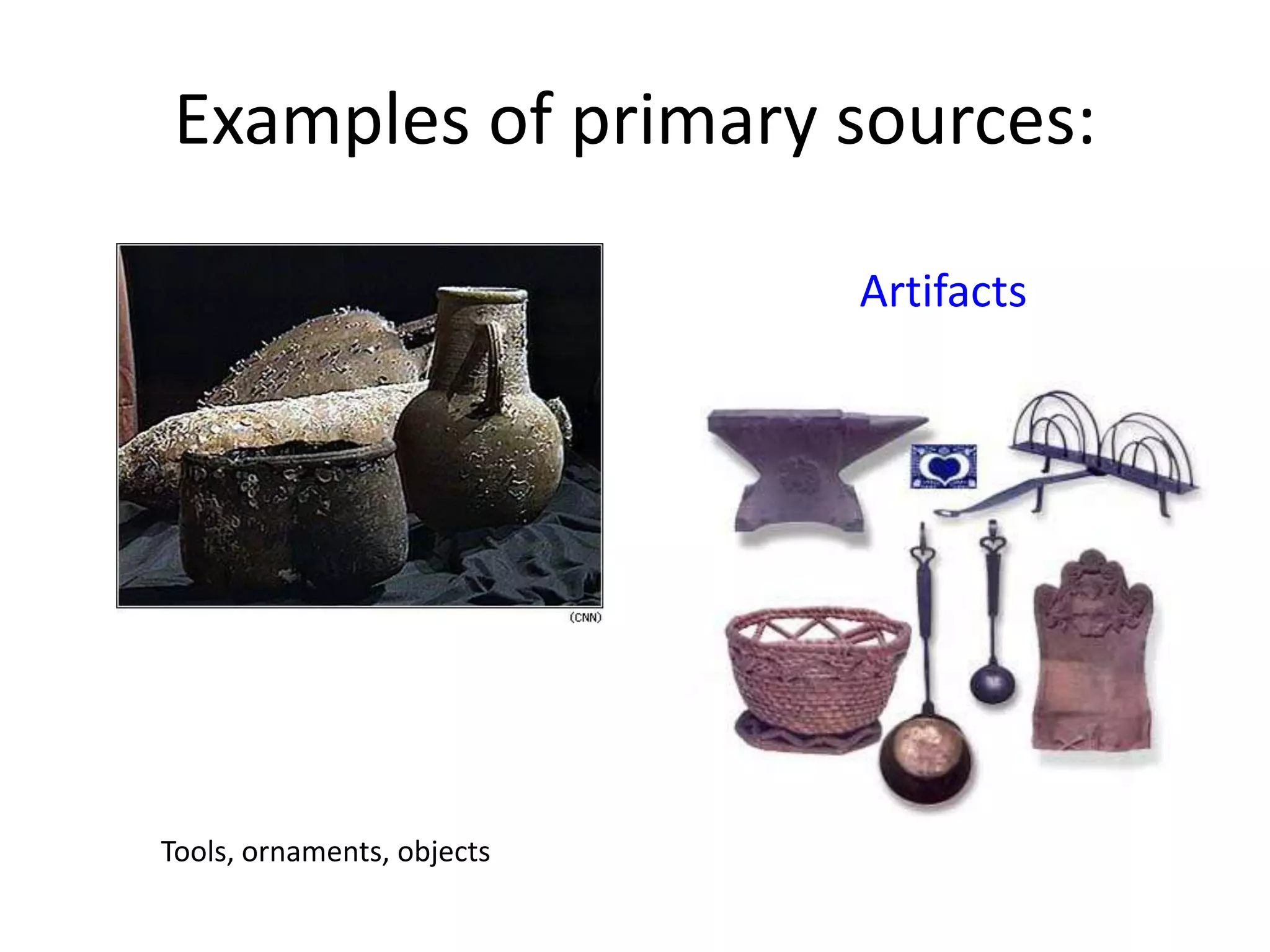
Examples of primary sources:
Artifacts
Tools, ornaments, objects
Secondary Sources
What are secondary sources?
• Secondary sources are made at a later time.
• They include written information by historians
or others AFTER an event has taken place.
What are secondary sources?
Although they can be useful and reliable,
they cannot reflect what people who lived
at the time thought or felt about the event.
But they can represent a more fair account
of the event because they can include more
than one point of view, or may include
information that was unavailable at the
time of the event.
Examples of secondary sources:
Textbooks, biographies, histories,
newspaper report by someone who
was not present
Examples of secondary sources:
Charts, graphs, or images created
AFTER the time period.
Name that Source!
The following slides contain examples of
primary and secondary sources. See if you can
classify each example as a primary or secondary
source.
Classify these: primary or secondary?
Classify these:
Classify these:
Classify these:
Classify these:
Classify these:
Classify these:
Classify these:
Who uses primary and secondary
sources to study history?
• SOCIAL SCIENTISTS study all aspects of
society—from past events and achievements
to human behavior and relationships among
groups.
4 Main Types of Social Scientists
• ANTHROPOLOGISTS study the origins and
development of human beings and their
cultures through oral histories,
archaeological evidence, and cultural
histories. Some anthropologists study the
development of early human beings.
• GEOGRAPHERS study the Earth’s surface, and
how location influences the way people live.
For example, a geographer would study how a
climate influences the kinds of food a
civilization produces.
• An ECONOMIST studies the production,
distribution, and consumption of goods and
services. Basically, they study the supply and
flow of money, resources and goods.
ARCHEOLOGISTS study the physical artifacts of
a culture. They study past human life as shown
by fossil relics and the monuments and tools
left by ancient peoples..
• past human life as shown by fossil relics and
the monuments and tools left by ancient
peoples

Ptm 1.5 big history powerpoint

  • 1.
    BIG HISTORY The Historyof the Universe
  • 2.
    How old isPlanet Earth? • Summit Academy’s is 6 years old • You are 14 years old (and counting) • The the United States is 237 years old (1776- 2013) • But Planet Earth is 13.7 billion years old
  • 3.
    How long is13.7 billion years? • Let’s take a second to get our minds around that figure. • A million seconds is about 11.5 days. • To count to a billion it would take you 1,000 times as long, about 32 years. • And to count to 13.7 billion would take you over 400 years.
  • 4.
    What about mankind? Howlong have we existed? • Mankind has only existed about 200,000 years. That’s a VERY short time compared to the life of planet Earth!
  • 5.
    Here’s another wayof looking at how short a time humans have existed compared with the life of our planet: The Empire State Building is 1,454 feet tall. The area represented by human life on planet Earth is only 58 feet! That’s only 1/26th of the building!
  • 6.
    An Introduction to Primaryand Secondary Sources
  • 7.
    What are primarysources? • Original records from the past recorded by people who were: – Involved in the event – Witnessed the event, OR – Knew the persons involved in the event
  • 8.
    • They canalso be objects (artifacts) or visual evidence. • They give you an idea about what people alive at the time saw or thought about the event. What are primary sources?
  • 9.
    • Keep inmind that a primary source reflects only one point of view and may contain a person’s bias (prejudice) toward an event. What are primary sources?
  • 10.
    Examples of primarysources: Books, magazines, newspapers Printed Publications
  • 11.
    Examples of primarysources: Personal Records Diaries, journals, records
  • 12.
    Examples of primarysources: Visual Materials Paintings, drawings, sculpture
  • 13.
    Examples of primarysources: Visual Materials photographs, film, maps
  • 14.
    Examples of primarysources: Oral Histories Chronicles, memoirs, myths, legends passed down by word of mouth
  • 15.
    Examples of primarysources: Songs and Poems
  • 16.
    Examples of primarysources: Artifacts Tools, ornaments, objects
  • 17.
  • 18.
    What are secondarysources? • Secondary sources are made at a later time. • They include written information by historians or others AFTER an event has taken place.
  • 19.
    What are secondarysources? Although they can be useful and reliable, they cannot reflect what people who lived at the time thought or felt about the event. But they can represent a more fair account of the event because they can include more than one point of view, or may include information that was unavailable at the time of the event.
  • 20.
    Examples of secondarysources: Textbooks, biographies, histories, newspaper report by someone who was not present
  • 21.
    Examples of secondarysources: Charts, graphs, or images created AFTER the time period.
  • 22.
    Name that Source! Thefollowing slides contain examples of primary and secondary sources. See if you can classify each example as a primary or secondary source.
  • 23.
  • 24.
  • 25.
  • 26.
  • 27.
  • 28.
  • 29.
  • 30.
  • 31.
    Who uses primaryand secondary sources to study history? • SOCIAL SCIENTISTS study all aspects of society—from past events and achievements to human behavior and relationships among groups.
  • 32.
    4 Main Typesof Social Scientists
  • 33.
    • ANTHROPOLOGISTS studythe origins and development of human beings and their cultures through oral histories, archaeological evidence, and cultural histories. Some anthropologists study the development of early human beings.
  • 34.
    • GEOGRAPHERS studythe Earth’s surface, and how location influences the way people live. For example, a geographer would study how a climate influences the kinds of food a civilization produces.
  • 35.
    • An ECONOMISTstudies the production, distribution, and consumption of goods and services. Basically, they study the supply and flow of money, resources and goods.
  • 36.
    ARCHEOLOGISTS study thephysical artifacts of a culture. They study past human life as shown by fossil relics and the monuments and tools left by ancient peoples..
  • 37.
    • past humanlife as shown by fossil relics and the monuments and tools left by ancient peoples