Archaeologists and Objects

       Urban Archaeology
           Session 7
What is an artefact?
“any portable object used, made or modified by
humans.”
                       - Renfrew and Bahn, 2001
• Artefacts and Ecofacts
Primary Context of Artefacts
• Matrix – what is around the object (usually
  sediment)
• Provenance – the horizontal and vertical
  position of the object in the matrix
• Principle of Association – other finds that the
  object is associated with (usually in the same
  matrix)
• If something has been moved, it can be in a
  secondary context.
Formation Processes
How archaeologists understand how something
has come to be buried:
• Cultural Formation Processes
  – Deliberate/accidental human behaviours that lead
    to the burial of an object
• Non-cultural / Natural Formation Processes
  – Natural events that lead to the burial of an object
                           - Renfrew & Bahn, 2001: 52
Objects in the Urban Landscape
But what about when the object is not where
people left it?
• Processes of moving objects
• Variety of primary contexts / secondary
  contexts – It is not always in an excavation
  context
  – e.g. looking in the attic, a wall cavity, digging a
    new bed in the garden.
Dating Objects
• Spot Dating (during excavation)
• Post-excavation dating
• Absolute Dating
  – computed numerical date
• Relative Dating
  – order of events
  – Stratigraphic Dating
     • Terminus Post Quem / Terminus Ante Quem
     • ‘Limit (Date) after which’ / ‘Date before which’
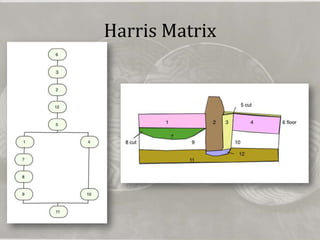
Harris Matrix
Archaeologists & Objects:
       A History
History of thinking about objects
                 1950s
• “The archaeologist is digging up, not things, but
  people” – Wheeler, 1954: 13
• Childe developed the idea of cultures, which
  represented peoples/societies and associated
  material culture traits in the same time and place
  – Childe, 1956: 3
• Classify things then look for connections between
  entities. i.e. “diffusion of ideas, migration,
  invasion or internal innovation” – Shanks and
  Tilley, 1992: 117
History of thinking about objects
                 1970s
• Renfrew (1978) questions classification. Cultures are
  arbitrary.
• Shennan (1978) looked at locations and variability of
  Beaker finds to challenge the idea of a coherent
  cultural tradition.
• Binford (1972) criticized the definition of artefacts as
  expressions of social norms specific to distinct groups.
  He argued there were not distinct cultures and
  interactions between those cultures, but there were
  culture systems that were adaptive and this explains
  where there is variability in the archaeological record.
Normative vs. Social Archaeology
             1970-80s
• Normative Archaeology could not tell us
  anything about non-material things in society
  such as religion, beliefs or politics
• Social Archaeology can tell us what the
  relationship between society and environment
  is, with material culture as the mediator. This
  led to attempts to reconstruct past societies
  using schemes of social evolution, often based
  on analysis of existing societies.
Social Archaeology might not work
               1980s
• Tilley (1981) and Hodder (1982) questioned
  this approach.
• The issue is that this approach relies on being
  able to explain a social element by referring to
  the part that something plays in maintaining
  keeping the social ‘whole’.
An example of how it might not work
• Understanding a ritual.
• Rappaport (1967: 224-42) says a ritual is:
   – “an information exchange device communicating
     cultural, ecological and demographic data across the
     boundaries of social groups”.
• So a ritual is doing something in the society:
   – “rituals regulate the dispersal of human populations,
     preserve a balance between farmed and fallowed
     land, and keep domestic animals within an adaptive
     goal range (Rappaport, 1971)
But… its too functional an
              explanation
• This tells us something about the ritual’s
  presence, but it doesn’t tell us:
  – The form of the ritual
  – The content of the ritual
  – Why one type of ritual should occur rather than
    another.
                    - Shanks and Tilley, 1992: 117
When You Find An Object…
What to do when you find an object
• When over 300 years old:
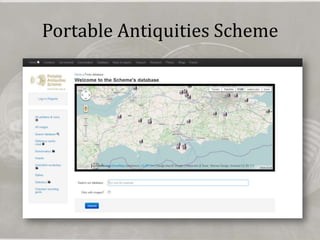
Portable Antiquities Scheme
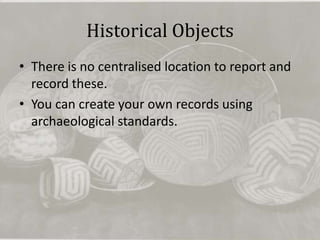
Historical Objects
• There is no centralised location to report and
  record these.
• You can create your own records using
  archaeological standards.

Urban Archaeology Session 7: Archaeologists and Objects

  • 1.
    Archaeologists and Objects Urban Archaeology Session 7
  • 2.
    What is anartefact? “any portable object used, made or modified by humans.” - Renfrew and Bahn, 2001 • Artefacts and Ecofacts
  • 3.
    Primary Context ofArtefacts • Matrix – what is around the object (usually sediment) • Provenance – the horizontal and vertical position of the object in the matrix • Principle of Association – other finds that the object is associated with (usually in the same matrix) • If something has been moved, it can be in a secondary context.
  • 4.
    Formation Processes How archaeologistsunderstand how something has come to be buried: • Cultural Formation Processes – Deliberate/accidental human behaviours that lead to the burial of an object • Non-cultural / Natural Formation Processes – Natural events that lead to the burial of an object - Renfrew & Bahn, 2001: 52
  • 5.
    Objects in theUrban Landscape But what about when the object is not where people left it? • Processes of moving objects • Variety of primary contexts / secondary contexts – It is not always in an excavation context – e.g. looking in the attic, a wall cavity, digging a new bed in the garden.
  • 6.
    Dating Objects • SpotDating (during excavation) • Post-excavation dating • Absolute Dating – computed numerical date • Relative Dating – order of events – Stratigraphic Dating • Terminus Post Quem / Terminus Ante Quem • ‘Limit (Date) after which’ / ‘Date before which’
  • 7.
  • 8.
  • 9.
    History of thinkingabout objects 1950s • “The archaeologist is digging up, not things, but people” – Wheeler, 1954: 13 • Childe developed the idea of cultures, which represented peoples/societies and associated material culture traits in the same time and place – Childe, 1956: 3 • Classify things then look for connections between entities. i.e. “diffusion of ideas, migration, invasion or internal innovation” – Shanks and Tilley, 1992: 117
  • 10.
    History of thinkingabout objects 1970s • Renfrew (1978) questions classification. Cultures are arbitrary. • Shennan (1978) looked at locations and variability of Beaker finds to challenge the idea of a coherent cultural tradition. • Binford (1972) criticized the definition of artefacts as expressions of social norms specific to distinct groups. He argued there were not distinct cultures and interactions between those cultures, but there were culture systems that were adaptive and this explains where there is variability in the archaeological record.
  • 11.
    Normative vs. SocialArchaeology 1970-80s • Normative Archaeology could not tell us anything about non-material things in society such as religion, beliefs or politics • Social Archaeology can tell us what the relationship between society and environment is, with material culture as the mediator. This led to attempts to reconstruct past societies using schemes of social evolution, often based on analysis of existing societies.
  • 12.
    Social Archaeology mightnot work 1980s • Tilley (1981) and Hodder (1982) questioned this approach. • The issue is that this approach relies on being able to explain a social element by referring to the part that something plays in maintaining keeping the social ‘whole’.
  • 13.
    An example ofhow it might not work • Understanding a ritual. • Rappaport (1967: 224-42) says a ritual is: – “an information exchange device communicating cultural, ecological and demographic data across the boundaries of social groups”. • So a ritual is doing something in the society: – “rituals regulate the dispersal of human populations, preserve a balance between farmed and fallowed land, and keep domestic animals within an adaptive goal range (Rappaport, 1971)
  • 14.
    But… its toofunctional an explanation • This tells us something about the ritual’s presence, but it doesn’t tell us: – The form of the ritual – The content of the ritual – Why one type of ritual should occur rather than another. - Shanks and Tilley, 1992: 117
  • 15.
    When You FindAn Object…
  • 16.
    What to dowhen you find an object • When over 300 years old:
  • 17.
  • 18.
    Historical Objects • Thereis no centralised location to report and record these. • You can create your own records using archaeological standards.

Editor's Notes

  • #8 Take the hypothetical section fig A. Here we can see 12 contexts, each numbered with a unique context number and whose sequence is represented in the Harris matrix in fig B.A horizontal layerMasonry wall remnantBackfill of the wall construction trench (sometimes called construction cut)A horizontal layer, probably the same as 1Construction cut for wall 2A clay floor abutting wall 2Fill of shallow cut 8Shallow pit cutA horizontal layerA horizontal layer, probably the same as 9Natural sterile ground formed before human occupation of the siteTrample in the base of cut 5 formed by workmen's boots constructing the structure wall 2 and floor 6 is associated with.If we know the date of context 1 and context 9 we can deduce that context 7, the backfilling of pit 8, occurred sometime after the date for 9 but before the date for 1, and if we recover an assemblage of artifacts from context 7 that occur nowhere else in the sequence, we have isolated them with a reasonable degree of certainty to a discrete range of time. In this instance we can now use the date we have for finds in context 7 to date other sites and sequences. In practice a huge amount of cross referencing with other recorded sequences is required to produce dating series from stratigraphic relationships such as the work in seriation.From:http://en.wikipedia.org/wiki/Dating_methodologies_in_archaeology