INFOMATICA ACADEMY CONTACT: 9821131002/9029004242
Degree Sem - I Important Engineering Materials162
Important Engineering Materials
 Syllabus:
 Cement: Manufacture of Portland cement, Chemical composition & Constitution of
Portland Cement, Setting & Hardening of Portland cement, Concrete RCC & Decay.
Refractories Preparation, properties and uses of silica Dolomite bricks, Silicon
Carbide (SiC).
 Nano materials, preparation (laser & CVD method), properties & uses of CNTS.
 Introduction:
 Cement is described as material possessing adhesive & cohesive properties &
capable of bonding materials like stones, bricks, building blocks Etc.
 The principle constituents of cement used for constructional purpose are
Calcareous: Compounds of calcium (Ca)
Argillaceous: Compounds of Al + Si.
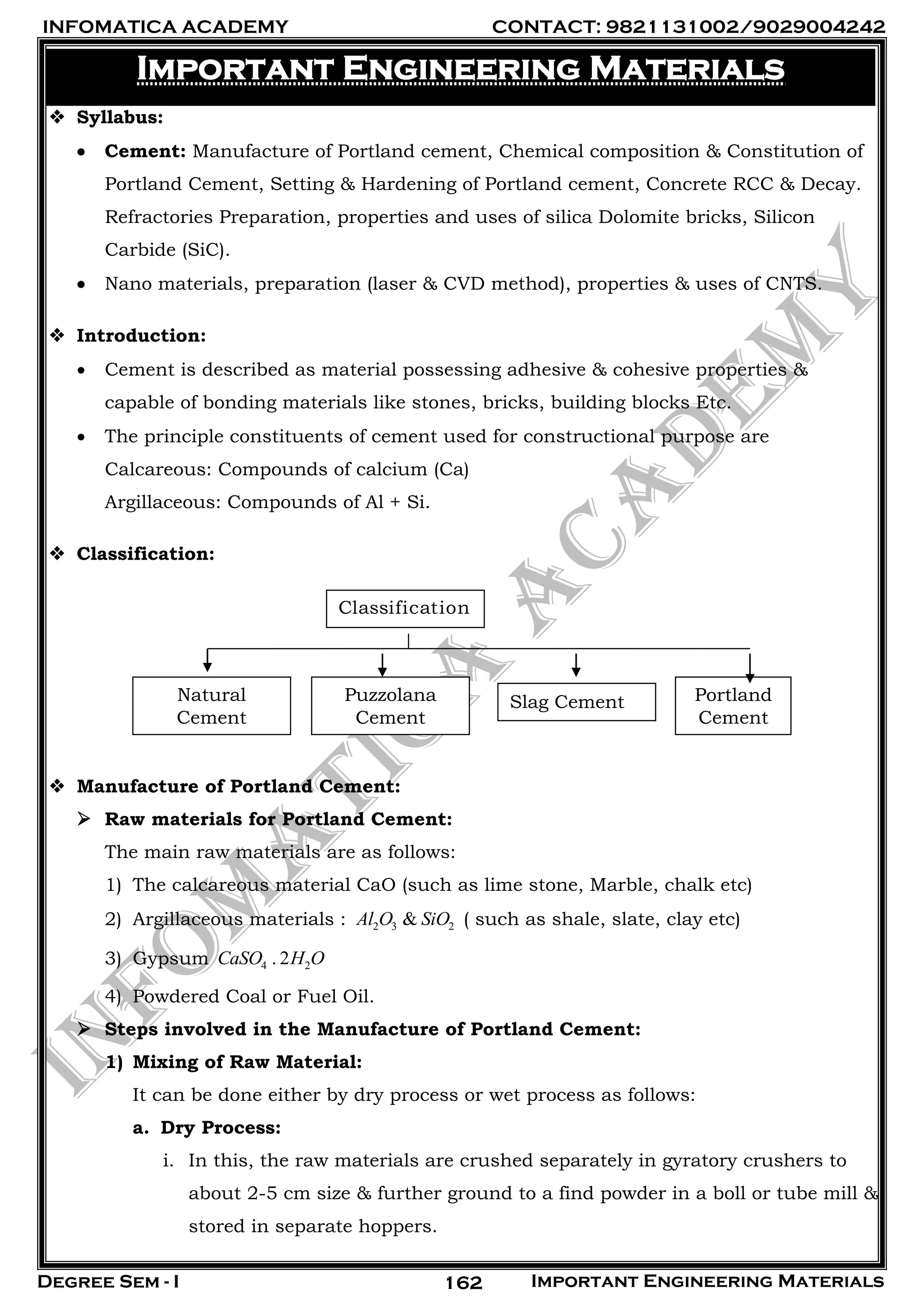
 Classification:
 Manufacture of Portland Cement:
 Raw materials for Portland Cement:
The main raw materials are as follows:
1) The calcareous material CaO (such as lime stone, Marble, chalk etc)
2) Argillaceous materials : 2 3 2&Al O SiO ( such as shale, slate, clay etc)
3) Gypsum 4 2. 2CaSO H O
4) Powdered Coal or Fuel Oil.
 Steps involved in the Manufacture of Portland Cement:
1) Mixing of Raw Material:
It can be done either by dry process or wet process as follows:
a. Dry Process:
i. In this, the raw materials are crushed separately in gyratory crushers to
about 2-5 cm size & further ground to a find powder in a boll or tube mill &
stored in separate hoppers.
Classification
Natural
Cement
Puzzolana
Cement
Slag Cement Portland
Cement
INFOMATICA ACADEMY CONTACT: 9821131002/9029004242
Degree Sem - I Important Engineering Materials163
ii. These powdered materials are mixed in the required proportions to get a
dry mix which is stored in storage bins called silos & now is ready for
feeding to the rotary kiln.
b. Wet Process:
i. In this the calcareous (lime) raw materials are crushed powdered & stored
in silos. The argillaceous raw materials like silica & alumina are thoroughly
washed with water to remove any adhering organic impurities.
ii. Powdered lime stone & washed we clay are then allowed to flow in channel
in the correct proportions to grinding mil.
iii. Where they mixed thoroughly to form a paste called slurry.
iv. The grinding is done either in a tube mill or a boll mill sometime in both.
v. The chemical composition of the slurry is then checked & corrected in a
proportion & about 38-40% water.
vi. Finally the slurry is stored in storage tanks so that it is ready for feeding to
the rotary kiln.
2) Burning:
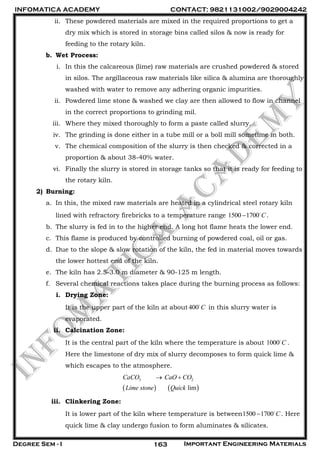
a. In this, the mixed raw materials are heated in a cylindrical steel rotary kiln
lined with refractory firebricks to a temperature range 1500 1700 C .
b. The slurry is fed in to the higher end. A long hot flame heats the lower end.
c. This flame is produced by controlled burning of powdered coal, oil or gas.
d. Due to the slope & slow rotation of the kiln, the fed in material moves towards
the lower hottest end of the kiln.
e. The kiln has 2.5-3.0 m diameter & 90-125 m length.
f. Several chemical reactions takes place during the burning process as follows:
i. Drying Zone:
It is the upper part of the kiln at about 400 C in this slurry water is
evaporated.
ii. Calcination Zone:
It is the central part of the kiln where the temperature is about 1000 C .
Here the limestone of dry mix of slurry decomposes to form quick lime &
which escapes to the atmosphere.
   
3 2
lim
CaCO CaO CO
Lime stone Quick
 
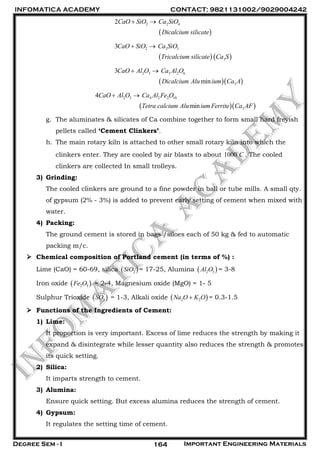
iii. Clinkering Zone:
It is lower part of the kiln where temperature is between1500 1700 C . Here
quick lime & clay undergo fusion to form aluminates & silicates.
INFOMATICA ACADEMY CONTACT: 9821131002/9029004242
Degree Sem - I Important Engineering Materials164
 
2 2 42CaO SiO Ca SiO
Dicalcium silicate
 
   
2 3 5
3
3CaO SiO Ca SiO
Tricalcium silicate Ca S
 
  
2 3 3 2 6
3
3
min
CaO Al O Ca Al O
Dicalcium Alu ium Ca A
 
  
2 3 4 2 2 10
3
4
min
CaO Al O Ca Al Fe O
Tetra calcium Alu iumFerrite Ca AF
 
g. The aluminates & silicates of Ca combine together to form small hard freyish
pellets called ‘Cement Clinkers’.
h. The main rotary kiln is attached to other small rotary kiln into which the
clinkers enter. They are cooled by air blasts to about 1000 C . The cooled
clinkers are collected In small trolleys.
3) Grinding:
The cooled clinkers are ground to a fine powder in ball or tube mills. A small qty.
of gypsum (2% - 3%) is added to prevent early setting of cement when mixed with
water.
4) Packing:
The ground cement is stored in bags /siloes each of 50 kg & fed to automatic
packing m/c.
 Chemical composition of Portland cement (in terms of %) :
Lime (CaO) = 60-69, silica  2SiO = 17-25, Alumina  2 3Al O = 3-8
Iron oxide  2 3Fe O = 2-4, Magnesium oxide (MgO) = 1- 5
Sulphur Trioxide  3SO = 1-3, Alkali oxide  2 2Na O K O = 0.3-1.5
 Functions of the Ingredients of Cement:
1) Lime:
It proportion is very important. Excess of lime reduces the strength by making it
expand & disintegrate while lesser quantity also reduces the strength & promotes
its quick setting.
2) Silica:
It imparts strength to cement.
3) Alumina:
Ensure quick setting. But excess alumina reduces the strength of cement.
4) Gypsum:
It regulates the setting time of cement.
INFOMATICA ACADEMY CONTACT: 9821131002/9029004242
Degree Sem - I Important Engineering Materials165
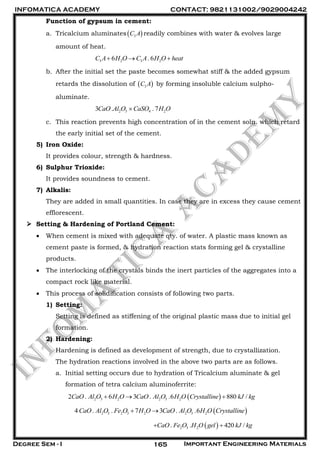
Function of gypsum in cement:
a. Tricalcium aluminates 3C A readily combines with water & evolves large
amount of heat.
3 2 3 26 . 6C A H O C A H O heat  
b. After the initial set the paste becomes somewhat stiff & the added gypsum
retards the dissolution of  3C A by forming insoluble calcium sulpho-
aluminate.
2 3 4 23 . . 7CaO Al O CaSO H O
c. This reaction prevents high concentration of in the cement soln. which retard
the early initial set of the cement.
5) Iron Oxide:
It provides colour, strength & hardness.
6) Sulphur Trioxide:
It provides soundness to cement.
7) Alkalis:
They are added in small quantities. In case they are in excess they cause cement
efflorescent.
 Setting & Hardening of Portland Cement:
 When cement is mixed with adequate qty. of water. A plastic mass known as
cement paste is formed, & hydration reaction stats forming gel & crystalline
products.
 The interlocking of the crystals binds the inert particles of the aggregates into a
compact rock like material.
 This process of solidification consists of following two parts.
1) Setting:
Setting is defined as stiffening of the original plastic mass due to initial gel
formation.
2) Hardening:
Hardening is defined as development of strength, due to crystallization.
The hydration reactions involved in the above two parts are as follows.
a. Initial setting occurs due to hydration of Tricalcium aluminate & gel
formation of tetra calcium aluminoferrite:
 2 3 2 2 3 22 . 6 3 . .6 880 /CaO Al O H O CaO Al O H O Crystalline kJ kg  
 2 3 2 3 2 2 3 24 . . 7 3 . .6CaO Al O Fe O H O CaO Al O H O Crystalline 
 2 3 2. . 420 /CaO Fe O H O gel kJ kg 
INFOMATICA ACADEMY CONTACT: 9821131002/9029004242
Degree Sem - I Important Engineering Materials166
b. Hydration of dicalcium silicate & tricalcium silicate forms Tobermorite Gel
(about 50% of hydrated cement) & cause initial setting & strength of
cement.
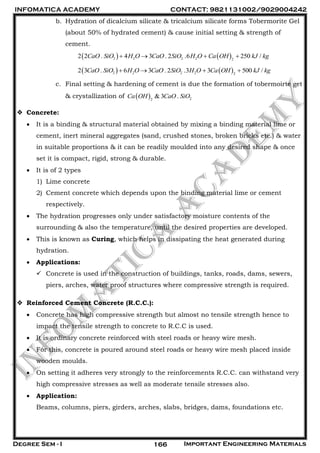
   2 2 2 2 2
2 2 . 4 3 . 2 .6 250 /CaO SiO H O CaO SiO H O Ca OH kJ kg   
   2 2 2 2 2
2 3 . 6 3 . 2 .3 3 500 /CaO SiO H O CaO SiO H O Ca OH kJ kg   
c. Final setting & hardening of cement is due the formation of tobermoirte get
& crystallization of   22
& 3 .Ca OH CaO SiO
 Concrete:
 It is a binding & structural material obtained by mixing a binding material lime or
cement, inert mineral aggregates (sand, crushed stones, broken bricks etc.) & water
in suitable proportions & it can be readily moulded into any desired shape & once
set it is compact, rigid, strong & durable.
 It is of 2 types
1) Lime concrete
2) Cement concrete which depends upon the binding material lime or cement
respectively.
 The hydration progresses only under satisfactory moisture contents of the
surrounding & also the temperature, until the desired properties are developed.
 This is known as Curing, which helps in dissipating the heat generated during
hydration.
 Applications:
 Concrete is used in the construction of buildings, tanks, roads, dams, sewers,
piers, arches, water proof structures where compressive strength is required.
 Reinforced Cement Concrete (R.C.C.):
 Concrete has high compressive strength but almost no tensile strength hence to
impact the tensile strength to concrete to R.C.C is used.
 It is ordinary concrete reinforced with steel roads or heavy wire mesh.
 For this, concrete is poured around steel roads or heavy wire mesh placed inside
wooden moulds.
 On setting it adheres very strongly to the reinforcements R.C.C. can withstand very
high compressive stresses as well as moderate tensile stresses also.
 Application:
Beams, columns, piers, girders, arches, slabs, bridges, dams, foundations etc.
INFOMATICA ACADEMY CONTACT: 9821131002/9029004242
Degree Sem - I Important Engineering Materials167
 Decay of cement:
It is mainly due to following reasons:
1) Concrete cement contains some free lime (CaO), which dissolves in acidic water &
makes the cement week. As lime is more soluble in soft water than hard water,
deterioration of concrete is more in soft water.
2) The metal sulphates presents in hard water combine with tricalcium aluminate to
form sulpho aluminates which occupy more volume resulting into expansion &
develops cracks thus the cement structure becomes week. Further hydrolysis of
silicates & aluminates also lead to decay.
3) Due to the cracks developed as mentioned above the steel gets exposed to 2O the
present in the atmosphere which causes the oxidization & hence decay. The process
is cumulative.
4) Prevention or minimization of decay can be accomplished as follows:
a. By treating the surface by silicon fluoride  4SiF when 2CaF (which is insoluble) is
formed which prevents dissolution of lime.
b. By coating the surface with epoxy resin point or bituminous or linseed oil which
makes the surface impermeable to acidic water.
c. To cover/ coat the reinforcing steel bars with proper epoxy paint, resin paints.
 Refractories:
 These are the materials which can withstand very high temperature over 300 C
without softening or degrading. The main function of refractory is to confine heat &
at the same time resist the abrasive & corrosive action of molten metal, slag & gases
at high working temperature.
 Three types of common refractory bricks are discussed here.
1) Silica Bricks:
a. Preparation:
i. The main raw materials used are quartz quartzite, sand-stone etc. the
siliceous rock is crushed & ground with 2% lime & water to from a thick
paste.
ii. So formed is moulded into bricks either manually or using a machine press
after which they are heated to about 1500 C for 25 hrs.
iii. Cooling takes about 1 or 2 weeks during heating quartzite converts into
crystobalite which during cooling gets converted into tridymite.
iv. Such that silica bricks are the mixture of these two.
INFOMATICA ACADEMY CONTACT: 9821131002/9029004242
Degree Sem - I Important Engineering Materials168
b. Properties:
i. They are relatively light & possess high rigidity & mechanical strength.
ii. They do not contract I use but permanently expand by 15% if reheated.
iii. They have homogenous texture free from air pockets & moulding defects
they are yellowish in color with brown specks & 25% porous.
iv. They possess low permeability to gases & not susceptible to thermal
spalling (means deformations) below100 C .
v. They can withstand a load of 2
3.5 /kg cm upto 1600 C .
c. Uses:
Glass furnaces, roofs of electric & hearth furnacesses, lining of acid
converters, bakeries, coke oven walls etc.
2) Dolomite Bricks:
a. Preparation:
They are made by mixing calcined dolomite (i.e. mixture CaO + MgO) in
equimolar proportion with silica as binding material. Other binding materials
are tar quick lime, iron oxide, clays etc. they are fired at 1500 C for about
24hrs.
b. Properties:
i. Less strong, more porous & have more softness & shrinkage.
ii. They can withstand a loaf of
2
3.5 /kg cm at 1650 C .
iii. They are not much resistant to thermal variations.
iv. They are stable towards basic slags.
c. Uses:
Open-hearth furnaces, electric furnace lining, Bessemer converters, ladle-
lining etc.
3) Silicon Carbide (SIC) Bricks:
a. Preparation:
i. They are made from sand (60%) & coke (40%) which are properly mixed &
saw dust & a little salt are added to it.
ii. The mixture is then fired at 1500 C in an electric furnace.
iii. During burning saw dust evolves gases which increase the porosity.
iv. Saw reacts with iron & impurities present in the raw material to form
volatile chloride which further increases the final porosity.
v. The silicon carbide obtained from the furnace is mixed with bonding agent
like clay. Silicon nitride etc.
INFOMATICA ACADEMY CONTACT: 9821131002/9029004242
Degree Sem - I Important Engineering Materials169
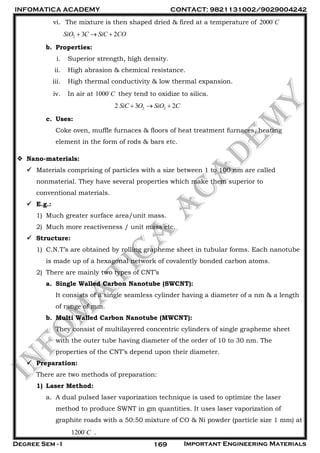
vi. The mixture is then shaped dried & fired at a temperature of 2000 C
2 3 2SiO C SiC CO  
b. Properties:
i. Superior strength, high density.
ii. High abrasion & chemical resistance.
iii. High thermal conductivity & low thermal expansion.
iv. In air at 1000 C they tend to oxidize to silica.
2 22 3 2SiC O SiO C  
c. Uses:
Coke oven, muffle furnaces & floors of heat treatment furnaces, heating
element in the form of rods & bars etc.
 Nano-materials:
 Materials comprising of particles with a size between 1 to 100 nm are called
nonmaterial. They have several properties which make them superior to
conventional materials.
 E.g.:
1) Much greater surface area/unit mass.
2) Much more reactiveness / unit mass etc.
 Structure:
1) C.N.T’s are obtained by rolling grapheme sheet in tubular forms. Each nanotube
is made up of a hexagonal network of covalently bonded carbon atoms.
2) There are mainly two types of CNT’s
a. Single Walled Carbon Nanotube (SWCNT):
It consists of a single seamless cylinder having a diameter of a nm & a length
of range of mm.
b. Multi Walled Carbon Nanotube (MWCNT):
They consist of multilayered concentric cylinders of single grapheme sheet
with the outer tube having diameter of the order of 10 to 30 nm. The
properties of the CNT’s depend upon their diameter.
 Preparation:
There are two methods of preparation:
1) Laser Method:
a. A dual pulsed laser vaporization technique is used to optimize the laser
method to produce SWNT in gm quantities. It uses laser vaporization of
graphite roads with a 50:50 mixture of CO & Ni powder (particle size 1 mm) at
1200 C .
INFOMATICA ACADEMY CONTACT: 9821131002/9029004242
Degree Sem - I Important Engineering Materials170
b. Followed by heat treatment in vacuum at 1000 C to remove the 6C O & other
fullerenes.
c. The initial laser vaporization pulse was followed by a second pulse to vaporize
the target more uniformly.
d. The uses of 2 successive laser pulses minimize the amount of carbon
deposited as suit.
e. The material thus produced appears as a mat of ‘ropes’ 10-20 mm in diameter
& up to 100 m or more in length.
f. Each rope consists primarily of a bundle of SWNT’ aligned along a common
axis.
g. By varying the temperature the catalyst composition & other process
parameters the average nanotube diameter & distribution can be varied.
2) Chemical vapour Deposition Method:
a. This method is useful for large scale production. Both SWCNT & MWCT are
obtained by this method. No amorphous carbon or undesirable nano particles
are obtained along with CNTs. This method id preferred.
b. It involves decomposition hydrocarbon gas such as methane, acetelene,
ethylene at about 1100 C in the presence of metal nanoparticle catalyst (usually
Ni, Co, Fe)
c. Supported on MgO or 2 3Al O carbon atoms produced by the decomposition
condense on cooler surface containing metal catalyst.
d. The size of the metal nano particles determines the diameter of the nano tube.
This method produces carbon tube with open ends.
e. Plasma enhanced chemical vapour deposition method is used to produce
vertically aligned CNT’s. This is the newly developed technique.
f. It makes uses of plasma generated by a strong electric field during the growth
process which produces tubes along the direction of electric field.
 Properties:
1) Electrical: These vary between semiconducting to metallic depending upon their
diameter & length.
2) Mechanical: CNT’s are stiffest & strongest in terms of elastic modulus & tensile
strength.
3) Thermal: Very high thermal conductivity. Also they have high thermal stability.
 Uses:
1) Sensors of gases such as 2NO and 3NH .
2) Catalyst & as supports of catalysis in several chemical reactions.
INFOMATICA ACADEMY CONTACT: 9821131002/9029004242
Degree Sem - I Important Engineering Materials171
3) Protective shields against electromagnetic radiations.
4) Drug delivery vessels.
5) CNT field emission transistors for switching components in computers.
 Questions:
1) What are the? (i) SWCNT & (ii) MWCNT (Dec 07) (3 Marks)
2) What are CNT’s? Explain different types. (May 08, 11) (3 Marks)
3) Describe the production of SWCNT by LASER method.
(Dec. 07 & May 10) (3 Marks)
4) Write applications of CNT. (May 10) (3 Marks)
 University Questions:
Dec 2007
1) What are (i) SWCNT & (ii) MWCNT? Describe the production of SWCNT by LASER
method. (6 Marks)
May 2008
2) What are the carbon-nanotubes? Explain different types of carbon nanotubes.
(2 Marks)
May 2009
3) What are Nano-materials? Give two properties of Nano-materials which makes them
different & superior to Conventional materials. (3 Marks)
May 2010
4) Describe the laser method for production of carbon nanotubes. Write applications of
carbon nanotubes. (5 Marks)
Dec 2011
5) Give the main physical change that takes place at the nano-scale with its
application. (5 Marks)
6) What are CNTs? What are its types? Give their applications. (5 Marks)
May 2012
7) What are the nano materials? Mention two reasons why properties of materials differ
at the nano scale. (3 Marks)

5. important engineering material

  • 1.
    INFOMATICA ACADEMY CONTACT:9821131002/9029004242 Degree Sem - I Important Engineering Materials162 Important Engineering Materials  Syllabus:  Cement: Manufacture of Portland cement, Chemical composition & Constitution of Portland Cement, Setting & Hardening of Portland cement, Concrete RCC & Decay. Refractories Preparation, properties and uses of silica Dolomite bricks, Silicon Carbide (SiC).  Nano materials, preparation (laser & CVD method), properties & uses of CNTS.  Introduction:  Cement is described as material possessing adhesive & cohesive properties & capable of bonding materials like stones, bricks, building blocks Etc.  The principle constituents of cement used for constructional purpose are Calcareous: Compounds of calcium (Ca) Argillaceous: Compounds of Al + Si.  Classification:  Manufacture of Portland Cement:  Raw materials for Portland Cement: The main raw materials are as follows: 1) The calcareous material CaO (such as lime stone, Marble, chalk etc) 2) Argillaceous materials : 2 3 2&Al O SiO ( such as shale, slate, clay etc) 3) Gypsum 4 2. 2CaSO H O 4) Powdered Coal or Fuel Oil.  Steps involved in the Manufacture of Portland Cement: 1) Mixing of Raw Material: It can be done either by dry process or wet process as follows: a. Dry Process: i. In this, the raw materials are crushed separately in gyratory crushers to about 2-5 cm size & further ground to a find powder in a boll or tube mill & stored in separate hoppers. Classification Natural Cement Puzzolana Cement Slag Cement Portland Cement
  • 2.
    INFOMATICA ACADEMY CONTACT:9821131002/9029004242 Degree Sem - I Important Engineering Materials163 ii. These powdered materials are mixed in the required proportions to get a dry mix which is stored in storage bins called silos & now is ready for feeding to the rotary kiln. b. Wet Process: i. In this the calcareous (lime) raw materials are crushed powdered & stored in silos. The argillaceous raw materials like silica & alumina are thoroughly washed with water to remove any adhering organic impurities. ii. Powdered lime stone & washed we clay are then allowed to flow in channel in the correct proportions to grinding mil. iii. Where they mixed thoroughly to form a paste called slurry. iv. The grinding is done either in a tube mill or a boll mill sometime in both. v. The chemical composition of the slurry is then checked & corrected in a proportion & about 38-40% water. vi. Finally the slurry is stored in storage tanks so that it is ready for feeding to the rotary kiln. 2) Burning: a. In this, the mixed raw materials are heated in a cylindrical steel rotary kiln lined with refractory firebricks to a temperature range 1500 1700 C . b. The slurry is fed in to the higher end. A long hot flame heats the lower end. c. This flame is produced by controlled burning of powdered coal, oil or gas. d. Due to the slope & slow rotation of the kiln, the fed in material moves towards the lower hottest end of the kiln. e. The kiln has 2.5-3.0 m diameter & 90-125 m length. f. Several chemical reactions takes place during the burning process as follows: i. Drying Zone: It is the upper part of the kiln at about 400 C in this slurry water is evaporated. ii. Calcination Zone: It is the central part of the kiln where the temperature is about 1000 C . Here the limestone of dry mix of slurry decomposes to form quick lime & which escapes to the atmosphere.     3 2 lim CaCO CaO CO Lime stone Quick   iii. Clinkering Zone: It is lower part of the kiln where temperature is between1500 1700 C . Here quick lime & clay undergo fusion to form aluminates & silicates.
  • 3.
    INFOMATICA ACADEMY CONTACT:9821131002/9029004242 Degree Sem - I Important Engineering Materials164   2 2 42CaO SiO Ca SiO Dicalcium silicate       2 3 5 3 3CaO SiO Ca SiO Tricalcium silicate Ca S      2 3 3 2 6 3 3 min CaO Al O Ca Al O Dicalcium Alu ium Ca A      2 3 4 2 2 10 3 4 min CaO Al O Ca Al Fe O Tetra calcium Alu iumFerrite Ca AF   g. The aluminates & silicates of Ca combine together to form small hard freyish pellets called ‘Cement Clinkers’. h. The main rotary kiln is attached to other small rotary kiln into which the clinkers enter. They are cooled by air blasts to about 1000 C . The cooled clinkers are collected In small trolleys. 3) Grinding: The cooled clinkers are ground to a fine powder in ball or tube mills. A small qty. of gypsum (2% - 3%) is added to prevent early setting of cement when mixed with water. 4) Packing: The ground cement is stored in bags /siloes each of 50 kg & fed to automatic packing m/c.  Chemical composition of Portland cement (in terms of %) : Lime (CaO) = 60-69, silica  2SiO = 17-25, Alumina  2 3Al O = 3-8 Iron oxide  2 3Fe O = 2-4, Magnesium oxide (MgO) = 1- 5 Sulphur Trioxide  3SO = 1-3, Alkali oxide  2 2Na O K O = 0.3-1.5  Functions of the Ingredients of Cement: 1) Lime: It proportion is very important. Excess of lime reduces the strength by making it expand & disintegrate while lesser quantity also reduces the strength & promotes its quick setting. 2) Silica: It imparts strength to cement. 3) Alumina: Ensure quick setting. But excess alumina reduces the strength of cement. 4) Gypsum: It regulates the setting time of cement.
  • 4.
    INFOMATICA ACADEMY CONTACT:9821131002/9029004242 Degree Sem - I Important Engineering Materials165 Function of gypsum in cement: a. Tricalcium aluminates 3C A readily combines with water & evolves large amount of heat. 3 2 3 26 . 6C A H O C A H O heat   b. After the initial set the paste becomes somewhat stiff & the added gypsum retards the dissolution of  3C A by forming insoluble calcium sulpho- aluminate. 2 3 4 23 . . 7CaO Al O CaSO H O c. This reaction prevents high concentration of in the cement soln. which retard the early initial set of the cement. 5) Iron Oxide: It provides colour, strength & hardness. 6) Sulphur Trioxide: It provides soundness to cement. 7) Alkalis: They are added in small quantities. In case they are in excess they cause cement efflorescent.  Setting & Hardening of Portland Cement:  When cement is mixed with adequate qty. of water. A plastic mass known as cement paste is formed, & hydration reaction stats forming gel & crystalline products.  The interlocking of the crystals binds the inert particles of the aggregates into a compact rock like material.  This process of solidification consists of following two parts. 1) Setting: Setting is defined as stiffening of the original plastic mass due to initial gel formation. 2) Hardening: Hardening is defined as development of strength, due to crystallization. The hydration reactions involved in the above two parts are as follows. a. Initial setting occurs due to hydration of Tricalcium aluminate & gel formation of tetra calcium aluminoferrite:  2 3 2 2 3 22 . 6 3 . .6 880 /CaO Al O H O CaO Al O H O Crystalline kJ kg    2 3 2 3 2 2 3 24 . . 7 3 . .6CaO Al O Fe O H O CaO Al O H O Crystalline   2 3 2. . 420 /CaO Fe O H O gel kJ kg 
  • 5.
    INFOMATICA ACADEMY CONTACT:9821131002/9029004242 Degree Sem - I Important Engineering Materials166 b. Hydration of dicalcium silicate & tricalcium silicate forms Tobermorite Gel (about 50% of hydrated cement) & cause initial setting & strength of cement.    2 2 2 2 2 2 2 . 4 3 . 2 .6 250 /CaO SiO H O CaO SiO H O Ca OH kJ kg       2 2 2 2 2 2 3 . 6 3 . 2 .3 3 500 /CaO SiO H O CaO SiO H O Ca OH kJ kg    c. Final setting & hardening of cement is due the formation of tobermoirte get & crystallization of   22 & 3 .Ca OH CaO SiO  Concrete:  It is a binding & structural material obtained by mixing a binding material lime or cement, inert mineral aggregates (sand, crushed stones, broken bricks etc.) & water in suitable proportions & it can be readily moulded into any desired shape & once set it is compact, rigid, strong & durable.  It is of 2 types 1) Lime concrete 2) Cement concrete which depends upon the binding material lime or cement respectively.  The hydration progresses only under satisfactory moisture contents of the surrounding & also the temperature, until the desired properties are developed.  This is known as Curing, which helps in dissipating the heat generated during hydration.  Applications:  Concrete is used in the construction of buildings, tanks, roads, dams, sewers, piers, arches, water proof structures where compressive strength is required.  Reinforced Cement Concrete (R.C.C.):  Concrete has high compressive strength but almost no tensile strength hence to impact the tensile strength to concrete to R.C.C is used.  It is ordinary concrete reinforced with steel roads or heavy wire mesh.  For this, concrete is poured around steel roads or heavy wire mesh placed inside wooden moulds.  On setting it adheres very strongly to the reinforcements R.C.C. can withstand very high compressive stresses as well as moderate tensile stresses also.  Application: Beams, columns, piers, girders, arches, slabs, bridges, dams, foundations etc.
  • 6.
    INFOMATICA ACADEMY CONTACT:9821131002/9029004242 Degree Sem - I Important Engineering Materials167  Decay of cement: It is mainly due to following reasons: 1) Concrete cement contains some free lime (CaO), which dissolves in acidic water & makes the cement week. As lime is more soluble in soft water than hard water, deterioration of concrete is more in soft water. 2) The metal sulphates presents in hard water combine with tricalcium aluminate to form sulpho aluminates which occupy more volume resulting into expansion & develops cracks thus the cement structure becomes week. Further hydrolysis of silicates & aluminates also lead to decay. 3) Due to the cracks developed as mentioned above the steel gets exposed to 2O the present in the atmosphere which causes the oxidization & hence decay. The process is cumulative. 4) Prevention or minimization of decay can be accomplished as follows: a. By treating the surface by silicon fluoride  4SiF when 2CaF (which is insoluble) is formed which prevents dissolution of lime. b. By coating the surface with epoxy resin point or bituminous or linseed oil which makes the surface impermeable to acidic water. c. To cover/ coat the reinforcing steel bars with proper epoxy paint, resin paints.  Refractories:  These are the materials which can withstand very high temperature over 300 C without softening or degrading. The main function of refractory is to confine heat & at the same time resist the abrasive & corrosive action of molten metal, slag & gases at high working temperature.  Three types of common refractory bricks are discussed here. 1) Silica Bricks: a. Preparation: i. The main raw materials used are quartz quartzite, sand-stone etc. the siliceous rock is crushed & ground with 2% lime & water to from a thick paste. ii. So formed is moulded into bricks either manually or using a machine press after which they are heated to about 1500 C for 25 hrs. iii. Cooling takes about 1 or 2 weeks during heating quartzite converts into crystobalite which during cooling gets converted into tridymite. iv. Such that silica bricks are the mixture of these two.
  • 7.
    INFOMATICA ACADEMY CONTACT:9821131002/9029004242 Degree Sem - I Important Engineering Materials168 b. Properties: i. They are relatively light & possess high rigidity & mechanical strength. ii. They do not contract I use but permanently expand by 15% if reheated. iii. They have homogenous texture free from air pockets & moulding defects they are yellowish in color with brown specks & 25% porous. iv. They possess low permeability to gases & not susceptible to thermal spalling (means deformations) below100 C . v. They can withstand a load of 2 3.5 /kg cm upto 1600 C . c. Uses: Glass furnaces, roofs of electric & hearth furnacesses, lining of acid converters, bakeries, coke oven walls etc. 2) Dolomite Bricks: a. Preparation: They are made by mixing calcined dolomite (i.e. mixture CaO + MgO) in equimolar proportion with silica as binding material. Other binding materials are tar quick lime, iron oxide, clays etc. they are fired at 1500 C for about 24hrs. b. Properties: i. Less strong, more porous & have more softness & shrinkage. ii. They can withstand a loaf of 2 3.5 /kg cm at 1650 C . iii. They are not much resistant to thermal variations. iv. They are stable towards basic slags. c. Uses: Open-hearth furnaces, electric furnace lining, Bessemer converters, ladle- lining etc. 3) Silicon Carbide (SIC) Bricks: a. Preparation: i. They are made from sand (60%) & coke (40%) which are properly mixed & saw dust & a little salt are added to it. ii. The mixture is then fired at 1500 C in an electric furnace. iii. During burning saw dust evolves gases which increase the porosity. iv. Saw reacts with iron & impurities present in the raw material to form volatile chloride which further increases the final porosity. v. The silicon carbide obtained from the furnace is mixed with bonding agent like clay. Silicon nitride etc.
  • 8.
    INFOMATICA ACADEMY CONTACT:9821131002/9029004242 Degree Sem - I Important Engineering Materials169 vi. The mixture is then shaped dried & fired at a temperature of 2000 C 2 3 2SiO C SiC CO   b. Properties: i. Superior strength, high density. ii. High abrasion & chemical resistance. iii. High thermal conductivity & low thermal expansion. iv. In air at 1000 C they tend to oxidize to silica. 2 22 3 2SiC O SiO C   c. Uses: Coke oven, muffle furnaces & floors of heat treatment furnaces, heating element in the form of rods & bars etc.  Nano-materials:  Materials comprising of particles with a size between 1 to 100 nm are called nonmaterial. They have several properties which make them superior to conventional materials.  E.g.: 1) Much greater surface area/unit mass. 2) Much more reactiveness / unit mass etc.  Structure: 1) C.N.T’s are obtained by rolling grapheme sheet in tubular forms. Each nanotube is made up of a hexagonal network of covalently bonded carbon atoms. 2) There are mainly two types of CNT’s a. Single Walled Carbon Nanotube (SWCNT): It consists of a single seamless cylinder having a diameter of a nm & a length of range of mm. b. Multi Walled Carbon Nanotube (MWCNT): They consist of multilayered concentric cylinders of single grapheme sheet with the outer tube having diameter of the order of 10 to 30 nm. The properties of the CNT’s depend upon their diameter.  Preparation: There are two methods of preparation: 1) Laser Method: a. A dual pulsed laser vaporization technique is used to optimize the laser method to produce SWNT in gm quantities. It uses laser vaporization of graphite roads with a 50:50 mixture of CO & Ni powder (particle size 1 mm) at 1200 C .
  • 9.
    INFOMATICA ACADEMY CONTACT:9821131002/9029004242 Degree Sem - I Important Engineering Materials170 b. Followed by heat treatment in vacuum at 1000 C to remove the 6C O & other fullerenes. c. The initial laser vaporization pulse was followed by a second pulse to vaporize the target more uniformly. d. The uses of 2 successive laser pulses minimize the amount of carbon deposited as suit. e. The material thus produced appears as a mat of ‘ropes’ 10-20 mm in diameter & up to 100 m or more in length. f. Each rope consists primarily of a bundle of SWNT’ aligned along a common axis. g. By varying the temperature the catalyst composition & other process parameters the average nanotube diameter & distribution can be varied. 2) Chemical vapour Deposition Method: a. This method is useful for large scale production. Both SWCNT & MWCT are obtained by this method. No amorphous carbon or undesirable nano particles are obtained along with CNTs. This method id preferred. b. It involves decomposition hydrocarbon gas such as methane, acetelene, ethylene at about 1100 C in the presence of metal nanoparticle catalyst (usually Ni, Co, Fe) c. Supported on MgO or 2 3Al O carbon atoms produced by the decomposition condense on cooler surface containing metal catalyst. d. The size of the metal nano particles determines the diameter of the nano tube. This method produces carbon tube with open ends. e. Plasma enhanced chemical vapour deposition method is used to produce vertically aligned CNT’s. This is the newly developed technique. f. It makes uses of plasma generated by a strong electric field during the growth process which produces tubes along the direction of electric field.  Properties: 1) Electrical: These vary between semiconducting to metallic depending upon their diameter & length. 2) Mechanical: CNT’s are stiffest & strongest in terms of elastic modulus & tensile strength. 3) Thermal: Very high thermal conductivity. Also they have high thermal stability.  Uses: 1) Sensors of gases such as 2NO and 3NH . 2) Catalyst & as supports of catalysis in several chemical reactions.
  • 10.
    INFOMATICA ACADEMY CONTACT:9821131002/9029004242 Degree Sem - I Important Engineering Materials171 3) Protective shields against electromagnetic radiations. 4) Drug delivery vessels. 5) CNT field emission transistors for switching components in computers.  Questions: 1) What are the? (i) SWCNT & (ii) MWCNT (Dec 07) (3 Marks) 2) What are CNT’s? Explain different types. (May 08, 11) (3 Marks) 3) Describe the production of SWCNT by LASER method. (Dec. 07 & May 10) (3 Marks) 4) Write applications of CNT. (May 10) (3 Marks)  University Questions: Dec 2007 1) What are (i) SWCNT & (ii) MWCNT? Describe the production of SWCNT by LASER method. (6 Marks) May 2008 2) What are the carbon-nanotubes? Explain different types of carbon nanotubes. (2 Marks) May 2009 3) What are Nano-materials? Give two properties of Nano-materials which makes them different & superior to Conventional materials. (3 Marks) May 2010 4) Describe the laser method for production of carbon nanotubes. Write applications of carbon nanotubes. (5 Marks) Dec 2011 5) Give the main physical change that takes place at the nano-scale with its application. (5 Marks) 6) What are CNTs? What are its types? Give their applications. (5 Marks) May 2012 7) What are the nano materials? Mention two reasons why properties of materials differ at the nano scale. (3 Marks)