Chapter Name :- Welding Process
Topic Name :- Laser Beam Welding
Introduction
⮚ Arc welding process that produces coalescence of
metals by heating them with a constricted arc between
an electrode and the work piece (transferred arc) or
between the electrode and the water cooled
constricting nozzle (non transferred arc)
⮚ Plasma, A gaseous mixture of positive ions, electrons
and neutral gas molecules
Chapter Name :- Welding Process
Topic Name :- Laser Beam Welding
Chapter Name :- Welding Process
Topic Name :- Laser Beam Welding
Chapter Name :- Welding Process
Topic Name :- Laser Beam Welding
⮚ Plasma :
• Gas which is heated to an extremely high temperature
and ionized so that it becomes electrically conductive.
• PAW process uses this plasma to transfer an electric
arc to the work piece
• The metal to be welded is melted by the intense heat
of the arc and fuses together
⮚ Objective of PAW :
• To increase the energy level of the arc plasma in a
controlled manner
• This is achieved by providing a gas nozzle around a
tungsten electrode operating on DCEN
How Plasma Welding Works
Chapter Name :- Welding Process
Topic Name :- Laser Beam Welding
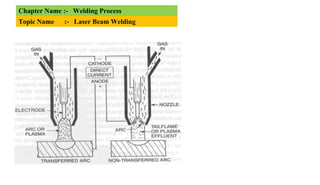
Transferred arc mode Non-Transferred mode
Arc is struck between the
electrode(-) and the work
piece(+)
Arc is struck between the
electrode(-) and the nozzle(+),
thus eliminating the necessity to
have the work as a part of the
electrical system
Used for high speed
welding and
Arc process produces plasma of
relatively low energy density
Used to weld Ceramics,
steels, Aluminium alloys,
Copper alloys, Titanium
alloys, Nickel alloys
Since the work piece in non-
transferred plasma arc welding
is not a part of electric circuit,
the plasma arc torch may move
from one work piece to other
without extinguishing the arc
Variants of PAW
Chapter Name :- Welding Process
Topic Name :- Laser Beam Welding
Chapter Name :- Welding Process
Topic Name :- Laser Beam Welding
Power Supply
• A DC power source (generator or rectifier)
having drooping characteristics and open circuit
voltage of 70 volts or above is suitable for PAW
• Rectifiers are generally preferred over DC
generators
• Working with He as an inert gas needs open
circuit voltage above 70 volts. This voltage can
be obtained by series operation of two power
sources; or the arc can be initiated with argon at
normal open circuit voltage and then helium can
be switched on
Equipment
Chapter Name :- Welding Process
Topic Name :- Laser Beam Welding
High frequency generator and current limiting
resistors
• Used for arc ignition
Plasma Torch
• Either transferred arc or non transferred arc typed
Equipment
Chapter Name :- Welding Process
Topic Name :- Laser Beam Welding
▪ Shields the molten weld from the atmosphere
▪ Two inert gases or gas mixtures are employed
▪ Argon(commonly used), Helium, Argon + Hydrogen
and Argon + Helium, as inert gases or gas mixtures
▪ Helium is preferred where a broad heat input pattern
and flatter cover pass is desired
▪ A mixture of argon and hydrogen supplies heat
energy higher than when only argon is used and thus
permits higher arc alloys and stainless steels
Shielding gases
Chapter Name :- Welding Process
Topic Name :- Laser Beam Welding
❑ Permits faster metal deposition rate and high
arc travel speed as compared to TIG
❑ Uniform penetration with high welding rate is
possible
❑ Stability of arc and Excellent weld quality
❑ Can produce radiographic quality weld at high
speed
❑ Can weld steel pieces up to about half inch
thick, square butt joint
❑ Useful for semi automatic and automatic
processes.
❑ Process is very fast and clean
❑ Requires less operator skill due to good
tolerance of arc to misalignments;
❑ High penetrating capability (keyhole effect)
Advantages
Chapter Name :- Welding Process
Topic Name :- Laser Beam Welding
❖ Special protection is required as Infrared and
UV Radiations is produced
❖ Consumption of Inert Gas is high
❖ Needs high power electrical equipment.
❖ Gives out ultraviolet and infrared radiation.
❖ Operation produces a high noise of the order
of 100dB
❖ Expensive equipment
❖ Can weld only upto 25mm thickness
❖ High distortions and wide welds as a result of
high heat input (in transferred arc process)
❖ More chances of Electrical hazards
Disadvantages
Chapter Name :- Welding Process
Topic Name :- Laser Beam Welding
•Applications
•Food Industry
•Cryogenics
•Automobiles
•Ship Construction

Plasma arc welding

  • 1.
    Chapter Name :-Welding Process Topic Name :- Laser Beam Welding Introduction ⮚ Arc welding process that produces coalescence of metals by heating them with a constricted arc between an electrode and the work piece (transferred arc) or between the electrode and the water cooled constricting nozzle (non transferred arc) ⮚ Plasma, A gaseous mixture of positive ions, electrons and neutral gas molecules
  • 2.
    Chapter Name :-Welding Process Topic Name :- Laser Beam Welding
  • 3.
    Chapter Name :-Welding Process Topic Name :- Laser Beam Welding
  • 4.
    Chapter Name :-Welding Process Topic Name :- Laser Beam Welding ⮚ Plasma : • Gas which is heated to an extremely high temperature and ionized so that it becomes electrically conductive. • PAW process uses this plasma to transfer an electric arc to the work piece • The metal to be welded is melted by the intense heat of the arc and fuses together ⮚ Objective of PAW : • To increase the energy level of the arc plasma in a controlled manner • This is achieved by providing a gas nozzle around a tungsten electrode operating on DCEN How Plasma Welding Works
  • 5.
    Chapter Name :-Welding Process Topic Name :- Laser Beam Welding Transferred arc mode Non-Transferred mode Arc is struck between the electrode(-) and the work piece(+) Arc is struck between the electrode(-) and the nozzle(+), thus eliminating the necessity to have the work as a part of the electrical system Used for high speed welding and Arc process produces plasma of relatively low energy density Used to weld Ceramics, steels, Aluminium alloys, Copper alloys, Titanium alloys, Nickel alloys Since the work piece in non- transferred plasma arc welding is not a part of electric circuit, the plasma arc torch may move from one work piece to other without extinguishing the arc Variants of PAW
  • 6.
    Chapter Name :-Welding Process Topic Name :- Laser Beam Welding
  • 7.
    Chapter Name :-Welding Process Topic Name :- Laser Beam Welding Power Supply • A DC power source (generator or rectifier) having drooping characteristics and open circuit voltage of 70 volts or above is suitable for PAW • Rectifiers are generally preferred over DC generators • Working with He as an inert gas needs open circuit voltage above 70 volts. This voltage can be obtained by series operation of two power sources; or the arc can be initiated with argon at normal open circuit voltage and then helium can be switched on Equipment
  • 8.
    Chapter Name :-Welding Process Topic Name :- Laser Beam Welding High frequency generator and current limiting resistors • Used for arc ignition Plasma Torch • Either transferred arc or non transferred arc typed Equipment
  • 9.
    Chapter Name :-Welding Process Topic Name :- Laser Beam Welding ▪ Shields the molten weld from the atmosphere ▪ Two inert gases or gas mixtures are employed ▪ Argon(commonly used), Helium, Argon + Hydrogen and Argon + Helium, as inert gases or gas mixtures ▪ Helium is preferred where a broad heat input pattern and flatter cover pass is desired ▪ A mixture of argon and hydrogen supplies heat energy higher than when only argon is used and thus permits higher arc alloys and stainless steels Shielding gases
  • 10.
    Chapter Name :-Welding Process Topic Name :- Laser Beam Welding ❑ Permits faster metal deposition rate and high arc travel speed as compared to TIG ❑ Uniform penetration with high welding rate is possible ❑ Stability of arc and Excellent weld quality ❑ Can produce radiographic quality weld at high speed ❑ Can weld steel pieces up to about half inch thick, square butt joint ❑ Useful for semi automatic and automatic processes. ❑ Process is very fast and clean ❑ Requires less operator skill due to good tolerance of arc to misalignments; ❑ High penetrating capability (keyhole effect) Advantages
  • 11.
    Chapter Name :-Welding Process Topic Name :- Laser Beam Welding ❖ Special protection is required as Infrared and UV Radiations is produced ❖ Consumption of Inert Gas is high ❖ Needs high power electrical equipment. ❖ Gives out ultraviolet and infrared radiation. ❖ Operation produces a high noise of the order of 100dB ❖ Expensive equipment ❖ Can weld only upto 25mm thickness ❖ High distortions and wide welds as a result of high heat input (in transferred arc process) ❖ More chances of Electrical hazards Disadvantages
  • 12.
    Chapter Name :-Welding Process Topic Name :- Laser Beam Welding •Applications •Food Industry •Cryogenics •Automobiles •Ship Construction