1
Defining a research ‘question’
Professor Peter Sandercock
University of Edinburgh
E-learning platform of the World Stroke Organization
2
Outline
• Finding a ‘good’ question
• Framing your question
• Refining it
E-learning platform of the World Stroke Organization
3
Wikipedia: research question
 A research question is the methodological point
of departure of scholarly research in both
the natural and social sciences. The research will
answer the question posed. At an undergraduate
level, the answer to the research question is
the thesis statement. The answer to a research
question will help address a "Research Problem"
which is a problem "readers think is worth solving”
E-learning platform of the World Stroke Organization
4
Where do new ‘questions’ come
from?
• Your boss/ supervisor
• The news
• Everyday observations (lab or clinical)
• Serendipity
• Previous single experiments or clinical trials
• Systematic review of all relevant experiments
• Cochrane reviews ‘implications for research’
E-learning platform of the World Stroke Organization
5
Is the question important?*
 Burden of disease
• How common is the problem?
• How much death/ disability does it cause?
 Do other people agree its important?
• The public/ patient advocates/charities
• Politicians (‘something's got to be done’)
• Health professionals
• Is it a priority topic for research funding bodies?
 What impact will the treatment have on burden?
• How feasible is the treatment?
• A small effect in a large % of patients will have greater impact than a
large effect in a small %
*vital to get this right in grant applications
E-learning platform of the World Stroke Organization
6
E-learning platform of the World Stroke Organization
7
Getting it right
• Frame the question on ‘the back of an
envelope’
• Think about PICO
• Discuss it for a reality check with peers
• Write it down
• It’s often an iterative process and the final
form of the question often ends up looking
very different!
E-learning platform of the World Stroke Organization
8
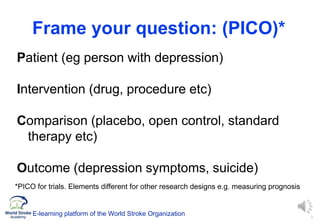
Frame your question: (PICO)*
Patient (eg person with depression)
Intervention (drug, procedure etc)
Comparison (placebo, open control, standard
therapy etc)
Outcome (depression symptoms, suicide)
*PICO for trials. Elements different for other research designs e.g. measuring prognosis
E-learning platform of the World Stroke Organization
9
Mead implications for research
‘…future research should look in more
detail at what types of exercise could most
benefit people with depression, and the
number and duration of sessions which are
of most benefit. Further larger trials are
needed to find out whether exercise is as
effective as antidepressants or
psychological treatments.’
E-learning platform of the World Stroke Organization
10
Trial inclusion criteria broad or
focused?
Broad: All patients with depression
Results widely applicable
Recruitment easy
Focused: patients requiring admission to
hospital for depression who have failed
conventional treatment
Results less widely applicable
Hard to recruit
E-learning platform of the World Stroke Organization
11
E-learning platform of the World Stroke Organization
Systematic review: broad or narrow?
• Subjects: any disease stage, or acute
treatment only
• Intervention: all in class (any
anticoagulant) or one specific (eg heparin)
• Comparison: ‘investigational’ vs any other
comparator or ‘investigational’ vs control
only
• Study type: Any design vs RCT only
• Search: all languages vs English only
12
What outcome to measure?
• Physiology
- Blood pressure
- Cortisol level
• Pathology (e.g. tumour size)
• Impairment
- Muscle weakness,
- Joint range of movement
• Function
- Independence in ADL
- Ability to work
• Event
- Non-fatal pulmonary embolus
- Admission to hospital
- Death
E-learning platform of the World Stroke Organization
13
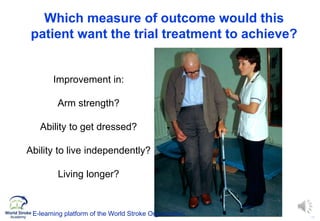
Which measure of outcome would this
patient want the trial treatment to achieve?
Improvement in:
Arm strength?
Ability to get dressed?
Ability to live independently?
Living longer?
E-learning platform of the World Stroke Organization
14
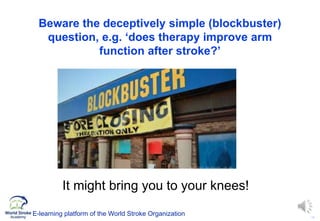
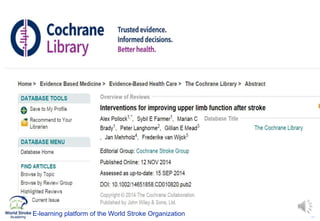
Beware the deceptively simple (blockbuster)
question, e.g. ‘does therapy improve arm
function after stroke?’
It might bring you to your knees!
E-learning platform of the World Stroke Organization
15
E-learning platform of the World Stroke Organization
16
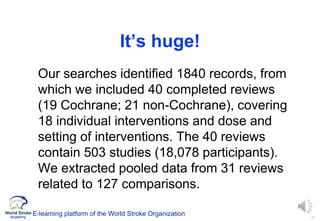
It’s huge!
Our searches identified 1840 records, from
which we included 40 completed reviews
(19 Cochrane; 21 non-Cochrane), covering
18 individual interventions and dose and
setting of interventions. The 40 reviews
contain 503 studies (18,078 participants).
We extracted pooled data from 31 reviews
related to 127 comparisons.
E-learning platform of the World Stroke Organization
17
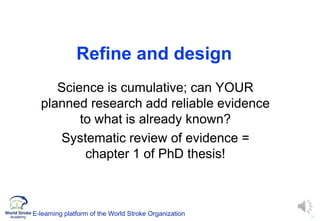
Refine and design
Science is cumulative; can YOUR
planned research add reliable evidence
to what is already known?
Systematic review of evidence =
chapter 1 of PhD thesis!
E-learning platform of the World Stroke Organization
18
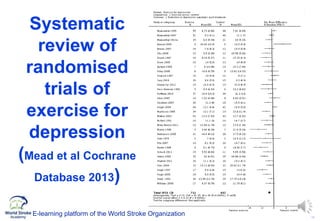
Systematic
review of
randomised
trials of
exercise for
depression
(Mead et al Cochrane
Database 2013)
E-learning platform of the World Stroke Organization
19
Final thoughts
• Take time to get your question right
• Get it right and you
- improve the design of your research
- increase your chance of getting funding
- Take an important step towards getting your
results published
E-learning platform of the World Stroke Organization

1 Defining a research question

  • 1.
    1 Defining a research‘question’ Professor Peter Sandercock University of Edinburgh E-learning platform of the World Stroke Organization
  • 2.
    2 Outline • Finding a‘good’ question • Framing your question • Refining it E-learning platform of the World Stroke Organization
  • 3.
    3 Wikipedia: research question A research question is the methodological point of departure of scholarly research in both the natural and social sciences. The research will answer the question posed. At an undergraduate level, the answer to the research question is the thesis statement. The answer to a research question will help address a "Research Problem" which is a problem "readers think is worth solving” E-learning platform of the World Stroke Organization
  • 4.
    4 Where do new‘questions’ come from? • Your boss/ supervisor • The news • Everyday observations (lab or clinical) • Serendipity • Previous single experiments or clinical trials • Systematic review of all relevant experiments • Cochrane reviews ‘implications for research’ E-learning platform of the World Stroke Organization
  • 5.
    5 Is the questionimportant?*  Burden of disease • How common is the problem? • How much death/ disability does it cause?  Do other people agree its important? • The public/ patient advocates/charities • Politicians (‘something's got to be done’) • Health professionals • Is it a priority topic for research funding bodies?  What impact will the treatment have on burden? • How feasible is the treatment? • A small effect in a large % of patients will have greater impact than a large effect in a small % *vital to get this right in grant applications E-learning platform of the World Stroke Organization
  • 6.
    6 E-learning platform ofthe World Stroke Organization
  • 7.
    7 Getting it right •Frame the question on ‘the back of an envelope’ • Think about PICO • Discuss it for a reality check with peers • Write it down • It’s often an iterative process and the final form of the question often ends up looking very different! E-learning platform of the World Stroke Organization
  • 8.
    8 Frame your question:(PICO)* Patient (eg person with depression) Intervention (drug, procedure etc) Comparison (placebo, open control, standard therapy etc) Outcome (depression symptoms, suicide) *PICO for trials. Elements different for other research designs e.g. measuring prognosis E-learning platform of the World Stroke Organization
  • 9.
    9 Mead implications forresearch ‘…future research should look in more detail at what types of exercise could most benefit people with depression, and the number and duration of sessions which are of most benefit. Further larger trials are needed to find out whether exercise is as effective as antidepressants or psychological treatments.’ E-learning platform of the World Stroke Organization
  • 10.
    10 Trial inclusion criteriabroad or focused? Broad: All patients with depression Results widely applicable Recruitment easy Focused: patients requiring admission to hospital for depression who have failed conventional treatment Results less widely applicable Hard to recruit E-learning platform of the World Stroke Organization
  • 11.
    11 E-learning platform ofthe World Stroke Organization Systematic review: broad or narrow? • Subjects: any disease stage, or acute treatment only • Intervention: all in class (any anticoagulant) or one specific (eg heparin) • Comparison: ‘investigational’ vs any other comparator or ‘investigational’ vs control only • Study type: Any design vs RCT only • Search: all languages vs English only
  • 12.
    12 What outcome tomeasure? • Physiology - Blood pressure - Cortisol level • Pathology (e.g. tumour size) • Impairment - Muscle weakness, - Joint range of movement • Function - Independence in ADL - Ability to work • Event - Non-fatal pulmonary embolus - Admission to hospital - Death E-learning platform of the World Stroke Organization
  • 13.
    13 Which measure ofoutcome would this patient want the trial treatment to achieve? Improvement in: Arm strength? Ability to get dressed? Ability to live independently? Living longer? E-learning platform of the World Stroke Organization
  • 14.
    14 Beware the deceptivelysimple (blockbuster) question, e.g. ‘does therapy improve arm function after stroke?’ It might bring you to your knees! E-learning platform of the World Stroke Organization
  • 15.
    15 E-learning platform ofthe World Stroke Organization
  • 16.
    16 It’s huge! Our searchesidentified 1840 records, from which we included 40 completed reviews (19 Cochrane; 21 non-Cochrane), covering 18 individual interventions and dose and setting of interventions. The 40 reviews contain 503 studies (18,078 participants). We extracted pooled data from 31 reviews related to 127 comparisons. E-learning platform of the World Stroke Organization
  • 17.
    17 Refine and design Scienceis cumulative; can YOUR planned research add reliable evidence to what is already known? Systematic review of evidence = chapter 1 of PhD thesis! E-learning platform of the World Stroke Organization
  • 18.
    18 Systematic review of randomised trials of exercisefor depression (Mead et al Cochrane Database 2013) E-learning platform of the World Stroke Organization
  • 19.
    19 Final thoughts • Taketime to get your question right • Get it right and you - improve the design of your research - increase your chance of getting funding - Take an important step towards getting your results published E-learning platform of the World Stroke Organization