


Sugeng Hariyanto (Dr.)
sugeng@transbahasa.com
sg_hariyanto@yahoo.co.id
 Research problems should be in interrogative forms.
    Start will questions words
 Topic is in “phrase form”.
Where the questions from?
 From literature review (previous research)
 Pre-existing topics (current situation/experience)
 Your own finding (from the data collected for other
  research).


   Topic:
     • Teachers’ belief
     • Grammar awareness
     • Teacher talk/student talk
Types of research questions
 Descriptive, explanatory, evaluative
    Desc.: How, when, where, what, is/are, do/does dan to
     what extent
    Explanatory: why
    Evaluative: What is the best …, should English students
     ….
 Primary/secondary
 Main/contributory
Types of research questions
 Descriptive, explanatory, evaluative
 Primary/secondary
    Primary: more important
    Secondary: less important, additional information
 Main/contributory
    Main: Most important
    Contributory: earlier question whose answer will lead to
     the main question
Types of research questions
 Overarching/subordinate
    Overarching: General main question
    Subordinate: Operationalized sub-questions of the
     overarching question
 Empirical/methodological/theoretical
    Empirical: producing empirical findings
    Methodological: observing or suitability of a research
     method
 Theoretical
    Observing theoretical concept and its application in the
     field
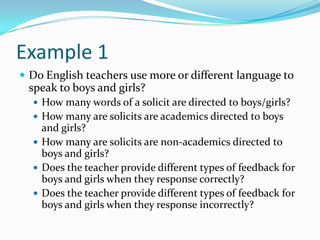
Example 1
 Do English teachers use more or different language to
 speak to boys and girls?
   How many words of a solicit are directed to boys/girls?
   How many are solicits are academics directed to boys
    and girls?
   How many are solicits are non-academics directed to
    boys and girls?
   Does the teacher provide different types of feedback for
    boys and girls when they response correctly?
   Does the teacher provide different types of feedback for
    boys and girls when they response incorrectly?
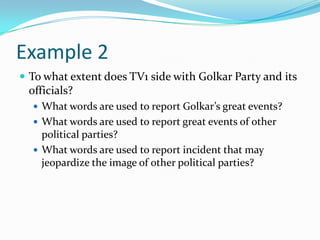
Example 2
 To what extent does TV1 side with Golkar Party and its
 officials?
   What words are used to report Golkar’s great events?
   What words are used to report great events of other
    political parties?
   What words are used to report incident that may
    jeopardize the image of other political parties?
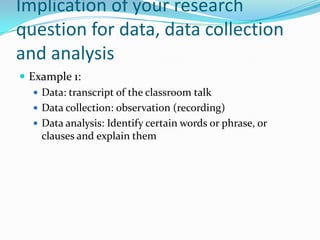
Implication of your research
question for data, data collection
and analysis
 Example 1:
    Data: transcript of the classroom talk
    Data collection: observation (recording)
    Data analysis: Identify certain words or phrase, or
     clauses and explain them
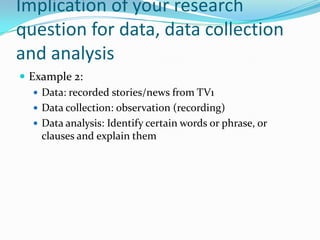
Implication of your research
question for data, data collection
and analysis
 Example 2:
    Data: recorded stories/news from TV1
    Data collection: observation (recording)
    Data analysis: Identify certain words or phrase, or
     clauses and explain them
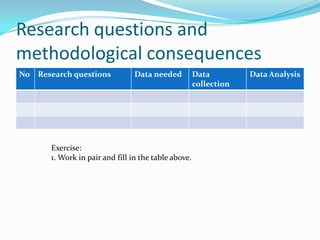
Research questions and
methodological consequences
No Research questions            Data needed          Data         Data Analysis
                                                      collection


       Exercise:
       1. Work in pair and fill in the table above.
Bibliography
 Litosseliti, Lia. et al. 2010. Research Methods in
  Lainguistics. New York. Continuum International
  Publishing Group

Qualitative research problems

  • 1.
  • 2.
     Research problemsshould be in interrogative forms.  Start will questions words  Topic is in “phrase form”.
  • 3.
    Where the questionsfrom?  From literature review (previous research)  Pre-existing topics (current situation/experience)  Your own finding (from the data collected for other research). Topic: • Teachers’ belief • Grammar awareness • Teacher talk/student talk
  • 4.
    Types of researchquestions  Descriptive, explanatory, evaluative  Desc.: How, when, where, what, is/are, do/does dan to what extent  Explanatory: why  Evaluative: What is the best …, should English students ….  Primary/secondary  Main/contributory
  • 5.
    Types of researchquestions  Descriptive, explanatory, evaluative  Primary/secondary  Primary: more important  Secondary: less important, additional information  Main/contributory  Main: Most important  Contributory: earlier question whose answer will lead to the main question
  • 6.
    Types of researchquestions  Overarching/subordinate  Overarching: General main question  Subordinate: Operationalized sub-questions of the overarching question  Empirical/methodological/theoretical  Empirical: producing empirical findings  Methodological: observing or suitability of a research method  Theoretical  Observing theoretical concept and its application in the field
  • 7.
    Example 1  DoEnglish teachers use more or different language to speak to boys and girls?  How many words of a solicit are directed to boys/girls?  How many are solicits are academics directed to boys and girls?  How many are solicits are non-academics directed to boys and girls?  Does the teacher provide different types of feedback for boys and girls when they response correctly?  Does the teacher provide different types of feedback for boys and girls when they response incorrectly?
  • 8.
    Example 2  Towhat extent does TV1 side with Golkar Party and its officials?  What words are used to report Golkar’s great events?  What words are used to report great events of other political parties?  What words are used to report incident that may jeopardize the image of other political parties?
  • 9.
    Implication of yourresearch question for data, data collection and analysis  Example 1:  Data: transcript of the classroom talk  Data collection: observation (recording)  Data analysis: Identify certain words or phrase, or clauses and explain them
  • 10.
    Implication of yourresearch question for data, data collection and analysis  Example 2:  Data: recorded stories/news from TV1  Data collection: observation (recording)  Data analysis: Identify certain words or phrase, or clauses and explain them
  • 11.
    Research questions and methodologicalconsequences No Research questions Data needed Data Data Analysis collection Exercise: 1. Work in pair and fill in the table above.
  • 12.
    Bibliography  Litosseliti, Lia.et al. 2010. Research Methods in Lainguistics. New York. Continuum International Publishing Group