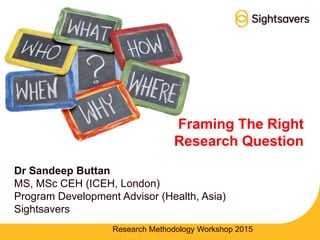
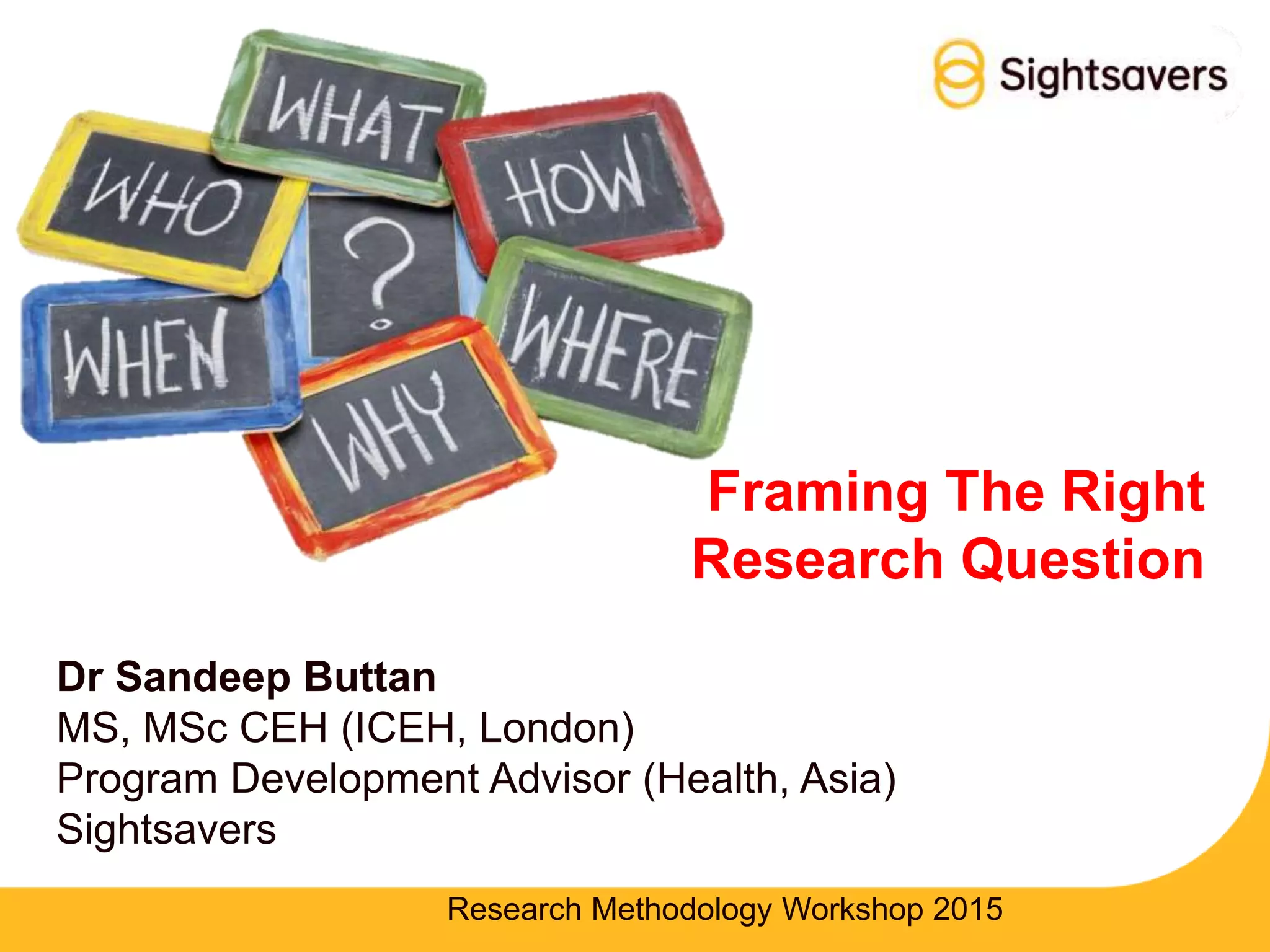
Framing The Right
Research Question
Dr Sandeep Buttan
MS, MSc CEH (ICEH, London)
Program Development Advisor (Health, Asia)
Sightsavers
Research Methodology Workshop 2015
Objectives
• Understand the importance of a well-developed research
question.
• Be aware of formal method(s) for generating a research
question.
• Develop a concise research question.
• Be able to evaluate the quality of a research question.
Research Methodology Workshop 2015
From Curiosity to Research…
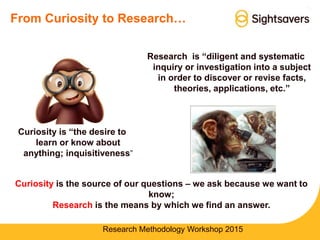
Curiosity is the source of our questions – we ask because we want to
know;
Research is the means by which we find an answer.
Research Methodology Workshop 2015
Research is “diligent and systematic
inquiry or investigation into a subject
in order to discover or revise facts,
theories, applications, etc.”
Curiosity is “the desire to
learn or know about
anything; inquisitiveness”
What is the Research Question?
A clear, focused, concise, complex and
arguable question around which the research
process is centred.
It defines:
 The focus of the research,
 The scope of the research
Research Methodology Workshop 2015
Importance of the Question
 The research question is the starting point of the study. Everything
flows from the research question.
 It will determine the population to be studied, the setting for the study,
the data to be collected, and the time period for the study.
 A clear and concisely stated research question is the most important
requirement for a successful study.
Importance of the Question
 The research question helps you plan the research in an appropriate
manner conserving resources that include your time, effort and costs
 A vague question or a series of unrelated questions will clutter the
research process and make it difficult to obtain clear answers
 More clutter leads to more noise and less focus
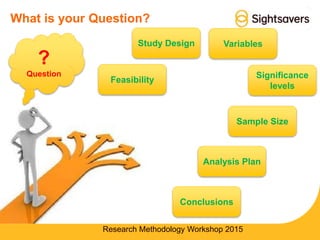
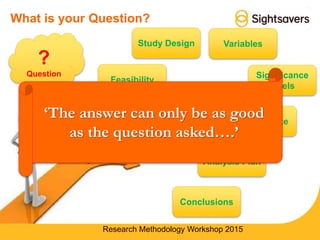
What is your Question?
Research Methodology Workshop 2015
?
Question
Study Design
Significance
levels
Sample Size
Analysis Plan
Conclusions
Variables
Feasibility
What is your Question?
Research Methodology Workshop 2015
?
Question
Study Design
Significance
levels
Sample Size
Analysis Plan
Conclusions
Variables
Feasibility
‘The answer can only be as good
as the question asked….’
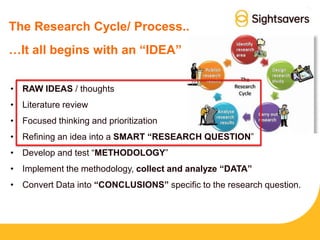
…It all begins with an “IDEA”
The Research Cycle/ Process..
• RAW IDEAS / thoughts
• Literature review
• Focused thinking and prioritization
• Refining an idea into a SMART “RESEARCH QUESTION”
• Develop and test “METHODOLOGY”
• Implement the methodology, collect and analyze “DATA”
• Convert Data into “CONCLUSIONS” specific to the research question.
FROM IDEAS TO
‘RESEARCH QUESTION’
Research Methodology Workshop 2015
Finding the Questions
A question of interest may come in to your mind in many ways
 A critical reading of the scientific literature
 Clinical experience
 Personal experience
 Interactions with peers and experts
 Observations
11
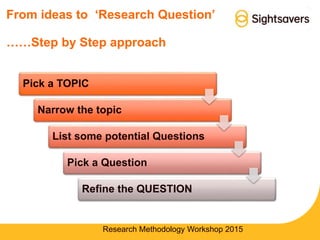
……Step by Step approach
Pick a TOPIC
Narrow the topic
List some potential Questions
Pick a Question
Refine the QUESTION
Research Methodology Workshop 2015
From ideas to ‘Research Question’
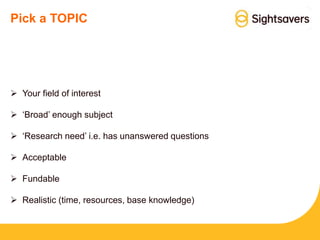
Pick a TOPIC
 Your field of interest
 ‘Broad’ enough subject
 ‘Research need’ i.e. has unanswered questions
 Acceptable
 Fundable
 Realistic (time, resources, base knowledge)
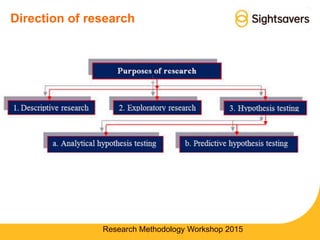
Direction of research
Research Methodology Workshop 2015
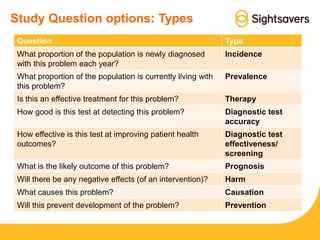
Study Question options: Types
Question Type
What proportion of the population is newly diagnosed
with this problem each year?
Incidence
What proportion of the population is currently living with
this problem?
Prevalence
Is this an effective treatment for this problem? Therapy
How good is this test at detecting this problem? Diagnostic test
accuracy
How effective is this test at improving patient health
outcomes?
Diagnostic test
effectiveness/
screening
What is the likely outcome of this problem? Prognosis
Will there be any negative effects (of an intervention)? Harm
What causes this problem? Causation
Will this prevent development of the problem? Prevention
16
Narrowing and Clarifying
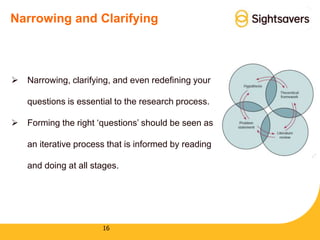
 Narrowing, clarifying, and even redefining your
questions is essential to the research process.
 Forming the right ‘questions’ should be seen as
an iterative process that is informed by reading
and doing at all stages.
© Sightsavers
Narrowing and Clarifying
 P: People or Population
 I: Intervention or Exposure
 C: Control or comparison
 O: outcome
Identify the study question- PICO
Research Methodology Workshop 2015
Study Question
People or Population- Who are the relevant patients?
– Define condition or disease, including explicit diagnostic criteria
– Population and setting of interest (age, race, sex, community,
hospital, outpatient)
Children with visual acuity impairment
Children aged 3–5 years with mild to moderate unilateral visual acuity
impairment
Study Question
Intervention or Exposure - What is the intervention/risk factor/exposure
of interest?
– Timing of exposure(s)
– Route of administration
– Dose intensity
– Duration of exposure or therapy
Glasses plus full time patching for 4.5 years
Moxifloxacin 0.04 % topical four times a day for one week
History of heavy smoking for more than 5 years
Study Question
Control or Comparison- What is the comparison intervention/risk
factor/exposure of interest?
– Placebo
– No treatment
– No exposure
– Standard care
Study Question
Outcome: What is the outcome/condition of interest?
– Criteria for defining outcomes
– Clinically important (relevant*)
– Important to patients
Change in best corrected Visual acuity (how many lines?)
Decrease in mid day IOP (mm Hg ?)
Research Questions-SMART
 S- Sharp, Specific , Simple to understand and Seeking new knowledge
 M- Measurable- Able to assess pertinent variables and outcomes
 A- Achievable within a realistic (realistic from the point of several
stakeholders) timeframe
 R- Relevant – actual value additions to existing knowledge or adding
new knowledge
 T- Time bound-Preferably obtain relevant answers within the lifetime of
the investigators
22
Worksheet
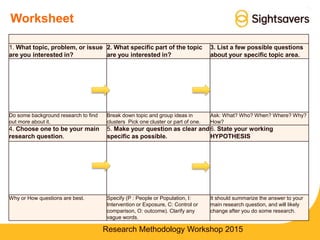
1. What topic, problem, or issue
are you interested in?
2. What specific part of the topic
are you interested in?
3. List a few possible questions
about your specific topic area.
Do some background research to find
out more about it.
Break down topic and group ideas in
clusters Pick one cluster or part of one.
Ask: What? Who? When? Where? Why?
How?
4. Choose one to be your main
research question.
5. Make your question as clear and
specific as possible.
6. State your working
HYPOTHESIS
Why or How questions are best. Specify (P : People or Population, I:
Intervention or Exposure, C: Control or
comparison, O: outcome). Clarify any
vague words.
It should summarize the answer to your
main research question, and will likely
change after you do some research.
Research Methodology Workshop 2015
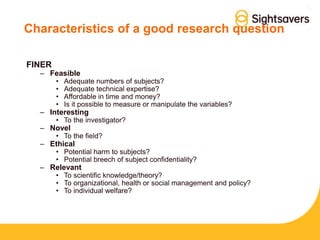
Characteristics of a good research question
FINER
– Feasible
• Adequate numbers of subjects?
• Adequate technical expertise?
• Affordable in time and money?
• Is it possible to measure or manipulate the variables?
– Interesting
• To the investigator?
– Novel
• To the field?
– Ethical
• Potential harm to subjects?
• Potential breech of subject confidentiality?
– Relevant
• To scientific knowledge/theory?
• To organizational, health or social management and policy?
• To individual welfare?
Caveat
 Not all questions can be pursued to their logical conclusions even if the
questions are focused and relevant
 Focused questions need not necessarily lead to clear answers- the
answers may very well end up muddying the waters!
25
‘Happy Hunting!!
sbuttan@sightsaers.org
Research Methodology Workshop 2015

Research question sb_faculty

  • 1.
    Framing The Right ResearchQuestion Dr Sandeep Buttan MS, MSc CEH (ICEH, London) Program Development Advisor (Health, Asia) Sightsavers Research Methodology Workshop 2015
  • 2.
    Objectives • Understand theimportance of a well-developed research question. • Be aware of formal method(s) for generating a research question. • Develop a concise research question. • Be able to evaluate the quality of a research question. Research Methodology Workshop 2015
  • 3.
    From Curiosity toResearch… Curiosity is the source of our questions – we ask because we want to know; Research is the means by which we find an answer. Research Methodology Workshop 2015 Research is “diligent and systematic inquiry or investigation into a subject in order to discover or revise facts, theories, applications, etc.” Curiosity is “the desire to learn or know about anything; inquisitiveness”
  • 4.
    What is theResearch Question? A clear, focused, concise, complex and arguable question around which the research process is centred. It defines:  The focus of the research,  The scope of the research Research Methodology Workshop 2015
  • 5.
    Importance of theQuestion  The research question is the starting point of the study. Everything flows from the research question.  It will determine the population to be studied, the setting for the study, the data to be collected, and the time period for the study.  A clear and concisely stated research question is the most important requirement for a successful study.
  • 6.
    Importance of theQuestion  The research question helps you plan the research in an appropriate manner conserving resources that include your time, effort and costs  A vague question or a series of unrelated questions will clutter the research process and make it difficult to obtain clear answers  More clutter leads to more noise and less focus
  • 7.
    What is yourQuestion? Research Methodology Workshop 2015 ? Question Study Design Significance levels Sample Size Analysis Plan Conclusions Variables Feasibility
  • 8.
    What is yourQuestion? Research Methodology Workshop 2015 ? Question Study Design Significance levels Sample Size Analysis Plan Conclusions Variables Feasibility ‘The answer can only be as good as the question asked….’
  • 9.
    …It all beginswith an “IDEA” The Research Cycle/ Process.. • RAW IDEAS / thoughts • Literature review • Focused thinking and prioritization • Refining an idea into a SMART “RESEARCH QUESTION” • Develop and test “METHODOLOGY” • Implement the methodology, collect and analyze “DATA” • Convert Data into “CONCLUSIONS” specific to the research question.
  • 10.
    FROM IDEAS TO ‘RESEARCHQUESTION’ Research Methodology Workshop 2015
  • 11.
    Finding the Questions Aquestion of interest may come in to your mind in many ways  A critical reading of the scientific literature  Clinical experience  Personal experience  Interactions with peers and experts  Observations 11
  • 12.
    ……Step by Stepapproach Pick a TOPIC Narrow the topic List some potential Questions Pick a Question Refine the QUESTION Research Methodology Workshop 2015 From ideas to ‘Research Question’
  • 13.
    Pick a TOPIC Your field of interest  ‘Broad’ enough subject  ‘Research need’ i.e. has unanswered questions  Acceptable  Fundable  Realistic (time, resources, base knowledge)
  • 14.
    Direction of research ResearchMethodology Workshop 2015
  • 15.
    Study Question options:Types Question Type What proportion of the population is newly diagnosed with this problem each year? Incidence What proportion of the population is currently living with this problem? Prevalence Is this an effective treatment for this problem? Therapy How good is this test at detecting this problem? Diagnostic test accuracy How effective is this test at improving patient health outcomes? Diagnostic test effectiveness/ screening What is the likely outcome of this problem? Prognosis Will there be any negative effects (of an intervention)? Harm What causes this problem? Causation Will this prevent development of the problem? Prevention
  • 16.
    16 Narrowing and Clarifying Narrowing, clarifying, and even redefining your questions is essential to the research process.  Forming the right ‘questions’ should be seen as an iterative process that is informed by reading and doing at all stages.
  • 17.
    © Sightsavers Narrowing andClarifying  P: People or Population  I: Intervention or Exposure  C: Control or comparison  O: outcome Identify the study question- PICO Research Methodology Workshop 2015
  • 18.
    Study Question People orPopulation- Who are the relevant patients? – Define condition or disease, including explicit diagnostic criteria – Population and setting of interest (age, race, sex, community, hospital, outpatient) Children with visual acuity impairment Children aged 3–5 years with mild to moderate unilateral visual acuity impairment
  • 19.
    Study Question Intervention orExposure - What is the intervention/risk factor/exposure of interest? – Timing of exposure(s) – Route of administration – Dose intensity – Duration of exposure or therapy Glasses plus full time patching for 4.5 years Moxifloxacin 0.04 % topical four times a day for one week History of heavy smoking for more than 5 years
  • 20.
    Study Question Control orComparison- What is the comparison intervention/risk factor/exposure of interest? – Placebo – No treatment – No exposure – Standard care
  • 21.
    Study Question Outcome: Whatis the outcome/condition of interest? – Criteria for defining outcomes – Clinically important (relevant*) – Important to patients Change in best corrected Visual acuity (how many lines?) Decrease in mid day IOP (mm Hg ?)
  • 22.
    Research Questions-SMART  S-Sharp, Specific , Simple to understand and Seeking new knowledge  M- Measurable- Able to assess pertinent variables and outcomes  A- Achievable within a realistic (realistic from the point of several stakeholders) timeframe  R- Relevant – actual value additions to existing knowledge or adding new knowledge  T- Time bound-Preferably obtain relevant answers within the lifetime of the investigators 22
  • 23.
    Worksheet 1. What topic,problem, or issue are you interested in? 2. What specific part of the topic are you interested in? 3. List a few possible questions about your specific topic area. Do some background research to find out more about it. Break down topic and group ideas in clusters Pick one cluster or part of one. Ask: What? Who? When? Where? Why? How? 4. Choose one to be your main research question. 5. Make your question as clear and specific as possible. 6. State your working HYPOTHESIS Why or How questions are best. Specify (P : People or Population, I: Intervention or Exposure, C: Control or comparison, O: outcome). Clarify any vague words. It should summarize the answer to your main research question, and will likely change after you do some research. Research Methodology Workshop 2015
  • 24.
    Characteristics of agood research question FINER – Feasible • Adequate numbers of subjects? • Adequate technical expertise? • Affordable in time and money? • Is it possible to measure or manipulate the variables? – Interesting • To the investigator? – Novel • To the field? – Ethical • Potential harm to subjects? • Potential breech of subject confidentiality? – Relevant • To scientific knowledge/theory? • To organizational, health or social management and policy? • To individual welfare?
  • 25.
    Caveat  Not allquestions can be pursued to their logical conclusions even if the questions are focused and relevant  Focused questions need not necessarily lead to clear answers- the answers may very well end up muddying the waters! 25
  • 26.