INTRODUCTION TO NURSING RESEARCHPresented by Dennis T. Nocom R.N.www.elearning.pchsinconline.com
What is research?Research can be defined as the search for knowledge or any systematic investigation to establish facts.Research is the system collection of data for the purpose of describing, explaining or predicting.Scientific approach- general set of orderly, disciplined procedures used to acquire dependable and useful information.www.elearning.pchsinconline.com
Inductive vs. deductiveInductive reasoning moves from specific to general, from particular instances to a general statement.Deductive reasoning moves from general to specific or from general premise to a particular situation or conclusion. Inductive – QUALITATIVEDeductive-QUANTITATIVEwww.elearning.pchsinconline.com
ORDER AND CONTROLSystematic- the investigator progresses logically thru a series of steps.Control- involves imposing conditions on the research situation so that biases and confounding factors are minimized.EMPIRICISM-Rooted in objective reality and gathered directly and indirectly through the senses.GENERALIZATION- The ability to go beyond the specifics of the situation.www.elearning.pchsinconline.com
Limitations of Scientific researchCan’t answer questions of a moral or ethical natureProblems of measurementVirtually every research contains some flawwww.elearning.pchsinconline.com
NURSING RESEARCHNursing research is the study of all aspects, components, activities and phenomena relating to health and of interest to nurses: WHY IS RESEARCH IMPORTANT IN NURSING?So that we could describe, explain, predict and control the events and phenomena that are of interest to nurses and to nursing.THUS, improve professional education and practicewww.elearning.pchsinconline.com
WHY IS IT IMPORTANT FOR NURSES TO DO RESEARCH?Because nursing is a profession, nurses should contribute to the generation of nursing knowledge.  Research is a major means by which nurses could generate knowledge.Through research, nurses could evaluate and document their contributions to their clients’ health and well-being and to the health care delivery system.Research is one of the duties of nurse.To demonstrate that nursing care has significant effects upon health outcomes and cost of care.To generate health policies and systems that promotes cost-effective use of resources.www.elearning.pchsinconline.com
ROLES OF NURSES IN RESEARCHAs DOERS, they contribute to the improvement of the nursing profession’s knowledge base as CONSUMERS, they improve their practice through the use of research findings.www.elearning.pchsinconline.com
BASIS vs. APPLIED RESEARCH BASICresearch aims to generate knowledge for the sake of knowledge production and theory construction, rather than for solving an immediate problem.APPLIEDresearch is concerned with finding solution to an immediate problem.www.elearning.pchsinconline.com
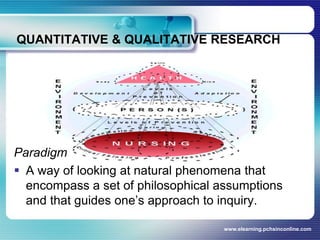
QUANTITATIVE & QUALITATIVE RESEARCHParadigmA way of looking at natural phenomena that encompass a set of philosophical assumptions and that guides one’s approach to inquiry.www.elearning.pchsinconline.com
QUANTITATIVE RESEARCH Quantitative research, is based in the paradigm of logical positivism and is focused upon outcomes for clients that are measurable, generally using statistics. The dominant research method is the randomised controlled trial.Objective, one realityMeasurableReduction, control, predictionStatistical analysiswww.elearning.pchsinconline.com
QUALITATIVE RESEARCHQualitative research, is based in the paradigm of phenomenology, grounded theory, ethnography and others, and examines the experience of those receiving or delivering the nursing care, focusing, in particular, on the meaning that it holds for the individual. The research methods most commonly used are interviews, case studies, focus groups and ethnographySubjectivity is valuedInterpretive, discovery, description, understandingReport rich in narrativeParticipantswww.elearning.pchsinconline.com
PHENOMENOLOGYIt is a qualitative research method that aims to describe lived experience phenomena that are important to nursing practice, education and research.GROUNDED THEORYIt is a qualitative research approach that aims to develop a grounded theory of theoretically complete explanation about a phenomenon.www.elearning.pchsinconline.com
ETHNOGRAPHYIt is the work of describing cultureEmic-the way members of a culture view their culture (insiders’ view)Etic-outsiders’ view of the experiences of a cultural groupParticipant observationField workETHNONURSING is the study and analysis of the local or indigenous people’s viewpoints, beliefs, and practice about nursing care behavior and processes of designated cultures. (LEININGER)www.elearning.pchsinconline.com
HISTORICAL RESEARCHHistorical research is a qualitative research designed to establish facts and relationships concerning past events.ACTION RESEARCHAction research is a method of research that involves taking action to improve practice and systematically studying the effects of the action taken.www.elearning.pchsinconline.com
CASE STUDYAre in-depth investigations of a single entity or small number of entities (individual, family, group, institution, community).TRIANGULATIONTriangulation is an approach to research that uses a combination of more than one research strategy in a single investigation.www.elearning.pchsinconline.com
SATURATIONThe collection of data in a qualitative study to the point where a sense of closure is attained because new data yield redundant information.PROLONGED ENGAGEMENTThe investment of sufficient time during data collection to have an In-depth understanding of the group under study, thereby enhancing credibility.www.elearning.pchsinconline.com
RESEARCH PROBLEMA situation that can be investigated through disciplined and systematic inquiryCriteria for evaluationSignificance of the problemresearchability of the problemfeasibilityinterest to the researcherwww.elearning.pchsinconline.com
EXAMPLESPrevalence of falls among elderly patientsPrevalence of decubitus ulcers among bedridden elderly patientsFood intake of institutionalized elderly with dementiaEffects of training program on the job performance of new nursesFactors affecting the compliance of persons with TB to chemotherapyKnowledge, attitudes and practices of young mothers on breastfeedingProfile of nurses who leave their jobs in the hospital for abroadHand washing practices of nursing personnel at the recovery roomKnowledge of oncology nurses on complimentary medicinewww.elearning.pchsinconline.com
Thank You !www.elearning.pchsinconline.com

Introto Nursing Research Show

  • 1.
    INTRODUCTION TO NURSINGRESEARCHPresented by Dennis T. Nocom R.N.www.elearning.pchsinconline.com
  • 2.
    What is research?Researchcan be defined as the search for knowledge or any systematic investigation to establish facts.Research is the system collection of data for the purpose of describing, explaining or predicting.Scientific approach- general set of orderly, disciplined procedures used to acquire dependable and useful information.www.elearning.pchsinconline.com
  • 3.
    Inductive vs. deductiveInductivereasoning moves from specific to general, from particular instances to a general statement.Deductive reasoning moves from general to specific or from general premise to a particular situation or conclusion. Inductive – QUALITATIVEDeductive-QUANTITATIVEwww.elearning.pchsinconline.com
  • 4.
    ORDER AND CONTROLSystematic-the investigator progresses logically thru a series of steps.Control- involves imposing conditions on the research situation so that biases and confounding factors are minimized.EMPIRICISM-Rooted in objective reality and gathered directly and indirectly through the senses.GENERALIZATION- The ability to go beyond the specifics of the situation.www.elearning.pchsinconline.com
  • 5.
    Limitations of ScientificresearchCan’t answer questions of a moral or ethical natureProblems of measurementVirtually every research contains some flawwww.elearning.pchsinconline.com
  • 6.
    NURSING RESEARCHNursing researchis the study of all aspects, components, activities and phenomena relating to health and of interest to nurses: WHY IS RESEARCH IMPORTANT IN NURSING?So that we could describe, explain, predict and control the events and phenomena that are of interest to nurses and to nursing.THUS, improve professional education and practicewww.elearning.pchsinconline.com
  • 7.
    WHY IS ITIMPORTANT FOR NURSES TO DO RESEARCH?Because nursing is a profession, nurses should contribute to the generation of nursing knowledge. Research is a major means by which nurses could generate knowledge.Through research, nurses could evaluate and document their contributions to their clients’ health and well-being and to the health care delivery system.Research is one of the duties of nurse.To demonstrate that nursing care has significant effects upon health outcomes and cost of care.To generate health policies and systems that promotes cost-effective use of resources.www.elearning.pchsinconline.com
  • 8.
    ROLES OF NURSESIN RESEARCHAs DOERS, they contribute to the improvement of the nursing profession’s knowledge base as CONSUMERS, they improve their practice through the use of research findings.www.elearning.pchsinconline.com
  • 9.
    BASIS vs. APPLIEDRESEARCH BASICresearch aims to generate knowledge for the sake of knowledge production and theory construction, rather than for solving an immediate problem.APPLIEDresearch is concerned with finding solution to an immediate problem.www.elearning.pchsinconline.com
  • 10.
    QUANTITATIVE & QUALITATIVERESEARCHParadigmA way of looking at natural phenomena that encompass a set of philosophical assumptions and that guides one’s approach to inquiry.www.elearning.pchsinconline.com
  • 11.
    QUANTITATIVE RESEARCH Quantitativeresearch, is based in the paradigm of logical positivism and is focused upon outcomes for clients that are measurable, generally using statistics. The dominant research method is the randomised controlled trial.Objective, one realityMeasurableReduction, control, predictionStatistical analysiswww.elearning.pchsinconline.com
  • 12.
    QUALITATIVE RESEARCHQualitative research,is based in the paradigm of phenomenology, grounded theory, ethnography and others, and examines the experience of those receiving or delivering the nursing care, focusing, in particular, on the meaning that it holds for the individual. The research methods most commonly used are interviews, case studies, focus groups and ethnographySubjectivity is valuedInterpretive, discovery, description, understandingReport rich in narrativeParticipantswww.elearning.pchsinconline.com
  • 13.
    PHENOMENOLOGYIt is aqualitative research method that aims to describe lived experience phenomena that are important to nursing practice, education and research.GROUNDED THEORYIt is a qualitative research approach that aims to develop a grounded theory of theoretically complete explanation about a phenomenon.www.elearning.pchsinconline.com
  • 14.
    ETHNOGRAPHYIt is thework of describing cultureEmic-the way members of a culture view their culture (insiders’ view)Etic-outsiders’ view of the experiences of a cultural groupParticipant observationField workETHNONURSING is the study and analysis of the local or indigenous people’s viewpoints, beliefs, and practice about nursing care behavior and processes of designated cultures. (LEININGER)www.elearning.pchsinconline.com
  • 15.
    HISTORICAL RESEARCHHistorical researchis a qualitative research designed to establish facts and relationships concerning past events.ACTION RESEARCHAction research is a method of research that involves taking action to improve practice and systematically studying the effects of the action taken.www.elearning.pchsinconline.com
  • 16.
    CASE STUDYAre in-depthinvestigations of a single entity or small number of entities (individual, family, group, institution, community).TRIANGULATIONTriangulation is an approach to research that uses a combination of more than one research strategy in a single investigation.www.elearning.pchsinconline.com
  • 17.
    SATURATIONThe collection ofdata in a qualitative study to the point where a sense of closure is attained because new data yield redundant information.PROLONGED ENGAGEMENTThe investment of sufficient time during data collection to have an In-depth understanding of the group under study, thereby enhancing credibility.www.elearning.pchsinconline.com
  • 18.
    RESEARCH PROBLEMA situationthat can be investigated through disciplined and systematic inquiryCriteria for evaluationSignificance of the problemresearchability of the problemfeasibilityinterest to the researcherwww.elearning.pchsinconline.com
  • 19.
    EXAMPLESPrevalence of fallsamong elderly patientsPrevalence of decubitus ulcers among bedridden elderly patientsFood intake of institutionalized elderly with dementiaEffects of training program on the job performance of new nursesFactors affecting the compliance of persons with TB to chemotherapyKnowledge, attitudes and practices of young mothers on breastfeedingProfile of nurses who leave their jobs in the hospital for abroadHand washing practices of nursing personnel at the recovery roomKnowledge of oncology nurses on complimentary medicinewww.elearning.pchsinconline.com
  • 20.