6.53
ELEMENTS,
TECHNIQUES, AND
LITERARY DEVICES IN
SPECIFIC FORMS OF
POETRY
(HUMSS_CW/MP11/12-Ic-f-6)
WHAT IS POETRY?
Poetry is the
spontaneous overflow of
powerful feelings: it takes
its origin from emotion
recollected in tranquility. –
William Wordsworth
7/1/20XX Pitch deck title 2
WHAT IS POETRY?
Poetry is not a turning
loose of emotion, but an
escape from emotions;
it is not the expression
of personality, but an
escape of personality. –
T.S. Eliot
7/1/20XX Pitch deck title 3
WHAT IS POETRY?
• It can be defined as 'literature in a metrical form'
or 'a composition forming rhythmic lines'. A poem
is something that follows a particular flow of
rhythm and meter. Compared to prose, where
there is no such restriction, and the content of
the piece flows according to story, a poem may
or may not have a story, but has a structured
method of writing.
7/1/20XX Pitch deck title 4
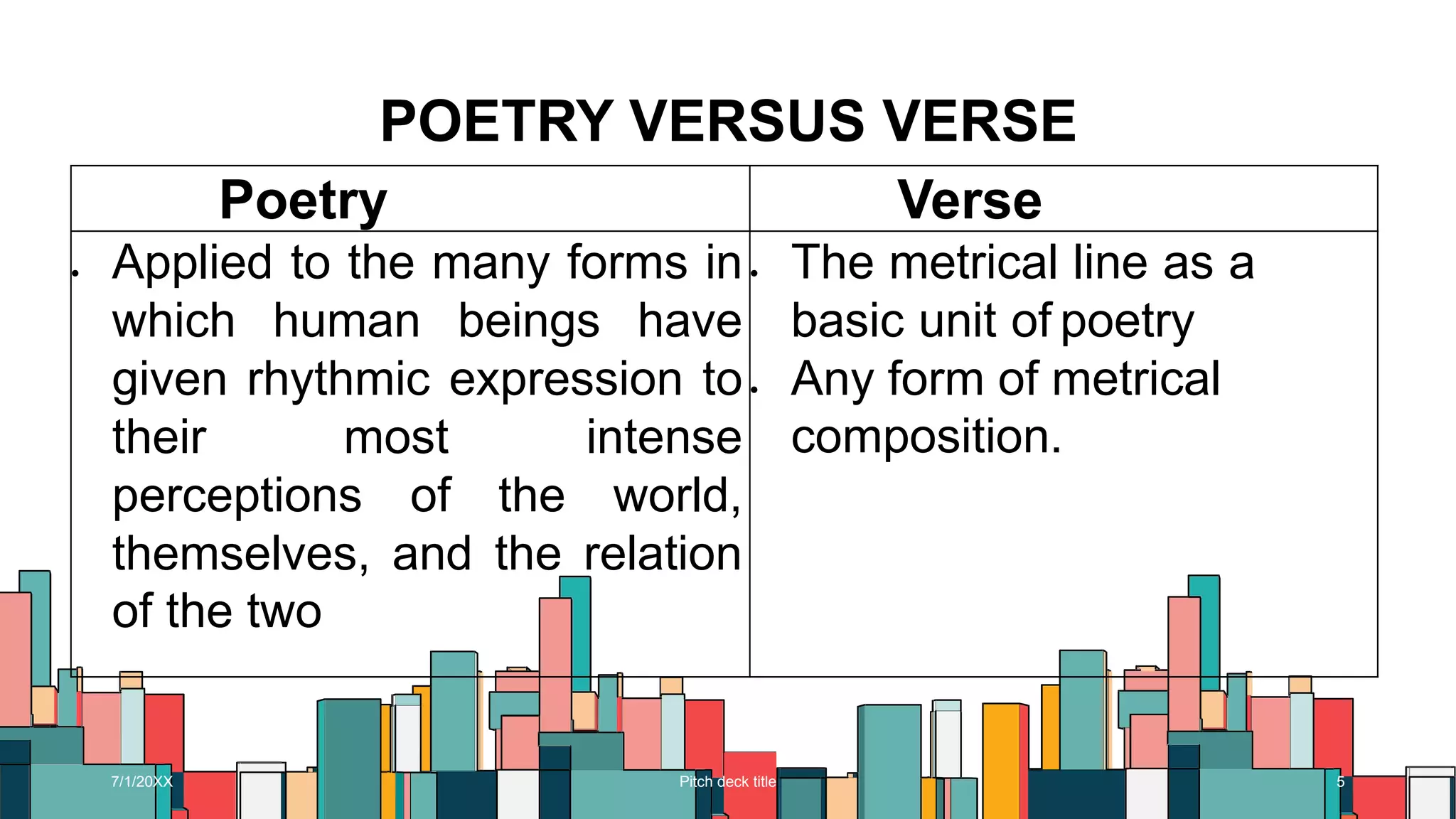
POETRY VERSUS VERSE
7/1/20XX Pitch deck title 5
Poetry Verse
 Applied to the many forms in
which human beings have
given rhythmic expression to
their most intense
perceptions of the world,
themselves, and the relation
of the two
 The metrical line as a
basic unit of poetry
 Any form of metrical
composition.
ELEMENTS OF POETRY
7/1/20XX Pitch deck title 6
1. Images – refer to the mental pictures
the poet creates through language
2. Diction – this refers to the selection of
specific words.
3. Form – is the arrangement words, lines,
verses, rhymes, and other features.
ELEMENTS OF POETRY
7/1/20XX Pitch deck title 7
4. Cadence – refers to the rhythmic change in the inflection of
sounds from words being spoken. It also refers to the flow of
words.
5. Meter – refers to the rhythm that continuously repeats a single
basic pattern. This is the basic structural make-up of the poem.
Do the syllables match with each other? Every line in the poem
must adhere to this structure. A poem is made up of blocks of
lines, which convey a single strand of thought. Within those
blocks, a structure of syllables which follow the rhythm must be
included. This is the meter or the metrical form of poetry.
ELEMENTS OF POETRY
7/1/20XX Pitch deck title 8
6. Rhyme – refers to the repetitive occurrence of identical
or similar sounding words usually found at the end of
lines on poems or songs. A poem may or may not have a
rhyme. When you write poetry that has rhyme, it means
that the last words or sounds of the lines match with
each other in some form. Rhyme is basically similar
sounding words like 'cat' and 'hat', 'close' and 'shows',
'house' and 'mouse', etc. Free verse poetry, though, does
not follow this system.
ELEMENTS OF POETRY
7/1/20XX Pitch deck title 9
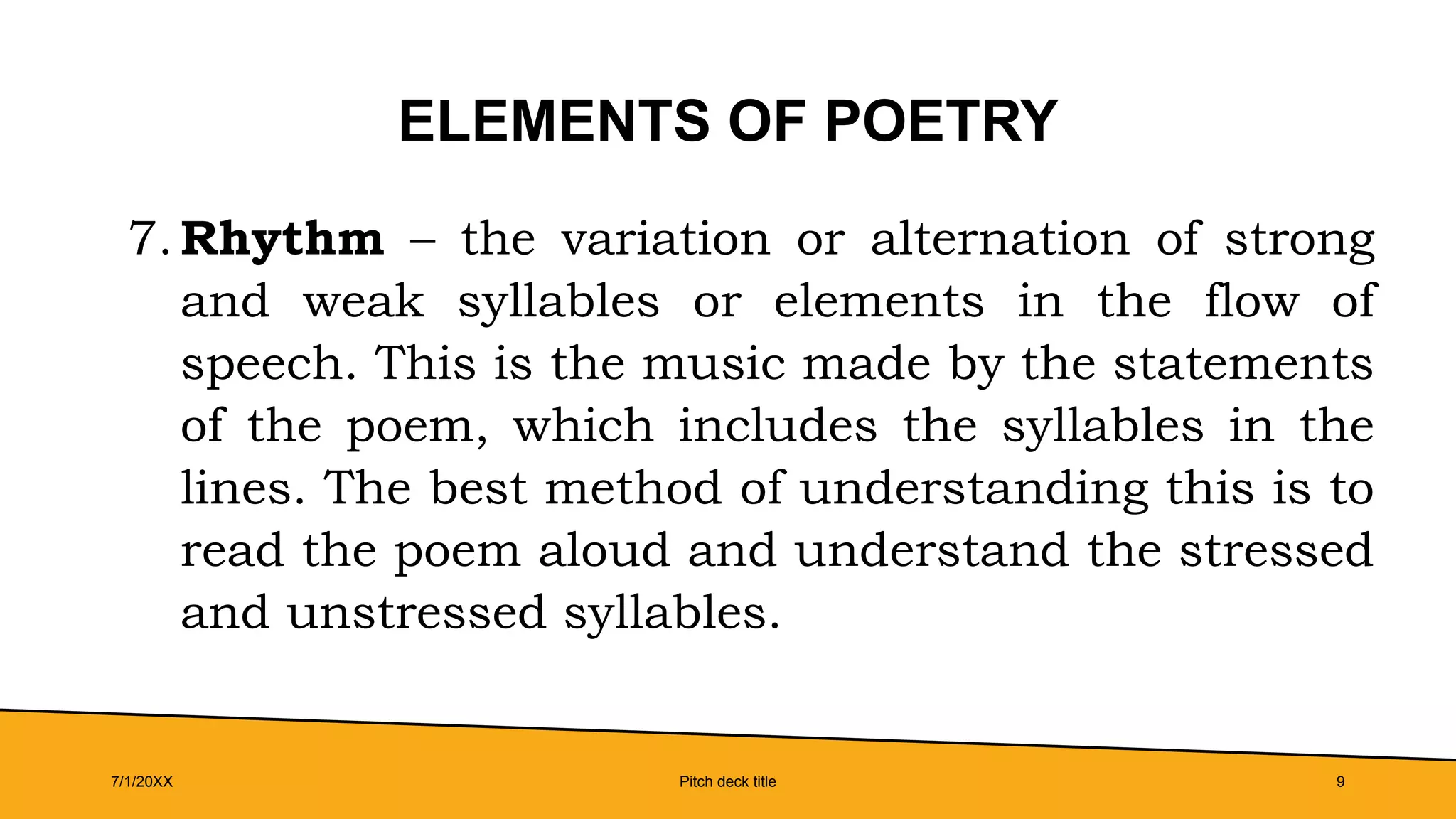
7.Rhythm – the variation or alternation of strong
and weak syllables or elements in the flow of
speech. This is the music made by the statements
of the poem, which includes the syllables in the
lines. The best method of understanding this is to
read the poem aloud and understand the stressed
and unstressed syllables.
ELEMENTS OF POETRY
7/1/20XX Pitch deck title 10
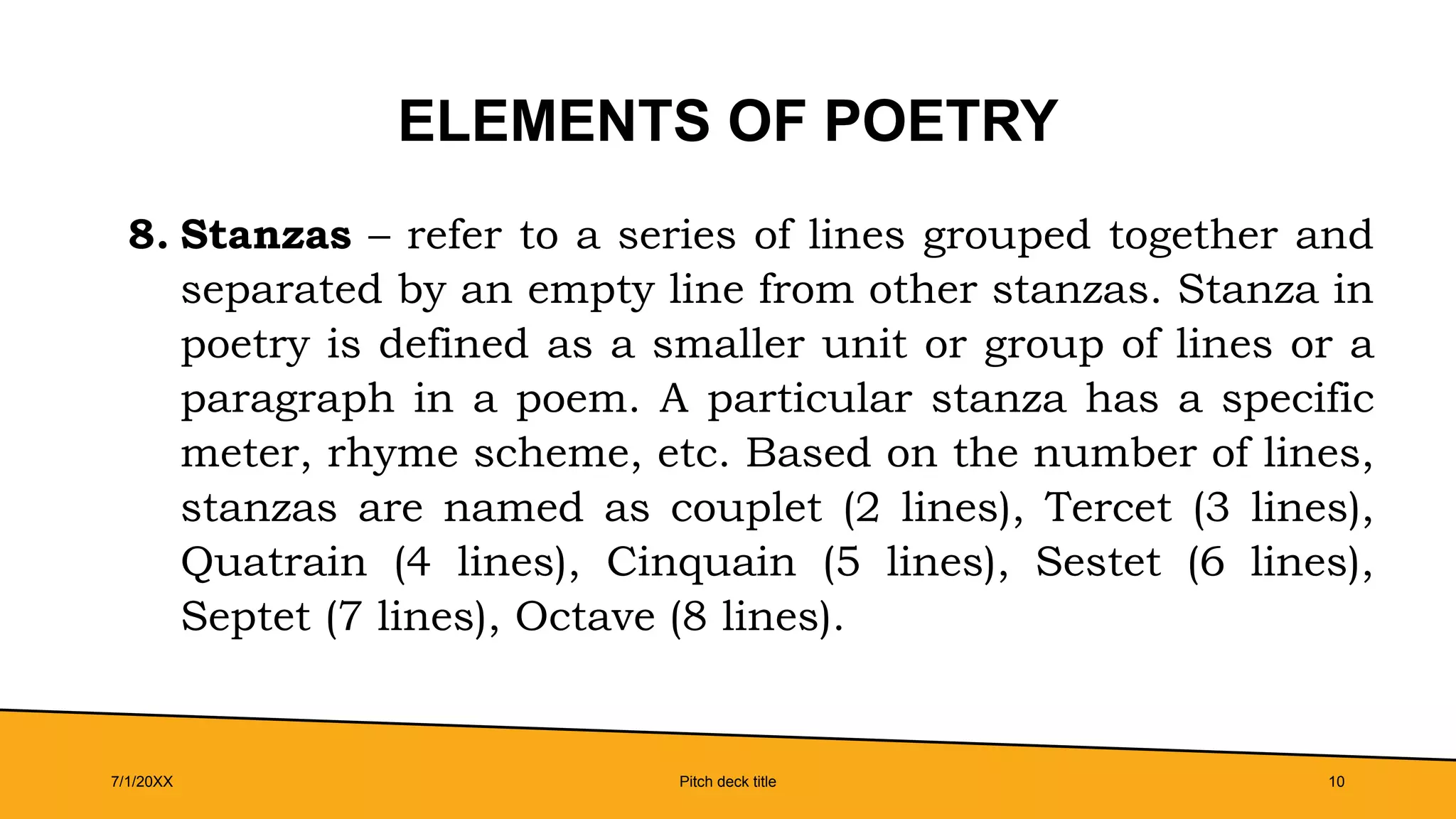
8. Stanzas – refer to a series of lines grouped together and
separated by an empty line from other stanzas. Stanza in
poetry is defined as a smaller unit or group of lines or a
paragraph in a poem. A particular stanza has a specific
meter, rhyme scheme, etc. Based on the number of lines,
stanzas are named as couplet (2 lines), Tercet (3 lines),
Quatrain (4 lines), Cinquain (5 lines), Sestet (6 lines),
Septet (7 lines), Octave (8 lines).
ELEMENTS OF POETRY
7/1/20XX Pitch deck title 11
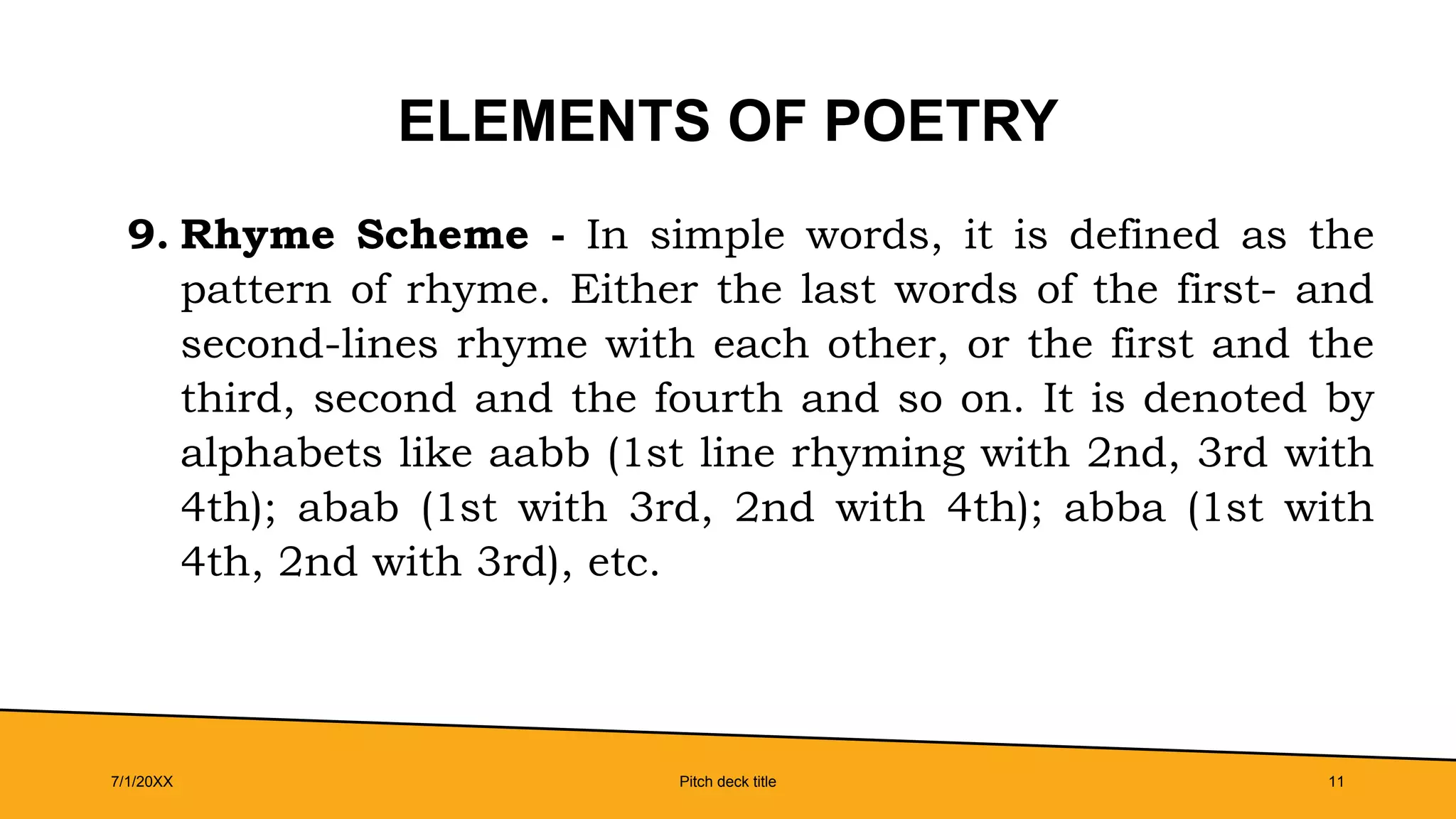
9. Rhyme Scheme - In simple words, it is defined as the
pattern of rhyme. Either the last words of the first- and
second-lines rhyme with each other, or the first and the
third, second and the fourth and so on. It is denoted by
alphabets like aabb (1st line rhyming with 2nd, 3rd with
4th); abab (1st with 3rd, 2nd with 4th); abba (1st with
4th, 2nd with 3rd), etc.
ELEMENTS OF POETRY
7/1/20XX Pitch deck title 12
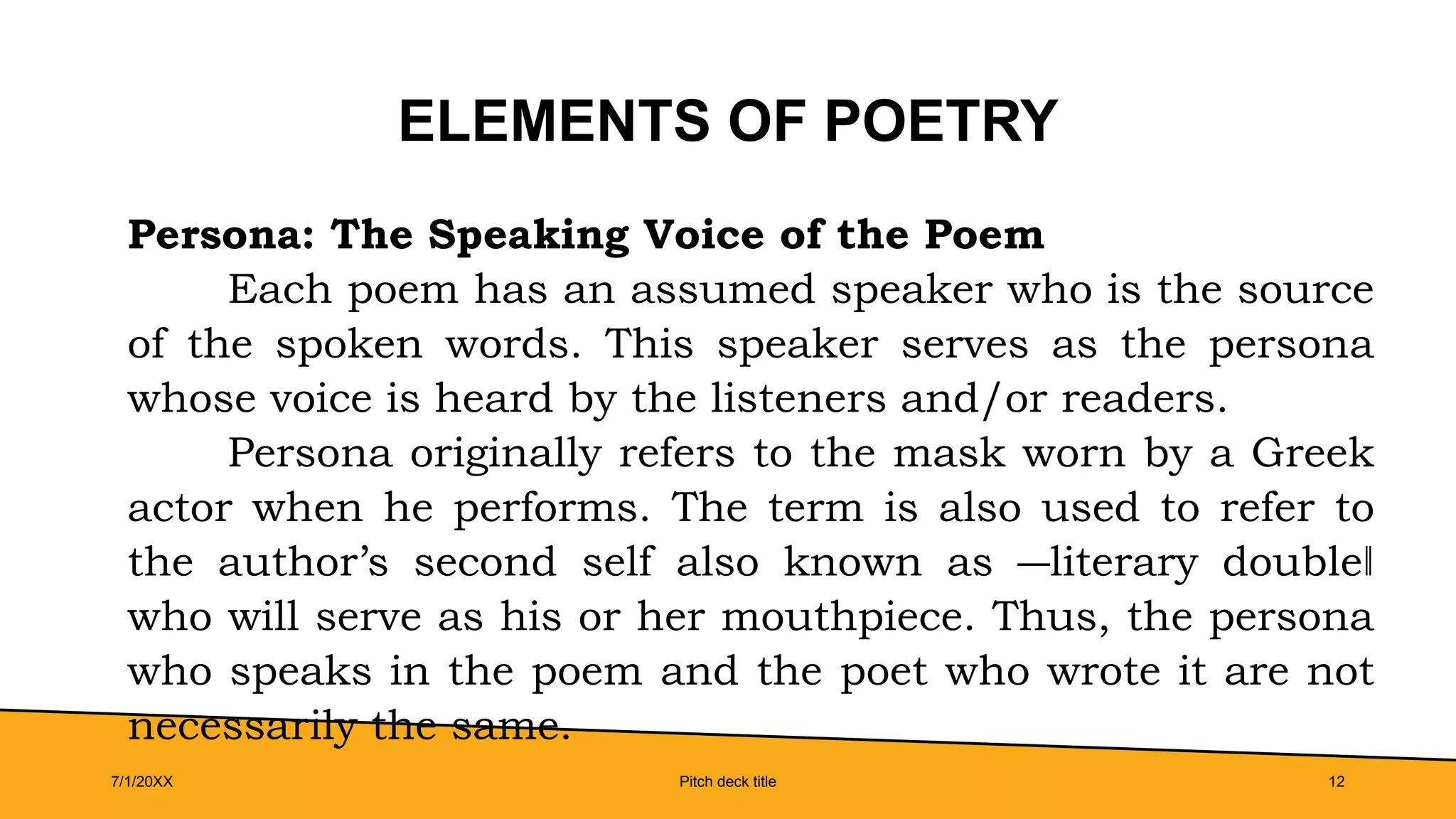
Persona: The Speaking Voice of the Poem
Each poem has an assumed speaker who is the source
of the spoken words. This speaker serves as the persona
whose voice is heard by the listeners and/or readers.
Persona originally refers to the mask worn by a Greek
actor when he performs. The term is also used to refer to
the author’s second self also known as ―literary double‖
who will serve as his or her mouthpiece. Thus, the persona
who speaks in the poem and the poet who wrote it are not
necessarily the same.
ELEMENTS OF POETRY
7/1/20XX Pitch deck title 13
Tone: The Attitude of the Poet towards the
Audience
In poetry, tone refers to the intellectual
and emotional attitudes of the poet towards
his or her intended audience.
ELEMENTS OF POETRY
7/1/20XX Pitch deck title 14
Mood: The Attitude of the Poet towards the
Subject Matter
The term mood is defined by some critics as a
quality of literature that is synonymous with tone or
atmosphere and sometimes both. Mood refers to the
emotional and intellectual attitudes of the author
towards his or her subject matter in each literary
work.
ELEMENTS OF POETRY
7/1/20XX Pitch deck title 15
Atmosphere: The Dominant Emotional
Aura of the Poem
In literature, the term atmosphere denotes the
dominant mood or emotional tone of a work. The
atmosphere in literature refers to the dominant
emotional aura or general feeling created in the
readers or audience by a work at any given point. It
also describes the overall feelings or emotions
experienced by the readers or audience.
TECHNIQUES AND LITERARY DEVICES
7/1/20XX Pitch deck title 16
ALLITERATION
7/1/20XX Pitch deck title 17
These are words begin with the same
letter.
Example: Sheep should sleep in a
shed.
ALLUSION
7/1/20XX Pitch deck title 18
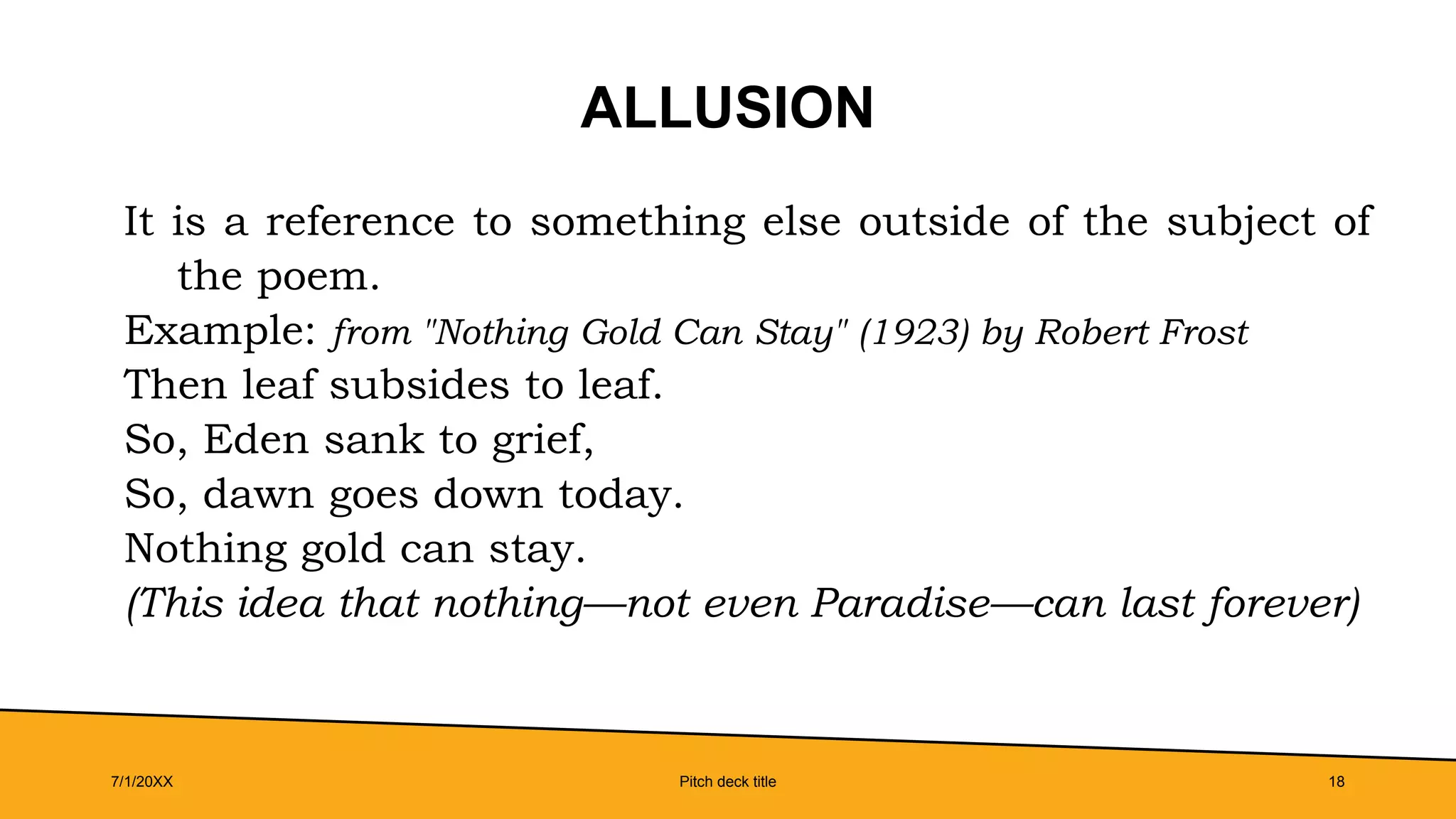
It is a reference to something else outside of the subject of
the poem.
Example: from "Nothing Gold Can Stay" (1923) by Robert Frost
Then leaf subsides to leaf.
So, Eden sank to grief,
So, dawn goes down today.
Nothing gold can stay.
(This idea that nothing—not even Paradise—can last forever)
METAPHOR
7/1/20XX Pitch deck title 19
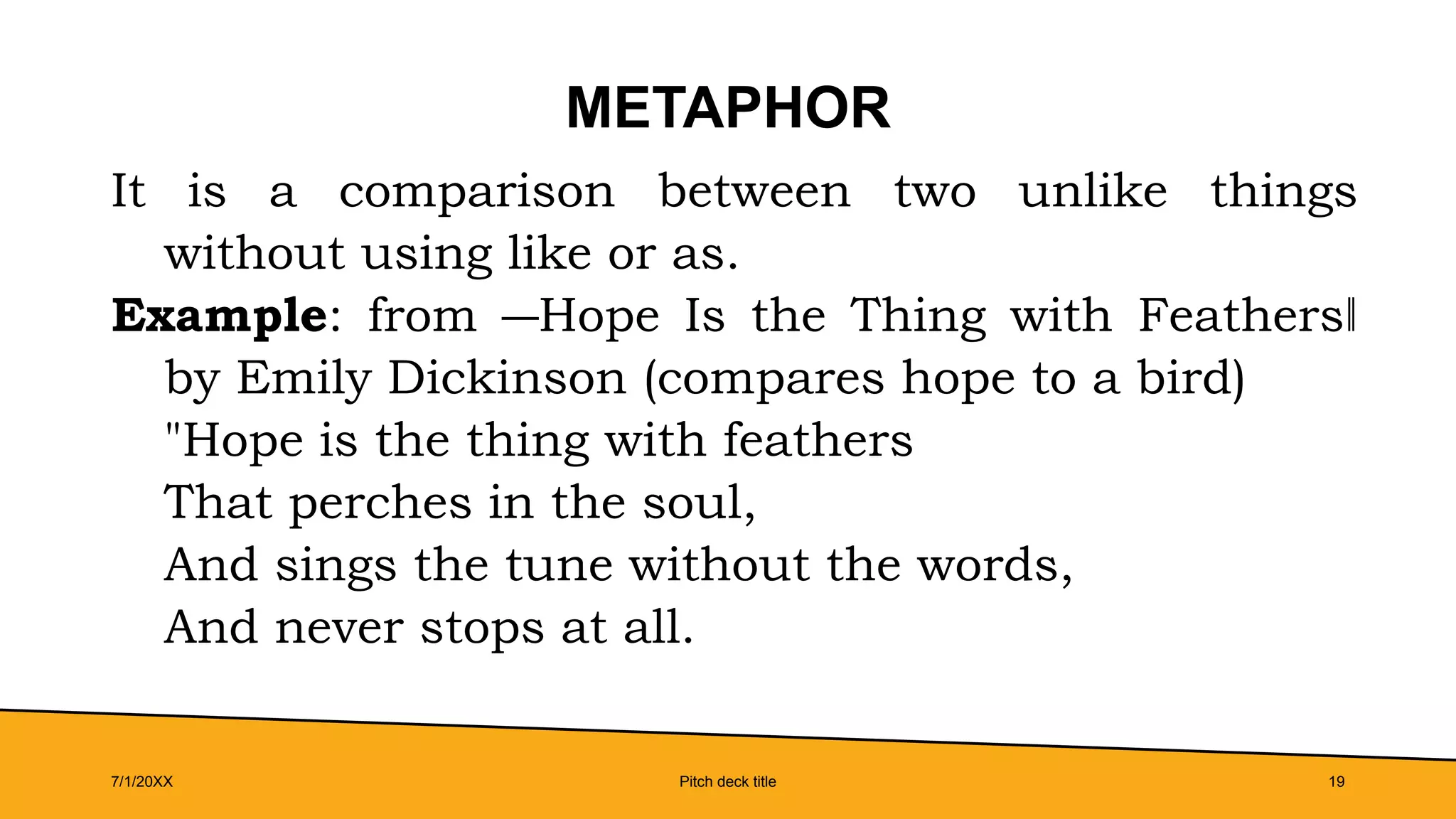
It is a comparison between two unlike things
without using like or as.
Example: from ―Hope Is the Thing with Feathers‖
by Emily Dickinson (compares hope to a bird)
"Hope is the thing with feathers
That perches in the soul,
And sings the tune without the words,
And never stops at all.
PERSONIFICATION
7/1/20XX Pitch deck title 20
It is attributing human qualities to animals or
inanimate objects.
Example: from ―Trees‖ by Joyce Kilmer
A tree that looks at God all day,
And lifts her leafy arms to pray.
REPETITION
7/1/20XX Pitch deck title 21
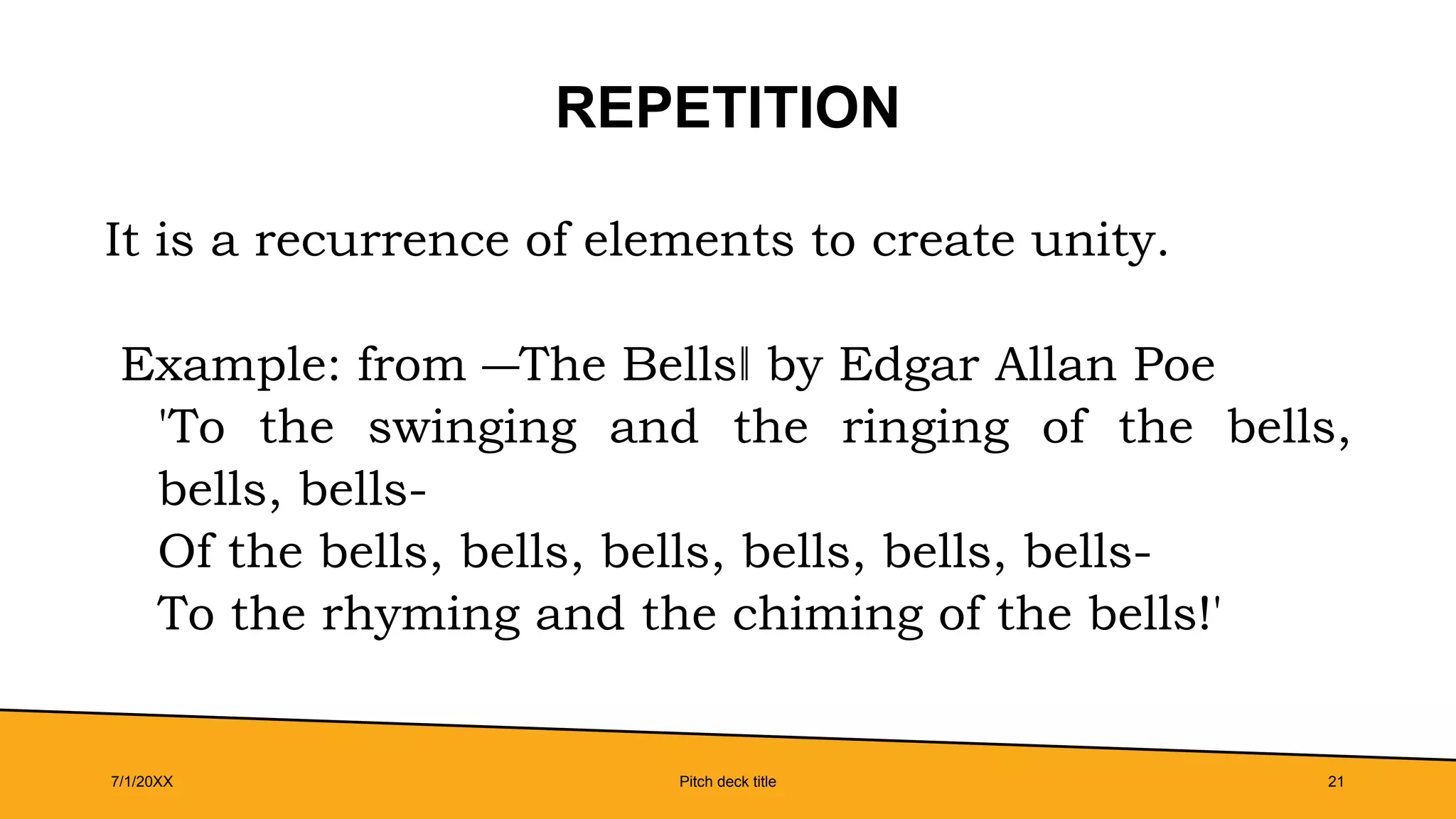
It is a recurrence of elements to create unity.
Example: from ―The Bells‖ by Edgar Allan Poe
'To the swinging and the ringing of the bells,
bells, bells-
Of the bells, bells, bells, bells, bells, bells-
To the rhyming and the chiming of the bells!'
SIMILE
7/1/20XX Pitch deck title 22
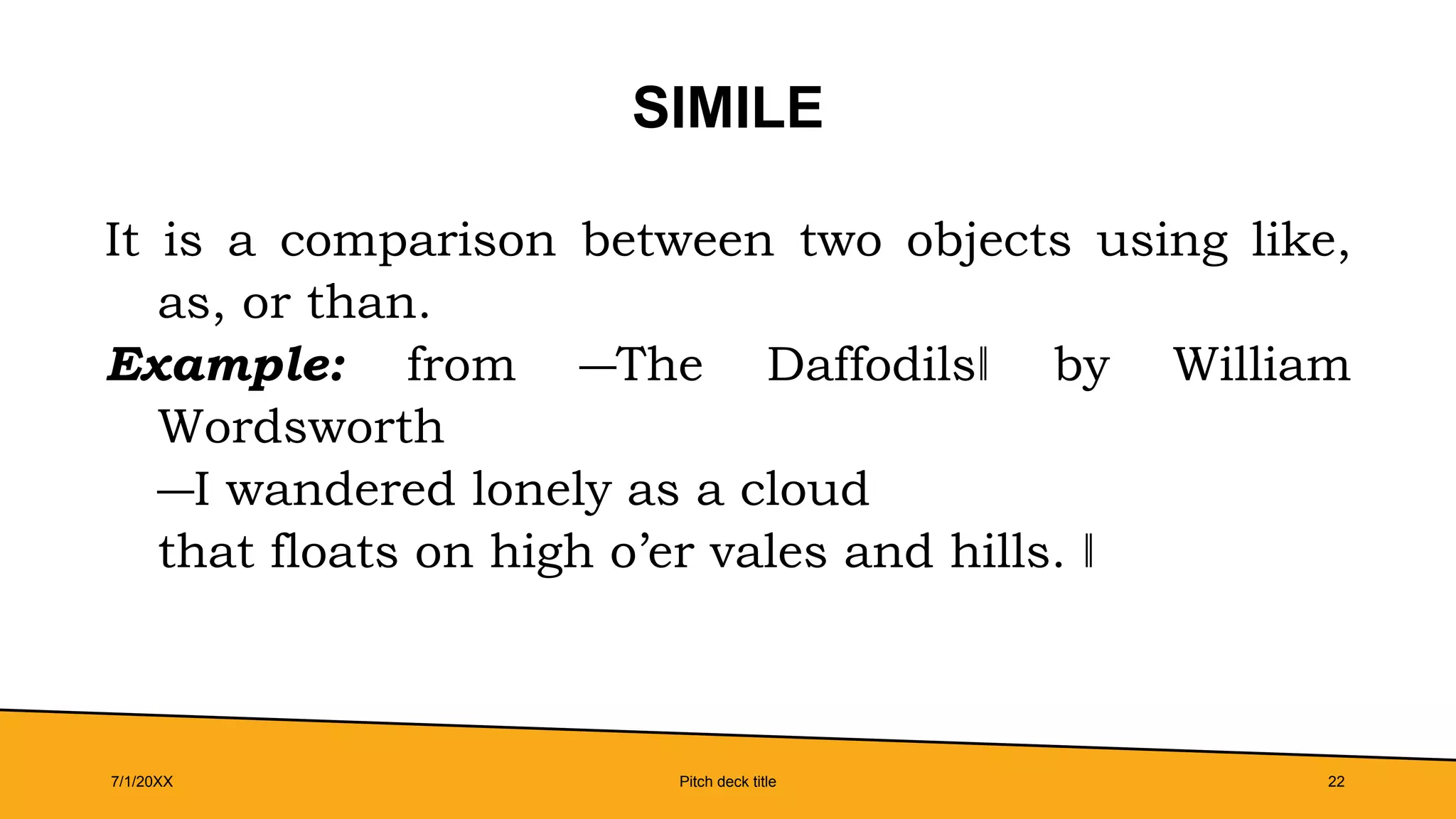
It is a comparison between two objects using like,
as, or than.
Example: from ―The Daffodils‖ by William
Wordsworth
―I wandered lonely as a cloud
that floats on high o’er vales and hills. ‖
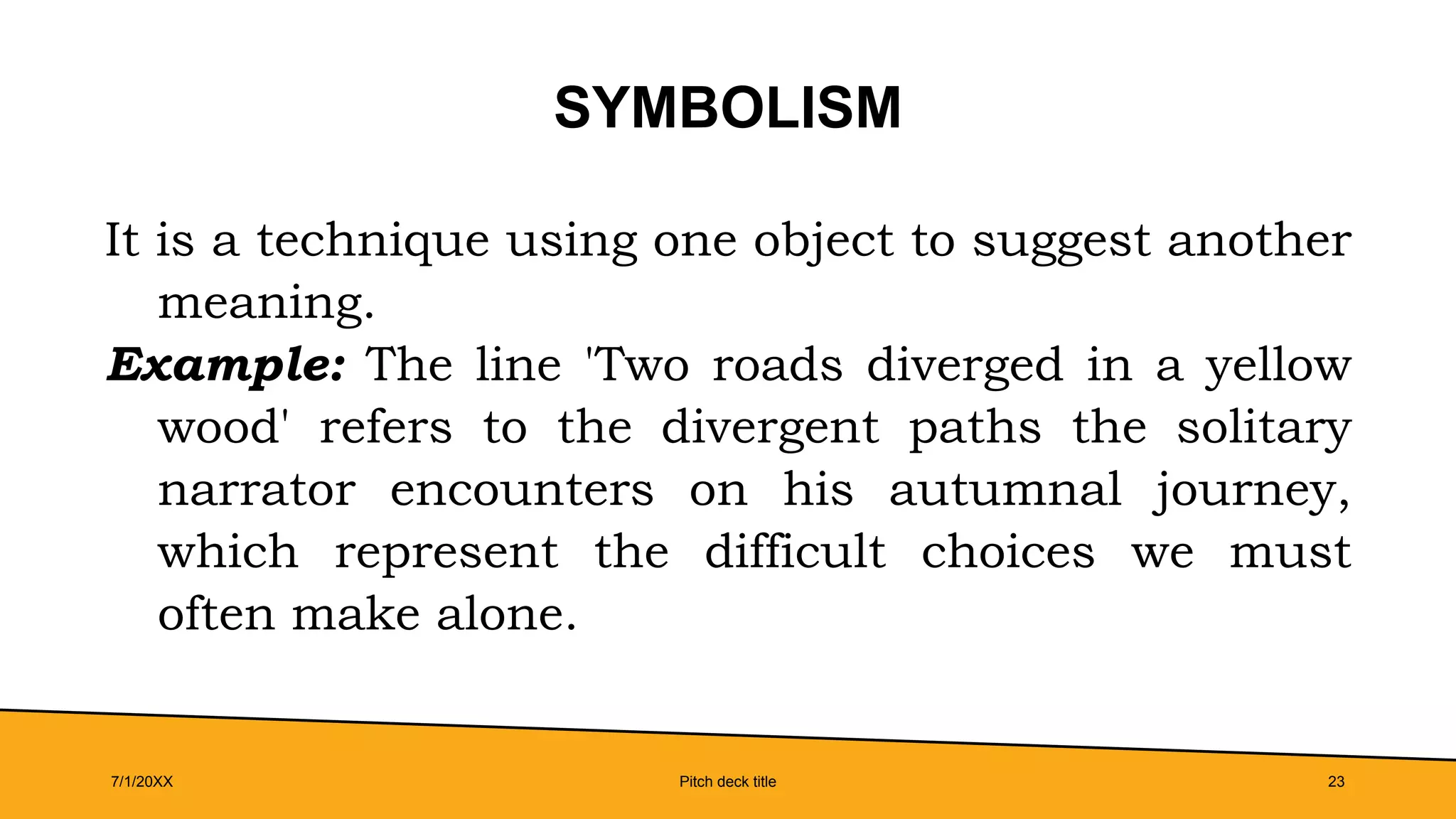
SYMBOLISM
7/1/20XX Pitch deck title 23
It is a technique using one object to suggest another
meaning.
Example: The line 'Two roads diverged in a yellow
wood' refers to the divergent paths the solitary
narrator encounters on his autumnal journey,
which represent the difficult choices we must
often make alone.
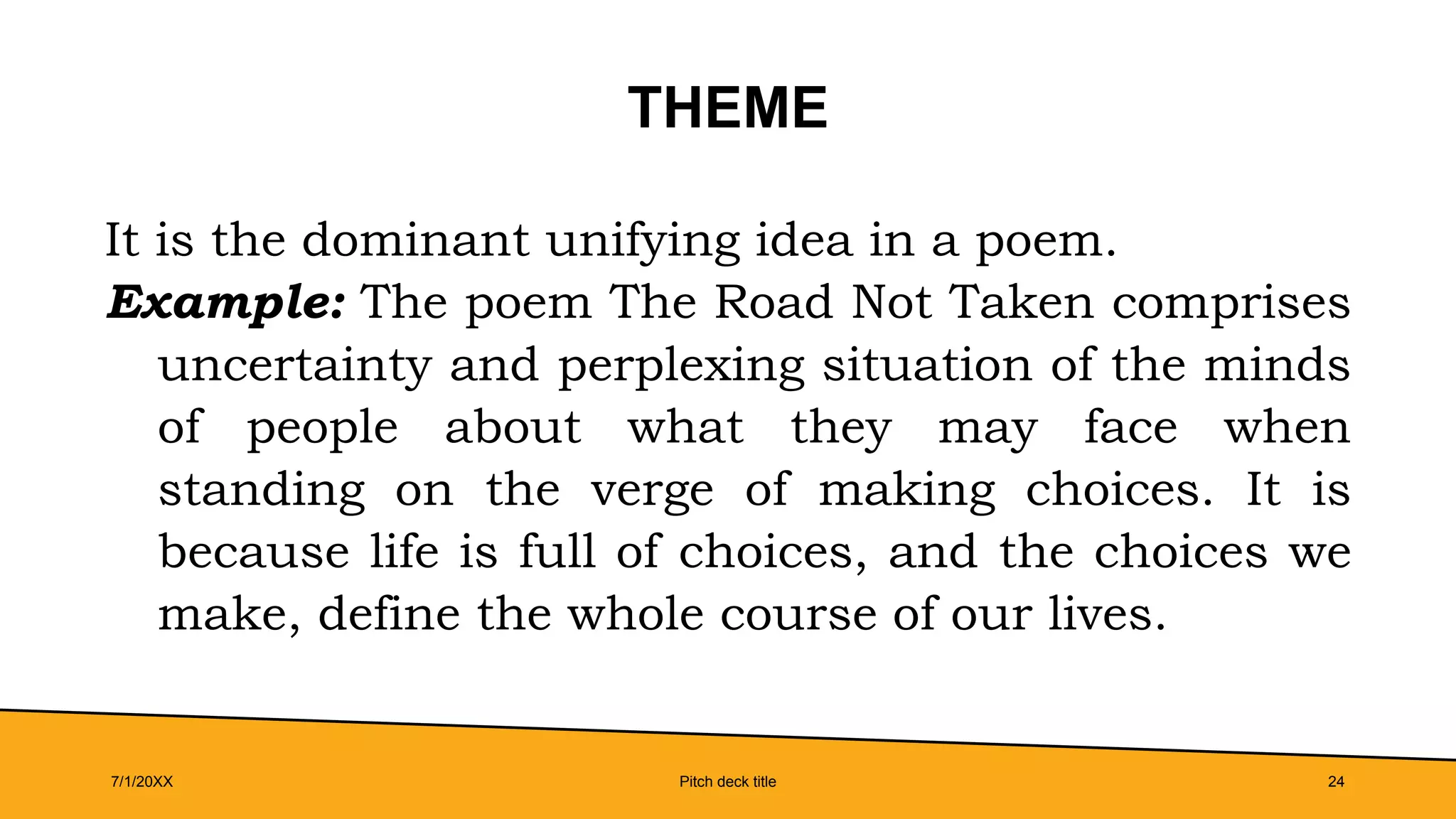
THEME
7/1/20XX Pitch deck title 24
It is the dominant unifying idea in a poem.
Example: The poem The Road Not Taken comprises
uncertainty and perplexing situation of the minds
of people about what they may face when
standing on the verge of making choices. It is
because life is full of choices, and the choices we
make, define the whole course of our lives.
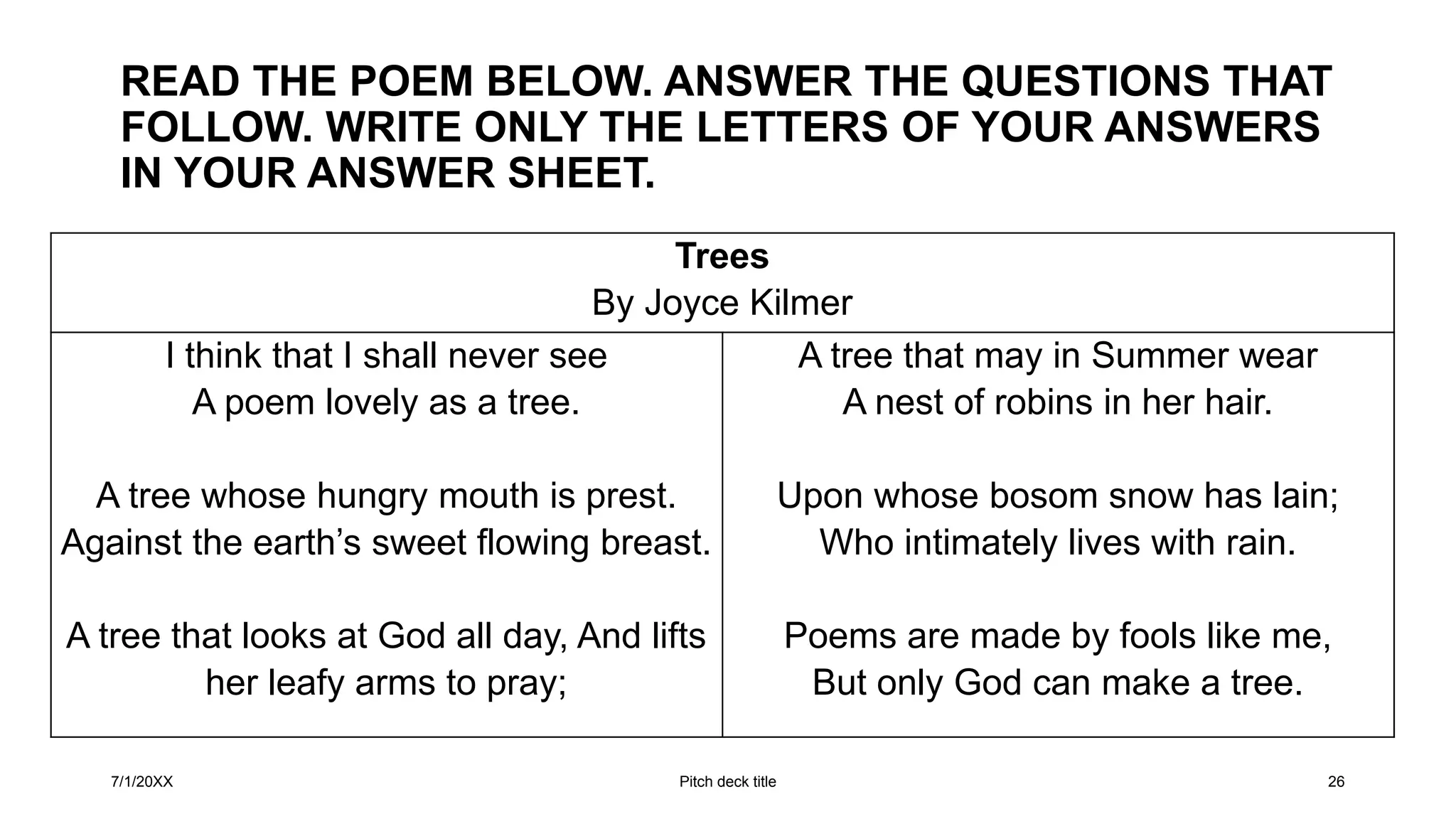
READ THE POEM BELOW. ANSWER THE QUESTIONS THAT
FOLLOW. WRITE ONLY THE LETTERS OF YOUR ANSWERS
IN YOUR ANSWER SHEET.
Trees
By Joyce Kilmer
I think that I shall never see
A poem lovely as a tree.
A tree whose hungry mouth is prest.
Against the earth’s sweet flowing breast.
A tree that looks at God all day, And lifts
her leafy arms to pray;
A tree that may in Summer wear
A nest of robins in her hair.
Upon whose bosom snow has lain;
Who intimately lives with rain.
Poems are made by fools like me,
But only God can make a tree.
7/1/20XX Pitch deck title 26
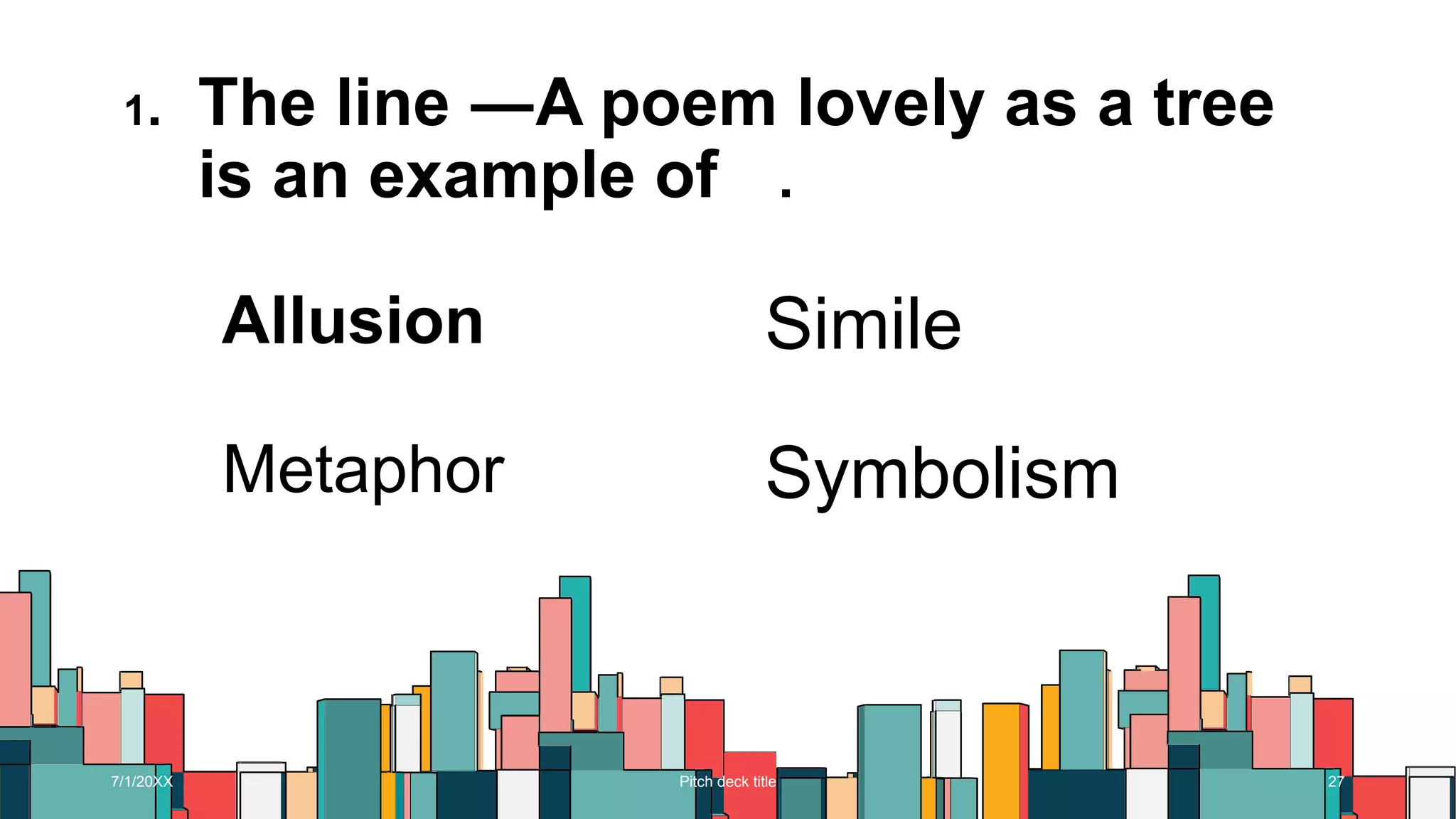
1. The line ―A poem lovely as a tree
is an example of .
7/1/20XX 27
Allusion
Metaphor
Simile
Symbolism
Pitch deck title
2. The words see-tree, prest-breast
show .
7/1/20XX 28
Form
Rhyme
Rhythm
Stanza
Pitch deck title
3. A nest of robins in her hair;‖ (Line 8) and
―And lifts and leafy arms to pray‖ (line 6)
are examples of .
7/1/20XX 29
Alliteration
Metaphor
Symbolism
Theme
Pitch deck title
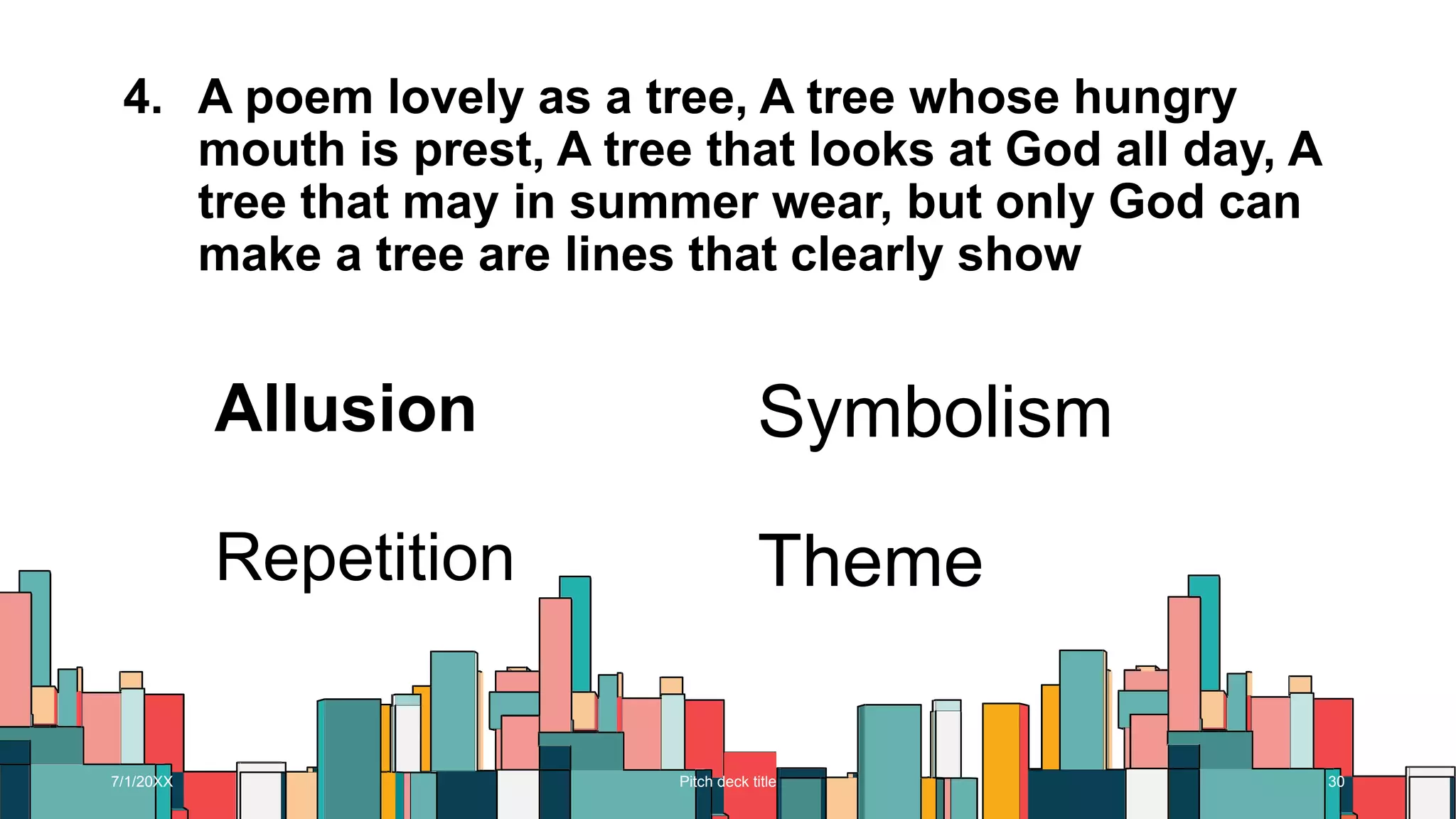
4. A poem lovely as a tree, A tree whose hungry
mouth is prest, A tree that looks at God all day, A
tree that may in summer wear, but only God can
make a tree are lines that clearly show
7/1/20XX 30
Allusion
Repetition
Symbolism
Theme
Pitch deck title
5. The poem Trees by Joyce Kilmer explains that
_____________________.
7/1/20XX 31
God created humans
and trees.
God gave humans
trees to provide shade.
Humans are as
beautiful as trees.
Humans despite being
talented could not replicate
the beauty achieved by
nature.
Pitch deck title
IDENTIFY THE ELEMENT OF
POETRY DESCRIBED IN EACH OF
THE FOLLOWING SENTENCES.
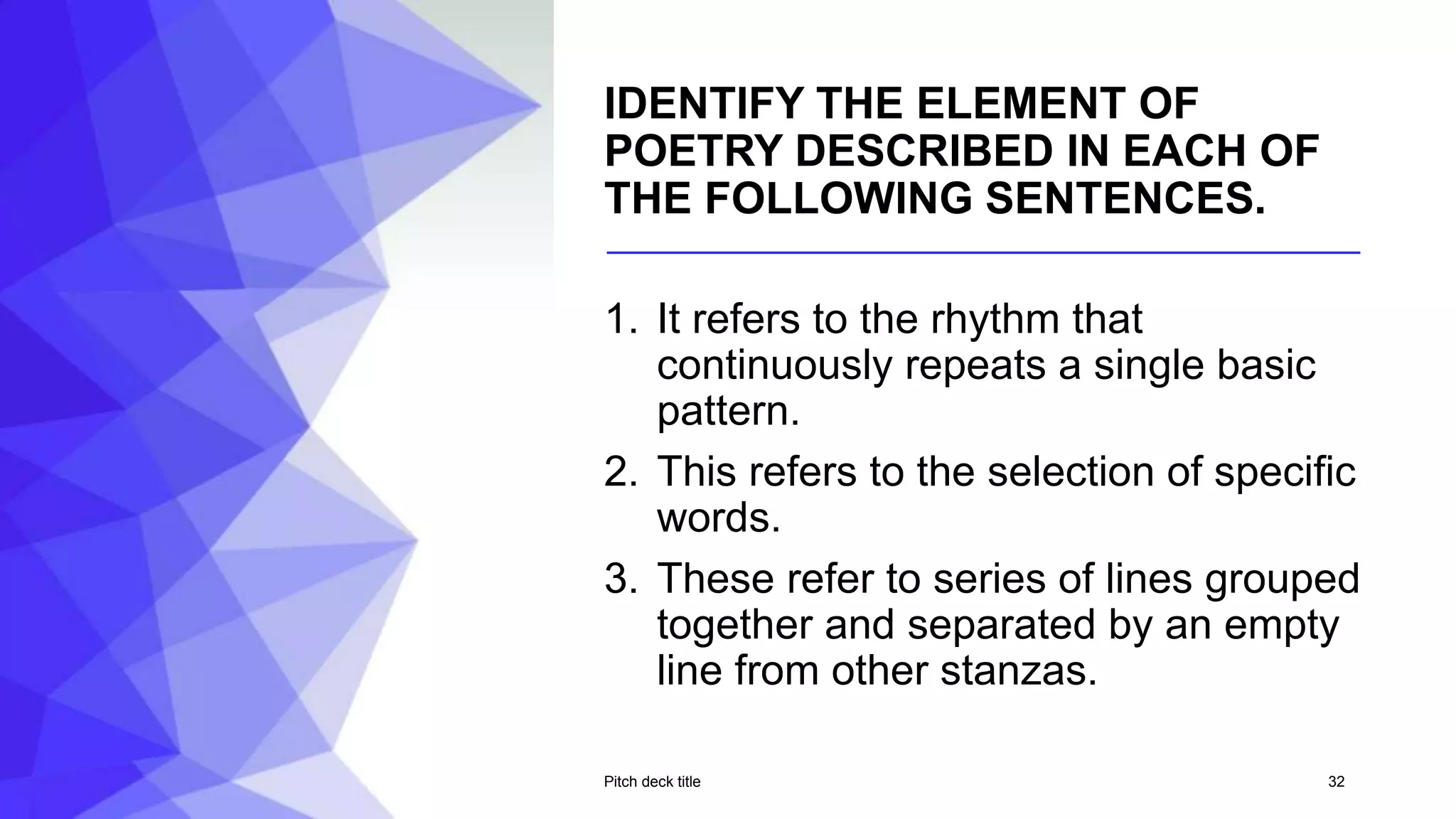
1. It refers to the rhythm that
continuously repeats a single basic
pattern.
2. This refers to the selection of specific
words.
3. These refer to series of lines grouped
together and separated by an empty
line from other stanzas.
7/1/20XX Pitch deck title 32
IDENTIFY THE ELEMENT OF POETRY DESCRIBED
IN EACH OF THE FOLLOWING SENTENCES.
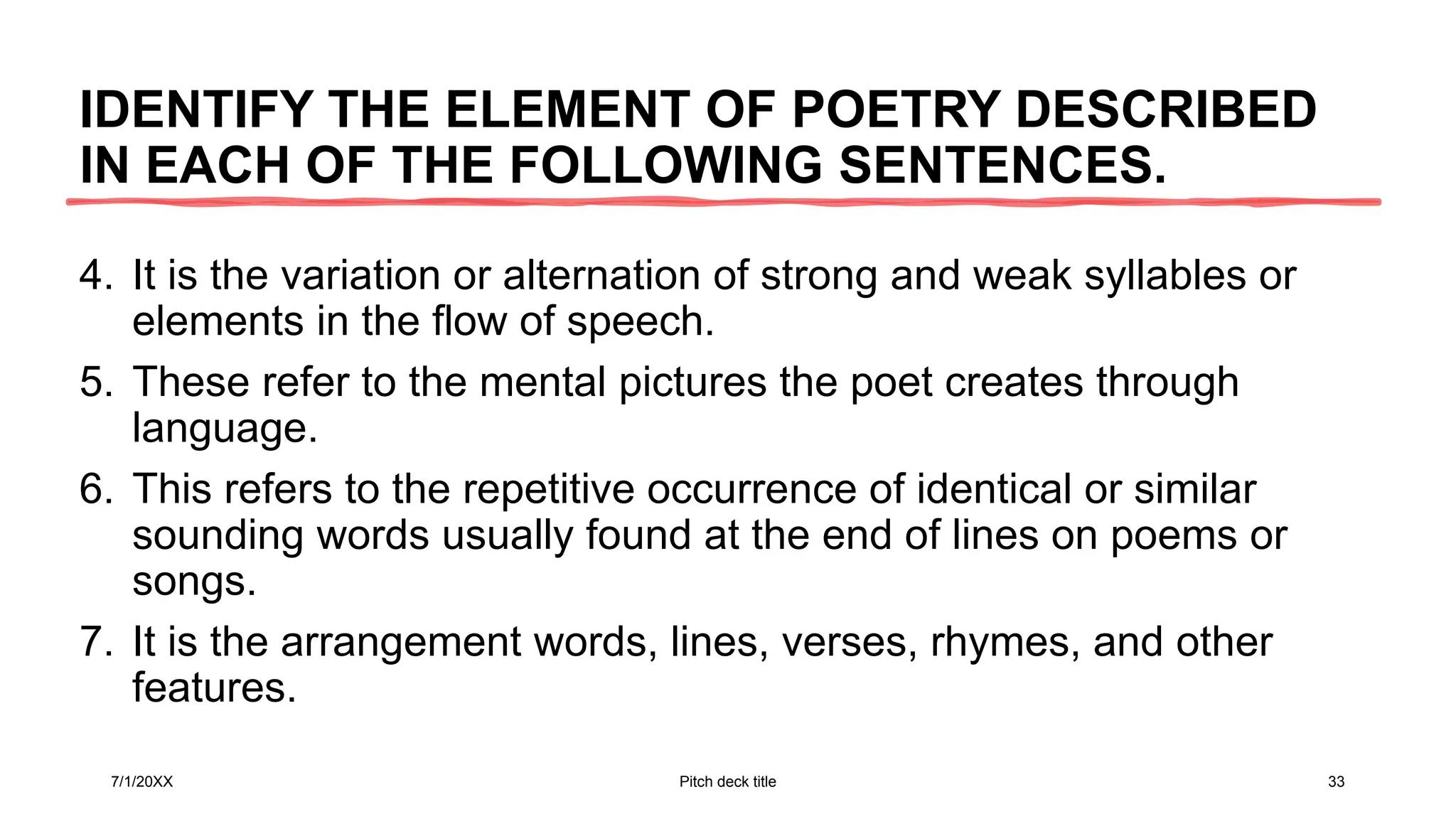
4. It is the variation or alternation of strong and weak syllables or
elements in the flow of speech.
5. These refer to the mental pictures the poet creates through
language.
6. This refers to the repetitive occurrence of identical or similar
sounding words usually found at the end of lines on poems or
songs.
7. It is the arrangement words, lines, verses, rhymes, and other
features.
7/1/20XX Pitch deck title 33
THANK YOU
IRENE A. JALOS, PhD
irene.jalos0306@gmail.com
7/1/20XX Pitch deck title 34

Elements, Techniques, and Literary Devices in Poetry

  • 1.
    6.53 ELEMENTS, TECHNIQUES, AND LITERARY DEVICESIN SPECIFIC FORMS OF POETRY (HUMSS_CW/MP11/12-Ic-f-6)
  • 2.
    WHAT IS POETRY? Poetryis the spontaneous overflow of powerful feelings: it takes its origin from emotion recollected in tranquility. – William Wordsworth 7/1/20XX Pitch deck title 2
  • 3.
    WHAT IS POETRY? Poetryis not a turning loose of emotion, but an escape from emotions; it is not the expression of personality, but an escape of personality. – T.S. Eliot 7/1/20XX Pitch deck title 3
  • 4.
    WHAT IS POETRY? •It can be defined as 'literature in a metrical form' or 'a composition forming rhythmic lines'. A poem is something that follows a particular flow of rhythm and meter. Compared to prose, where there is no such restriction, and the content of the piece flows according to story, a poem may or may not have a story, but has a structured method of writing. 7/1/20XX Pitch deck title 4
  • 5.
    POETRY VERSUS VERSE 7/1/20XXPitch deck title 5 Poetry Verse  Applied to the many forms in which human beings have given rhythmic expression to their most intense perceptions of the world, themselves, and the relation of the two  The metrical line as a basic unit of poetry  Any form of metrical composition.
  • 6.
    ELEMENTS OF POETRY 7/1/20XXPitch deck title 6 1. Images – refer to the mental pictures the poet creates through language 2. Diction – this refers to the selection of specific words. 3. Form – is the arrangement words, lines, verses, rhymes, and other features.
  • 7.
    ELEMENTS OF POETRY 7/1/20XXPitch deck title 7 4. Cadence – refers to the rhythmic change in the inflection of sounds from words being spoken. It also refers to the flow of words. 5. Meter – refers to the rhythm that continuously repeats a single basic pattern. This is the basic structural make-up of the poem. Do the syllables match with each other? Every line in the poem must adhere to this structure. A poem is made up of blocks of lines, which convey a single strand of thought. Within those blocks, a structure of syllables which follow the rhythm must be included. This is the meter or the metrical form of poetry.
  • 8.
    ELEMENTS OF POETRY 7/1/20XXPitch deck title 8 6. Rhyme – refers to the repetitive occurrence of identical or similar sounding words usually found at the end of lines on poems or songs. A poem may or may not have a rhyme. When you write poetry that has rhyme, it means that the last words or sounds of the lines match with each other in some form. Rhyme is basically similar sounding words like 'cat' and 'hat', 'close' and 'shows', 'house' and 'mouse', etc. Free verse poetry, though, does not follow this system.
  • 9.
    ELEMENTS OF POETRY 7/1/20XXPitch deck title 9 7.Rhythm – the variation or alternation of strong and weak syllables or elements in the flow of speech. This is the music made by the statements of the poem, which includes the syllables in the lines. The best method of understanding this is to read the poem aloud and understand the stressed and unstressed syllables.
  • 10.
    ELEMENTS OF POETRY 7/1/20XXPitch deck title 10 8. Stanzas – refer to a series of lines grouped together and separated by an empty line from other stanzas. Stanza in poetry is defined as a smaller unit or group of lines or a paragraph in a poem. A particular stanza has a specific meter, rhyme scheme, etc. Based on the number of lines, stanzas are named as couplet (2 lines), Tercet (3 lines), Quatrain (4 lines), Cinquain (5 lines), Sestet (6 lines), Septet (7 lines), Octave (8 lines).
  • 11.
    ELEMENTS OF POETRY 7/1/20XXPitch deck title 11 9. Rhyme Scheme - In simple words, it is defined as the pattern of rhyme. Either the last words of the first- and second-lines rhyme with each other, or the first and the third, second and the fourth and so on. It is denoted by alphabets like aabb (1st line rhyming with 2nd, 3rd with 4th); abab (1st with 3rd, 2nd with 4th); abba (1st with 4th, 2nd with 3rd), etc.
  • 12.
    ELEMENTS OF POETRY 7/1/20XXPitch deck title 12 Persona: The Speaking Voice of the Poem Each poem has an assumed speaker who is the source of the spoken words. This speaker serves as the persona whose voice is heard by the listeners and/or readers. Persona originally refers to the mask worn by a Greek actor when he performs. The term is also used to refer to the author’s second self also known as ―literary double‖ who will serve as his or her mouthpiece. Thus, the persona who speaks in the poem and the poet who wrote it are not necessarily the same.
  • 13.
    ELEMENTS OF POETRY 7/1/20XXPitch deck title 13 Tone: The Attitude of the Poet towards the Audience In poetry, tone refers to the intellectual and emotional attitudes of the poet towards his or her intended audience.
  • 14.
    ELEMENTS OF POETRY 7/1/20XXPitch deck title 14 Mood: The Attitude of the Poet towards the Subject Matter The term mood is defined by some critics as a quality of literature that is synonymous with tone or atmosphere and sometimes both. Mood refers to the emotional and intellectual attitudes of the author towards his or her subject matter in each literary work.
  • 15.
    ELEMENTS OF POETRY 7/1/20XXPitch deck title 15 Atmosphere: The Dominant Emotional Aura of the Poem In literature, the term atmosphere denotes the dominant mood or emotional tone of a work. The atmosphere in literature refers to the dominant emotional aura or general feeling created in the readers or audience by a work at any given point. It also describes the overall feelings or emotions experienced by the readers or audience.
  • 16.
    TECHNIQUES AND LITERARYDEVICES 7/1/20XX Pitch deck title 16
  • 17.
    ALLITERATION 7/1/20XX Pitch decktitle 17 These are words begin with the same letter. Example: Sheep should sleep in a shed.
  • 18.
    ALLUSION 7/1/20XX Pitch decktitle 18 It is a reference to something else outside of the subject of the poem. Example: from "Nothing Gold Can Stay" (1923) by Robert Frost Then leaf subsides to leaf. So, Eden sank to grief, So, dawn goes down today. Nothing gold can stay. (This idea that nothing—not even Paradise—can last forever)
  • 19.
    METAPHOR 7/1/20XX Pitch decktitle 19 It is a comparison between two unlike things without using like or as. Example: from ―Hope Is the Thing with Feathers‖ by Emily Dickinson (compares hope to a bird) "Hope is the thing with feathers That perches in the soul, And sings the tune without the words, And never stops at all.
  • 20.
    PERSONIFICATION 7/1/20XX Pitch decktitle 20 It is attributing human qualities to animals or inanimate objects. Example: from ―Trees‖ by Joyce Kilmer A tree that looks at God all day, And lifts her leafy arms to pray.
  • 21.
    REPETITION 7/1/20XX Pitch decktitle 21 It is a recurrence of elements to create unity. Example: from ―The Bells‖ by Edgar Allan Poe 'To the swinging and the ringing of the bells, bells, bells- Of the bells, bells, bells, bells, bells, bells- To the rhyming and the chiming of the bells!'
  • 22.
    SIMILE 7/1/20XX Pitch decktitle 22 It is a comparison between two objects using like, as, or than. Example: from ―The Daffodils‖ by William Wordsworth ―I wandered lonely as a cloud that floats on high o’er vales and hills. ‖
  • 23.
    SYMBOLISM 7/1/20XX Pitch decktitle 23 It is a technique using one object to suggest another meaning. Example: The line 'Two roads diverged in a yellow wood' refers to the divergent paths the solitary narrator encounters on his autumnal journey, which represent the difficult choices we must often make alone.
  • 24.
    THEME 7/1/20XX Pitch decktitle 24 It is the dominant unifying idea in a poem. Example: The poem The Road Not Taken comprises uncertainty and perplexing situation of the minds of people about what they may face when standing on the verge of making choices. It is because life is full of choices, and the choices we make, define the whole course of our lives.
  • 26.
    READ THE POEMBELOW. ANSWER THE QUESTIONS THAT FOLLOW. WRITE ONLY THE LETTERS OF YOUR ANSWERS IN YOUR ANSWER SHEET. Trees By Joyce Kilmer I think that I shall never see A poem lovely as a tree. A tree whose hungry mouth is prest. Against the earth’s sweet flowing breast. A tree that looks at God all day, And lifts her leafy arms to pray; A tree that may in Summer wear A nest of robins in her hair. Upon whose bosom snow has lain; Who intimately lives with rain. Poems are made by fools like me, But only God can make a tree. 7/1/20XX Pitch deck title 26
  • 27.
    1. The line―A poem lovely as a tree is an example of . 7/1/20XX 27 Allusion Metaphor Simile Symbolism Pitch deck title
  • 28.
    2. The wordssee-tree, prest-breast show . 7/1/20XX 28 Form Rhyme Rhythm Stanza Pitch deck title
  • 29.
    3. A nestof robins in her hair;‖ (Line 8) and ―And lifts and leafy arms to pray‖ (line 6) are examples of . 7/1/20XX 29 Alliteration Metaphor Symbolism Theme Pitch deck title
  • 30.
    4. A poemlovely as a tree, A tree whose hungry mouth is prest, A tree that looks at God all day, A tree that may in summer wear, but only God can make a tree are lines that clearly show 7/1/20XX 30 Allusion Repetition Symbolism Theme Pitch deck title
  • 31.
    5. The poemTrees by Joyce Kilmer explains that _____________________. 7/1/20XX 31 God created humans and trees. God gave humans trees to provide shade. Humans are as beautiful as trees. Humans despite being talented could not replicate the beauty achieved by nature. Pitch deck title
  • 32.
    IDENTIFY THE ELEMENTOF POETRY DESCRIBED IN EACH OF THE FOLLOWING SENTENCES. 1. It refers to the rhythm that continuously repeats a single basic pattern. 2. This refers to the selection of specific words. 3. These refer to series of lines grouped together and separated by an empty line from other stanzas. 7/1/20XX Pitch deck title 32
  • 33.
    IDENTIFY THE ELEMENTOF POETRY DESCRIBED IN EACH OF THE FOLLOWING SENTENCES. 4. It is the variation or alternation of strong and weak syllables or elements in the flow of speech. 5. These refer to the mental pictures the poet creates through language. 6. This refers to the repetitive occurrence of identical or similar sounding words usually found at the end of lines on poems or songs. 7. It is the arrangement words, lines, verses, rhymes, and other features. 7/1/20XX Pitch deck title 33
  • 34.
    THANK YOU IRENE A.JALOS, PhD irene.jalos0306@gmail.com 7/1/20XX Pitch deck title 34