Finding Needles in Exponential Haystacks
Joel Spencer
June 6, 2014
Yandex - Moscow
Erd˝os Magic:
If a random object has a positive probability of being
good than a good object MUST exist
Modern Erd˝os Magic:
If a randomized algorithm has a positive probability of
producing a good object than a good object MUST exist
Working with Paul Erd˝os was like taking a walk in the hills. Every
time when I thought that we had achieved our goal and deserved a
rest, Paul pointed to the top of another hill and off we would go.
– Fan Chung
PART I
The Lov´asz Local Lemma
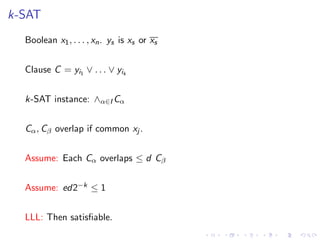
k-SAT
Boolean x1, . . . , xn. ys is xs or xs
Clause C = yi1 ∨ . . . ∨ yik
k-SAT instance: ∧α∈I Cα
Cα, Cβ overlap if common xj .
Assume: Each Cα overlaps ≤ d Cβ
Assume: ed2−k ≤ 1
LLL: Then satisfiable.
k-SAT
Fix d, k (e.g.: k = 5, d = 10) but let n → ∞
Where is the satisfying assignment?
Original Proof: Can’t Find it
k-SAT
Fix d, k (e.g.: k = 5, d = 10) but let n → ∞
Where is the satisfying assignment?
Original Proof: Can’t Find it
MOSER: I can find it!
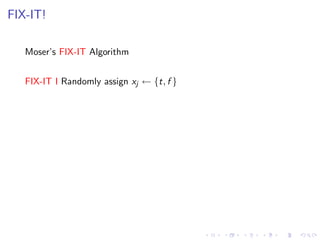
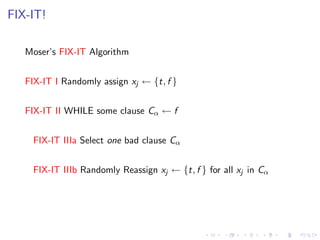
FIX-IT!
Moser’s FIX-IT Algorithm
FIX-IT I Randomly assign xj ← {t, f }
FIX-IT!
Moser’s FIX-IT Algorithm
FIX-IT I Randomly assign xj ← {t, f }
FIX-IT II WHILE some clause Cα ← f
FIX-IT!
Moser’s FIX-IT Algorithm
FIX-IT I Randomly assign xj ← {t, f }
FIX-IT II WHILE some clause Cα ← f
FIX-IT IIIa Select one bad clause Cα
FIX-IT!
Moser’s FIX-IT Algorithm
FIX-IT I Randomly assign xj ← {t, f }
FIX-IT II WHILE some clause Cα ← f
FIX-IT IIIa Select one bad clause Cα
FIX-IT IIIb Randomly Reassign xj ← {t, f } for all xj in Cα
FIX-IT!
Moser’s FIX-IT Algorithm
FIX-IT I Randomly assign xj ← {t, f }
FIX-IT II WHILE some clause Cα ← f
FIX-IT IIIa Select one bad clause Cα
FIX-IT IIIb Randomly Reassign xj ← {t, f } for all xj in Cα
FIX-IT IV
FIX-IT!
Moser’s FIX-IT Algorithm
FIX-IT I Randomly assign xj ← {t, f }
FIX-IT II WHILE some clause Cα ← f
FIX-IT IIIa Select one bad clause Cα
FIX-IT IIIb Randomly Reassign xj ← {t, f } for all xj in Cα
FIX-IT IV There is no IV!
The LOG
LOG - Clauses reassigned in order FIX-IT IIIb applies
TLOG = length of LOG. (= ∞ if no stop)
Modern Erd˝os Magic: E[TLOG] < ∞ implies satisfiable and a
good 1 algorithm
Example: Variables 12345678. Clauses A : 123, B : 234, C : 345,
D : 456, E : 567, F : 678. LOG = ADCFECBF
1
with E[TLOG] reasonable
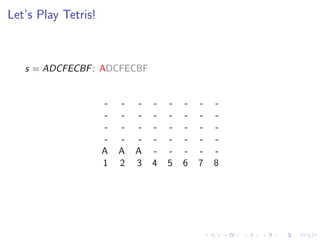
Let’s Play Tetris!
s = ADCFECBF: ADCFECBF
- - - - - - - -
- - - - - - - -
- - - - - - - -
- - - - - - - -
A A A - - - - -
1 2 3 4 5 6 7 8
Let’s Play Tetris!
s = ADCFECBF: ADCFECBF
- - - - - - - -
- - - - - - - -
- - - - - - - -
- - - - - - - -
A A A D D D - -
1 2 3 4 5 6 7 8
Let’s Play Tetris!
s = ADCFECBF: ADCFECBF
- - - - - - - -
- - - - - - - -
- - - - - - - -
- - C C C - - -
A A A D D D - -
1 2 3 4 5 6 7 8
Let’s Play Tetris!
s = ADCFECBF: ADCFECBF
- - - - - - - -
- - - - - - - -
- - - - - - - -
- - C C C F F F
A A A D D D - -
1 2 3 4 5 6 7 8
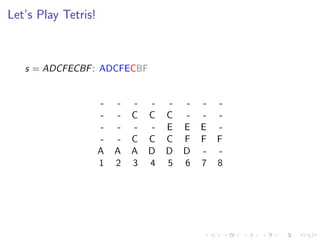
Let’s Play Tetris!
s = ADCFECBF: ADCFECBF
- - - - - - - -
- - - - - - - -
- - - - E E E -
- - C C C F F F
A A A D D D - -
1 2 3 4 5 6 7 8
Let’s Play Tetris!
s = ADCFECBF: ADCFECBF
- - - - - - - -
- - C C C - - -
- - - - E E E -
- - C C C F F F
A A A D D D - -
1 2 3 4 5 6 7 8
Let’s Play Tetris!
s = ADCFECBF: ADCFECBF
- B B B - - - -
- - C C C - - -
- - - - E E E -
- - C C C F F F
A A A D D D - -
1 2 3 4 5 6 7 8
Let’s Play Tetris!
s = ADCFECBF: ADCFECBF
- B B B - - - -
- - C C C F F F
- - - - E E E -
- - C C C F F F
A A A D D D - -
1 2 3 4 5 6 7 8
Let’s Play Tetris!
s = ADCFECBF
- B B B - - - -
- - C C C F F F
- - - - E E E -
- - C C C F F F
A A A D D D - -
1 2 3 4 5 6 7 8
The Pyramid Pyr(s) = ADCFEF is support of last:
- - - - - F F F
- - - - E E E -
- - C C C F F F
A A A D D D - -
1 2 3 4 5 6 7 8
Analysis
Pyramids of prefixes of LOG distinct.
ADCFECBF: A; D; ADC;
DF;ADCFE;ADCFEC;ADCFECB;ADCFEF
E[TLOG] = s Pr[s pyramid of prefix ]
Preprocess Randomness
Each xj chooses countably many assignments.
Probability X1 · · · Xt is pyramid of prefix is ≤ (2−k )t
- - C C C - - -
A A A - - - - -
1 2 3 4 5 6 7 8
A, C false with different coinflips!
An Interesting Algebra
X, Y commute if no overlap.
Tetris same if and only if equal in algebra
ADC = DAC
- - C C C - - -
A A A D D D - -
1 2 3 4 5 6 7 8
ADC, DAC use same coinflips.
Algebraic Combinatorics
Property KNUTH: s(2−k )length(s) < ∞
(sum over pyramids s in algebra)
E[TLOG] ≤ s(2−k )length(s)
Modern Erd˝os Magic: [KNUTH] implies satisfiability and FIX-IT
takes “time” at most sum.
Algebraic Combinatorics: When does [KNUTH] hold?
Partial Answer: if ed2−k ≤ 1
A Prescient Adversary
FIX-IT I Randomly assign xj ← {t, f }
FIX-IT II WHILE some clause Cα ← f
FIX-IT IIIa Select one bad clause Cα
FIX-IT IIIb Randomly Reassign xj ← {t, f } for all xj in Cα
Each xj selects countably many t, f .
Adversary knows coinflips in advance
Still can’t stop FIX-IT from halting!
PART II
Eliminating Outliers
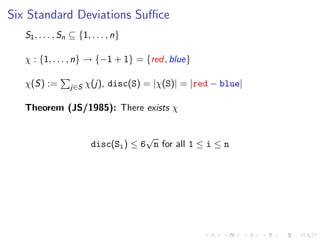
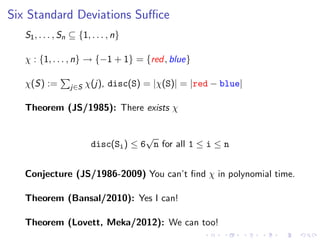
Six Standard Deviations Suffice
S1, . . . , Sn ⊆ {1, . . . , n}
χ : {1, . . . , n} → {−1 + 1} = {red, blue}
χ(S) := j∈S χ(j), disc(S) = |χ(S)| = |red − blue|
Theorem (JS/1985): There exists χ
disc(Si) ≤ 6
√
n for all 1 ≤ i ≤ n
Six Standard Deviations Suffice
S1, . . . , Sn ⊆ {1, . . . , n}
χ : {1, . . . , n} → {−1 + 1} = {red, blue}
χ(S) := j∈S χ(j), disc(S) = |χ(S)| = |red − blue|
Theorem (JS/1985): There exists χ
disc(Si) ≤ 6
√
n for all 1 ≤ i ≤ n
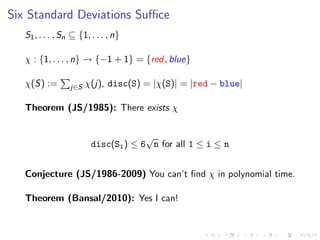
Conjecture (JS/1986-2009) You can’t find χ in polynomial time.
Six Standard Deviations Suffice
S1, . . . , Sn ⊆ {1, . . . , n}
χ : {1, . . . , n} → {−1 + 1} = {red, blue}
χ(S) := j∈S χ(j), disc(S) = |χ(S)| = |red − blue|
Theorem (JS/1985): There exists χ
disc(Si) ≤ 6
√
n for all 1 ≤ i ≤ n
Conjecture (JS/1986-2009) You can’t find χ in polynomial time.
Theorem (Bansal/2010): Yes I can!
Six Standard Deviations Suffice
S1, . . . , Sn ⊆ {1, . . . , n}
χ : {1, . . . , n} → {−1 + 1} = {red, blue}
χ(S) := j∈S χ(j), disc(S) = |χ(S)| = |red − blue|
Theorem (JS/1985): There exists χ
disc(Si) ≤ 6
√
n for all 1 ≤ i ≤ n
Conjecture (JS/1986-2009) You can’t find χ in polynomial time.
Theorem (Bansal/2010): Yes I can!
Theorem (Lovett, Meka/2012): We can too!
A Vector Formulation
ri ∈ Rn, 1 ≤ i ≤ n, |ri |∞ ≤ 1
Initial z ∈ [−1, +1]n (e.g.: z = 0.)
Theorem: There exists x ∈ {−1, +1}n with
|ri · (x − z)| ≤ K
√
n
for all 1 ≤ i ≤ n.
A Vector Formulation
ri ∈ Rn, 1 ≤ i ≤ n, |ri |∞ ≤ 1
Initial z ∈ [−1, +1]n (e.g.: z = 0.)
Theorem: There exists x ∈ {−1, +1}n with
|ri · (x − z)| ≤ K
√
n
for all 1 ≤ i ≤ n.
z = 0, x random. Problem: OUTLIERS!
Phase I
Find x ∈ [−1, +1]n with all least n
2 at ±1.
Idea: Start x ← z. Move x in a Controlled Brownian Motion.
Phase I
Find x ∈ [−1, +1]n with all least n
2 at ±1.
Idea: Start x ← z. Move x in a Controlled Brownian Motion.
Technical: i frozen if |xi | ≥ 1 − ǫ. Each step of distance δ
Phase I
Find x ∈ [−1, +1]n with all least n
2 at ±1.
Idea: Start x ← z. Move x in a Controlled Brownian Motion.
Technical: i frozen if |xi | ≥ 1 − ǫ. Each step of distance δ
Set Lj = [n−1/2rj ] · [x − z]
WANT: ALL |Lj | ≤ K
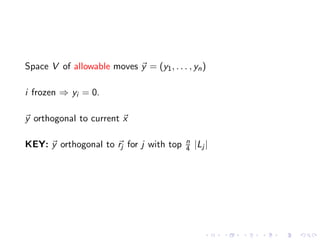
Space V of allowable moves y = (y1, . . . , yn)
i frozen ⇒ yi = 0.
Space V of allowable moves y = (y1, . . . , yn)
i frozen ⇒ yi = 0.
y orthogonal to current x
Space V of allowable moves y = (y1, . . . , yn)
i frozen ⇒ yi = 0.
y orthogonal to current x
KEY: y orthogonal to rj for j with top n
4 |Lj |
The Random Move
d = dim(V ) ≥ n
4 − 1 ∼ n
4 .
Gaussian g = d−1/2[n1b1 + . . . + nd bd ], orthonormal bs
Move x ← x + δg
The Random Move
d = dim(V ) ≥ n
4 − 1 ∼ n
4 .
Gaussian g = d−1/2[n1b1 + . . . + nd bd ], orthonormal bs
Move x ← x + δg
Lj ← Lj + δ[n−1/2rj ] · g
Gaussian Nondirectional
Lj ← Lj + N(0, τ2) with τ2 ≤ 1
d δ2 ≤ 4
n δ2
Gaussian Casino
Martingale 0 = X0, X1, . . . , XT .
∆t = Xt − Xt−1 ∼ N(0, τ2) with τ2 ≤ σ2
t
σ2 := σ2
1 + . . . + σ2
T
Theorem: Pr[XT ≥ λσ] ≤ exp[−λ2/2]
Theorem: Pr[max0≤t≤T Xt ≥ λσ] ≤ exp[−λ2/2]
|x|2 ← |x|2 + δ2. Set T = 4nδ−2 (fictitious continuation).
Fix j. Xt value of Lj after step t.
Martingale!
σ2 = T · 4
n δ2 = 16
Pr[|Lj | ≥ K] ≤ 2e−K2/32 ≤ 0.1
Pr[|Lj | ≥ K at any time ] ≤ 0.1.
SUCCESS: Fewer than n
5 j with |Lj | ≥ K.
Positive Probability of SUCCESS
|x|2 ← |x|2 + δ2. Set T = 4nδ−2 (fictitious continuation).
Fix j. Xt value of Lj after step t.
Martingale!
σ2 = T · 4
n δ2 = 16
Pr[|Lj | ≥ K] ≤ 2e−K2/32 ≤ 0.1
Pr[|Lj | ≥ K at any time ] ≤ 0.1.
SUCCESS: Fewer than n
5 j with |Lj | ≥ K.
Positive Probability of SUCCESS
SUCCESS implies that ALL |Lj | ≤ K
Phase s
m = 21−s n. Start z with ≤ m coordinates frozen. End x with ≤ m
2
coordinates frozen.
Effectively |rj | ≤
√
m
Would get K
√
m but still have n = m2s−1 vectors.
Actually get: K
√
m
√
s = K
√
n
√
s2(1−s)/2
Converges!
Thank You!
It is six in the morning.
The house is asleep.
Nice music is playing.
I prove and conjecture.
– Paul Erd˝os, in letter to Vera S´os

Joel Spencer – Finding Needles in Exponential Haystacks

  • 1.
    Finding Needles inExponential Haystacks Joel Spencer June 6, 2014 Yandex - Moscow
  • 2.
    Erd˝os Magic: If arandom object has a positive probability of being good than a good object MUST exist
  • 3.
    Modern Erd˝os Magic: Ifa randomized algorithm has a positive probability of producing a good object than a good object MUST exist
  • 4.
    Working with PaulErd˝os was like taking a walk in the hills. Every time when I thought that we had achieved our goal and deserved a rest, Paul pointed to the top of another hill and off we would go. – Fan Chung
  • 5.
  • 6.
    k-SAT Boolean x1, .. . , xn. ys is xs or xs Clause C = yi1 ∨ . . . ∨ yik k-SAT instance: ∧α∈I Cα Cα, Cβ overlap if common xj . Assume: Each Cα overlaps ≤ d Cβ Assume: ed2−k ≤ 1 LLL: Then satisfiable.
  • 7.
    k-SAT Fix d, k(e.g.: k = 5, d = 10) but let n → ∞ Where is the satisfying assignment? Original Proof: Can’t Find it
  • 8.
    k-SAT Fix d, k(e.g.: k = 5, d = 10) but let n → ∞ Where is the satisfying assignment? Original Proof: Can’t Find it MOSER: I can find it!
  • 9.
    FIX-IT! Moser’s FIX-IT Algorithm FIX-ITI Randomly assign xj ← {t, f }
  • 10.
    FIX-IT! Moser’s FIX-IT Algorithm FIX-ITI Randomly assign xj ← {t, f } FIX-IT II WHILE some clause Cα ← f
  • 11.
    FIX-IT! Moser’s FIX-IT Algorithm FIX-ITI Randomly assign xj ← {t, f } FIX-IT II WHILE some clause Cα ← f FIX-IT IIIa Select one bad clause Cα
  • 12.
    FIX-IT! Moser’s FIX-IT Algorithm FIX-ITI Randomly assign xj ← {t, f } FIX-IT II WHILE some clause Cα ← f FIX-IT IIIa Select one bad clause Cα FIX-IT IIIb Randomly Reassign xj ← {t, f } for all xj in Cα
  • 13.
    FIX-IT! Moser’s FIX-IT Algorithm FIX-ITI Randomly assign xj ← {t, f } FIX-IT II WHILE some clause Cα ← f FIX-IT IIIa Select one bad clause Cα FIX-IT IIIb Randomly Reassign xj ← {t, f } for all xj in Cα FIX-IT IV
  • 14.
    FIX-IT! Moser’s FIX-IT Algorithm FIX-ITI Randomly assign xj ← {t, f } FIX-IT II WHILE some clause Cα ← f FIX-IT IIIa Select one bad clause Cα FIX-IT IIIb Randomly Reassign xj ← {t, f } for all xj in Cα FIX-IT IV There is no IV!
  • 15.
    The LOG LOG -Clauses reassigned in order FIX-IT IIIb applies TLOG = length of LOG. (= ∞ if no stop) Modern Erd˝os Magic: E[TLOG] < ∞ implies satisfiable and a good 1 algorithm Example: Variables 12345678. Clauses A : 123, B : 234, C : 345, D : 456, E : 567, F : 678. LOG = ADCFECBF 1 with E[TLOG] reasonable
  • 16.
    Let’s Play Tetris! s= ADCFECBF: ADCFECBF - - - - - - - - - - - - - - - - - - - - - - - - - - - - - - - - A A A - - - - - 1 2 3 4 5 6 7 8
  • 17.
    Let’s Play Tetris! s= ADCFECBF: ADCFECBF - - - - - - - - - - - - - - - - - - - - - - - - - - - - - - - - A A A D D D - - 1 2 3 4 5 6 7 8
  • 18.
    Let’s Play Tetris! s= ADCFECBF: ADCFECBF - - - - - - - - - - - - - - - - - - - - - - - - - - C C C - - - A A A D D D - - 1 2 3 4 5 6 7 8
  • 19.
    Let’s Play Tetris! s= ADCFECBF: ADCFECBF - - - - - - - - - - - - - - - - - - - - - - - - - - C C C F F F A A A D D D - - 1 2 3 4 5 6 7 8
  • 20.
    Let’s Play Tetris! s= ADCFECBF: ADCFECBF - - - - - - - - - - - - - - - - - - - - E E E - - - C C C F F F A A A D D D - - 1 2 3 4 5 6 7 8
  • 21.
    Let’s Play Tetris! s= ADCFECBF: ADCFECBF - - - - - - - - - - C C C - - - - - - - E E E - - - C C C F F F A A A D D D - - 1 2 3 4 5 6 7 8
  • 22.
    Let’s Play Tetris! s= ADCFECBF: ADCFECBF - B B B - - - - - - C C C - - - - - - - E E E - - - C C C F F F A A A D D D - - 1 2 3 4 5 6 7 8
  • 23.
    Let’s Play Tetris! s= ADCFECBF: ADCFECBF - B B B - - - - - - C C C F F F - - - - E E E - - - C C C F F F A A A D D D - - 1 2 3 4 5 6 7 8
  • 24.
    Let’s Play Tetris! s= ADCFECBF - B B B - - - - - - C C C F F F - - - - E E E - - - C C C F F F A A A D D D - - 1 2 3 4 5 6 7 8 The Pyramid Pyr(s) = ADCFEF is support of last: - - - - - F F F - - - - E E E - - - C C C F F F A A A D D D - - 1 2 3 4 5 6 7 8
  • 25.
    Analysis Pyramids of prefixesof LOG distinct. ADCFECBF: A; D; ADC; DF;ADCFE;ADCFEC;ADCFECB;ADCFEF E[TLOG] = s Pr[s pyramid of prefix ]
  • 26.
    Preprocess Randomness Each xjchooses countably many assignments. Probability X1 · · · Xt is pyramid of prefix is ≤ (2−k )t - - C C C - - - A A A - - - - - 1 2 3 4 5 6 7 8 A, C false with different coinflips!
  • 27.
    An Interesting Algebra X,Y commute if no overlap. Tetris same if and only if equal in algebra ADC = DAC - - C C C - - - A A A D D D - - 1 2 3 4 5 6 7 8 ADC, DAC use same coinflips.
  • 28.
    Algebraic Combinatorics Property KNUTH:s(2−k )length(s) < ∞ (sum over pyramids s in algebra) E[TLOG] ≤ s(2−k )length(s) Modern Erd˝os Magic: [KNUTH] implies satisfiability and FIX-IT takes “time” at most sum. Algebraic Combinatorics: When does [KNUTH] hold? Partial Answer: if ed2−k ≤ 1
  • 29.
    A Prescient Adversary FIX-ITI Randomly assign xj ← {t, f } FIX-IT II WHILE some clause Cα ← f FIX-IT IIIa Select one bad clause Cα FIX-IT IIIb Randomly Reassign xj ← {t, f } for all xj in Cα Each xj selects countably many t, f . Adversary knows coinflips in advance Still can’t stop FIX-IT from halting!
  • 30.
  • 31.
    Six Standard DeviationsSuffice S1, . . . , Sn ⊆ {1, . . . , n} χ : {1, . . . , n} → {−1 + 1} = {red, blue} χ(S) := j∈S χ(j), disc(S) = |χ(S)| = |red − blue| Theorem (JS/1985): There exists χ disc(Si) ≤ 6 √ n for all 1 ≤ i ≤ n
  • 32.
    Six Standard DeviationsSuffice S1, . . . , Sn ⊆ {1, . . . , n} χ : {1, . . . , n} → {−1 + 1} = {red, blue} χ(S) := j∈S χ(j), disc(S) = |χ(S)| = |red − blue| Theorem (JS/1985): There exists χ disc(Si) ≤ 6 √ n for all 1 ≤ i ≤ n Conjecture (JS/1986-2009) You can’t find χ in polynomial time.
  • 33.
    Six Standard DeviationsSuffice S1, . . . , Sn ⊆ {1, . . . , n} χ : {1, . . . , n} → {−1 + 1} = {red, blue} χ(S) := j∈S χ(j), disc(S) = |χ(S)| = |red − blue| Theorem (JS/1985): There exists χ disc(Si) ≤ 6 √ n for all 1 ≤ i ≤ n Conjecture (JS/1986-2009) You can’t find χ in polynomial time. Theorem (Bansal/2010): Yes I can!
  • 34.
    Six Standard DeviationsSuffice S1, . . . , Sn ⊆ {1, . . . , n} χ : {1, . . . , n} → {−1 + 1} = {red, blue} χ(S) := j∈S χ(j), disc(S) = |χ(S)| = |red − blue| Theorem (JS/1985): There exists χ disc(Si) ≤ 6 √ n for all 1 ≤ i ≤ n Conjecture (JS/1986-2009) You can’t find χ in polynomial time. Theorem (Bansal/2010): Yes I can! Theorem (Lovett, Meka/2012): We can too!
  • 35.
    A Vector Formulation ri∈ Rn, 1 ≤ i ≤ n, |ri |∞ ≤ 1 Initial z ∈ [−1, +1]n (e.g.: z = 0.) Theorem: There exists x ∈ {−1, +1}n with |ri · (x − z)| ≤ K √ n for all 1 ≤ i ≤ n.
  • 36.
    A Vector Formulation ri∈ Rn, 1 ≤ i ≤ n, |ri |∞ ≤ 1 Initial z ∈ [−1, +1]n (e.g.: z = 0.) Theorem: There exists x ∈ {−1, +1}n with |ri · (x − z)| ≤ K √ n for all 1 ≤ i ≤ n. z = 0, x random. Problem: OUTLIERS!
  • 37.
    Phase I Find x∈ [−1, +1]n with all least n 2 at ±1. Idea: Start x ← z. Move x in a Controlled Brownian Motion.
  • 38.
    Phase I Find x∈ [−1, +1]n with all least n 2 at ±1. Idea: Start x ← z. Move x in a Controlled Brownian Motion. Technical: i frozen if |xi | ≥ 1 − ǫ. Each step of distance δ
  • 39.
    Phase I Find x∈ [−1, +1]n with all least n 2 at ±1. Idea: Start x ← z. Move x in a Controlled Brownian Motion. Technical: i frozen if |xi | ≥ 1 − ǫ. Each step of distance δ Set Lj = [n−1/2rj ] · [x − z] WANT: ALL |Lj | ≤ K
  • 40.
    Space V ofallowable moves y = (y1, . . . , yn)
  • 41.
    Space V ofallowable moves y = (y1, . . . , yn) i frozen ⇒ yi = 0.
  • 42.
    Space V ofallowable moves y = (y1, . . . , yn) i frozen ⇒ yi = 0. y orthogonal to current x
  • 43.
    Space V ofallowable moves y = (y1, . . . , yn) i frozen ⇒ yi = 0. y orthogonal to current x KEY: y orthogonal to rj for j with top n 4 |Lj |
  • 44.
    The Random Move d= dim(V ) ≥ n 4 − 1 ∼ n 4 . Gaussian g = d−1/2[n1b1 + . . . + nd bd ], orthonormal bs Move x ← x + δg
  • 45.
    The Random Move d= dim(V ) ≥ n 4 − 1 ∼ n 4 . Gaussian g = d−1/2[n1b1 + . . . + nd bd ], orthonormal bs Move x ← x + δg Lj ← Lj + δ[n−1/2rj ] · g Gaussian Nondirectional Lj ← Lj + N(0, τ2) with τ2 ≤ 1 d δ2 ≤ 4 n δ2
  • 46.
    Gaussian Casino Martingale 0= X0, X1, . . . , XT . ∆t = Xt − Xt−1 ∼ N(0, τ2) with τ2 ≤ σ2 t σ2 := σ2 1 + . . . + σ2 T Theorem: Pr[XT ≥ λσ] ≤ exp[−λ2/2] Theorem: Pr[max0≤t≤T Xt ≥ λσ] ≤ exp[−λ2/2]
  • 47.
    |x|2 ← |x|2+ δ2. Set T = 4nδ−2 (fictitious continuation). Fix j. Xt value of Lj after step t. Martingale! σ2 = T · 4 n δ2 = 16 Pr[|Lj | ≥ K] ≤ 2e−K2/32 ≤ 0.1 Pr[|Lj | ≥ K at any time ] ≤ 0.1. SUCCESS: Fewer than n 5 j with |Lj | ≥ K. Positive Probability of SUCCESS
  • 48.
    |x|2 ← |x|2+ δ2. Set T = 4nδ−2 (fictitious continuation). Fix j. Xt value of Lj after step t. Martingale! σ2 = T · 4 n δ2 = 16 Pr[|Lj | ≥ K] ≤ 2e−K2/32 ≤ 0.1 Pr[|Lj | ≥ K at any time ] ≤ 0.1. SUCCESS: Fewer than n 5 j with |Lj | ≥ K. Positive Probability of SUCCESS SUCCESS implies that ALL |Lj | ≤ K
  • 49.
    Phase s m =21−s n. Start z with ≤ m coordinates frozen. End x with ≤ m 2 coordinates frozen. Effectively |rj | ≤ √ m Would get K √ m but still have n = m2s−1 vectors. Actually get: K √ m √ s = K √ n √ s2(1−s)/2 Converges!
  • 50.
    Thank You! It issix in the morning. The house is asleep. Nice music is playing. I prove and conjecture. – Paul Erd˝os, in letter to Vera S´os