RESEARCH METHODS
    OVERVIEW
   Dr. John Bradford
Research Methods
• All research begins with a ‘Literature
  Review’!
  – A ‘lit review’ is a review of the existing literature
    on the topic
• Types of Research (not exhaustive!)
1. Surveys and Interviews
2. Experiments
3. Observation/ethnography
4. Unobtrusive (nonreactive) research
Survey
• Survey: a series of questions asked of a
  number of people
     1. Interview
     2. Self-administered questionnaire
  – Surveys are especially good for discovering basic
    ‘demographic information’- age, gender,
    income, education, etc.
  – Allows researchers to obtain information about
    things that cannot observed directly, such as
    attitudes.
Survey
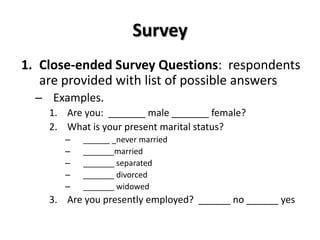
1. Close-ended Survey Questions: respondents
   are provided with list of possible answers
  – Examples.
    1. Are you: _______ male _______ female?
    2. What is your present marital status?
       –   ______ _never married
       –   _______married
       –   _______ separated
       –   _______ divorced
       –   _______ widowed
    3. Are you presently employed? ______ no ______ yes
Survey
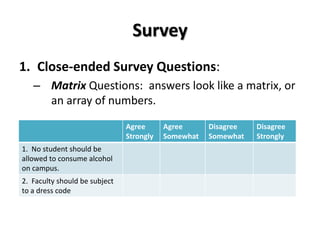
1. Close-ended Survey Questions:
   – Matrix Questions: answers look like a matrix, or
     an array of numbers.
                               Agree      Agree      Disagree   Disagree
                               Strongly   Somewhat   Somewhat   Strongly
1. No student should be
allowed to consume alcohol
on campus.
2. Faculty should be subject
to a dress code
Survey
2. Open-ended Survey Questions:
   Respondents answer questions in their own
   words.
Examples:
  – What is the most important thing you have
    learned so far in this class?
  – What is the thing that you like most about your
    sociology class? The thing you like least?
Survey
         6 Guidelines for Crafting Survey Questions
1.   Adapt phrasing of questions to the educational level
     of your respondents.
2.   Avoid double negatives in a question
3.   Avoid ‘marathon’ questions.
4.   Don’t ask ‘double-barreled’ questions: ask only one
     question at a time!
5.   Don’t ask ‘leading’ or ‘loaded’ questions
6.   Don’t ask questions that your respondent cannot
     answer
     –   Inaccessible information, or illogical questions.
Experiment
•   An experiment involves manipulating the
    independent variable (X) and observing the effect on
    the dependent variable (Y)
•   Experiments are the only means by which we can
    explore causal relationships; only way we can know
    for sure if changes to X cause changes in Y.
•   Experimenter needs two dependent variable (Y)
    groups of Y:
    1. Experimental group- receives ‘treatment’ of independent
       variable (X)
    2. Control group- does not receive treatment; is left alone.
Experiment
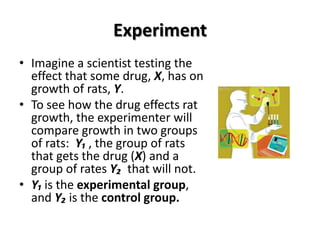
• Imagine a scientist testing the
  effect that some drug, X, has on
  growth of rats, Y.
• To see how the drug effects rat
  growth, the experimenter will
  compare growth in two groups
  of rats: Y₁ , the group of rats
  that gets the drug (X) and a
  group of rates Y₂ that will not.
• Y₁ is the experimental group,
  and Y₂ is the control group.
Experiment
• One assumes separation or isolation
  between the setting where X is
  applied and the control, where X isn’t
  applied.
• It is important that rats which receive
  the drug and rats which do not be
  alike in all relevant characteristics and
  conditions, so that any observed
  differences between rats which
  receive the drug (the experimental
  group) and those that do not (the
  control group) can be attributed only
  to the drug (X), and not to something
  else.
Experiment
• A counter-factual refers to something that did not
  happen, but could have or would have occurred.
   – Whenever we infer causal relationships (‘X’ caused ‘Y’
     to happen), we compare what did happen with what
     we believe would have happened in the absence of the
     cause, i.e. we compare a factual with a counter-factual
     (imagined) condition.
• We use the ‘control group’ to make a
  counterfactual argument, which says that: “in the
  absence of X, this is how Y₁ would have behaved.”
  We assume that Y₁ would have behaved like Y₂, the
  control.
• Why? Because they are alike in all relevant
  characteristics, so any difference we observe must
  be a result of the independent variable, X.
Experiment
             5 Rules for Doing True Experiments
1.   Have at least two groups (control and experiment)
2.   Randomly assign people to groups
3.   Treat the experimental group by manipulating the
     independent variable
4.   Observe the effect of the treatment on the dependent
     variable in the experimental group
5.   Compare the dependent variable differences (the
     outcome of treatment) in the experimental and
     control groups
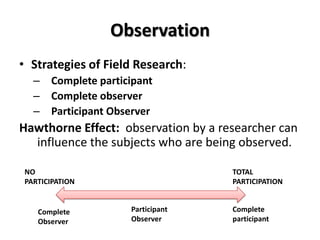
Observation
• Strategies of Field Research:
  – Complete participant
  – Complete observer
  – Participant Observer
Hawthorne Effect: observation by a researcher can
  influence the subjects who are being observed.

NO                                   TOTAL
PARTICIPATION                        PARTICIPATION


   Complete         Participant      Complete
   Observer         Observer         participant
Unobtrusive (Nonreactive) Research
• Artifacts (archeologists)
• Statistics
• Content Analysis

• Triangulation = using several research
  methods.
Sampling
• A Sample is a portion of the larger population
  that you will study to make inferences about
  the larger population.
• General rule: the more diverse a population
  is, the larger the sample needs to be!
• Samples should be random: every element in
  the population has the same probability of
  being in the sample.

1 29-13 research methods overview

  • 1.
    RESEARCH METHODS OVERVIEW Dr. John Bradford
  • 2.
    Research Methods • Allresearch begins with a ‘Literature Review’! – A ‘lit review’ is a review of the existing literature on the topic • Types of Research (not exhaustive!) 1. Surveys and Interviews 2. Experiments 3. Observation/ethnography 4. Unobtrusive (nonreactive) research
  • 3.
    Survey • Survey: aseries of questions asked of a number of people 1. Interview 2. Self-administered questionnaire – Surveys are especially good for discovering basic ‘demographic information’- age, gender, income, education, etc. – Allows researchers to obtain information about things that cannot observed directly, such as attitudes.
  • 4.
    Survey 1. Close-ended SurveyQuestions: respondents are provided with list of possible answers – Examples. 1. Are you: _______ male _______ female? 2. What is your present marital status? – ______ _never married – _______married – _______ separated – _______ divorced – _______ widowed 3. Are you presently employed? ______ no ______ yes
  • 5.
    Survey 1. Close-ended SurveyQuestions: – Matrix Questions: answers look like a matrix, or an array of numbers. Agree Agree Disagree Disagree Strongly Somewhat Somewhat Strongly 1. No student should be allowed to consume alcohol on campus. 2. Faculty should be subject to a dress code
  • 6.
    Survey 2. Open-ended SurveyQuestions: Respondents answer questions in their own words. Examples: – What is the most important thing you have learned so far in this class? – What is the thing that you like most about your sociology class? The thing you like least?
  • 7.
    Survey 6 Guidelines for Crafting Survey Questions 1. Adapt phrasing of questions to the educational level of your respondents. 2. Avoid double negatives in a question 3. Avoid ‘marathon’ questions. 4. Don’t ask ‘double-barreled’ questions: ask only one question at a time! 5. Don’t ask ‘leading’ or ‘loaded’ questions 6. Don’t ask questions that your respondent cannot answer – Inaccessible information, or illogical questions.
  • 8.
    Experiment • An experiment involves manipulating the independent variable (X) and observing the effect on the dependent variable (Y) • Experiments are the only means by which we can explore causal relationships; only way we can know for sure if changes to X cause changes in Y. • Experimenter needs two dependent variable (Y) groups of Y: 1. Experimental group- receives ‘treatment’ of independent variable (X) 2. Control group- does not receive treatment; is left alone.
  • 9.
    Experiment • Imagine ascientist testing the effect that some drug, X, has on growth of rats, Y. • To see how the drug effects rat growth, the experimenter will compare growth in two groups of rats: Y₁ , the group of rats that gets the drug (X) and a group of rates Y₂ that will not. • Y₁ is the experimental group, and Y₂ is the control group.
  • 10.
    Experiment • One assumesseparation or isolation between the setting where X is applied and the control, where X isn’t applied. • It is important that rats which receive the drug and rats which do not be alike in all relevant characteristics and conditions, so that any observed differences between rats which receive the drug (the experimental group) and those that do not (the control group) can be attributed only to the drug (X), and not to something else.
  • 11.
    Experiment • A counter-factualrefers to something that did not happen, but could have or would have occurred. – Whenever we infer causal relationships (‘X’ caused ‘Y’ to happen), we compare what did happen with what we believe would have happened in the absence of the cause, i.e. we compare a factual with a counter-factual (imagined) condition. • We use the ‘control group’ to make a counterfactual argument, which says that: “in the absence of X, this is how Y₁ would have behaved.” We assume that Y₁ would have behaved like Y₂, the control. • Why? Because they are alike in all relevant characteristics, so any difference we observe must be a result of the independent variable, X.
  • 12.
    Experiment 5 Rules for Doing True Experiments 1. Have at least two groups (control and experiment) 2. Randomly assign people to groups 3. Treat the experimental group by manipulating the independent variable 4. Observe the effect of the treatment on the dependent variable in the experimental group 5. Compare the dependent variable differences (the outcome of treatment) in the experimental and control groups
  • 13.
    Observation • Strategies ofField Research: – Complete participant – Complete observer – Participant Observer Hawthorne Effect: observation by a researcher can influence the subjects who are being observed. NO TOTAL PARTICIPATION PARTICIPATION Complete Participant Complete Observer Observer participant
  • 14.
    Unobtrusive (Nonreactive) Research •Artifacts (archeologists) • Statistics • Content Analysis • Triangulation = using several research methods.
  • 15.
    Sampling • A Sampleis a portion of the larger population that you will study to make inferences about the larger population. • General rule: the more diverse a population is, the larger the sample needs to be! • Samples should be random: every element in the population has the same probability of being in the sample.

Editor's Notes

  • #11 Comparisons are made with the assumption that events in the test condition have not affected events in settings where the test condition is absent.
  • #12 A “fact” is something that does exist or did happen. Therefore a counter-fact is something that does not exist or did not actually happen.