Why Government Deficits are
      not a problem
      John Bradford, Ph.D.
‘Taxes Drive Money’
               Fundamentals
• Money is fundamentally a unit of accounting; a
  unit of measuring credits and debts.
• This unit is determined by a government that
  issues currency denominated in this unit (e.g. US
  Dollars).
• Money is valuable because governments accept
  only their own currency as a means of payment
  for taxes (and fees and penalties, etc.)
• Money is accepted as a means of exchange
  because people need money in order to pay
  taxes.
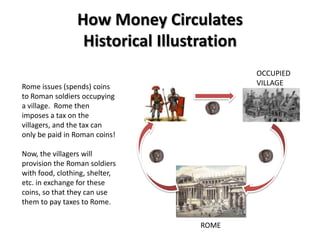
How Money Circulates
                  Historical Illustration
                                            OCCUPIED
Rome issues (spends) coins                  VILLAGE
to Roman soldiers occupying
a village. Rome then
imposes a tax on the
villagers, and the tax can
only be paid in Roman coins!

Now, the villagers will
provision the Roman soldiers
with food, clothing, shelter,
etc. in exchange for these
coins, so that they can use
them to pay taxes to Rome.

                                  ROME
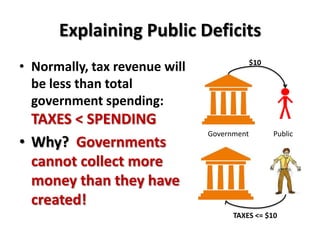
Explaining Public Deficits
• Normally, tax revenue will                $10

  be less than total
  government spending:
  TAXES < SPENDING
                               Government         Public
• Why? Governments
  cannot collect more
  money than they have
  created!
                                     TAXES <= $10
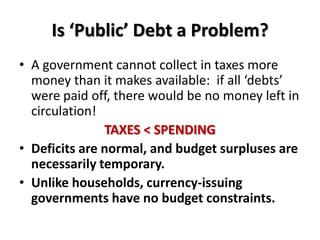
Is ‘Public’ Debt a Problem?
• A government cannot collect in taxes more
  money than it makes available: if all ‘debts’
  were paid off, there would be no money left in
  circulation!
               TAXES < SPENDING
• Deficits are normal, and budget surpluses are
  necessarily temporary.
• Unlike households, currency-issuing
  governments have no budget constraints.
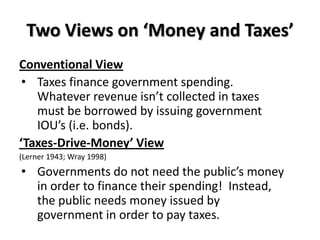
Two Views on ‘Money and Taxes’
Conventional View
 • Taxes finance government spending.
   Whatever revenue isn’t collected in taxes
   must be borrowed by issuing government
   IOU’s (i.e. bonds).
‘Taxes-Drive-Money’ View
(Lerner 1943; Wray 1998)
• Governments do not need the public’s money
  in order to finance their spending! Instead,
  the public needs money issued by
  government in order to pay taxes.
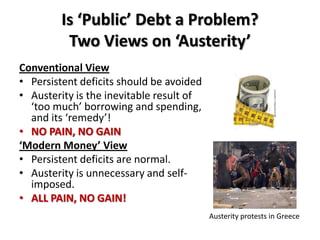
Is ‘Public’ Debt a Problem?
          Two Views on ‘Austerity’
Conventional View
• Persistent deficits should be avoided
• Austerity is the inevitable result of
  ‘too much’ borrowing and spending,
  and its ‘remedy’!
• NO PAIN, NO GAIN
‘Modern Money’ View
• Persistent deficits are normal.
• Austerity is unnecessary and self-
  imposed.
• ALL PAIN, NO GAIN!
                                          Austerity protests in Greece
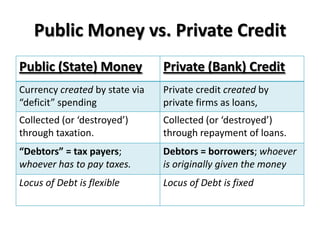
Public Money vs. Private Credit
Public (State) Money            Private (Bank) Credit
Currency created by state via   Private credit created by
“deficit” spending              private firms as loans,
Collected (or ‘destroyed’)      Collected (or ‘destroyed’)
through taxation.               through repayment of loans.
“Debtors” = tax payers;         Debtors = borrowers; whoever
whoever has to pay taxes.       is originally given the money
Locus of Debt is flexible       Locus of Debt is fixed
Public Money vs. Private Credit
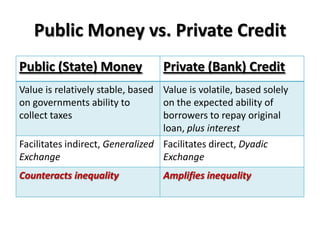
Public (State) Money              Private (Bank) Credit
Value is relatively stable, based Value is volatile, based solely
on governments ability to         on the expected ability of
collect taxes                     borrowers to repay original
                                  loan, plus interest
Facilitates indirect, Generalized Facilitates direct, Dyadic
Exchange                          Exchange
Counteracts inequality            Amplifies inequality
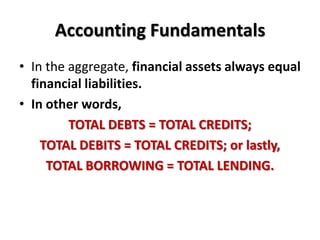
Accounting Fundamentals
• In the aggregate, financial assets always equal
  financial liabilities.
• In other words,
         TOTAL DEBTS = TOTAL CREDITS;
    TOTAL DEBITS = TOTAL CREDITS; or lastly,
     TOTAL BORROWING = TOTAL LENDING.
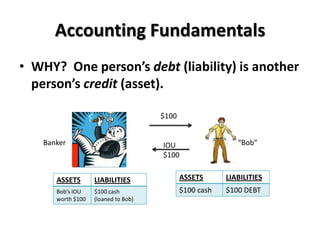
Accounting Fundamentals
• WHY? One person’s debt (liability) is another
  person’s credit (asset).

                                      $100


    Banker                            IOU                   “Bob”
                                      $100


       ASSETS       LIABILITIES              ASSETS      LIABILITIES
       Bob’s IOU    $100 cash                $100 cash   $100 DEBT
       worth $100   (loaned to Bob)
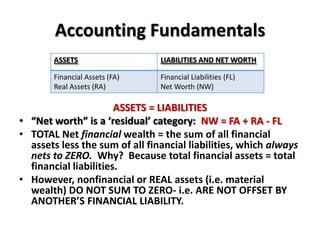
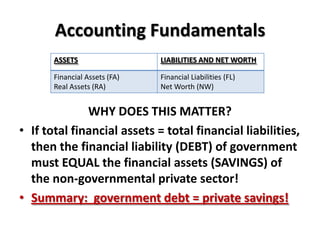
Accounting Fundamentals
       ASSETS                   LIABILITIES AND NET WORTH

       Financial Assets (FA)    Financial Liabilities (FL)
       Real Assets (RA)         Net Worth (NW)

                       ASSETS = LIABILITIES
• “Net worth” is a ‘residual’ category: NW = FA + RA - FL
• TOTAL Net financial wealth = the sum of all financial
  assets less the sum of all financial liabilities, which always
  nets to ZERO. Why? Because total financial assets = total
  financial liabilities.
• However, nonfinancial or REAL assets (i.e. material
  wealth) DO NOT SUM TO ZERO- i.e. ARE NOT OFFSET BY
  ANOTHER’S FINANCIAL LIABILITY.
Accounting Fundamentals
       ASSETS                  LIABILITIES AND NET WORTH

       Financial Assets (FA)   Financial Liabilities (FL)
       Real Assets (RA)        Net Worth (NW)


              WHY DOES THIS MATTER?
• If total financial assets = total financial liabilities,
  then the financial liability (DEBT) of government
  must EQUAL the financial assets (SAVINGS) of
  the non-governmental private sector!
• Summary: government debt = private savings!
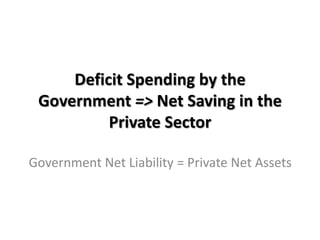
Deficit Spending by the
 Government => Net Saving in the
          Private Sector

Government Net Liability = Private Net Assets
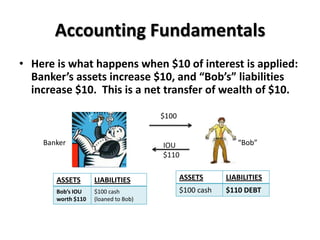
Accounting Fundamentals
• Here is what happens when $10 of interest is applied:
  Banker’s assets increase $10, and “Bob’s” liabilities
  increase $10. This is a net transfer of wealth of $10.

                                      $100


    Banker                            IOU                   “Bob”
                                      $110


       ASSETS       LIABILITIES              ASSETS      LIABILITIES
       Bob’s IOU    $100 cash                $100 cash   $110 DEBT
       worth $110   (loaned to Bob)
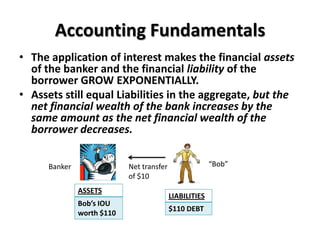
Accounting Fundamentals
• The application of interest makes the financial assets
  of the banker and the financial liability of the
  borrower GROW EXPONENTIALLY.
• Assets still equal Liabilities in the aggregate, but the
  net financial wealth of the bank increases by the
  same amount as the net financial wealth of the
  borrower decreases.


      Banker                Net transfer                 “Bob”
                            of $10
               ASSETS
                                           LIABILITIES
               Bob’s IOU
                                           $110 DEBT
               worth $110
Accounting Fundamentals
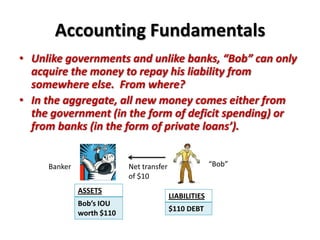
• Unlike governments and unlike banks, “Bob” can only
  acquire the money to repay his liability from
  somewhere else. From where?
• In the aggregate, all new money comes either from
  the government (in the form of deficit spending) or
  from banks (in the form of private loans’).


     Banker                Net transfer                 “Bob”
                           of $10
              ASSETS
                                          LIABILITIES
              Bob’s IOU
                                          $110 DEBT
              worth $110
Linking Inequality and Debt
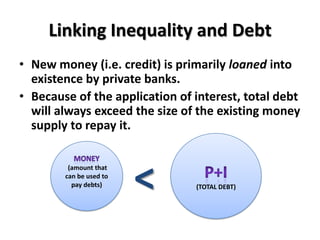
• New money (i.e. credit) is primarily loaned into
  existence by private banks.
• Because of the application of interest, total debt
  will always exceed the size of the existing money
  supply to repay it.


         (amount that
        can be used to
          pay debts)
                         <      (TOTAL DEBT)
Linking Inequality and Debt

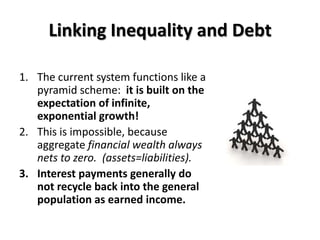
1. The current system functions like a
   pyramid scheme: it is built on the
   expectation of infinite,
   exponential growth!
2. This is impossible, because
   aggregate financial wealth always
   nets to zero. (assets=liabilities).
3. Interest payments generally do
   not recycle back into the general
   population as earned income.
Linking Inequality and Debt

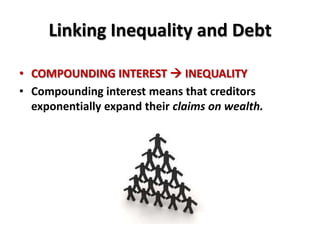
• COMPOUNDING INTEREST  INEQUALITY
• Compounding interest means that creditors
  exponentially expand their claims on wealth.
Linking Inequality and Debt
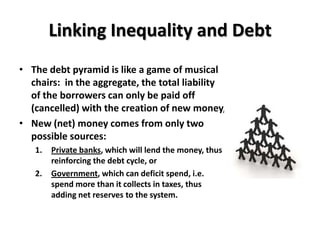
• The debt pyramid is like a game of musical
  chairs: in the aggregate, the total liability
  of the borrowers can only be paid off
  (cancelled) with the creation of new money,
• New (net) money comes from only two
  possible sources:
   1.   Private banks, which will lend the money, thus
        reinforcing the debt cycle, or
   2.   Government, which can deficit spend, i.e.
        spend more than it collects in taxes, thus
        adding net reserves to the system.
Money Creation in the U.S.
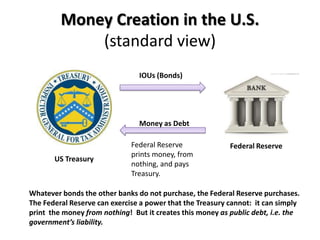
             (standard view)
                                IOUs (Bonds)


                                Money as Debt

                              Federal Reserve              Federal Reserve
                              prints money, from
       US Treasury
                              nothing, and pays
                              Treasury.

Whatever bonds the other banks do not purchase, the Federal Reserve purchases.
The Federal Reserve can exercise a power that the Treasury cannot: it can simply
print the money from nothing! But it creates this money as public debt, i.e. the
government’s liability.
Money Creation in the U.S.
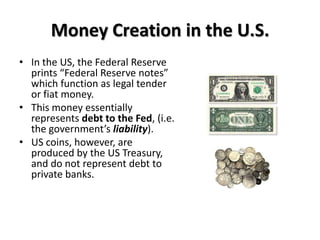
• In the US, the Federal Reserve
  prints “Federal Reserve notes”
  which function as legal tender
  or fiat money.
• This money essentially
  represents debt to the Fed, (i.e.
  the government’s liability).
• US coins, however, are
  produced by the US Treasury,
  and do not represent debt to
  private banks.
The United States does not “borrow”
         Dollars from China
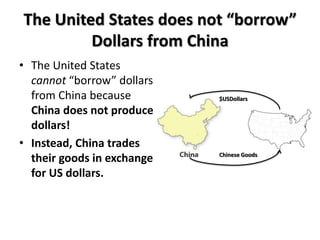
• The United States
  cannot “borrow” dollars
  from China because        $USDollars

  China does not produce
  dollars!
• Instead, China trades
                            Chinese Goods
  their goods in exchange
  for US dollars.
The United States does not “borrow”
         Dollars from China
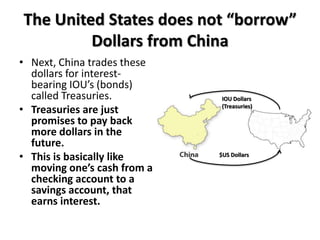
• Next, China trades these
  dollars for interest-
  bearing IOU’s (bonds)
  called Treasuries.         IOU Dollars
• Treasuries are just        (Treasuries)

  promises to pay back
  more dollars in the
  future.
• This is basically like     $US Dollars

  moving one’s cash from a
  checking account to a
  savings account, that
  earns interest.
The United States does not “borrow”
         Dollars from China
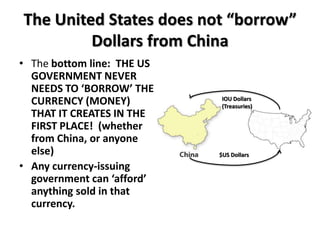
• The bottom line: THE US
  GOVERNMENT NEVER
  NEEDS TO ‘BORROW’ THE
  CURRENCY (MONEY)          IOU Dollars
                            (Treasuries)
  THAT IT CREATES IN THE
  FIRST PLACE! (whether
  from China, or anyone
  else)                     $US Dollars

• Any currency-issuing
  government can ‘afford’
  anything sold in that
  currency.
Holders of US Treasury Securities
                       2010
                                 Other
                                 2%
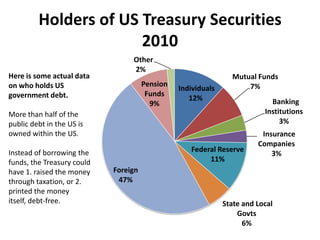
Here is some actual data                                        Mutual Funds
on who holds US                       Pension                       7%
                                                Individuals
government debt.                       Funds
                                                   12%                      Banking
                                        9%
More than half of the                                                     Institutions
public debt in the US is                                                       3%
owned within the US.                                                     Insurance
                                                                        Companies
Instead of borrowing the                           Federal Reserve
                                                                            3%
funds, the Treasury could                               11%
have 1. raised the money    Foreign
through taxation, or 2.      47%
printed the money
itself, debt-free.                                            State and Local
                                                                  Govts
                                                                    6%
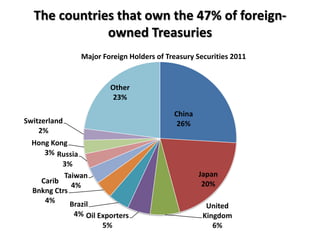
The countries that own the 47% of foreign-
              owned Treasuries
                Major Foreign Holders of Treasury Securities 2011


                        Other
                         23%

                                           China
Switzerland                                 26%
    2%
  Hong Kong
     3% Russia
          3%
           Taiwan                                  Japan
    Carib                                           20%
             4%
  Bnkng Ctrs
     4%      Brazil                                  United
              4% Oil Exporters                      Kingdom
                      5%                               6%

Money notes 2 14-13

  • 1.
    Why Government Deficitsare not a problem John Bradford, Ph.D.
  • 2.
    ‘Taxes Drive Money’ Fundamentals • Money is fundamentally a unit of accounting; a unit of measuring credits and debts. • This unit is determined by a government that issues currency denominated in this unit (e.g. US Dollars). • Money is valuable because governments accept only their own currency as a means of payment for taxes (and fees and penalties, etc.) • Money is accepted as a means of exchange because people need money in order to pay taxes.
  • 3.
    How Money Circulates Historical Illustration OCCUPIED Rome issues (spends) coins VILLAGE to Roman soldiers occupying a village. Rome then imposes a tax on the villagers, and the tax can only be paid in Roman coins! Now, the villagers will provision the Roman soldiers with food, clothing, shelter, etc. in exchange for these coins, so that they can use them to pay taxes to Rome. ROME
  • 4.
    Explaining Public Deficits •Normally, tax revenue will $10 be less than total government spending: TAXES < SPENDING Government Public • Why? Governments cannot collect more money than they have created! TAXES <= $10
  • 5.
    Is ‘Public’ Debta Problem? • A government cannot collect in taxes more money than it makes available: if all ‘debts’ were paid off, there would be no money left in circulation! TAXES < SPENDING • Deficits are normal, and budget surpluses are necessarily temporary. • Unlike households, currency-issuing governments have no budget constraints.
  • 6.
    Two Views on‘Money and Taxes’ Conventional View • Taxes finance government spending. Whatever revenue isn’t collected in taxes must be borrowed by issuing government IOU’s (i.e. bonds). ‘Taxes-Drive-Money’ View (Lerner 1943; Wray 1998) • Governments do not need the public’s money in order to finance their spending! Instead, the public needs money issued by government in order to pay taxes.
  • 7.
    Is ‘Public’ Debta Problem? Two Views on ‘Austerity’ Conventional View • Persistent deficits should be avoided • Austerity is the inevitable result of ‘too much’ borrowing and spending, and its ‘remedy’! • NO PAIN, NO GAIN ‘Modern Money’ View • Persistent deficits are normal. • Austerity is unnecessary and self- imposed. • ALL PAIN, NO GAIN! Austerity protests in Greece
  • 8.
    Public Money vs.Private Credit Public (State) Money Private (Bank) Credit Currency created by state via Private credit created by “deficit” spending private firms as loans, Collected (or ‘destroyed’) Collected (or ‘destroyed’) through taxation. through repayment of loans. “Debtors” = tax payers; Debtors = borrowers; whoever whoever has to pay taxes. is originally given the money Locus of Debt is flexible Locus of Debt is fixed
  • 9.
    Public Money vs.Private Credit Public (State) Money Private (Bank) Credit Value is relatively stable, based Value is volatile, based solely on governments ability to on the expected ability of collect taxes borrowers to repay original loan, plus interest Facilitates indirect, Generalized Facilitates direct, Dyadic Exchange Exchange Counteracts inequality Amplifies inequality
  • 10.
    Accounting Fundamentals • Inthe aggregate, financial assets always equal financial liabilities. • In other words, TOTAL DEBTS = TOTAL CREDITS; TOTAL DEBITS = TOTAL CREDITS; or lastly, TOTAL BORROWING = TOTAL LENDING.
  • 11.
    Accounting Fundamentals • WHY?One person’s debt (liability) is another person’s credit (asset). $100 Banker IOU “Bob” $100 ASSETS LIABILITIES ASSETS LIABILITIES Bob’s IOU $100 cash $100 cash $100 DEBT worth $100 (loaned to Bob)
  • 12.
    Accounting Fundamentals ASSETS LIABILITIES AND NET WORTH Financial Assets (FA) Financial Liabilities (FL) Real Assets (RA) Net Worth (NW) ASSETS = LIABILITIES • “Net worth” is a ‘residual’ category: NW = FA + RA - FL • TOTAL Net financial wealth = the sum of all financial assets less the sum of all financial liabilities, which always nets to ZERO. Why? Because total financial assets = total financial liabilities. • However, nonfinancial or REAL assets (i.e. material wealth) DO NOT SUM TO ZERO- i.e. ARE NOT OFFSET BY ANOTHER’S FINANCIAL LIABILITY.
  • 13.
    Accounting Fundamentals ASSETS LIABILITIES AND NET WORTH Financial Assets (FA) Financial Liabilities (FL) Real Assets (RA) Net Worth (NW) WHY DOES THIS MATTER? • If total financial assets = total financial liabilities, then the financial liability (DEBT) of government must EQUAL the financial assets (SAVINGS) of the non-governmental private sector! • Summary: government debt = private savings!
  • 14.
    Deficit Spending bythe Government => Net Saving in the Private Sector Government Net Liability = Private Net Assets
  • 15.
    Accounting Fundamentals • Hereis what happens when $10 of interest is applied: Banker’s assets increase $10, and “Bob’s” liabilities increase $10. This is a net transfer of wealth of $10. $100 Banker IOU “Bob” $110 ASSETS LIABILITIES ASSETS LIABILITIES Bob’s IOU $100 cash $100 cash $110 DEBT worth $110 (loaned to Bob)
  • 16.
    Accounting Fundamentals • Theapplication of interest makes the financial assets of the banker and the financial liability of the borrower GROW EXPONENTIALLY. • Assets still equal Liabilities in the aggregate, but the net financial wealth of the bank increases by the same amount as the net financial wealth of the borrower decreases. Banker Net transfer “Bob” of $10 ASSETS LIABILITIES Bob’s IOU $110 DEBT worth $110
  • 17.
    Accounting Fundamentals • Unlikegovernments and unlike banks, “Bob” can only acquire the money to repay his liability from somewhere else. From where? • In the aggregate, all new money comes either from the government (in the form of deficit spending) or from banks (in the form of private loans’). Banker Net transfer “Bob” of $10 ASSETS LIABILITIES Bob’s IOU $110 DEBT worth $110
  • 18.
    Linking Inequality andDebt • New money (i.e. credit) is primarily loaned into existence by private banks. • Because of the application of interest, total debt will always exceed the size of the existing money supply to repay it. (amount that can be used to pay debts) < (TOTAL DEBT)
  • 19.
    Linking Inequality andDebt 1. The current system functions like a pyramid scheme: it is built on the expectation of infinite, exponential growth! 2. This is impossible, because aggregate financial wealth always nets to zero. (assets=liabilities). 3. Interest payments generally do not recycle back into the general population as earned income.
  • 20.
    Linking Inequality andDebt • COMPOUNDING INTEREST  INEQUALITY • Compounding interest means that creditors exponentially expand their claims on wealth.
  • 21.
    Linking Inequality andDebt • The debt pyramid is like a game of musical chairs: in the aggregate, the total liability of the borrowers can only be paid off (cancelled) with the creation of new money, • New (net) money comes from only two possible sources: 1. Private banks, which will lend the money, thus reinforcing the debt cycle, or 2. Government, which can deficit spend, i.e. spend more than it collects in taxes, thus adding net reserves to the system.
  • 22.
    Money Creation inthe U.S. (standard view) IOUs (Bonds) Money as Debt Federal Reserve Federal Reserve prints money, from US Treasury nothing, and pays Treasury. Whatever bonds the other banks do not purchase, the Federal Reserve purchases. The Federal Reserve can exercise a power that the Treasury cannot: it can simply print the money from nothing! But it creates this money as public debt, i.e. the government’s liability.
  • 23.
    Money Creation inthe U.S. • In the US, the Federal Reserve prints “Federal Reserve notes” which function as legal tender or fiat money. • This money essentially represents debt to the Fed, (i.e. the government’s liability). • US coins, however, are produced by the US Treasury, and do not represent debt to private banks.
  • 24.
    The United Statesdoes not “borrow” Dollars from China • The United States cannot “borrow” dollars from China because $USDollars China does not produce dollars! • Instead, China trades Chinese Goods their goods in exchange for US dollars.
  • 25.
    The United Statesdoes not “borrow” Dollars from China • Next, China trades these dollars for interest- bearing IOU’s (bonds) called Treasuries. IOU Dollars • Treasuries are just (Treasuries) promises to pay back more dollars in the future. • This is basically like $US Dollars moving one’s cash from a checking account to a savings account, that earns interest.
  • 26.
    The United Statesdoes not “borrow” Dollars from China • The bottom line: THE US GOVERNMENT NEVER NEEDS TO ‘BORROW’ THE CURRENCY (MONEY) IOU Dollars (Treasuries) THAT IT CREATES IN THE FIRST PLACE! (whether from China, or anyone else) $US Dollars • Any currency-issuing government can ‘afford’ anything sold in that currency.
  • 27.
    Holders of USTreasury Securities 2010 Other 2% Here is some actual data Mutual Funds on who holds US Pension 7% Individuals government debt. Funds 12% Banking 9% More than half of the Institutions public debt in the US is 3% owned within the US. Insurance Companies Instead of borrowing the Federal Reserve 3% funds, the Treasury could 11% have 1. raised the money Foreign through taxation, or 2. 47% printed the money itself, debt-free. State and Local Govts 6%
  • 28.
    The countries thatown the 47% of foreign- owned Treasuries Major Foreign Holders of Treasury Securities 2011 Other 23% China Switzerland 26% 2% Hong Kong 3% Russia 3% Taiwan Japan Carib 20% 4% Bnkng Ctrs 4% Brazil United 4% Oil Exporters Kingdom 5% 6%

Editor's Notes

  • #5 In all major economies, the vast majority of money is created by private banks as debt through the fractional reserve system. In the US, all new money is created by private banks, as debt.
  • #6 In the U.S., much of the ‘debt’ is artificial, an internal account procedure- arising from the fact that the Treasury appears to ‘borrow’ from the Federal Reserve whatever it doesn’t collect in taxes; the Treasury could just as well exercise the power to create currency itself!
  • #19 In all major economies, the vast majority of money is created by private banks as debt through the fractional reserve system. In the US, all new money is created by private banks, as debt.
  • #21 Compounding growth will engender “power-law” distributions of wealth and/or income even when profits and losses are randomly distributed (i.e. when mean profits = 0); compounding interest is a monetary (rather than physical) form of compounding growth.
  • #28 For the Federal Reserve (aka Monetary Authority) holdings, go to: http://www.federalreserve.gov/releases/z1/current/accessible/l108.htm
  • #33 Acceptability as a means of tax payment is sufficient (but not necessary)for something to become money.
  • #39 In all major economies, the vast majority of money is created by private banks as debt through the fractional reserve system. In the US, all new money is created by private banks, as debt.