The European Conquest and Colonization of the Americas
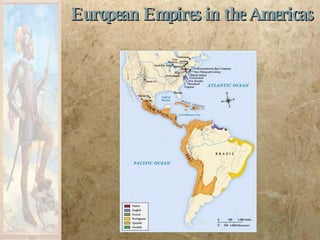
Five Nations started colonies in the New World Spain – in South, Central and North America Portugal – in Brazil France – In Canada  Great Britain – along the East Coast of North America The Dutch – On Long Island
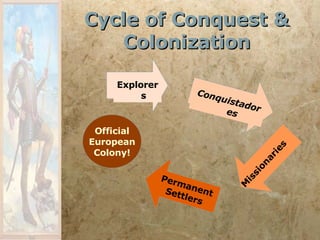
Cycle of Conquest & Colonization Explorers Conquistadores Missionaries Permanent Settlers Official European Colony!
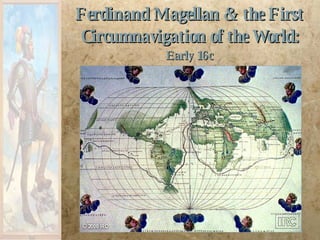
Ferdinand Magellan & the First Circumnavigation of the World: Early 16c
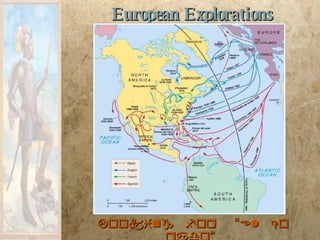
European Explorations “”
Christófo Colón  [1451-1506]
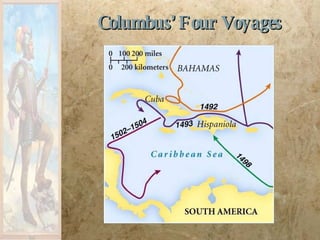
Columbus’ Four Voyages
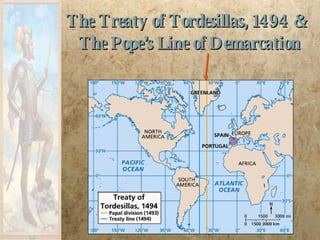
The Treaty of Tordesillas, 1494 &  The Pope’s Line of Demarcation
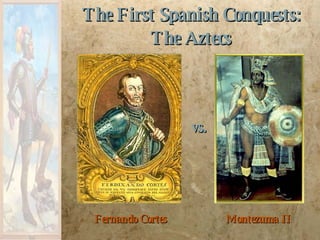
Fernando Cortes The First Spanish Conquests: The Aztecs Montezuma II vs.
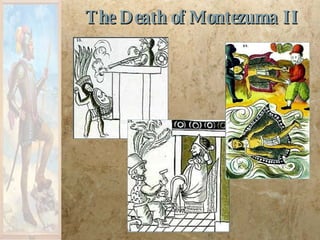
The Death of Montezuma II
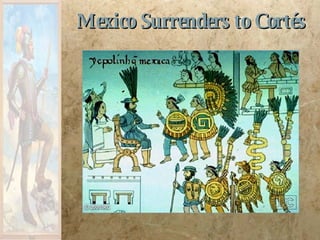
Mexico Surrenders to Cortés
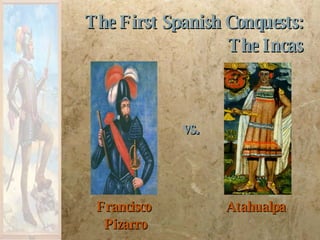
Francisco  Pizarro The First Spanish Conquests:   The Incas Atahualpa vs.
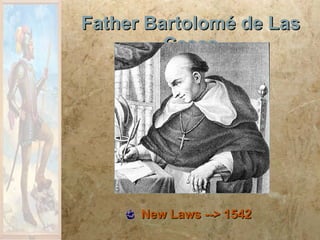
Father Bartolomé de Las Casas New Laws --> 1542
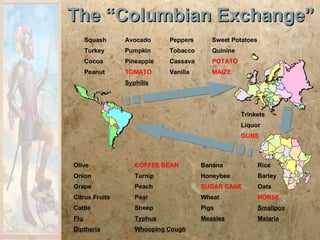
The “Columbian Exchange” Squash  Avocado Peppers Sweet Potatoes Turkey Pumpkin Tobacco Quinine Cocoa Pineapple Cassava POTATO Peanut TOMATO Vanilla MAIZE Syphilis Olive COFFEE BEAN Banana Rice Onion Turnip Honeybee Barley Grape Peach SUGAR CANE Oats Citrus Fruits Pear Wheat HORSE Cattle Sheep Pigs Smallpox Flu Typhus Measles Malaria Diptheria Whooping Cough Trinkets Liquor GUNS
Why would the 'Columbian Exchange' be considered the tsunami of unintentional "bio-terrorism"?? Docs. 1- 4
The   Spanish   Gain land and riches Gain converts (Catholic) Conquered and destroyed native cultures (Encomeinda system)
Spain  in the New World Motivated by the 3 G’s God, Glory and Gold Destroyed native culture Encomienda system
Mercantilism Economic activity should enhance power of the state (more gold and silver).
Mercantilism  An economic policy of the major trading nations from the 16th to the 18th cent.,based on the premise that national wealth and power were best served by increasing exports and collecting precious metals in return. State action, an essential feature of the mercantile system, was used to accomplish its purposes-to sell more than it bought to accumulate bullion and raw materials.
Under a mercantilist policy, a government exercised much control over economic life by regulating production, encouraging foreign trade, levying duties on imports to gain revenue, making treaties to obtain exclusive trading privileges, and exploiting the commerce of the colonies.
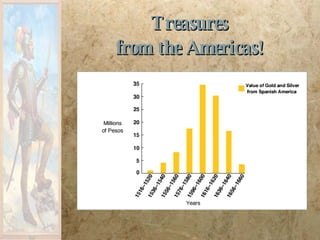
Mercantilism Favorable balance of trade – Spanish try to control access to wealth Mining (gold and silver) Control commerce.
Fight for control Spanish crown, colonists, and church fight for Indian cheap labor.
Foundation of economy – Indian labor. Indian slavery and coercion – Indians paid tribute of gold and silver and worked for almost nothing or nothing.
The Congregacion Churches attempt to control Indians Placed Indians on reservations
The Missions Once Indians were concentrated, Missions were established to convert and westernize the natives Church schools
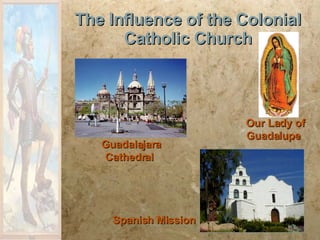
The Influence of the Colonial Catholic Church Guadalajara Cathedral Our Lady of Guadalupe Spanish Mission
Encomienda An assignment of Indians who were to serve the Spanish grantee (colonist) with tribute and labor…Indian slavery!
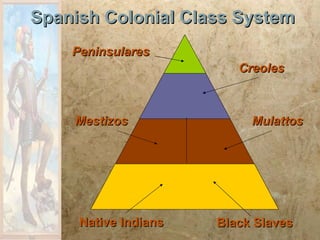
Encomienda System  = Feudal System Headed by the Viceroy – a noble Social hierarchy based on race Peninsulares Creoles Mestizos Mulattoes Presidio – fort used to defend the mission – castle
Haciendas As the encomienda system began to fail colonists created plantations called Haciendas – moved towards capitalism Tribute was no longer given Slavery still existed
Spanish Colonial Class System Peninsulares Creoles Mestizos Mulattos Native Indians Black Slaves
Treasures from the Americas!
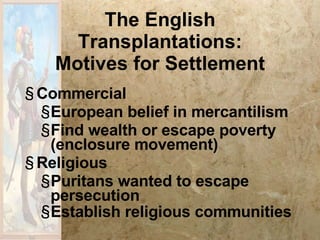
The English Transplantations: Motives for Settlement Commercial European belief in mercantilism Find wealth or escape poverty (enclosure movement) Religious Puritans wanted to escape persecution Establish religious communities
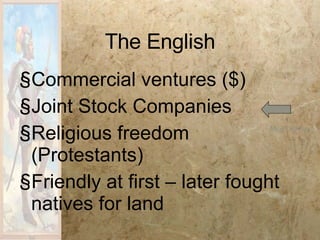
The English Commercial ventures ($) Joint Stock Companies Religious freedom (Protestants) Friendly at first – later fought natives for land Must Know
The English Transplantations: Plymouth Pilgrims Separatists looking for religious freedom Created Mayflower Compact Government gets power from the people Relations with the natives
New England Pilgrims (1620) were religious  dissenters  who wanted to separate from the Church of England.  They faced fines, imprisonment or death in England for practicing their religion Came for Religious Freedom
New England The Pilgrims were headed for Virginia,  but were blown off course in a storm, and ended up in Massachusetts Created the Mayflower Compact – a document that says the government gets its power from the people Must Know Must Know
The English Transplantations: Massachusetts Bay Puritans Wanted to purify church Faced persecution “ City on a hill” A religious model for the world Intolerant of dissent
New England Puritans (1630) also sought religious freedom Wanted to create  Cities on a hill  – religious cities that would serve as a model for others Covenant Communities intolerant of dissent Must Know Must Know
New England Puritans were governed by the male members of the church Town meetings – discussions about church rules that eventually became legislative assemblies Must Know
The English Transplantations: Jamestown The first permanent English settlement Colonists were “gentlemen” Expected to find gold Poor location and management Located for defense Smith saved colony from disaster
Jamestown Jamestown started as a Joint-Stock company, but it was poorly managed and later a Royal Colony (controlled by the king) Jamestown was founded in 1607 Must Know Must Know
The English Transplantations: Jamestown By 1609 it became a Joint-stock investment (Virginia Company) Tobacco made the colony profitable Getting to the colony Indentures& Headrights
Jamestown Jamestown nearly failed due to lack of supplies, poor weather and poor location 60 miles up the James River in a swampy area (Defense).
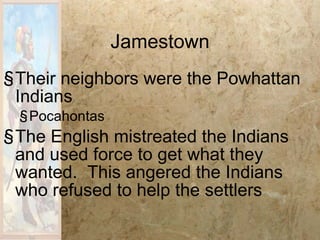
Jamestown Their neighbors were the Powhattan Indians Pocahontas The English mistreated the Indians and used force to get what they wanted.  This angered the Indians who refused to help the settlers
What saved Jamestown? Tobacco was grown and the colony began to make a profit.  Brought more settlers and $ Must Know
France  in the New World Commercial Incentives Fishing and fur trade Northwest Passage Adopted native customs Married into families Learned language
The French Fishing, Fur Trapping Looking for the Northwest Passage Gain converts (Catholic) Traded w/ natives (partners) Married Native American women
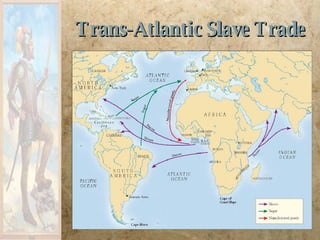
Trans-Atlantic Slave Trade
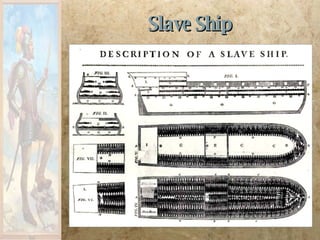
Slave Ship
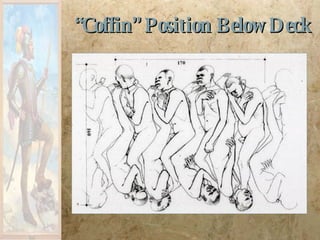
“ Coffin” Position Below Deck
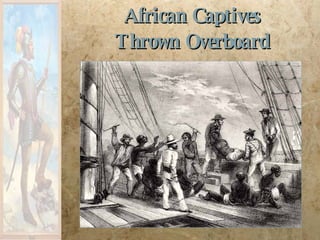
African Captives Thrown Overboard
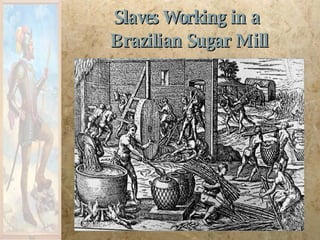
Slaves Working in a  Brazilian Sugar Mill
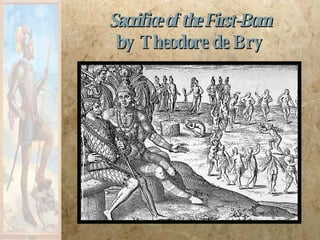
Sacrifice of the First-Born by Theodore de Bry
European Empires in the Americas

1 2,3,4 Europ Conquest And Colonization

  • 1.
    The European Conquestand Colonization of the Americas
  • 2.
    Five Nations startedcolonies in the New World Spain – in South, Central and North America Portugal – in Brazil France – In Canada Great Britain – along the East Coast of North America The Dutch – On Long Island
  • 3.
    Cycle of Conquest& Colonization Explorers Conquistadores Missionaries Permanent Settlers Official European Colony!
  • 4.
    Ferdinand Magellan &the First Circumnavigation of the World: Early 16c
  • 5.
  • 6.
    Christófo Colón [1451-1506]
  • 7.
  • 8.
    The Treaty ofTordesillas, 1494 & The Pope’s Line of Demarcation
  • 9.
    Fernando Cortes TheFirst Spanish Conquests: The Aztecs Montezuma II vs.
  • 10.
    The Death ofMontezuma II
  • 11.
  • 12.
    Francisco PizarroThe First Spanish Conquests: The Incas Atahualpa vs.
  • 13.
    Father Bartolomé deLas Casas New Laws --> 1542
  • 14.
    The “Columbian Exchange”Squash Avocado Peppers Sweet Potatoes Turkey Pumpkin Tobacco Quinine Cocoa Pineapple Cassava POTATO Peanut TOMATO Vanilla MAIZE Syphilis Olive COFFEE BEAN Banana Rice Onion Turnip Honeybee Barley Grape Peach SUGAR CANE Oats Citrus Fruits Pear Wheat HORSE Cattle Sheep Pigs Smallpox Flu Typhus Measles Malaria Diptheria Whooping Cough Trinkets Liquor GUNS
  • 15.
    Why would the'Columbian Exchange' be considered the tsunami of unintentional "bio-terrorism"?? Docs. 1- 4
  • 16.
    The Spanish Gain land and riches Gain converts (Catholic) Conquered and destroyed native cultures (Encomeinda system)
  • 17.
    Spain inthe New World Motivated by the 3 G’s God, Glory and Gold Destroyed native culture Encomienda system
  • 18.
    Mercantilism Economic activityshould enhance power of the state (more gold and silver).
  • 19.
    Mercantilism Aneconomic policy of the major trading nations from the 16th to the 18th cent.,based on the premise that national wealth and power were best served by increasing exports and collecting precious metals in return. State action, an essential feature of the mercantile system, was used to accomplish its purposes-to sell more than it bought to accumulate bullion and raw materials.
  • 20.
    Under a mercantilistpolicy, a government exercised much control over economic life by regulating production, encouraging foreign trade, levying duties on imports to gain revenue, making treaties to obtain exclusive trading privileges, and exploiting the commerce of the colonies.
  • 21.
    Mercantilism Favorable balanceof trade – Spanish try to control access to wealth Mining (gold and silver) Control commerce.
  • 22.
    Fight for controlSpanish crown, colonists, and church fight for Indian cheap labor.
  • 23.
    Foundation of economy– Indian labor. Indian slavery and coercion – Indians paid tribute of gold and silver and worked for almost nothing or nothing.
  • 24.
    The Congregacion Churchesattempt to control Indians Placed Indians on reservations
  • 25.
    The Missions OnceIndians were concentrated, Missions were established to convert and westernize the natives Church schools
  • 26.
    The Influence ofthe Colonial Catholic Church Guadalajara Cathedral Our Lady of Guadalupe Spanish Mission
  • 27.
    Encomienda An assignmentof Indians who were to serve the Spanish grantee (colonist) with tribute and labor…Indian slavery!
  • 28.
    Encomienda System = Feudal System Headed by the Viceroy – a noble Social hierarchy based on race Peninsulares Creoles Mestizos Mulattoes Presidio – fort used to defend the mission – castle
  • 29.
    Haciendas As theencomienda system began to fail colonists created plantations called Haciendas – moved towards capitalism Tribute was no longer given Slavery still existed
  • 30.
    Spanish Colonial ClassSystem Peninsulares Creoles Mestizos Mulattos Native Indians Black Slaves
  • 31.
  • 32.
    The English Transplantations:Motives for Settlement Commercial European belief in mercantilism Find wealth or escape poverty (enclosure movement) Religious Puritans wanted to escape persecution Establish religious communities
  • 33.
    The English Commercialventures ($) Joint Stock Companies Religious freedom (Protestants) Friendly at first – later fought natives for land Must Know
  • 34.
    The English Transplantations:Plymouth Pilgrims Separatists looking for religious freedom Created Mayflower Compact Government gets power from the people Relations with the natives
  • 35.
    New England Pilgrims(1620) were religious dissenters who wanted to separate from the Church of England. They faced fines, imprisonment or death in England for practicing their religion Came for Religious Freedom
  • 36.
    New England ThePilgrims were headed for Virginia, but were blown off course in a storm, and ended up in Massachusetts Created the Mayflower Compact – a document that says the government gets its power from the people Must Know Must Know
  • 37.
    The English Transplantations:Massachusetts Bay Puritans Wanted to purify church Faced persecution “ City on a hill” A religious model for the world Intolerant of dissent
  • 38.
    New England Puritans(1630) also sought religious freedom Wanted to create Cities on a hill – religious cities that would serve as a model for others Covenant Communities intolerant of dissent Must Know Must Know
  • 39.
    New England Puritanswere governed by the male members of the church Town meetings – discussions about church rules that eventually became legislative assemblies Must Know
  • 40.
    The English Transplantations:Jamestown The first permanent English settlement Colonists were “gentlemen” Expected to find gold Poor location and management Located for defense Smith saved colony from disaster
  • 41.
    Jamestown Jamestown startedas a Joint-Stock company, but it was poorly managed and later a Royal Colony (controlled by the king) Jamestown was founded in 1607 Must Know Must Know
  • 42.
    The English Transplantations:Jamestown By 1609 it became a Joint-stock investment (Virginia Company) Tobacco made the colony profitable Getting to the colony Indentures& Headrights
  • 43.
    Jamestown Jamestown nearlyfailed due to lack of supplies, poor weather and poor location 60 miles up the James River in a swampy area (Defense).
  • 44.
    Jamestown Their neighborswere the Powhattan Indians Pocahontas The English mistreated the Indians and used force to get what they wanted. This angered the Indians who refused to help the settlers
  • 45.
    What saved Jamestown?Tobacco was grown and the colony began to make a profit. Brought more settlers and $ Must Know
  • 46.
    France inthe New World Commercial Incentives Fishing and fur trade Northwest Passage Adopted native customs Married into families Learned language
  • 47.
    The French Fishing,Fur Trapping Looking for the Northwest Passage Gain converts (Catholic) Traded w/ natives (partners) Married Native American women
  • 48.
  • 49.
  • 50.
  • 51.
  • 52.
    Slaves Working ina Brazilian Sugar Mill
  • 53.
    Sacrifice of theFirst-Born by Theodore de Bry
  • 54.
    European Empires inthe Americas