Rome: Challenges from
within
SOCIAL STUDIES FOR 9TH EGB
TEACHER: MAURICIO TORRES
Introduction
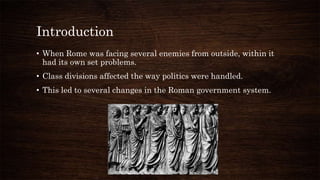
• When Rome was facing several enemies from outside, within it
had its own set problems.
• Class divisions affected the way politics were handled.
• This led to several changes in the Roman government system.
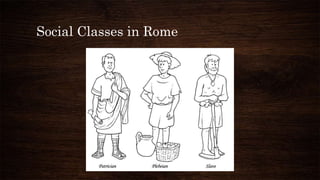
Social Classes in Rome
Plebeians
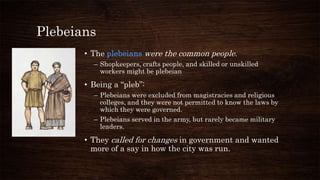
• The plebeians were the common people.
– Shopkeepers, crafts people, and skilled or unskilled
workers might be plebeian
• Being a “pleb”:
– Plebeians were excluded from magistracies and religious
colleges, and they were not permitted to know the laws by
which they were governed.
– Plebeians served in the army, but rarely became military
leaders.
• They called for changes in government and wanted
more of a say in how the city was run.
Patricians
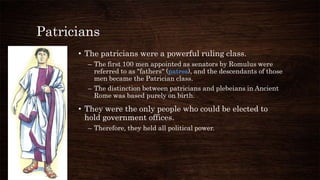
• The patricians were a powerful ruling class.
– The first 100 men appointed as senators by Romulus were
referred to as "fathers" (patres), and the descendants of those
men became the Patrician class.
– The distinction between patricians and plebeians in Ancient
Rome was based purely on birth.
• They were the only people who could be elected to
hold government offices.
– Therefore, they held all political power.
Changing Government
• Even though plebeians
outnumbered the
patricians, they were not
allowed to participate in
government.
• In 494 BC, they formed a
council to elect their own
officials.
• To the patricians, these
events represented a change
that could bring a total
collapse of their society.
• They feared that the Republic
would fall apart.
• Then the patricians decided
to cooperate and change the
government, before major
revolutions could tear Rome
apart.
Class Struggle
• Even though these events
happened almost 2500 years
ago, in the last two centuries
they are still contemporary.
• In the 1800s, German born,
Karl Marx discussed these
class disputes, which later
became the basis for his
theories: MARXISM
• According to Marx:
– a class is formed when its
members achieve class
consciousness and solidarity.
– This largely happens when the
members of a class become
aware of their exploitation and
the conflict with another class.
– A class will then realize their
shared interests and a common
identity. According to Marx, a
class will then take action
against those that are exploiting
the lower classes.
Ask Yourself
• Contrast:
– What are the main differences between the plebeians and the patricians?
• Infer:
– Why do you think the word patrician comes from “patre”?
– What reasons did the plebeians use to revolt?
• Recall:
– What determined who was a patrician or a plebeian?
• Compare:
– Is our society today in any way like the Roman Republic’s?
– Does the “Revolución Ciudadana” use Marxist theories in their
propaganda?
Bibliography
• Burstein, S. M., & Shek, R. (2012). World History (Teacher´s
Edition) (1st Edition ed.). (H. McDougal, Ed.) Orlando, Florida,
US.: Houghton Mifflin Harcourt Publishing Company.
• Images taken from Google.

1 2 challenges from within

  • 1.
    Rome: Challenges from within SOCIALSTUDIES FOR 9TH EGB TEACHER: MAURICIO TORRES
  • 2.
    Introduction • When Romewas facing several enemies from outside, within it had its own set problems. • Class divisions affected the way politics were handled. • This led to several changes in the Roman government system.
  • 3.
  • 4.
    Plebeians • The plebeianswere the common people. – Shopkeepers, crafts people, and skilled or unskilled workers might be plebeian • Being a “pleb”: – Plebeians were excluded from magistracies and religious colleges, and they were not permitted to know the laws by which they were governed. – Plebeians served in the army, but rarely became military leaders. • They called for changes in government and wanted more of a say in how the city was run.
  • 5.
    Patricians • The patricianswere a powerful ruling class. – The first 100 men appointed as senators by Romulus were referred to as "fathers" (patres), and the descendants of those men became the Patrician class. – The distinction between patricians and plebeians in Ancient Rome was based purely on birth. • They were the only people who could be elected to hold government offices. – Therefore, they held all political power.
  • 7.
    Changing Government • Eventhough plebeians outnumbered the patricians, they were not allowed to participate in government. • In 494 BC, they formed a council to elect their own officials. • To the patricians, these events represented a change that could bring a total collapse of their society. • They feared that the Republic would fall apart. • Then the patricians decided to cooperate and change the government, before major revolutions could tear Rome apart.
  • 8.
    Class Struggle • Eventhough these events happened almost 2500 years ago, in the last two centuries they are still contemporary. • In the 1800s, German born, Karl Marx discussed these class disputes, which later became the basis for his theories: MARXISM • According to Marx: – a class is formed when its members achieve class consciousness and solidarity. – This largely happens when the members of a class become aware of their exploitation and the conflict with another class. – A class will then realize their shared interests and a common identity. According to Marx, a class will then take action against those that are exploiting the lower classes.
  • 9.
    Ask Yourself • Contrast: –What are the main differences between the plebeians and the patricians? • Infer: – Why do you think the word patrician comes from “patre”? – What reasons did the plebeians use to revolt? • Recall: – What determined who was a patrician or a plebeian? • Compare: – Is our society today in any way like the Roman Republic’s? – Does the “Revolución Ciudadana” use Marxist theories in their propaganda?
  • 10.
    Bibliography • Burstein, S.M., & Shek, R. (2012). World History (Teacher´s Edition) (1st Edition ed.). (H. McDougal, Ed.) Orlando, Florida, US.: Houghton Mifflin Harcourt Publishing Company. • Images taken from Google.