Ancient Rome
Setting the Stage
a.

b.

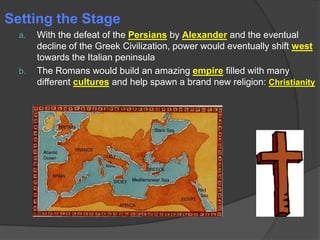
With the defeat of the Persians by Alexander and the eventual
decline of the Greek Civilization, power would eventually shift west
towards the Italian peninsula
The Romans would build an amazing empire filled with many
different cultures and help spawn a brand new religion: Christianity
Origins of Rome
a.

b.
c.

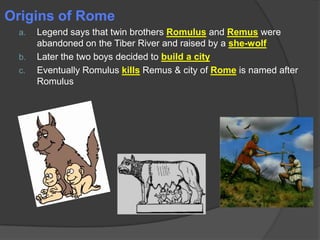
Legend says that twin brothers Romulus and Remus were
abandoned on the Tiber River and raised by a she-wolf
Later the two boys decided to build a city
Eventually Romulus kills Remus & city of Rome is named after
Romulus
Geography

e.

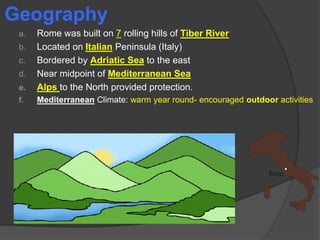
Rome was built on 7 rolling hills of Tiber River
Located on Italian Peninsula (Italy)
Bordered by Adriatic Sea to the east
Near midpoint of Mediterranean Sea
Alps to the North provided protection.

f.

Mediterranean Climate: warm year round- encouraged outdoor activities

a.
b.
c.
d.
The First Romans
a.

Three groups settled on Italian Peninsula from 1000-500 B.C.
i.
The Latins
1. Built original settlement of wooden huts in Rome
2. Considered to be the first Romans
3. Helped spread Latin derived languages to the area
ii.

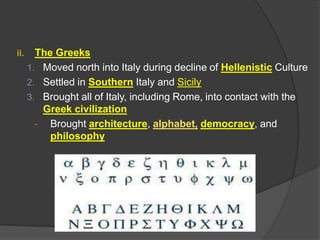
The Greeks
1. Moved north into Italy during decline of Hellenistic Culture
2. Settled in Southern Italy and Sicily
3. Brought all of Italy, including Rome, into contact with the
Greek civilization
- Brought architecture, alphabet, democracy, and
philosophy
iii. The Etruscans- from the North
1. Skilled metal workers native to northern Italy
2. Strongly influenced Roman civilization
- Social class system
- Arch
- Paved roads
- lust for killing
People of Rome
a.
b.
c.
d.

Rome was divided up into several different groups who struggled for power
Patricians: wealthy landowners who held most of the power
Plebeians: the common farmers, artisans, and merchants; majority of
population
Slaves: not based on race
Early Roman Government MR.E
509- Wealthy nobles overthrew the cruel
Etruscan king and promised to never be
ruled by a MONARCHY again.
 They established a REPUBLIC = form
of government in which the voters elect
officials to run the state


 (Representative democracy)



Only adult males could vote or be in the
government.
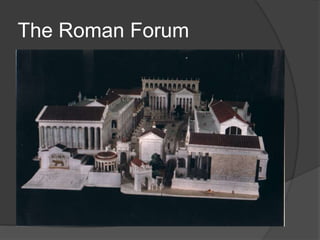
The Roman Forum
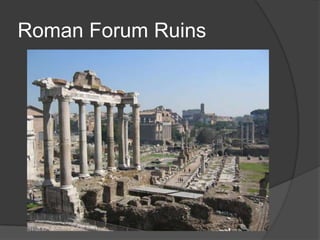
Roman Forum Ruins
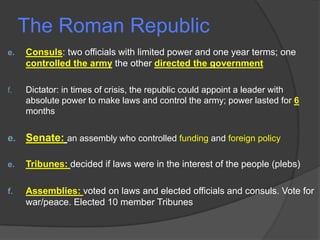
The Roman Republic
e.

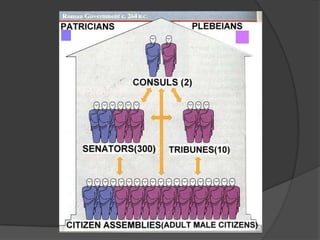
Consuls: two officials with limited power and one year terms; one
controlled the army the other directed the government

f.

Dictator: in times of crisis, the republic could appoint a leader with
absolute power to make laws and control the army; power lasted for 6
months

e.

Senate: an assembly who controlled funding and foreign policy

e.

Tribunes: decided if laws were in the interest of the people (plebs)

f.

Assemblies: voted on laws and elected officials and consuls. Vote for
war/peace. Elected 10 member Tribunes


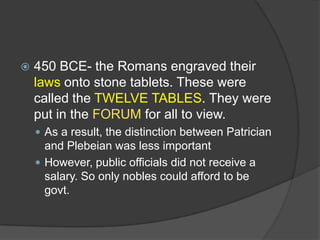
450 BCE- the Romans engraved their
laws onto stone tablets. These were
called the TWELVE TABLES. They were
put in the FORUM for all to view.
 As a result, the distinction between Patrician

and Plebeian was less important
 However, public officials did not receive a
salary. So only nobles could afford to be
govt.
7.

Roman Power Expands
a.

b.
c.
d.
e.

f.
g.

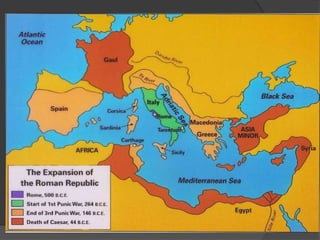
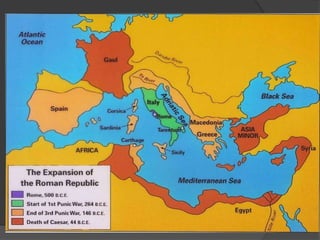
Steadily the Romans conquered the Italian Peninsula
As Rome conquered lands, people were absorbed into their ever
growing territory
They has a very organized army and wise political policies
Some people were accepted as citizens, others simply became allies
Legions: : military units made up of 5,000 soldiers
Rome went to war against Carthage; a powerful city in North Africa
The struggle became known as the Punic Wars (264-146 B.C.)
Geography & Early
Republic

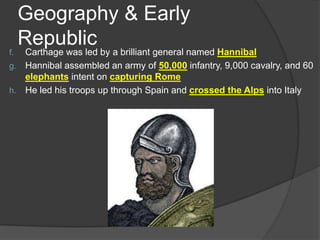
Carthage was led by a brilliant general named Hannibal
g. Hannibal assembled an army of 50,000 infantry, 9,000 cavalry, and 60
elephants intent on capturing Rome
h. He led his troops up through Spain and crossed the Alps into Italy
f.
The Punic Wars
Event A – The Rise of Carthage
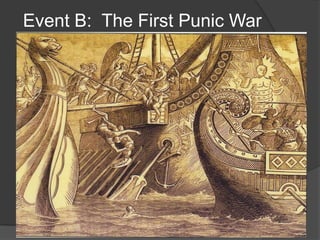
Event B: The First Punic War
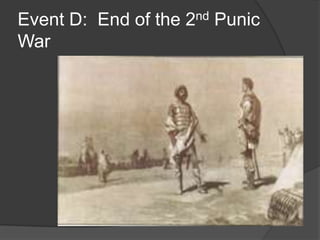
Event D: End of the 2nd Punic
War
Event E: The Third Punic War
Rome- Geography, Republic, Punic wars notes

Rome- Geography, Republic, Punic wars notes

  • 1.
  • 2.
    Setting the Stage a. b. Withthe defeat of the Persians by Alexander and the eventual decline of the Greek Civilization, power would eventually shift west towards the Italian peninsula The Romans would build an amazing empire filled with many different cultures and help spawn a brand new religion: Christianity
  • 3.
    Origins of Rome a. b. c. Legendsays that twin brothers Romulus and Remus were abandoned on the Tiber River and raised by a she-wolf Later the two boys decided to build a city Eventually Romulus kills Remus & city of Rome is named after Romulus
  • 4.
    Geography e. Rome was builton 7 rolling hills of Tiber River Located on Italian Peninsula (Italy) Bordered by Adriatic Sea to the east Near midpoint of Mediterranean Sea Alps to the North provided protection. f. Mediterranean Climate: warm year round- encouraged outdoor activities a. b. c. d.
  • 5.
    The First Romans a. Threegroups settled on Italian Peninsula from 1000-500 B.C. i. The Latins 1. Built original settlement of wooden huts in Rome 2. Considered to be the first Romans 3. Helped spread Latin derived languages to the area
  • 6.
    ii. The Greeks 1. Movednorth into Italy during decline of Hellenistic Culture 2. Settled in Southern Italy and Sicily 3. Brought all of Italy, including Rome, into contact with the Greek civilization - Brought architecture, alphabet, democracy, and philosophy
  • 7.
    iii. The Etruscans-from the North 1. Skilled metal workers native to northern Italy 2. Strongly influenced Roman civilization - Social class system - Arch - Paved roads - lust for killing
  • 8.
    People of Rome a. b. c. d. Romewas divided up into several different groups who struggled for power Patricians: wealthy landowners who held most of the power Plebeians: the common farmers, artisans, and merchants; majority of population Slaves: not based on race
  • 9.
    Early Roman GovernmentMR.E 509- Wealthy nobles overthrew the cruel Etruscan king and promised to never be ruled by a MONARCHY again.  They established a REPUBLIC = form of government in which the voters elect officials to run the state   (Representative democracy)  Only adult males could vote or be in the government.
  • 11.
  • 12.
  • 13.
    The Roman Republic e. Consuls:two officials with limited power and one year terms; one controlled the army the other directed the government f. Dictator: in times of crisis, the republic could appoint a leader with absolute power to make laws and control the army; power lasted for 6 months e. Senate: an assembly who controlled funding and foreign policy e. Tribunes: decided if laws were in the interest of the people (plebs) f. Assemblies: voted on laws and elected officials and consuls. Vote for war/peace. Elected 10 member Tribunes
  • 15.
     450 BCE- theRomans engraved their laws onto stone tablets. These were called the TWELVE TABLES. They were put in the FORUM for all to view.  As a result, the distinction between Patrician and Plebeian was less important  However, public officials did not receive a salary. So only nobles could afford to be govt.
  • 16.
    7. Roman Power Expands a. b. c. d. e. f. g. Steadilythe Romans conquered the Italian Peninsula As Rome conquered lands, people were absorbed into their ever growing territory They has a very organized army and wise political policies Some people were accepted as citizens, others simply became allies Legions: : military units made up of 5,000 soldiers Rome went to war against Carthage; a powerful city in North Africa The struggle became known as the Punic Wars (264-146 B.C.)
  • 17.
    Geography & Early Republic Carthagewas led by a brilliant general named Hannibal g. Hannibal assembled an army of 50,000 infantry, 9,000 cavalry, and 60 elephants intent on capturing Rome h. He led his troops up through Spain and crossed the Alps into Italy f.
  • 18.
  • 20.
    Event A –The Rise of Carthage
  • 21.
    Event B: TheFirst Punic War
  • 23.
    Event D: Endof the 2nd Punic War
  • 24.
    Event E: TheThird Punic War