Ch. 14 The Roman Republic
509 B.C. – 30 B.C.
Lesson 1 The Government
The Roman Republic
• In 509 B.C. The Romans overthrew Tarquin the Etruscan king
• Set up a Republic – a form of government in which people
choose their rulers
• However, not all Romans were equal
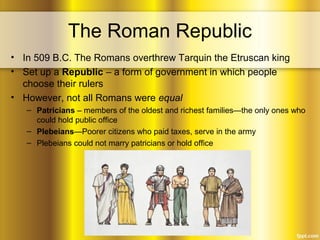
– Patricians – members of the oldest and richest families—the only ones who
could hold public office
– Plebeians—Poorer citizens who paid taxes, serve in the army
– Plebeians could not marry patricians or hold office
The Government
• Roman idea of government chosen by the people has served as a
model for future generations (United States included)
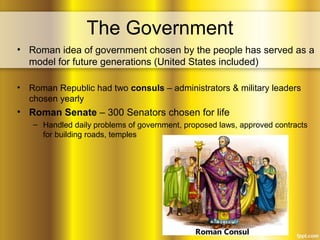
• Roman Republic had two consuls – administrators & military leaders
chosen yearly
• Roman Senate – 300 Senators chosen for life
– Handled daily problems of government, proposed laws, approved contracts
for building roads, temples
The Government
• Judges or tribunes – government officials who protected the
rights of the plebeians
• All Roman citizens belong to assemblies
• In 450 B.C. Romans began to write their laws down
• Carved laws on 12 bronze tablets called The Twelve Tables
• Placed in the Forum– the Foundation of all future Roman Law
• Romans gradually grew more democratic
• By 250 B.C. no one could be sold into slavery due to their debts
• Plebeians could finally hold public office
Ch. 14 The Roman Republic
Lesson 2 Roman Expansion
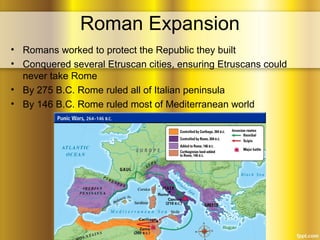
Roman Expansion
• Romans worked to protect the Republic they built
• Conquered several Etruscan cities, ensuring Etruscans could
never take Rome
• By 275 B.C. Rome ruled all of Italian peninsula
• By 146 B.C. Rome ruled most of Mediterranean world
• New Warfare arrangement: Legions – army containing 5,000
soldiers (legionaries) & divided into groups of 60 to 120 soldiers
• Outperformed the phalanx
• Legion was smaller, moved faster, could attack from all sides not
just one direction
• Romans let conquered people keep their own governments & did
not tax them at first
• In return, the conquered were expected to serve in Roman army
• Result: enemies of Rome became loyal Roman allies
• Turn to page 221 in World History Book
• Answer Linking Across Time
Ch. 14 The Roman Republic
Lesson 3 Punic Wars
The Punic Wars
• Romans conquered Greek city-states in southern Italy 264 B.C.
• Rome’s Rival = Carthage: Phoenician city that controlled most of
North & West Africa, most of Spain, & islands off Italy’s coast
• Romans felt threatened by the Carthaginians & First Punic War
began 264 B.C. lasting 23 years
• Carthage’s military strength: navy
• Rome’s military strength: army
• In 241 B.C. Carthaginians agreed to make peace & left Sicily
Hannibal & Second Punic War
• General Hannibal Barca won many victories against Rome
beginning in 218 B.C.
• Journeyed through Spain, France, Swiss Alps & into Rome
• Without enough supplies to batter down Rome’s city walls
Hannibal unable to capture Rome
• 201 B.C. Carthage agreed to pay Rome money & give up all
territories including Spain
• Spanish resources of copper, gold, lead, iron belonged to Rome
Hannibal & Second Punic War
• General Hannibal Barca won many victories against Rome
beginning in 218 B.C.
• Journeyed through Spain, France, Swiss Alps & into Rome
• Without enough supplies to batter down Rome’s city walls
Hannibal unable to capture Rome
• 201 B.C. Carthage agreed to pay Rome money & give up all
territories including Spain
• Spanish resources of copper, gold, lead, iron belonged to Rome
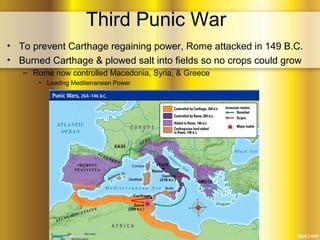
Third Punic War
• To prevent Carthage regaining power, Rome attacked in 149 B.C.
• Burned Carthage & plowed salt into fields so no crops could grow
– Rome now controlled Macedonia, Syria, & Greece
• Leading Mediterranean Power
Ch. 14 The Roman Republic
Lesson 4 Effects of Conquest
Effects of Conquest
• Conquests & Wealth changed Rome’s economy & government
• Changes:
– Replacement of small farms by large estates
– The Coming of Slavery
– Movement from Farms to Cities
– Decline of the Roman Republic
– Landless farmers moved to Rome
– Government officials too busy getting rich to worry about solving the
republic’s problems
– Gap between rich and poor grew much greater
– Rich hated poor; poor hated rich
– Rome was no longer politically stable
Ch. 14 The Roman Republic
Lesson 5 Roman Leadership
The Reformers
• Next 100 years – Popular Leaders tried to Improve Conditions in
Rome
• Reformers & Generals
• Tiberius Gracchus – 133 B.C. – Limited the amount of land
people could own; divided public lands; gave to the poor
• 107 B.C. General Marius – Opened the army to all – convinced
poor to join offering them pay, land, pension
• In 60 B.C political power passed to a triumvirate – group of 3
persons with equal power
• Julius Caesar, Crassus, & Pompeius
• Caesar eventually became Sole Ruler
Julius Caesar
• “Born into one of the oldest patricians families in Rome, Gaius
Julius Caesar, knew politics could be a dangerous job. Even so,
he had a big advantage—the loyalty of the legions who served
him. The legions helped Caesar become the reform-minded ruler
of Rome, but they could not save him from murder by the
senators who felt his popularity and power threatened the
Republic.”
• Caesar built up large, strong, loyal army
• Conquered northern France and Belgium; invaded Britain
• Reforms: redistributed state lands in Italy, built new infrastructure,
doubled the Senate to give business people more power
End of Republic
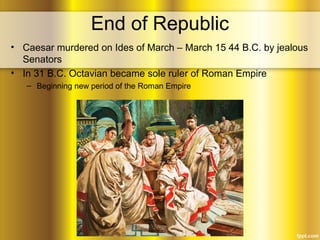
• Caesar murdered on Ides of March – March 15 44 B.C. by jealous
Senators
• In 31 B.C. Octavian became sole ruler of Roman Empire
– Beginning new period of the Roman Empire
Julius Caesar

The Roman Republic

  • 1.
    Ch. 14 TheRoman Republic 509 B.C. – 30 B.C. Lesson 1 The Government
  • 2.
    The Roman Republic •In 509 B.C. The Romans overthrew Tarquin the Etruscan king • Set up a Republic – a form of government in which people choose their rulers • However, not all Romans were equal – Patricians – members of the oldest and richest families—the only ones who could hold public office – Plebeians—Poorer citizens who paid taxes, serve in the army – Plebeians could not marry patricians or hold office
  • 3.
    The Government • Romanidea of government chosen by the people has served as a model for future generations (United States included) • Roman Republic had two consuls – administrators & military leaders chosen yearly • Roman Senate – 300 Senators chosen for life – Handled daily problems of government, proposed laws, approved contracts for building roads, temples
  • 4.
    The Government • Judgesor tribunes – government officials who protected the rights of the plebeians • All Roman citizens belong to assemblies • In 450 B.C. Romans began to write their laws down • Carved laws on 12 bronze tablets called The Twelve Tables • Placed in the Forum– the Foundation of all future Roman Law • Romans gradually grew more democratic • By 250 B.C. no one could be sold into slavery due to their debts • Plebeians could finally hold public office
  • 5.
    Ch. 14 TheRoman Republic Lesson 2 Roman Expansion
  • 6.
    Roman Expansion • Romansworked to protect the Republic they built • Conquered several Etruscan cities, ensuring Etruscans could never take Rome • By 275 B.C. Rome ruled all of Italian peninsula • By 146 B.C. Rome ruled most of Mediterranean world
  • 7.
    • New Warfarearrangement: Legions – army containing 5,000 soldiers (legionaries) & divided into groups of 60 to 120 soldiers • Outperformed the phalanx • Legion was smaller, moved faster, could attack from all sides not just one direction • Romans let conquered people keep their own governments & did not tax them at first • In return, the conquered were expected to serve in Roman army • Result: enemies of Rome became loyal Roman allies • Turn to page 221 in World History Book • Answer Linking Across Time
  • 8.
    Ch. 14 TheRoman Republic Lesson 3 Punic Wars
  • 9.
    The Punic Wars •Romans conquered Greek city-states in southern Italy 264 B.C. • Rome’s Rival = Carthage: Phoenician city that controlled most of North & West Africa, most of Spain, & islands off Italy’s coast • Romans felt threatened by the Carthaginians & First Punic War began 264 B.C. lasting 23 years • Carthage’s military strength: navy • Rome’s military strength: army • In 241 B.C. Carthaginians agreed to make peace & left Sicily
  • 10.
    Hannibal & SecondPunic War • General Hannibal Barca won many victories against Rome beginning in 218 B.C. • Journeyed through Spain, France, Swiss Alps & into Rome • Without enough supplies to batter down Rome’s city walls Hannibal unable to capture Rome • 201 B.C. Carthage agreed to pay Rome money & give up all territories including Spain • Spanish resources of copper, gold, lead, iron belonged to Rome
  • 11.
    Hannibal & SecondPunic War • General Hannibal Barca won many victories against Rome beginning in 218 B.C. • Journeyed through Spain, France, Swiss Alps & into Rome • Without enough supplies to batter down Rome’s city walls Hannibal unable to capture Rome • 201 B.C. Carthage agreed to pay Rome money & give up all territories including Spain • Spanish resources of copper, gold, lead, iron belonged to Rome
  • 12.
    Third Punic War •To prevent Carthage regaining power, Rome attacked in 149 B.C. • Burned Carthage & plowed salt into fields so no crops could grow – Rome now controlled Macedonia, Syria, & Greece • Leading Mediterranean Power
  • 13.
    Ch. 14 TheRoman Republic Lesson 4 Effects of Conquest
  • 14.
    Effects of Conquest •Conquests & Wealth changed Rome’s economy & government • Changes: – Replacement of small farms by large estates – The Coming of Slavery – Movement from Farms to Cities – Decline of the Roman Republic – Landless farmers moved to Rome – Government officials too busy getting rich to worry about solving the republic’s problems – Gap between rich and poor grew much greater – Rich hated poor; poor hated rich – Rome was no longer politically stable
  • 15.
    Ch. 14 TheRoman Republic Lesson 5 Roman Leadership
  • 16.
    The Reformers • Next100 years – Popular Leaders tried to Improve Conditions in Rome • Reformers & Generals • Tiberius Gracchus – 133 B.C. – Limited the amount of land people could own; divided public lands; gave to the poor • 107 B.C. General Marius – Opened the army to all – convinced poor to join offering them pay, land, pension • In 60 B.C political power passed to a triumvirate – group of 3 persons with equal power • Julius Caesar, Crassus, & Pompeius • Caesar eventually became Sole Ruler
  • 17.
    Julius Caesar • “Borninto one of the oldest patricians families in Rome, Gaius Julius Caesar, knew politics could be a dangerous job. Even so, he had a big advantage—the loyalty of the legions who served him. The legions helped Caesar become the reform-minded ruler of Rome, but they could not save him from murder by the senators who felt his popularity and power threatened the Republic.” • Caesar built up large, strong, loyal army • Conquered northern France and Belgium; invaded Britain • Reforms: redistributed state lands in Italy, built new infrastructure, doubled the Senate to give business people more power
  • 18.
    End of Republic •Caesar murdered on Ides of March – March 15 44 B.C. by jealous Senators • In 31 B.C. Octavian became sole ruler of Roman Empire – Beginning new period of the Roman Empire
  • 19.