Ancient Rome

From Republic to Empire
 Modern scholars
  believe that in the 8th
  century B.C., the
  inhabitants of some
  small Latin settlements
  on hills in the TIBER
  VALLEY united and
  established a common
                            FORUM
  meeting place, the
  FORUM, around which
  the city of Rome grew.
THE ROMAN MONARCHY to 509 B.C.
According to tradition, early Rome was ruled by KINGS elected
by the people.
  The king's executive power was conferred by a POPULAR
    ASSEMBLY made up of all arms-bearing citizens.
  The king turned for advice to a council of nobles, called the
    SENATE.
  Each senator had lifelong tenure and the members of this
    group and their families constituted the PATRICIAN class.
  The other class of Romans, the PLEBEIANS (commoners)
    included small farmers, artisans, and many clients
    (dependents of patrician landowners). In return for a
    livelihood, the clients gave their patrician patrons political
    support in the ASSEMBLY
ROMAN SENATE
EARLY REPUBLIC
         509-133 B.C.
 In 509 B.C., according to
  tradition, the PATRICIANS
  expelled the last Etruscan
  king and established a
  REPUBLIC.
 The power to rule was
  transferred to two new
  officials called CONSULS.
 Elected annually from the
  patrician class, the consul
  exercised their power in the
  interests of that class.
 Although the PATRICIANS
  controlled the government, they
  found themselves unable to
  exist without the plebeians.
 The PLEBEIANS produced the
  FOOD and supplied the
  LABOR that kept the Roman
  economy going.
 They also supplied the soldiers
  for the Roman MILITARY –
  especially important since
  Rome was in continual military
  conflict during the age of the
  Republic.
PLEBEIAN STRUGGLE FOR EQUAL RIGHTS
 For more than two centuries following the establishment of the
  Republic, the plebeians struggled for political and social equality.
    Outright civil war was averted by the willingness of the patricians
     to compromise.
    Much of the plebeians’ success in this struggle was also due to
     their tactics of collective action and to their having organized a
     corporate group within the state.
    The unofficial body was known
      as the PLEBEIAN COUNCIL.
    It was presided over by plebeian
      officials called
      TRIBUNES, whose job was to
      safeguard the interests of the
      plebeians and to negotiate with
      the consuls and the Senate.
 The advancement of the PLEBEIANS during the early
  Republic took two main lines: the safeguarding of their
  FUNDAMENTAL RIGHTS and the progressive enlargement
  of their share of POLITICAL POWER.
FUNDAMENTAL RIGHTS
 Because the consuls often interpreted
  Rome's unwritten customary law to
  suit PATRICIAN INTERESTS, the
  plebeians demanded that it be written
  down.
    As a result, about 450 B.C., the
      law was inscribed on twelve
      tablets of bronze and set up
      publicly in the Forum.
    The LAW OF THE TWELVE
      TABLETS was the first landmark
      in the long history of Roman law.
 The plebeians in time acquired
  other fundamental rights and
  safeguards:
    They secured the right to
     APPEAL A DEATH
     SENTENCE imposed by a
     consul and to be retried before
     the popular assembly.
    The tribunes gained a VETO
     POWER over any legislation or
     executive act that threatened
     the rights of the plebeians.
    MARRIAGE between patricians
     and plebeians, prohibited by the
     Law of the Twelve Tablets, was
     legalized.
    The enslavement of citizens for
     DEBT was abolished
POLITICAL POWER
 Little by little, the plebeian class acquired
  more power in the functioning of government.
    In 367 B.C., ONE CONSULSHIP was
       reserved for the plebeians.
    Before the end of the century, they were
       eligible to hold other important positions:
       PRAETOR (in charge of the law
       courts), QUAESTOR
       (treasurer), CENSOR (supervisor of
       public morals and state contracts).
    Some plebeians succeeded in gaining entry to the SENATE.
    The long struggle for equality ended in 287 B.C. when the
     PLEBEIAN COUNCIL was recognized as a constitutional
     body, henceforth known as the TRIBAL ASSEMBLY, with
     the right to PASS LAWS that were binding on all citizens.
    The Roman Republic was now technically a democracy,
     although in actual practice a senatorial aristocracy of
     patricians and rich plebeians continued to control the state.
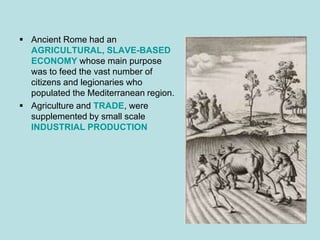
 Ancient Rome had an
  AGRICULTURAL, SLAVE-BASED
  ECONOMY whose main purpose
  was to feed the vast number of
  citizens and legionaries who
  populated the Mediterranean region.
 Agriculture and TRADE, were
  supplemented by small scale
  INDUSTRIAL PRODUCTION
 When the Romans conquered the
  Mediterranean, they took millions of
  SLAVES to Italy, where they worked on
  the large plantations or in the houses
  and workplaces of wealthy citizens.
 The Italian economy depended on
  abundant slave labor, with slaves
  constituting 40 PERCENT OF THE
  POPULATION. Slaves served as
  singers, scribes, jewelers, bartenders, a
  nd even doctors. One slave trained in
  medicine was worth the price of 50
  agricultural slaves.
SLAVERY IN ANCIENT ROME
 The staple crops of Roman farmers in
  Italy were various
  GRAINS, OLIVES, and GRAPES.
  OLIVE OIL and WINE were among the
  most important products in the ancient
  civilized world and led Italy's exports.
 Farmers could give surplus
  crops to the government in lieu
  of a monetary tax. This system
  allowed rulers to gain
  popularity with the masses
  through FREE GRAIN
  DISTRIBUTION. Unfortunately
  it also left farmers with little
  incentive to increase
  productivity or output, since
  more crop translated into more
  taxes (and more free grain
  distributions). The need to
  secure GRAIN-PRODUCING
  PROVINCES was one
  important factor that led to
  expansion and conquest.
 Improved farming methods learned from the Greeks and
  Carthaginians encouraged RICH ARISTOCRATS to buy more
  and more land and, abandoning the cultivation of
  grain, introduce LARGE-SCALE SCIENTIFIC PRODUCTION
  of olive oil and wine, or of sheep and cattle. This trend was
  especially profitable because an abundance of cheap SLAVES
  from the conquered areas was available to work on the
  estates. These large slave plantations, called
  LATIFUNDIA, were now common in Italy, while small farms
  were the exception.
 The land problem was further complicated by the government's
  earlier practice of LEASING part of the territory acquired in the
  conquest of the Italian peninsula to anyone willing to pay a
  percentage of the crop or animals raised on it. Only the
  patricians or wealthy plebeians could afford to lease large
  tracts of this PUBLIC LAND and in time they treated it as their
  own property. Plebeian protests had led to an attempt to limit
  the holdings of a single individual to 320 acres, but the law was
  never enforced.
 As a result of
  expansion, important social
  and economic problems faced
  Rome by the middle of the
  second century B.C. One of
  the most pressing problems
  was the DISAPPEARANCE
  OF THE SMALL
  LANDOWNER. Burdened by
  frequent military service, his
  farm buildings destroyed by
  war, and unable to compete
  with the cheap grain imported
  from the new Roman province
  of Sicily, the SMALL FARMER
  SOLD OUT and moved to
  Rome. Here he joined the
  unemployed, discontented
  PROLETARIAT.
 Religion played a very important
  role in the daily life of Ancient
  Rome. The Romans believed that
  GODS CONTROLLED THEIR
  LIVES and, as a result, spent a
  great deal of their time
  worshipping them.
 The most important god was
  JUPITER. He was the king of
  gods who ruled with his wife
  JUNO, the goddess of the sky.
 Other gods includes MARS,
  MERCURY, NEPTUNE, JANIS,
  DIANA, VESTA, MINERVA,
  VENUS.
 After the reign of the EMPEROR
  AUGUSTUS (27 BC to AD 14),
  the emperor was also considered
  to be a god and he was
  worshipped on special occasions.
 TEMPLES to worship the gods
  were built throughout the
  Roman Empire.
 Each family home would also
  have a small altar and shrine.
  The Romans had PERSONAL
  HOUSEHOLD GODS or spirits
  which were worshipped every
  day at home. The shrine
  contained statues of the spirits
  and the head of the household
  led family prayers around the
  shrine each day.
 In terms of the arts, Roman
  citizens were practical people
  who spent less time on
  art, literature, and philosophy
  and more time on
  ENGINEERING, CONSTRUCTI
  ON, and MILITARY
  OPERATIONS.
ENGINEERING
        PRACTICES
 In designing their bridges and
  aqueducts, the Romans
  placed a series of STONE
  ARCHES next to one another
  to provide mutual support.
 Fourteen
  AQUEDUCTS, stretching a
  total of 265 miles, supplied
  some 50 gallons of water daily
  for each inhabitant of Rome.
 The practical nature of the
  Romans and their skill and
  initiative in engineering were
  demonstrated in the many
  DAMS, RESERVOIRS, and
  HARBORS they built.
 The BARREL
  VAULT, basically a series of
  adjoining arches forming a
  structure resembling a
  tunnel, was a new method of
  enclosing space. In the barrel
  vault the supports of the
  arches became heavy
  masonry walls to bear the
  weight of the vaulted roof.
 The Romans next developed
  the CROSS VALUT by
  intersection two barrel vaults
  at right angles.
 Another important advance
  in architecture was the
  Roman's success in
  constructing CONCRETE
  DOMES on a large scale.
  The weight of the dome was
  transferred directly to the
  walls and no other support
  was necessary. The largest
  of the dome structures was
  the PANTHEON (temple of
  all the gods).
 The standard type of Roman public building was the BASCILICA, a
  colonnaded structure that became a model for early Christian churches.
  Rows of columns divided the interior into a central nave and side aisles,
  with the roof over the nave raised to admit light, creating a
  CLERESTORY (an upper portion of a wall containing windows for
  supplying natural light to a building.
 The Romans developed a distinctive
  SCULPTURE which was
  realistic, secular, and individualistic.
  EQUESTRIAN STATUES sculpted
  coffins (SARCOPHAGI), and the
  RELIEFS found on imperial
  monuments were exceptionally fine
  works of art. The Romans were
  particularly skilled in producing floor
  MOSAICS and in painting
  FRESCOES. Roman
  epic, dramatic, and lyric POETRY
  forms were usually written in
  conscious imitation of Greek
  masterpieces.
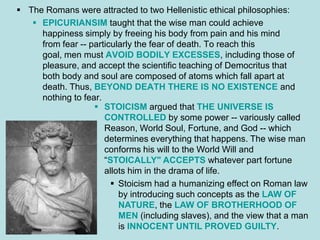
 The Romans were attracted to two Hellenistic ethical philosophies:
    EPICURIANSIM taught that the wise man could achieve
     happiness simply by freeing his body from pain and his mind
     from fear -- particularly the fear of death. To reach this
     goal, men must AVOID BODILY EXCESSES, including those of
     pleasure, and accept the scientific teaching of Democritus that
     both body and soul are composed of atoms which fall apart at
     death. Thus, BEYOND DEATH THERE IS NO EXISTENCE and
     nothing to fear.
                    STOICISM argued that THE UNIVERSE IS
                      CONTROLLED by some power -- variously called
                      Reason, World Soul, Fortune, and God -- which
                      determines everything that happens. The wise man
                      conforms his will to the World Will and
                      “STOICALLY" ACCEPTS whatever part fortune
                      allots him in the drama of life.
                         Stoicism had a humanizing effect on Roman law
                          by introducing such concepts as the LAW OF
                          NATURE, the LAW OF BROTHERHOOD OF
                          MEN (including slaves), and the view that a man
                          is INNOCENT UNTIL PROVED GUILTY.
POLITICAL THEORY AND
  LEGAL PRINCIPLES
 Roman political thinkers
  contributed many governmental
  theories:
    The SOCIAL CONTRACT
     theory (that government
     originated as a voluntary
     agreement among citizens).
    The idea of POPULAR
     SOVEREIGNTY (that all
     power ultimately resides with
     the people).
    The concept that LAW must
     be the basis for government.
 Originally, the wars which the
  Republic fought were largely
  DEFENSIVE WARS.
  Soon, however, the Romans
  were moving to gain control
  over neighboring territory in
  order to NEUTRALIZE THE
  THREAT OF ATTACK. Their
  logic was that control over
  these territories would
  PREVENT POTENTIAL
  ATTACK from the people
  occupying those territories and
  at the same time provide a
  buffer region between
  themselves and potential
  attackers.
 Weakened by civil war, the Roman
  Republic gave way to the ROMAN
  EMPIRE, with its AUTOCRATIC form
  of government and LARGE
  TERRITORIAL HOLDINGS in Europe
  and around the Mediterranean.
 Several events marked the transition
  from Republic to Empire, including
  JULIUS CAESAR’s appointment as
  perpetual DICTATOR (44 BC), the
  victory of OCTAVIAN at the Battle of
  Actium (31 BC), and the Roman
  Senate's granting to Octavian of the
  title AUGUSTUS. (27 BC).

Rome2

  • 1.
  • 2.
     Modern scholars believe that in the 8th century B.C., the inhabitants of some small Latin settlements on hills in the TIBER VALLEY united and established a common FORUM meeting place, the FORUM, around which the city of Rome grew.
  • 3.
    THE ROMAN MONARCHYto 509 B.C. According to tradition, early Rome was ruled by KINGS elected by the people.  The king's executive power was conferred by a POPULAR ASSEMBLY made up of all arms-bearing citizens.  The king turned for advice to a council of nobles, called the SENATE.  Each senator had lifelong tenure and the members of this group and their families constituted the PATRICIAN class.  The other class of Romans, the PLEBEIANS (commoners) included small farmers, artisans, and many clients (dependents of patrician landowners). In return for a livelihood, the clients gave their patrician patrons political support in the ASSEMBLY
  • 4.
  • 5.
    EARLY REPUBLIC 509-133 B.C.  In 509 B.C., according to tradition, the PATRICIANS expelled the last Etruscan king and established a REPUBLIC.  The power to rule was transferred to two new officials called CONSULS.  Elected annually from the patrician class, the consul exercised their power in the interests of that class.
  • 6.
     Although thePATRICIANS controlled the government, they found themselves unable to exist without the plebeians.  The PLEBEIANS produced the FOOD and supplied the LABOR that kept the Roman economy going.  They also supplied the soldiers for the Roman MILITARY – especially important since Rome was in continual military conflict during the age of the Republic.
  • 7.
    PLEBEIAN STRUGGLE FOREQUAL RIGHTS  For more than two centuries following the establishment of the Republic, the plebeians struggled for political and social equality.  Outright civil war was averted by the willingness of the patricians to compromise.  Much of the plebeians’ success in this struggle was also due to their tactics of collective action and to their having organized a corporate group within the state.  The unofficial body was known as the PLEBEIAN COUNCIL.  It was presided over by plebeian officials called TRIBUNES, whose job was to safeguard the interests of the plebeians and to negotiate with the consuls and the Senate.
  • 8.
     The advancementof the PLEBEIANS during the early Republic took two main lines: the safeguarding of their FUNDAMENTAL RIGHTS and the progressive enlargement of their share of POLITICAL POWER.
  • 9.
    FUNDAMENTAL RIGHTS  Becausethe consuls often interpreted Rome's unwritten customary law to suit PATRICIAN INTERESTS, the plebeians demanded that it be written down.  As a result, about 450 B.C., the law was inscribed on twelve tablets of bronze and set up publicly in the Forum.  The LAW OF THE TWELVE TABLETS was the first landmark in the long history of Roman law.
  • 10.
     The plebeiansin time acquired other fundamental rights and safeguards:  They secured the right to APPEAL A DEATH SENTENCE imposed by a consul and to be retried before the popular assembly.  The tribunes gained a VETO POWER over any legislation or executive act that threatened the rights of the plebeians.  MARRIAGE between patricians and plebeians, prohibited by the Law of the Twelve Tablets, was legalized.  The enslavement of citizens for DEBT was abolished
  • 11.
    POLITICAL POWER  Littleby little, the plebeian class acquired more power in the functioning of government.  In 367 B.C., ONE CONSULSHIP was reserved for the plebeians.  Before the end of the century, they were eligible to hold other important positions: PRAETOR (in charge of the law courts), QUAESTOR (treasurer), CENSOR (supervisor of public morals and state contracts).  Some plebeians succeeded in gaining entry to the SENATE.  The long struggle for equality ended in 287 B.C. when the PLEBEIAN COUNCIL was recognized as a constitutional body, henceforth known as the TRIBAL ASSEMBLY, with the right to PASS LAWS that were binding on all citizens.  The Roman Republic was now technically a democracy, although in actual practice a senatorial aristocracy of patricians and rich plebeians continued to control the state.
  • 12.
     Ancient Romehad an AGRICULTURAL, SLAVE-BASED ECONOMY whose main purpose was to feed the vast number of citizens and legionaries who populated the Mediterranean region.  Agriculture and TRADE, were supplemented by small scale INDUSTRIAL PRODUCTION
  • 13.
     When theRomans conquered the Mediterranean, they took millions of SLAVES to Italy, where they worked on the large plantations or in the houses and workplaces of wealthy citizens.  The Italian economy depended on abundant slave labor, with slaves constituting 40 PERCENT OF THE POPULATION. Slaves served as singers, scribes, jewelers, bartenders, a nd even doctors. One slave trained in medicine was worth the price of 50 agricultural slaves.
  • 14.
  • 15.
     The staplecrops of Roman farmers in Italy were various GRAINS, OLIVES, and GRAPES. OLIVE OIL and WINE were among the most important products in the ancient civilized world and led Italy's exports.
  • 16.
     Farmers couldgive surplus crops to the government in lieu of a monetary tax. This system allowed rulers to gain popularity with the masses through FREE GRAIN DISTRIBUTION. Unfortunately it also left farmers with little incentive to increase productivity or output, since more crop translated into more taxes (and more free grain distributions). The need to secure GRAIN-PRODUCING PROVINCES was one important factor that led to expansion and conquest.
  • 17.
     Improved farmingmethods learned from the Greeks and Carthaginians encouraged RICH ARISTOCRATS to buy more and more land and, abandoning the cultivation of grain, introduce LARGE-SCALE SCIENTIFIC PRODUCTION of olive oil and wine, or of sheep and cattle. This trend was especially profitable because an abundance of cheap SLAVES from the conquered areas was available to work on the estates. These large slave plantations, called LATIFUNDIA, were now common in Italy, while small farms were the exception.
  • 18.
     The landproblem was further complicated by the government's earlier practice of LEASING part of the territory acquired in the conquest of the Italian peninsula to anyone willing to pay a percentage of the crop or animals raised on it. Only the patricians or wealthy plebeians could afford to lease large tracts of this PUBLIC LAND and in time they treated it as their own property. Plebeian protests had led to an attempt to limit the holdings of a single individual to 320 acres, but the law was never enforced.
  • 19.
     As aresult of expansion, important social and economic problems faced Rome by the middle of the second century B.C. One of the most pressing problems was the DISAPPEARANCE OF THE SMALL LANDOWNER. Burdened by frequent military service, his farm buildings destroyed by war, and unable to compete with the cheap grain imported from the new Roman province of Sicily, the SMALL FARMER SOLD OUT and moved to Rome. Here he joined the unemployed, discontented PROLETARIAT.
  • 20.
     Religion playeda very important role in the daily life of Ancient Rome. The Romans believed that GODS CONTROLLED THEIR LIVES and, as a result, spent a great deal of their time worshipping them.  The most important god was JUPITER. He was the king of gods who ruled with his wife JUNO, the goddess of the sky.  Other gods includes MARS, MERCURY, NEPTUNE, JANIS, DIANA, VESTA, MINERVA, VENUS.  After the reign of the EMPEROR AUGUSTUS (27 BC to AD 14), the emperor was also considered to be a god and he was worshipped on special occasions.
  • 21.
     TEMPLES toworship the gods were built throughout the Roman Empire.  Each family home would also have a small altar and shrine. The Romans had PERSONAL HOUSEHOLD GODS or spirits which were worshipped every day at home. The shrine contained statues of the spirits and the head of the household led family prayers around the shrine each day.
  • 22.
     In termsof the arts, Roman citizens were practical people who spent less time on art, literature, and philosophy and more time on ENGINEERING, CONSTRUCTI ON, and MILITARY OPERATIONS.
  • 23.
    ENGINEERING PRACTICES  In designing their bridges and aqueducts, the Romans placed a series of STONE ARCHES next to one another to provide mutual support.  Fourteen AQUEDUCTS, stretching a total of 265 miles, supplied some 50 gallons of water daily for each inhabitant of Rome.  The practical nature of the Romans and their skill and initiative in engineering were demonstrated in the many DAMS, RESERVOIRS, and HARBORS they built.
  • 24.
     The BARREL VAULT, basically a series of adjoining arches forming a structure resembling a tunnel, was a new method of enclosing space. In the barrel vault the supports of the arches became heavy masonry walls to bear the weight of the vaulted roof.  The Romans next developed the CROSS VALUT by intersection two barrel vaults at right angles.
  • 25.
     Another importantadvance in architecture was the Roman's success in constructing CONCRETE DOMES on a large scale. The weight of the dome was transferred directly to the walls and no other support was necessary. The largest of the dome structures was the PANTHEON (temple of all the gods).
  • 26.
     The standardtype of Roman public building was the BASCILICA, a colonnaded structure that became a model for early Christian churches. Rows of columns divided the interior into a central nave and side aisles, with the roof over the nave raised to admit light, creating a CLERESTORY (an upper portion of a wall containing windows for supplying natural light to a building.
  • 27.
     The Romansdeveloped a distinctive SCULPTURE which was realistic, secular, and individualistic. EQUESTRIAN STATUES sculpted coffins (SARCOPHAGI), and the RELIEFS found on imperial monuments were exceptionally fine works of art. The Romans were particularly skilled in producing floor MOSAICS and in painting FRESCOES. Roman epic, dramatic, and lyric POETRY forms were usually written in conscious imitation of Greek masterpieces.
  • 28.
     The Romanswere attracted to two Hellenistic ethical philosophies:  EPICURIANSIM taught that the wise man could achieve happiness simply by freeing his body from pain and his mind from fear -- particularly the fear of death. To reach this goal, men must AVOID BODILY EXCESSES, including those of pleasure, and accept the scientific teaching of Democritus that both body and soul are composed of atoms which fall apart at death. Thus, BEYOND DEATH THERE IS NO EXISTENCE and nothing to fear.  STOICISM argued that THE UNIVERSE IS CONTROLLED by some power -- variously called Reason, World Soul, Fortune, and God -- which determines everything that happens. The wise man conforms his will to the World Will and “STOICALLY" ACCEPTS whatever part fortune allots him in the drama of life.  Stoicism had a humanizing effect on Roman law by introducing such concepts as the LAW OF NATURE, the LAW OF BROTHERHOOD OF MEN (including slaves), and the view that a man is INNOCENT UNTIL PROVED GUILTY.
  • 29.
    POLITICAL THEORY AND LEGAL PRINCIPLES  Roman political thinkers contributed many governmental theories:  The SOCIAL CONTRACT theory (that government originated as a voluntary agreement among citizens).  The idea of POPULAR SOVEREIGNTY (that all power ultimately resides with the people).  The concept that LAW must be the basis for government.
  • 30.
     Originally, thewars which the Republic fought were largely DEFENSIVE WARS. Soon, however, the Romans were moving to gain control over neighboring territory in order to NEUTRALIZE THE THREAT OF ATTACK. Their logic was that control over these territories would PREVENT POTENTIAL ATTACK from the people occupying those territories and at the same time provide a buffer region between themselves and potential attackers.
  • 31.
     Weakened bycivil war, the Roman Republic gave way to the ROMAN EMPIRE, with its AUTOCRATIC form of government and LARGE TERRITORIAL HOLDINGS in Europe and around the Mediterranean.  Several events marked the transition from Republic to Empire, including JULIUS CAESAR’s appointment as perpetual DICTATOR (44 BC), the victory of OCTAVIAN at the Battle of Actium (31 BC), and the Roman Senate's granting to Octavian of the title AUGUSTUS. (27 BC).