ROMAN EMPIRE UNIT TEST STUDY GUIDE
ARCHAIC ROME
• The Romans believed that their history could be dated back to a Trojan hero named Aeneas(i-NEE-uhs).
• When the Greeks destroyed Troy during the Trojan War, Aeneas fled withhis followersto Italy.
• An ancient story named the Aeneidtells the story of Aeneas.
• According to legend, Romulus(adescendent of Aeneas) founded the city of Rome in 753 BC, after killing his
brother, and crowned himself the first king of Rome. The city of Rome was then led by kings for hundreds of years.
THE ROMANREPUBLIC
• In the Roman Republic, the people electedtheir own leaders.
• Magistrates-anothername fora government official
• Consuls-the2most powerfulmagistrates in Rome
• RomanSenate-Councilof powerfulRomans who advised the city’sleaders
• Forum-Rome’s public meeting place which housed the government, temples, and an open market
• Social Structure
• Patricians– wealthy class (small portion of population)
• Plebians– common/lowerclass (majority of population
• PunicWars – a long series of wars between Rome and Carthage
• Rome wonthese series of wars and as a result conquered Sicily,Spain, and Northern Africa – expanding
their republic even more
JULIUS CAESAR
• Julius Caesar was one of Rome’s most powerfulgenerals
• Roman’s admired him for his bravery in battle and land acquisitions
• Caesar’s military made him an important figure in Roman politics
• Caesar was also an excellent speaker whichwon him many supporters
• In 45 BC, Julius Caesar proclaimed himself the dictator of Rome
• Many of the Roman senators did not approve of the way Caesar came to power
• On March 15, 44 BC a group of senators attacked Caesar in the senate and killed him
• Caesar’s adopted son Octavianwould become ruler of Rome after his death
OCTAVIAN– EMPERORAUGUSTUS
• In 27 BC, Octaviangave up his senate seat and was named “Augustus” which means “revered one”
• With Augustus as the new leader, Rome would enter a new era known as the RomanEmpire
• The first 200 years of the Roman Empire were very peaceful = PaxRomanawhich means Roman Peace
• As the leader of Rome, Augustus made many improvements in the city. He created a fire department and a police
forceto protect the city’s people. He built new aqueducts and repaired old ones to increase Rome’s water supply.
Augustus also workedon improving and expanding Rome’s road network.
ROMANRELIGION
• As the Roman Empire expanded, it included many differentpeople groups with different languages and religions.
• The Romans were very tolerant of other people group’s religions. This is called religioustolerance.
• However,the Romans were not tolerant of other religions when they conflictedwith Roman law.
• For example, the Romans began to clash with the Jews, so they treated them harshly and taxed them heavily.
• Before the year AD 300, the Romans were polytheistic and worshipped many Roman gods.
• In the AD 300s, many Romans convertedto a new religion, knownas Christianity
• Christianity is based on the life and teachings of Jesus ofNazareth.
• Jesus claimed to be the son of the Christian God sent to earth.
• Around 30 AD, Jesus was arrested by the Romans and crucifiedby the Romans
• Crucifixionisa type of execution in whicha person is nailed to a cross.
• According to the Bible, Jesus was nailed the cross, died, and rose from the dead (called the Resurrection)
• Jesus had 12 Apostles whoweredisciples whom Jesus chose to receive special training and spread Christianity.
• Christians spread the word about the new religion, but the Romans persecuted the Christians just like the Jews.
ROMANINFLUENCE ON LANGUAGE
• Today the alphabet of the Latin language, whichexpanded from22 to 26 letters, and is used throughout the
Western World.
• Latin shaped the languages of Italy, France, Spain, Portugal and Romania. These are called the Romance languages.
DIVIDING ROME
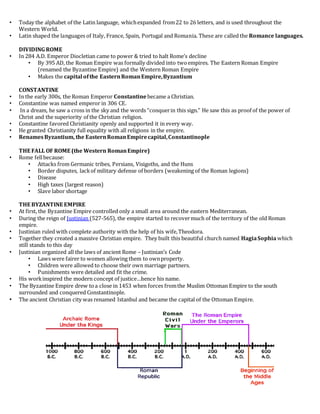
• In 284 A.D. Emperor Diocletian came to power & tried to halt Rome’s decline
• By 395 AD, the Roman Empire was formally divided into twoempires. The Eastern Roman Empire
(renamed the Byzantine Empire) and the Western Roman Empire
• Makes the capital ofthe EasternRomanEmpire,Byzantium
CONSTANTINE
• In the early 300s, the Roman Emperor Constantinebecame a Christian.
• Constantine was named emperor in 306 CE.
• In a dream, he saw a cross in the sky and the words “conquerin this sign.” He saw this as proof of the power of
Christ and the superiority of the Christian religion.
• Constantine favored Christianity openly and supported it in every way.
• He granted Christianity full equality with all religions in the empire.
• RenamesByzantium, the EasternRomanEmpirecapital,Constantinople
THE FALL OF ROME (the Western RomanEmpire)
• Rome fellbecause:
• Attacks from Germanic tribes, Persians, Visigoths, and the Huns
• Border disputes, lackof military defense of borders (weakening of the Roman legions)
• Disease
• High taxes (largest reason)
• Slave labor shortage
THE BYZANTINE EMPIRE
• At first, the Byzantine Empire controlled only a small area around the eastern Mediterranean.
• During the reign of Justinian (527-565), the empire started to recovermuch of the territory of the old Roman
empire.
• Justinian ruled with complete authority with the help of his wife,Theodora.
• Together they created a massive Christian empire. They built this beautiful church named HagiaSophiawhich
still stands to this day
• Justinian organized all the laws of ancient Rome – Justinian’s Code
• Laws were fairer to women allowing them to ownproperty.
• Children were allowed to choose their own marriage partners.
• Punishments were detailed and fit the crime.
• His workinspired the modern concept of justice…hence his name.
• The Byzantine Empire drew toa close in 1453 when forces fromthe Muslim Ottoman Empire to the south
surrounded and conquered Constantinople.
• The ancient Christian city was renamed Istanbul and became the capital of the Ottoman Empire.

Roman Empire study guide notes

  • 1.
    ROMAN EMPIRE UNITTEST STUDY GUIDE ARCHAIC ROME • The Romans believed that their history could be dated back to a Trojan hero named Aeneas(i-NEE-uhs). • When the Greeks destroyed Troy during the Trojan War, Aeneas fled withhis followersto Italy. • An ancient story named the Aeneidtells the story of Aeneas. • According to legend, Romulus(adescendent of Aeneas) founded the city of Rome in 753 BC, after killing his brother, and crowned himself the first king of Rome. The city of Rome was then led by kings for hundreds of years. THE ROMANREPUBLIC • In the Roman Republic, the people electedtheir own leaders. • Magistrates-anothername fora government official • Consuls-the2most powerfulmagistrates in Rome • RomanSenate-Councilof powerfulRomans who advised the city’sleaders • Forum-Rome’s public meeting place which housed the government, temples, and an open market • Social Structure • Patricians– wealthy class (small portion of population) • Plebians– common/lowerclass (majority of population • PunicWars – a long series of wars between Rome and Carthage • Rome wonthese series of wars and as a result conquered Sicily,Spain, and Northern Africa – expanding their republic even more JULIUS CAESAR • Julius Caesar was one of Rome’s most powerfulgenerals • Roman’s admired him for his bravery in battle and land acquisitions • Caesar’s military made him an important figure in Roman politics • Caesar was also an excellent speaker whichwon him many supporters • In 45 BC, Julius Caesar proclaimed himself the dictator of Rome • Many of the Roman senators did not approve of the way Caesar came to power • On March 15, 44 BC a group of senators attacked Caesar in the senate and killed him • Caesar’s adopted son Octavianwould become ruler of Rome after his death OCTAVIAN– EMPERORAUGUSTUS • In 27 BC, Octaviangave up his senate seat and was named “Augustus” which means “revered one” • With Augustus as the new leader, Rome would enter a new era known as the RomanEmpire • The first 200 years of the Roman Empire were very peaceful = PaxRomanawhich means Roman Peace • As the leader of Rome, Augustus made many improvements in the city. He created a fire department and a police forceto protect the city’s people. He built new aqueducts and repaired old ones to increase Rome’s water supply. Augustus also workedon improving and expanding Rome’s road network. ROMANRELIGION • As the Roman Empire expanded, it included many differentpeople groups with different languages and religions. • The Romans were very tolerant of other people group’s religions. This is called religioustolerance. • However,the Romans were not tolerant of other religions when they conflictedwith Roman law. • For example, the Romans began to clash with the Jews, so they treated them harshly and taxed them heavily. • Before the year AD 300, the Romans were polytheistic and worshipped many Roman gods. • In the AD 300s, many Romans convertedto a new religion, knownas Christianity • Christianity is based on the life and teachings of Jesus ofNazareth. • Jesus claimed to be the son of the Christian God sent to earth. • Around 30 AD, Jesus was arrested by the Romans and crucifiedby the Romans • Crucifixionisa type of execution in whicha person is nailed to a cross. • According to the Bible, Jesus was nailed the cross, died, and rose from the dead (called the Resurrection) • Jesus had 12 Apostles whoweredisciples whom Jesus chose to receive special training and spread Christianity. • Christians spread the word about the new religion, but the Romans persecuted the Christians just like the Jews. ROMANINFLUENCE ON LANGUAGE
  • 2.
    • Today thealphabet of the Latin language, whichexpanded from22 to 26 letters, and is used throughout the Western World. • Latin shaped the languages of Italy, France, Spain, Portugal and Romania. These are called the Romance languages. DIVIDING ROME • In 284 A.D. Emperor Diocletian came to power & tried to halt Rome’s decline • By 395 AD, the Roman Empire was formally divided into twoempires. The Eastern Roman Empire (renamed the Byzantine Empire) and the Western Roman Empire • Makes the capital ofthe EasternRomanEmpire,Byzantium CONSTANTINE • In the early 300s, the Roman Emperor Constantinebecame a Christian. • Constantine was named emperor in 306 CE. • In a dream, he saw a cross in the sky and the words “conquerin this sign.” He saw this as proof of the power of Christ and the superiority of the Christian religion. • Constantine favored Christianity openly and supported it in every way. • He granted Christianity full equality with all religions in the empire. • RenamesByzantium, the EasternRomanEmpirecapital,Constantinople THE FALL OF ROME (the Western RomanEmpire) • Rome fellbecause: • Attacks from Germanic tribes, Persians, Visigoths, and the Huns • Border disputes, lackof military defense of borders (weakening of the Roman legions) • Disease • High taxes (largest reason) • Slave labor shortage THE BYZANTINE EMPIRE • At first, the Byzantine Empire controlled only a small area around the eastern Mediterranean. • During the reign of Justinian (527-565), the empire started to recovermuch of the territory of the old Roman empire. • Justinian ruled with complete authority with the help of his wife,Theodora. • Together they created a massive Christian empire. They built this beautiful church named HagiaSophiawhich still stands to this day • Justinian organized all the laws of ancient Rome – Justinian’s Code • Laws were fairer to women allowing them to ownproperty. • Children were allowed to choose their own marriage partners. • Punishments were detailed and fit the crime. • His workinspired the modern concept of justice…hence his name. • The Byzantine Empire drew toa close in 1453 when forces fromthe Muslim Ottoman Empire to the south surrounded and conquered Constantinople. • The ancient Christian city was renamed Istanbul and became the capital of the Ottoman Empire.