Handling “Out of Memory” Errors
John Tang Boyland
ECOOP EHWS, July 25, 2005
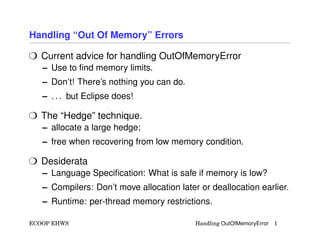
Handling “Out Of Memory” Errors
H Current advice for handling OutOfMemoryError
– Use to find memory limits.
– Don’t! There’s nothing you can do.
– . . . but Eclipse does!
H The “Hedge” technique.
– allocate a large hedge;
– free when recovering from low memory condition.
H Desiderata
– Language Specification: What is safe if memory is low?
– Compilers: Don’t move allocation later or deallocation earlier.
– Runtime: per-thread memory restrictions.
ECOOP EHWS Handling OutOfMemoryError 1
An OutOfMemoryError occurs
?
Exception thrown here
H Recovery difficult because of “low memory” condition.
H When exception is thrown, last request is not fulfilled.
ECOOP EHWS Handling OutOfMemoryError 2
Measuring Available Memory
Exception thrown and caught
Object allocated and discarded
H A loop:
– Try allocating a HUGE array;
– Catch the exception and try again with a smaller amount.
– Repeat until no exception is thrown.
H A rough underestimate of available memory.
(More accurate than Runtime.freeMemory().)
ECOOP EHWS Handling OutOfMemoryError 3
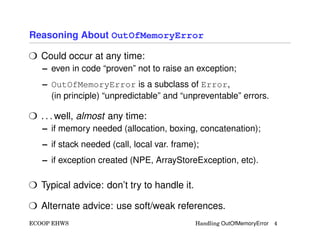
Reasoning About OutOfMemoryError
H Could occur at any time:
– even in code “proven” not to raise an exception;
– OutOfMemoryError is a subclass of Error,
(in principle) “unpredictable” and “unpreventable” errors.
H . . . well, almost any time:
– if memory needed (allocation, boxing, concatenation);
– if stack needed (call, local var. frame);
– if exception created (NPE, ArrayStoreException, etc).
H Typical advice: don’t try to handle it.
H Alternate advice: use soft/weak references.
ECOOP EHWS Handling OutOfMemoryError 4
A “Real” Program Must Handle the Error
H Almost no realistic program can provably avoid running out
of memory.
H For example: Eclipse
– uses more memory if more files are being edited;
– memory is used by many different parts (GUI, Compiler, as-
sistance, markers etc)
H Crashing on OOME is unacceptable:
– user’s work is lost, and
– workbench left (perhaps) in inconsistent state, but
– logging errors or saving files taken memory;
H The error must be handled.
ECOOP EHWS Handling OutOfMemoryError 5
Handling OutOfMemoryError in Eclipse (1 of 2)
H Eclipse catches OOME and displays warning dialog:
– but memory is low;
– dialog appears after emergency exit fails;
– otherwise only error messages on Unix stdout.
H Eclipse 3.1 uses a larger max heap size than previously
– Normally degradation (thrashing) long precedes OOME.
– Artificially lowering the heap size gets previous behavior.
ECOOP EHWS Handling OutOfMemoryError 6
Handling OutOfMemoryError in Eclipse (2 of 2)
Exception in thread "...JavaReconciler" java.lang.OutOfMemoryError
Error while logging event loop exception:
java.lang.OutOfMemoryError: Java heap space
Logging exception:
java.lang.OutOfMemoryError: Java heap space
Error while informing user about event loop exception:
java.lang.OutOfMemoryError: Java heap space
Dialog open exception:
java.lang.OutOfMemoryError: Java heap space
Fatal error happened during workbench emergency close.
java.lang.OutOfMemoryError: Java heap space
Unhandled event loop exception
Reason: Java heap space
H Then dialog brought up.
ECOOP EHWS Handling OutOfMemoryError 7
The “Hedge” Technique
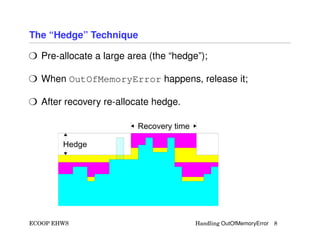
H Pre-allocate a large area (the “hedge”);
H When OutOfMemoryError happens, release it;
H After recovery re-allocate hedge.
Recovery time
Hedge
ECOOP EHWS Handling OutOfMemoryError 8
Difficulties Using the Hedge Technique
H Need to overestimate memory required for recovery;
H Interrupted computation may leave data inconsistent;
H finally clauses before recovery may re-throw OOME;
H Error may be thrown in thread other than the “guilty” one;
H Compiler may move allocation later or deallocation earlier;
H Cannot be made automatic.
(see next slides)
ECOOP EHWS Handling OutOfMemoryError 9
One Problem Leads To Another (1 of 3)
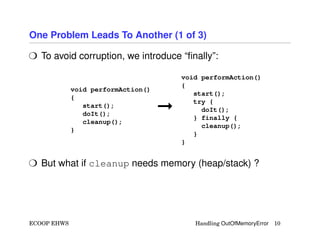
H To avoid corruption, we introduce “finally”:
void performAction()
{
start();
doIt();
cleanup();
}
©
void performAction()
{
start();
try {
doIt();
} finally {
cleanup();
}
}
H But what if cleanup needs memory (heap/stack) ?
ECOOP EHWS Handling OutOfMemoryError 10
One Problem Leads To Another (2 of 3)
H So we pre-allocate some memory:
void performAction()
{
start();
int[] space = new int[1000];
// Point A
try {
doIt();
} finally {
// Point B
space = null;
cleanup();
}
}
H But what if the compiler . . .
– moves the allocation later (B)?
– moves the deallocation earlier (A)?
ECOOP EHWS Handling OutOfMemoryError 11
One Problem Leads To Another (3 of 3)
H Fake uses force early allocation.
H Fake tests force late deallocation.
void performAction()
{
start();
int[] space = new int[1000];
space[45] = 1+space[fact(6)];
try {
doIt();
} finally {
if (space[45] > space[44]) {
space = null;
cleanup();
}
}
}
H We have obfuscated our program.
ECOOP EHWS Handling OutOfMemoryError 12
Placing Hedge Recovery
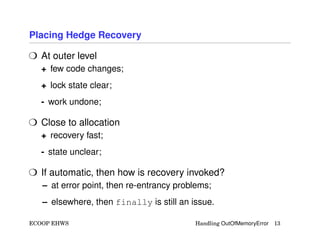
H At outer level
+ few code changes;
+ lock state clear;
- work undone;
H Close to allocation
+ recovery fast;
- state unclear;
H If automatic, then how is recovery invoked?
– at error point, then re-entrancy problems;
– elsewhere, then finally is still an issue.
ECOOP EHWS Handling OutOfMemoryError 13
Experiences With Hedge Recovery
H Importing Java Into Internal Representation:
– Must persist in “eras”;
– As few eras as possible;
– No easy way to use weak/soft references;
H Converted JDK 1.4.2 provided source
– 4500 source files;
– 12 hours;
– 11 OutOfMemoryErrors generated;
– (300 Mb max heap on Solaris x86).
H Avoided threading issues (single-threaded code).
ECOOP EHWS Handling OutOfMemoryError 14
Conclusions
H Hedge recovery can work.
Perhaps Eclipse could use it.
H Hedge recovery would be safer if:
– Language specified what operations need memory;
– Compilers don’t move allocation/deallocation past try-finally
boundaries;
– Threads had own memory restrictions.
H Thrashing is a good alternative for interactive programs.
ECOOP EHWS Handling OutOfMemoryError 15

Memory error-talk

  • 1.
    Handling “Out ofMemory” Errors John Tang Boyland ECOOP EHWS, July 25, 2005
  • 2.
    Handling “Out OfMemory” Errors H Current advice for handling OutOfMemoryError – Use to find memory limits. – Don’t! There’s nothing you can do. – . . . but Eclipse does! H The “Hedge” technique. – allocate a large hedge; – free when recovering from low memory condition. H Desiderata – Language Specification: What is safe if memory is low? – Compilers: Don’t move allocation later or deallocation earlier. – Runtime: per-thread memory restrictions. ECOOP EHWS Handling OutOfMemoryError 1
  • 3.
    An OutOfMemoryError occurs ? Exceptionthrown here H Recovery difficult because of “low memory” condition. H When exception is thrown, last request is not fulfilled. ECOOP EHWS Handling OutOfMemoryError 2
  • 4.
    Measuring Available Memory Exceptionthrown and caught Object allocated and discarded H A loop: – Try allocating a HUGE array; – Catch the exception and try again with a smaller amount. – Repeat until no exception is thrown. H A rough underestimate of available memory. (More accurate than Runtime.freeMemory().) ECOOP EHWS Handling OutOfMemoryError 3
  • 5.
    Reasoning About OutOfMemoryError HCould occur at any time: – even in code “proven” not to raise an exception; – OutOfMemoryError is a subclass of Error, (in principle) “unpredictable” and “unpreventable” errors. H . . . well, almost any time: – if memory needed (allocation, boxing, concatenation); – if stack needed (call, local var. frame); – if exception created (NPE, ArrayStoreException, etc). H Typical advice: don’t try to handle it. H Alternate advice: use soft/weak references. ECOOP EHWS Handling OutOfMemoryError 4
  • 6.
    A “Real” ProgramMust Handle the Error H Almost no realistic program can provably avoid running out of memory. H For example: Eclipse – uses more memory if more files are being edited; – memory is used by many different parts (GUI, Compiler, as- sistance, markers etc) H Crashing on OOME is unacceptable: – user’s work is lost, and – workbench left (perhaps) in inconsistent state, but – logging errors or saving files taken memory; H The error must be handled. ECOOP EHWS Handling OutOfMemoryError 5
  • 7.
    Handling OutOfMemoryError inEclipse (1 of 2) H Eclipse catches OOME and displays warning dialog: – but memory is low; – dialog appears after emergency exit fails; – otherwise only error messages on Unix stdout. H Eclipse 3.1 uses a larger max heap size than previously – Normally degradation (thrashing) long precedes OOME. – Artificially lowering the heap size gets previous behavior. ECOOP EHWS Handling OutOfMemoryError 6
  • 8.
    Handling OutOfMemoryError inEclipse (2 of 2) Exception in thread "...JavaReconciler" java.lang.OutOfMemoryError Exception in thread "...JavaReconciler" java.lang.OutOfMemoryError Exception in thread "...JavaReconciler" java.lang.OutOfMemoryError Error while logging event loop exception: java.lang.OutOfMemoryError: Java heap space Logging exception: java.lang.OutOfMemoryError: Java heap space Error while informing user about event loop exception: java.lang.OutOfMemoryError: Java heap space Dialog open exception: java.lang.OutOfMemoryError: Java heap space Fatal error happened during workbench emergency close. java.lang.OutOfMemoryError: Java heap space Unhandled event loop exception Reason: Java heap space H Then dialog brought up. ECOOP EHWS Handling OutOfMemoryError 7
  • 9.
    The “Hedge” Technique HPre-allocate a large area (the “hedge”); H When OutOfMemoryError happens, release it; H After recovery re-allocate hedge. Recovery time Hedge ECOOP EHWS Handling OutOfMemoryError 8
  • 10.
    Difficulties Using theHedge Technique H Need to overestimate memory required for recovery; H Interrupted computation may leave data inconsistent; H finally clauses before recovery may re-throw OOME; H Error may be thrown in thread other than the “guilty” one; H Compiler may move allocation later or deallocation earlier; H Cannot be made automatic. (see next slides) ECOOP EHWS Handling OutOfMemoryError 9
  • 11.
    One Problem LeadsTo Another (1 of 3) H To avoid corruption, we introduce “finally”: void performAction() { start(); doIt(); cleanup(); } © void performAction() { start(); try { doIt(); } finally { cleanup(); } } H But what if cleanup needs memory (heap/stack) ? ECOOP EHWS Handling OutOfMemoryError 10
  • 12.
    One Problem LeadsTo Another (2 of 3) H So we pre-allocate some memory: void performAction() { start(); int[] space = new int[1000]; // Point A try { doIt(); } finally { // Point B space = null; cleanup(); } } H But what if the compiler . . . – moves the allocation later (B)? – moves the deallocation earlier (A)? ECOOP EHWS Handling OutOfMemoryError 11
  • 13.
    One Problem LeadsTo Another (3 of 3) H Fake uses force early allocation. H Fake tests force late deallocation. void performAction() { start(); int[] space = new int[1000]; space[45] = 1+space[fact(6)]; try { doIt(); } finally { if (space[45] > space[44]) { space = null; cleanup(); } } } H We have obfuscated our program. ECOOP EHWS Handling OutOfMemoryError 12
  • 14.
    Placing Hedge Recovery HAt outer level + few code changes; + lock state clear; - work undone; H Close to allocation + recovery fast; - state unclear; H If automatic, then how is recovery invoked? – at error point, then re-entrancy problems; – elsewhere, then finally is still an issue. ECOOP EHWS Handling OutOfMemoryError 13
  • 15.
    Experiences With HedgeRecovery H Importing Java Into Internal Representation: – Must persist in “eras”; – As few eras as possible; – No easy way to use weak/soft references; H Converted JDK 1.4.2 provided source – 4500 source files; – 12 hours; – 11 OutOfMemoryErrors generated; – (300 Mb max heap on Solaris x86). H Avoided threading issues (single-threaded code). ECOOP EHWS Handling OutOfMemoryError 14
  • 16.
    Conclusions H Hedge recoverycan work. Perhaps Eclipse could use it. H Hedge recovery would be safer if: – Language specified what operations need memory; – Compilers don’t move allocation/deallocation past try-finally boundaries; – Threads had own memory restrictions. H Thrashing is a good alternative for interactive programs. ECOOP EHWS Handling OutOfMemoryError 15