THE EARLY REPUBLIC
& CINCINNATUS
Social Studies for 9th EBG
Teacher: Mauricio Torres
A Republic
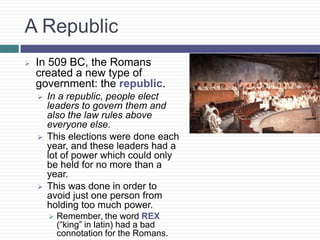
 In 509 BC, the Romans
created a new type of
government: the republic.
 In a republic, people elect
leaders to govern them and
also the law rules above
everyone else.
 This elections were done each
year, and these leaders had a
lot of power which could only
be held for no more than a
year.
 This was done in order to
avoid just one person from
holding too much power.
 Remember, the word REX
(“king” in latin) had a bad
connotation for the Romans.
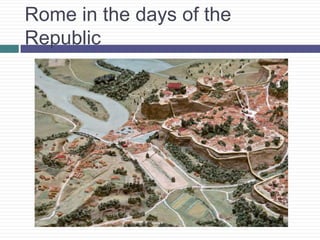
Rome in the days of the
Republic
Republic vs. Democracy
 Even though officials were elected, they were
not chosen from a small group of people:
 Wealthy
 Powerful
 These wealthy Romans held all he
power, while poor and common romans had
no say at all.
Challenges from Outside
 After the republic was
created, Romans found
themselves fighting wars with
their neighbors.
 Most of the battles were won and
they incorporated their neighbor’s
land as their own (as well as its
inhabitants).
 But some battle were also
lost, and this was a costly matter.
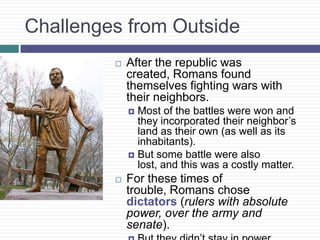
 For these times of
trouble, Romans chose
dictators (rulers with absolute
power, over the army and
senate).
Cincinnatus
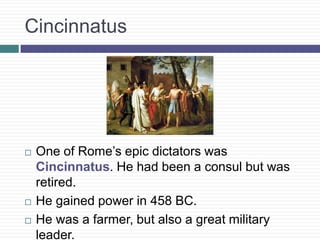
 One of Rome’s epic dictators was
Cincinnatus. He had been a consul but was
retired.
 He gained power in 458 BC.
 He was a farmer, but also a great military
leader.
Cincinnatus the dictator
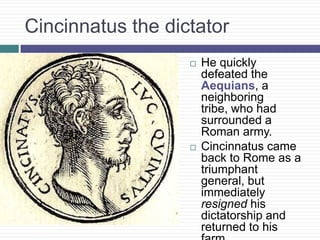
 He quickly
defeated the
Aequians, a
neighboring
tribe, who had
surrounded a
Roman army.
 Cincinnatus came
back to Rome as a
triumphant
general, but
immediately
resigned his
dictatorship and
returned to his
Trouble continues
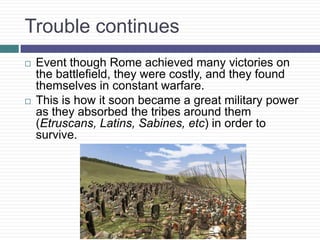
 Event though Rome achieved many victories on
the battlefield, they were costly, and they found
themselves in constant warfare.
 This is how it soon became a great military power
as they absorbed the tribes around them
(Etruscans, Latins, Sabines, etc) in order to
survive.
Early Wars
 Italian campaigns
(458-396 BC):
 Sabines, Etruscans,
Latins.
 Celtic invasions of
Italy(390-387 BC):
 The Gauls, led by
Brennus invade the
Italian peninsula and
sack Rome.
 Roman expansion
into Italy (343–282
BC):
 They fight several
wars against the
Samnites.
 Pyrrhic War (280–
275 BC):
 Rome was able to
defeat the
Greeks, and took
control of the Italian
peninsula.
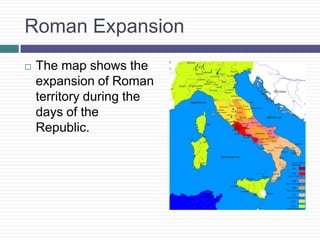
Roman Expansion
 The map shows the
expansion of Roman
territory during the
days of the
Republic.
Ask Yourself
 Identify:
 What was the Roman office of Dictator?
 Explain:
 How was the republic different from a monarchy?
 Why did Romans hate the term Rex?
 Infer:
 What would push Cincinnatus to abandon power so
quickly?
 Describe:
 Describe Roman expansion during the early days of
the Republic
Bibliography
 Burstein, S. M., & Shek, R. (2012). World
History (Teacher´s Edition) (1st Edition
ed.). (H. McDougal, Ed.) Orlando, Florida,
US.: Houghton Mifflin Harcourt Publishing
Company.
 Images taken from www.google.com

Rome: The Early Republic

  • 1.
    THE EARLY REPUBLIC &CINCINNATUS Social Studies for 9th EBG Teacher: Mauricio Torres
  • 2.
    A Republic  In509 BC, the Romans created a new type of government: the republic.  In a republic, people elect leaders to govern them and also the law rules above everyone else.  This elections were done each year, and these leaders had a lot of power which could only be held for no more than a year.  This was done in order to avoid just one person from holding too much power.  Remember, the word REX (“king” in latin) had a bad connotation for the Romans.
  • 3.
    Rome in thedays of the Republic
  • 4.
    Republic vs. Democracy Even though officials were elected, they were not chosen from a small group of people:  Wealthy  Powerful  These wealthy Romans held all he power, while poor and common romans had no say at all.
  • 5.
    Challenges from Outside After the republic was created, Romans found themselves fighting wars with their neighbors.  Most of the battles were won and they incorporated their neighbor’s land as their own (as well as its inhabitants).  But some battle were also lost, and this was a costly matter.  For these times of trouble, Romans chose dictators (rulers with absolute power, over the army and senate).
  • 6.
    Cincinnatus  One ofRome’s epic dictators was Cincinnatus. He had been a consul but was retired.  He gained power in 458 BC.  He was a farmer, but also a great military leader.
  • 7.
    Cincinnatus the dictator He quickly defeated the Aequians, a neighboring tribe, who had surrounded a Roman army.  Cincinnatus came back to Rome as a triumphant general, but immediately resigned his dictatorship and returned to his
  • 8.
    Trouble continues  Eventthough Rome achieved many victories on the battlefield, they were costly, and they found themselves in constant warfare.  This is how it soon became a great military power as they absorbed the tribes around them (Etruscans, Latins, Sabines, etc) in order to survive.
  • 9.
    Early Wars  Italiancampaigns (458-396 BC):  Sabines, Etruscans, Latins.  Celtic invasions of Italy(390-387 BC):  The Gauls, led by Brennus invade the Italian peninsula and sack Rome.  Roman expansion into Italy (343–282 BC):  They fight several wars against the Samnites.  Pyrrhic War (280– 275 BC):  Rome was able to defeat the Greeks, and took control of the Italian peninsula.
  • 10.
    Roman Expansion  Themap shows the expansion of Roman territory during the days of the Republic.
  • 11.
    Ask Yourself  Identify: What was the Roman office of Dictator?  Explain:  How was the republic different from a monarchy?  Why did Romans hate the term Rex?  Infer:  What would push Cincinnatus to abandon power so quickly?  Describe:  Describe Roman expansion during the early days of the Republic
  • 12.
    Bibliography  Burstein, S.M., & Shek, R. (2012). World History (Teacher´s Edition) (1st Edition ed.). (H. McDougal, Ed.) Orlando, Florida, US.: Houghton Mifflin Harcourt Publishing Company.  Images taken from www.google.com

Editor's Notes

  • #2 Presentation slide for courses, classes, lectures et al.
  • #3 Relative vocabulary list.
  • #10 Beginning course details and/or books/materials needed for a class/project.