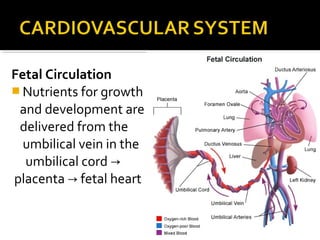
Fetal Circulation
 Nutrients for growth
and development are
delivered from the
umbilical vein in the
umbilical cord →
placenta → fetal heart
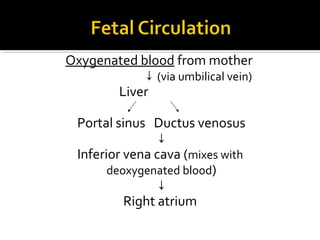
Oxygenated blood from mother
↓ (via umbilical vein)
Liver
Portal sinus Ductus venosus
↓
Inferior vena cava (mixes with
deoxygenated blood)
↓
Right atrium
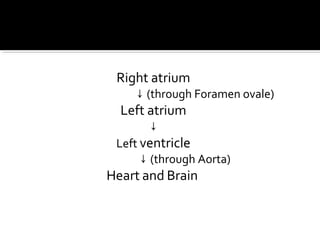
Right atrium

↓ (through Foramen ovale)

Left atrium
↓

Left ventricle
↓ (through Aorta)

Heart and Brain
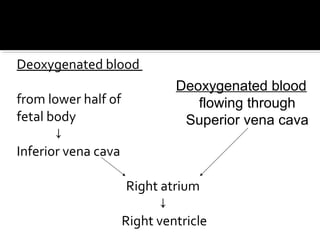
Deoxygenated blood
from lower half of
fetal body
↓
Inferior vena cava

Deoxygenated blood
flowing through
Superior vena cava

Right atrium
↓
Right ventricle
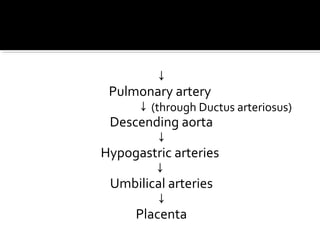
Right ventricle
↓
Pulmonary artery
↓ (through Ductus arteriosus)
Descending aorta
↓
Hypogastric arteries
↓
Umbilical arteries
↓
Placenta
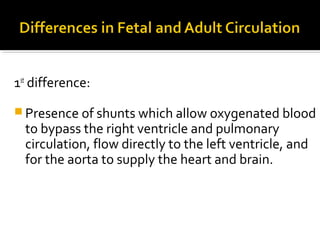
1st difference:
 Presence of shunts which allow oxygenated blood

to bypass the right ventricle and pulmonary
circulation, flow directly to the left ventricle, and
for the aorta to supply the heart and brain.
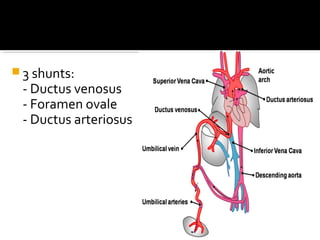
 3 shunts:

- Ductus venosus
- Foramen ovale
- Ductus arteriosus
2nd difference:
 Ventricles of the fetal heart work in parallel
compared to the adult heart which works in
sequence.
 Fetal cardiac output per unit weight is 3 times

higher than that of an adult at rest.
 This compensated for low O2 content of fetal
blood.
 Is accomplished by ↑ heart rate and ↓ peripheral
resistance
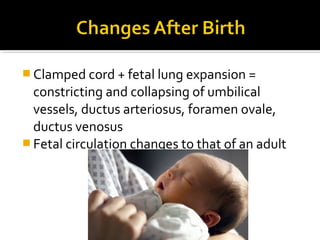
 Clamped cord + fetal lung expansion =

constricting and collapsing of umbilical
vessels, ductus arteriosus, foramen ovale,
ductus venosus
 Fetal circulation changes to that of an adult
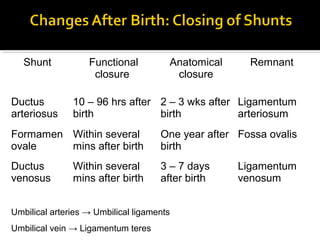
Shunt

Ductus
arteriosus

Functional
closure

Anatomical
closure

Remnant

10 – 96 hrs after 2 – 3 wks after Ligamentum
birth
birth
arteriosum

Formamen Within several
ovale
mins after birth

One year after Fossa ovalis
birth

Ductus
venosus

3 – 7 days
after birth

Within several
mins after birth

Umbilical arteries → Umbilical ligaments
Umbilical vein → Ligamentum teres

Ligamentum
venosum
 Maintenance of ductus arteriosus depends

on:
- difference in blood pressure bet. Pulmonary
artery and aorta
- difference in O2 tension of blood passing
through ductus. ↑ p O2 = stops flow. Mediated
through prostaglandins.
Hematopoiesis
 First seen in the yolk sac during embryonic period

(mesoblastic period)

 Liver takes over up to bear term (hepatic period)
 Bone marrow: starts hematopoietic function at

around 4 months fetal age; major site of blood
formation in adults (myeloid period)
Hematopoiesis
 Erythrocytes progress from nulceated to non-

nucleated
 Blood vol. and Hgb concentration increase
progressively
 Midpregnancy: Hgb 15 gms/dl
 Term: 18 gms/dl
Hematopoiesis
 Fetal erythrocytes: 2/3 that of adult’s (due to

large volume and more easily deformable)

 During states of fetal anemia: fetal liver

synthesizes erythropoietin and excretes it into
the amniotic fluid. (for erythropoiesis in utero)
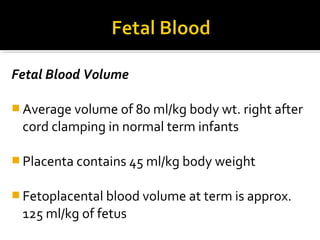
Fetal Blood Volume
 Average volume of 80 ml/kg body wt. right after

cord clamping in normal term infants
 Placenta contains 45 ml/kg body weight
 Fetoplacental blood volume at term is approx.

125 ml/kg of fetus
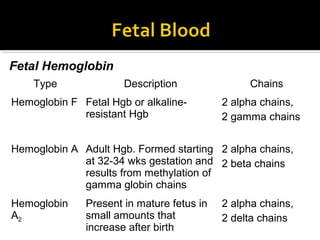
Fetal Hemoglobin
Type

Description

Hemoglobin F Fetal Hgb or alkalineresistant Hgb

Chains
2 alpha chains,
2 gamma chains

Hemoglobin A Adult Hgb. Formed starting 2 alpha chains,
at 32-34 wks gestation and 2 beta chains
results from methylation of
gamma globin chains
Hemoglobin
A2

Present in mature fetus in
small amounts that
increase after birth

2 alpha chains,
2 delta chains
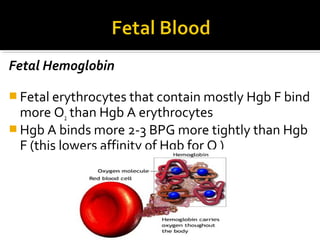
Fetal Hemoglobin
 Fetal erythrocytes that contain mostly Hgb F bind

more O2 than Hgb A erythrocytes
 Hgb A binds more 2-3 BPG more tightly than Hgb
F (this lowers affinity of Hgb for O2)
 Increased O2 affinity of fetal erythrocytes results

from lower concentartion of 2-3 BPG in the fetus

 Affinity of fetal blood for O2 decreases at higher

temp. (maternal hyperthermia)
 Sufficient development of synaptic functions are

signified by flexion of fetal neck & trunk
 If fetus is removed from the uterus during the 10 th

wk, spontaneous movements may be
observed although movements in utero aren’t
felt by the mother until 18-20 wks
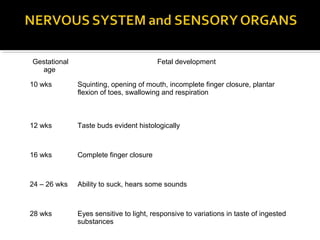
Gestational
age

Fetal development

10 wks

Squinting, opening of mouth, incomplete finger closure, plantar
flexion of toes, swallowing and respiration

12 wks

Taste buds evident histologically

16 wks

Complete finger closure

24 – 26 wks

Ability to suck, hears some sounds

28 wks

Eyes sensitive to light, responsive to variations in taste of ingested
substances
 11 wks gestation → peristalsis in small intestine,

transporting glucose actively

 16 wks gestation → able to swallow amniotic fluid,

absorb much water from it, and propel
unabsorbed matter to lowe colon

 Hydrochloric acid & other digestive enzymes

present in very small amounts


Term fetuses can swallow 450 ml amniotic fluid in 24
hours



This regulates amniotic fluid volume:
- inhibition of swallowing (esophageal atresia) =
Polyhydramnios



Amniotic fluid contributes little to caloric requirements of
fetus, but contributes essential nutrients: 0.8 gms of
soluble protein is ingested daily by the fetus from
amniotic fluids. Half is alubumin.


Meconium passed after birth



Dark greenish black color of meconium caused by bile
pigments (esp. biliverdin)



Meconium passage during labor due to hypoxia
(stimulates smooth muscle of colon to contract)
 Small bowel obstruction may lead to vomiting in

utero
 Fetuses with congenital chloride diarrhea may

have diarrhea in utero. Vomiting and diarrhea in
utero may lead to polyhydramnios and preterm
delivery
Liver and Pancreas
 Fetal liver enzymes reduced in amount compared to
adult
 Fetal liver has limited capacity to convert free bilirubin
to conjugated bilirubin
 Fetus produces more bilirubin due to shorter life span
of fetal erythrocytes. Small fraction is conjugated and
excreted and oxidized to biliverdin
 Much bilirubin is transferred to the placenta and to the
maternal liver for conjugation and excretion
 Fetal pancreas responds to hyperglycemia

by ↑ insulin

 Insulin containing granules identified in fetal

pancreas at 9-10 wks. Insulin in fetal plasma
detectable at 12 wks.
 Insulin levels: ↑ in newborns of diabetic mothers

and LGAs (large for gestational age); ↓in infants
who are SGA (small for gestational age)
Fetal Physiology By Abdul Qahar

Fetal Physiology By Abdul Qahar

  • 3.
    Fetal Circulation  Nutrientsfor growth and development are delivered from the umbilical vein in the umbilical cord → placenta → fetal heart
  • 4.
    Oxygenated blood frommother ↓ (via umbilical vein) Liver Portal sinus Ductus venosus ↓ Inferior vena cava (mixes with deoxygenated blood) ↓ Right atrium
  • 5.
    Right atrium ↓ (throughForamen ovale) Left atrium ↓ Left ventricle ↓ (through Aorta) Heart and Brain
  • 6.
    Deoxygenated blood from lowerhalf of fetal body ↓ Inferior vena cava Deoxygenated blood flowing through Superior vena cava Right atrium ↓ Right ventricle
  • 7.
    Right ventricle ↓ Pulmonary artery ↓(through Ductus arteriosus) Descending aorta ↓ Hypogastric arteries ↓ Umbilical arteries ↓ Placenta
  • 8.
    1st difference:  Presenceof shunts which allow oxygenated blood to bypass the right ventricle and pulmonary circulation, flow directly to the left ventricle, and for the aorta to supply the heart and brain.
  • 9.
     3 shunts: -Ductus venosus - Foramen ovale - Ductus arteriosus
  • 10.
    2nd difference:  Ventriclesof the fetal heart work in parallel compared to the adult heart which works in sequence.
  • 11.
     Fetal cardiacoutput per unit weight is 3 times higher than that of an adult at rest.  This compensated for low O2 content of fetal blood.  Is accomplished by ↑ heart rate and ↓ peripheral resistance
  • 12.
     Clamped cord+ fetal lung expansion = constricting and collapsing of umbilical vessels, ductus arteriosus, foramen ovale, ductus venosus  Fetal circulation changes to that of an adult
  • 13.
    Shunt Ductus arteriosus Functional closure Anatomical closure Remnant 10 – 96hrs after 2 – 3 wks after Ligamentum birth birth arteriosum Formamen Within several ovale mins after birth One year after Fossa ovalis birth Ductus venosus 3 – 7 days after birth Within several mins after birth Umbilical arteries → Umbilical ligaments Umbilical vein → Ligamentum teres Ligamentum venosum
  • 14.
     Maintenance ofductus arteriosus depends on: - difference in blood pressure bet. Pulmonary artery and aorta - difference in O2 tension of blood passing through ductus. ↑ p O2 = stops flow. Mediated through prostaglandins.
  • 15.
    Hematopoiesis  First seenin the yolk sac during embryonic period (mesoblastic period)  Liver takes over up to bear term (hepatic period)  Bone marrow: starts hematopoietic function at around 4 months fetal age; major site of blood formation in adults (myeloid period)
  • 16.
    Hematopoiesis  Erythrocytes progressfrom nulceated to non- nucleated  Blood vol. and Hgb concentration increase progressively  Midpregnancy: Hgb 15 gms/dl  Term: 18 gms/dl
  • 17.
    Hematopoiesis  Fetal erythrocytes:2/3 that of adult’s (due to large volume and more easily deformable)  During states of fetal anemia: fetal liver synthesizes erythropoietin and excretes it into the amniotic fluid. (for erythropoiesis in utero)
  • 18.
    Fetal Blood Volume Average volume of 80 ml/kg body wt. right after cord clamping in normal term infants  Placenta contains 45 ml/kg body weight  Fetoplacental blood volume at term is approx. 125 ml/kg of fetus
  • 19.
    Fetal Hemoglobin Type Description Hemoglobin FFetal Hgb or alkalineresistant Hgb Chains 2 alpha chains, 2 gamma chains Hemoglobin A Adult Hgb. Formed starting 2 alpha chains, at 32-34 wks gestation and 2 beta chains results from methylation of gamma globin chains Hemoglobin A2 Present in mature fetus in small amounts that increase after birth 2 alpha chains, 2 delta chains
  • 20.
    Fetal Hemoglobin  Fetalerythrocytes that contain mostly Hgb F bind more O2 than Hgb A erythrocytes  Hgb A binds more 2-3 BPG more tightly than Hgb F (this lowers affinity of Hgb for O2)
  • 21.
     Increased O2affinity of fetal erythrocytes results from lower concentartion of 2-3 BPG in the fetus  Affinity of fetal blood for O2 decreases at higher temp. (maternal hyperthermia)
  • 22.
     Sufficient developmentof synaptic functions are signified by flexion of fetal neck & trunk  If fetus is removed from the uterus during the 10 th wk, spontaneous movements may be observed although movements in utero aren’t felt by the mother until 18-20 wks
  • 23.
    Gestational age Fetal development 10 wks Squinting,opening of mouth, incomplete finger closure, plantar flexion of toes, swallowing and respiration 12 wks Taste buds evident histologically 16 wks Complete finger closure 24 – 26 wks Ability to suck, hears some sounds 28 wks Eyes sensitive to light, responsive to variations in taste of ingested substances
  • 24.
     11 wksgestation → peristalsis in small intestine, transporting glucose actively  16 wks gestation → able to swallow amniotic fluid, absorb much water from it, and propel unabsorbed matter to lowe colon  Hydrochloric acid & other digestive enzymes present in very small amounts
  • 25.
     Term fetuses canswallow 450 ml amniotic fluid in 24 hours  This regulates amniotic fluid volume: - inhibition of swallowing (esophageal atresia) = Polyhydramnios  Amniotic fluid contributes little to caloric requirements of fetus, but contributes essential nutrients: 0.8 gms of soluble protein is ingested daily by the fetus from amniotic fluids. Half is alubumin.
  • 26.
     Meconium passed afterbirth  Dark greenish black color of meconium caused by bile pigments (esp. biliverdin)  Meconium passage during labor due to hypoxia (stimulates smooth muscle of colon to contract)
  • 27.
     Small bowelobstruction may lead to vomiting in utero  Fetuses with congenital chloride diarrhea may have diarrhea in utero. Vomiting and diarrhea in utero may lead to polyhydramnios and preterm delivery
  • 28.
    Liver and Pancreas Fetal liver enzymes reduced in amount compared to adult  Fetal liver has limited capacity to convert free bilirubin to conjugated bilirubin  Fetus produces more bilirubin due to shorter life span of fetal erythrocytes. Small fraction is conjugated and excreted and oxidized to biliverdin  Much bilirubin is transferred to the placenta and to the maternal liver for conjugation and excretion
  • 29.
     Fetal pancreasresponds to hyperglycemia by ↑ insulin  Insulin containing granules identified in fetal pancreas at 9-10 wks. Insulin in fetal plasma detectable at 12 wks.
  • 30.
     Insulin levels:↑ in newborns of diabetic mothers and LGAs (large for gestational age); ↓in infants who are SGA (small for gestational age)