Digital logic design
lecture 07
By-Farhat Ullah
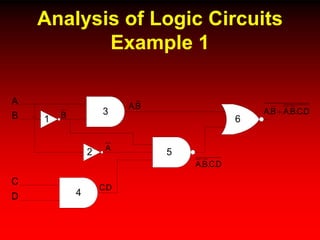
Analysis of Logic Circuits
Example 1
3
6
4
5
1
2
A
B
C
D
B
BA.
DC.
DCBA ...
A
DCBABA .... 
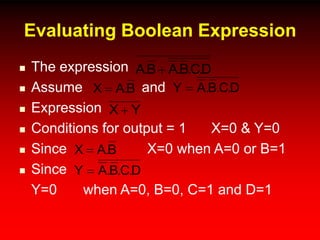
Evaluating Boolean Expression
 The expression
 Assume and
 Expression
 Conditions for output = 1 X=0 & Y=0
 Since X=0 when A=0 or B=1
 Since
Y=0 when A=0, B=0, C=1 and D=1
DCBABA .... 
BAX . DCBAY ...
YX 
BAX .
DCBAY ...
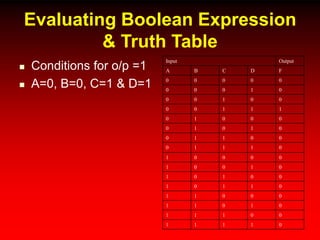
Evaluating Boolean Expression
& Truth Table
 Conditions for o/p =1
 A=0, B=0, C=1 & D=1
Input Output
A B C D F
0 0 0 0 0
0 0 0 1 0
0 0 1 0 0
0 0 1 1 1
0 1 0 0 0
0 1 0 1 0
0 1 1 0 0
0 1 1 1 0
1 0 0 0 0
1 0 0 1 0
1 0 1 0 0
1 0 1 1 0
1 1 0 0 0
1 1 0 1 0
1 1 1 0 0
1 1 1 1 0
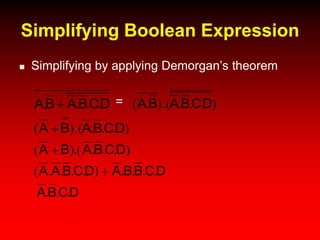
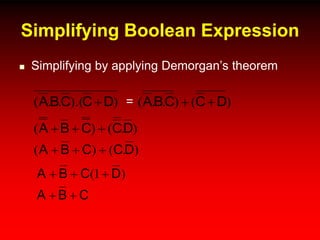
Simplifying Boolean Expression
 Simplifying by applying Demorgan’s theorem
=DCBABA ....  )...).(.( DCBABA
)...).(( DCBABA 
)...).(( DCBABA 
DCBBADCBAA ....)....( 
DCBA ...
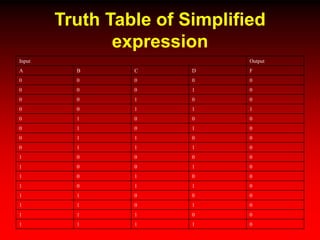
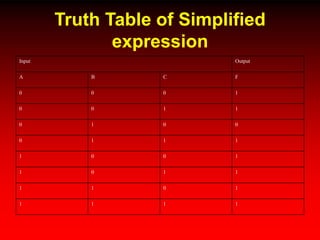
Truth Table of Simplified
expression
Input Output
A B C D F
0 0 0 0 0
0 0 0 1 0
0 0 1 0 0
0 0 1 1 1
0 1 0 0 0
0 1 0 1 0
0 1 1 0 0
0 1 1 1 0
1 0 0 0 0
1 0 0 1 0
1 0 1 0 0
1 0 1 1 0
1 1 0 0 0
1 1 0 1 0
1 1 1 0 0
1 1 1 1 0
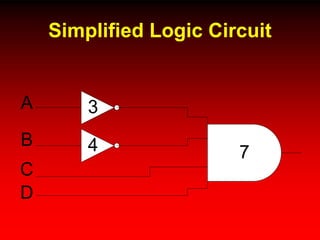
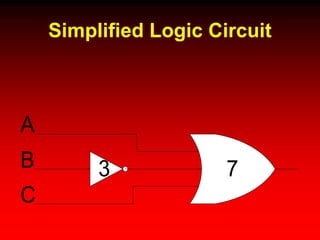
Simplified Logic Circuit
7
3
4
A
B
C
D
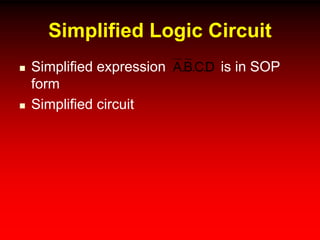
Simplified Logic Circuit
 Simplified expression is in SOP
form
 Simplified circuit
DCBA ...
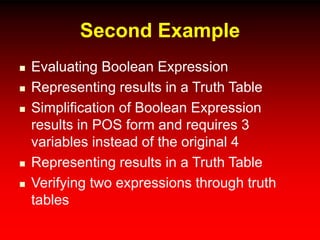
Second Example
 Evaluating Boolean Expression
 Representing results in a Truth Table
 Simplification of Boolean Expression
results in POS form and requires 3
variables instead of the original 4
 Representing results in a Truth Table
 Verifying two expressions through truth
tables
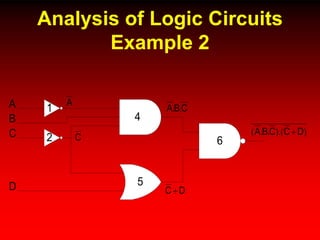
Analysis of Logic Circuits
Example 2
4
5
1
2 6
A
B
C
D
A
C
CBA ..
DC
)).(..( DCCBA 
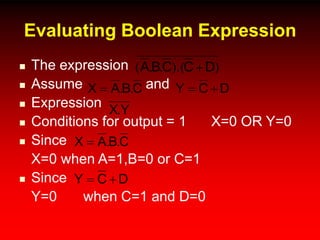
Evaluating Boolean Expression
 The expression
 Assume and
 Expression
 Conditions for output = 1 X=0 OR Y=0
 Since
X=0 when A=1,B=0 or C=1
 Since
Y=0 when C=1 and D=0
)).(..( DCCBA 
CBAX .. DCY 
YX.
CBAX ..
DCY 
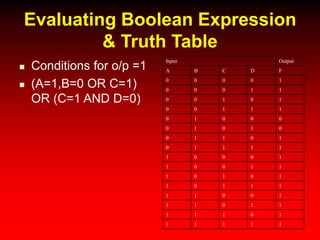
Evaluating Boolean Expression
& Truth Table
 Conditions for o/p =1
 (A=1,B=0 OR C=1)
OR (C=1 AND D=0)
Input Output
A B C D F
0 0 0 0 1
0 0 0 1 1
0 0 1 0 1
0 0 1 1 1
0 1 0 0 0
0 1 0 1 0
0 1 1 0 1
0 1 1 1 1
1 0 0 0 1
1 0 0 1 1
1 0 1 0 1
1 0 1 1 1
1 1 0 0 1
1 1 0 1 1
1 1 1 0 1
1 1 1 1 1
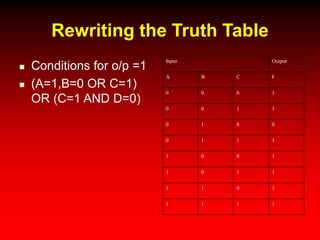
Rewriting the Truth Table
 Conditions for o/p =1
 (A=1,B=0 OR C=1)
OR (C=1 AND D=0)
Input Output
A B C F
0 0 0 1
0 0 1 1
0 1 0 0
0 1 1 1
1 0 0 1
1 0 1 1
1 1 0 1
1 1 1 1
Simplifying Boolean Expression
 Simplifying by applying Demorgan’s theorem
= )()..( DCCBA )).(..( DCCBA 
).()( DCCBA 
).()( DCCBA 
)1( DCBA 
CBA 
Truth Table of Simplified
expression
Input Output
A B C F
0 0 0 1
0 0 1 1
0 1 0 0
0 1 1 1
1 0 0 1
1 0 1 1
1 1 0 1
1 1 1 1
Simplified Logic Circuit
73
A
B
C
Simplified Logic Circuit
 Simplified expression is in POS
form representing a single Sum term
 Simplified circuit
CBA 
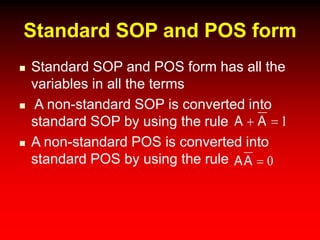
Standard SOP and POS form
 Standard SOP and POS form has all the
variables in all the terms
 A non-standard SOP is converted into
standard SOP by using the rule
 A non-standard POS is converted into
standard POS by using the rule 0AA
1 AA
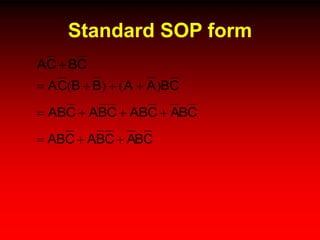
Standard SOP form
CBCA 
CBAABBCA )()( 
CBACABCBACAB 
CBACBACAB 
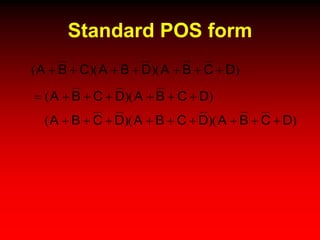
Standard POS form
))()(( DCBADBACBA 
))(( DCBADCBA 
))()(( DCBADCBADCBA 
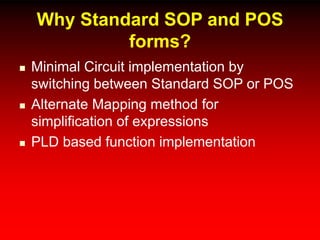
Why Standard SOP and POS
forms?
 Minimal Circuit implementation by
switching between Standard SOP or POS
 Alternate Mapping method for
simplification of expressions
 PLD based function implementation
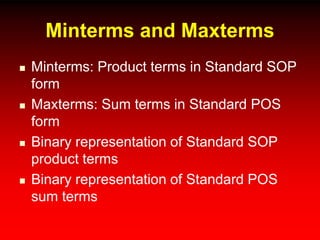
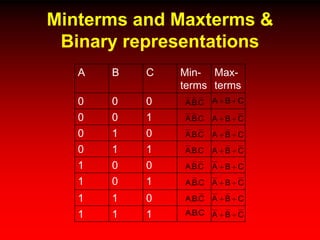
Minterms and Maxterms
 Minterms: Product terms in Standard SOP
form
 Maxterms: Sum terms in Standard POS
form
 Binary representation of Standard SOP
product terms
 Binary representation of Standard POS
sum terms
Minterms and Maxterms &
Binary representations
CBA .. CBA 
CBA .. CBA 
CBA .. CBA 
CBA .. CBA 
CBA .. CBA 
CBA .. CBA 
CBA .. CBA 
CBA .. CBA 
A B C Min-
terms
Max-
terms
0 0 0
0 0 1
0 1 0
0 1 1
1 0 0
1 0 1
1 1 0
1 1 1
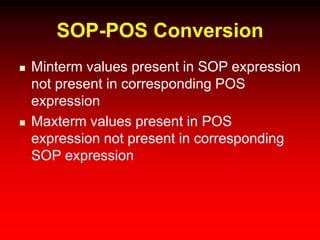
SOP-POS Conversion
 Minterm values present in SOP expression
not present in corresponding POS
expression
 Maxterm values present in POS
expression not present in corresponding
SOP expression
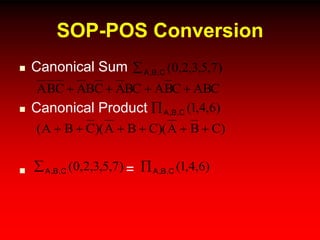
 Canonical Sum
 Canonical Product
 =
SOP-POS Conversion
ABCCBABCACBACBA 
)CBA)(CBA)(CBA( 
)7,5,3,2,0(,, CBA
)6,4,1(,, CBA
)7,5,3,2,0(,, CBA )6,4,1(,, CBA
Boolean Expressions and Truth
Tables
 Standard SOP & POS expressions
converted to truth table form
 Standard SOP & POS expressions
determined from truth table
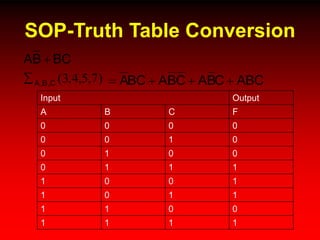
SOP-Truth Table Conversion
BCBA 
ABCCBACBABCA )7,5,4,3(,, CBA
Input Output
A B C F
0 0 0 0
0 0 1 0
0 1 0 0
0 1 1 1
1 0 0 1
1 0 1 1
1 1 0 0
1 1 1 1
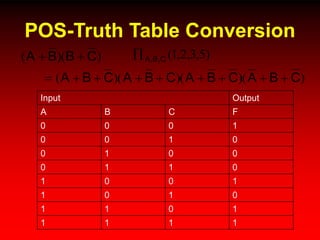
POS-Truth Table Conversion
))(( CBBA  )5,3,2,1(,, CBA
))()()(( CBACBACBACBA 
Input Output
A B C F
0 0 0 1
0 0 1 0
0 1 0 0
0 1 1 0
1 0 0 1
1 0 1 0
1 1 0 1
1 1 1 1

Digital logic design lecture 07

  • 1.
    Digital logic design lecture07 By-Farhat Ullah
  • 2.
    Analysis of LogicCircuits Example 1 3 6 4 5 1 2 A B C D B BA. DC. DCBA ... A DCBABA .... 
  • 3.
    Evaluating Boolean Expression The expression  Assume and  Expression  Conditions for output = 1 X=0 & Y=0  Since X=0 when A=0 or B=1  Since Y=0 when A=0, B=0, C=1 and D=1 DCBABA ....  BAX . DCBAY ... YX  BAX . DCBAY ...
  • 4.
    Evaluating Boolean Expression &Truth Table  Conditions for o/p =1  A=0, B=0, C=1 & D=1 Input Output A B C D F 0 0 0 0 0 0 0 0 1 0 0 0 1 0 0 0 0 1 1 1 0 1 0 0 0 0 1 0 1 0 0 1 1 0 0 0 1 1 1 0 1 0 0 0 0 1 0 0 1 0 1 0 1 0 0 1 0 1 1 0 1 1 0 0 0 1 1 0 1 0 1 1 1 0 0 1 1 1 1 0
  • 5.
    Simplifying Boolean Expression Simplifying by applying Demorgan’s theorem =DCBABA ....  )...).(.( DCBABA )...).(( DCBABA  )...).(( DCBABA  DCBBADCBAA ....)....(  DCBA ...
  • 6.
    Truth Table ofSimplified expression Input Output A B C D F 0 0 0 0 0 0 0 0 1 0 0 0 1 0 0 0 0 1 1 1 0 1 0 0 0 0 1 0 1 0 0 1 1 0 0 0 1 1 1 0 1 0 0 0 0 1 0 0 1 0 1 0 1 0 0 1 0 1 1 0 1 1 0 0 0 1 1 0 1 0 1 1 1 0 0 1 1 1 1 0
  • 7.
  • 8.
    Simplified Logic Circuit Simplified expression is in SOP form  Simplified circuit DCBA ...
  • 9.
    Second Example  EvaluatingBoolean Expression  Representing results in a Truth Table  Simplification of Boolean Expression results in POS form and requires 3 variables instead of the original 4  Representing results in a Truth Table  Verifying two expressions through truth tables
  • 10.
    Analysis of LogicCircuits Example 2 4 5 1 2 6 A B C D A C CBA .. DC )).(..( DCCBA 
  • 11.
    Evaluating Boolean Expression The expression  Assume and  Expression  Conditions for output = 1 X=0 OR Y=0  Since X=0 when A=1,B=0 or C=1  Since Y=0 when C=1 and D=0 )).(..( DCCBA  CBAX .. DCY  YX. CBAX .. DCY 
  • 12.
    Evaluating Boolean Expression &Truth Table  Conditions for o/p =1  (A=1,B=0 OR C=1) OR (C=1 AND D=0) Input Output A B C D F 0 0 0 0 1 0 0 0 1 1 0 0 1 0 1 0 0 1 1 1 0 1 0 0 0 0 1 0 1 0 0 1 1 0 1 0 1 1 1 1 1 0 0 0 1 1 0 0 1 1 1 0 1 0 1 1 0 1 1 1 1 1 0 0 1 1 1 0 1 1 1 1 1 0 1 1 1 1 1 1
  • 13.
    Rewriting the TruthTable  Conditions for o/p =1  (A=1,B=0 OR C=1) OR (C=1 AND D=0) Input Output A B C F 0 0 0 1 0 0 1 1 0 1 0 0 0 1 1 1 1 0 0 1 1 0 1 1 1 1 0 1 1 1 1 1
  • 14.
    Simplifying Boolean Expression Simplifying by applying Demorgan’s theorem = )()..( DCCBA )).(..( DCCBA  ).()( DCCBA  ).()( DCCBA  )1( DCBA  CBA 
  • 15.
    Truth Table ofSimplified expression Input Output A B C F 0 0 0 1 0 0 1 1 0 1 0 0 0 1 1 1 1 0 0 1 1 0 1 1 1 1 0 1 1 1 1 1
  • 16.
  • 17.
    Simplified Logic Circuit Simplified expression is in POS form representing a single Sum term  Simplified circuit CBA 
  • 18.
    Standard SOP andPOS form  Standard SOP and POS form has all the variables in all the terms  A non-standard SOP is converted into standard SOP by using the rule  A non-standard POS is converted into standard POS by using the rule 0AA 1 AA
  • 19.
    Standard SOP form CBCA CBAABBCA )()(  CBACABCBACAB  CBACBACAB 
  • 20.
    Standard POS form ))()((DCBADBACBA  ))(( DCBADCBA  ))()(( DCBADCBADCBA 
  • 21.
    Why Standard SOPand POS forms?  Minimal Circuit implementation by switching between Standard SOP or POS  Alternate Mapping method for simplification of expressions  PLD based function implementation
  • 22.
    Minterms and Maxterms Minterms: Product terms in Standard SOP form  Maxterms: Sum terms in Standard POS form  Binary representation of Standard SOP product terms  Binary representation of Standard POS sum terms
  • 23.
    Minterms and Maxterms& Binary representations CBA .. CBA  CBA .. CBA  CBA .. CBA  CBA .. CBA  CBA .. CBA  CBA .. CBA  CBA .. CBA  CBA .. CBA  A B C Min- terms Max- terms 0 0 0 0 0 1 0 1 0 0 1 1 1 0 0 1 0 1 1 1 0 1 1 1
  • 24.
    SOP-POS Conversion  Mintermvalues present in SOP expression not present in corresponding POS expression  Maxterm values present in POS expression not present in corresponding SOP expression
  • 25.
     Canonical Sum Canonical Product  = SOP-POS Conversion ABCCBABCACBACBA  )CBA)(CBA)(CBA(  )7,5,3,2,0(,, CBA )6,4,1(,, CBA )7,5,3,2,0(,, CBA )6,4,1(,, CBA
  • 26.
    Boolean Expressions andTruth Tables  Standard SOP & POS expressions converted to truth table form  Standard SOP & POS expressions determined from truth table
  • 27.
    SOP-Truth Table Conversion BCBA ABCCBACBABCA )7,5,4,3(,, CBA Input Output A B C F 0 0 0 0 0 0 1 0 0 1 0 0 0 1 1 1 1 0 0 1 1 0 1 1 1 1 0 0 1 1 1 1
  • 28.
    POS-Truth Table Conversion ))((CBBA  )5,3,2,1(,, CBA ))()()(( CBACBACBACBA  Input Output A B C F 0 0 0 1 0 0 1 0 0 1 0 0 0 1 1 0 1 0 0 1 1 0 1 0 1 1 0 1 1 1 1 1