The Not-So-Elementary Task of Preparing 
Elementary School Teachers to 
Understand Elementary Mathematics 
Yopp Distinguished Speaker Series 
University of North Carolina, Greensboro 
September 8, 2014 
Dr. Randy Philipp 
San Diego State University 
RPhilipp@mail.sdsu.edu
Abstract 
!If elementary school mathematics is so elementary, then 
why do so many people struggle to understand? Using 
video of children's mathematical thinking, we will 
consider some of the complexities of seemingly simple 
topics of whole numbers and fractions, highlighting 
some of the issues related to mathematical 
understanding, and I will share how a focus on 
children’s mathematical thinking motivates prospective 
elementary school teachers to more deeply engage with 
mathematics. !
Thank You! 
UNCG Mathematics Education Group in the 
School of Education 
The Graduate Students 
James D. and Johanna F. Yopp
Presentation Plan 
• What does it mean to do mathematics? 
• Consider issues related to mathematics 
content. 
• There is a problem with how PSTs are 
learning mathematics, but we found one 
approach. 
• I’ll share 4 principles of mathematics 
teaching and learning addressed by a focus 
on children’s mathematical thinking.
But first: A secondary question to keep in 
mind today 
2014 AMTE Session organized with Rob Wieman 
Is Video the New Manipulative in Education? 
-Maarten Dolk, Freudenthal Institute
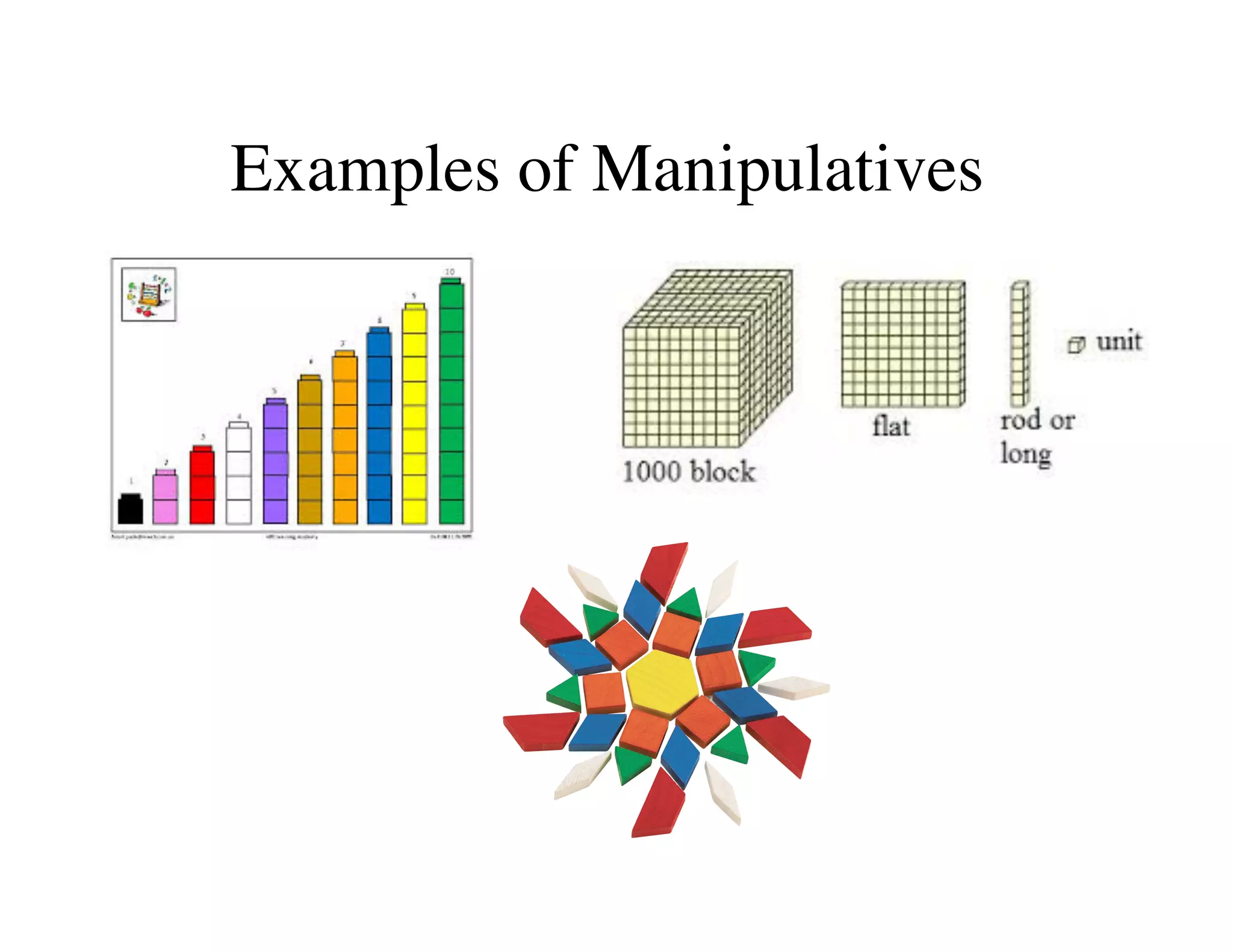
Examples of Manipulatives
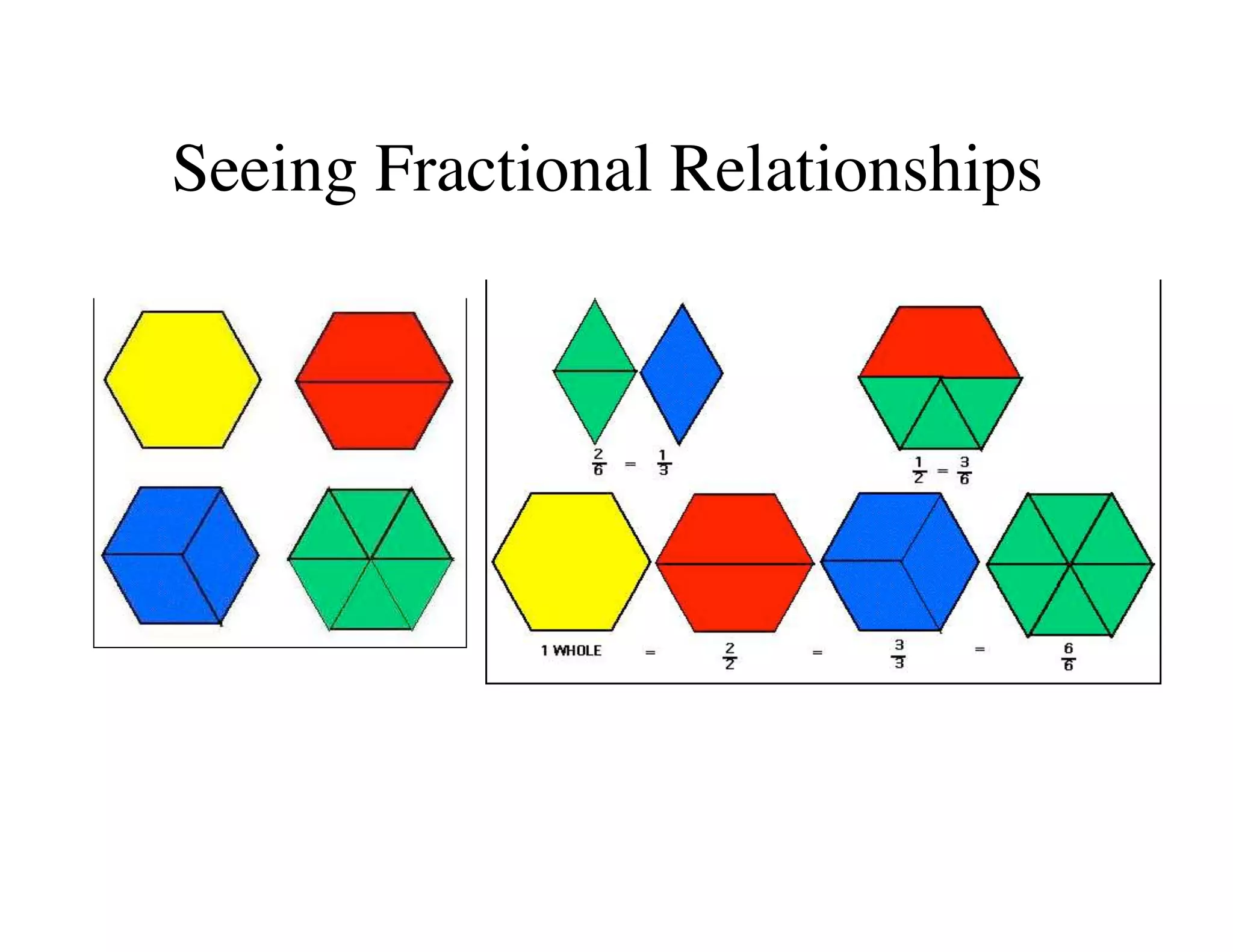
Seeing Fractional Relationships 
! 
!
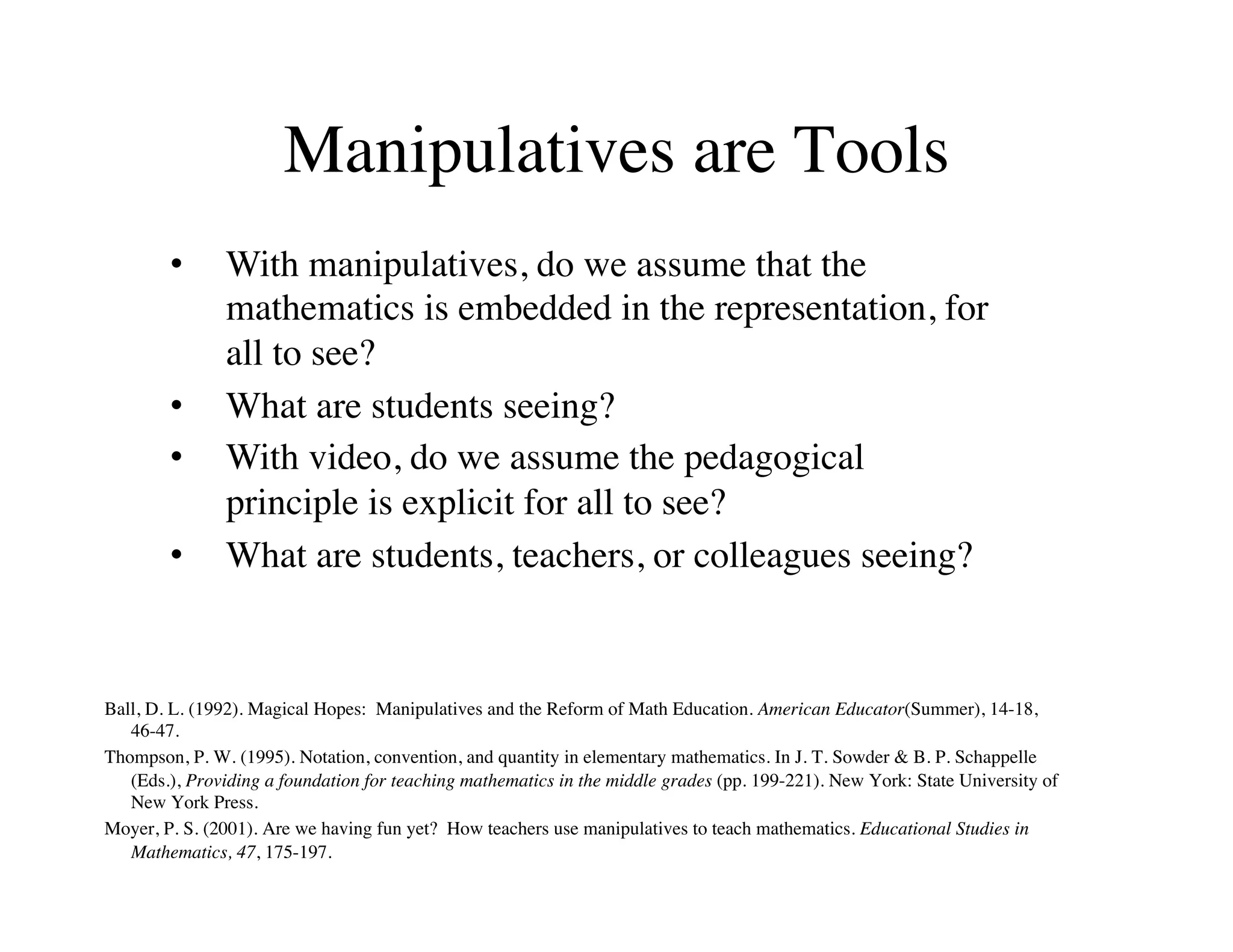
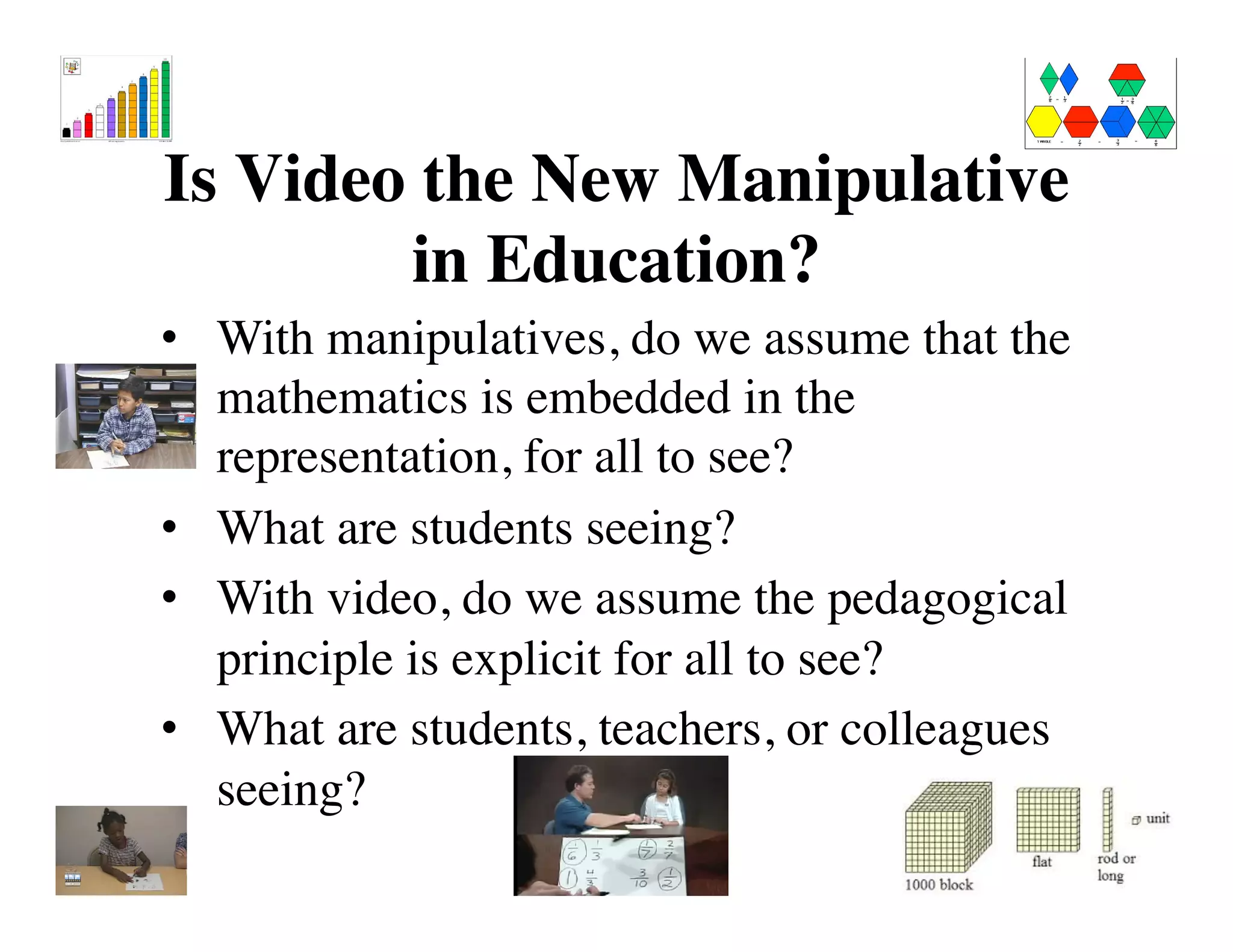
Manipulatives are Tools 
• With manipulatives, do we assume that the 
mathematics is embedded in the representation, for 
all to see? 
• What are students seeing? 
• With video, do we assume the pedagogical 
principle is explicit for all to see? 
• What are students, teachers, or colleagues seeing? 
Ball, D. L. (1992). Magical Hopes: Manipulatives and the Reform of Math Education. American Educator(Summer), 14-18, 
46-47. 
Thompson, P. W. (1995). Notation, convention, and quantity in elementary mathematics. In J. T. Sowder & B. P. Schappelle 
(Eds.), Providing a foundation for teaching mathematics in the middle grades (pp. 199-221). New York: State University of 
New York Press. 
Moyer, P. S. (2001). Are we having fun yet? How teachers use manipulatives to teach mathematics. Educational Studies in 
Mathematics, 47, 175-197.
Presentation Plan 
• What does it mean to do mathematics? 
• Consider issues related to mathematics 
content. 
• There is a problem with how PSTs are 
learning mathematics, but we found one 
approach. 
• I’ll share 4 principles of mathematics 
teaching and learning addressed by a focus 
on children’s mathematical thinking.
Define Mathematical Proficiency 
• Concepts ! 
• Procedures ! 
• Problem Solving! 
• Reasoning and Justifying! 
• Positive Outlook!
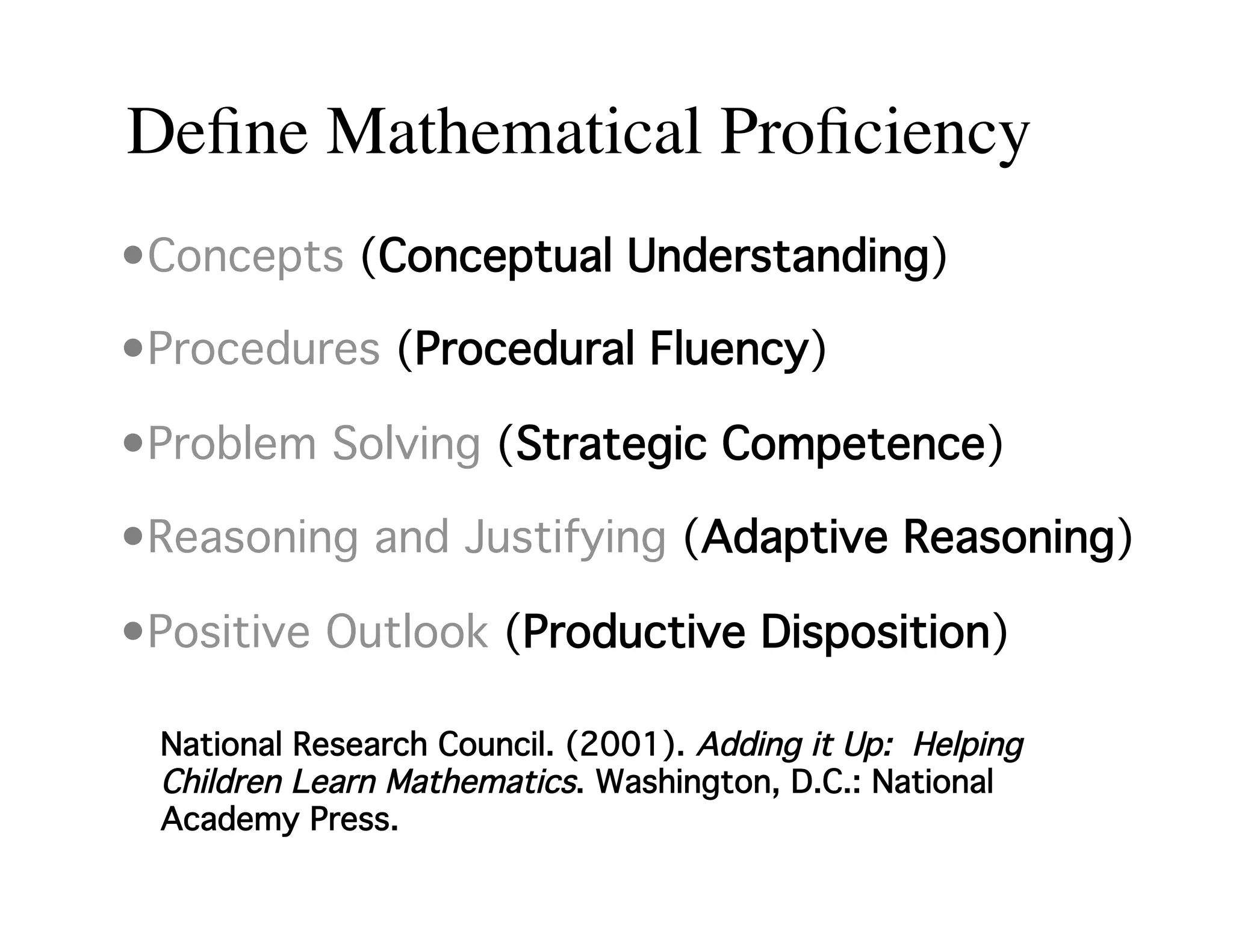
Define Mathematical Proficiency 
• Concepts (Conceptual Understanding)! 
• Procedures (Procedural Fluency)! 
• Problem Solving (Strategic Competence)! 
• Reasoning and Justifying (Adaptive Reasoning)! 
• Positive Outlook (Productive Disposition)! 
National Research Council. (2001). Adding it Up: Helping 
Children Learn Mathematics. Washington, D.C.: National 
Academy Press.!
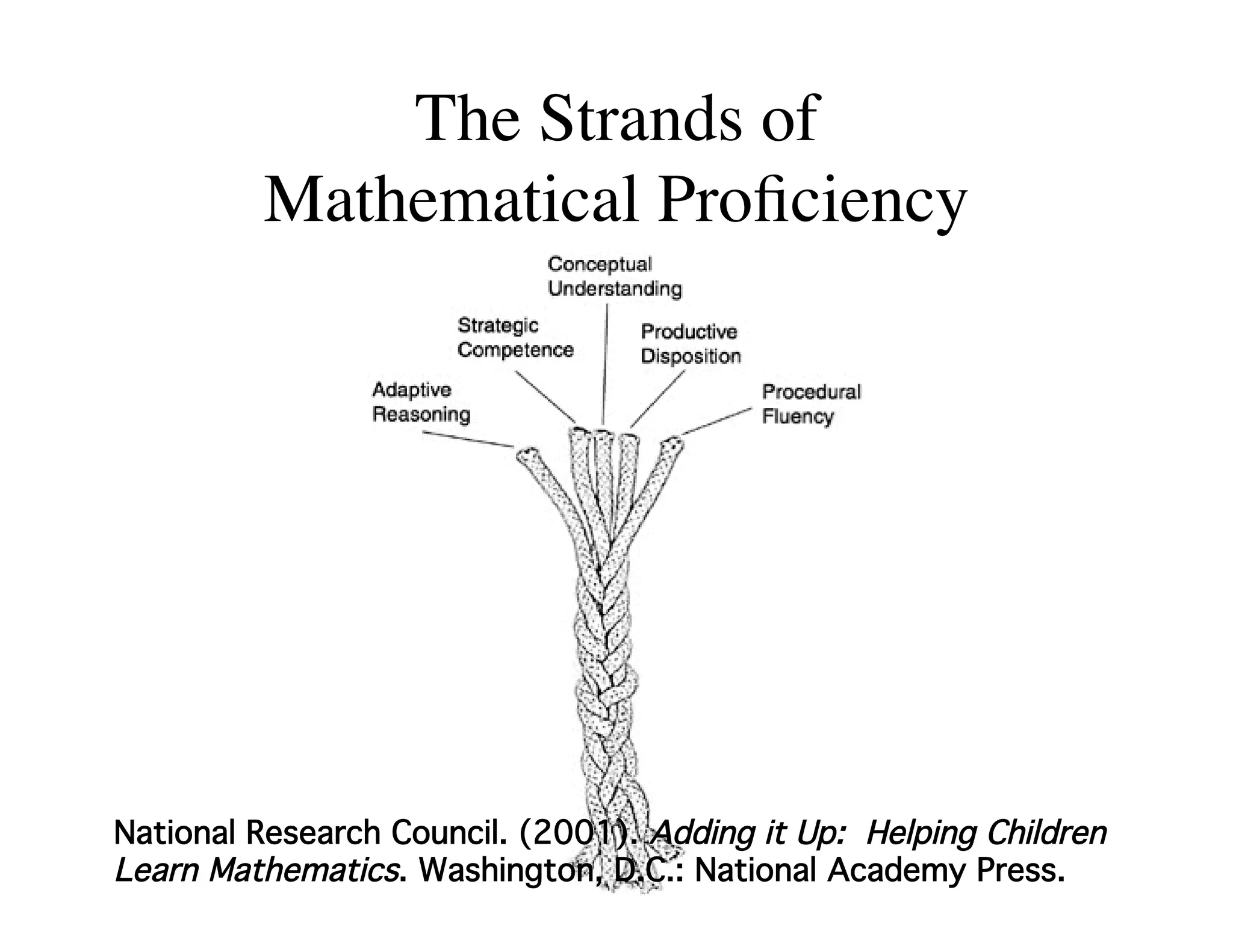
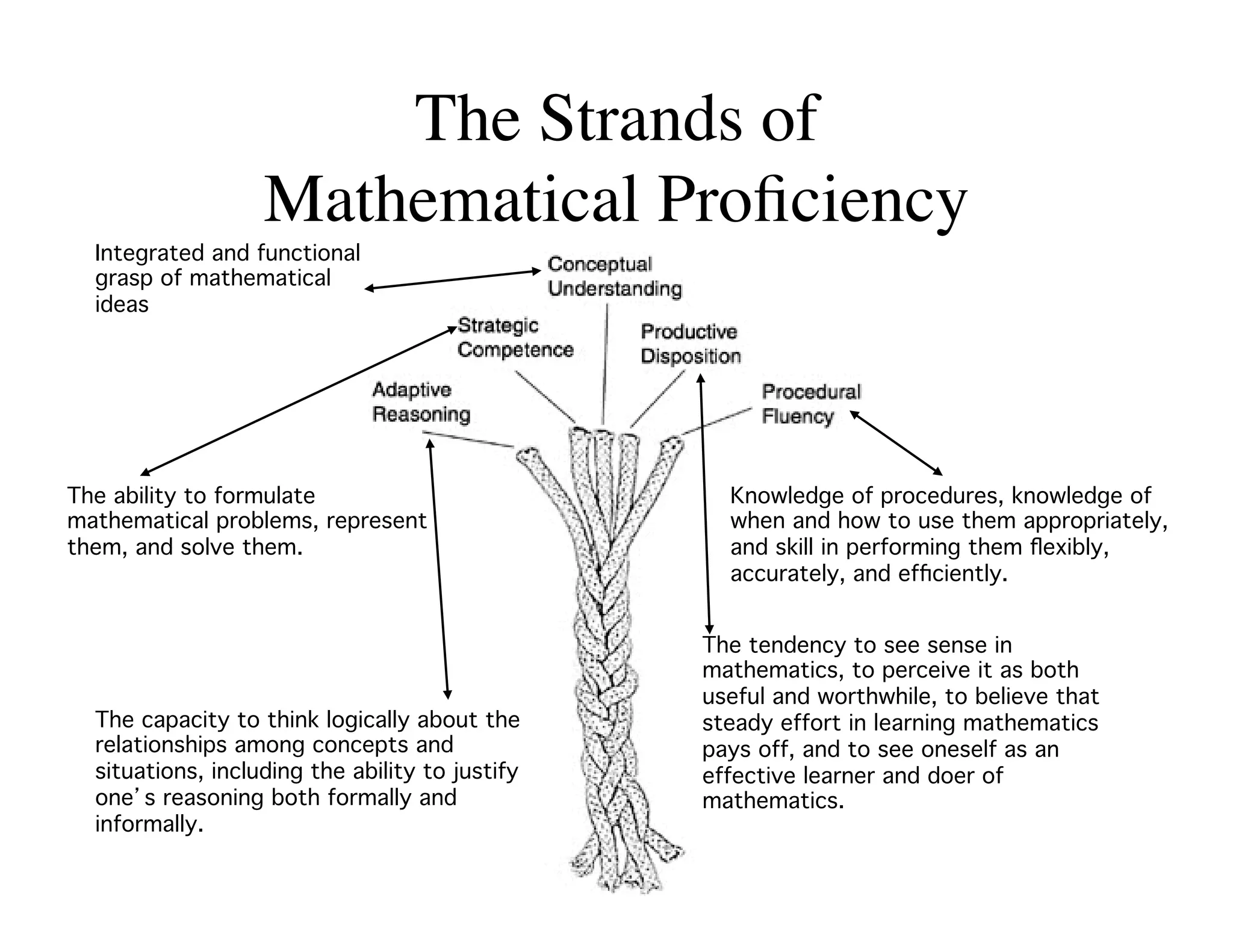
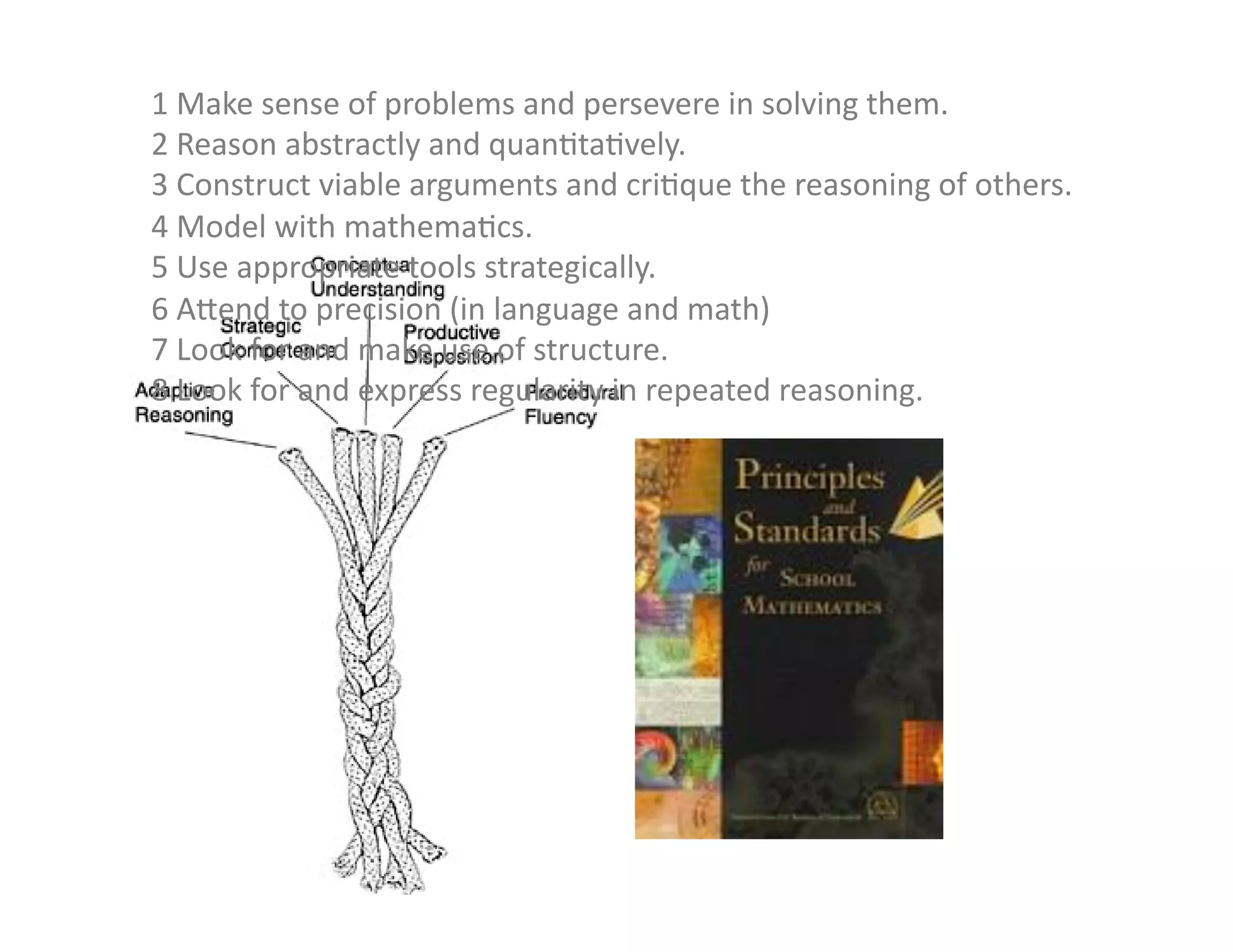
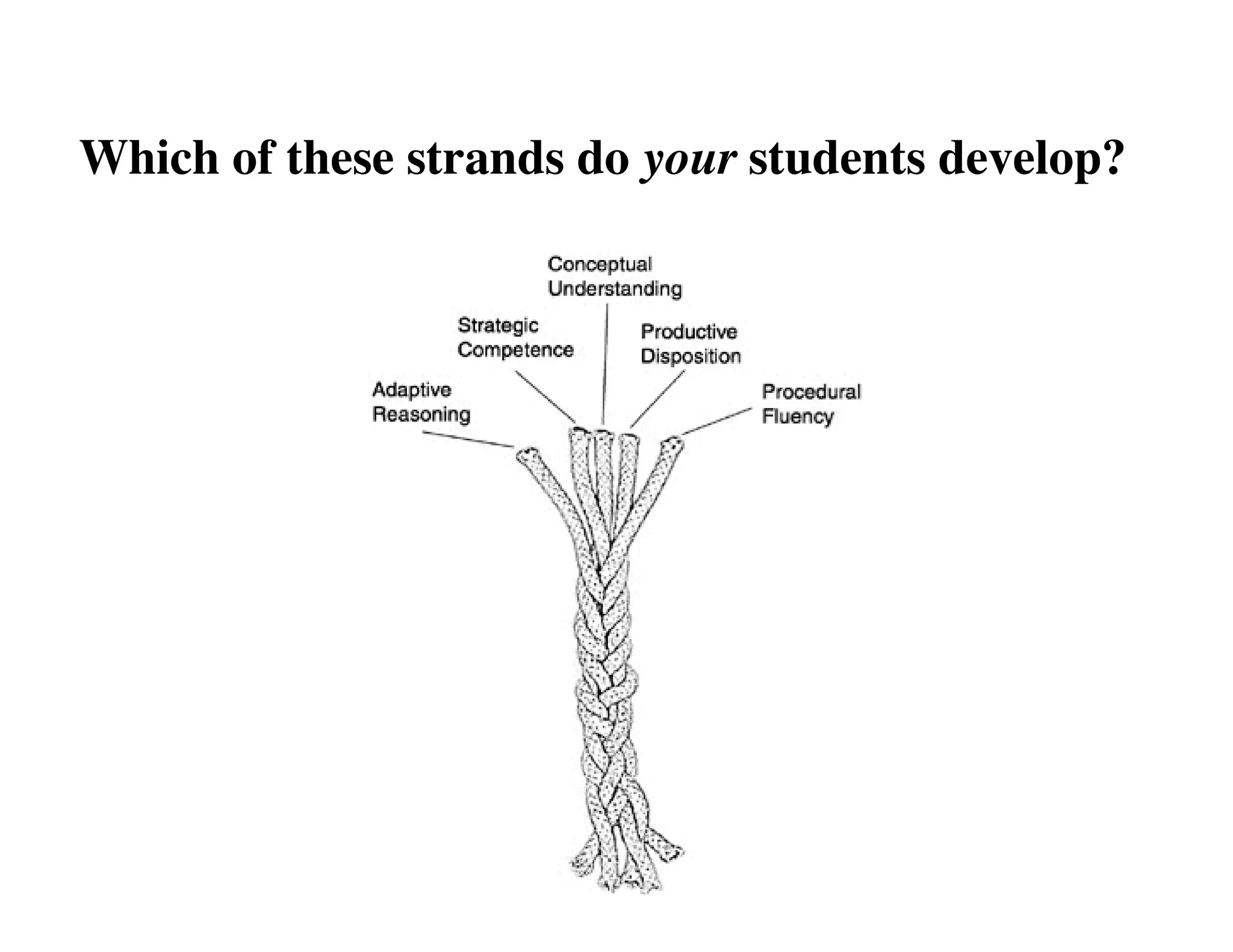
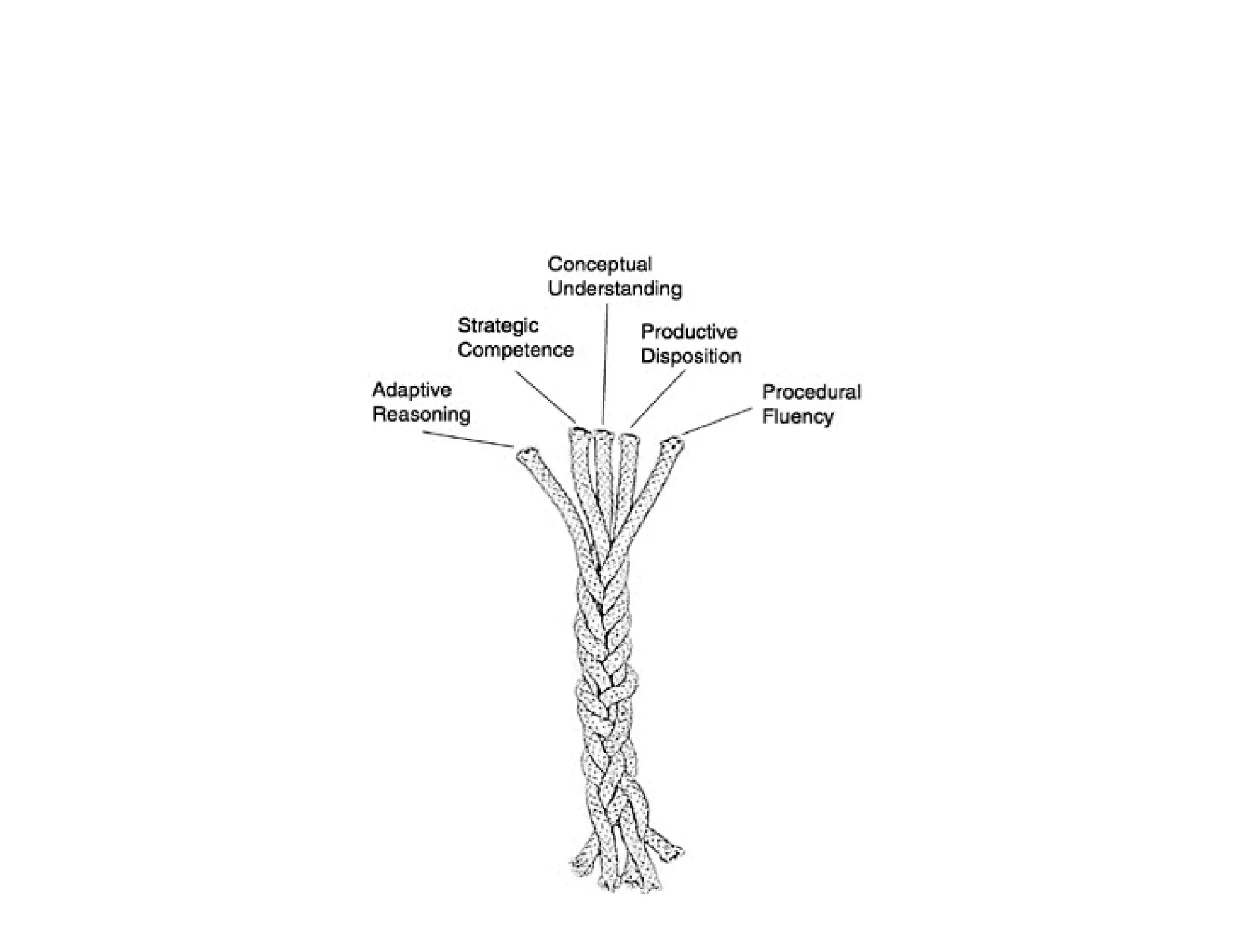
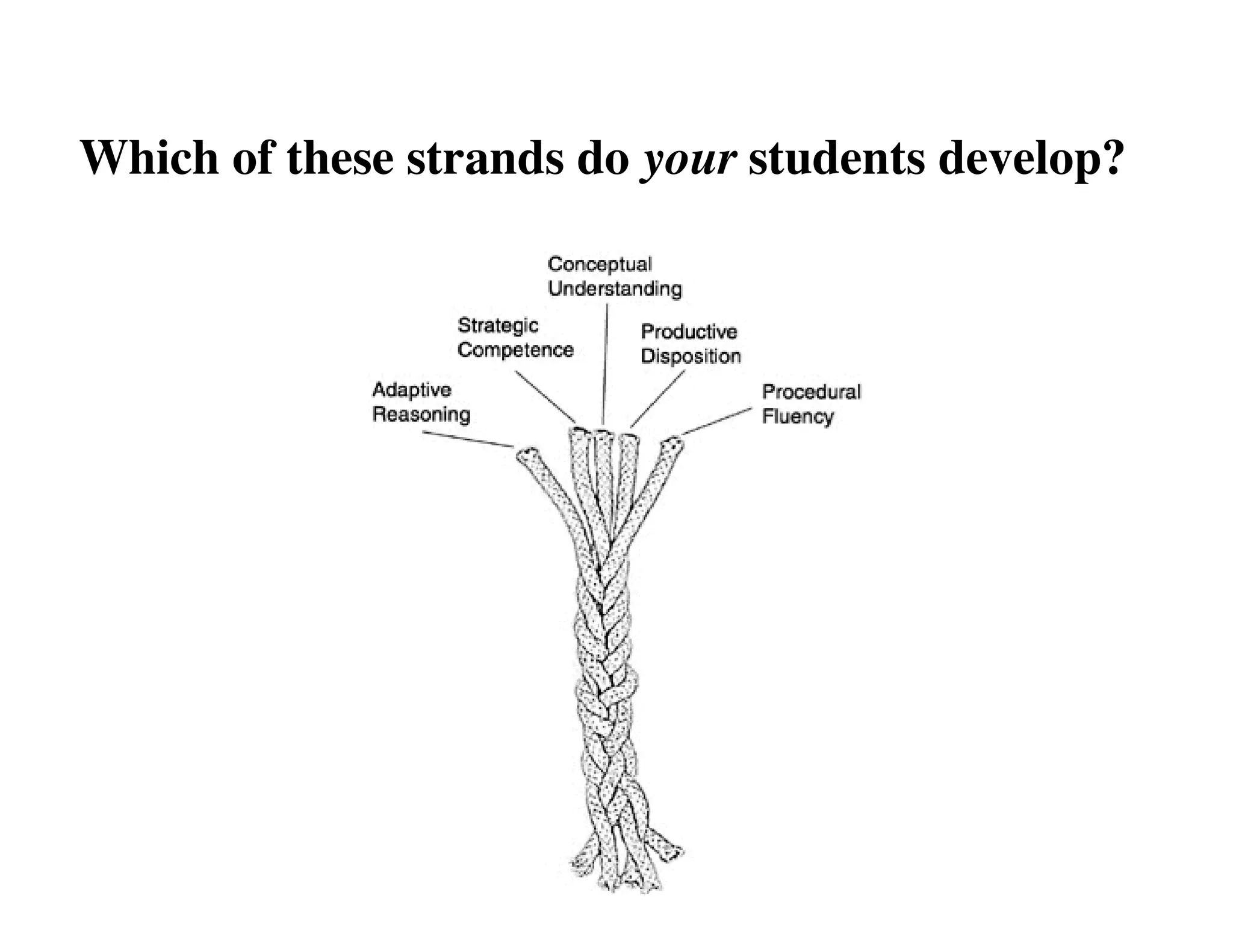
The Strands of  
Mathematical Proficiency 
National Research Council. (2001). Adding it Up: Helping Children 
Learn Mathematics. Washington, D.C.: National Academy Press.!
The Strands of  
Mathematical Proficiency 
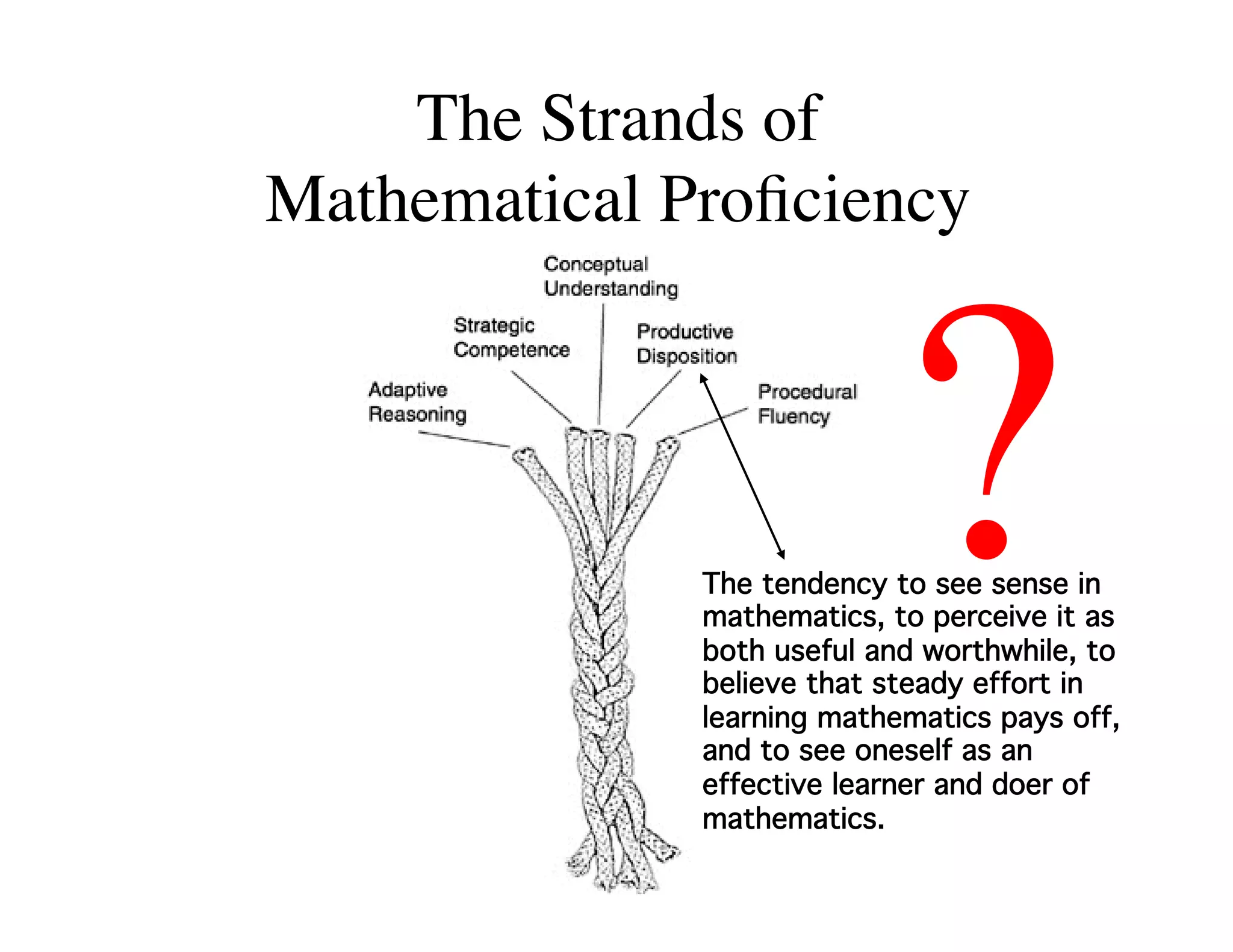
The tendency to see sense in 
mathematics, to perceive it as both 
useful and worthwhile, to believe that 
steady effort in learning mathematics 
pays off, and to see oneself as an 
effective learner and doer of 
mathematics.! 
Integrated and functional 
grasp of mathematical 
ideas! 
The capacity to think logically about the 
relationships among concepts and 
situations, including the ability to justify 
one’s reasoning both formally and 
informally.! 
Knowledge of procedures, knowledge of 
when and how to use them appropriately, 
and skill in performing them flexibly, 
accurately, and efficiently.! 
The ability to formulate 
mathematical problems, represent 
them, and solve them.!
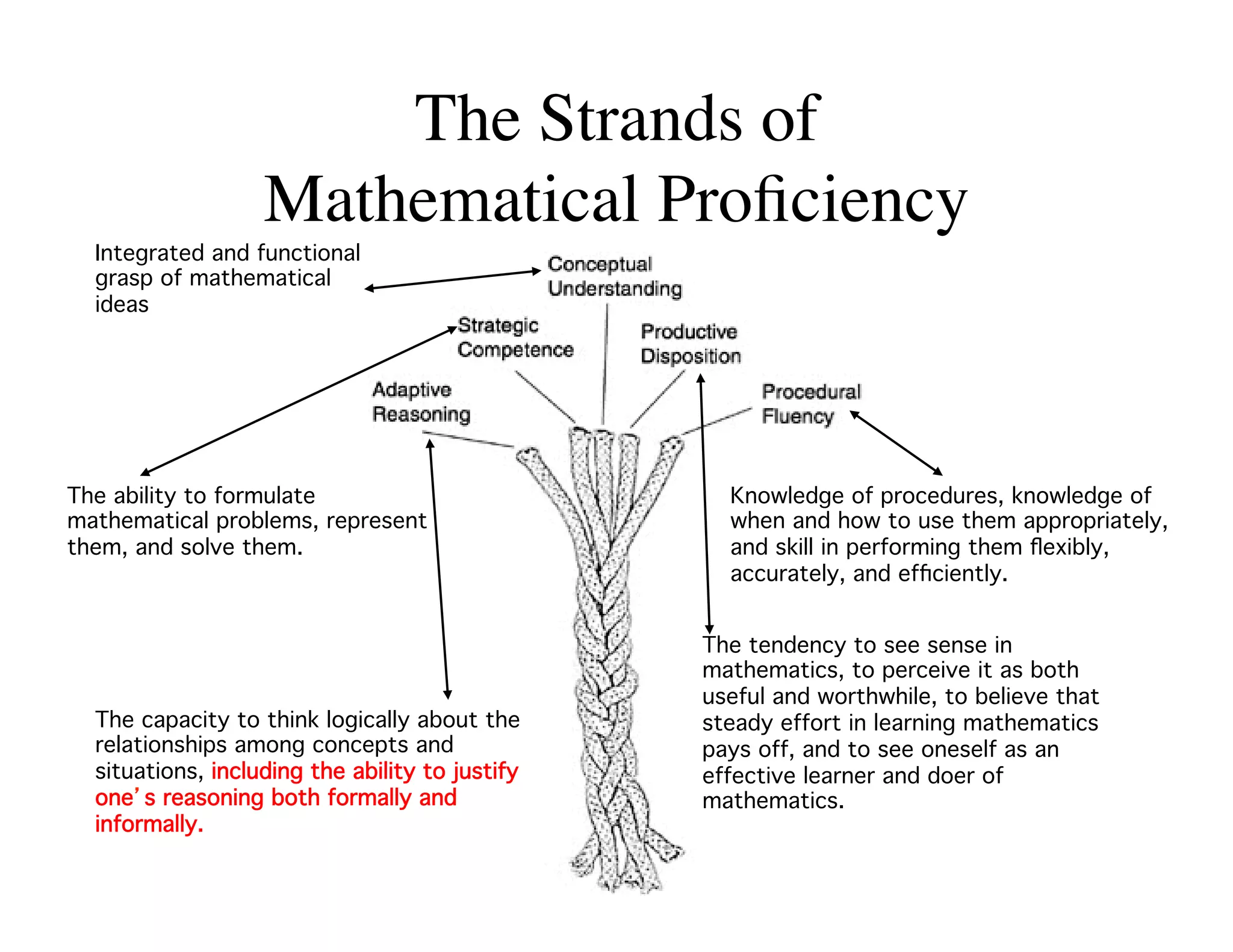
The Strands of  
Mathematical Proficiency 
The tendency to see sense in 
mathematics, to perceive it as both 
useful and worthwhile, to believe that 
steady effort in learning mathematics 
pays off, and to see oneself as an 
effective learner and doer of 
mathematics.! 
Integrated and functional 
grasp of mathematical 
ideas! 
The capacity to think logically about the 
relationships among concepts and 
situations, including the ability to justify 
one’s reasoning both formally and 
informally.! 
Knowledge of procedures, knowledge of 
when and how to use them appropriately, 
and skill in performing them flexibly, 
accurately, and efficiently.! 
The ability to formulate 
mathematical problems, represent 
them, and solve them.!
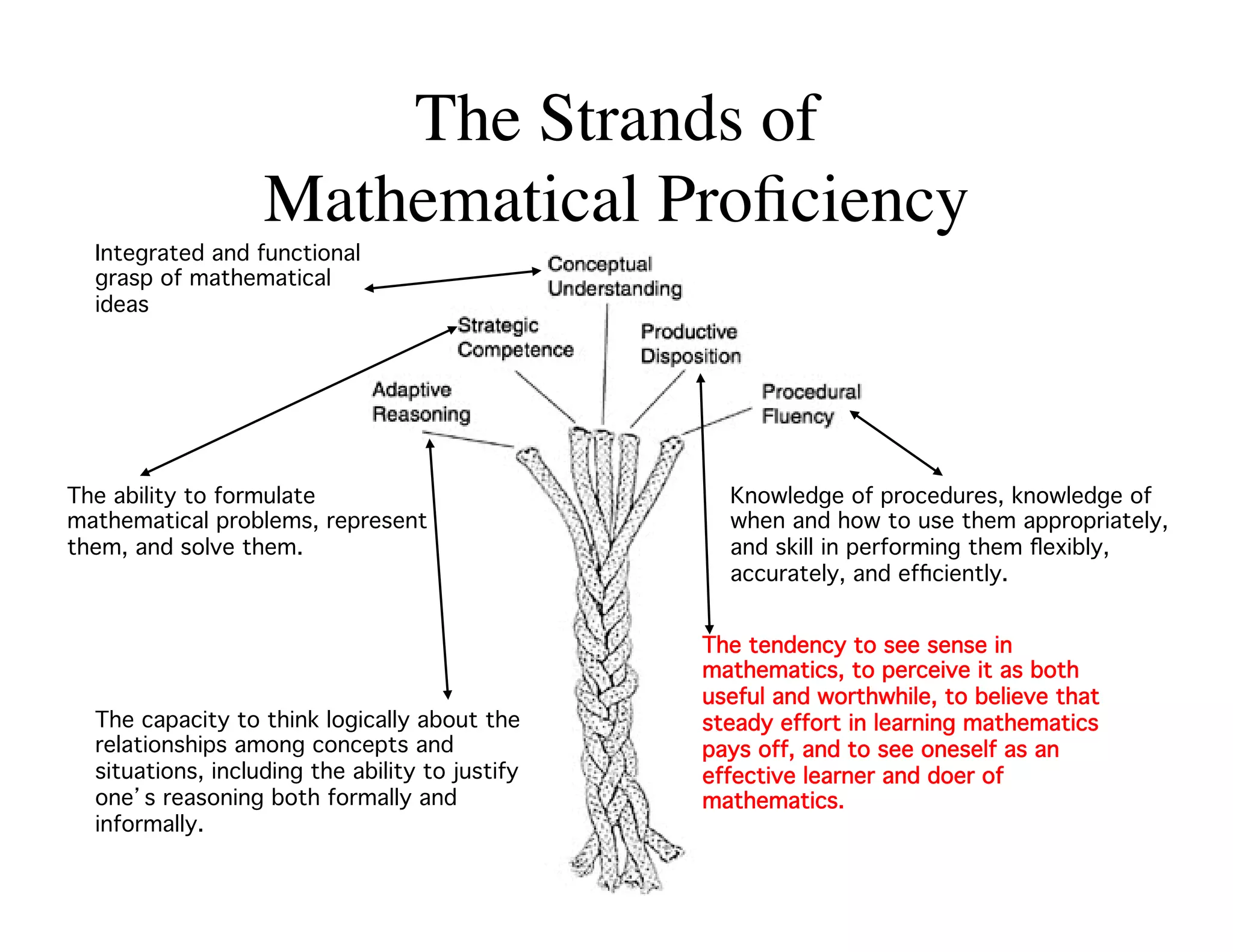
The Strands of  
Mathematical Proficiency 
The tendency to see sense in 
mathematics, to perceive it as both 
useful and worthwhile, to believe that 
steady effort in learning mathematics 
pays off, and to see oneself as an 
effective learner and doer of 
mathematics.! 
Integrated and functional 
grasp of mathematical 
ideas! 
The capacity to think logically about the 
relationships among concepts and 
situations, including the ability to justify 
one’s reasoning both formally and 
informally.! 
Knowledge of procedures, knowledge of 
when and how to use them appropriately, 
and skill in performing them flexibly, 
accurately, and efficiently.! 
The ability to formulate 
mathematical problems, represent 
them, and solve them.!
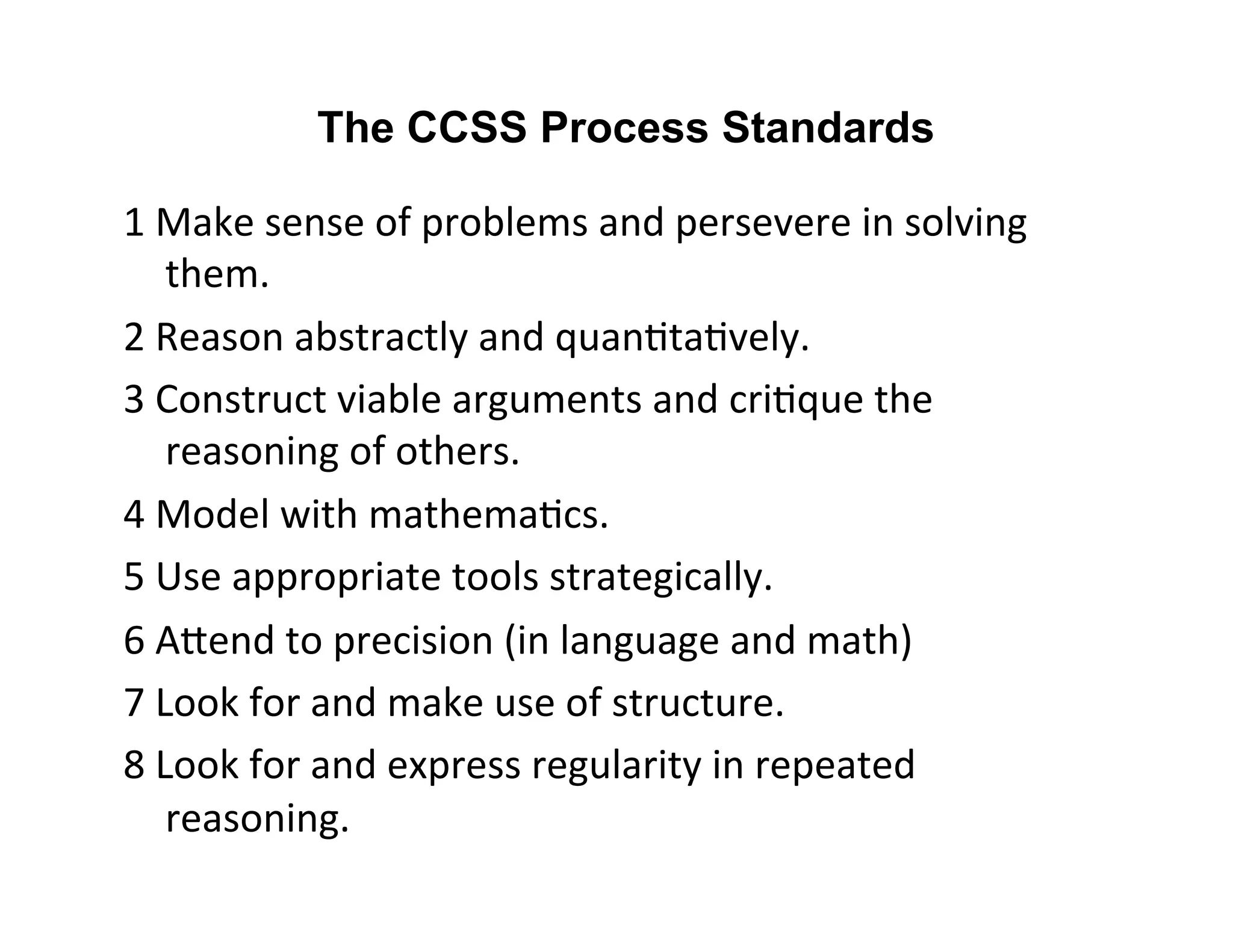
The CCSS Process Standards 
1 
Make 
sense 
of 
problems 
and 
persevere 
in 
solving 
them. 
2 
Reason 
abstractly 
and 
quan=ta=vely. 
3 
Construct 
viable 
arguments 
and 
cri=que 
the 
reasoning 
of 
others. 
4 
Model 
with 
mathema=cs. 
5 
Use 
appropriate 
tools 
strategically. 
6 
AFend 
to 
precision 
(in 
language 
and 
math) 
7 
Look 
for 
and 
make 
use 
of 
structure. 
8 
Look 
for 
and 
express 
regularity 
in 
repeated 
reasoning.
1 
Make 
sense 
of 
problems 
and 
persevere 
in 
solving 
them. 
2 
Reason 
abstractly 
and 
quan=ta=vely. 
3 
Construct 
viable 
arguments 
and 
cri=que 
the 
reasoning 
of 
others. 
4 
Model 
with 
mathema=cs. 
5 
Use 
appropriate 
tools 
strategically. 
6 
AFend 
to 
precision 
(in 
language 
and 
math) 
7 
Look 
for 
and 
make 
use 
of 
structure. 
8 
Look 
for 
and 
express 
regularity 
in 
repeated 
reasoning.
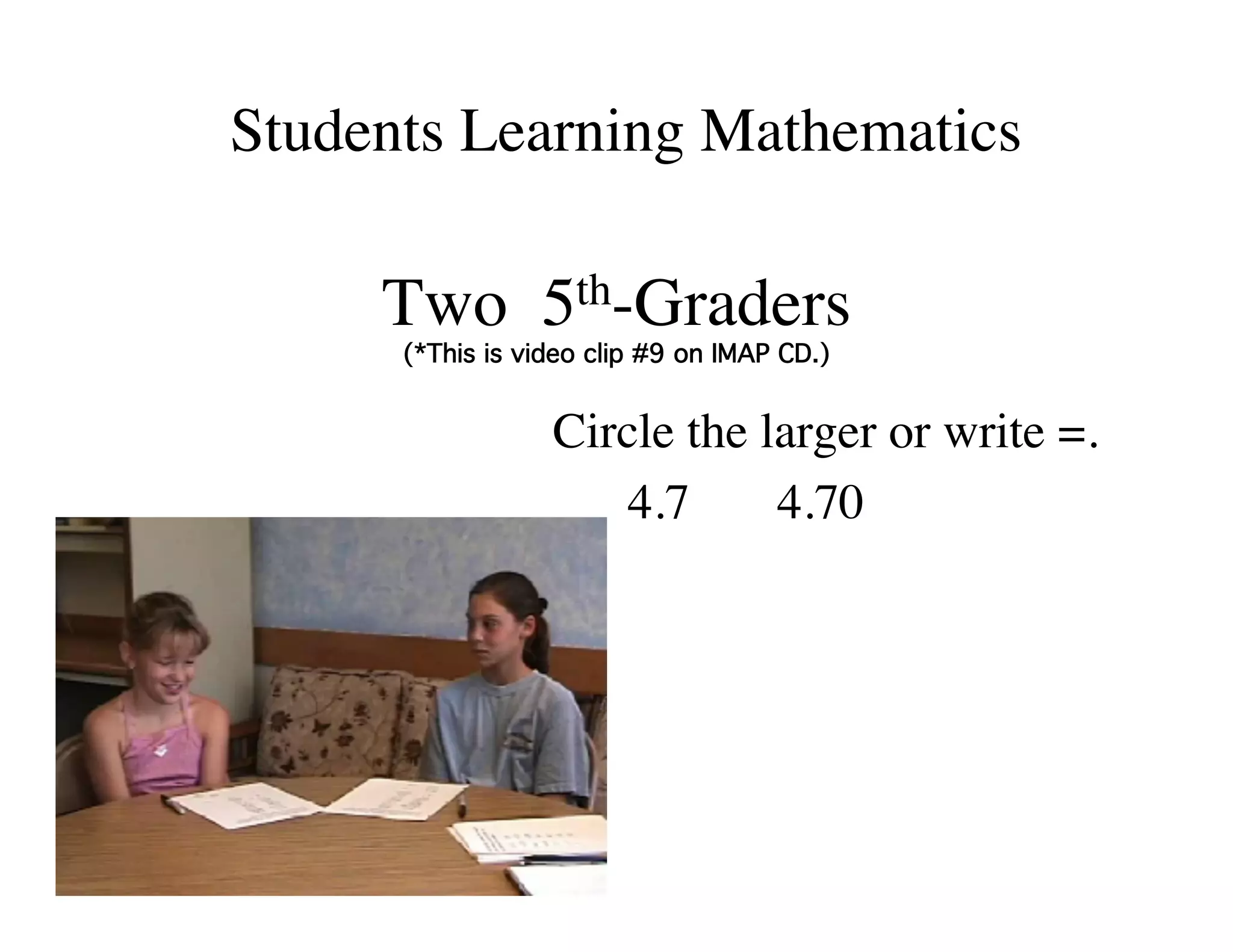
Students Learning Mathematics 
Two 5th-Graders  
(*This is video clip #9 on IMAP CD.)! 
Circle the larger or write =. 
4.7 4.70
Which of these strands do your students develop?
Presentation Plan 
• What does it mean to do mathematics? 
• Consider issues related to mathematics 
content. 
• There is a problem with how PSTs are 
learning mathematics, but we found one 
approach. 
• I’ll share 4 principles of mathematics 
teaching and learning addressed by a focus 
on children’s mathematical thinking.
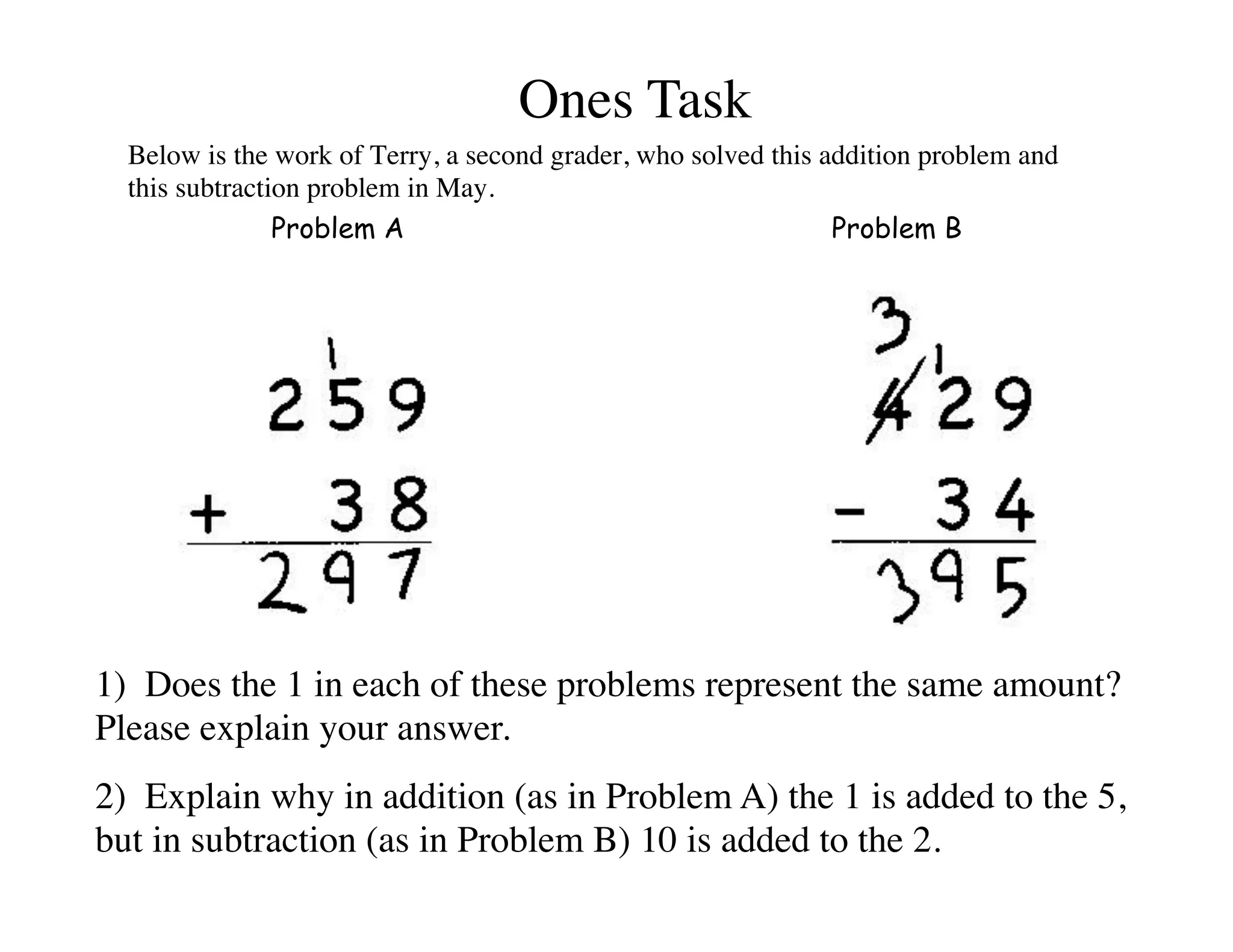
Ones Task 
Below is the work of Terry, a second grader, who solved this addition problem and 
this subtraction problem in May. 
Problem A Problem B 
1) Does the 1 in each of these problems represent the same amount? 
Please explain your answer. 
2) Explain why in addition (as in Problem A) the 1 is added to the 5, 
but in subtraction (as in Problem B) 10 is added to the 2.
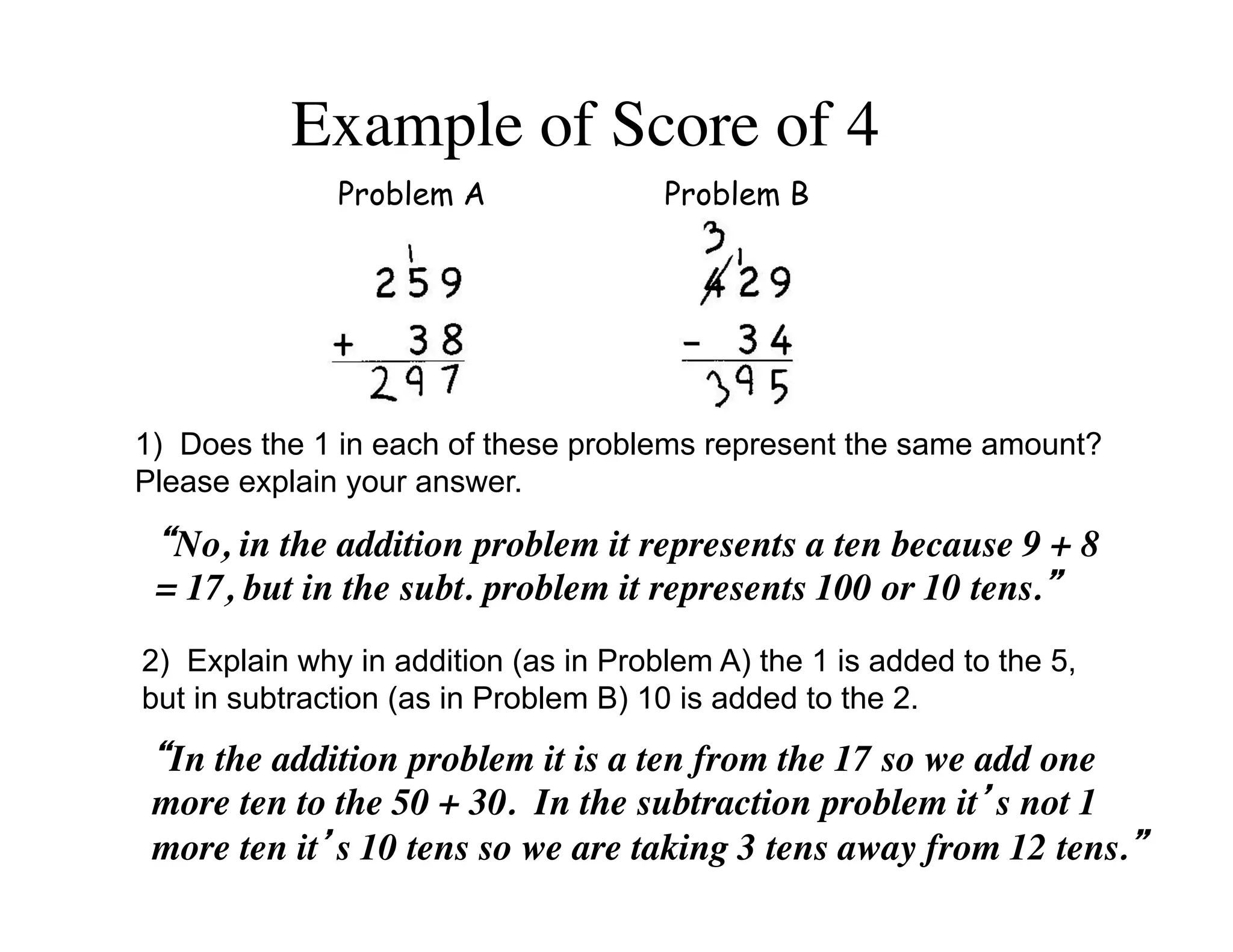
Example of Score of 4 
Problem A Problem B 
1) Does the 1 in each of these problems represent the same amount? 
Please explain your answer. 
“No, in the addition problem it represents a ten because 9 + 8 
= 17, but in the subt. problem it represents 100 or 10 tens.” 
2) Explain why in addition (as in Problem A) the 1 is added to the 5, 
but in subtraction (as in Problem B) 10 is added to the 2. 
“In the addition problem it is a ten from the 17 so we add one 
more ten to the 50 + 30. In the subtraction problem it’s not 1 
more ten it’s 10 tens so we are taking 3 tens away from 12 tens.”
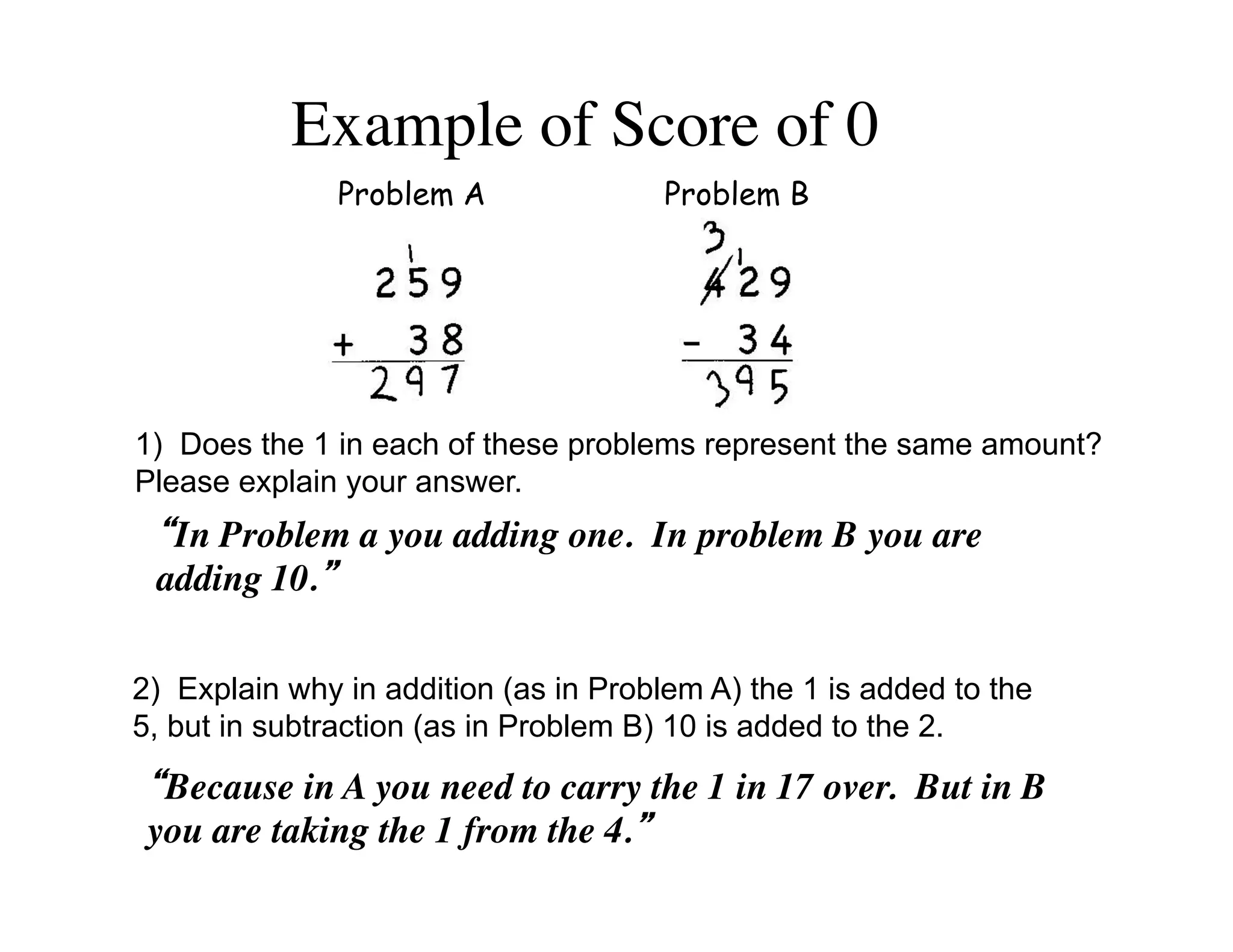
Example of Score of 0 
Problem A Problem B 
1) Does the 1 in each of these problems represent the same amount? 
Please explain your answer. 
“In Problem a you adding one. In problem B you are 
adding 10.” 
2) Explain why in addition (as in Problem A) the 1 is added to the 
5, but in subtraction (as in Problem B) 10 is added to the 2. 
“Because in A you need to carry the 1 in 17 over. But in B 
you are taking the 1 from the 4.”
Principal Investigators 
Randy Philipp, PI 
Vicki Jacobs, co-PI 
Faculty Associates 
Lisa Lamb, Jessica Pierson 
Research Associate 
Bonnie Schappelle 
Project Coordinators 
Candace Cabral 
Graduate Students 
John (Zig) Siegfried 
Others 
Chris Macias-Papierniak, 
Courtney White 
Funded by the National Science Foundation, ESI-0455785
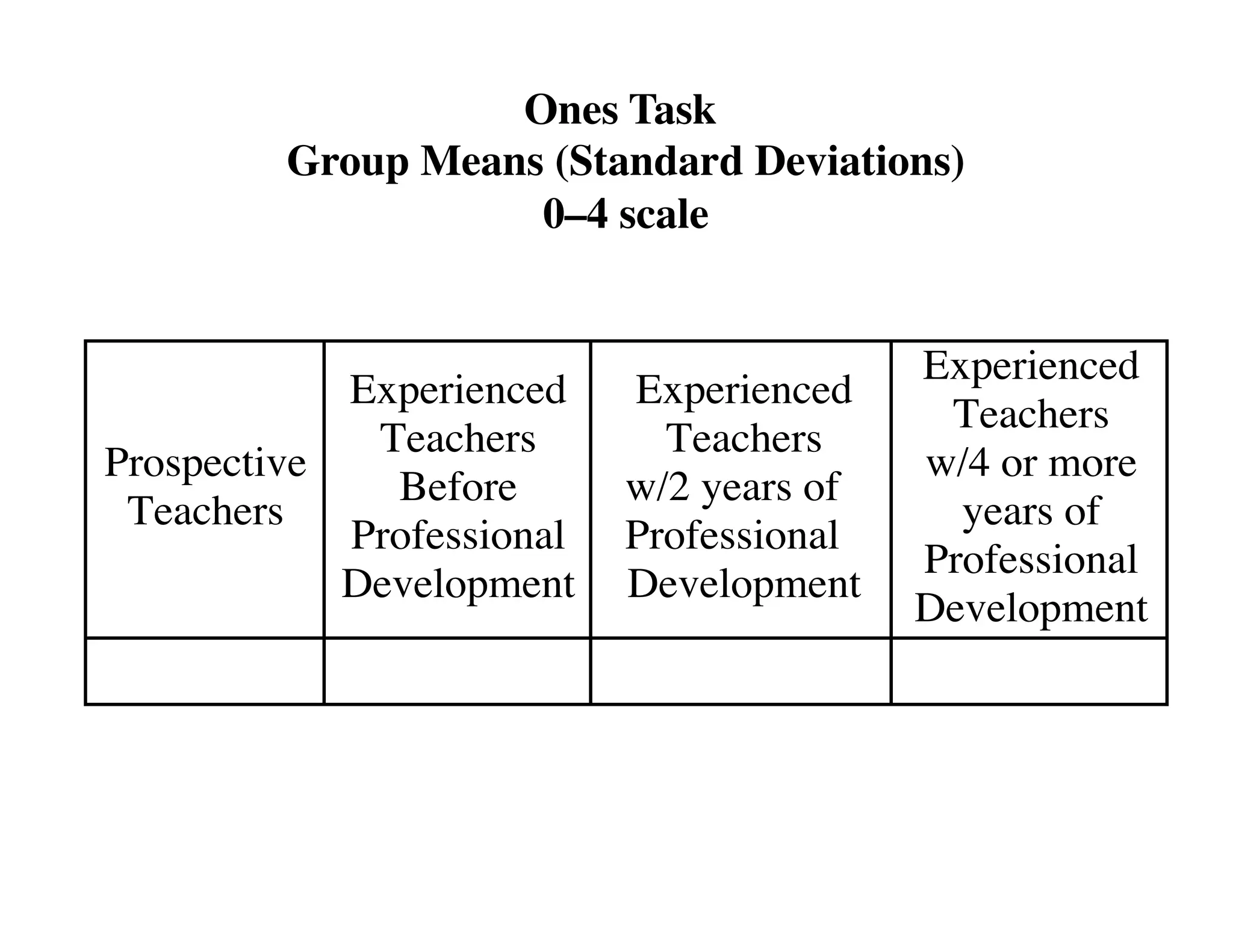
Prospective 
Teachers 
Experienced 
Teachers 
Before 
Professional 
Development 
Experienced 
Teachers 
w/2 years of 
Professional 
Development 
Experienced 
Teachers 
w/4 or more 
years of 
Professional 
Development 
Ones Task 
Group Means (Standard Deviations) 
0–4 scale
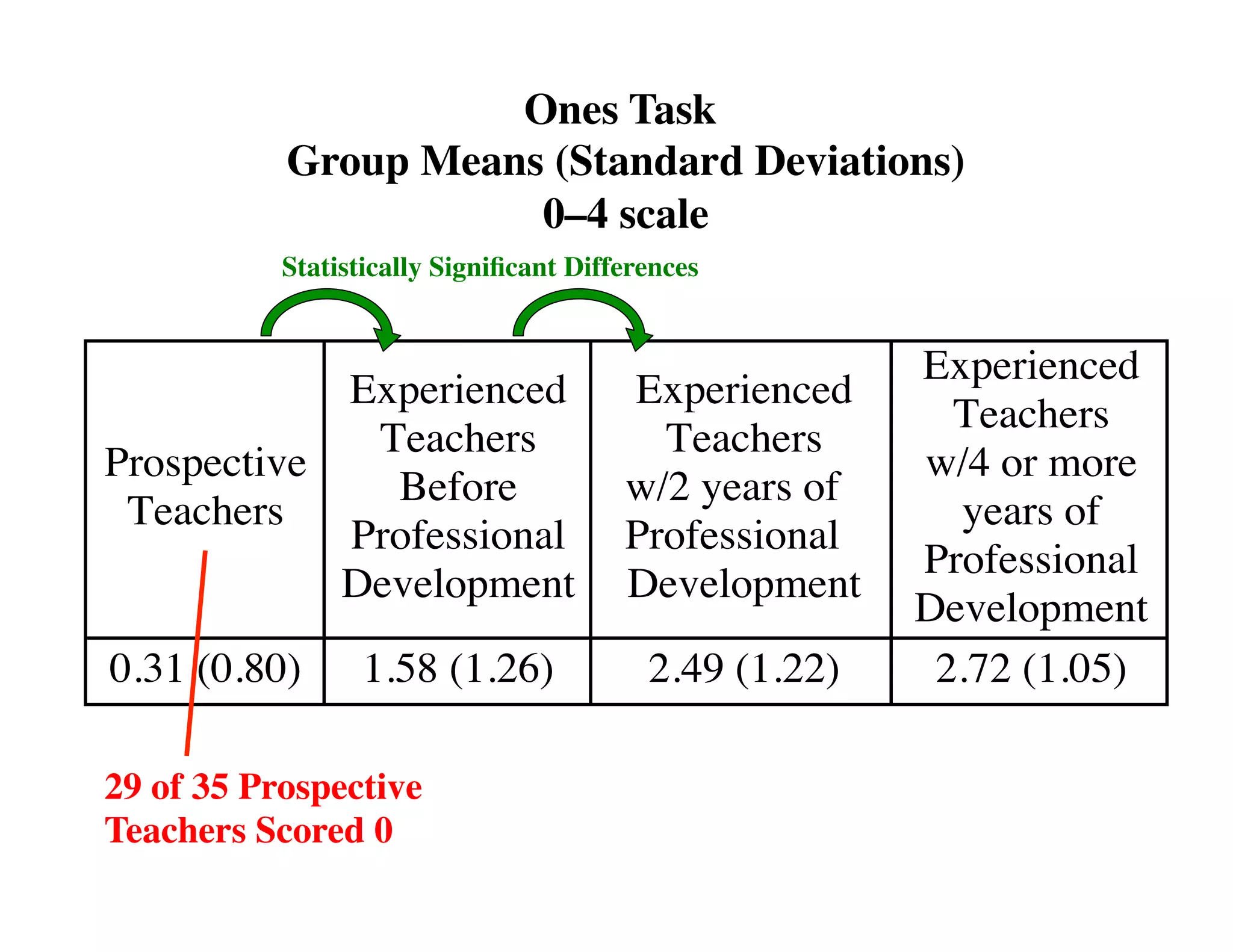
Group Means (Standard Deviations) 
Statistically Significant Differences 
Prospective 
Teachers 
Ones Task 
0–4 scale 
Experienced 
Teachers 
Before 
Professional 
Development 
Experienced 
Teachers 
w/2 years of 
Professional 
Development 
Experienced 
Teachers 
w/4 or more 
years of 
Professional 
Development 
0.31 (0.80) 1.58 (1.26) 2.49 (1.22) 2.72 (1.05) 
29 of 35 Prospective 
Teachers Scored 0
The Strands of  
Mathematical Proficiency 
? 
The tendency to see sense in 
mathematics, to perceive it as 
both useful and worthwhile, to 
believe that steady effort in 
learning mathematics pays off, 
and to see oneself as an 
effective learner and doer of 
mathematics.!
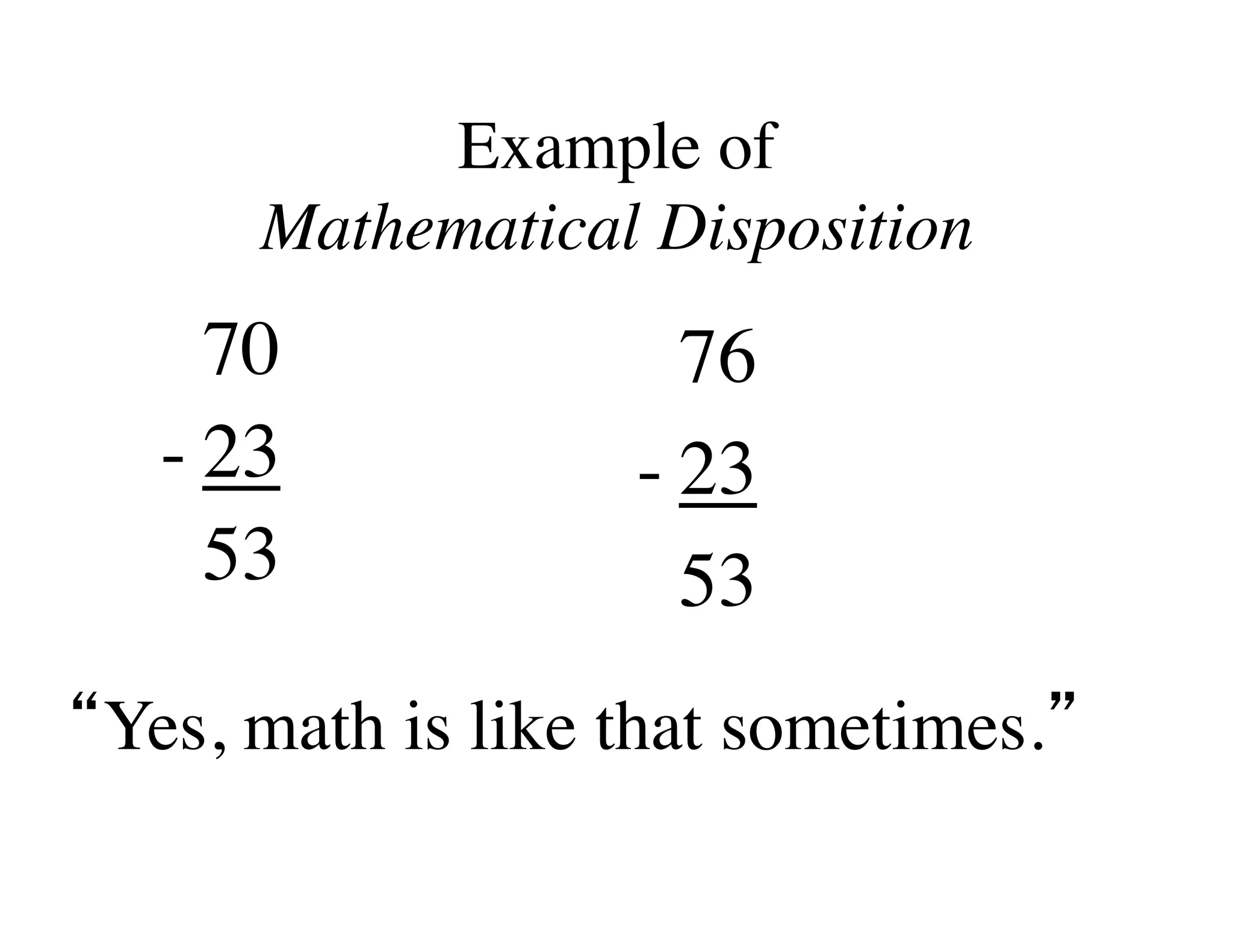
Example of  
Mathematical Disposition 
70 
- 23 
53 
76 
- 23 
53 
“Yes, math is like that sometimes.”
Mathematical Integrity 
An education isn't how much you have 
committed to memory, or even how much you 
know. It's being able to differentiate between 
what you do know and what you don't.! 
! 
(Anatole France, Nobel Prize-winning author)!
Presentation Plan 
• What does it mean to do mathematics? 
• Consider issues related to mathematics 
content. 
• There is a problem with how PSTs are 
learning mathematics, but we found one 
approach. 
• I’ll share 4 principles of mathematics 
teaching and learning addressed by a focus 
on children’s mathematical thinking.
The Problem 
Even when students attend a thoughtfully planned 
mathematics course for prospective elementary school 
teachers (PSTs), too many go through the course in a 
perfunctory manner. 
(Ball, 1990; Ma, 1999; Sowder, Philipp, Armstrong,  
Schappelle, 1998) 
Many PSTs do not seem to value the experience.
Why? 
Many PSTs hold a complex system of beliefs 
that supports their not valuing the learning of 
more mathematics. For example, consider the 
effect of believing the following: 
“If I, a college student, do not know something, 
then children would not be expected to learn it. 
And if I do know something, then I certainly 
don’t need to learn it again.”
In other words… 
We, mathematics instructors of 
PSTs, are answering questions that 
PSTs have yet to ask.
Should we try to get PSTs to care more 
about mathematics for mathematics sake? 
This is one starting point. 
We took a different starting 
point, building on the work 
of Nel Noddings (1984).
Why not start with what PSTs care about? 
Children! 
-Darling-Hammond  Sclan, 1996
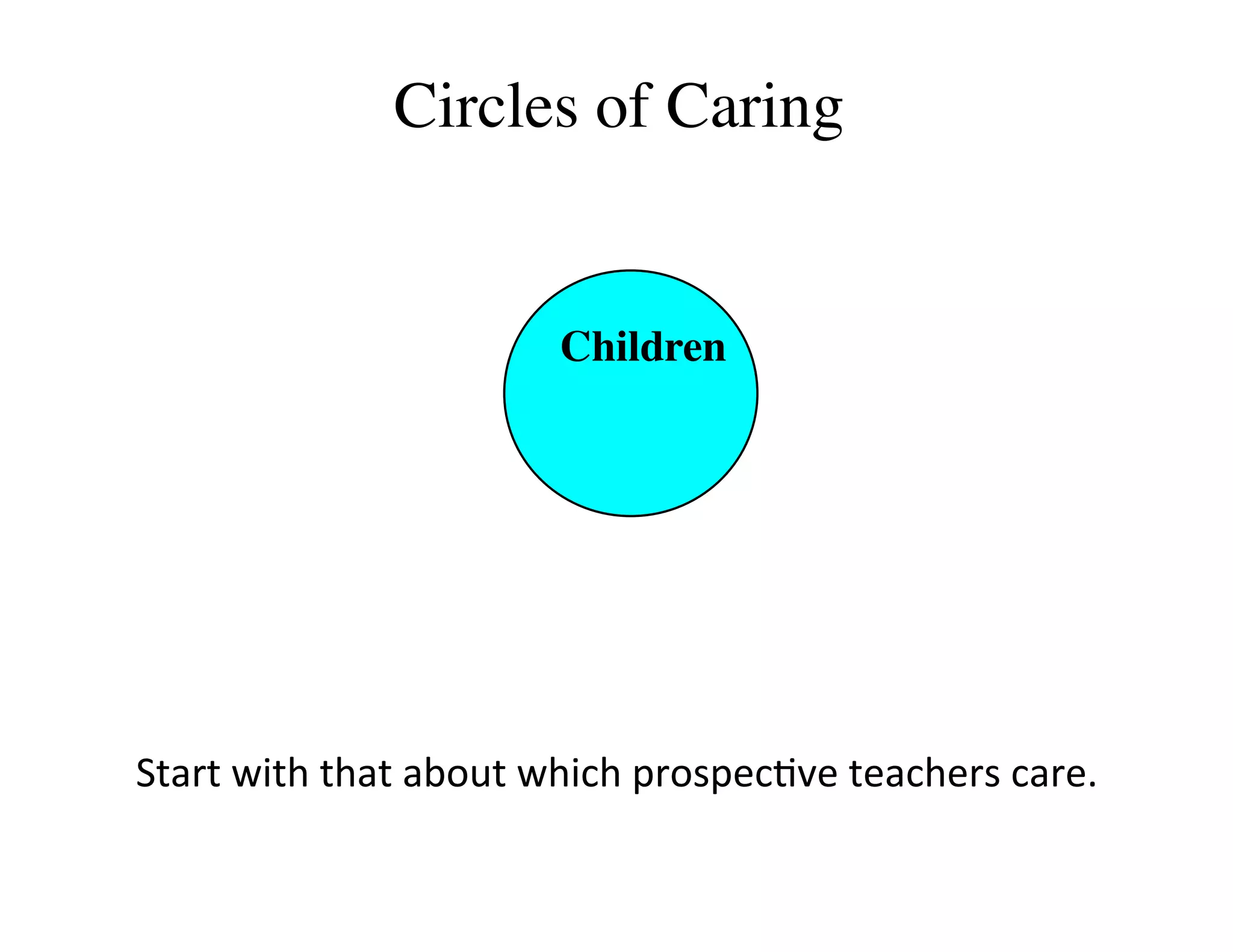
Circles of Caring 
Children 
Start 
with 
that 
about 
which 
prospec=ve 
teachers 
care.
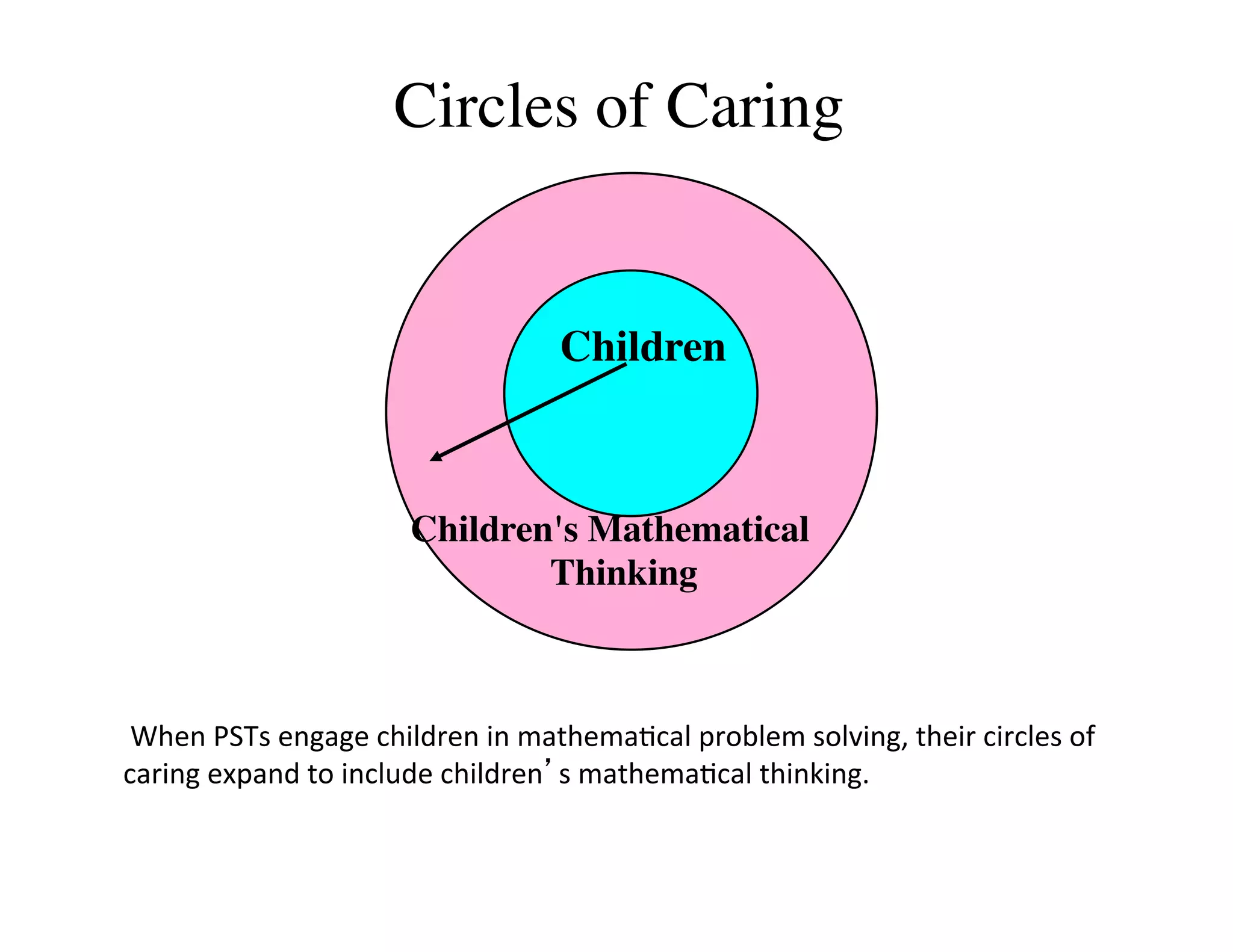
Circles of Caring 
Children 
Children's Mathematical 
Thinking 
When 
PSTs 
engage 
children 
in 
mathema=cal 
problem 
solving, 
their 
circles 
of 
caring 
expand 
to 
include 
children’s 
mathema=cal 
thinking.
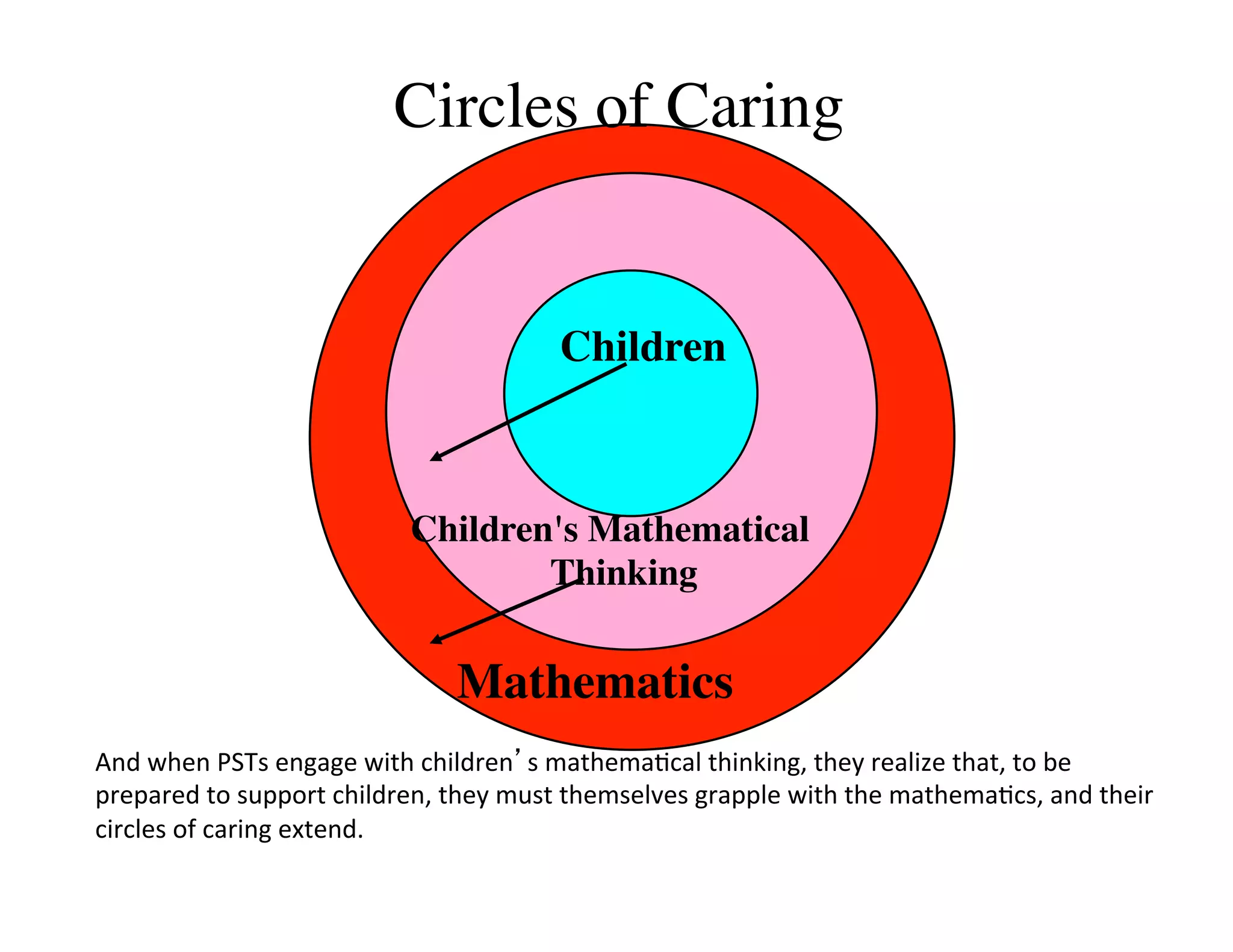
Circles of Caring 
Children 
Children's Mathematical 
Thinking 
Mathematics 
And 
when 
PSTs 
engage 
with 
children’s 
mathema=cal 
thinking, 
they 
realize 
that, 
to 
be 
prepared 
to 
support 
children, 
they 
must 
themselves 
grapple 
with 
the 
mathema=cs, 
and 
their 
circles 
of 
caring 
extend.
This 
idea 
is 
at 
least 
100 
years 
old. 
John Dewey, 1902 
Every 
subject 
has 
two 
aspects, 
“one 
for 
the 
scien=st 
as 
a 
scien=st; 
the 
other 
for 
the 
teacher 
as 
a 
teacher” 
(p. 
351). 
“[The 
teacher] 
is 
concerned, 
not 
with 
the 
subject-­‐maFer 
as 
such, 
but 
with 
the 
subject-­‐maFer 
as 
a 
related 
factor 
in 
a 
total 
and 
growing 
experience 
[of 
the 
child]” 
(p. 
352). 
! 
! 
Dewey, J. (1902/1990). The child and the curriculum. 
Chicago: The University of Chicago Press. !
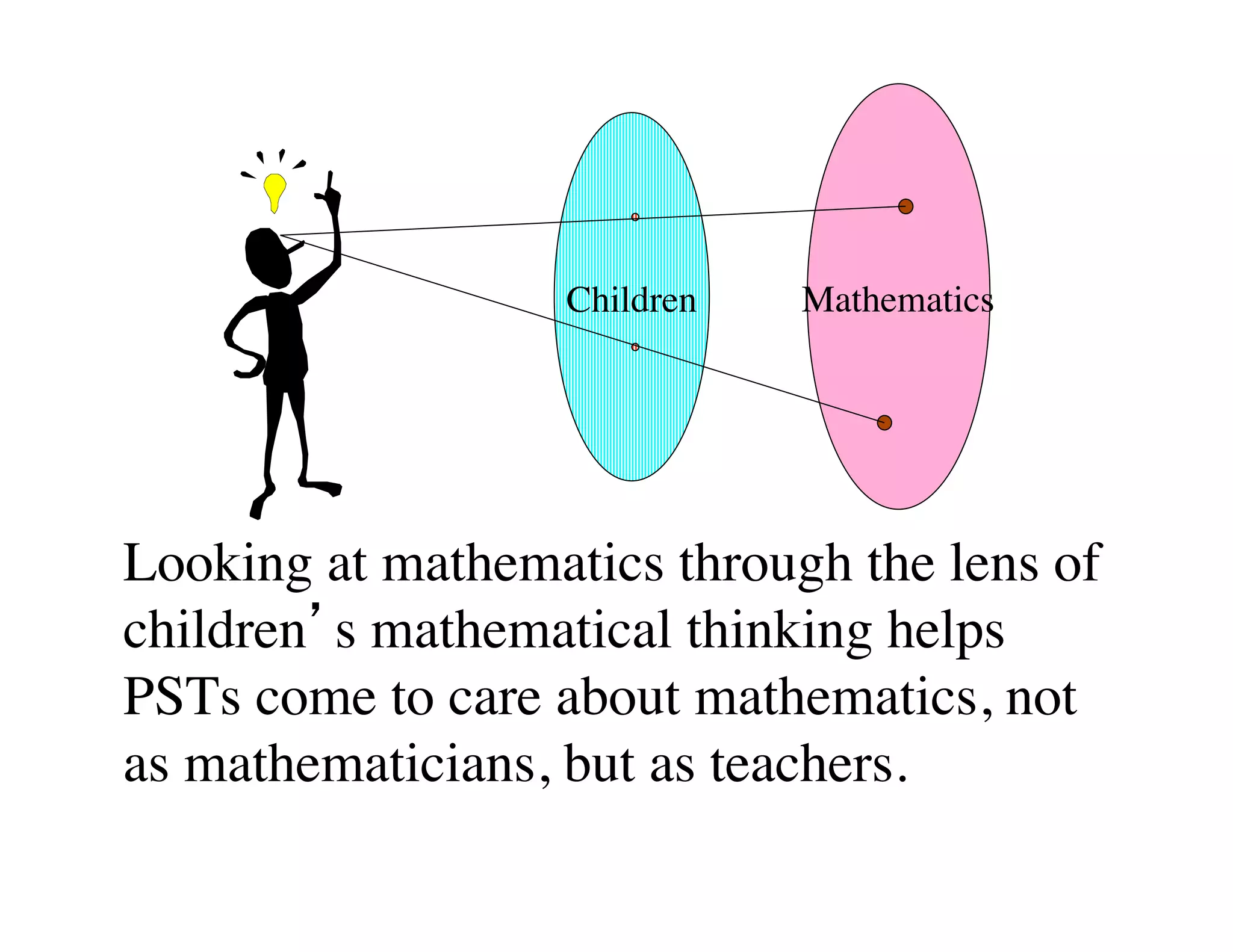
Children 
Mathematics 
Looking at mathematics through the lens of 
children’s mathematical thinking helps 
PSTs come to care about mathematics, not 
as mathematicians, but as teachers.
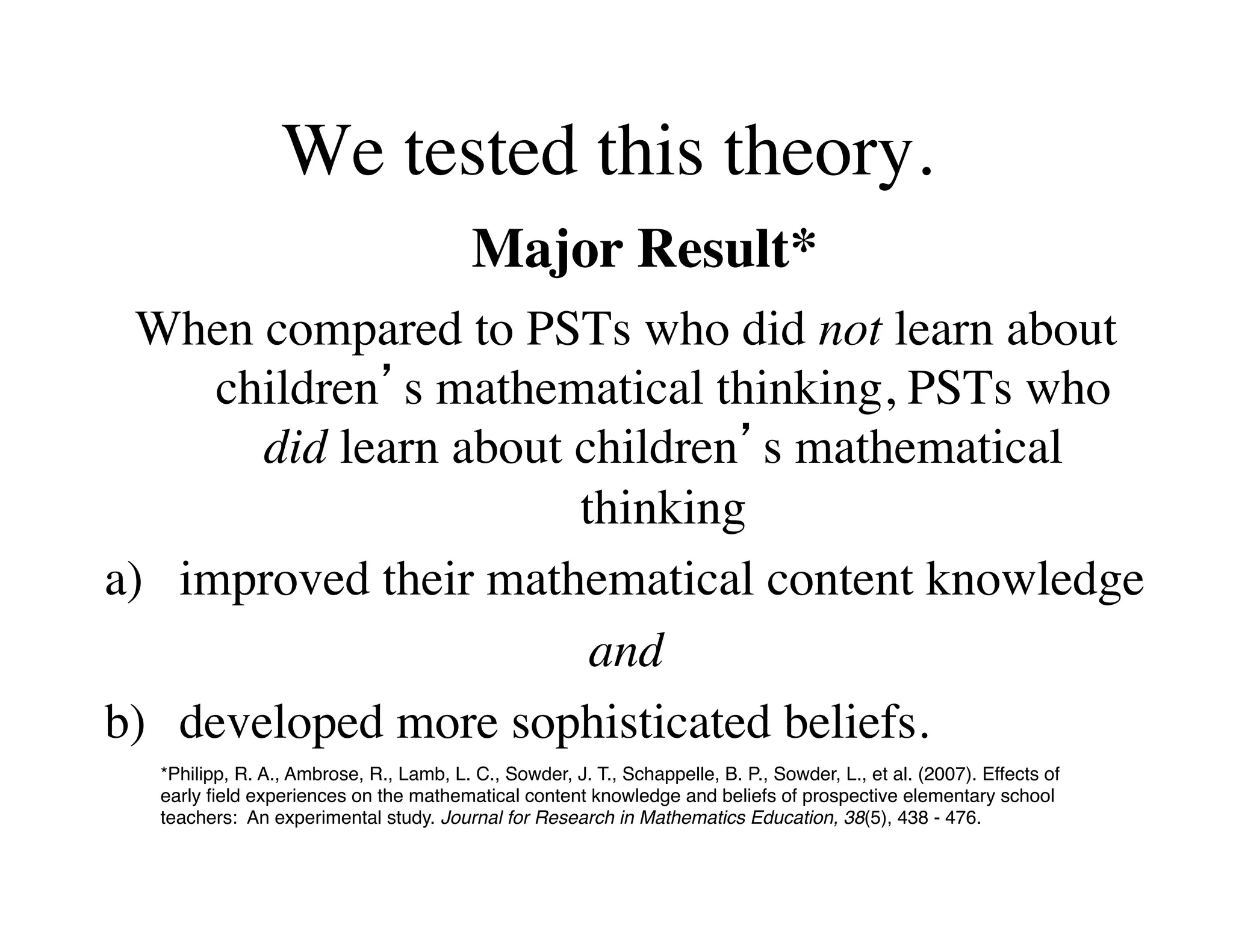
We tested this theory. 
Major Result* 
When compared to PSTs who did not learn about 
children’s mathematical thinking, PSTs who 
did learn about children’s mathematical 
thinking 
a) improved their mathematical content knowledge 
and 
b) 
developed more sophisticated beliefs. 
*Philipp, R. A., Ambrose, R., Lamb, L. C., Sowder, J. T., Schappelle, B. P., Sowder, L., et al. (2007). Effects of 
early field experiences on the mathematical content knowledge and beliefs of prospective elementary school 
teachers: An experimental study. Journal for Research in Mathematics Education, 38(5), 438 - 476.
Where Might We Infuse Children’s 
Mathematical Thinking? 
• Education Courses 
• Mathematics Courses 
• Hybrid Courses (CMTE) 
– Link Content to Children 
– Help PSTs Consider Future (e.g., Ali)
How did the focus on children’s 
thinking help the PSTs?
A PST Speaks for Herself 
Why study about children’s mathematical thinking while 
learning mathematics? 
CMTE Clip, 0:23 - 0:56
Presentation Plan 
• What does it mean to do mathematics? 
• Consider issues related to mathematics 
content. 
• There is a problem with how PSTs are 
learning mathematics, but we found one 
approach. 
• I’ll share 4 principles of mathematics 
teaching and learning addressed by a focus 
on children’s mathematical thinking.
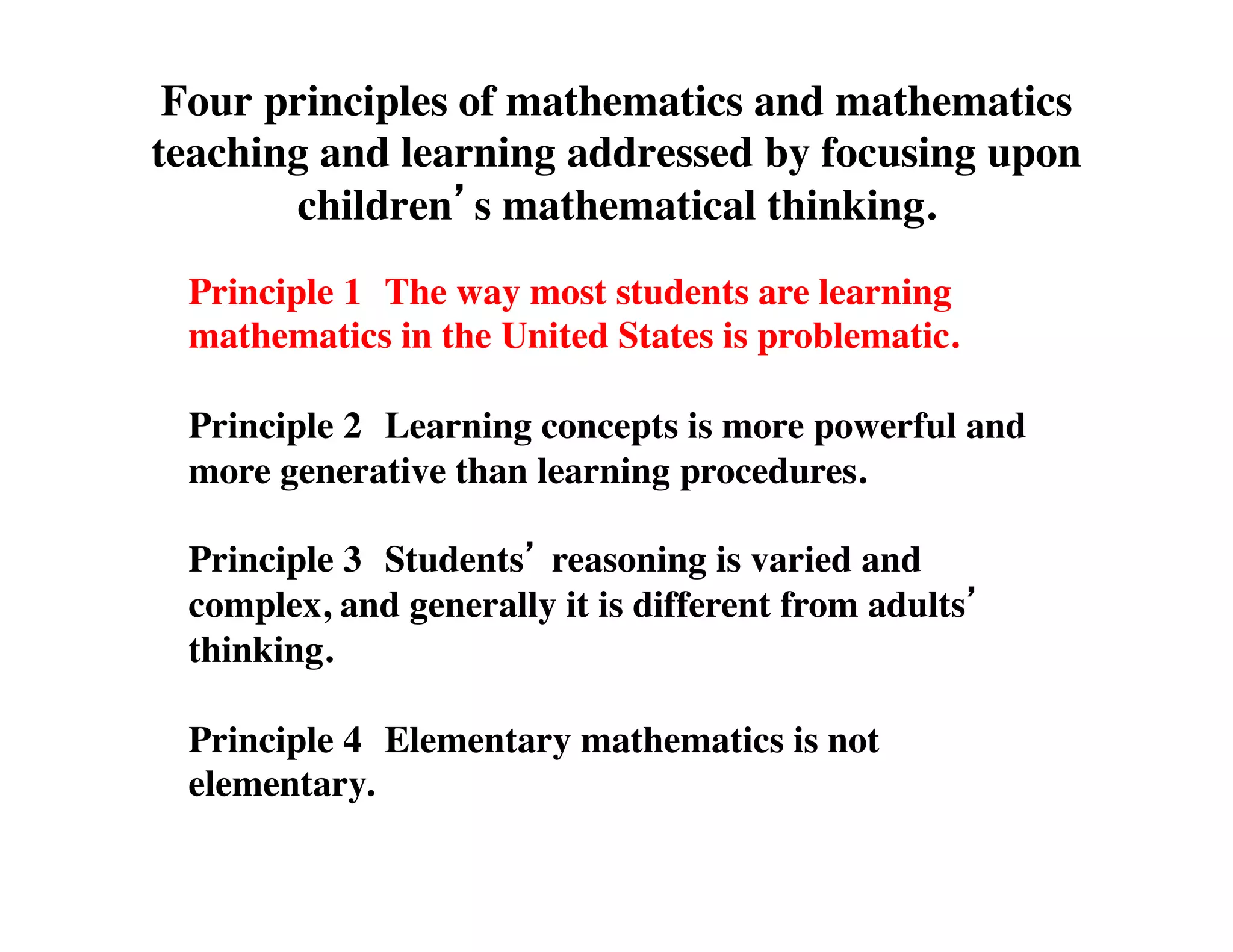
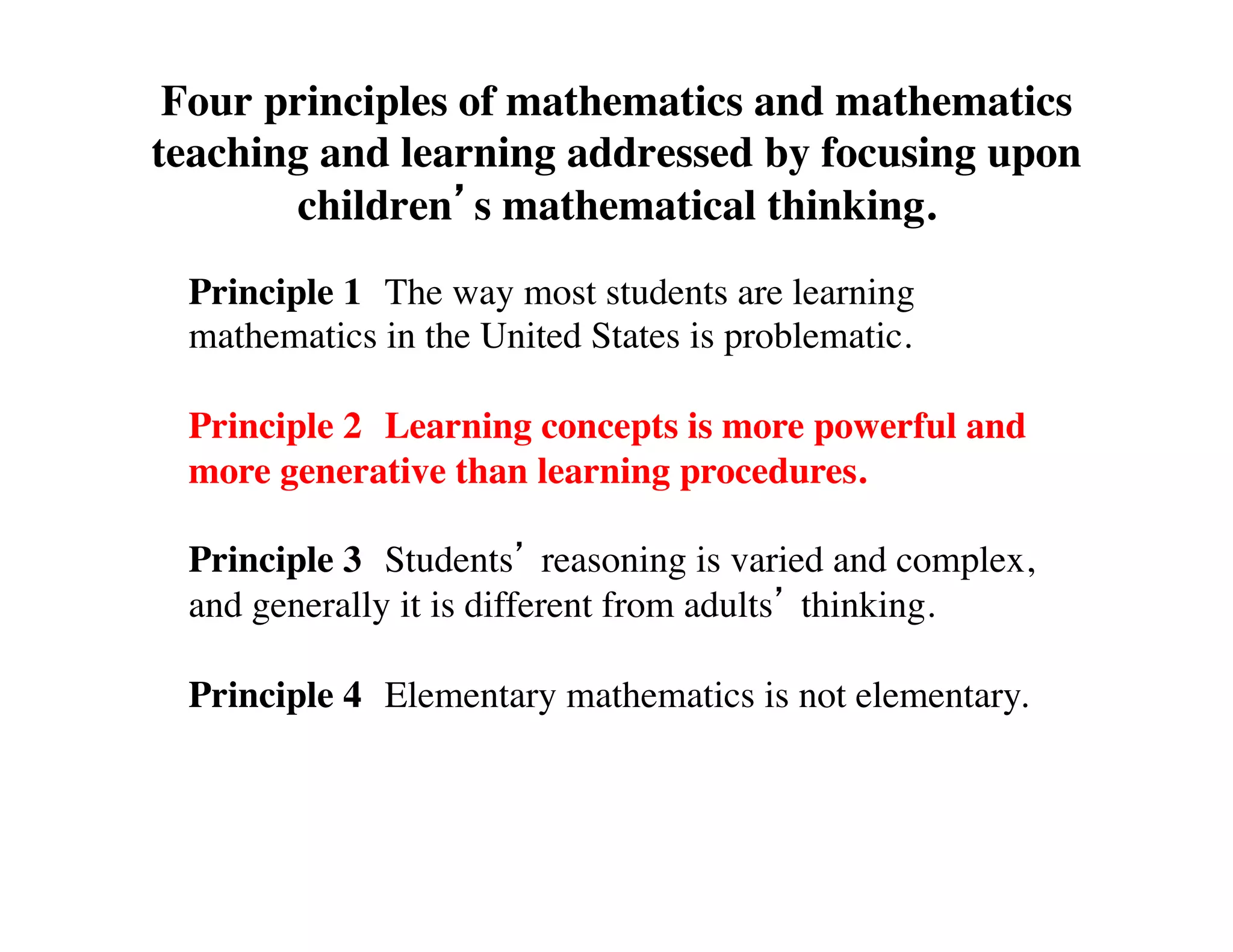
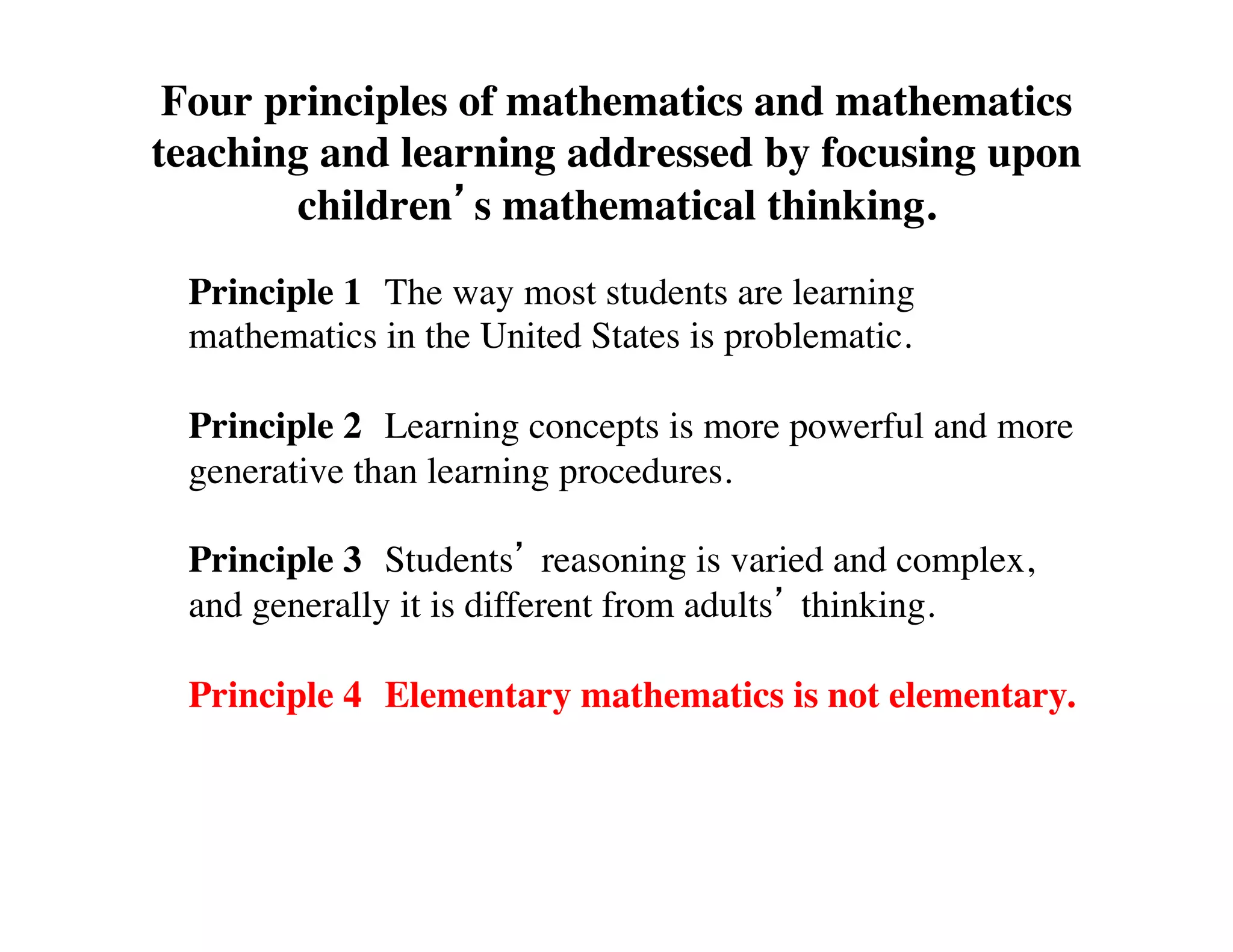
Four principles of mathematics and mathematics 
teaching and learning addressed by focusing upon 
children’s mathematical thinking. 
Principle 1 
The way most students are learning 
mathematics in the United States is problematic. 
Principle 2 
Learning concepts is more powerful and 
more generative than learning procedures. 
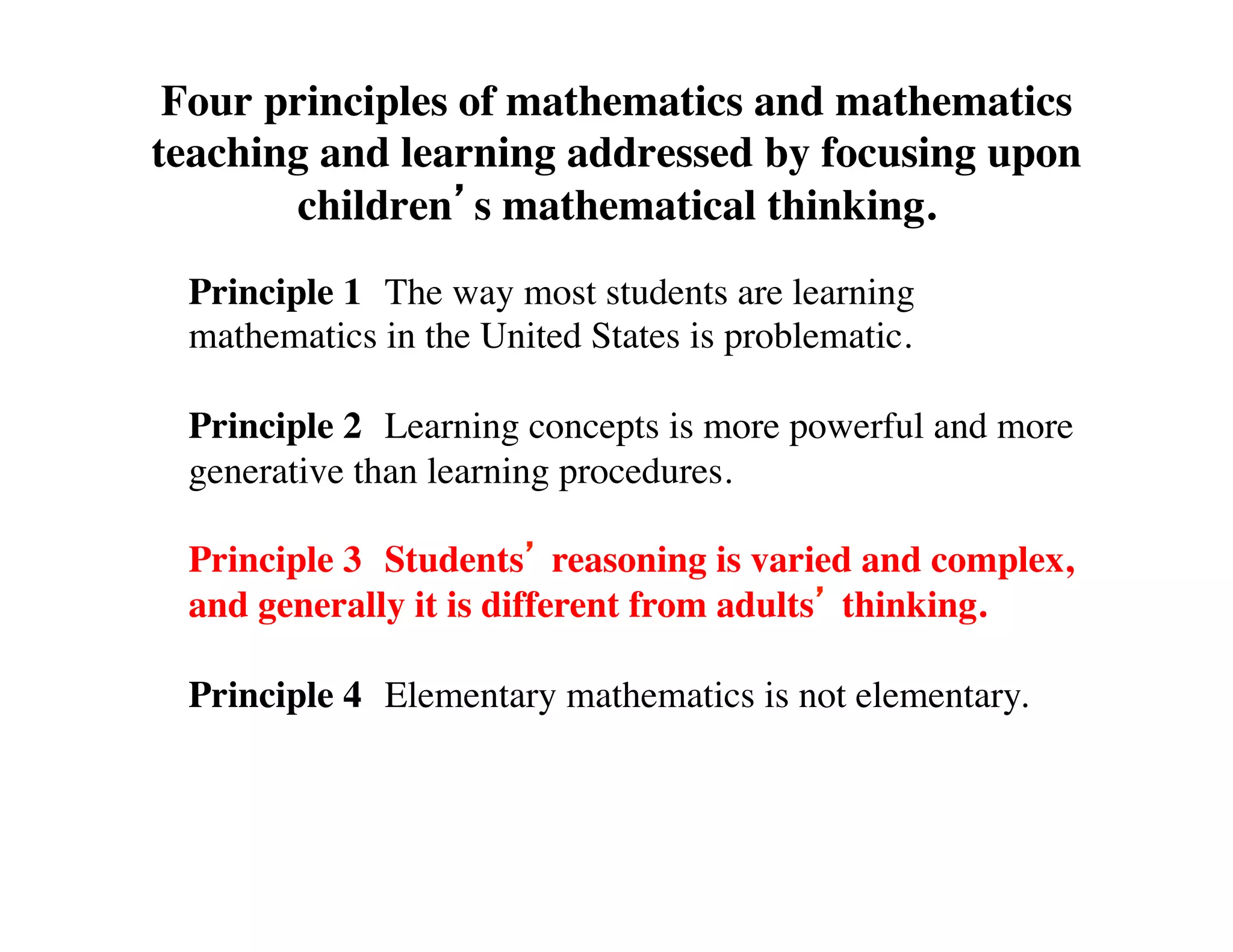
Principle 3 
Students’ reasoning is varied and 
complex, and generally it is different from adults’ 
thinking. 
Principle 4 
Elementary mathematics is not 
elementary.
Four principles of mathematics and mathematics 
teaching and learning addressed by focusing upon 
children’s mathematical thinking. 
Principle 1 
The way most students are learning 
mathematics in the United States is problematic. 
Principle 2 
Learning concepts is more powerful and 
more generative than learning procedures. 
Principle 3 
Students’ reasoning is varied and 
complex, and generally it is different from adults’ 
thinking. 
Principle 4 
Elementary mathematics is not 
elementary.
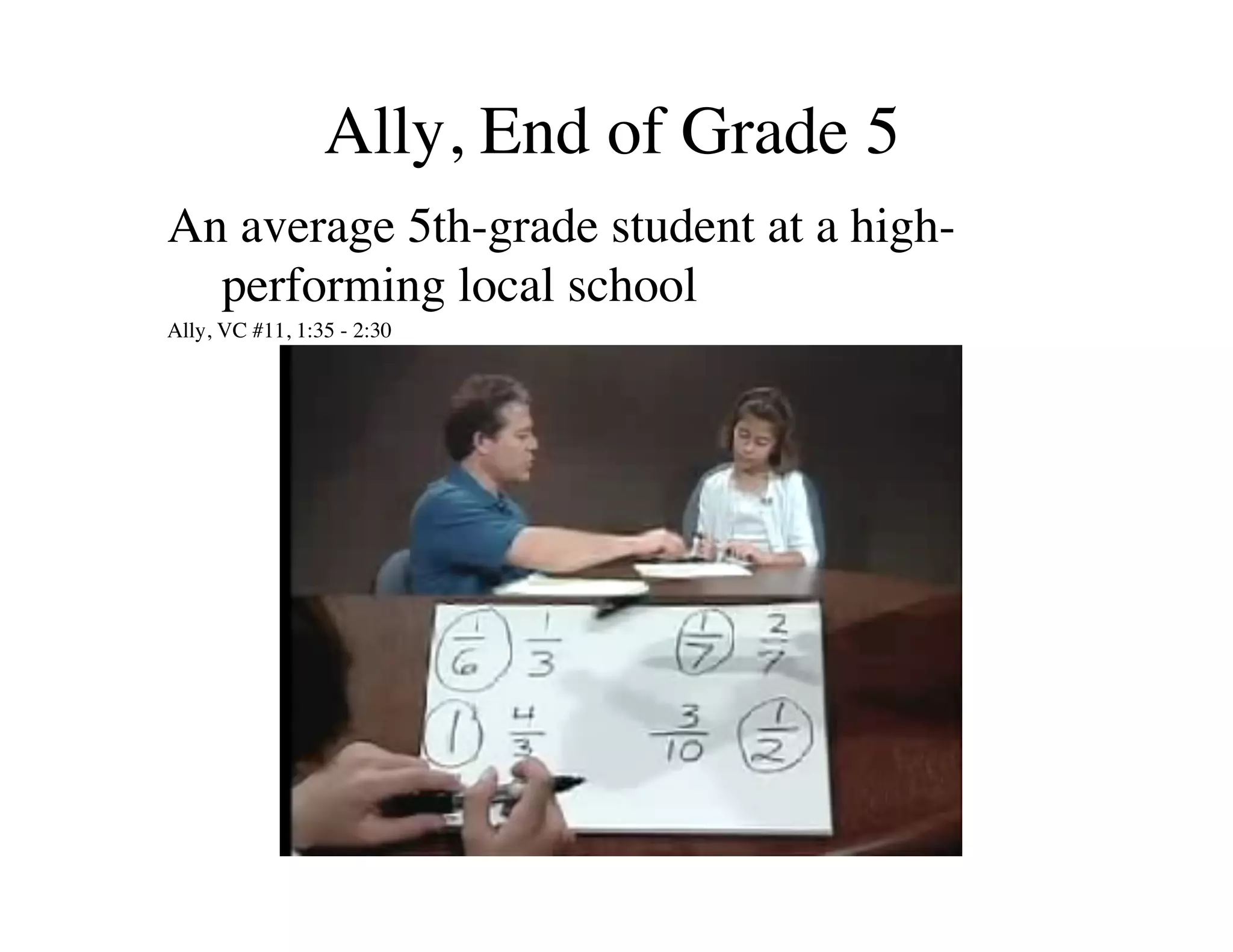
Ally, End of Grade 5! 
An average 5th-grade student at a high-performing 
local school 
Ally, VC #11, 1:35 - 2:30
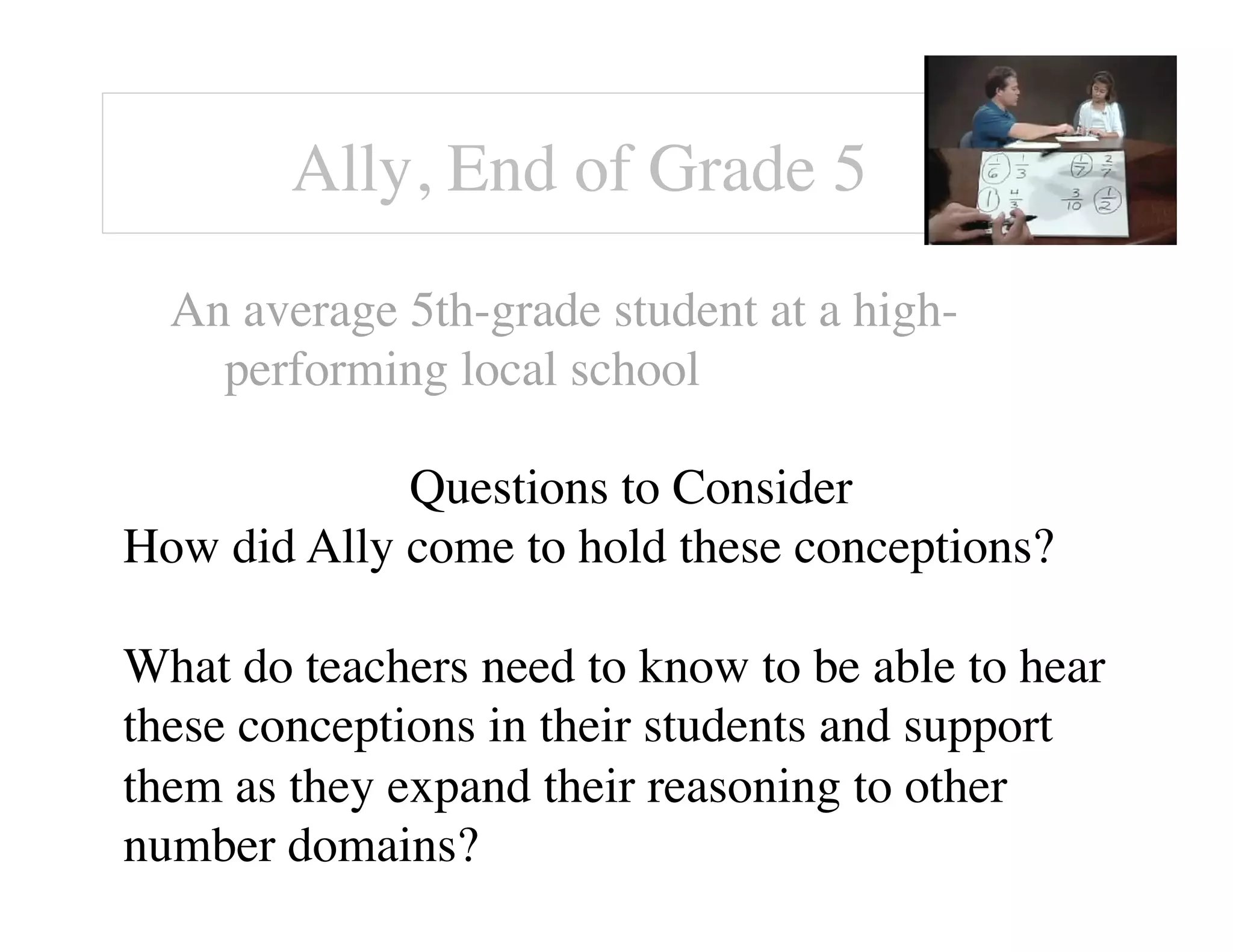
Ally, End of Grade 5! 
An average 5th-grade student at a high-performing 
local school 
Questions to Consider 
How did Ally come to hold these conceptions? 
What do teachers need to know to be able to hear 
these conceptions in their students and support 
them as they expand their reasoning to other 
number domains?
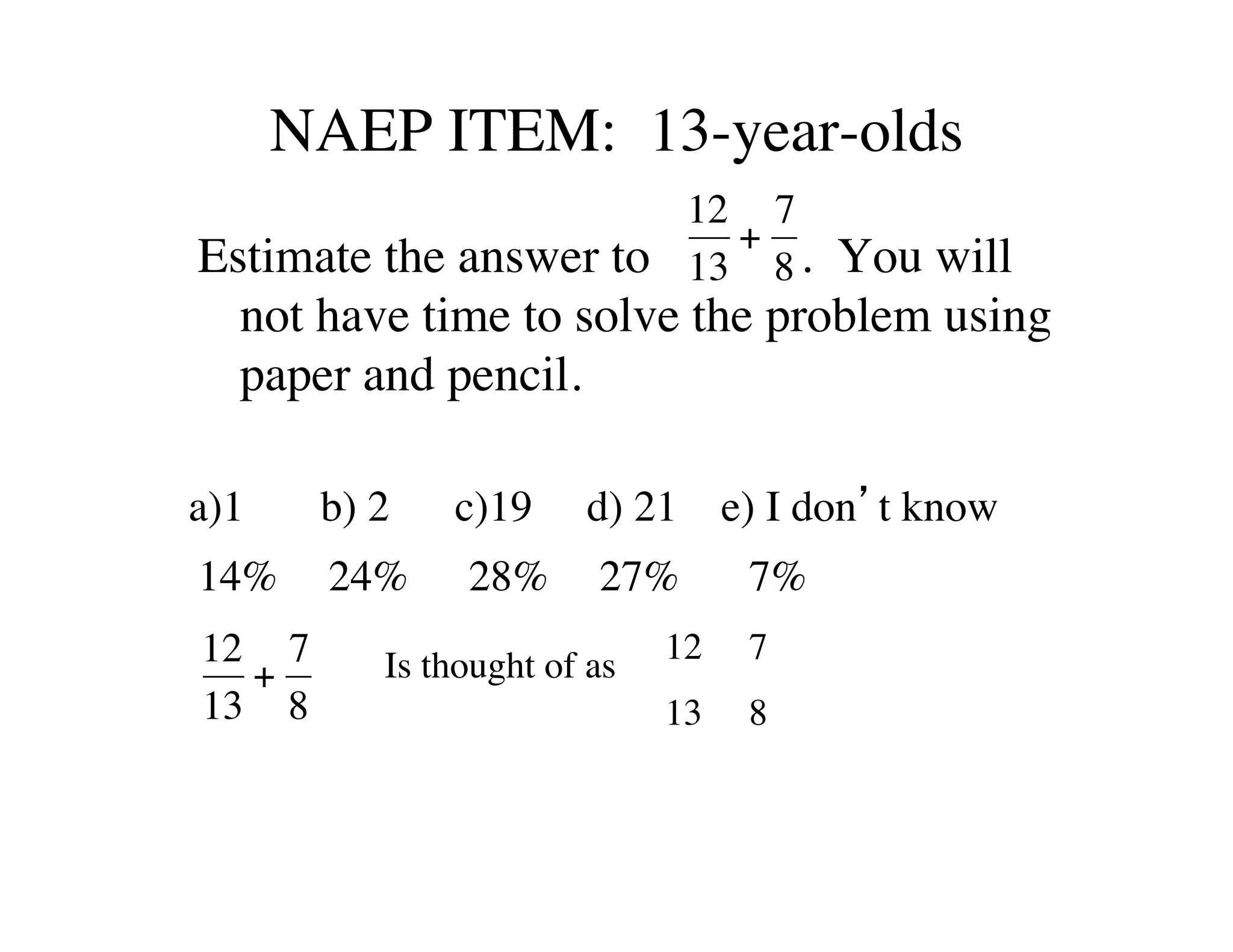
NAEP ITEM: 13-year-olds 
Estimate the answer to . You will 
not have time to solve the problem using 
paper and pencil. 
€ 
12 
13 
+ 
7 
8 
a)1 b) 2 c)19 d) 21 e) I don’t know 
14% 
24% 
28% 
27% 
7% 
€ 
12 
13 
+ 
7 
8 
Is thought of as 
12 7 
13 8
Four principles of mathematics and mathematics 
teaching and learning addressed by focusing upon 
children’s mathematical thinking. 
Principle 1 
The way most students are learning 
mathematics in the United States is problematic. 
Principle 2 
Learning concepts is more powerful and 
more generative than learning procedures. 
Principle 3 
Students’ reasoning is varied and complex, 
and generally it is different from adults’ thinking. 
Principle 4 
Elementary mathematics is not elementary.
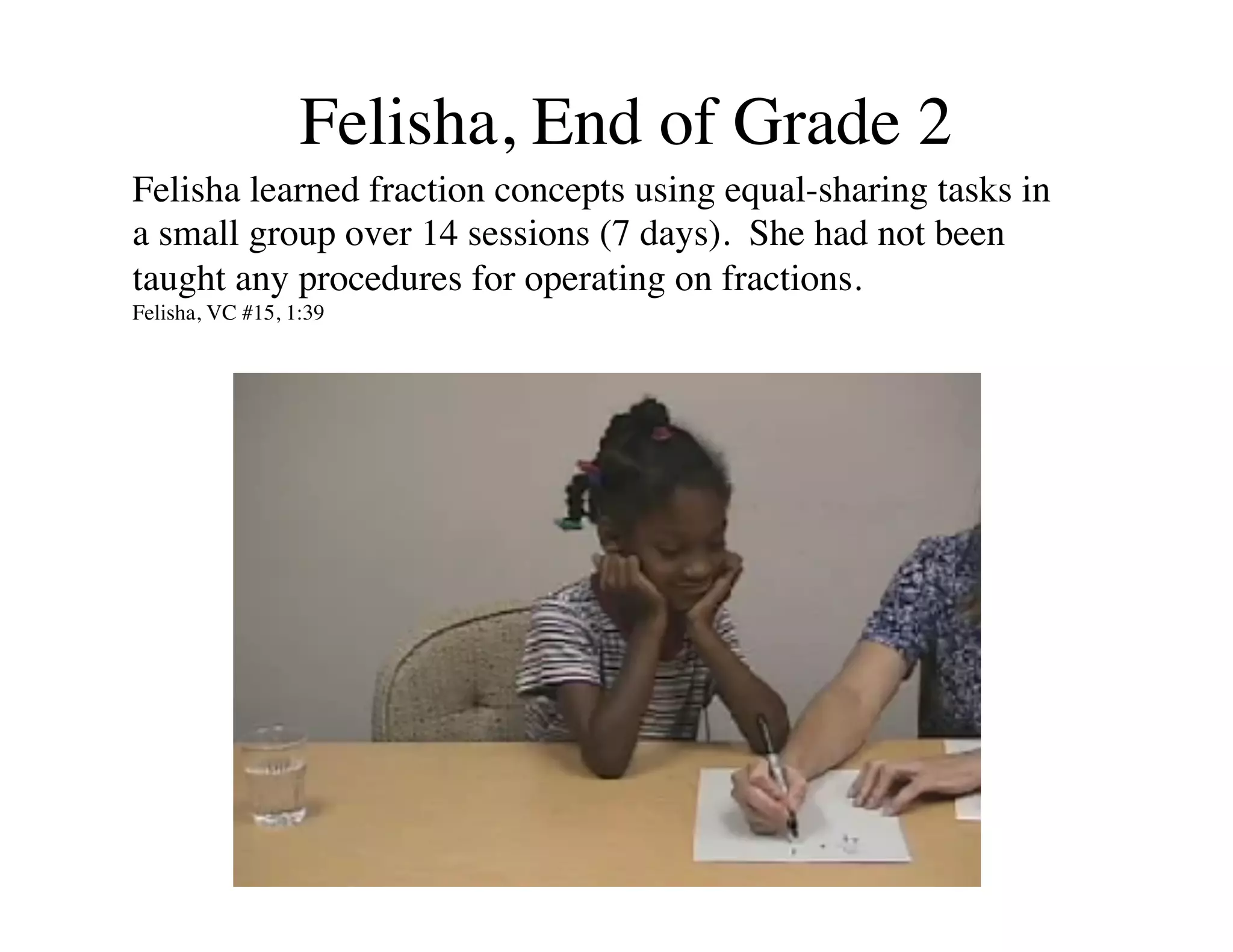
Felisha, End of Grade 2 
Felisha learned fraction concepts using equal-sharing tasks in 
a small group over 14 sessions (7 days). She had not been 
taught any procedures for operating on fractions. 
Felisha, VC #15, 1:39
Felisha, End of Grade 2 
Questions to Consider 
What do teachers need to know to help students 
make sense of fractions as Felisha has done? 
What do teachers need to know to be able to pose 
a question that might help Felisha expand her 
thinking?
Consider two problems 
• A problem for secondary-school algebra students 
• A problem for primary-grade students (K-2)
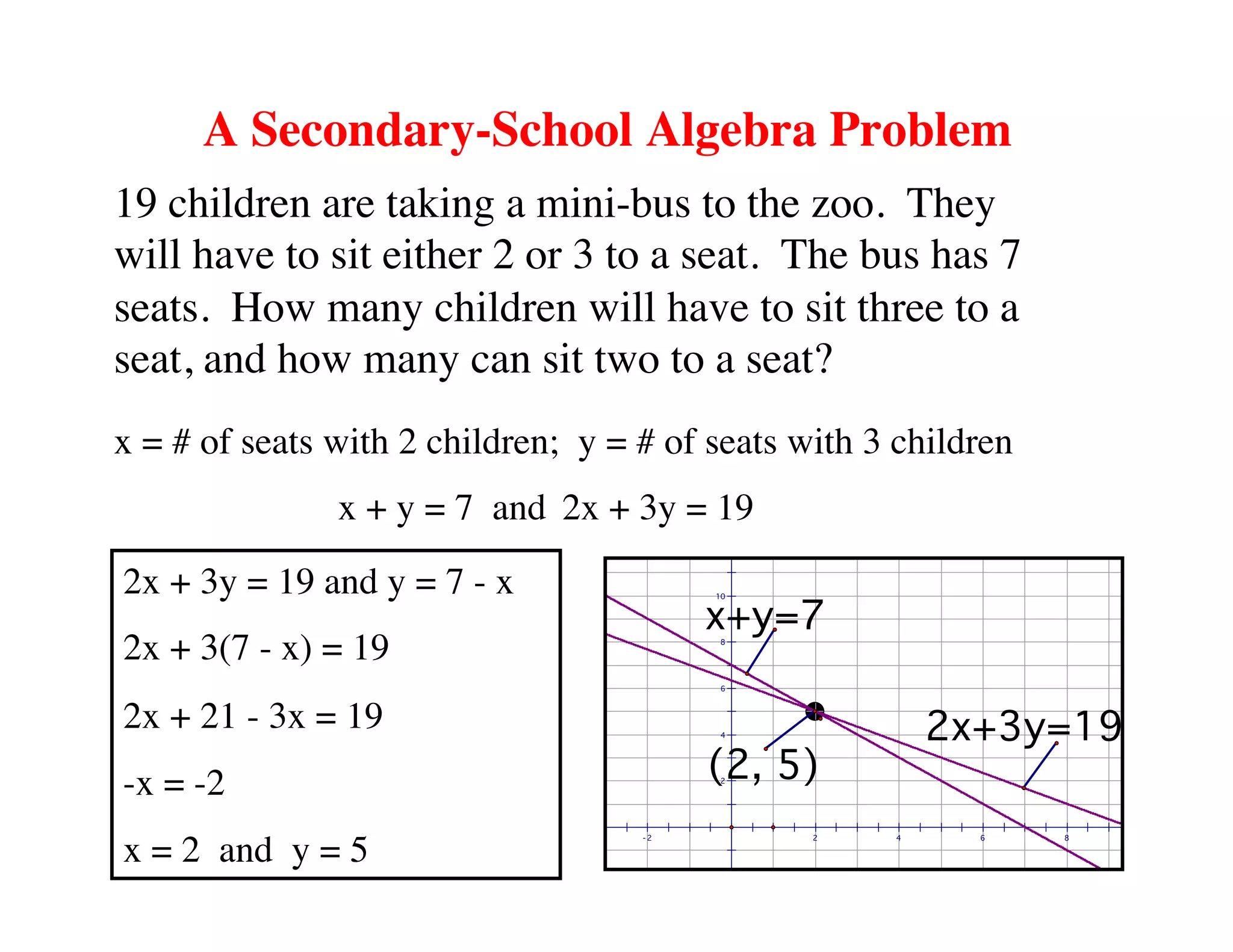
A Secondary-School Algebra Problem 
19 children are taking a mini-bus to the zoo. They 
will have to sit either 2 or 3 to a seat. The bus has 7 
seats. How many children will have to sit three to a 
seat, and how many can sit two to a seat? 
x = # of seats with 2 children; y = # of seats with 3 children 
x + y = 7 and 
2x + 3y = 19 
10 
8 
6 
4 
(2, 5) 
2 
- 2 2 4 6 8 
- 2 
2x+3y=19 
x+y=7 2x + 3y = 19 and y = 7 - x 
2x + 3(7 - x) = 19 
2x + 21 - 3x = 19 
-x = -2 
x = 2 and y = 5
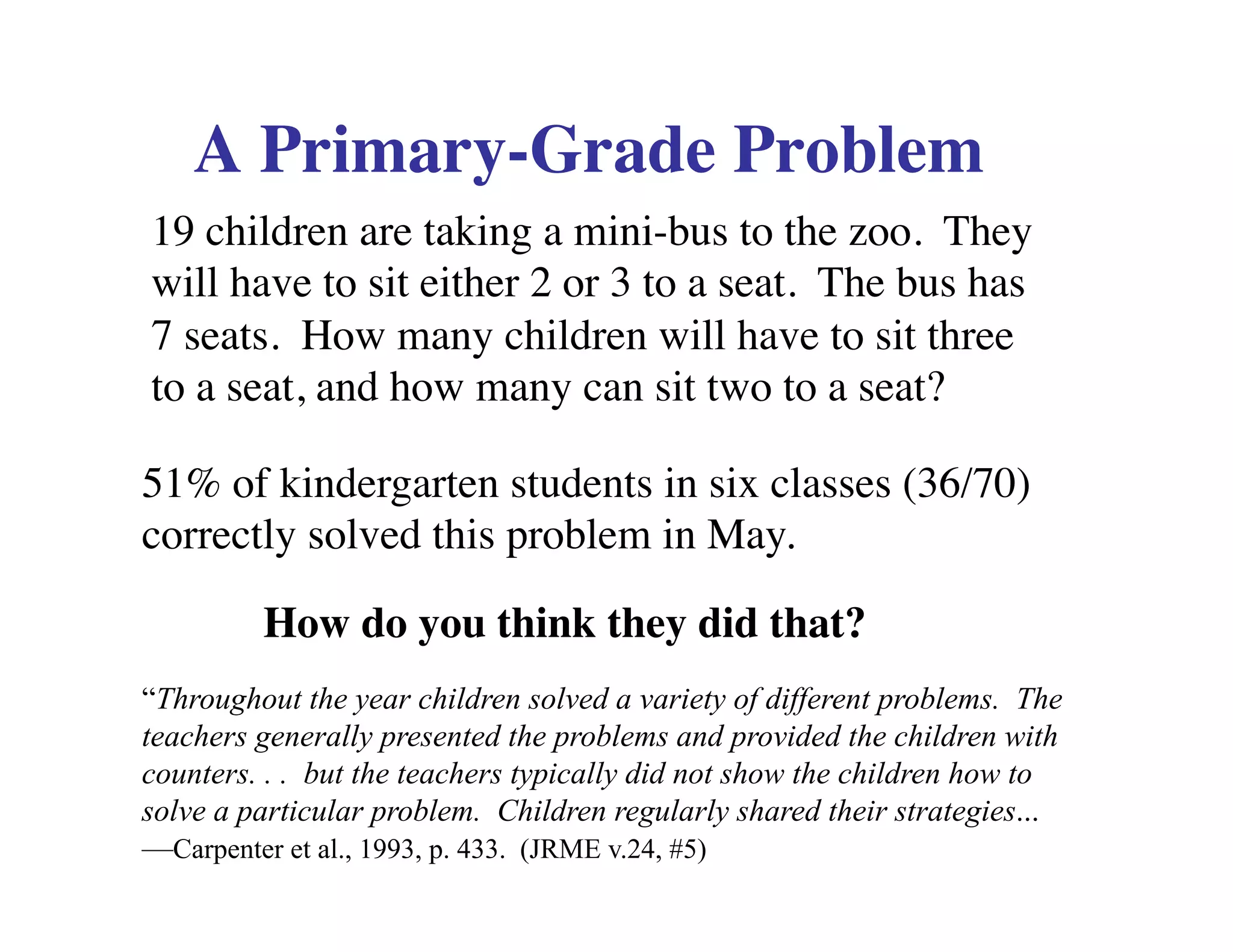
A Primary-Grade Problem 
19 children are taking a mini-bus to the zoo. They 
will have to sit either 2 or 3 to a seat. The bus has 
7 seats. How many children will have to sit three 
to a seat, and how many can sit two to a seat? 
51% of kindergarten students in six classes (36/70) 
correctly solved this problem in May. 
How do you think they did that? 
“Throughout the year children solved a variety of different problems. The 
teachers generally presented the problems and provided the children with 
counters. . . but the teachers typically did not show the children how to 
solve a particular problem. Children regularly shared their strategies... 
—Carpenter et al., 1993, p. 433. (JRME v.24, #5)
Four principles of mathematics and mathematics 
teaching and learning addressed by focusing upon 
children’s mathematical thinking. 
Principle 1 
The way most students are learning 
mathematics in the United States is problematic. 
Principle 2 
Learning concepts is more powerful and more 
generative than learning procedures. 
Principle 3 
Students’ reasoning is varied and complex, 
and generally it is different from adults’ thinking. 
Principle 4 
Elementary mathematics is not elementary.
Often What We Think We are Teaching 
is Not What Students are Learning 
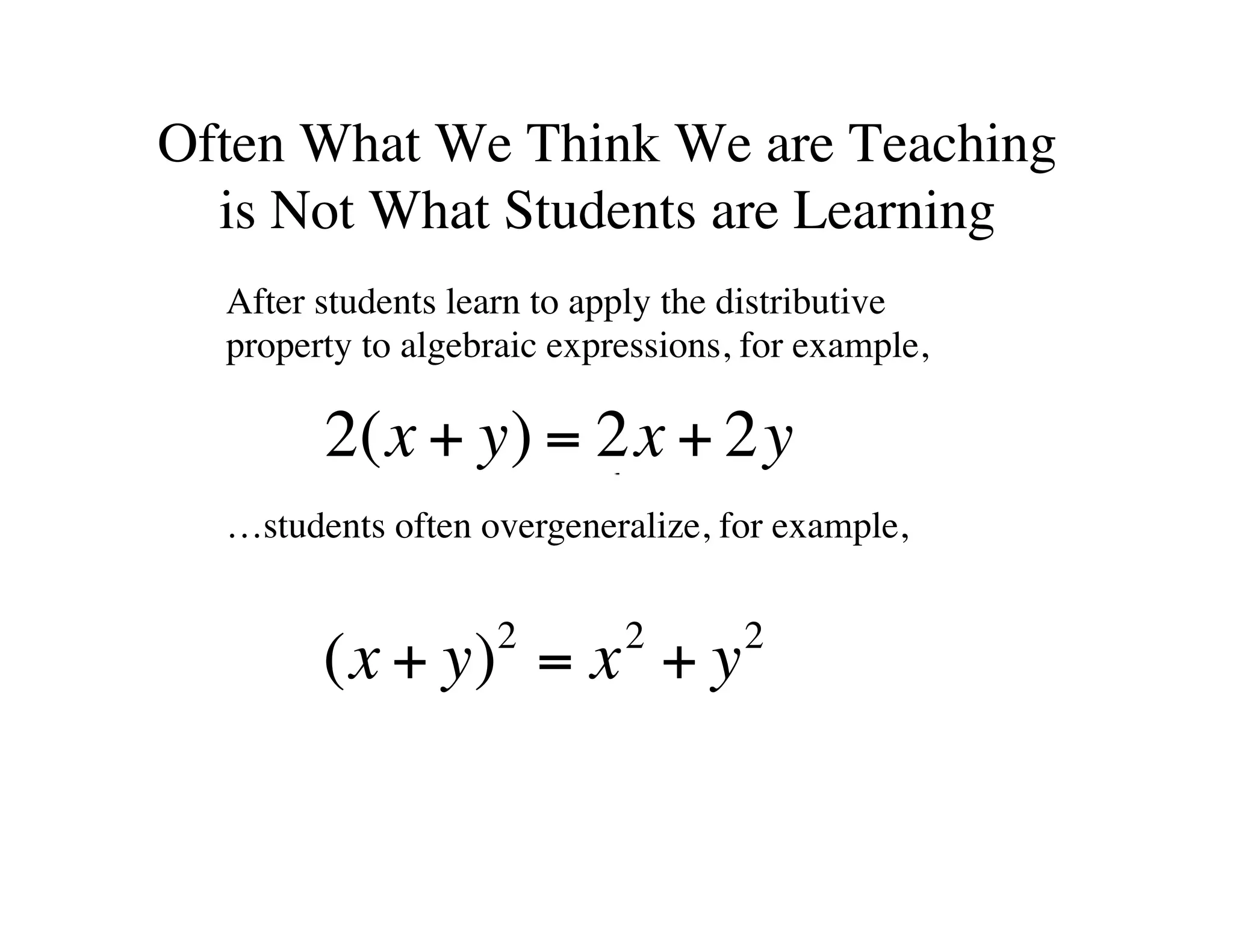
After students learn to apply the distributive 
property to algebraic expressions, for example, 
2(x + y) = 2x + 2y 
…students often overgeneralize, for example, 
(x + y)2 = x2 + y2
Often What We Think We are Teaching 
is Not What Students are Learning
Often What We Find Students are Thinking 
is Not What We Have Been Teaching! 
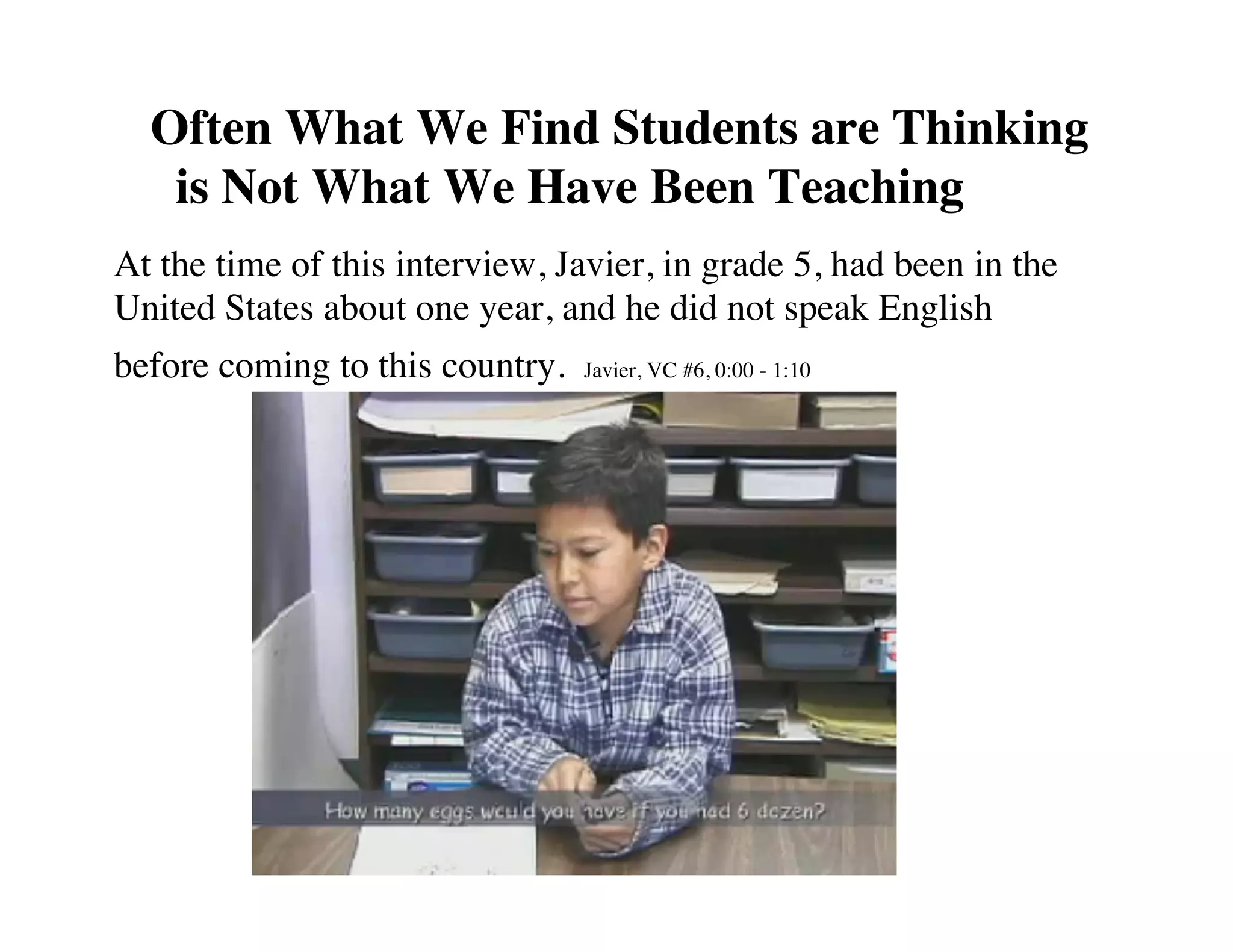
At the time of this interview, Javier, in grade 5, had been in the 
United States about one year, and he did not speak English 
before coming to this country. Javier, VC #6, 0:00 - 1:10
Javier*, Grade 5 
How many eggs are in six cartons (of one dozen)? 
Javier thinks for 15 seconds, and says, “72.” 
I: How did you get that? 
Javier writes and says, “5 times 12 is 60, and 12 
more is 72.” 
I: “How did you know 12 x 5 is 60?” 
J: “Because 12 times 10 equals 120. If I take 
the [sic] half of 120, that would be 60.” 
*At the time of this interview, Javier had been in the United States about one year, and 
he did not speak English before coming to this country.
One Representation of Javier’s Thinking 
6 x 12 
= (5 x 12) + (1 x 12) 
= [(1 
2 
x 10) x 12] + 12 
= [1 
2 
x (10 x 12)] + 12 
= [1 
2 
x (120)] + 12 
= 60 + 12 
= 72 
(Distributive prop. of x over +) 
(Substitution property) 
(Associative property of x) 
Place value 
What would a teacher need to know to 
understand Javier’s thinking, and where do 
teachers learn this?
How do we, as teachers, respond when 
faced with a child who has a more 
mathematically creative or innovative 
solution than we have?
Four principles of mathematics and mathematics 
teaching and learning addressed by focusing upon 
children’s mathematical thinking. 
Principle 1 
The way most students are learning 
mathematics in the United States is problematic. 
Principle 2 
Learning concepts is more powerful and more 
generative than learning procedures. 
Principle 3 
Students’ reasoning is varied and complex, 
and generally it is different from adults’ thinking. 
Principle 4 
Elementary mathematics is not elementary.
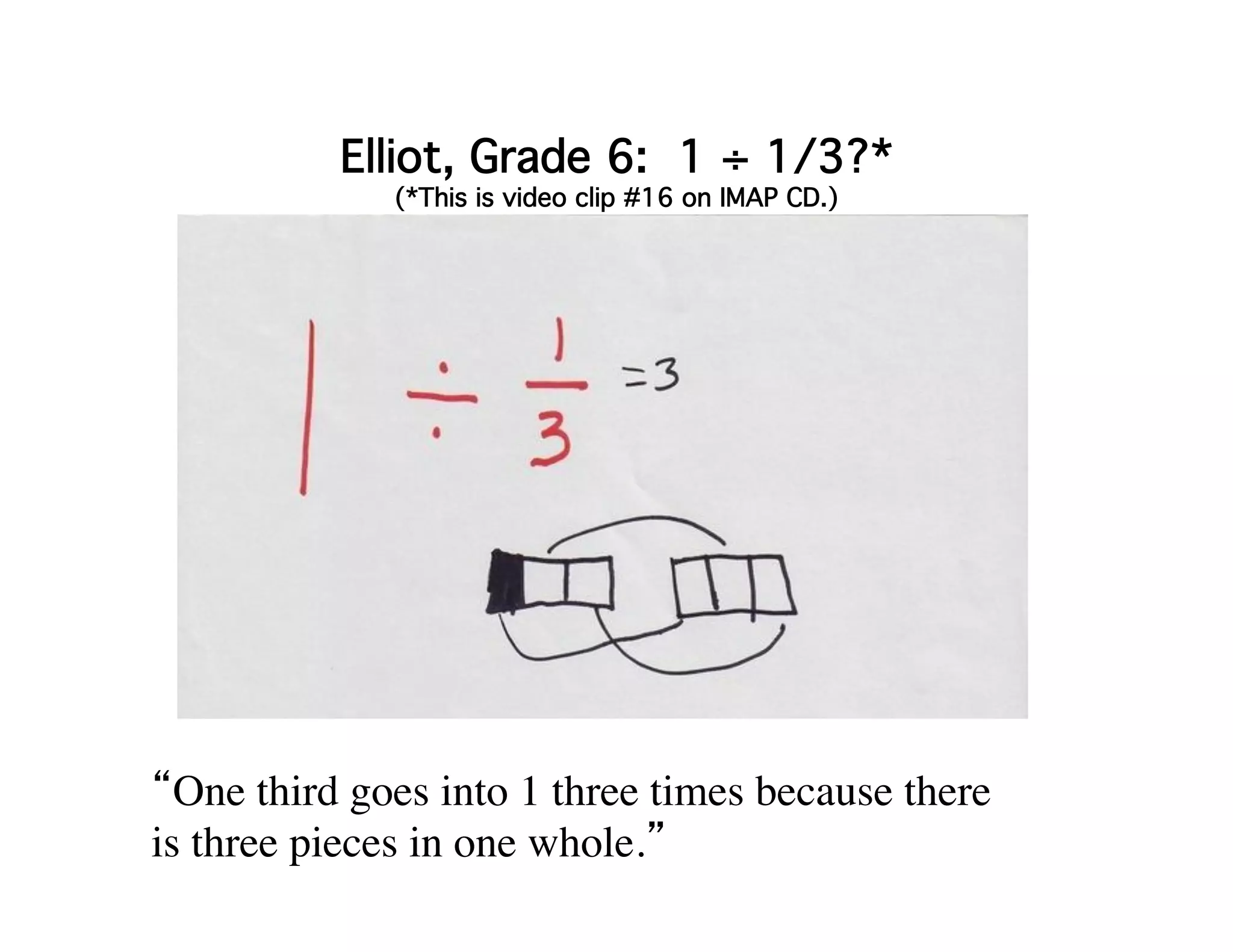
Elliot, Grade 6: 1 ÷ 1/3?* 
(*This is video clip #16 on IMAP CD.) 
“One third goes into 1 three times because there 
is three pieces in one whole.”
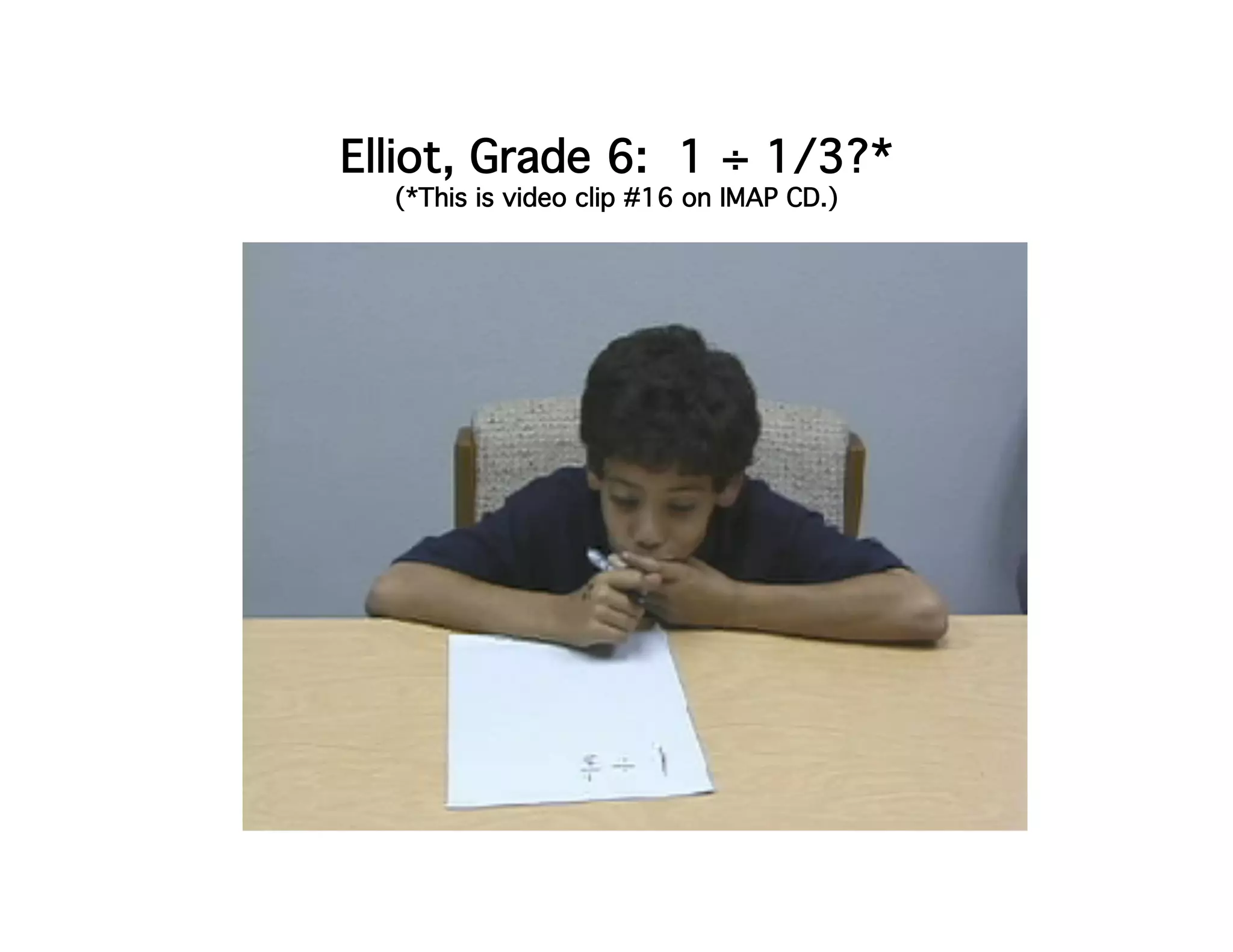
Elliot, Grade 6: 1 ÷ 1/3?* 
(*This is video clip #16 on IMAP CD.)
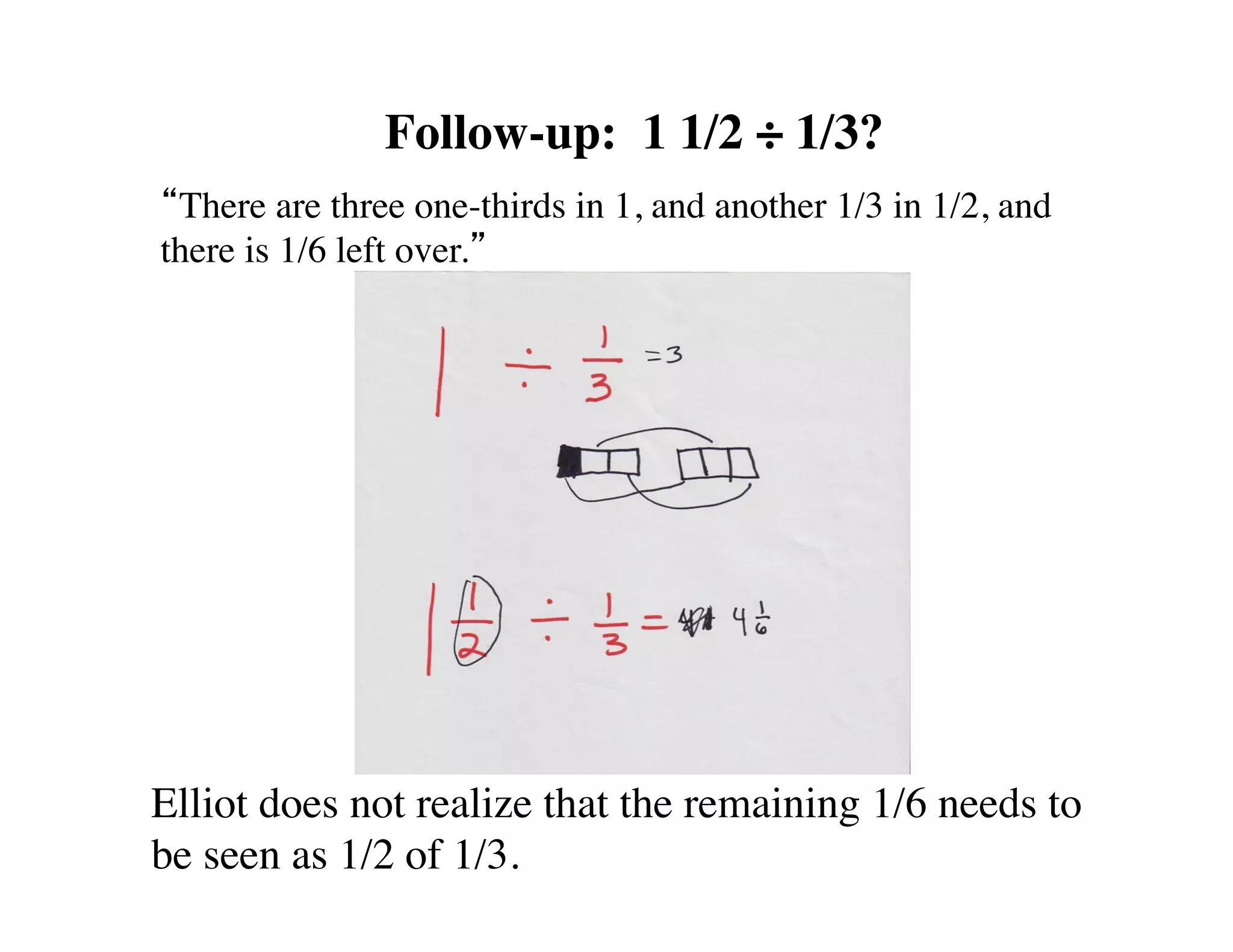
Follow-up: 1 1/2 ÷ 1/3? 
“There are three one-thirds in 1, and another 1/3 in 1/2, and 
there is 1/6 left over.” 
Elliot does not realize that the remaining 1/6 needs to 
be seen as 1/2 of 1/3.
Elliot, Grade 6 
Question for PSTs 
Explain Elliot’s reasoning. 
What does one need to understand to be in 
the position to support Elliot? 
Issue 
Understanding is seldom black and white. Everybody 
understands something about anything, and no one understands 
everything about anything.
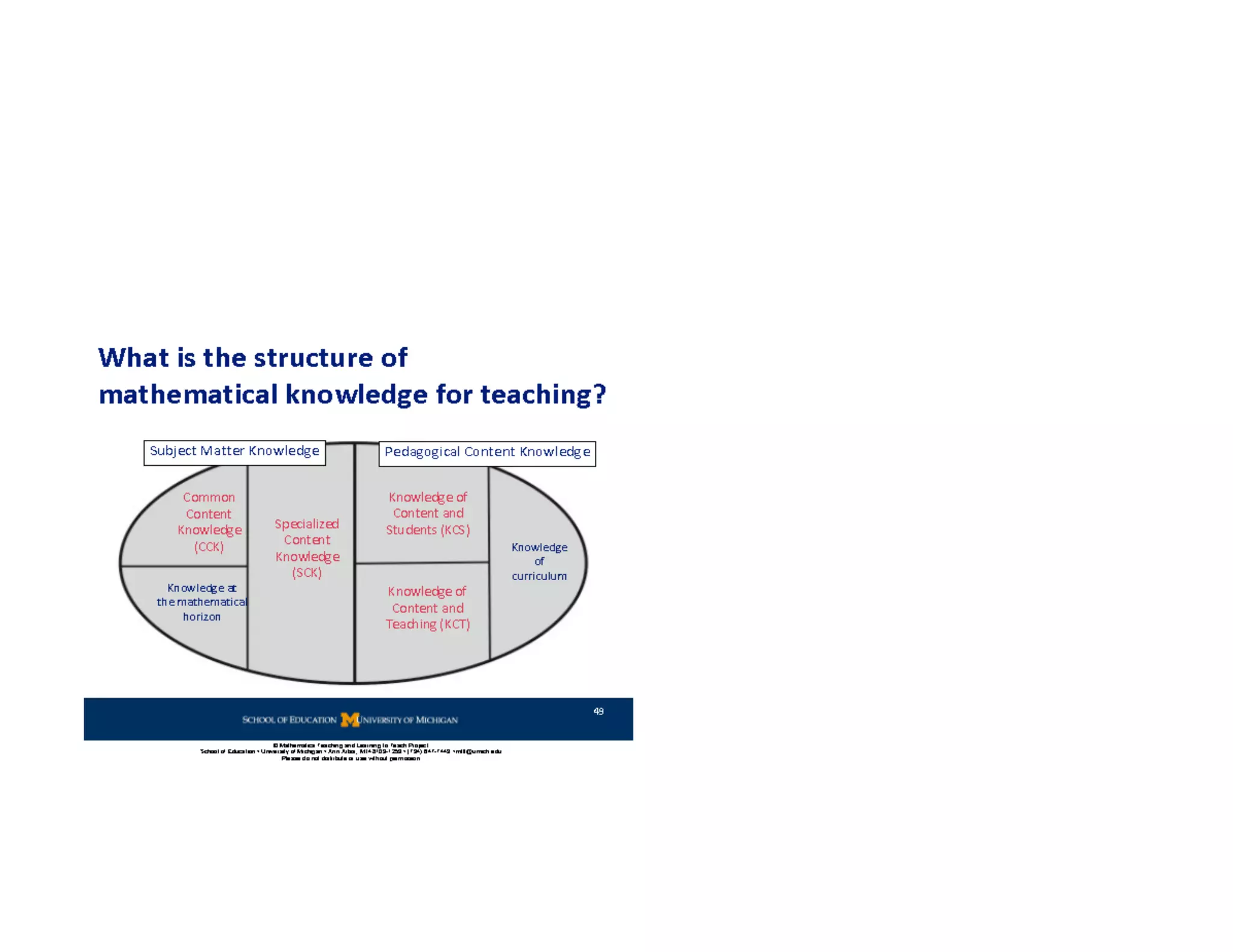
What knowledge do teachers need to 
teach mathematics?
What knowledge do teachers need to 
teach mathematics?
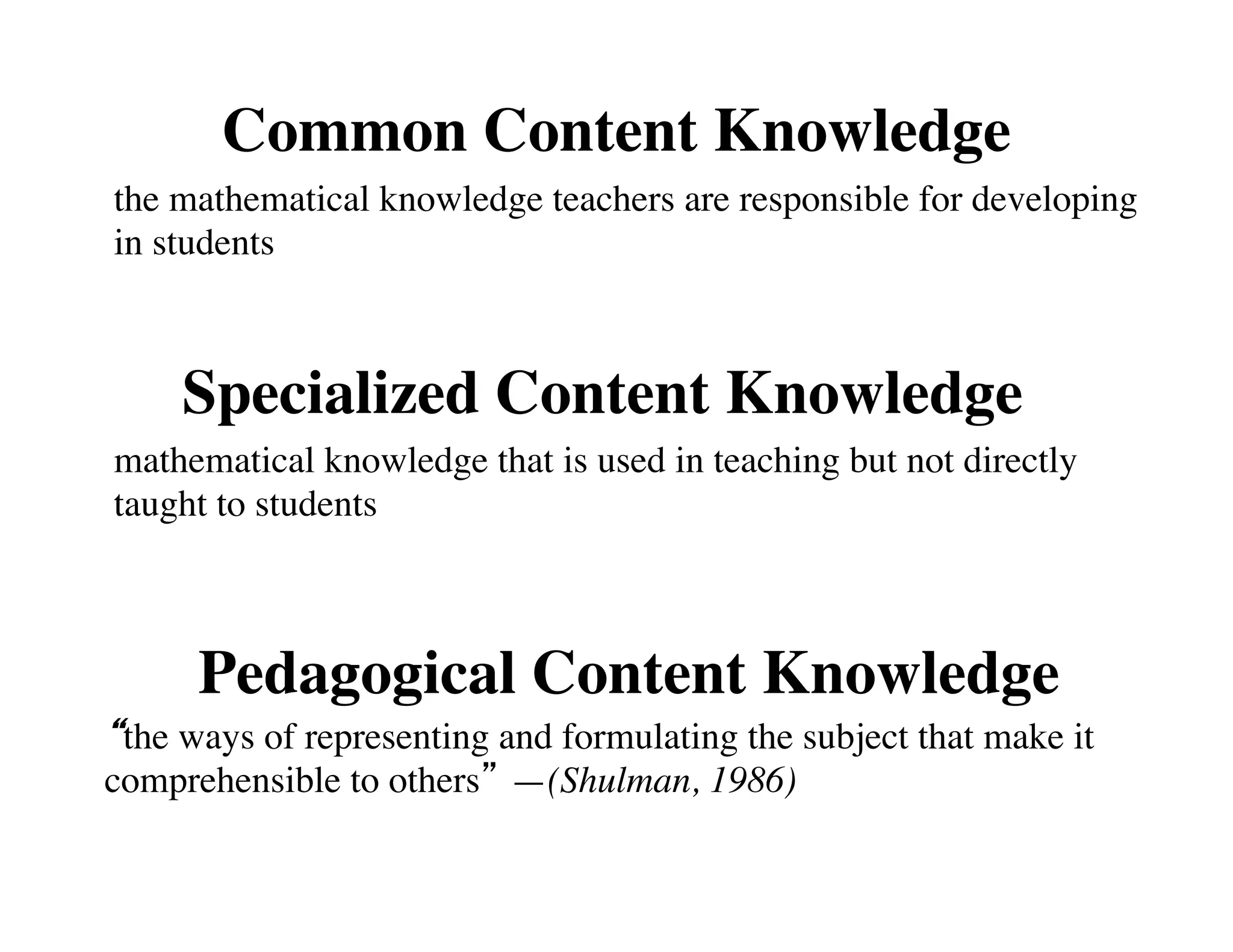
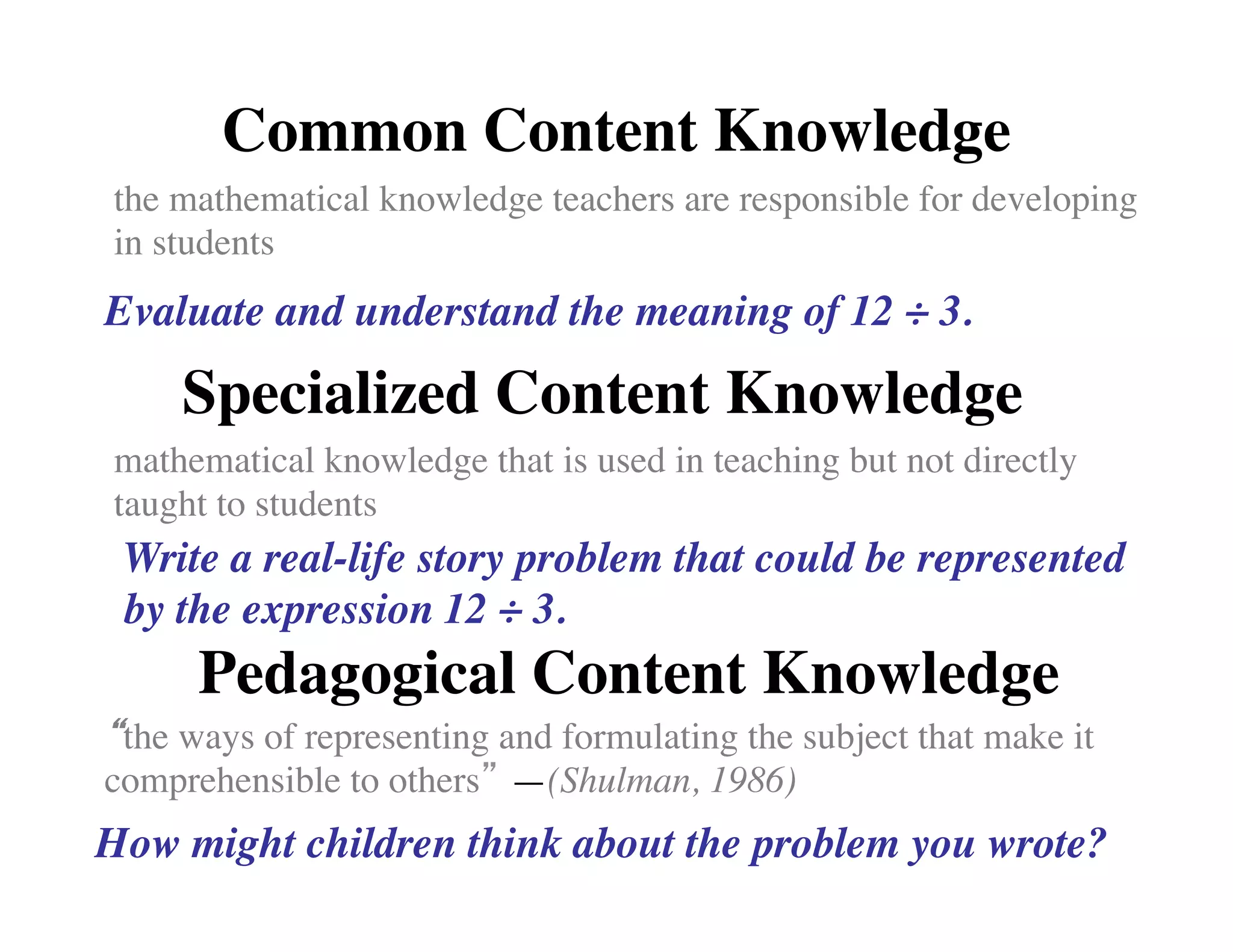
Common Content Knowledge 
the mathematical knowledge teachers are responsible for developing 
in students 
Specialized Content Knowledge 
mathematical knowledge that is used in teaching but not directly 
taught to students 
Pedagogical Content Knowledge 
“the ways of representing and formulating the subject that make it 
comprehensible to others” —(Shulman, 1986)
Common Content Knowledge 
the mathematical knowledge teachers are responsible for developing 
in students 
Evaluate and understand the meaning of 12 ÷ 3. 
Specialized Content Knowledge 
mathematical knowledge that is used in teaching but not directly 
taught to students 
Write a real-life story problem that could be represented 
by the expression 12 ÷ 3. 
Pedagogical Content Knowledge 
“the ways of representing and formulating the subject that make it 
comprehensible to others” —(Shulman, 1986) 
How might children think about the problem you wrote?
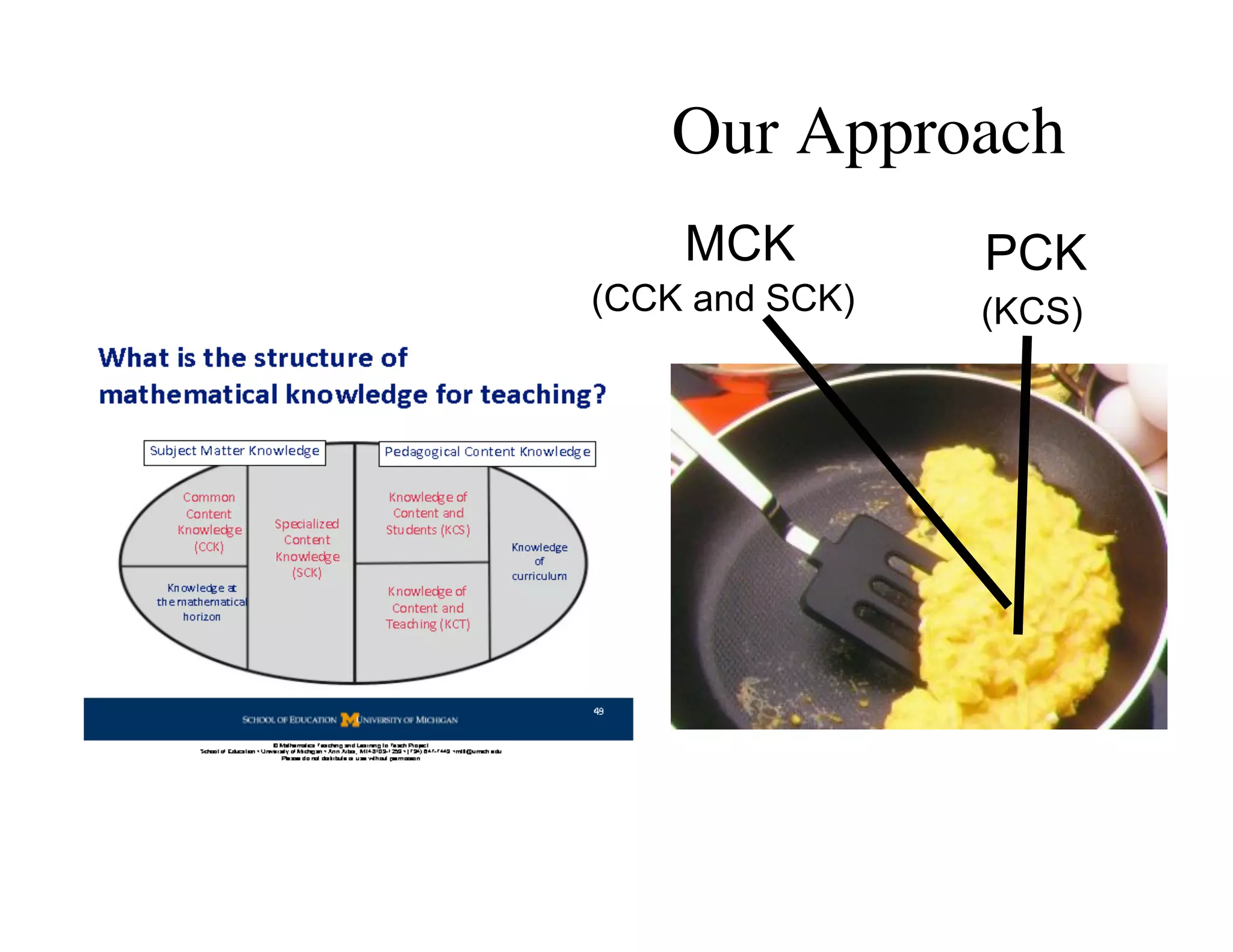
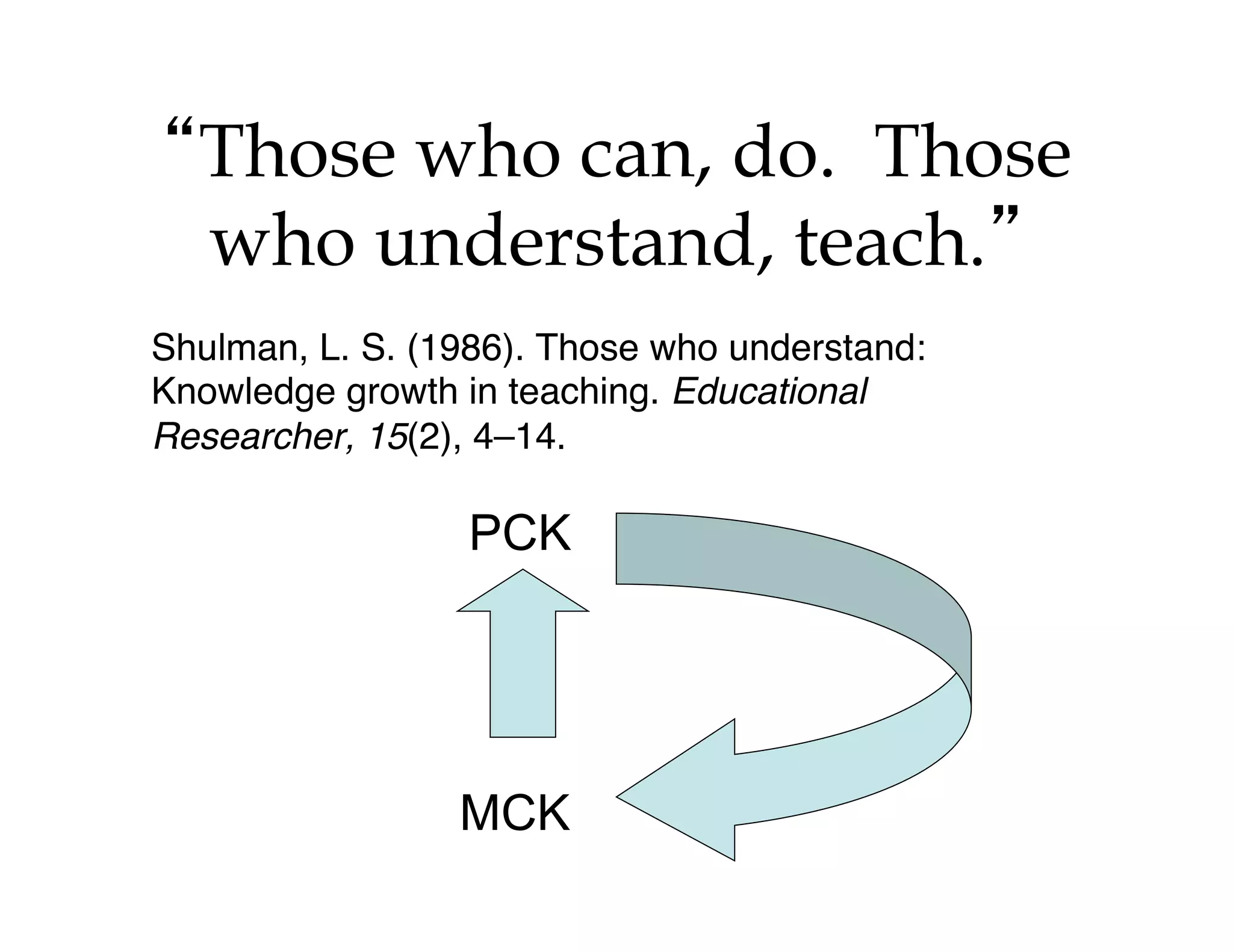
Our Approach 
MCK 
(CCK and SCK) 
PCK 
(KCS)
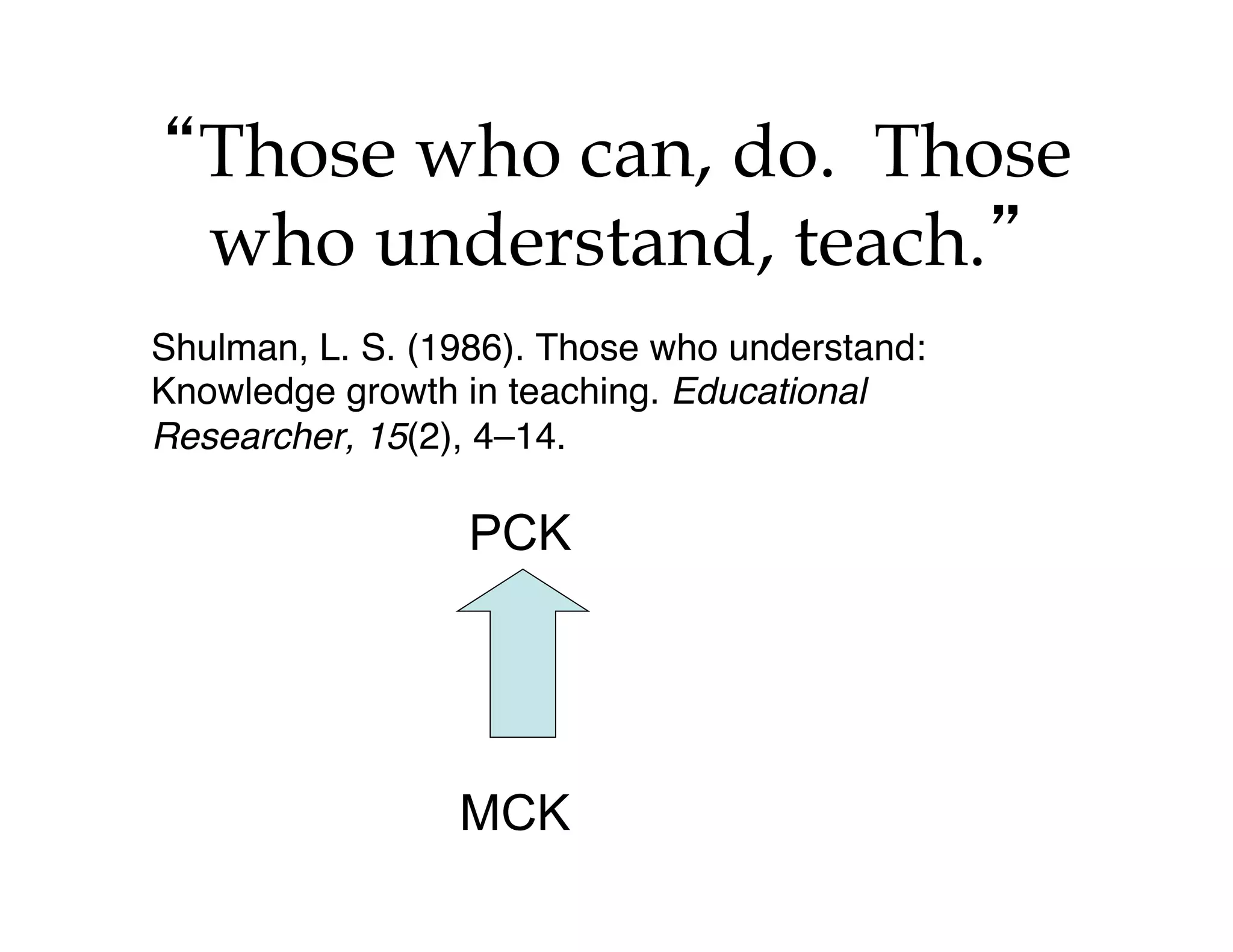
“Those who can, do. Those 
who understand, teach.” 
Shulman, L. S. (1986). Those who understand: 
Knowledge growth in teaching. Educational 
Researcher, 15(2), 4–14.
“Those who can, do. Those 
who understand, teach.” 
Shulman, L. S. (1986). Those who understand: 
Knowledge growth in teaching. Educational 
Researcher, 15(2), 4–14. 
PCK 
MCK
“Those who can, do. Those 
who understand, teach.” 
Shulman, L. S. (1986). Those who understand: 
Knowledge growth in teaching. Educational 
Researcher, 15(2), 4–14. 
PCK 
MCK
Which of these strands do your students develop?
Is Video the New Manipulative 
in Education? 
• With manipulatives, do we assume that the 
mathematics is embedded in the 
representation, for all to see? 
• What are students seeing? 
• With video, do we assume the pedagogical 
principle is explicit for all to see? 
• What are students, teachers, or colleagues 
seeing? 
!
Thank you. 
Discussion

Philipp pm slides

  • 1.
    The Not-So-Elementary Taskof Preparing Elementary School Teachers to Understand Elementary Mathematics Yopp Distinguished Speaker Series University of North Carolina, Greensboro September 8, 2014 Dr. Randy Philipp San Diego State University RPhilipp@mail.sdsu.edu
  • 2.
    Abstract !If elementaryschool mathematics is so elementary, then why do so many people struggle to understand? Using video of children's mathematical thinking, we will consider some of the complexities of seemingly simple topics of whole numbers and fractions, highlighting some of the issues related to mathematical understanding, and I will share how a focus on children’s mathematical thinking motivates prospective elementary school teachers to more deeply engage with mathematics. !
  • 3.
    Thank You! UNCGMathematics Education Group in the School of Education The Graduate Students James D. and Johanna F. Yopp
  • 4.
    Presentation Plan •What does it mean to do mathematics? • Consider issues related to mathematics content. • There is a problem with how PSTs are learning mathematics, but we found one approach. • I’ll share 4 principles of mathematics teaching and learning addressed by a focus on children’s mathematical thinking.
  • 5.
    But first: Asecondary question to keep in mind today 2014 AMTE Session organized with Rob Wieman Is Video the New Manipulative in Education? -Maarten Dolk, Freudenthal Institute
  • 6.
  • 7.
  • 8.
    Manipulatives are Tools • With manipulatives, do we assume that the mathematics is embedded in the representation, for all to see? • What are students seeing? • With video, do we assume the pedagogical principle is explicit for all to see? • What are students, teachers, or colleagues seeing? Ball, D. L. (1992). Magical Hopes: Manipulatives and the Reform of Math Education. American Educator(Summer), 14-18, 46-47. Thompson, P. W. (1995). Notation, convention, and quantity in elementary mathematics. In J. T. Sowder & B. P. Schappelle (Eds.), Providing a foundation for teaching mathematics in the middle grades (pp. 199-221). New York: State University of New York Press. Moyer, P. S. (2001). Are we having fun yet? How teachers use manipulatives to teach mathematics. Educational Studies in Mathematics, 47, 175-197.
  • 9.
    Presentation Plan •What does it mean to do mathematics? • Consider issues related to mathematics content. • There is a problem with how PSTs are learning mathematics, but we found one approach. • I’ll share 4 principles of mathematics teaching and learning addressed by a focus on children’s mathematical thinking.
  • 10.
    Define Mathematical Proficiency • Concepts ! • Procedures ! • Problem Solving! • Reasoning and Justifying! • Positive Outlook!
  • 11.
    Define Mathematical Proficiency • Concepts (Conceptual Understanding)! • Procedures (Procedural Fluency)! • Problem Solving (Strategic Competence)! • Reasoning and Justifying (Adaptive Reasoning)! • Positive Outlook (Productive Disposition)! National Research Council. (2001). Adding it Up: Helping Children Learn Mathematics. Washington, D.C.: National Academy Press.!
  • 12.
    The Strands of Mathematical Proficiency National Research Council. (2001). Adding it Up: Helping Children Learn Mathematics. Washington, D.C.: National Academy Press.!
  • 13.
    The Strands of Mathematical Proficiency The tendency to see sense in mathematics, to perceive it as both useful and worthwhile, to believe that steady effort in learning mathematics pays off, and to see oneself as an effective learner and doer of mathematics.! Integrated and functional grasp of mathematical ideas! The capacity to think logically about the relationships among concepts and situations, including the ability to justify one’s reasoning both formally and informally.! Knowledge of procedures, knowledge of when and how to use them appropriately, and skill in performing them flexibly, accurately, and efficiently.! The ability to formulate mathematical problems, represent them, and solve them.!
  • 14.
    The Strands of Mathematical Proficiency The tendency to see sense in mathematics, to perceive it as both useful and worthwhile, to believe that steady effort in learning mathematics pays off, and to see oneself as an effective learner and doer of mathematics.! Integrated and functional grasp of mathematical ideas! The capacity to think logically about the relationships among concepts and situations, including the ability to justify one’s reasoning both formally and informally.! Knowledge of procedures, knowledge of when and how to use them appropriately, and skill in performing them flexibly, accurately, and efficiently.! The ability to formulate mathematical problems, represent them, and solve them.!
  • 15.
    The Strands of Mathematical Proficiency The tendency to see sense in mathematics, to perceive it as both useful and worthwhile, to believe that steady effort in learning mathematics pays off, and to see oneself as an effective learner and doer of mathematics.! Integrated and functional grasp of mathematical ideas! The capacity to think logically about the relationships among concepts and situations, including the ability to justify one’s reasoning both formally and informally.! Knowledge of procedures, knowledge of when and how to use them appropriately, and skill in performing them flexibly, accurately, and efficiently.! The ability to formulate mathematical problems, represent them, and solve them.!
  • 16.
    The CCSS ProcessStandards 1 Make sense of problems and persevere in solving them. 2 Reason abstractly and quan=ta=vely. 3 Construct viable arguments and cri=que the reasoning of others. 4 Model with mathema=cs. 5 Use appropriate tools strategically. 6 AFend to precision (in language and math) 7 Look for and make use of structure. 8 Look for and express regularity in repeated reasoning.
  • 17.
    1 Make sense of problems and persevere in solving them. 2 Reason abstractly and quan=ta=vely. 3 Construct viable arguments and cri=que the reasoning of others. 4 Model with mathema=cs. 5 Use appropriate tools strategically. 6 AFend to precision (in language and math) 7 Look for and make use of structure. 8 Look for and express regularity in repeated reasoning.
  • 18.
    Students Learning Mathematics Two 5th-Graders (*This is video clip #9 on IMAP CD.)! Circle the larger or write =. 4.7 4.70
  • 19.
    Which of thesestrands do your students develop?
  • 20.
    Presentation Plan •What does it mean to do mathematics? • Consider issues related to mathematics content. • There is a problem with how PSTs are learning mathematics, but we found one approach. • I’ll share 4 principles of mathematics teaching and learning addressed by a focus on children’s mathematical thinking.
  • 21.
    Ones Task Belowis the work of Terry, a second grader, who solved this addition problem and this subtraction problem in May. Problem A Problem B 1) Does the 1 in each of these problems represent the same amount? Please explain your answer. 2) Explain why in addition (as in Problem A) the 1 is added to the 5, but in subtraction (as in Problem B) 10 is added to the 2.
  • 22.
    Example of Scoreof 4 Problem A Problem B 1) Does the 1 in each of these problems represent the same amount? Please explain your answer. “No, in the addition problem it represents a ten because 9 + 8 = 17, but in the subt. problem it represents 100 or 10 tens.” 2) Explain why in addition (as in Problem A) the 1 is added to the 5, but in subtraction (as in Problem B) 10 is added to the 2. “In the addition problem it is a ten from the 17 so we add one more ten to the 50 + 30. In the subtraction problem it’s not 1 more ten it’s 10 tens so we are taking 3 tens away from 12 tens.”
  • 23.
    Example of Scoreof 0 Problem A Problem B 1) Does the 1 in each of these problems represent the same amount? Please explain your answer. “In Problem a you adding one. In problem B you are adding 10.” 2) Explain why in addition (as in Problem A) the 1 is added to the 5, but in subtraction (as in Problem B) 10 is added to the 2. “Because in A you need to carry the 1 in 17 over. But in B you are taking the 1 from the 4.”
  • 24.
    Principal Investigators RandyPhilipp, PI Vicki Jacobs, co-PI Faculty Associates Lisa Lamb, Jessica Pierson Research Associate Bonnie Schappelle Project Coordinators Candace Cabral Graduate Students John (Zig) Siegfried Others Chris Macias-Papierniak, Courtney White Funded by the National Science Foundation, ESI-0455785
  • 25.
    Prospective Teachers Experienced Teachers Before Professional Development Experienced Teachers w/2 years of Professional Development Experienced Teachers w/4 or more years of Professional Development Ones Task Group Means (Standard Deviations) 0–4 scale
  • 26.
    Group Means (StandardDeviations) Statistically Significant Differences Prospective Teachers Ones Task 0–4 scale Experienced Teachers Before Professional Development Experienced Teachers w/2 years of Professional Development Experienced Teachers w/4 or more years of Professional Development 0.31 (0.80) 1.58 (1.26) 2.49 (1.22) 2.72 (1.05) 29 of 35 Prospective Teachers Scored 0
  • 27.
    The Strands of Mathematical Proficiency ? The tendency to see sense in mathematics, to perceive it as both useful and worthwhile, to believe that steady effort in learning mathematics pays off, and to see oneself as an effective learner and doer of mathematics.!
  • 28.
    Example of Mathematical Disposition 70 - 23 53 76 - 23 53 “Yes, math is like that sometimes.”
  • 29.
    Mathematical Integrity Aneducation isn't how much you have committed to memory, or even how much you know. It's being able to differentiate between what you do know and what you don't.! ! (Anatole France, Nobel Prize-winning author)!
  • 30.
    Presentation Plan •What does it mean to do mathematics? • Consider issues related to mathematics content. • There is a problem with how PSTs are learning mathematics, but we found one approach. • I’ll share 4 principles of mathematics teaching and learning addressed by a focus on children’s mathematical thinking.
  • 31.
    The Problem Evenwhen students attend a thoughtfully planned mathematics course for prospective elementary school teachers (PSTs), too many go through the course in a perfunctory manner. (Ball, 1990; Ma, 1999; Sowder, Philipp, Armstrong, Schappelle, 1998) Many PSTs do not seem to value the experience.
  • 32.
    Why? Many PSTshold a complex system of beliefs that supports their not valuing the learning of more mathematics. For example, consider the effect of believing the following: “If I, a college student, do not know something, then children would not be expected to learn it. And if I do know something, then I certainly don’t need to learn it again.”
  • 33.
    In other words… We, mathematics instructors of PSTs, are answering questions that PSTs have yet to ask.
  • 34.
    Should we tryto get PSTs to care more about mathematics for mathematics sake? This is one starting point. We took a different starting point, building on the work of Nel Noddings (1984).
  • 35.
    Why not startwith what PSTs care about? Children! -Darling-Hammond Sclan, 1996
  • 36.
    Circles of Caring Children Start with that about which prospec=ve teachers care.
  • 37.
    Circles of Caring Children Children's Mathematical Thinking When PSTs engage children in mathema=cal problem solving, their circles of caring expand to include children’s mathema=cal thinking.
  • 38.
    Circles of Caring Children Children's Mathematical Thinking Mathematics And when PSTs engage with children’s mathema=cal thinking, they realize that, to be prepared to support children, they must themselves grapple with the mathema=cs, and their circles of caring extend.
  • 39.
    This idea is at least 100 years old. John Dewey, 1902 Every subject has two aspects, “one for the scien=st as a scien=st; the other for the teacher as a teacher” (p. 351). “[The teacher] is concerned, not with the subject-­‐maFer as such, but with the subject-­‐maFer as a related factor in a total and growing experience [of the child]” (p. 352). ! ! Dewey, J. (1902/1990). The child and the curriculum. Chicago: The University of Chicago Press. !
  • 40.
    Children Mathematics Lookingat mathematics through the lens of children’s mathematical thinking helps PSTs come to care about mathematics, not as mathematicians, but as teachers.
  • 41.
    We tested thistheory. Major Result* When compared to PSTs who did not learn about children’s mathematical thinking, PSTs who did learn about children’s mathematical thinking a) improved their mathematical content knowledge and b) developed more sophisticated beliefs. *Philipp, R. A., Ambrose, R., Lamb, L. C., Sowder, J. T., Schappelle, B. P., Sowder, L., et al. (2007). Effects of early field experiences on the mathematical content knowledge and beliefs of prospective elementary school teachers: An experimental study. Journal for Research in Mathematics Education, 38(5), 438 - 476.
  • 42.
    Where Might WeInfuse Children’s Mathematical Thinking? • Education Courses • Mathematics Courses • Hybrid Courses (CMTE) – Link Content to Children – Help PSTs Consider Future (e.g., Ali)
  • 43.
    How did thefocus on children’s thinking help the PSTs?
  • 44.
    A PST Speaksfor Herself Why study about children’s mathematical thinking while learning mathematics? CMTE Clip, 0:23 - 0:56
  • 45.
    Presentation Plan •What does it mean to do mathematics? • Consider issues related to mathematics content. • There is a problem with how PSTs are learning mathematics, but we found one approach. • I’ll share 4 principles of mathematics teaching and learning addressed by a focus on children’s mathematical thinking.
  • 46.
    Four principles ofmathematics and mathematics teaching and learning addressed by focusing upon children’s mathematical thinking. Principle 1 The way most students are learning mathematics in the United States is problematic. Principle 2 Learning concepts is more powerful and more generative than learning procedures. Principle 3 Students’ reasoning is varied and complex, and generally it is different from adults’ thinking. Principle 4 Elementary mathematics is not elementary.
  • 47.
    Four principles ofmathematics and mathematics teaching and learning addressed by focusing upon children’s mathematical thinking. Principle 1 The way most students are learning mathematics in the United States is problematic. Principle 2 Learning concepts is more powerful and more generative than learning procedures. Principle 3 Students’ reasoning is varied and complex, and generally it is different from adults’ thinking. Principle 4 Elementary mathematics is not elementary.
  • 48.
    Ally, End ofGrade 5! An average 5th-grade student at a high-performing local school Ally, VC #11, 1:35 - 2:30
  • 49.
    Ally, End ofGrade 5! An average 5th-grade student at a high-performing local school Questions to Consider How did Ally come to hold these conceptions? What do teachers need to know to be able to hear these conceptions in their students and support them as they expand their reasoning to other number domains?
  • 50.
    NAEP ITEM: 13-year-olds Estimate the answer to . You will not have time to solve the problem using paper and pencil. € 12 13 + 7 8 a)1 b) 2 c)19 d) 21 e) I don’t know 14% 24% 28% 27% 7% € 12 13 + 7 8 Is thought of as 12 7 13 8
  • 51.
    Four principles ofmathematics and mathematics teaching and learning addressed by focusing upon children’s mathematical thinking. Principle 1 The way most students are learning mathematics in the United States is problematic. Principle 2 Learning concepts is more powerful and more generative than learning procedures. Principle 3 Students’ reasoning is varied and complex, and generally it is different from adults’ thinking. Principle 4 Elementary mathematics is not elementary.
  • 52.
    Felisha, End ofGrade 2 Felisha learned fraction concepts using equal-sharing tasks in a small group over 14 sessions (7 days). She had not been taught any procedures for operating on fractions. Felisha, VC #15, 1:39
  • 53.
    Felisha, End ofGrade 2 Questions to Consider What do teachers need to know to help students make sense of fractions as Felisha has done? What do teachers need to know to be able to pose a question that might help Felisha expand her thinking?
  • 54.
    Consider two problems • A problem for secondary-school algebra students • A problem for primary-grade students (K-2)
  • 55.
    A Secondary-School AlgebraProblem 19 children are taking a mini-bus to the zoo. They will have to sit either 2 or 3 to a seat. The bus has 7 seats. How many children will have to sit three to a seat, and how many can sit two to a seat? x = # of seats with 2 children; y = # of seats with 3 children x + y = 7 and 2x + 3y = 19 10 8 6 4 (2, 5) 2 - 2 2 4 6 8 - 2 2x+3y=19 x+y=7 2x + 3y = 19 and y = 7 - x 2x + 3(7 - x) = 19 2x + 21 - 3x = 19 -x = -2 x = 2 and y = 5
  • 56.
    A Primary-Grade Problem 19 children are taking a mini-bus to the zoo. They will have to sit either 2 or 3 to a seat. The bus has 7 seats. How many children will have to sit three to a seat, and how many can sit two to a seat? 51% of kindergarten students in six classes (36/70) correctly solved this problem in May. How do you think they did that? “Throughout the year children solved a variety of different problems. The teachers generally presented the problems and provided the children with counters. . . but the teachers typically did not show the children how to solve a particular problem. Children regularly shared their strategies... —Carpenter et al., 1993, p. 433. (JRME v.24, #5)
  • 57.
    Four principles ofmathematics and mathematics teaching and learning addressed by focusing upon children’s mathematical thinking. Principle 1 The way most students are learning mathematics in the United States is problematic. Principle 2 Learning concepts is more powerful and more generative than learning procedures. Principle 3 Students’ reasoning is varied and complex, and generally it is different from adults’ thinking. Principle 4 Elementary mathematics is not elementary.
  • 58.
    Often What WeThink We are Teaching is Not What Students are Learning After students learn to apply the distributive property to algebraic expressions, for example, 2(x + y) = 2x + 2y …students often overgeneralize, for example, (x + y)2 = x2 + y2
  • 59.
    Often What WeThink We are Teaching is Not What Students are Learning
  • 60.
    Often What WeFind Students are Thinking is Not What We Have Been Teaching! At the time of this interview, Javier, in grade 5, had been in the United States about one year, and he did not speak English before coming to this country. Javier, VC #6, 0:00 - 1:10
  • 61.
    Javier*, Grade 5 How many eggs are in six cartons (of one dozen)? Javier thinks for 15 seconds, and says, “72.” I: How did you get that? Javier writes and says, “5 times 12 is 60, and 12 more is 72.” I: “How did you know 12 x 5 is 60?” J: “Because 12 times 10 equals 120. If I take the [sic] half of 120, that would be 60.” *At the time of this interview, Javier had been in the United States about one year, and he did not speak English before coming to this country.
  • 62.
    One Representation ofJavier’s Thinking 6 x 12 = (5 x 12) + (1 x 12) = [(1 2 x 10) x 12] + 12 = [1 2 x (10 x 12)] + 12 = [1 2 x (120)] + 12 = 60 + 12 = 72 (Distributive prop. of x over +) (Substitution property) (Associative property of x) Place value What would a teacher need to know to understand Javier’s thinking, and where do teachers learn this?
  • 63.
    How do we,as teachers, respond when faced with a child who has a more mathematically creative or innovative solution than we have?
  • 64.
    Four principles ofmathematics and mathematics teaching and learning addressed by focusing upon children’s mathematical thinking. Principle 1 The way most students are learning mathematics in the United States is problematic. Principle 2 Learning concepts is more powerful and more generative than learning procedures. Principle 3 Students’ reasoning is varied and complex, and generally it is different from adults’ thinking. Principle 4 Elementary mathematics is not elementary.
  • 65.
    Elliot, Grade 6:1 ÷ 1/3?* (*This is video clip #16 on IMAP CD.) “One third goes into 1 three times because there is three pieces in one whole.”
  • 66.
    Elliot, Grade 6:1 ÷ 1/3?* (*This is video clip #16 on IMAP CD.)
  • 67.
    Follow-up: 1 1/2÷ 1/3? “There are three one-thirds in 1, and another 1/3 in 1/2, and there is 1/6 left over.” Elliot does not realize that the remaining 1/6 needs to be seen as 1/2 of 1/3.
  • 68.
    Elliot, Grade 6 Question for PSTs Explain Elliot’s reasoning. What does one need to understand to be in the position to support Elliot? Issue Understanding is seldom black and white. Everybody understands something about anything, and no one understands everything about anything.
  • 69.
    What knowledge doteachers need to teach mathematics?
  • 71.
    What knowledge doteachers need to teach mathematics?
  • 72.
    Common Content Knowledge the mathematical knowledge teachers are responsible for developing in students Specialized Content Knowledge mathematical knowledge that is used in teaching but not directly taught to students Pedagogical Content Knowledge “the ways of representing and formulating the subject that make it comprehensible to others” —(Shulman, 1986)
  • 73.
    Common Content Knowledge the mathematical knowledge teachers are responsible for developing in students Evaluate and understand the meaning of 12 ÷ 3. Specialized Content Knowledge mathematical knowledge that is used in teaching but not directly taught to students Write a real-life story problem that could be represented by the expression 12 ÷ 3. Pedagogical Content Knowledge “the ways of representing and formulating the subject that make it comprehensible to others” —(Shulman, 1986) How might children think about the problem you wrote?
  • 75.
    Our Approach MCK (CCK and SCK) PCK (KCS)
  • 76.
    “Those who can,do. Those who understand, teach.” Shulman, L. S. (1986). Those who understand: Knowledge growth in teaching. Educational Researcher, 15(2), 4–14.
  • 77.
    “Those who can,do. Those who understand, teach.” Shulman, L. S. (1986). Those who understand: Knowledge growth in teaching. Educational Researcher, 15(2), 4–14. PCK MCK
  • 78.
    “Those who can,do. Those who understand, teach.” Shulman, L. S. (1986). Those who understand: Knowledge growth in teaching. Educational Researcher, 15(2), 4–14. PCK MCK
  • 79.
    Which of thesestrands do your students develop?
  • 80.
    Is Video theNew Manipulative in Education? • With manipulatives, do we assume that the mathematics is embedded in the representation, for all to see? • What are students seeing? • With video, do we assume the pedagogical principle is explicit for all to see? • What are students, teachers, or colleagues seeing? !
  • 81.