05/09/2006 FMUIT'06 1
A Technique for Information Sharing
using Inter-Vehicle Communication
with Message Ferrying
Takashi Shinkawa, Takashi Terauchi, Tomoya Kitani,
Naoki Shibata†, Keiichi Yasumoto,
Minoru Ito, and Teruo Higashino† †
Nara Institute of Science and Technology
† Shiga University
† †Osaka University
05/09/2006 FMUIT'06 2
Overview of our proposal
 Problem of a technique for traffic jam information sharing
using inter-vehicle communication(our previous work)
- It is a technique to propagate the message through the
node (ferry) that regularly moves on the known route
• When car density of an area becomes
low temporarily, collected information is lost.
• When there is no car in a region, traffic jam
information must be collected from scratch.
• Message Ferrying
Introduction of message ferrying
05/09/2006 FMUIT'06 3
Outline
⇒Background
- Our previous work
- Problem of our previous work
 Proposed method
 Experimental Result
 Conclusion and Future work
05/09/2006 FMUIT'06 4
Background
 The traffic jam in urban areas is becoming
a big problem in many countries
• As services to provision traffic information to
avoid traffic jam
VICS (Vehicle Information and Communication System)
It provides traffic information collected in management center
CYBER NAVI (Pioneer)
It uses statistical traffic information generated from history
in addition to VICS
 There is a room for improvement in the service range,
operational cost, time lag of the information, etc
05/09/2006 FMUIT'06 5
Our previous work
 Purpose
- To realize a mechanism for cars to autonomously
collect and exchange traffic information
 Approach
- To reduce the initial infrastructure cost and the
operational cost of the system
- To cover a large service area
 We adopt inter-vehicle communication
 We do not use infrastructure or a management
center
05/09/2006 FMUIT'06 6
Collecting traffic information
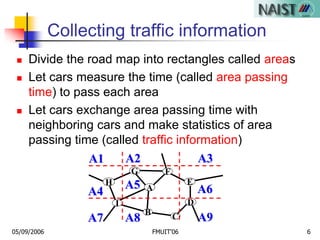
 Divide the road map into rectangles called areas
 Let cars measure the time (called area passing
time) to pass each area
 Let cars exchange area passing time with
neighboring cars and make statistics of area
passing time (called traffic information)
A6
A9
A2
A5
A1 A3
A4
A7 A8
G
A
H
I
B
D
C
F
E
05/09/2006 FMUIT'06 7
Area passing time
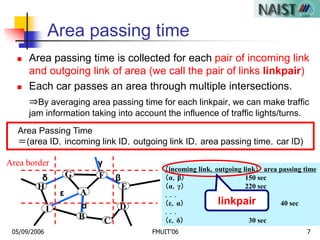
(incoming link,outgoing link) area passing time
(α,β) 150 sec
(α,γ) 220 sec
...
(ε,α) 40 sec
...
(ε,δ) 30 sec
Area Passing Time
=(area ID,incoming link ID,outgoing link ID,area passing time,car ID)
linkpair
G
E
A
H
I
B
α
βδ
ε
D
C
F
Area border γ
 Area passing time is collected for each pair of incoming link
and outgoing link of area (we call the pair of links linkpair)
 Each car passes an area through multiple intersections.
⇒By averaging area passing time for each linkpair, we can make traffic
jam information taking into account the influence of traffic lights/turns.
05/09/2006 FMUIT'06 8
Propagation of area passing time
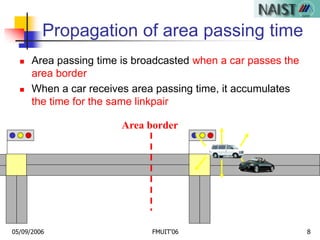
 Area passing time is broadcasted when a car passes the
area border
 When a car receives area passing time, it accumulates
the time for the same linkpair
Area border
05/09/2006 FMUIT'06 9
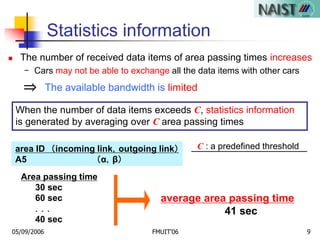
Statistics information
area ID (incoming link,outgoing link)
A5 (α,β)
Area passing time
30 sec
60 sec
...
40 sec
average area passing time
41 sec
The available bandwidth is limited⇒
 The number of received data items of area passing times increases
- Cars may not be able to exchange all the data items with other cars
When the number of data items exceeds C, statistics information
is generated by averaging over C area passing times
C : a predefined threshold
05/09/2006 FMUIT'06 10
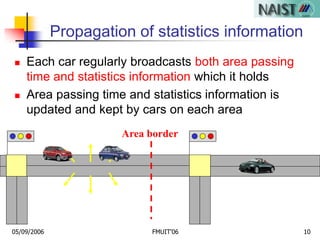
Propagation of statistics information
 Each car regularly broadcasts both area passing
time and statistics information which it holds
 Area passing time and statistics information is
updated and kept by cars on each area
Area border
05/09/2006 FMUIT'06 11
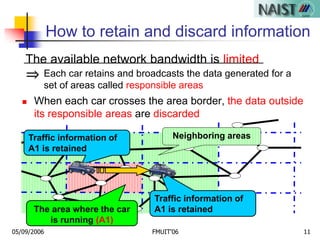
 When each car crosses the area border, the data outside
its responsible areas are discarded
Neighboring areas
The area where the car
is running (A1)
Traffic information of
A1 is retained
Traffic information of
A1 is retained
How to retain and discard information
⇒ Each car retains and broadcasts the data generated for a
set of areas called responsible areas
The available network bandwidth is limited
05/09/2006 FMUIT'06 12
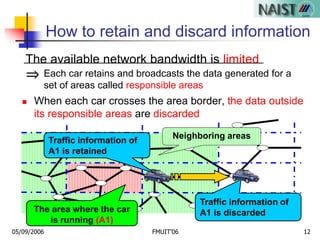
Traffic information of
A1 is discarded
Neighboring areas
How to retain and discard information
The area where the car
is running (A1)
 When each car crosses the area border, the data outside
its responsible areas are discarded
⇒ Each car retains and broadcasts the data generated for a
set of areas called responsible areas
The available network bandwidth is limited
Traffic information of
A1 is retained
05/09/2006 FMUIT'06 13
Problem of previous work
 Problem1:When car density of an area
becomes low temporarily
- The information may be lost
 Problem2: When there is no other car with
the latest traffic information on the area
- The traffic information must be collected from
the scratch.
Introduction of message ferrying
05/09/2006 FMUIT'06 14
Outline
 Background
⇒Proposed method
- Introduction of message ferrying
- Improvement idea of problem
 Experimental result
 Conclusion and future work
05/09/2006 FMUIT'06 15
Message ferrying[1]
 It is a technique to propagate the message
through special nodes (called ferries) that
regularly move along the known routes
- The purpose of message ferrying is to achieve
efficient data propagation in disconnected ad hoc
networks
[1]Wenrui Zhao and Mostafa H. Ammar,
“Message Ferrying: Proactive Routing in Highly-partitioned
Wireless Ad Hoc Networks”, FTDCS 2003
05/09/2006 FMUIT'06 16
Send
Overview of message ferrying
n1
n2
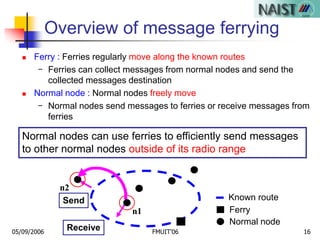
 Ferry : Ferries regularly move along the known routes
- Ferries can collect messages from normal nodes and send the
collected messages destination
 Normal node : Normal nodes freely move
- Normal nodes send messages to ferries or receive messages from
ferries
Normal nodes can use ferries to efficiently send messages
to other normal nodes outside of its radio range
Ferry
Normal node
Known route
Receive
05/09/2006 FMUIT'06 17
Known route
Ferry
Basic ideas of our proposal
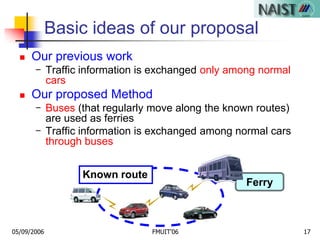
 Our previous work
- Traffic information is exchanged only among normal
cars
 Our proposed Method
- Buses (that regularly move along the known routes)
are used as ferries
- Traffic information is exchanged among normal cars
through buses
05/09/2006 FMUIT'06 18
How to cope with Problem1
Traffic information
of A1 is lost
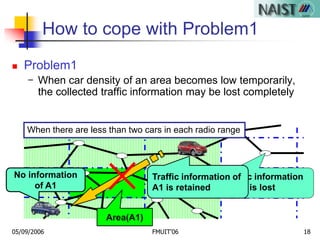
 Problem1
- When car density of an area becomes low temporarily,
the collected traffic information may be lost completely
No information
of A1
Traffic information of
A1 is retained
Area(A1)
When there are less than two cars in each radio range
05/09/2006 FMUIT'06 19
The revival of traffic information becomes possible
Our solution for Problem1
Area(A1)
Keep holding
information of A1
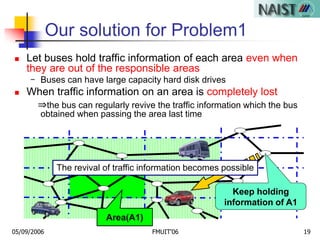
 Let buses hold traffic information of each area even when
they are out of the responsible areas
- Buses can have large capacity hard disk drives
 When traffic information on an area is completely lost
⇒the bus can regularly revive the traffic information which the bus
obtained when passing the area last time
05/09/2006 FMUIT'06 20
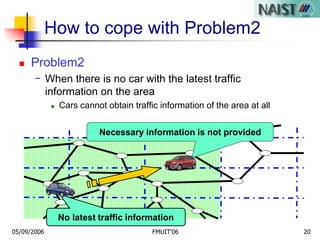
How to cope with Problem2
 Problem2
- When there is no car with the latest traffic
information on the area
 Cars cannot obtain traffic information of the area at all
Necessary information is not provided
No latest traffic information
05/09/2006 FMUIT'06 21
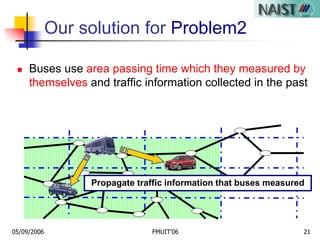
Our solution for Problem2
 Buses use area passing time which they measured by
themselves and traffic information collected in the past
Propagate traffic information that buses measured
05/09/2006 FMUIT'06 22
Outline
 Background
 Proposed method
⇒Performance evaluation
 Conclusion and future work
05/09/2006 FMUIT'06 23
Overview of Experiment
 To what extent, the proposed method (with
buses) can improve our previous method
(w/o buses) with respect to information
propagation ratio.
 We have implemented our method and
conducted simulation with traffic flow
simulator NETSTREAM developed by
Toyota Central R&D Labs
05/09/2006 FMUIT'06 24
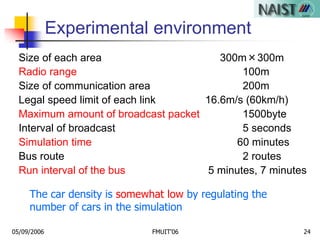
Experimental environment
Size of each area 300m×300m
Radio range 100m
Size of communication area 200m
Legal speed limit of each link 16.6m/s (60km/h)
Maximum amount of broadcast packet 1500byte
Interval of broadcast 5 seconds
Simulation time 60 minutes
Bus route 2 routes
Run interval of the bus 5 minutes, 7 minutes
The car density is somewhat low by regulating the
number of cars in the simulation
05/09/2006 FMUIT'06 25
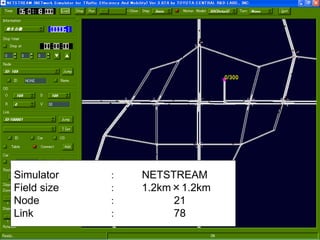
Simulator : NETSTREAM
Field size : 1.2km×1.2km
Node : 21
Link : 78
05/09/2006 FMUIT'06 26
The route a of the bus
The route b of the bus
B
C
D
E
F
G
H
I
J
K
L
M
N
O
P
R
S
Q
A A11
A13
A4
A12
A9 A10A8
A6
A3
A7A5
A2A1
A14
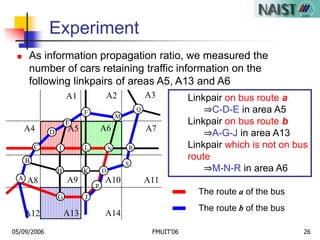
 As information propagation ratio, we measured the
number of cars retaining traffic information on the
following linkpairs of areas A5, A13 and A6
Experiment
Linkpair on bus route a
⇒C-D-E in area A5
Linkpair on bus route b
⇒A-G-J in area A13
Linkpair which is not on bus
route
⇒M-N-R in area A6
05/09/2006 FMUIT'06 27
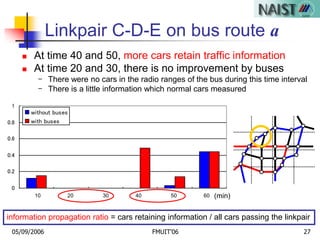
Linkpair C-D-E on bus route a
 At time 40 and 50, more cars retain traffic information
 At time 20 and 30, there is no improvement by buses
- There were no cars in the radio ranges of the bus during this time interval
- There is a little information which normal cars measured
0
0.2
0.4
0.6
0.8
1
1 2 3 4 5 6
without buses
with buses
10 20 30 40 50 60 (min)
information propagation ratio = cars retaining information / all cars passing the linkpair
05/09/2006 FMUIT'06 28
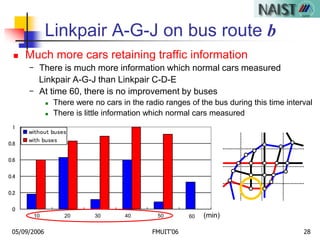
Linkpair A-G-J on bus route b
 Much more cars retaining traffic information
- There is much more information which normal cars measured
Linkpair A-G-J than Linkpair C-D-E
- At time 60, there is no improvement by buses
 There were no cars in the radio ranges of the bus during this time interval
 There is little information which normal cars measured
0
0.2
0.4
0.6
0.8
1
1 2 3 4 5 6
without buses
with buses
10 20 30 40 50 60 (min)
05/09/2006 FMUIT'06 29
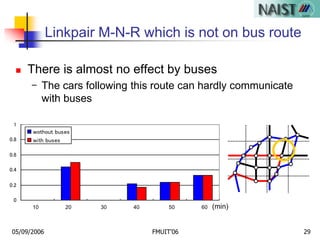
Linkpair M-N-R which is not on bus route
 There is almost no effect by buses
- The cars following this route can hardly communicate
with buses
0
0.2
0.4
0.6
0.8
1
1 2 3 4 5 6
wothout buses
with buses
10 20 30 40 50 60 (min)
05/09/2006 FMUIT'06 30
Conclusion and future work
 Conclusion
- We proposed an extension of our previous work to
improve efficiency of traffic information sharing using
inter-vehicle communication
- Our method based on the message ferrying technique
improve the efficiency to a certain extent
 Future work
- Enhance our method to utilize ferries more aggressively
05/09/2006 FMUIT'06 31
Shinkawa, T., Terauchi, T., Kitani, T., Shibata, N., Yasumoto, K.,
Ito, M. and Higashino, T.: A Technique for Information
Sharing using Inter-Vehicle Communication with
Message Ferrying, International Workshop on Future Mobile
and Ubiquitous Information Technologies (FMUIT'06).
DOI:10.1109/MDM.2006.23 [ PDF ]
Kitani, T., Shinkawa, T., Shibata, N., Yasumoto, K., Ito, M., and
Higashino, T.: Efficient VANET-based Traffic Information
Sharing using Buses on Regular Routes, Proc. of 2008 IEEE
67th Vehicular Technology Conference (VTC2008-Spring), pp.
3031-3036.
DOI:10.1109/VETECS.2008.326 [PDF ]

(Slides) A Technique for Information Sharing using Inter-Vehicle Communication with Message Ferrying

  • 1.
    05/09/2006 FMUIT'06 1 ATechnique for Information Sharing using Inter-Vehicle Communication with Message Ferrying Takashi Shinkawa, Takashi Terauchi, Tomoya Kitani, Naoki Shibata†, Keiichi Yasumoto, Minoru Ito, and Teruo Higashino† † Nara Institute of Science and Technology † Shiga University † †Osaka University
  • 2.
    05/09/2006 FMUIT'06 2 Overviewof our proposal  Problem of a technique for traffic jam information sharing using inter-vehicle communication(our previous work) - It is a technique to propagate the message through the node (ferry) that regularly moves on the known route • When car density of an area becomes low temporarily, collected information is lost. • When there is no car in a region, traffic jam information must be collected from scratch. • Message Ferrying Introduction of message ferrying
  • 3.
    05/09/2006 FMUIT'06 3 Outline ⇒Background -Our previous work - Problem of our previous work  Proposed method  Experimental Result  Conclusion and Future work
  • 4.
    05/09/2006 FMUIT'06 4 Background The traffic jam in urban areas is becoming a big problem in many countries • As services to provision traffic information to avoid traffic jam VICS (Vehicle Information and Communication System) It provides traffic information collected in management center CYBER NAVI (Pioneer) It uses statistical traffic information generated from history in addition to VICS  There is a room for improvement in the service range, operational cost, time lag of the information, etc
  • 5.
    05/09/2006 FMUIT'06 5 Ourprevious work  Purpose - To realize a mechanism for cars to autonomously collect and exchange traffic information  Approach - To reduce the initial infrastructure cost and the operational cost of the system - To cover a large service area  We adopt inter-vehicle communication  We do not use infrastructure or a management center
  • 6.
    05/09/2006 FMUIT'06 6 Collectingtraffic information  Divide the road map into rectangles called areas  Let cars measure the time (called area passing time) to pass each area  Let cars exchange area passing time with neighboring cars and make statistics of area passing time (called traffic information) A6 A9 A2 A5 A1 A3 A4 A7 A8 G A H I B D C F E
  • 7.
    05/09/2006 FMUIT'06 7 Areapassing time (incoming link,outgoing link) area passing time (α,β) 150 sec (α,γ) 220 sec ... (ε,α) 40 sec ... (ε,δ) 30 sec Area Passing Time =(area ID,incoming link ID,outgoing link ID,area passing time,car ID) linkpair G E A H I B α βδ ε D C F Area border γ  Area passing time is collected for each pair of incoming link and outgoing link of area (we call the pair of links linkpair)  Each car passes an area through multiple intersections. ⇒By averaging area passing time for each linkpair, we can make traffic jam information taking into account the influence of traffic lights/turns.
  • 8.
    05/09/2006 FMUIT'06 8 Propagationof area passing time  Area passing time is broadcasted when a car passes the area border  When a car receives area passing time, it accumulates the time for the same linkpair Area border
  • 9.
    05/09/2006 FMUIT'06 9 Statisticsinformation area ID (incoming link,outgoing link) A5 (α,β) Area passing time 30 sec 60 sec ... 40 sec average area passing time 41 sec The available bandwidth is limited⇒  The number of received data items of area passing times increases - Cars may not be able to exchange all the data items with other cars When the number of data items exceeds C, statistics information is generated by averaging over C area passing times C : a predefined threshold
  • 10.
    05/09/2006 FMUIT'06 10 Propagationof statistics information  Each car regularly broadcasts both area passing time and statistics information which it holds  Area passing time and statistics information is updated and kept by cars on each area Area border
  • 11.
    05/09/2006 FMUIT'06 11 When each car crosses the area border, the data outside its responsible areas are discarded Neighboring areas The area where the car is running (A1) Traffic information of A1 is retained Traffic information of A1 is retained How to retain and discard information ⇒ Each car retains and broadcasts the data generated for a set of areas called responsible areas The available network bandwidth is limited
  • 12.
    05/09/2006 FMUIT'06 12 Trafficinformation of A1 is discarded Neighboring areas How to retain and discard information The area where the car is running (A1)  When each car crosses the area border, the data outside its responsible areas are discarded ⇒ Each car retains and broadcasts the data generated for a set of areas called responsible areas The available network bandwidth is limited Traffic information of A1 is retained
  • 13.
    05/09/2006 FMUIT'06 13 Problemof previous work  Problem1:When car density of an area becomes low temporarily - The information may be lost  Problem2: When there is no other car with the latest traffic information on the area - The traffic information must be collected from the scratch. Introduction of message ferrying
  • 14.
    05/09/2006 FMUIT'06 14 Outline Background ⇒Proposed method - Introduction of message ferrying - Improvement idea of problem  Experimental result  Conclusion and future work
  • 15.
    05/09/2006 FMUIT'06 15 Messageferrying[1]  It is a technique to propagate the message through special nodes (called ferries) that regularly move along the known routes - The purpose of message ferrying is to achieve efficient data propagation in disconnected ad hoc networks [1]Wenrui Zhao and Mostafa H. Ammar, “Message Ferrying: Proactive Routing in Highly-partitioned Wireless Ad Hoc Networks”, FTDCS 2003
  • 16.
    05/09/2006 FMUIT'06 16 Send Overviewof message ferrying n1 n2  Ferry : Ferries regularly move along the known routes - Ferries can collect messages from normal nodes and send the collected messages destination  Normal node : Normal nodes freely move - Normal nodes send messages to ferries or receive messages from ferries Normal nodes can use ferries to efficiently send messages to other normal nodes outside of its radio range Ferry Normal node Known route Receive
  • 17.
    05/09/2006 FMUIT'06 17 Knownroute Ferry Basic ideas of our proposal  Our previous work - Traffic information is exchanged only among normal cars  Our proposed Method - Buses (that regularly move along the known routes) are used as ferries - Traffic information is exchanged among normal cars through buses
  • 18.
    05/09/2006 FMUIT'06 18 Howto cope with Problem1 Traffic information of A1 is lost  Problem1 - When car density of an area becomes low temporarily, the collected traffic information may be lost completely No information of A1 Traffic information of A1 is retained Area(A1) When there are less than two cars in each radio range
  • 19.
    05/09/2006 FMUIT'06 19 Therevival of traffic information becomes possible Our solution for Problem1 Area(A1) Keep holding information of A1  Let buses hold traffic information of each area even when they are out of the responsible areas - Buses can have large capacity hard disk drives  When traffic information on an area is completely lost ⇒the bus can regularly revive the traffic information which the bus obtained when passing the area last time
  • 20.
    05/09/2006 FMUIT'06 20 Howto cope with Problem2  Problem2 - When there is no car with the latest traffic information on the area  Cars cannot obtain traffic information of the area at all Necessary information is not provided No latest traffic information
  • 21.
    05/09/2006 FMUIT'06 21 Oursolution for Problem2  Buses use area passing time which they measured by themselves and traffic information collected in the past Propagate traffic information that buses measured
  • 22.
    05/09/2006 FMUIT'06 22 Outline Background  Proposed method ⇒Performance evaluation  Conclusion and future work
  • 23.
    05/09/2006 FMUIT'06 23 Overviewof Experiment  To what extent, the proposed method (with buses) can improve our previous method (w/o buses) with respect to information propagation ratio.  We have implemented our method and conducted simulation with traffic flow simulator NETSTREAM developed by Toyota Central R&D Labs
  • 24.
    05/09/2006 FMUIT'06 24 Experimentalenvironment Size of each area 300m×300m Radio range 100m Size of communication area 200m Legal speed limit of each link 16.6m/s (60km/h) Maximum amount of broadcast packet 1500byte Interval of broadcast 5 seconds Simulation time 60 minutes Bus route 2 routes Run interval of the bus 5 minutes, 7 minutes The car density is somewhat low by regulating the number of cars in the simulation
  • 25.
    05/09/2006 FMUIT'06 25 Simulator: NETSTREAM Field size : 1.2km×1.2km Node : 21 Link : 78
  • 26.
    05/09/2006 FMUIT'06 26 Theroute a of the bus The route b of the bus B C D E F G H I J K L M N O P R S Q A A11 A13 A4 A12 A9 A10A8 A6 A3 A7A5 A2A1 A14  As information propagation ratio, we measured the number of cars retaining traffic information on the following linkpairs of areas A5, A13 and A6 Experiment Linkpair on bus route a ⇒C-D-E in area A5 Linkpair on bus route b ⇒A-G-J in area A13 Linkpair which is not on bus route ⇒M-N-R in area A6
  • 27.
    05/09/2006 FMUIT'06 27 LinkpairC-D-E on bus route a  At time 40 and 50, more cars retain traffic information  At time 20 and 30, there is no improvement by buses - There were no cars in the radio ranges of the bus during this time interval - There is a little information which normal cars measured 0 0.2 0.4 0.6 0.8 1 1 2 3 4 5 6 without buses with buses 10 20 30 40 50 60 (min) information propagation ratio = cars retaining information / all cars passing the linkpair
  • 28.
    05/09/2006 FMUIT'06 28 LinkpairA-G-J on bus route b  Much more cars retaining traffic information - There is much more information which normal cars measured Linkpair A-G-J than Linkpair C-D-E - At time 60, there is no improvement by buses  There were no cars in the radio ranges of the bus during this time interval  There is little information which normal cars measured 0 0.2 0.4 0.6 0.8 1 1 2 3 4 5 6 without buses with buses 10 20 30 40 50 60 (min)
  • 29.
    05/09/2006 FMUIT'06 29 LinkpairM-N-R which is not on bus route  There is almost no effect by buses - The cars following this route can hardly communicate with buses 0 0.2 0.4 0.6 0.8 1 1 2 3 4 5 6 wothout buses with buses 10 20 30 40 50 60 (min)
  • 30.
    05/09/2006 FMUIT'06 30 Conclusionand future work  Conclusion - We proposed an extension of our previous work to improve efficiency of traffic information sharing using inter-vehicle communication - Our method based on the message ferrying technique improve the efficiency to a certain extent  Future work - Enhance our method to utilize ferries more aggressively
  • 31.
    05/09/2006 FMUIT'06 31 Shinkawa,T., Terauchi, T., Kitani, T., Shibata, N., Yasumoto, K., Ito, M. and Higashino, T.: A Technique for Information Sharing using Inter-Vehicle Communication with Message Ferrying, International Workshop on Future Mobile and Ubiquitous Information Technologies (FMUIT'06). DOI:10.1109/MDM.2006.23 [ PDF ] Kitani, T., Shinkawa, T., Shibata, N., Yasumoto, K., Ito, M., and Higashino, T.: Efficient VANET-based Traffic Information Sharing using Buses on Regular Routes, Proc. of 2008 IEEE 67th Vehicular Technology Conference (VTC2008-Spring), pp. 3031-3036. DOI:10.1109/VETECS.2008.326 [PDF ]

Editor's Notes

  • #2 I would like to talk about `` A Technique for Information Sharing using Inter-Vehicle Communication with Message Ferrying.''
  • #3 In our previous work, we have proposed a technique for traffic jam information sharing using inter-vehicle communication. However, problems occur in the following cases. First, when car density of the area becomes low temporarily, the collected information is lost. Second, when there is no car in a region, traffic jam information must be collected from the scratch. So, we try to mitigate these problems by introducing the message ferrying technique. Message ferrying is a technique to propagate the message through the node that regularly moves on the known route.
  • #4 This is the outline of this presentation. First, I will talk about the background.
  • #5 In these days, the traffic jam in urban areas is becoming a big problem in many countries. In Japan, as services to provision traffic information to avoid traffic jam, there are VICS, CYBER NAVI, etc. %VICS provides traffic information collected in a management center. %CYBER NAVI uses statistical traffic information generated from history in addition to VICS. However, there is a room for improvement in the service range, operational cost, time lag of the information, etc.
  • #6 So, in our previous work, we aimed at realizing a mechanism for cars to autonomously collect and exchange traffic information. Approach is to reduce the initial infrastructure cost and the operational cost of the system and to cover large service area. We do not use infrastructure and a management center, instead we adopt inter-vehicle communication.
  • #7 I will talk about how to collect traffic information. First, we divide the road map into rectangles called areas. Second we let cars measure the time to pass each area. This time is called area passing time. Third, we let cars exchange area passing time with neighboring cars and make statistics of area passing time .
  • #8 Area passing time is collected for each pair of incoming link and outgoing link of each area. Hereafter, we call the pair of incoming link and outgoing link, linkpair. %There are multiple linkpairs in each area. We think that each car passes an area through multiple intersections. By averaging area passing time for each linkpair, we can make traffic jam information taking into account the influence of traffic lights/turns. Area passing time is generated and exchanged as a tuple shown here. This table shows example of linkpairs. %For example, as shown in this figure, when a car goes from link α into the area and goes out through link β, %Area passing time for linkpair (α, β) is generated like this.
  • #9 (Animation) Area passing time is broadcasted when a car passes the area border. When a car receives area passing time, it accumulates the time for the same linkpair.
  • #10 If the number of received data items of area passing times increases, cars may not be able to exchange all the data items with other cars by broadcast, because the available bandwidth is limited. Here, we set a predefined threshold denoted by C. When the number of data items exceeds C, statistics information is generated by averaging over C area passing times.
  • #11 (Animation) Then we let each car regularly broadcast both area passing time and statistics information which it holds. Area passing time and statistics information is updated and kept by cars on each area.
  • #12 I will talk about how to retain and discard information. We let each car retain and broadcast the data generated for a set of areas called responsible areas, because the available bandwidth is limited. The responsible areas of each car contain the area where the car is running and its neighboring areas, that is, red and green areas in this figure.
  • #13 When each car crosses the area border, the data outside its responsible areas are discarded.
  • #14 As I explained before there are two problems in our previous work, we will cope with these problems. %In our previous work, traffic information is collected and maintained as explained before. %However, the method has the following problems. %First, when car density of an area becomes low temporarily, %the collected traffic information may be lost completely %because there are no cars which mediate propagation of traffic information. %Second, when there is no other car with the latest traffic information on the area, %The traffic information must be collected from the scratch. %So, we try to mitigate these problems by introducing the message ferrying technique.
  • #15 Next topic is about the proposed method.
  • #16 %Here, I will talk about the outline of the message ferrying technique. Message ferrying is a technique to propagate the message through special node that regularly moves along the known route. The purpose of message ferrying is to achieve efficient data propagation in disconnected ad hoc networks.
  • #17 In the message ferrying technique, all nodes are classified into normal nodes and ferries. Here, normal nodes freely move, but ferries regularly move along the known routes. Normal nodes can use ferries to efficiently send messages to other normal nodes outside of its radio range. (Animation) (Animation) For example, as shown in this figure, node n1 can use a ferry to send messages to node n2 which is not in n1’s radio range.
  • #18 I will talk about basic ideas of our proposal. In our previous work, traffic information is exchanged only among normal cars. (Animation) On the other hand, in our proposed method, buses are used as ferries, and traffic information is exchanged among normal cars through buses.
  • #19 I will talk about how to cope with the problem one which occurs when car density of the area becomes low temporarily. The collected traffic information may be lost completely %because there are no cars which mediate propagation of traffic information. As shown In this figure, when there are no less than two cars in each radio range, traffic information is not propagated. (Animation) When this car retaining traffic information of A1 goes out of neighboring areas of A1, traffic information of A1 is lost.
  • #20 So, in this case, we let buses keep holding traffic information of each area even when they are out of the responsible areas, since buses can have large capacity hard disk drives. Even when traffic information on an area is completely lost, the bus can regularly revive the traffic information which the bus obtained when passing the area last time. So, by using buses, the revival of traffic information becomes possible.
  • #21 Next, I will talk about how to cope with problem two which occurs when there is no other car with the latest traffic information on the area. In this case, cars cannot obtain necessary traffic information of the area at all.
  • #22 So we let buses use area passing time which they measured by themselves and traffic information collected in the past.
  • #23 Last topic is about performance evaluation.
  • #24 We would like to confirm to what extent, the proposed method (with buses) can improve our previous method with respect to information propagation ratio. We have implemented our method and conducted simulation with traffic flow simulator NETSTREAM developed by Toyota Central R&D Labs.
  • #25 The configuration of the simulation is shown here. We let two buses follow two different routes every 5 minutes and 7 minutes, respectively. In this configuration, we kept the car density somewhat low by regulating the number of cars in the simulation and conducted the simulation for 60 minutes.
  • #26 This is a snapshot of NETSTREAM with the roadmap which we used.
  • #27 This is the detail of the road map used in the simulation. We specified two different bus routes a and b as shown in this figure. We measured the number of cars retaining traffic information on the following linkpairs of areas A5, A13 and A6. (Animation) First, in area A5, linkpair C-D-E on bus route a is used. (Animation) Next, in area A13, linkpair A-G-J on bus route b is used. (Animation) Last, in area A6, linkpair M-N-R which is not on any bus route is used.
  • #28 First, this is experimental result of linkpair C-D-E on bus route a. The Y-axis represents the information propagation ratio. Here, Information propagation ratio is the value that divided cars retaining information by all cars passing the link pair . The larger is better. The X-axis represents the simulation time. % Here, all cars represent the number of cars which actually passed the route. (Animation) At time 40 and 50, we see that our proposed method allows much more cars to retain traffic information than our previous method without buses. (Animation) At time 20 and 30, there is no improvement by buses. We consider that this is because there were no cars in the radio ranges of the bus during this time interval and there is little information which normal cars measured.
  • #29 Next, this is experimental result of linkpair A-G-J on bus route b. (Animation) Especially, we see that the impact of using buses is prominent than the case of linkpair on bus route a. We consider that this is because there is much information which normal cars measured Linkpair A-G-J than Linkpair C-D-E.
  • #30 Last, this is experimental result of linkpair which is not on bus route. We see that there is almost no effect by buses. We consider that this is because the cars follow this route can hardly communicate with buses.
  • #31 This is conclusion and future work. %We proposed an extension of our previous work to %improve efficiency of traffic information sharing using inter-vehicle communication. %We have confirmed that our method based on the message ferrying technique improve the efficiency to a certain extent %As part of future work, we enhance our method to utilize ferries more aggressively.
  • #32 Thank you for your kind attention.