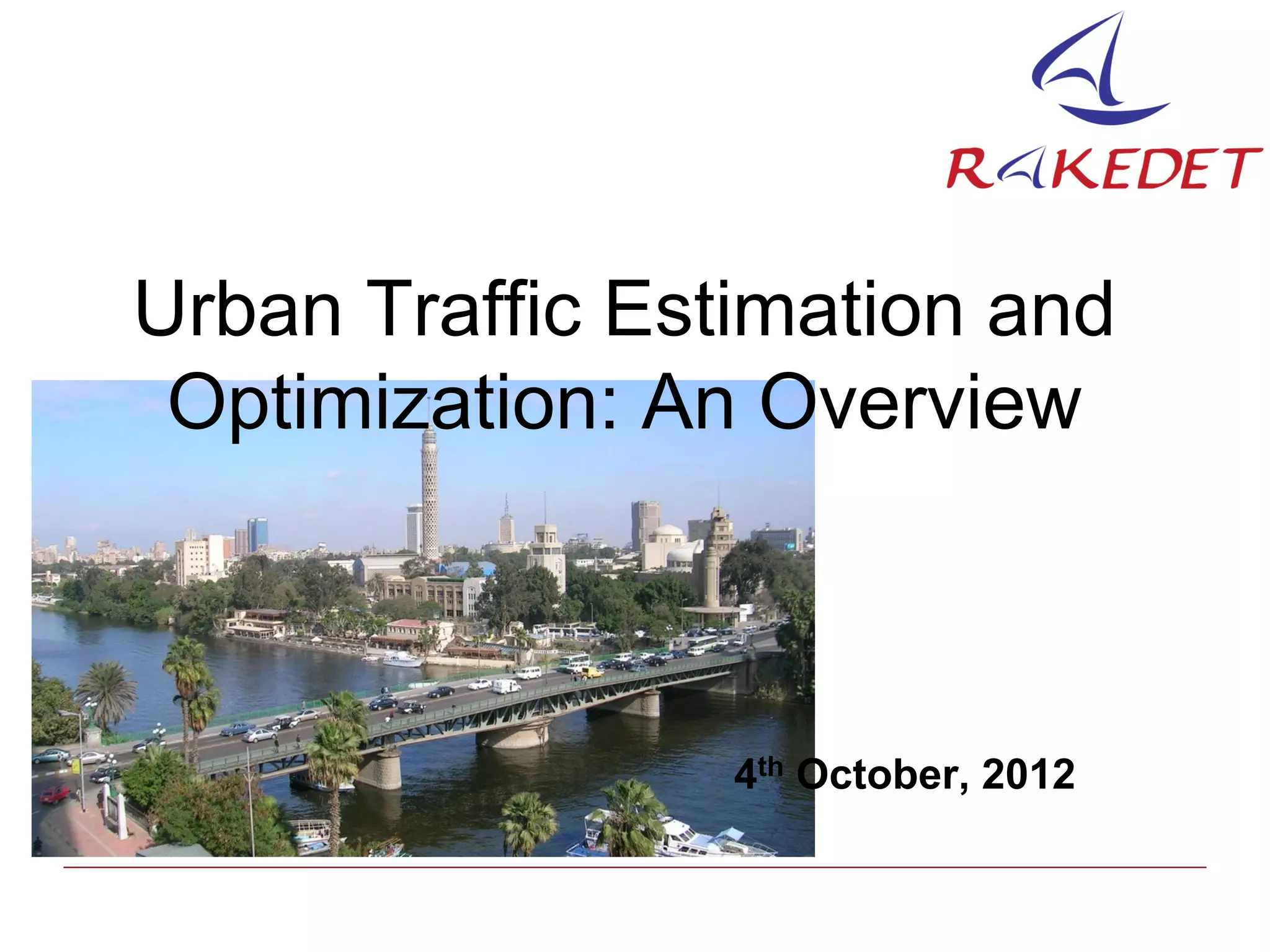
Urban Traffic Estimation and
 Optimization: An Overview


                 4th October, 2012
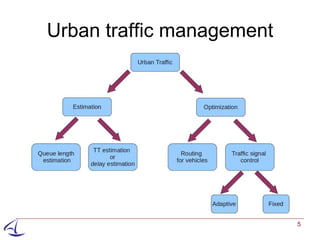
Urban Traffic Estimation

• Two categories;
  – Queue length estimation
  – Travel time (TT) estimation or delay estimation
• Methods;
  – Mobile phones,
  – Mobile phones combined with GPS receivers, also
    referred to as probe car data
  – “Recently” using V2V communication*
 * Laura Garelli et al, “MobSampling: V2V Communications for Traffic
 Density Estimation”, VTC, Spring 2011.
                                                                       2
Related references
• F. Calabrese et al, Real-Time Urban Monitoring Using Cell
  Phones: A Case Study in Rome, IEEE Transactions on ITS,
  2011.

• L. Guo et al, An Automatic Traffic Congestion Detection
  Method Based on Floating Car Data, 15th World Congress on
  Intelligent Transport System, 2008.

• Ryan Herring et al, Estimating Arterial Traffic Conditions
  using Sparse Probe Data, 13th IEEE ITS conference, 2010.


                                                               3
Urban Traffic Optimization
• Through routing of vehicles
  - [Traffic Optimization in Transport Networks Based on Local Routing,
  The European Physical Journal, 2010]
  - [Dynamic Vehicle Routing Based on On-line Traffic Information, A
  Journal of the Institute for Operations Research & The Management
  Science, 2004]
• Through traffic signal control
   – Fixed-time method
   [A Surrogate Model for Traffic Optimization of Congested Networks:
     an Analytic Queueing Network Approach”, 2009]
   – Traffic-responsive method
                                                                        4
Urban traffic management


                           5
A Surrogate Model for Traffic Optimization
   of Congested Networks: an Analytic
       Queueing Network Approach


        C. Osorio and M. Bielrlaire, 2009.

               a civil engineering scope
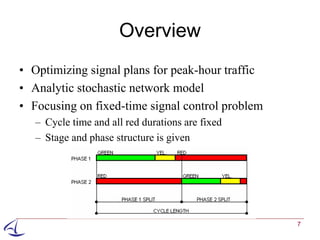
Overview
• Optimizing signal plans for peak-hour traffic
• Analytic stochastic network model
• Focusing on fixed-time signal control problem
   – Cycle time and all red durations are fixed
   – Stage and phase structure is given


                                                  7
Objective and assumptions
• Objective:
  – Minimize the average time T, spent in the network by
    adjusting the green splits at each intersection

• Assumptions:
  – Each queue is modeled as a two-dimensional M/M/1/K
    queue
  – Service rates of the queues leading to an intersection, are
    defined as the capacities of the intersection.
  – Formulations of the capacities of intersections are based on
    the Swiss National Trans. Standards.
                                                               8
Model
• According to the authors, a job:
   1.   arrives to a station i,
   2.   waits if the server is occupied,
   3.   is served (this is called the active phase),
   4.   is blocked if its destination station is full (this is called the
        blocked phase),
   5.   leaves the station
• The state is represented by the number of:
   –    active jobs Ai,
   –    blocked jobs Bi and
   –    waiting jobs Wi
• The total number of jobs Ni at a station i = Ai + Bi+ Wi
                                                                            9
Discussion
• Urban planning point-of-view

• Focus on fixed-time signal plan method

• Model, state definition and the limitation of
  generalization / extension of the model

• No interactivity with the vehicles,
   – i.e. no use of V2I nor V2V communications
                                                  10
Traffic-responsive methods
• According to the previous reference:
  – Traffic-responsive methods use real-time
    measurements
• Three ways;
  – Small adjustments to a predefined plan
  – Choosing between a set of pre-specified plans
  – Taking a decision (optimizing) the switching time(s)
    to the next stage. (no cycle time nor splits
    optimization)
                                                       11
Traffic Optimization in Transport Networks
         Based on Local Routing


               S. Scellato et al,
      The European Physical Journal, 2010
Overview
• Global urban traffic optimization based on local
  decisions (at the vehicle level)
• Congestion-aware vehicular-routing as a minimization
  problem using graph theory
• Edges represent the streets and nodes represent the
  intersections
• The solution takes into account:
   – the length of the road (path) and
   – the congestion in the outgoing roads

                                                         13
Assumptions and objective
• Assumptions:
   – Only local knowledge of congestion is available,
   – Drivers know the shortest paths to their destinations,
   – Weighted urban graph is simulated using GA (Genetic
     Algorithm), i.e. Nagel-Schreckenberg model.
   – Edges’ weights represent the road’s lengths
• Objective:
   – At each node (intersection), the vehicle considers (1) the
     nearby congestion, and (2) shortest path, in order to choose
     the next node as a hop on the path to destination.
                                                                14
Dynamic Vehicle Routing Based on
   On-line Traffic Information

          B. Fleischmann, S. Gnutzmann and
                     E. SandvoßA

   Journal of the Institute for Operations Research &
           The Management Science, 2004
Overview
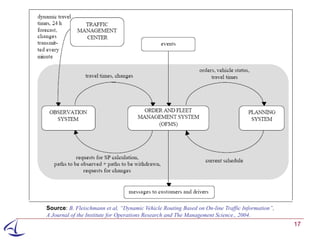
• Dynamic routing system for fleet of vehicles
• Planning framework for pickup-delivery problem
• Usage of dynamic data
   – Travel time information
   – Customers’ orders

• Dynamic routing system contains three subsystems:
   – Traffic observation system
   – Fleet management system
   – Planning system

                                                      16
Source: B. Fleischmann et al, “Dynamic Vehicle Routing Based on On-line Traffic Information”,
A Journal of the Institute for Operations Research and The Management Science., 2004.
                                                                                                17
System model and assumptions
• Fleet of vehicles serving customer orders in urban area.
• Customers require a transport: from pickup location to a
  delivery location in a given time window.
• Central system;
   – Aware of the status and location of each vehicle,
   – Sends the instructions at any time to any driver,
   – The response time of the system shall not exceed one second.

• Orders are arriving at any time,
• Travel times varying with the time of the day according to a
  forecast,
• Travel time forecast are updated at random incidents.

                                                                    18
MobSampling: V2V Communications for
     Traffic Density Estimation


           Laura Garelli et al,
        IEEE VTC – Spring, 2011.
Overview
• Distributed V2V-based method to estimate traffic
  density in real-time
• No infrastructure required
• Based on vehicular cooperation
• Usage:
   – Local decision by the vehicles on the routes,
   – Dynamic traffic light adaptation,
   – Monitoring CO2 emissions in different areas


                                                     20
Concept
• The vehicle (called sampler) has two roles:

  – Collection info about traffic, i.e. density estimation

  – Role switching, i.e. handing over the task to
    another vehicle (when about to leave the target
    area, or the geographical region where traffic is to
    be estimated)

                                                        21
Rakedet LLC
District Egypt, 51B Misr Helwan Agriculture road, Maadi. 11711.
Cairo, Egypt
info@rakedet.com
                                                                  22

Urban Traffic Estimation & Optimization: An Overview

  • 1.
    Urban Traffic Estimationand Optimization: An Overview 4th October, 2012
  • 2.
    Urban Traffic Estimation •Two categories; – Queue length estimation – Travel time (TT) estimation or delay estimation • Methods; – Mobile phones, – Mobile phones combined with GPS receivers, also referred to as probe car data – “Recently” using V2V communication* * Laura Garelli et al, “MobSampling: V2V Communications for Traffic Density Estimation”, VTC, Spring 2011. 2
  • 3.
    Related references • F.Calabrese et al, Real-Time Urban Monitoring Using Cell Phones: A Case Study in Rome, IEEE Transactions on ITS, 2011. • L. Guo et al, An Automatic Traffic Congestion Detection Method Based on Floating Car Data, 15th World Congress on Intelligent Transport System, 2008. • Ryan Herring et al, Estimating Arterial Traffic Conditions using Sparse Probe Data, 13th IEEE ITS conference, 2010. 3
  • 4.
    Urban Traffic Optimization •Through routing of vehicles - [Traffic Optimization in Transport Networks Based on Local Routing, The European Physical Journal, 2010] - [Dynamic Vehicle Routing Based on On-line Traffic Information, A Journal of the Institute for Operations Research & The Management Science, 2004] • Through traffic signal control – Fixed-time method [A Surrogate Model for Traffic Optimization of Congested Networks: an Analytic Queueing Network Approach”, 2009] – Traffic-responsive method 4
  • 5.
  • 6.
    A Surrogate Modelfor Traffic Optimization of Congested Networks: an Analytic Queueing Network Approach C. Osorio and M. Bielrlaire, 2009. a civil engineering scope
  • 7.
    Overview • Optimizing signalplans for peak-hour traffic • Analytic stochastic network model • Focusing on fixed-time signal control problem – Cycle time and all red durations are fixed – Stage and phase structure is given 7
  • 8.
    Objective and assumptions •Objective: – Minimize the average time T, spent in the network by adjusting the green splits at each intersection • Assumptions: – Each queue is modeled as a two-dimensional M/M/1/K queue – Service rates of the queues leading to an intersection, are defined as the capacities of the intersection. – Formulations of the capacities of intersections are based on the Swiss National Trans. Standards. 8
  • 9.
    Model • According tothe authors, a job: 1. arrives to a station i, 2. waits if the server is occupied, 3. is served (this is called the active phase), 4. is blocked if its destination station is full (this is called the blocked phase), 5. leaves the station • The state is represented by the number of: – active jobs Ai, – blocked jobs Bi and – waiting jobs Wi • The total number of jobs Ni at a station i = Ai + Bi+ Wi 9
  • 10.
    Discussion • Urban planningpoint-of-view • Focus on fixed-time signal plan method • Model, state definition and the limitation of generalization / extension of the model • No interactivity with the vehicles, – i.e. no use of V2I nor V2V communications 10
  • 11.
    Traffic-responsive methods • Accordingto the previous reference: – Traffic-responsive methods use real-time measurements • Three ways; – Small adjustments to a predefined plan – Choosing between a set of pre-specified plans – Taking a decision (optimizing) the switching time(s) to the next stage. (no cycle time nor splits optimization) 11
  • 12.
    Traffic Optimization inTransport Networks Based on Local Routing S. Scellato et al, The European Physical Journal, 2010
  • 13.
    Overview • Global urbantraffic optimization based on local decisions (at the vehicle level) • Congestion-aware vehicular-routing as a minimization problem using graph theory • Edges represent the streets and nodes represent the intersections • The solution takes into account: – the length of the road (path) and – the congestion in the outgoing roads 13
  • 14.
    Assumptions and objective •Assumptions: – Only local knowledge of congestion is available, – Drivers know the shortest paths to their destinations, – Weighted urban graph is simulated using GA (Genetic Algorithm), i.e. Nagel-Schreckenberg model. – Edges’ weights represent the road’s lengths • Objective: – At each node (intersection), the vehicle considers (1) the nearby congestion, and (2) shortest path, in order to choose the next node as a hop on the path to destination. 14
  • 15.
    Dynamic Vehicle RoutingBased on On-line Traffic Information B. Fleischmann, S. Gnutzmann and E. SandvoßA Journal of the Institute for Operations Research & The Management Science, 2004
  • 16.
    Overview • Dynamic routingsystem for fleet of vehicles • Planning framework for pickup-delivery problem • Usage of dynamic data – Travel time information – Customers’ orders • Dynamic routing system contains three subsystems: – Traffic observation system – Fleet management system – Planning system 16
  • 17.
    Source: B. Fleischmannet al, “Dynamic Vehicle Routing Based on On-line Traffic Information”, A Journal of the Institute for Operations Research and The Management Science., 2004. 17
  • 18.
    System model andassumptions • Fleet of vehicles serving customer orders in urban area. • Customers require a transport: from pickup location to a delivery location in a given time window. • Central system; – Aware of the status and location of each vehicle, – Sends the instructions at any time to any driver, – The response time of the system shall not exceed one second. • Orders are arriving at any time, • Travel times varying with the time of the day according to a forecast, • Travel time forecast are updated at random incidents. 18
  • 19.
    MobSampling: V2V Communicationsfor Traffic Density Estimation Laura Garelli et al, IEEE VTC – Spring, 2011.
  • 20.
    Overview • Distributed V2V-basedmethod to estimate traffic density in real-time • No infrastructure required • Based on vehicular cooperation • Usage: – Local decision by the vehicles on the routes, – Dynamic traffic light adaptation, – Monitoring CO2 emissions in different areas 20
  • 21.
    Concept • The vehicle(called sampler) has two roles: – Collection info about traffic, i.e. density estimation – Role switching, i.e. handing over the task to another vehicle (when about to leave the target area, or the geographical region where traffic is to be estimated) 21
  • 22.
    Rakedet LLC District Egypt,51B Misr Helwan Agriculture road, Maadi. 11711. Cairo, Egypt info@rakedet.com 22