Congestion Alleviation Scheduling TechniqueCongestion Alleviation Scheduling Technique
for Car Drivers Based onfor Car Drivers Based on
Prediction of Future Congestion on Roads andPrediction of Future Congestion on Roads and
SpotsSpots
Hisaka Kuriyama, Yoshihiro Murata, Naoki Shibata*
,
Keiichi Yasumoto, Minoru Ito

Nara Institute of Science and Technology
 *
Shiga University
October 3, 2007 ITSC 2007 H. Kuriyama et al. 2
1. Background
2. Proposed method
3. Experiment
4. Conclusion
Outline
October 3, 2007 ITSC 2007 H. Kuriyama et al. 3
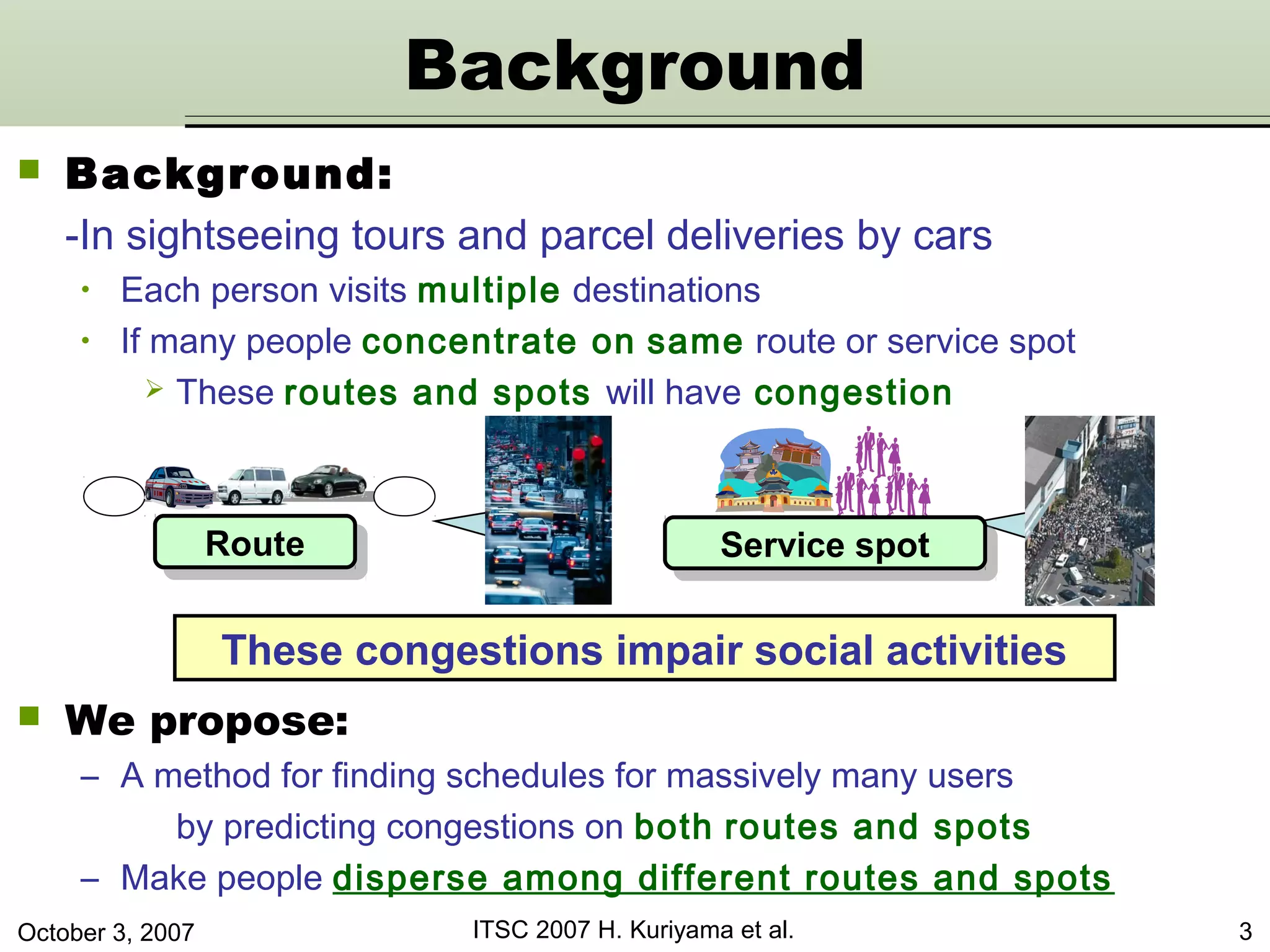
 Background:
-In sightseeing tours and parcel deliveries by cars
• Each person visits multiple destinations
• If many people concentrate on same route or service spot
 These routes and spots will have congestion
RouteRoute Service spotService spot
These congestions impair social activities
Background
 We propose:
– A method for finding schedules for massively many users
by predicting congestions on both routes and spots
– Make people disperse among different routes and spots
October 3, 2007 ITSC 2007 H. Kuriyama et al. 4
 A method by T.Yamashita et al. [2]
 distributes users over routes
 RIS (Route Information Sharing)
• Each user transmits route information to a server
• Server estimates future traffic congestion using this information and
feeds its estimate back to each user
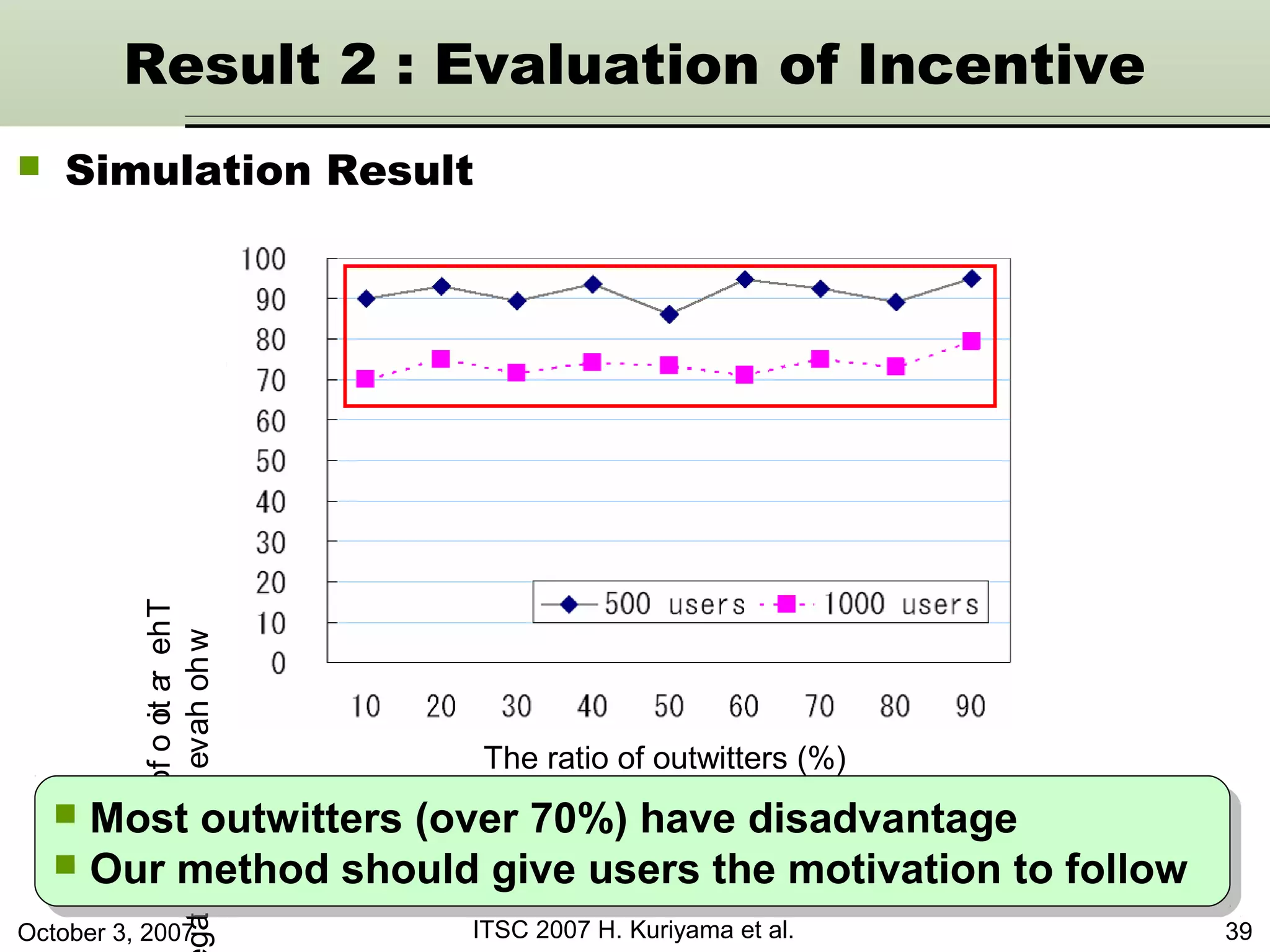
• Each user uses the estimation to re-plan their route
[2] T. Yamashita, et al., "Smooth Traffic Flow with a Cooperative Car Navigation System", AAMAS(2005)
[3] T. Kataoka, et al., "Distributed Visitors Coordination System in Theme Park Problem“ , MMAS(2004)
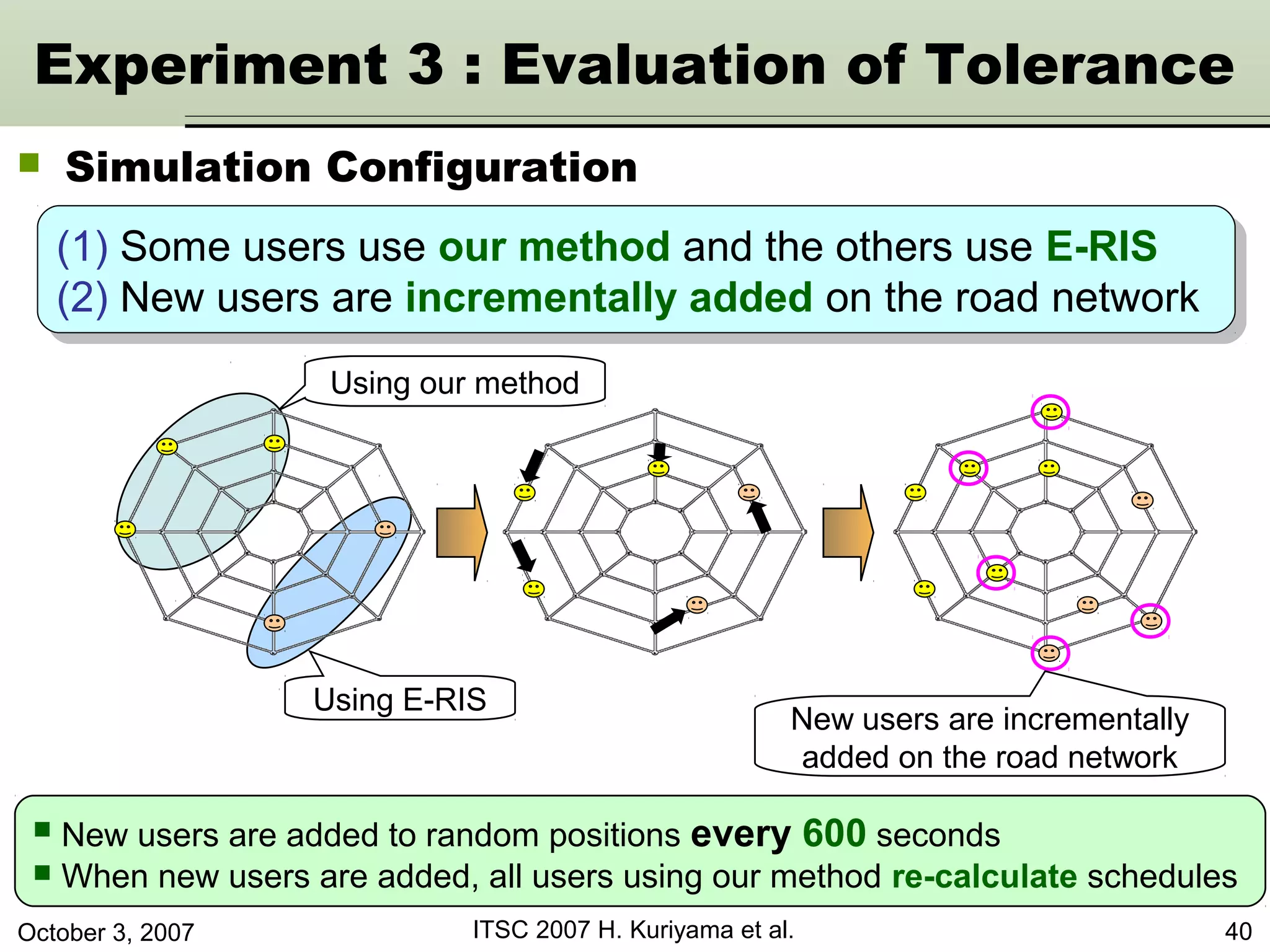
 A method by T.Kataoka et al. [3]
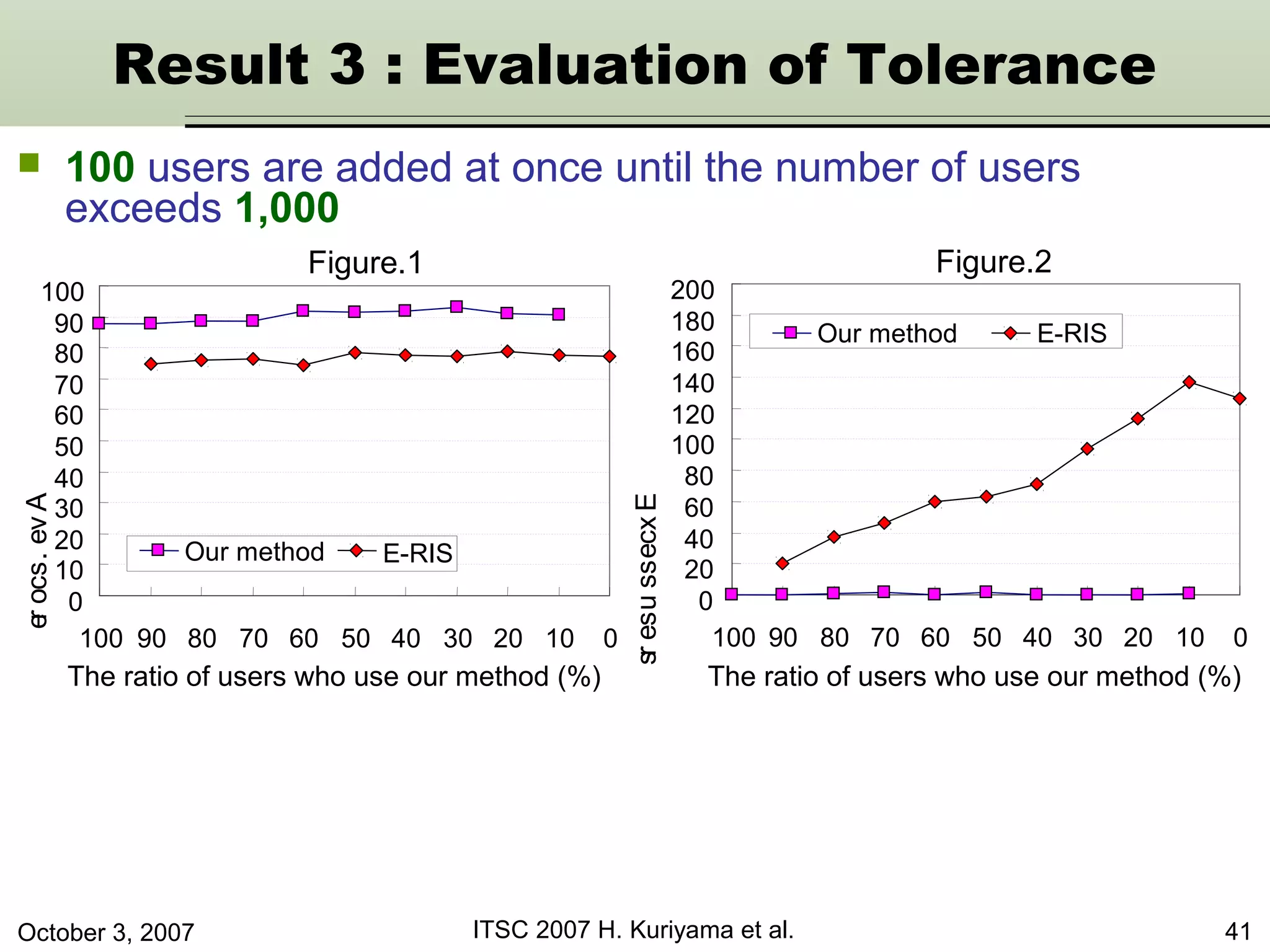
 distributes users over spots
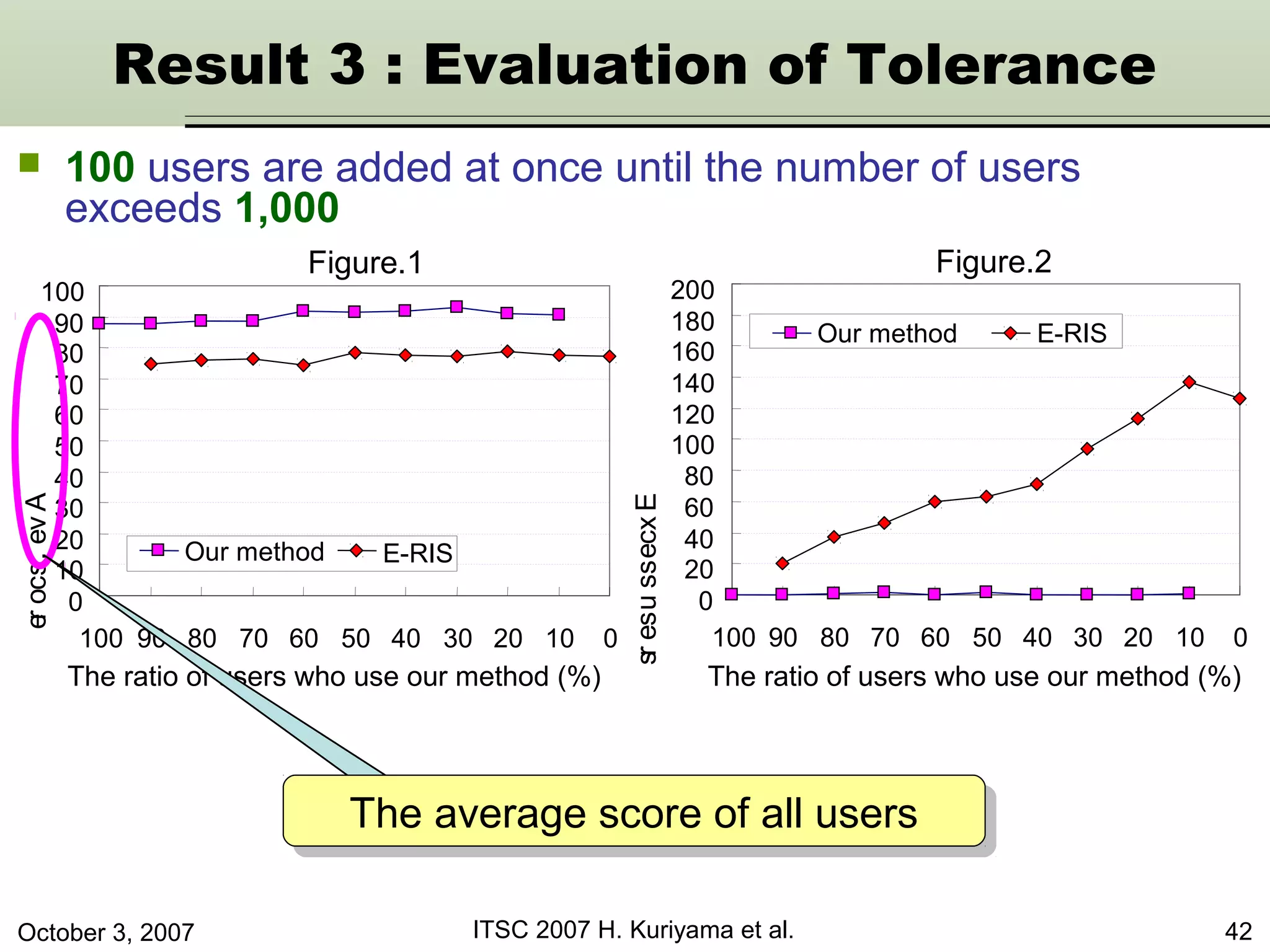
• Each user selects the least congested spot
Server
For distributing tourists over either routes or spotsFor distributing tourists over either routes or spots
Existing Studies
October 3, 2007 ITSC 2007 H. Kuriyama et al. 5
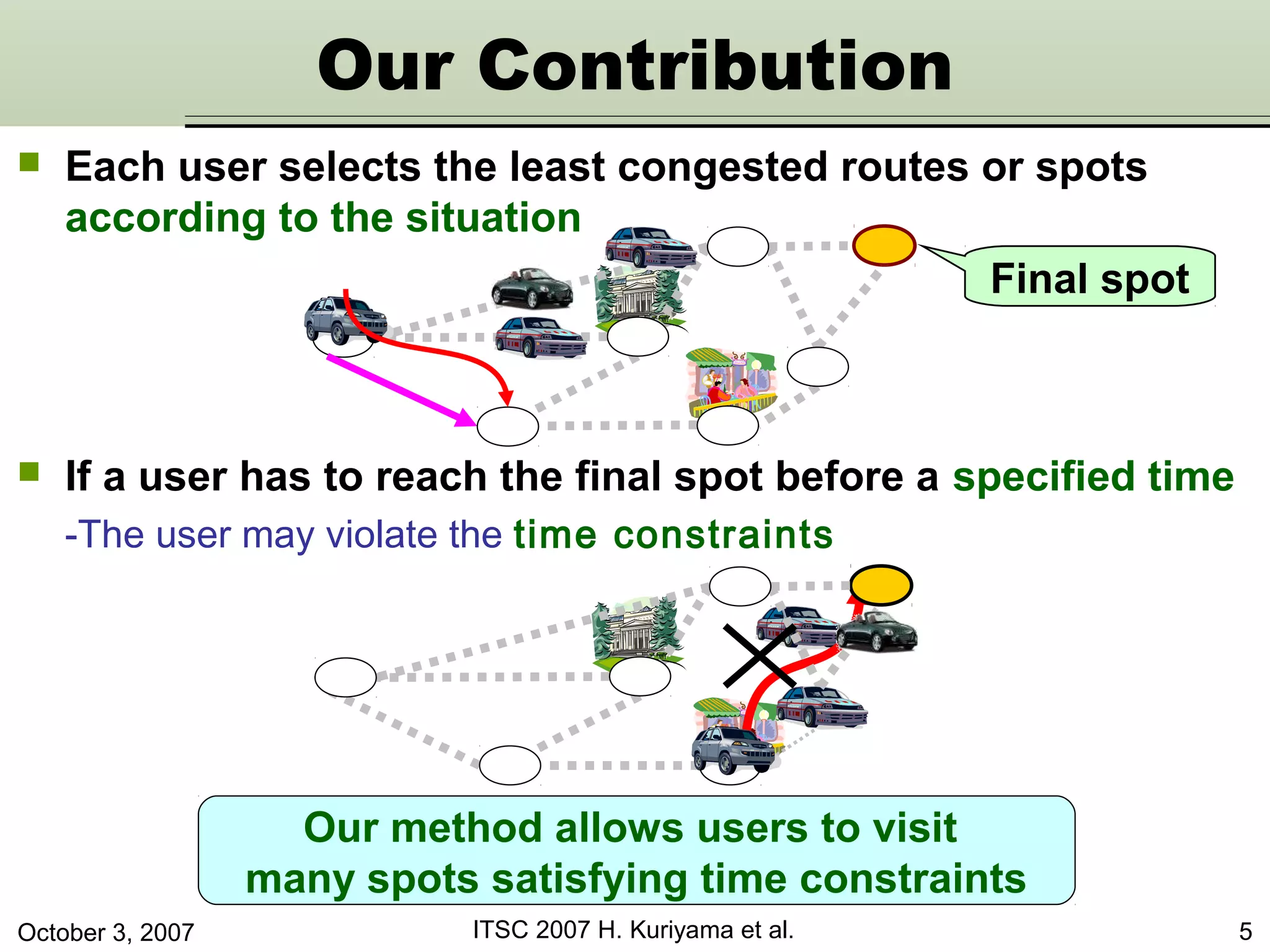
Our method allows users to visit
many spots satisfying time constraints
Final spot
Our Contribution
 Each user selects the least congested routes or spots
according to the situation
 If a user has to reach the final spot before a specified time
-The user may violate the time constraints
October 3, 2007 ITSC 2007 H. Kuriyama et al. 6
1. Background
2. Proposed
method
3. Experiment
4. Conclusion
Outline
October 3, 2007 ITSC 2007 H. Kuriyama et al. 7
Our Approach
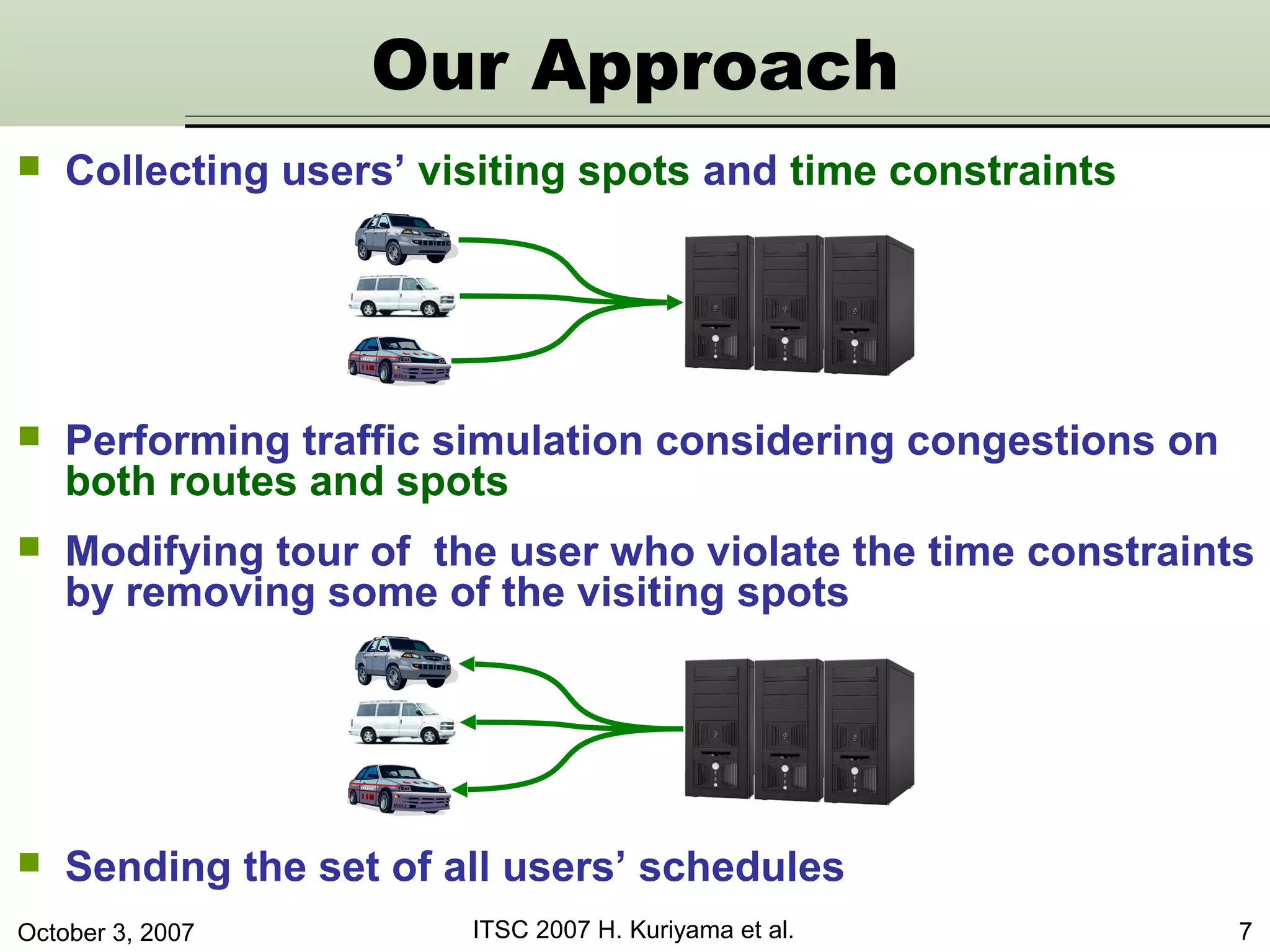
 Collecting users’ visiting spots and time constraints
 Sending the set of all users’ schedules
 Performing traffic simulation considering congestions on
both routes and spots
 Modifying tour of the user who violate the time constraints
by removing some of the visiting spots
October 3, 2007 ITSC 2007 H. Kuriyama et al. 8
Problem Definition
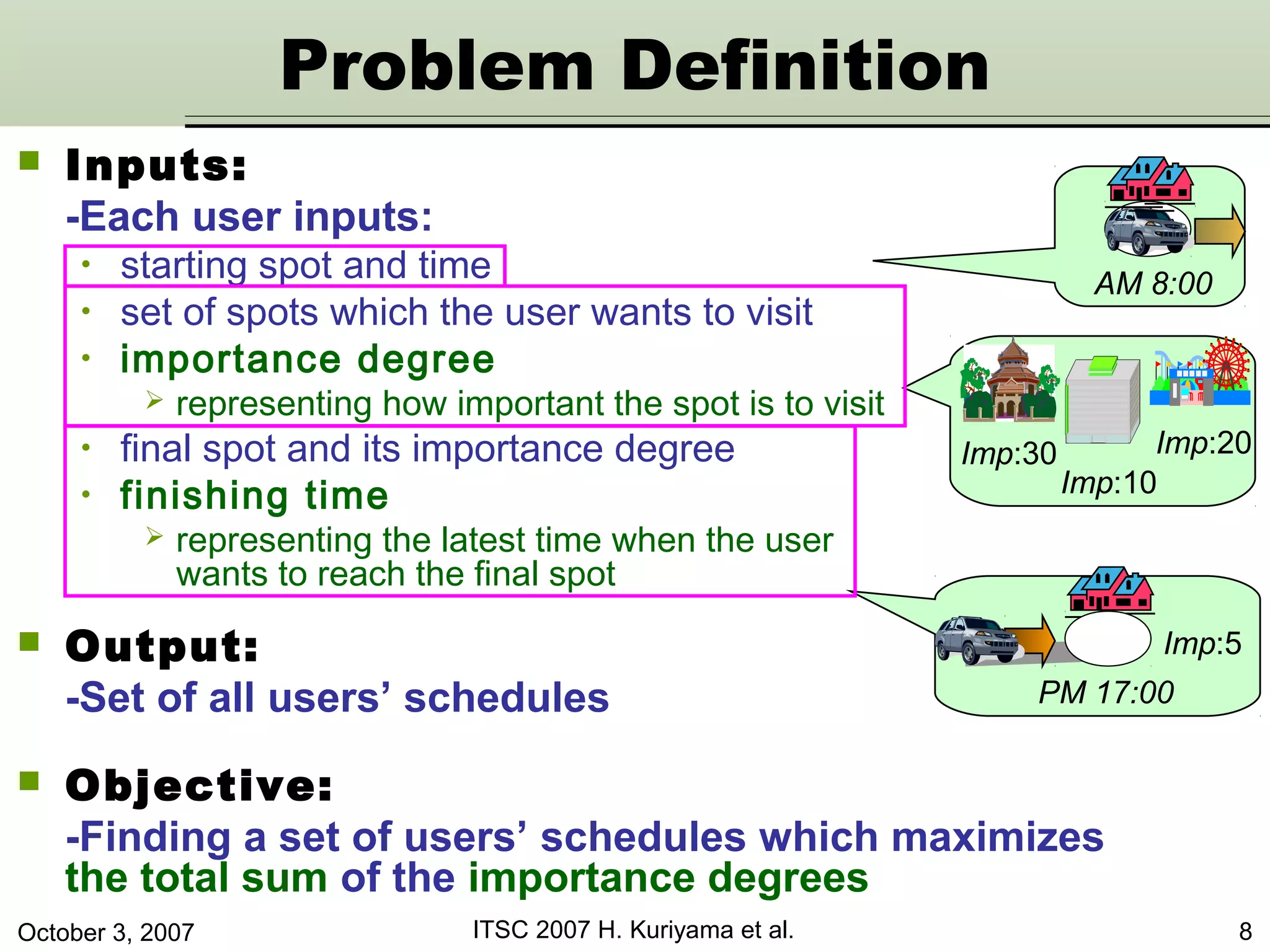
 Inputs:
-Each user inputs:
• starting spot and time
• set of spots which the user wants to visit
• importance degree
 representing how important the spot is to visit
• final spot and its importance degree
• finishing time
 representing the latest time when the user
wants to reach the final spot
 Objective:
-Finding a set of users’ schedules which maximizes
the total sum of the importance degrees
 Output:
-Set of all users’ schedules
AM 8:00
Imp:30
Imp:10
Imp:20
Imp:5
PM 17:00
October 3, 2007 ITSC 2007 H. Kuriyama et al. 9
Algorithm for Modifying Schedules
1. Finding schedule
-Find schedule for each user with the minimum distance to go
through all the requested spots
2. Performing simulation
-Perform simulation based on the routes generated by step 1.
3. Modifying schedule
-Modify schedule by decreasing/increasing the number of spots
4. Iterating steps 2. to 3.
-Repeat from step 2. until all users can reach the final spot no later
than the finishing time OR the predetermined time expires
 Outline of the Scheduling algorithm:
October 3, 2007 ITSC 2007 H. Kuriyama et al. 10
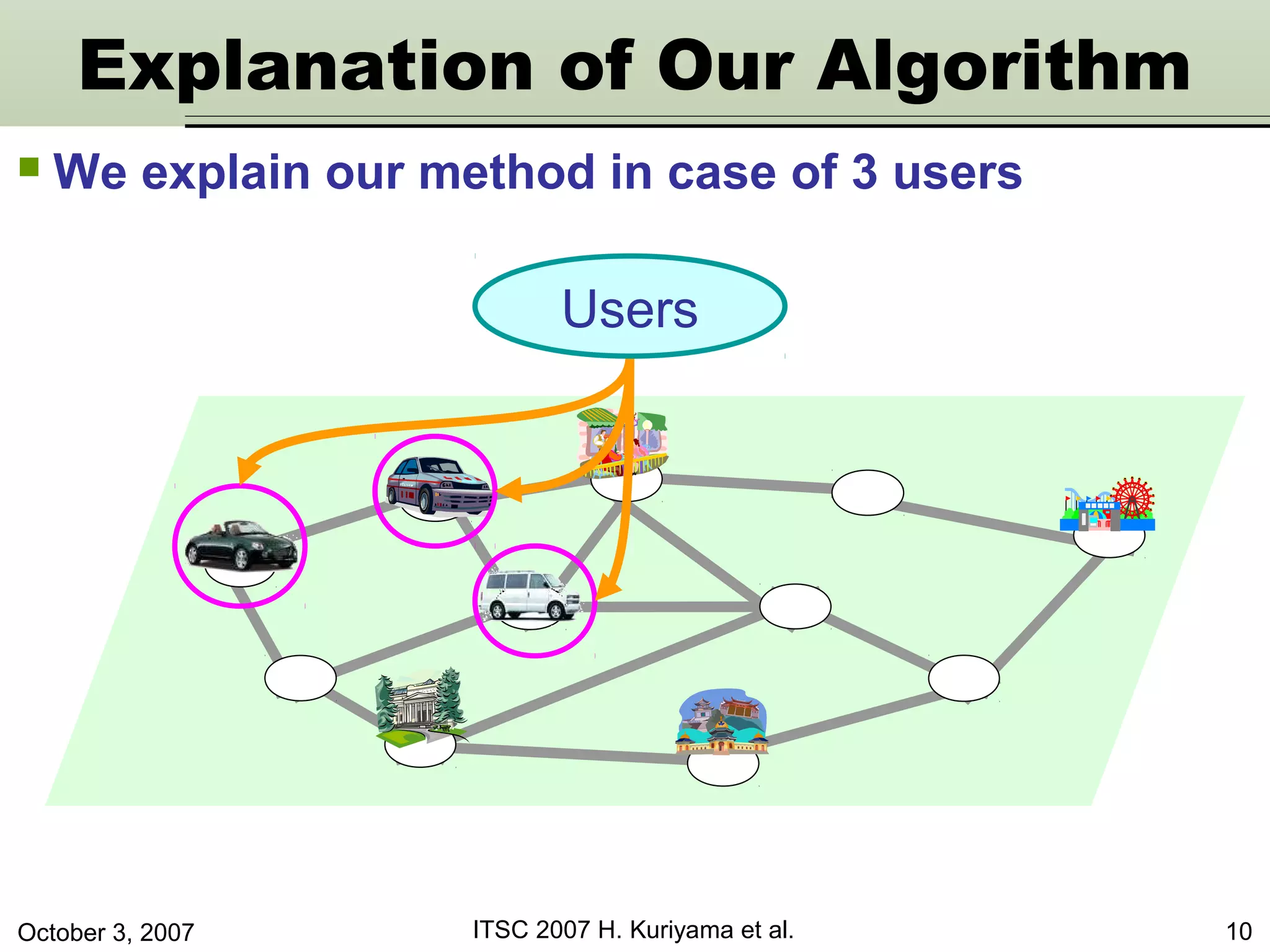
Users
Explanation of Our Algorithm
 We explain our method in case of 3 users
October 3, 2007 ITSC 2007 H. Kuriyama et al. 11
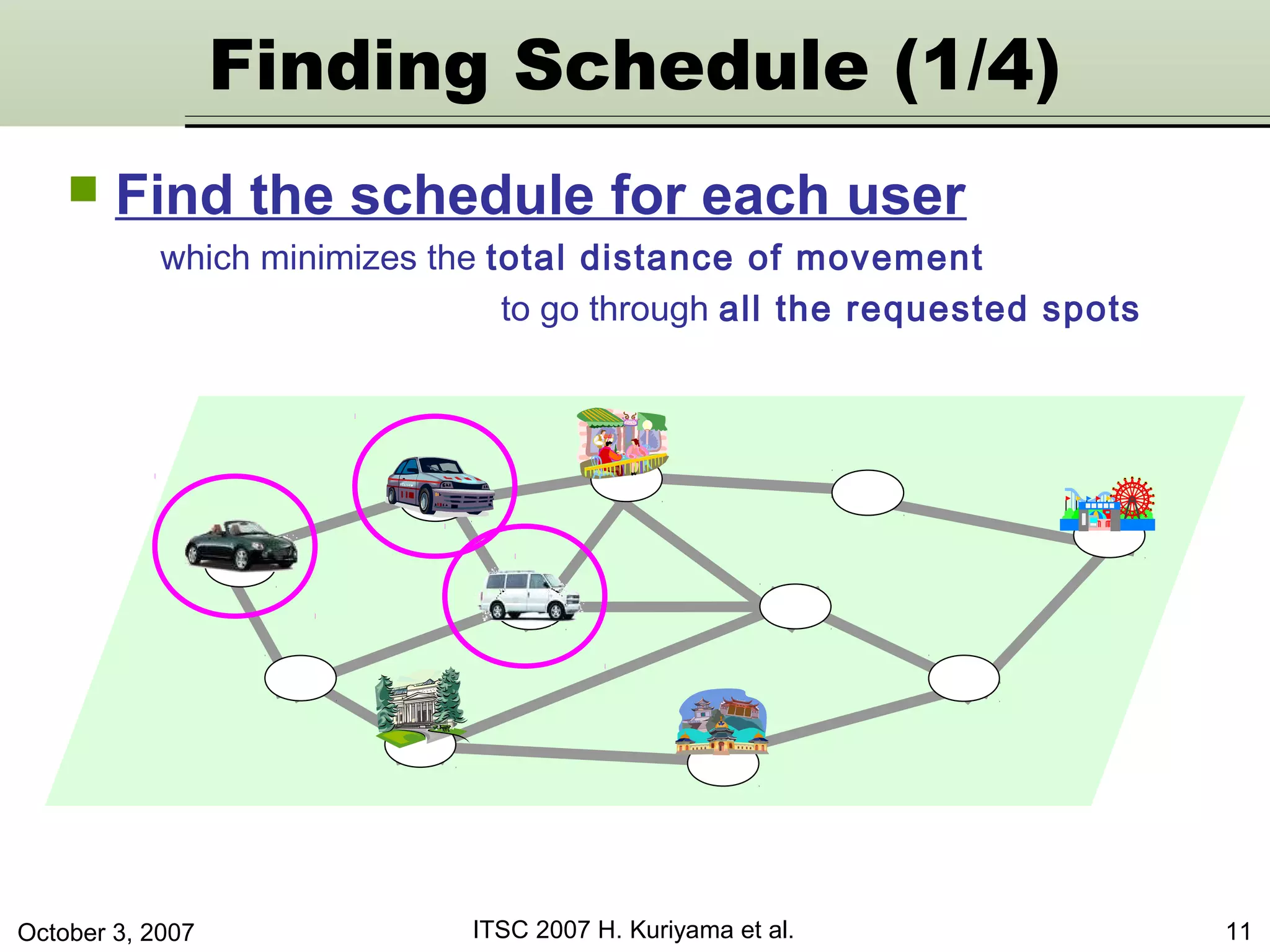
 Find the schedule for each user
which minimizes the total distance of movement
to go through all the requested spots
Finding Schedule (1/4)
October 3, 2007 ITSC 2007 H. Kuriyama et al. 12
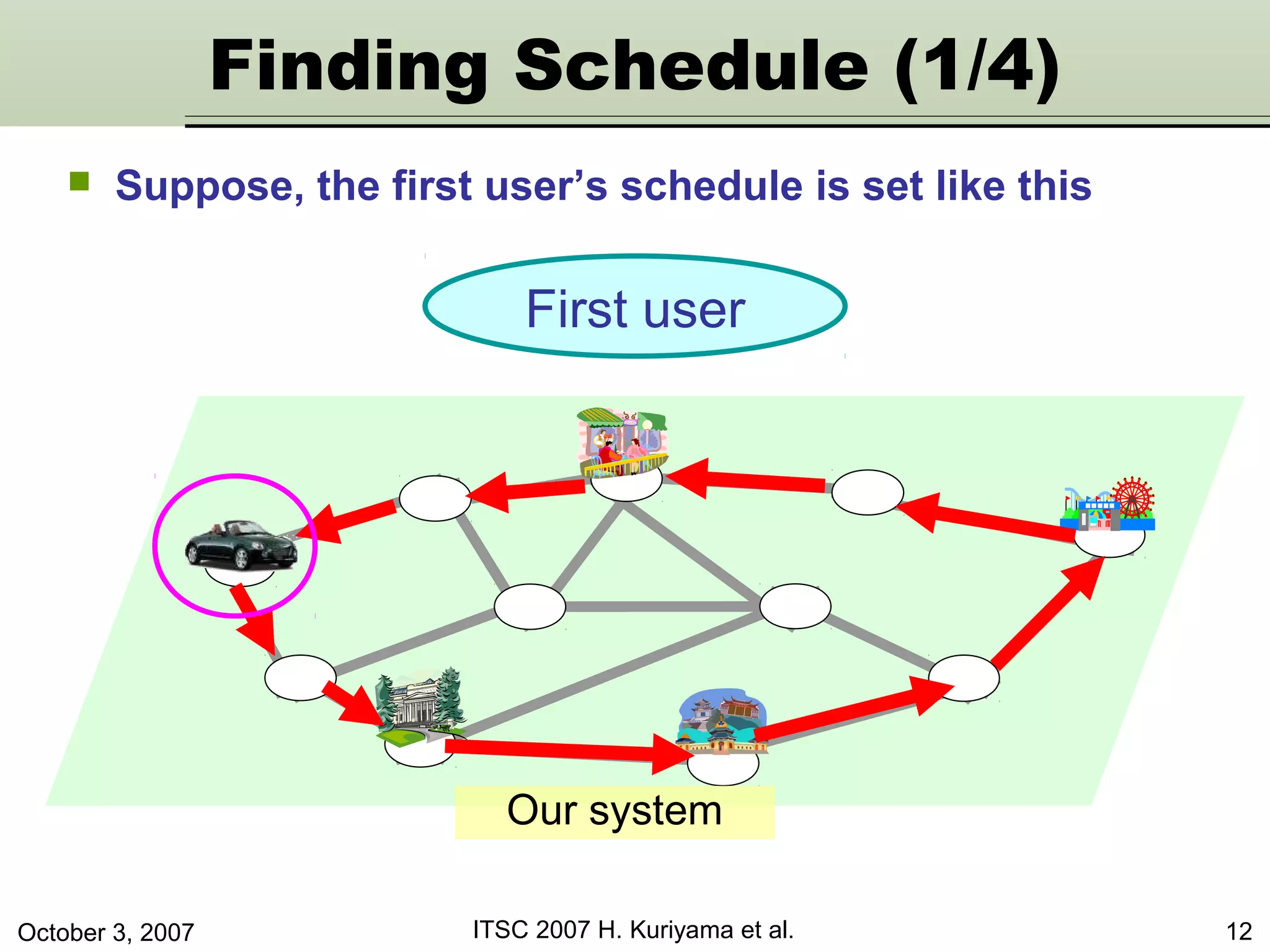
Our system
First user
Finding Schedule (1/4)
 Suppose, the first user’s schedule is set like this
October 3, 2007 ITSC 2007 H. Kuriyama et al. 13
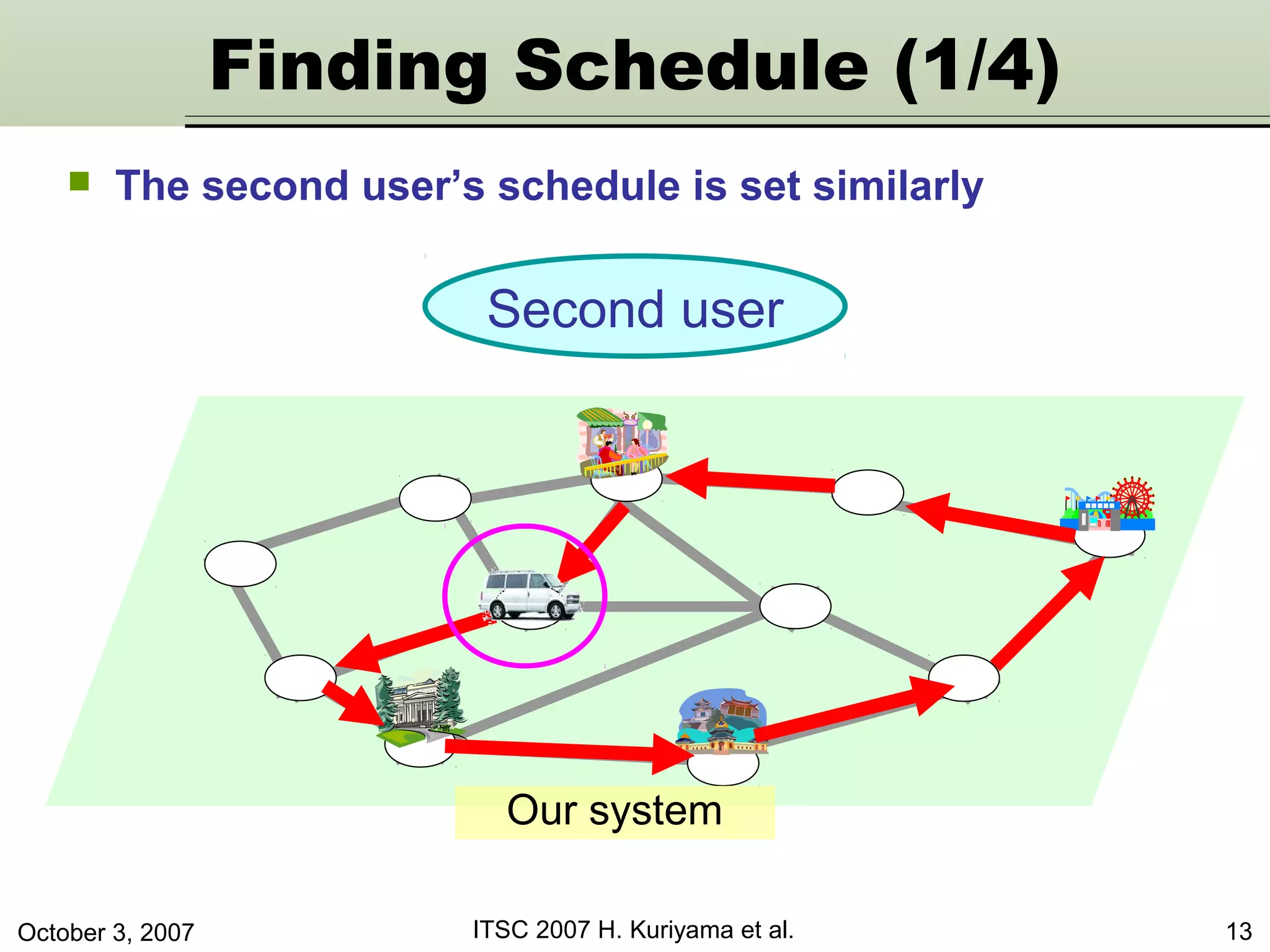
Our system
Second user
Finding Schedule (1/4)
 The second user’s schedule is set similarly
October 3, 2007 ITSC 2007 H. Kuriyama et al. 14
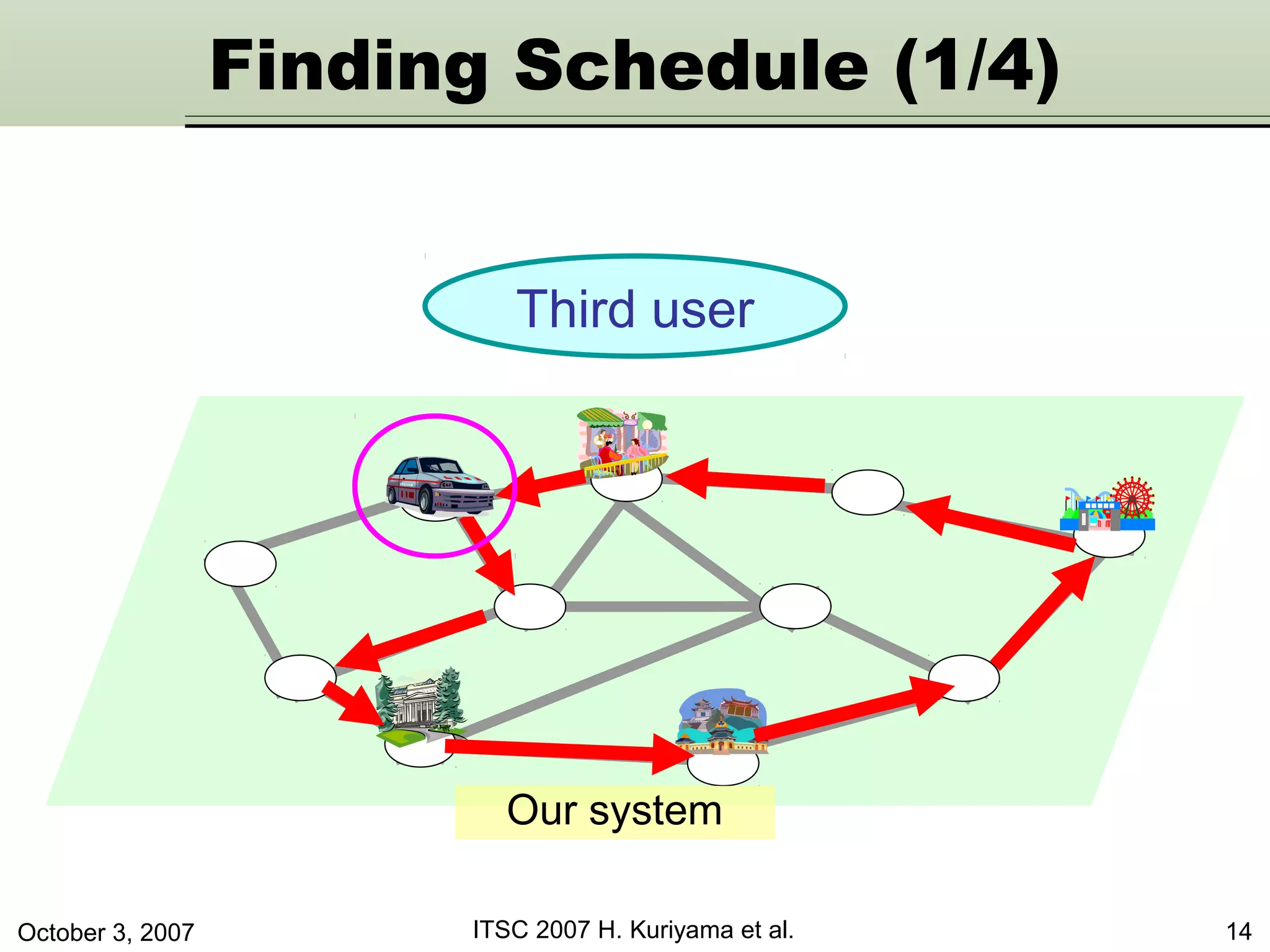
Our system
Third user
Finding Schedule (1/4)
October 3, 2007 ITSC 2007 H. Kuriyama et al. 15
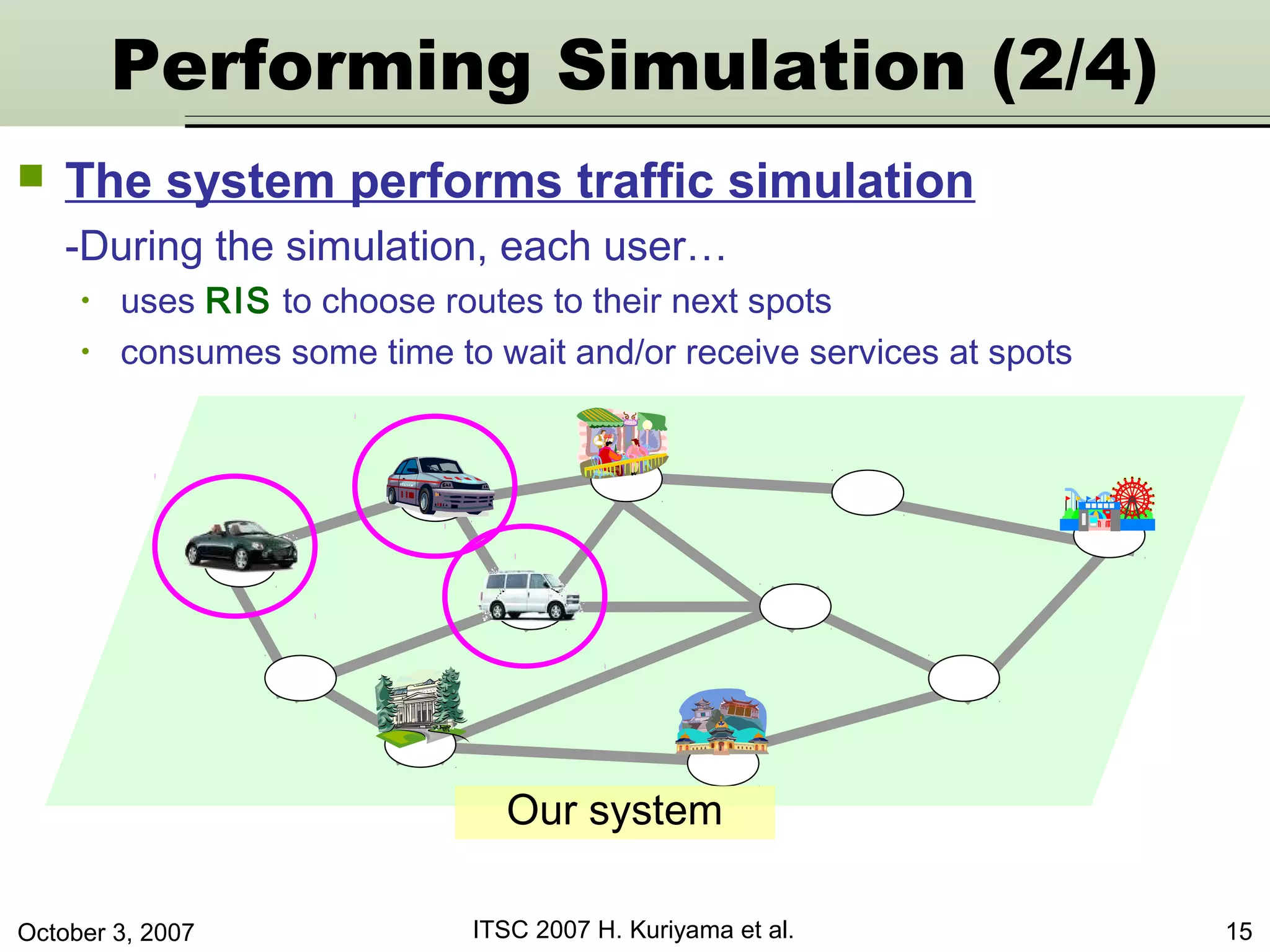
Our system
Performing Simulation (2/4)
 The system performs traffic simulation
-During the simulation, each user…
• uses RIS to choose routes to their next spots
• consumes some time to wait and/or receive services at spots
October 3, 2007 ITSC 2007 H. Kuriyama et al. 16
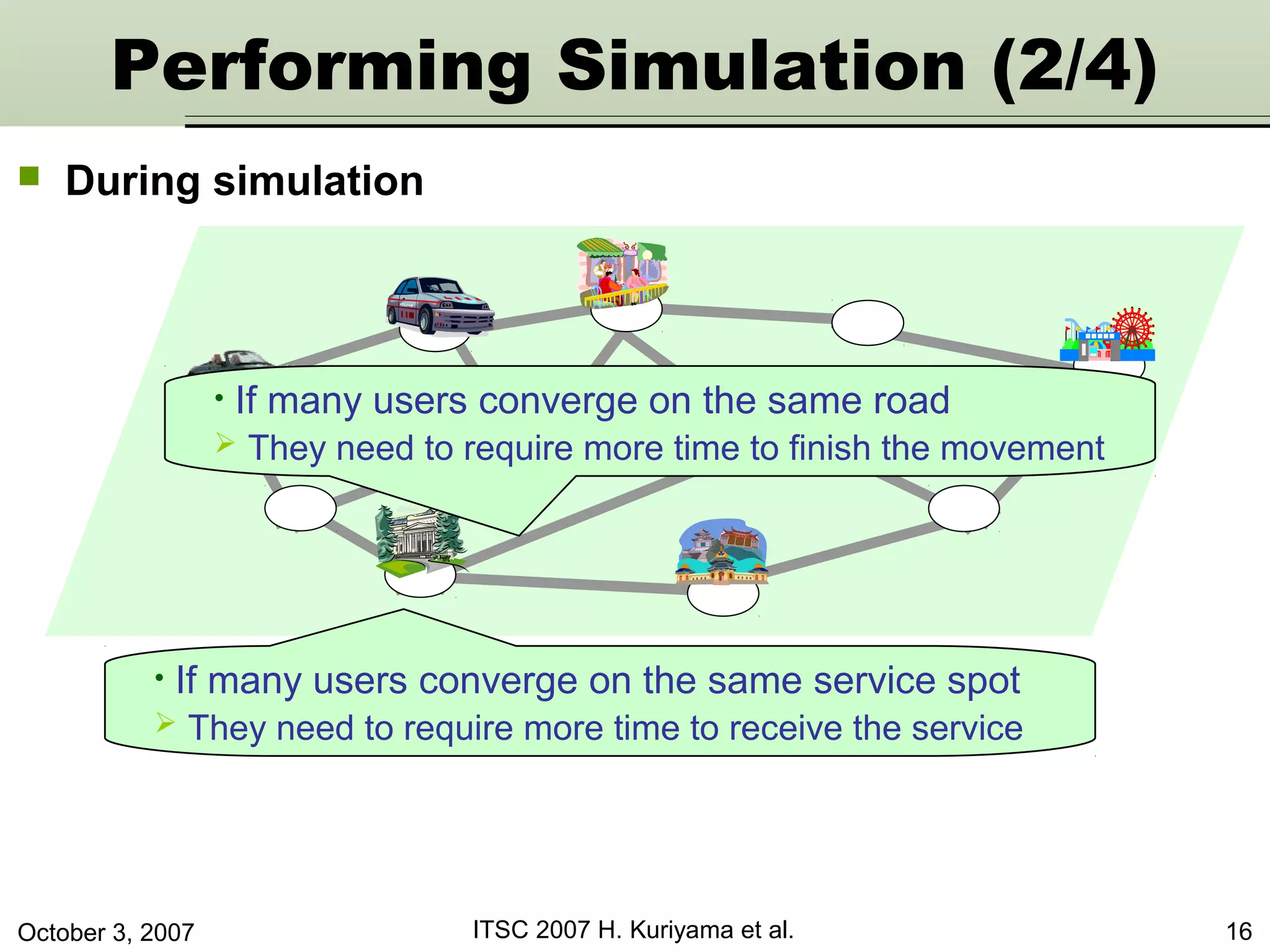
 During simulation
Performing Simulation (2/4)
• If many users converge on the same service spot
 They need to require more time to receive the service
• If many users converge on the same road
 They need to require more time to finish the movement
October 3, 2007 ITSC 2007 H. Kuriyama et al. 17
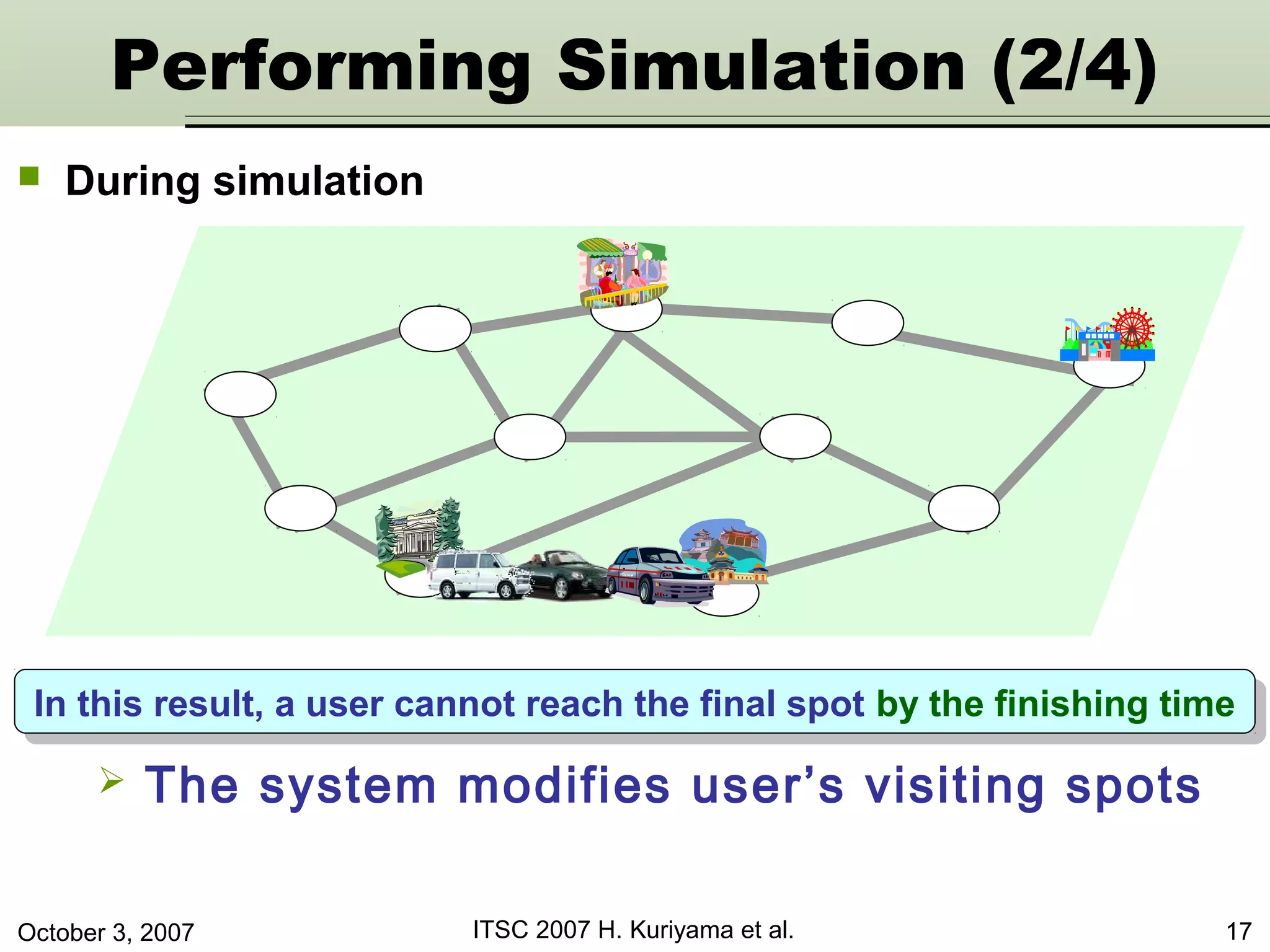
 The system modifies user’s visiting spots
 During simulation
Performing Simulation (2/4)
In this result, a user cannot reach the final spot by the finishing timeIn this result, a user cannot reach the final spot by the finishing time
October 3, 2007 ITSC 2007 H. Kuriyama et al. 18
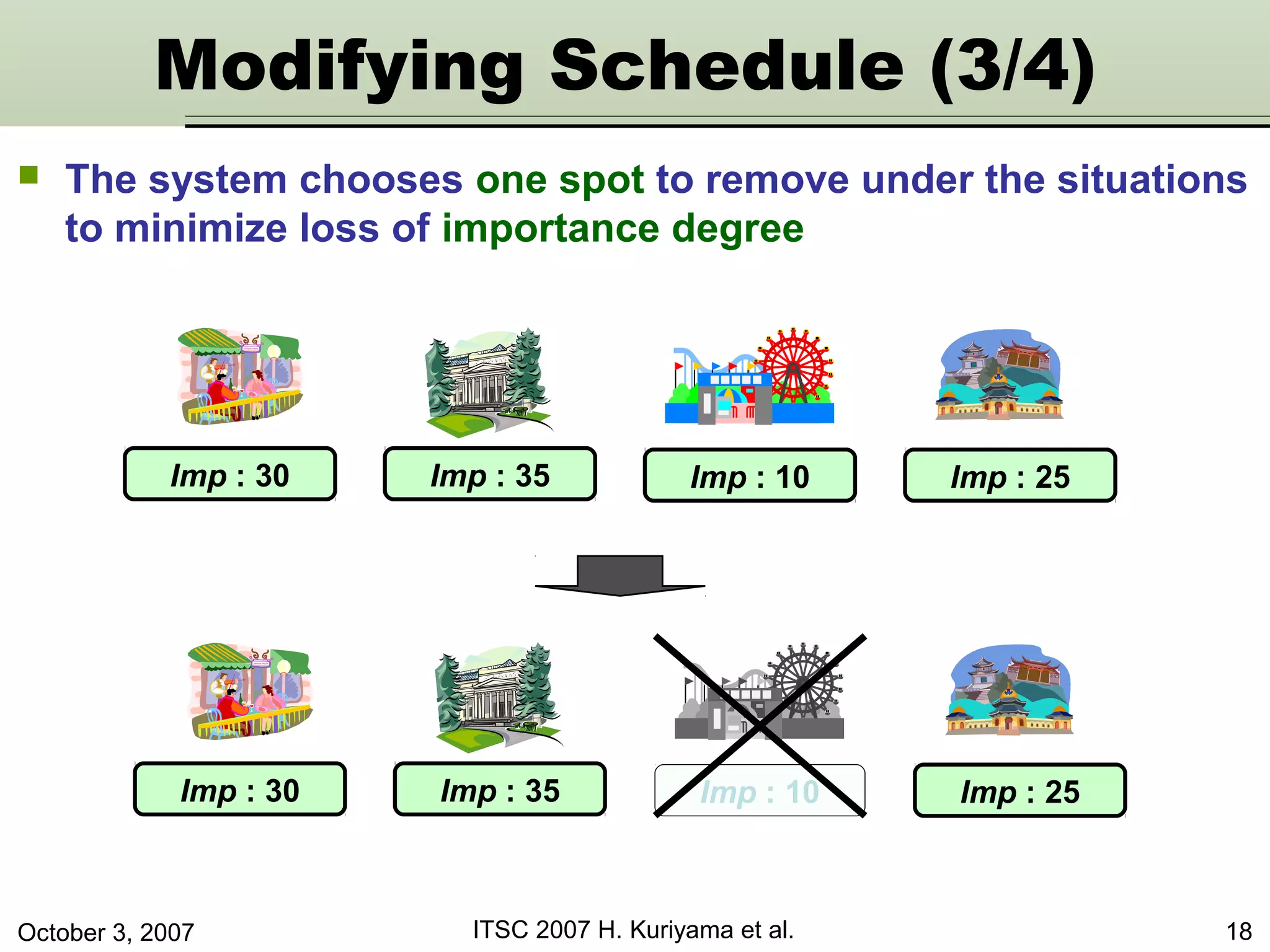
Imp : 30 Imp : 35 Imp : 10 Imp : 25
Modifying Schedule (3/4)
 The system chooses one spot to remove under the situations
to minimize loss of importance degree
October 3, 2007 ITSC 2007 H. Kuriyama et al. 19
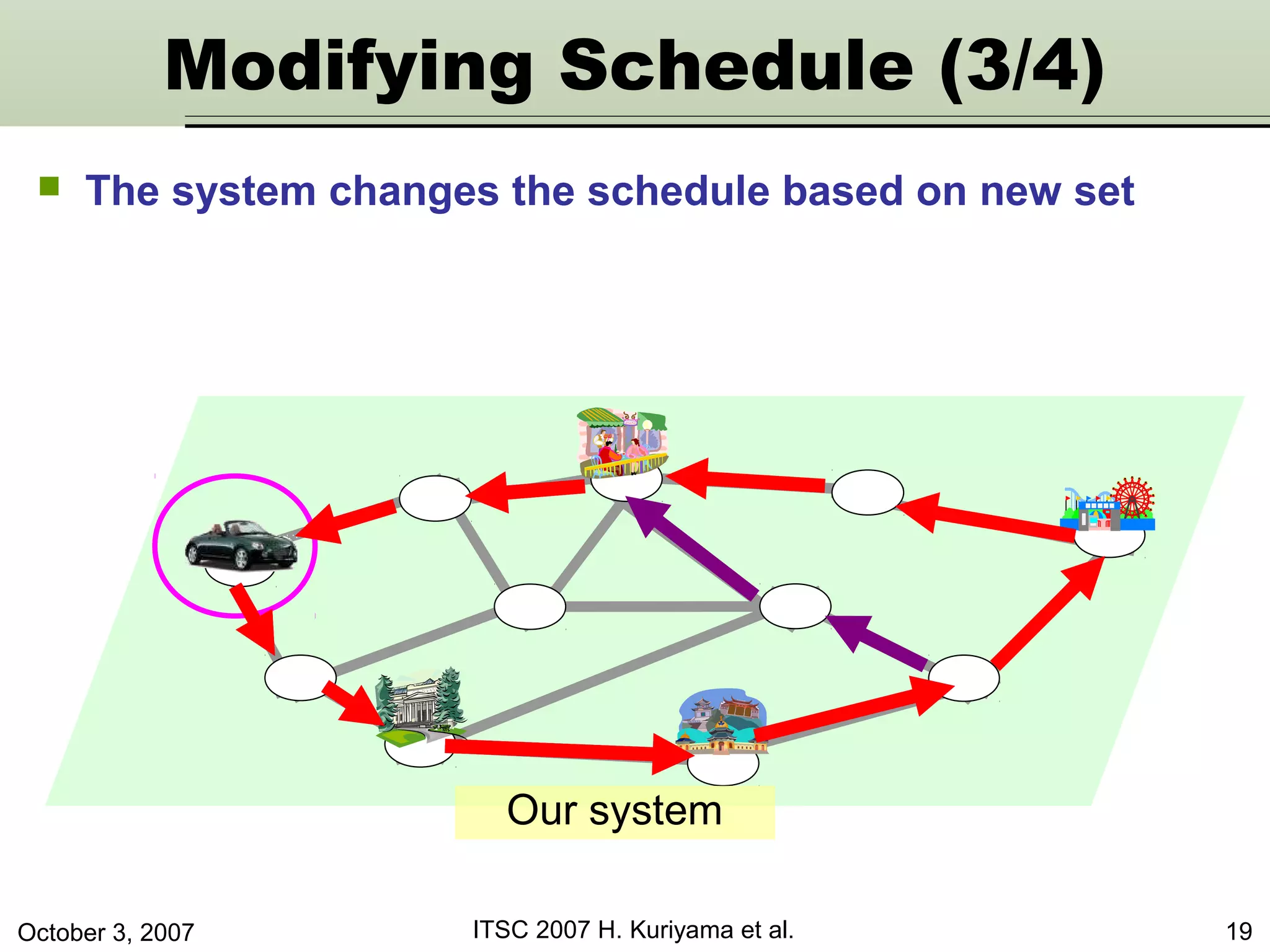
Our system
Modifying Schedule (3/4)
 The system changes the schedule based on new set
October 3, 2007 ITSC 2007 H. Kuriyama et al. 20
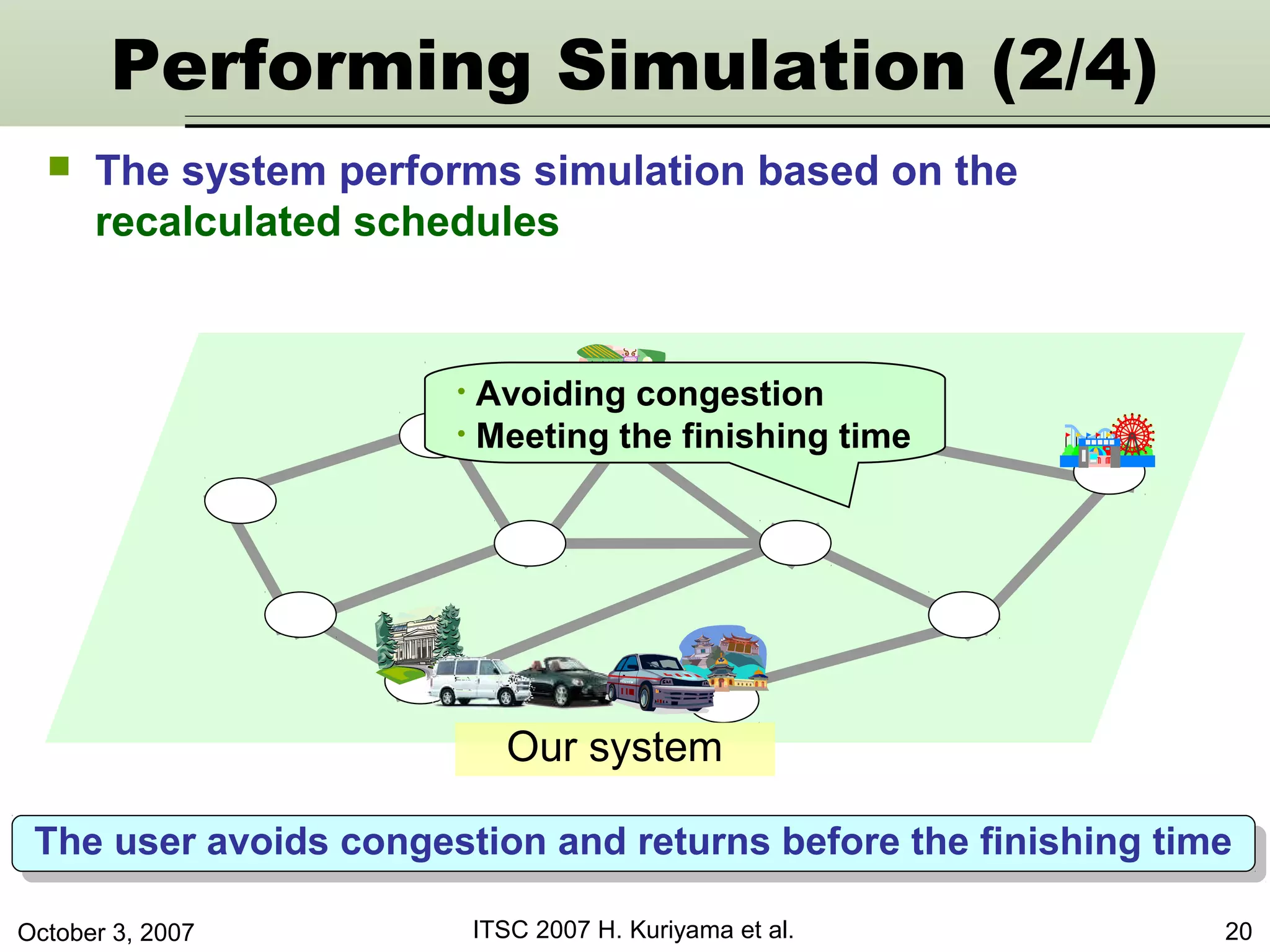
• Avoiding congestion
• Meeting the finishing time
Our system
Performing Simulation (2/4)
The user avoids congestion and returns before the finishing timeThe user avoids congestion and returns before the finishing time
 The system performs simulation based on the
recalculated schedules
October 3, 2007 ITSC 2007 H. Kuriyama et al. 21
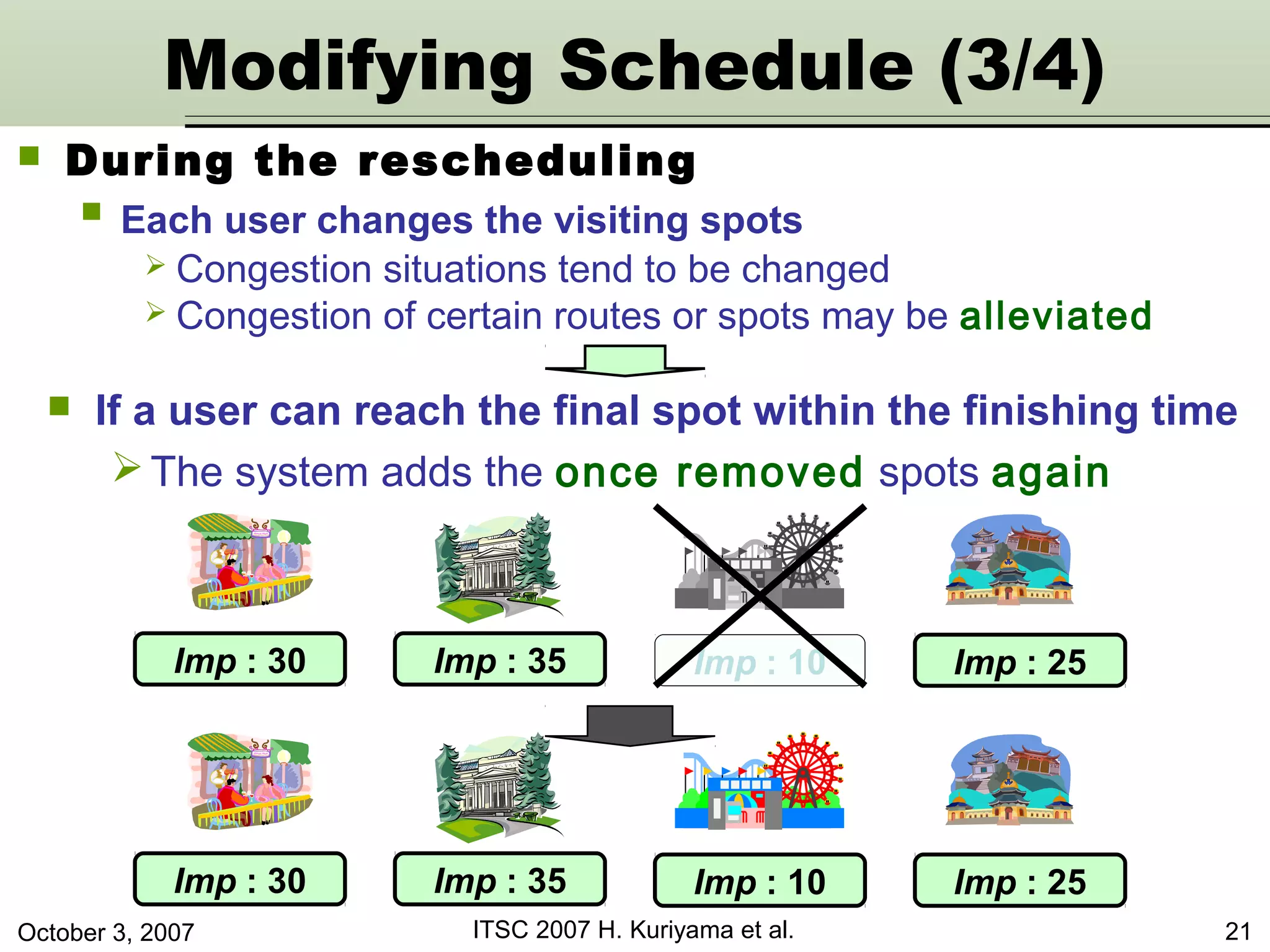
 If a user can reach the final spot within the finishing time
The system adds the once removed spots again
Imp : 30 Imp : 35 Imp : 10 Imp : 25
Modifying Schedule (3/4)
 During the rescheduling
 Each user changes the visiting spots
 Congestion situations tend to be changed
 Congestion of certain routes or spots may be alleviated
October 3, 2007 ITSC 2007 H. Kuriyama et al. 22
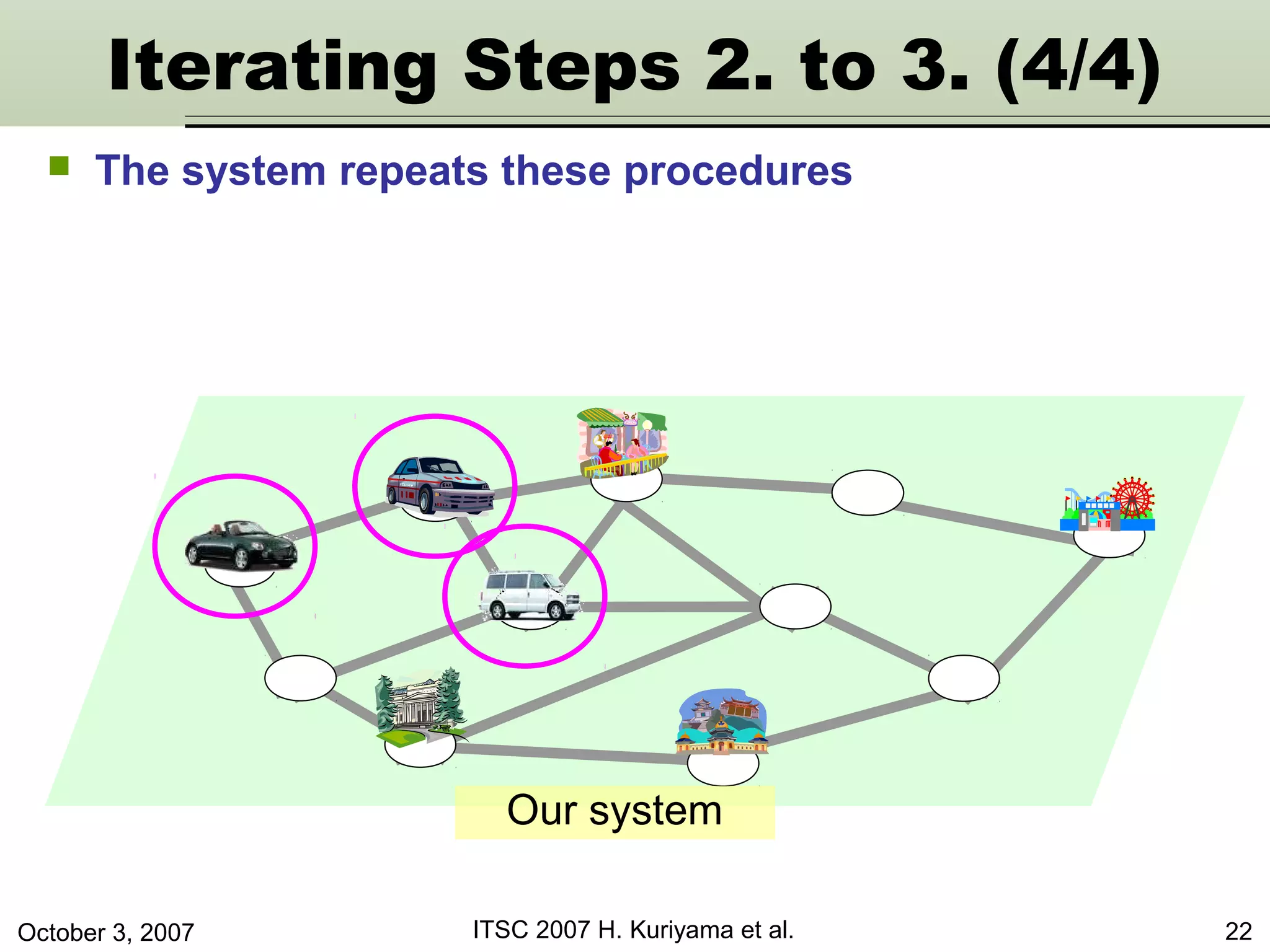
Iterating Steps 2. to 3. (4/4)
Our system
 The system repeats these procedures
October 3, 2007 ITSC 2007 H. Kuriyama et al. 23
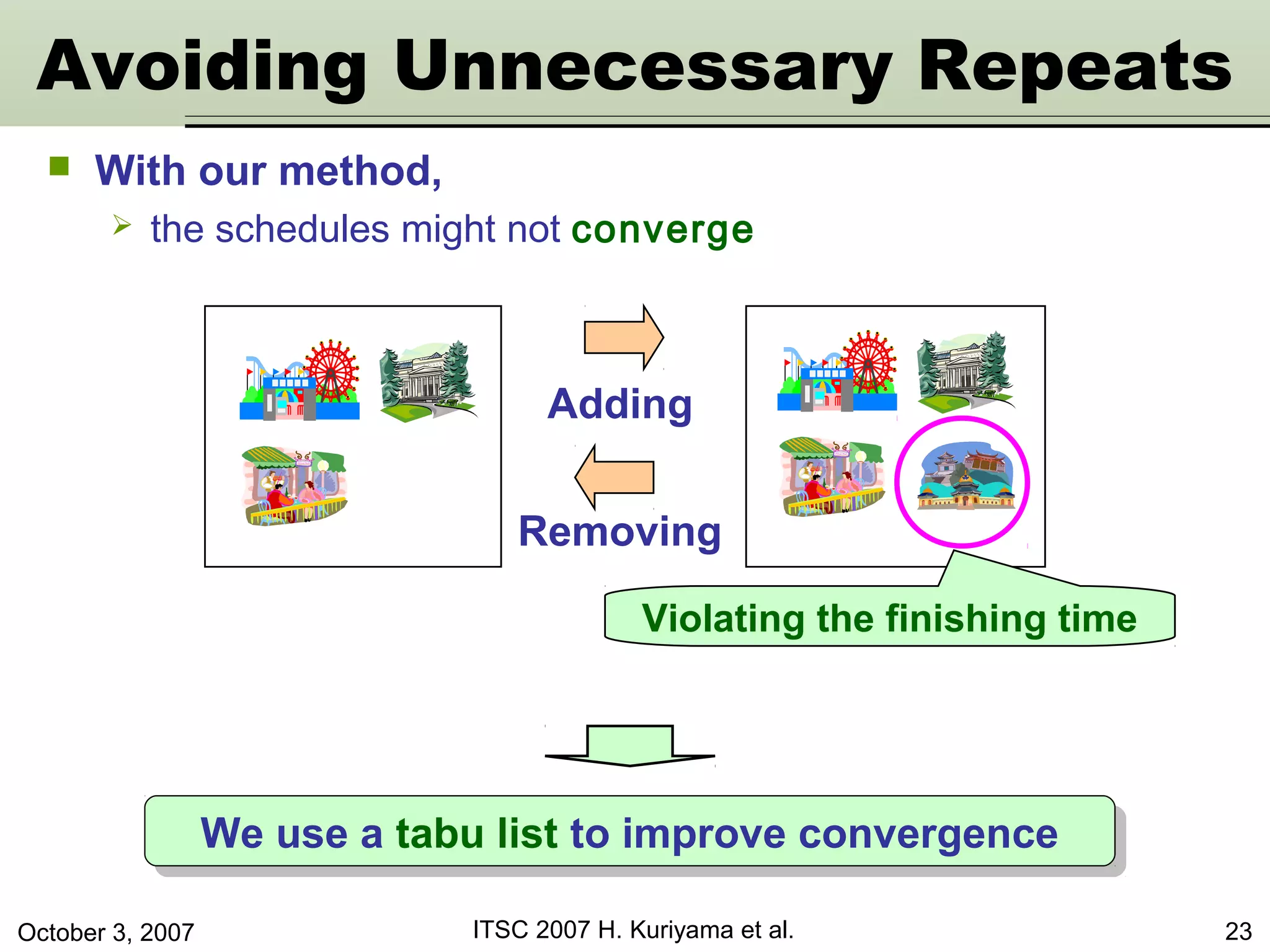
 With our method,
 the schedules might not converge
We use a tabu list to improve convergenceWe use a tabu list to improve convergence
Avoiding Unnecessary Repeats
Removing
Adding
Violating the finishing time
October 3, 2007 ITSC 2007 H. Kuriyama et al. 24
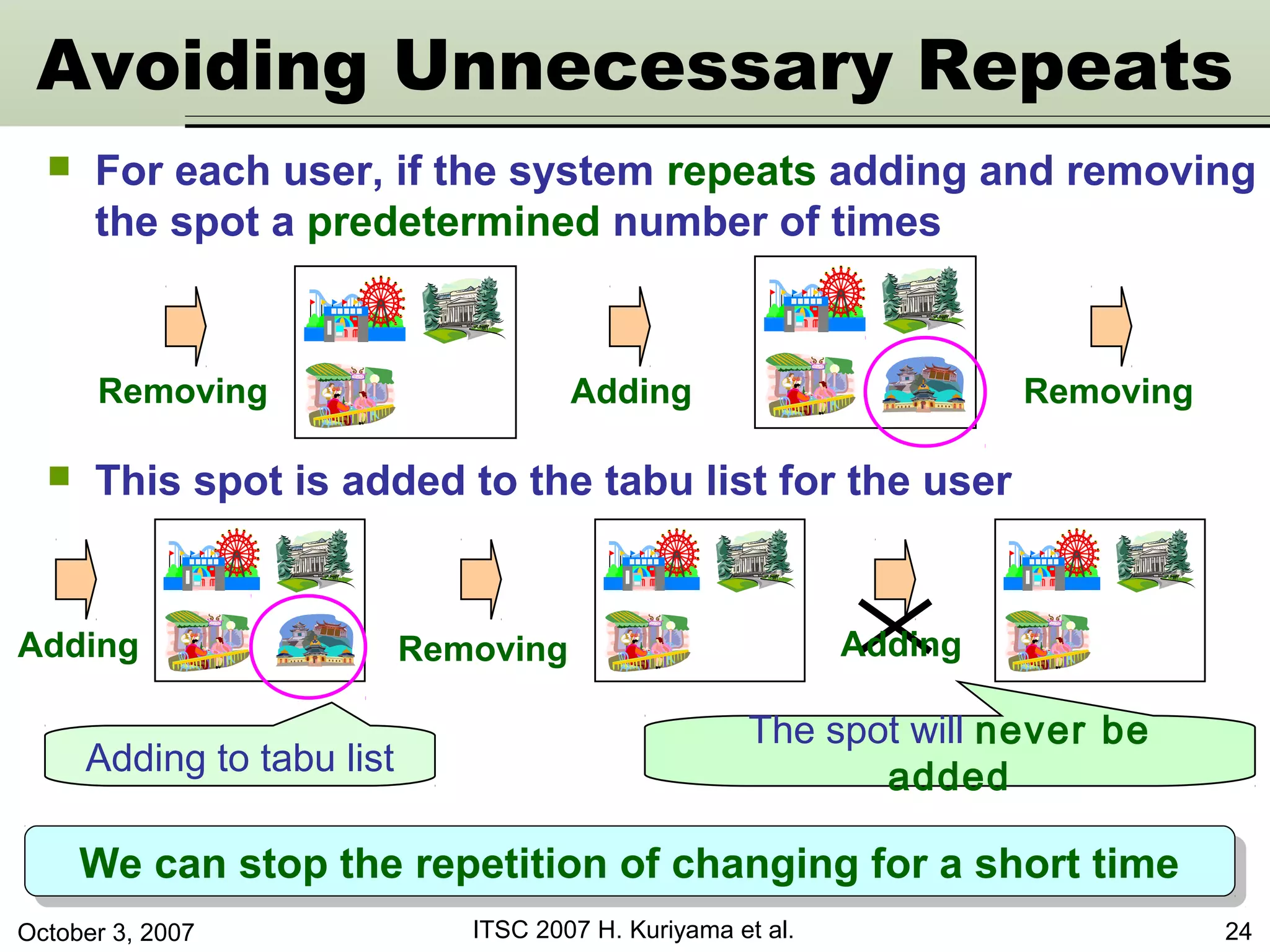
 For each user, if the system repeats adding and removing
the spot a predetermined number of times
 This spot is added to the tabu list for the user
Adding to tabu list
We can stop the repetition of changing for a short timeWe can stop the repetition of changing for a short time
Removing
The spot will never be
added
Avoiding Unnecessary Repeats
Adding Removing
RemovingAdding Adding
October 3, 2007 ITSC 2007 H. Kuriyama et al. 25
Outline
• Background
• Proposed method
• Experiment
• Conclusion
October 3, 2007 ITSC 2007 H. Kuriyama et al. 26
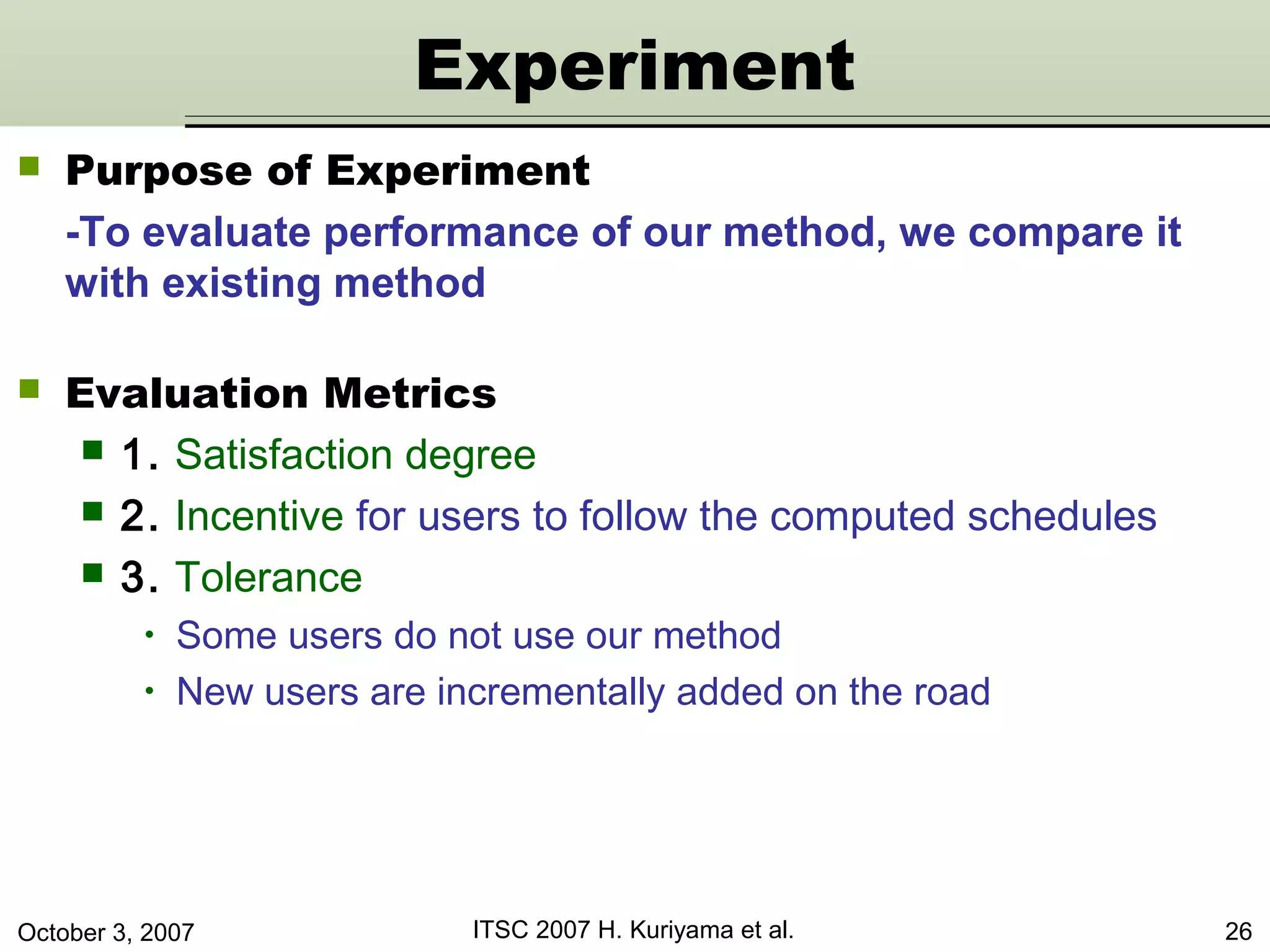
 Purpose of Experiment
-To evaluate performance of our method, we compare it
with existing method
Experiment
 Evaluation Metrics
 1. Satisfaction degree
 2. Incentive for users to follow the computed schedules
 3. Tolerance
• Some users do not use our method
• New users are incrementally added on the road
October 3, 2007 ITSC 2007 H. Kuriyama et al. 27
 Road Network used for Simulation
 Each User’s behavior
-Visiting 4 spots
-Finally returning to the starting spot
Number of spots 32
Number of roads 56
Total length of map 59.6 [km]
Service time of each spot 600 -1,800 [sec]
Capacity of each spot 10-30 [users]
Number of users 500 or 1,000
Spot
Road
 Each User’s input
data
-Random
Simulation Configuration
These values are determined so that each user would
have to wait for a while before receiving the service if
500 users are distributed evenly among all spots
These values are determined so that each user would
have to wait for a while before receiving the service if
500 users are distributed evenly among all spots
October 3, 2007 ITSC 2007 H. Kuriyama et al. 28
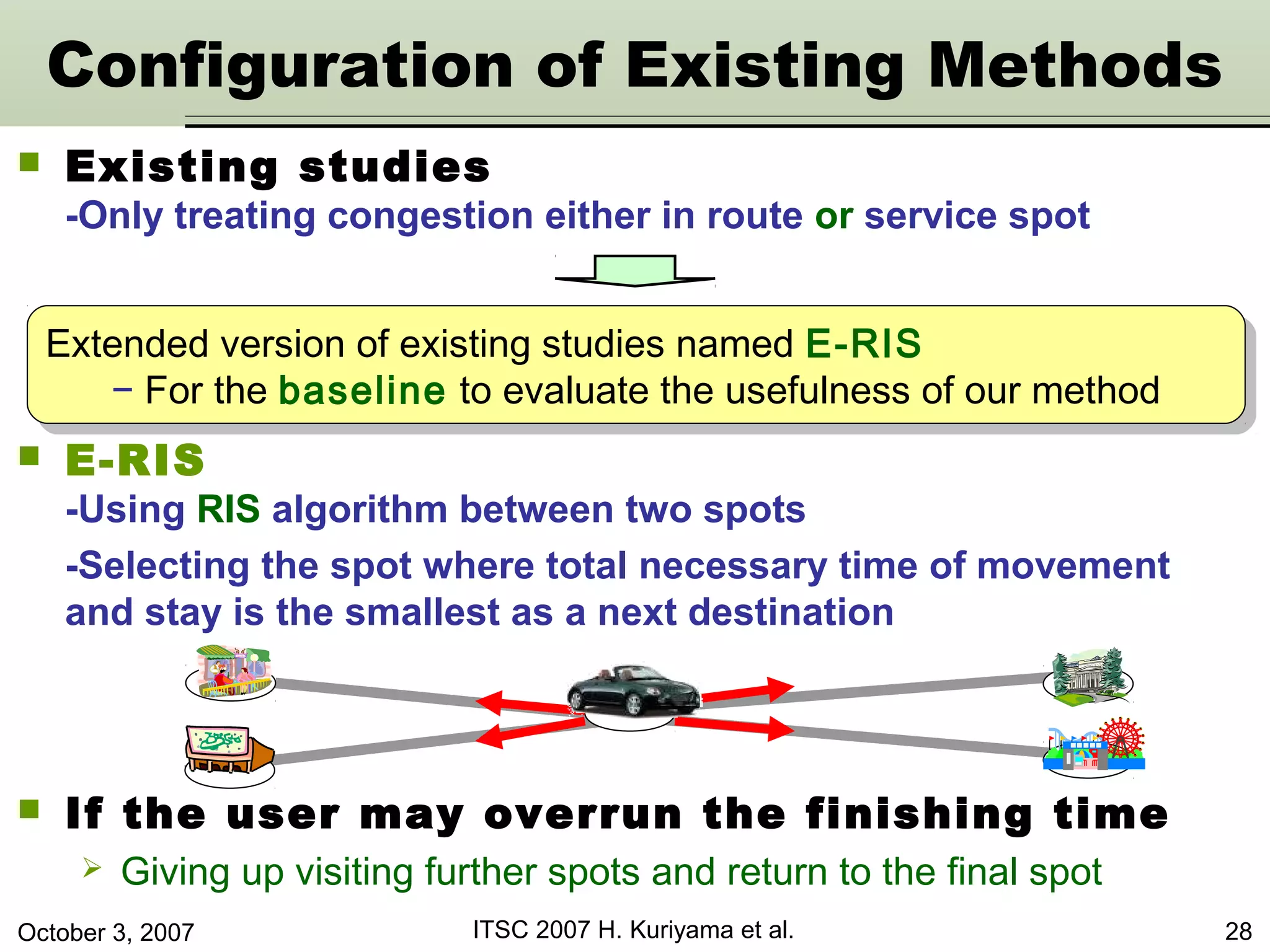
 Existing studies
-Only treating congestion either in route or service spot
Configuration of Existing Methods
Extended version of existing studies named E-RIS
− For the baseline to evaluate the usefulness of our method
Extended version of existing studies named E-RIS
− For the baseline to evaluate the usefulness of our method
 E-RIS
-Using RIS algorithm between two spots
-Selecting the spot where total necessary time of movement
and stay is the smallest as a next destination
 If the user may overrun the finishing time
 Giving up visiting further spots and return to the final spot
October 3, 2007 ITSC 2007 H. Kuriyama et al. 29
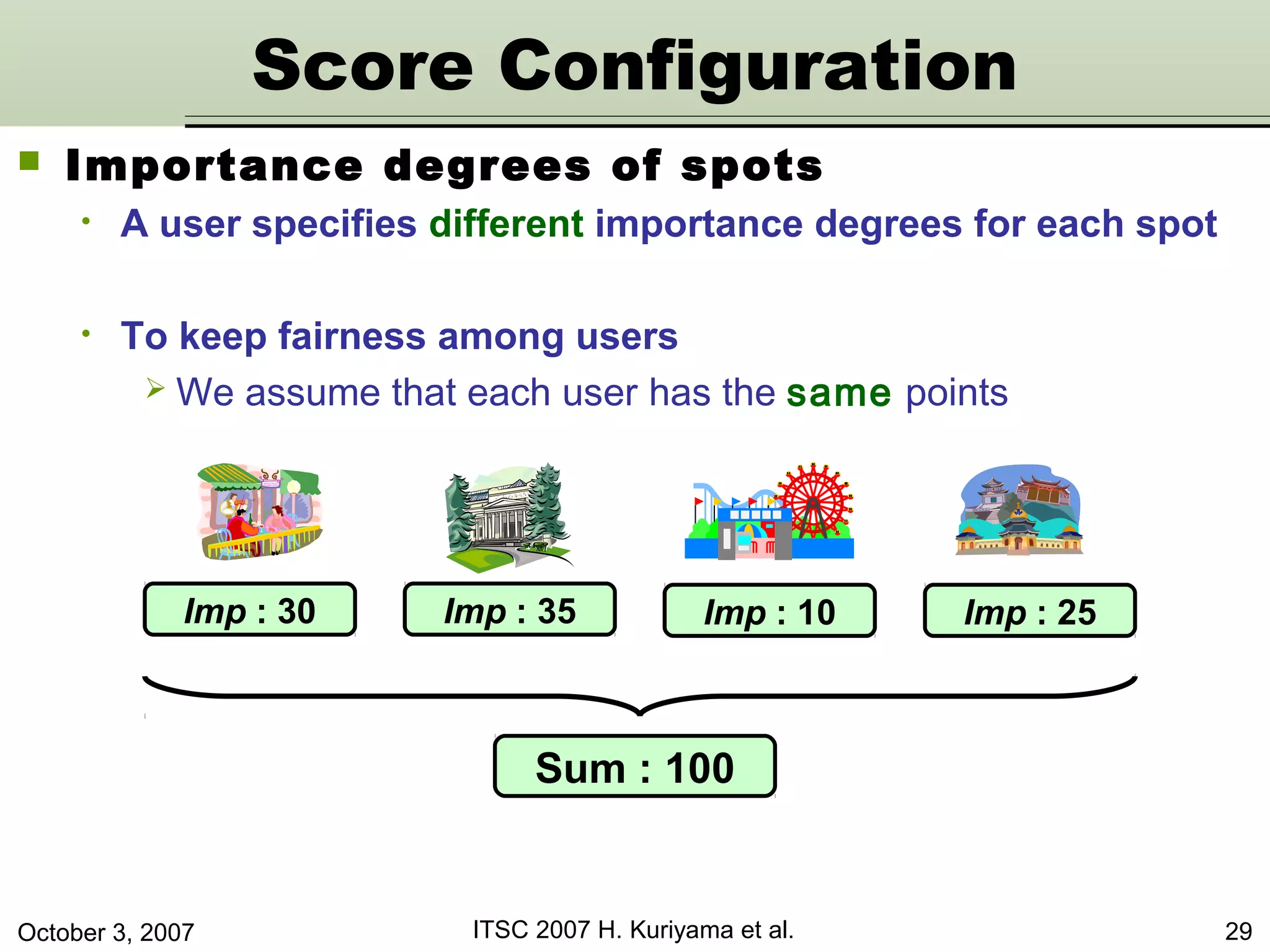
Sum : 100
 Importance degrees of spots
• A user specifies different importance degrees for each spot
• To keep fairness among users
 We assume that each user has the same points
Imp : 30 Imp : 35 Imp : 10 Imp : 25
Score Configuration
October 3, 2007 ITSC 2007 H. Kuriyama et al. 30
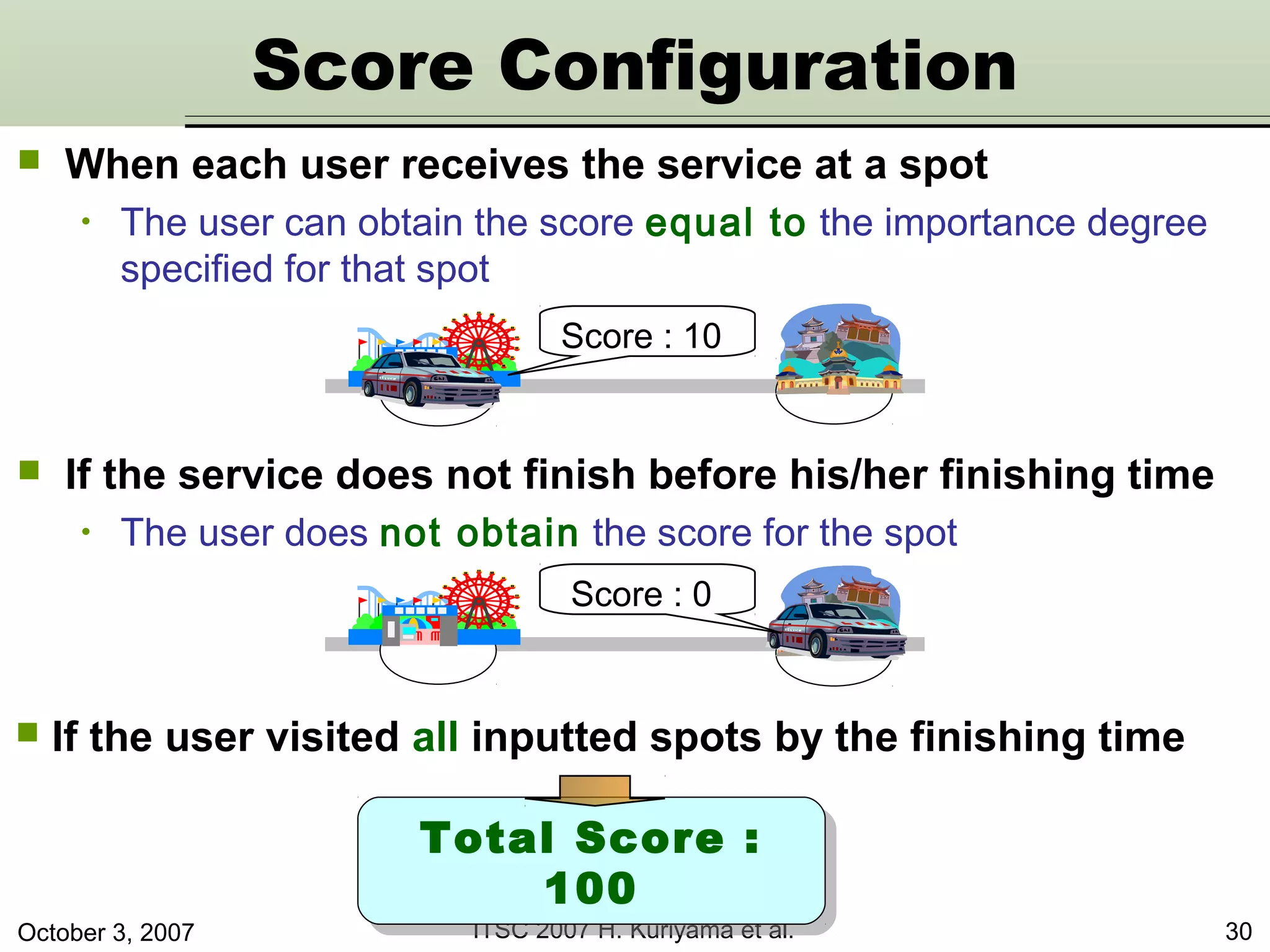
 When each user receives the service at a spot
• The user can obtain the score equal to the importance degree
specified for that spot
 If the service does not finish before his/her finishing time
• The user does not obtain the score for the spot
Score : 10
Total Score :
100
Total Score :
100
 If the user visited all inputted spots by the finishing time
Score Configuration
Score : 0
October 3, 2007 ITSC 2007 H. Kuriyama et al. 31
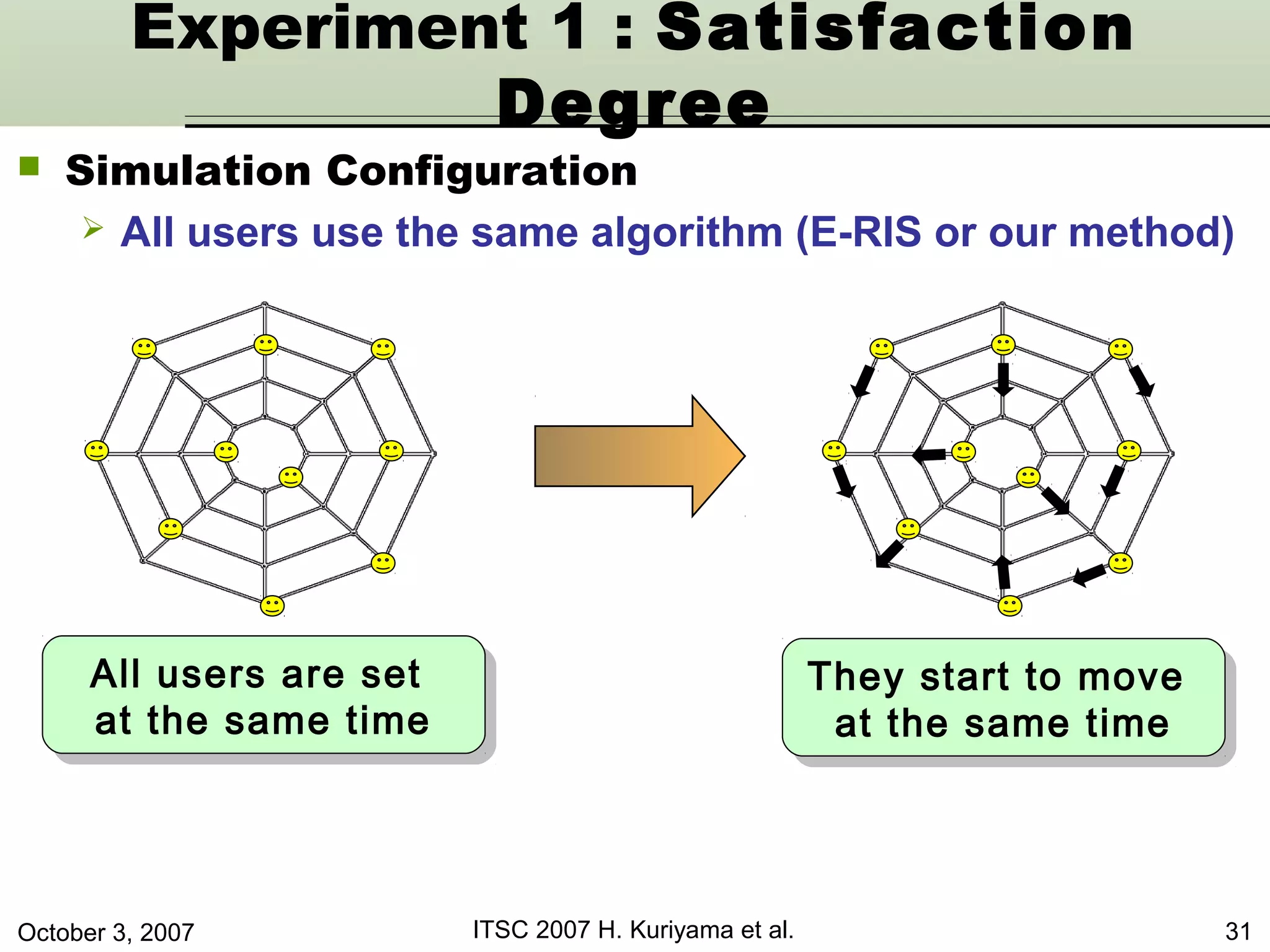
 Simulation Configuration
 All users use the same algorithm (E-RIS or our method)
Experiment 1 : Satisfaction
Degree
They start to move
at the same time
They start to move
at the same time
All users are set
at the same time
All users are set
at the same time
October 3, 2007 ITSC 2007 H. Kuriyama et al. 32
Ave.score
Excessusers
0
20
40
60
80
100
500 users 1,000 users
E-RIS
Our method
0
50
100
150
200
250
500 users 1,000 users
E-RIS
Our method
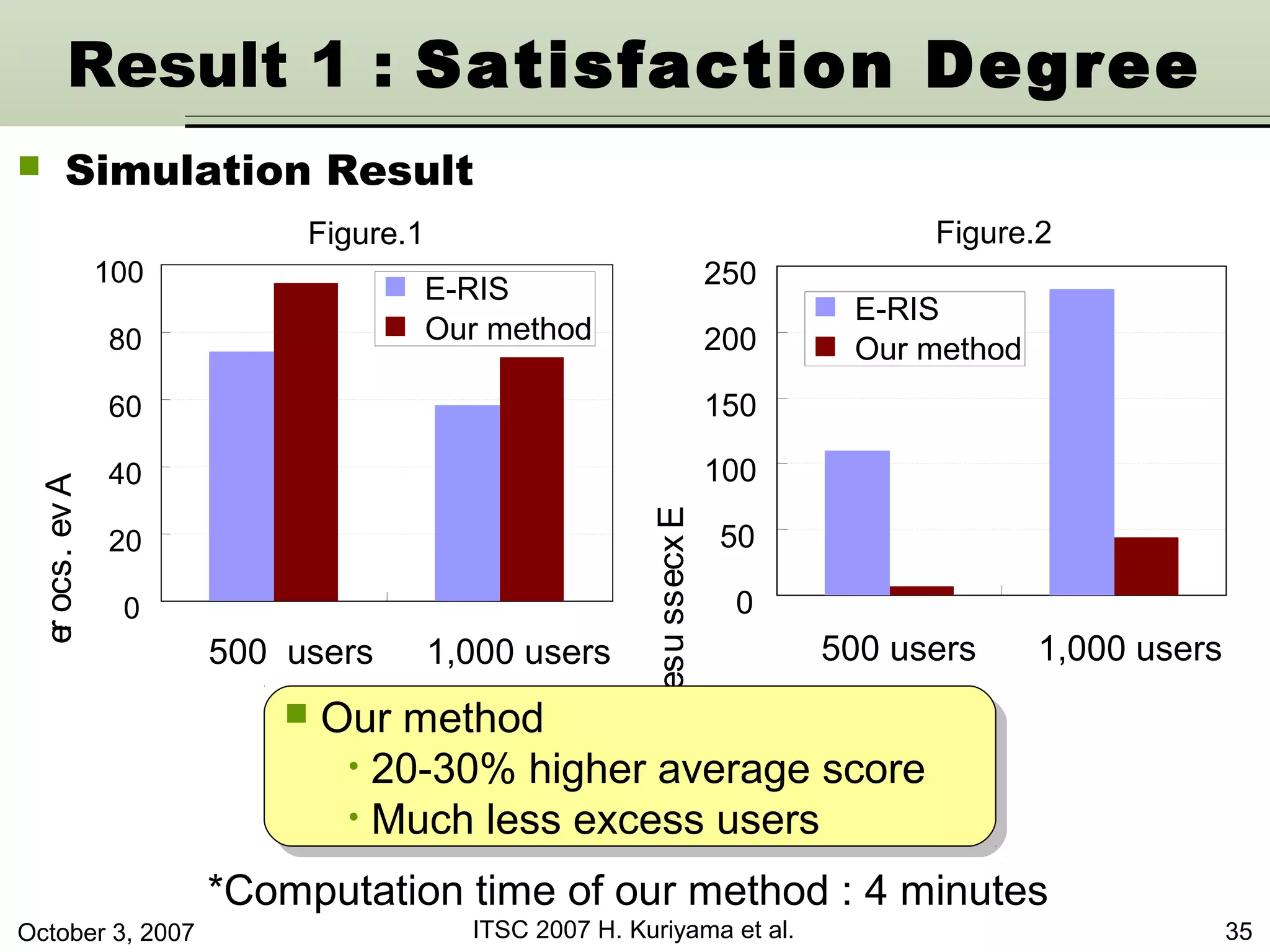
Result 1 : Satisfaction Degree
 Simulation Result
Figure.1 Figure.2
October 3, 2007 ITSC 2007 H. Kuriyama et al. 33
Ave.score
Excessusers
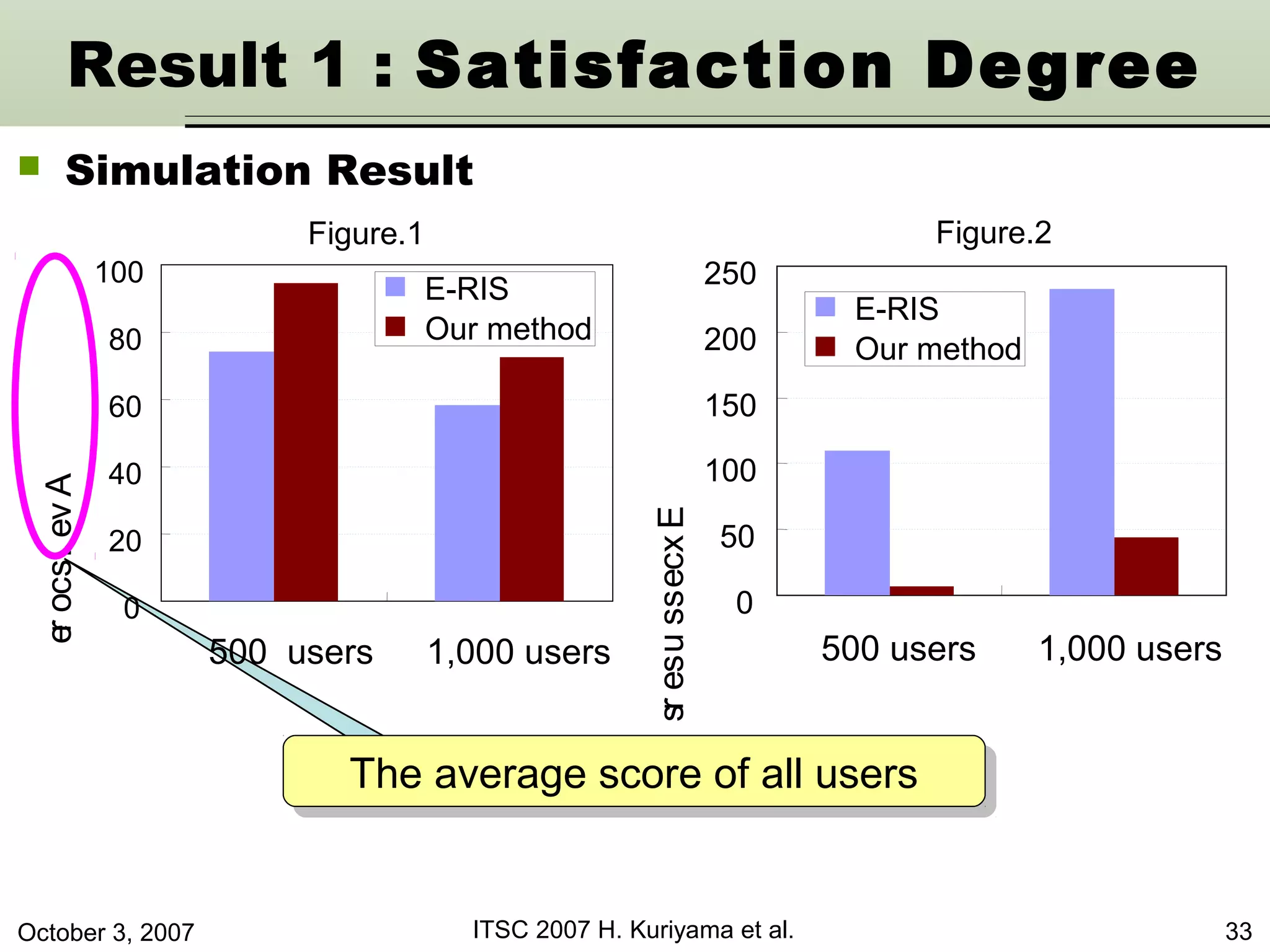
The average score of all usersThe average score of all users
0
20
40
60
80
100
E-RIS
Our method
0
50
100
150
200
250
E-RIS
Our method
Figure.1 Figure.2
500 users 1,000 users 500 users 1,000 users
Result 1 : Satisfaction Degree
 Simulation Result
October 3, 2007 ITSC 2007 H. Kuriyama et al. 34
Ave.score
Excessusers
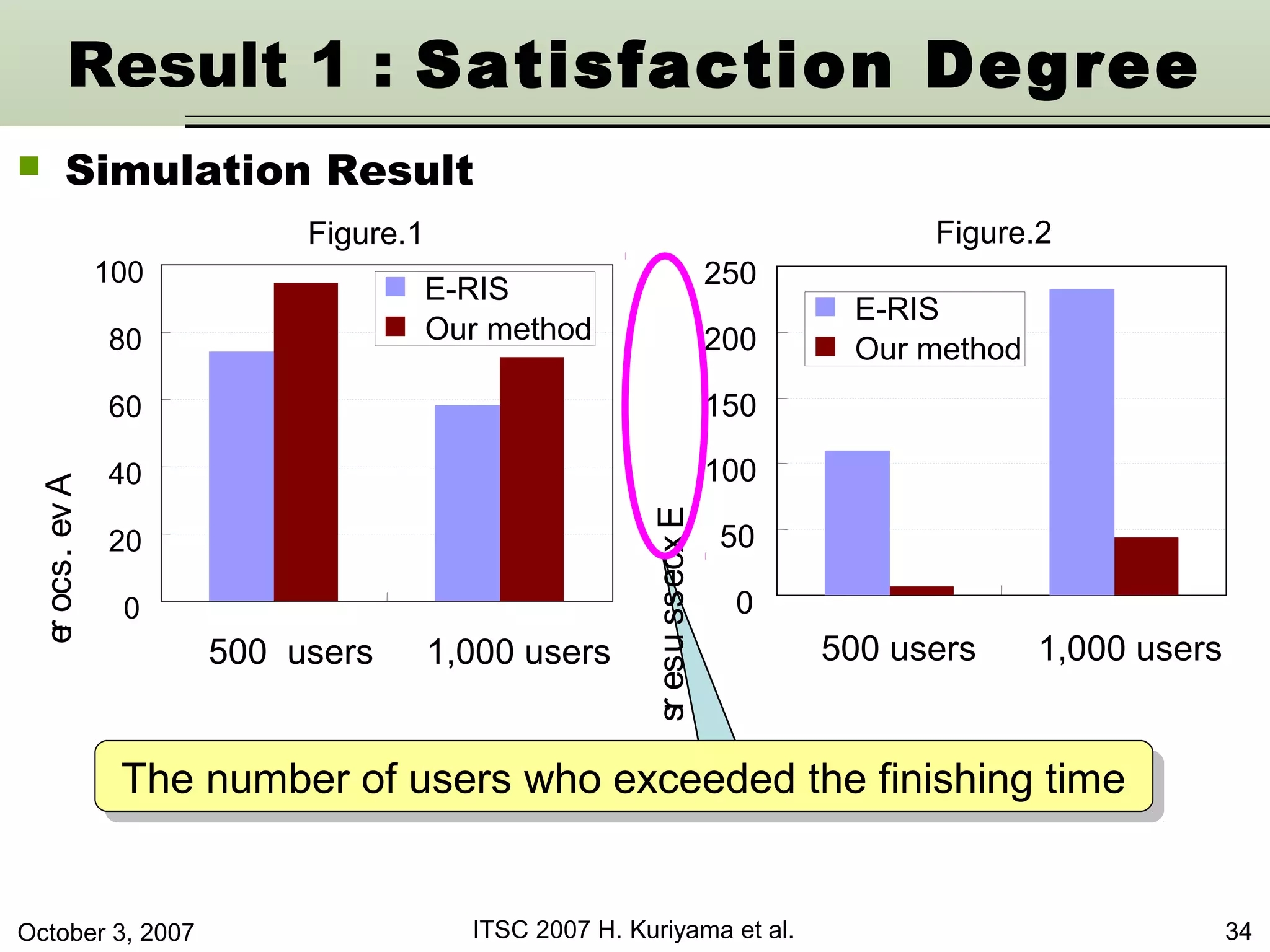
The number of users who exceeded the finishing timeThe number of users who exceeded the finishing time
0
20
40
60
80
100
E-RIS
Our method
0
50
100
150
200
250
E-RIS
Our method
Figure.1 Figure.2
500 users 1,000 users 500 users 1,000 users
Result 1 : Satisfaction Degree
 Simulation Result
October 3, 2007 ITSC 2007 H. Kuriyama et al. 35
 Simulation Result
*Computation time of our method : 4 minutes
Ave.score
Excessusers
 Our method
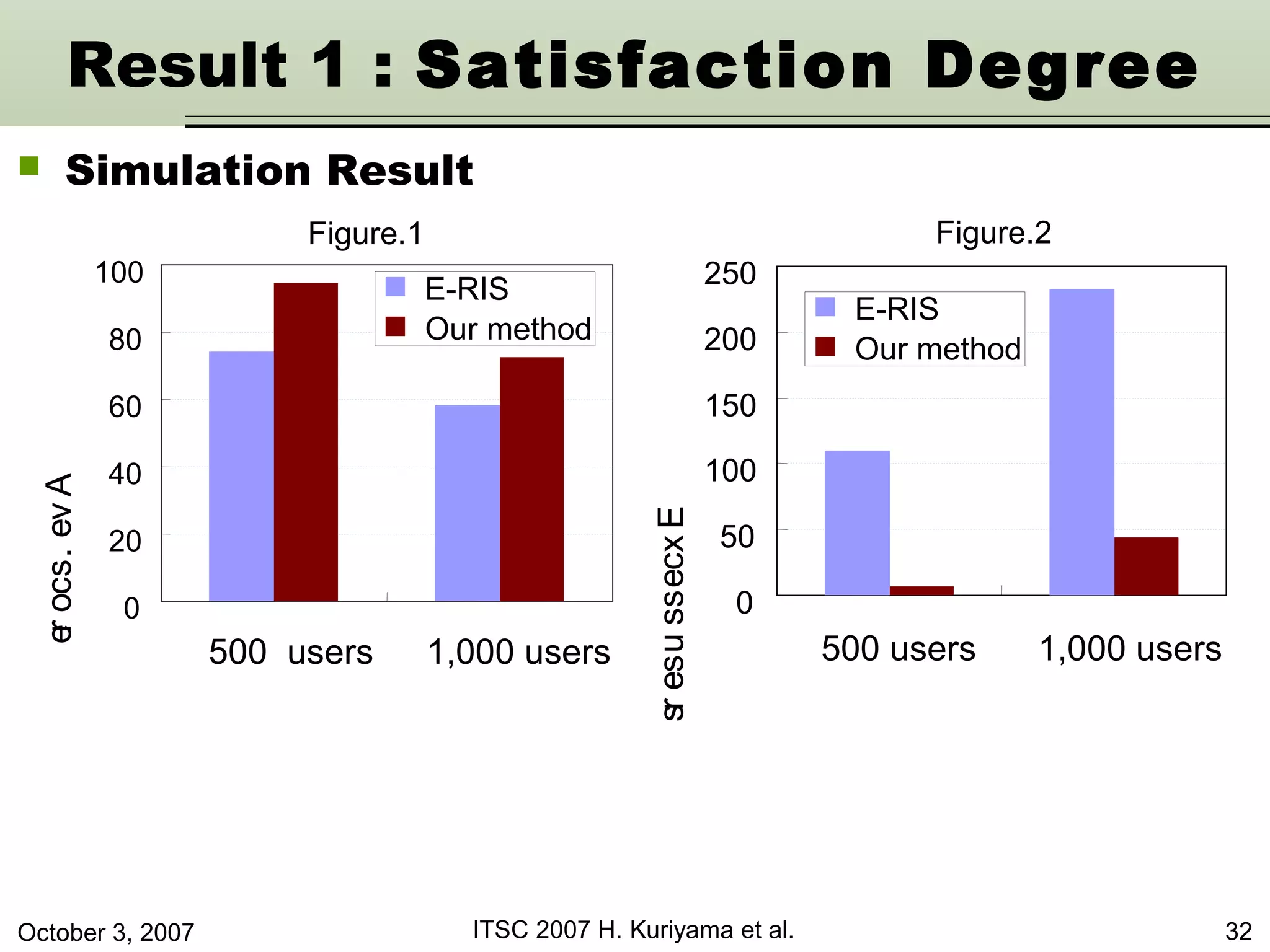
• 20-30% higher average score
• Much less excess users
 Our method
• 20-30% higher average score
• Much less excess users
0
20
40
60
80
100
E-RIS
Our method
0
50
100
150
200
250
E-RIS
Our method
Figure.1 Figure.2
500 users 1,000 users 500 users 1,000 users
Result 1 : Satisfaction Degree
October 3, 2007 ITSC 2007 H. Kuriyama et al. 36
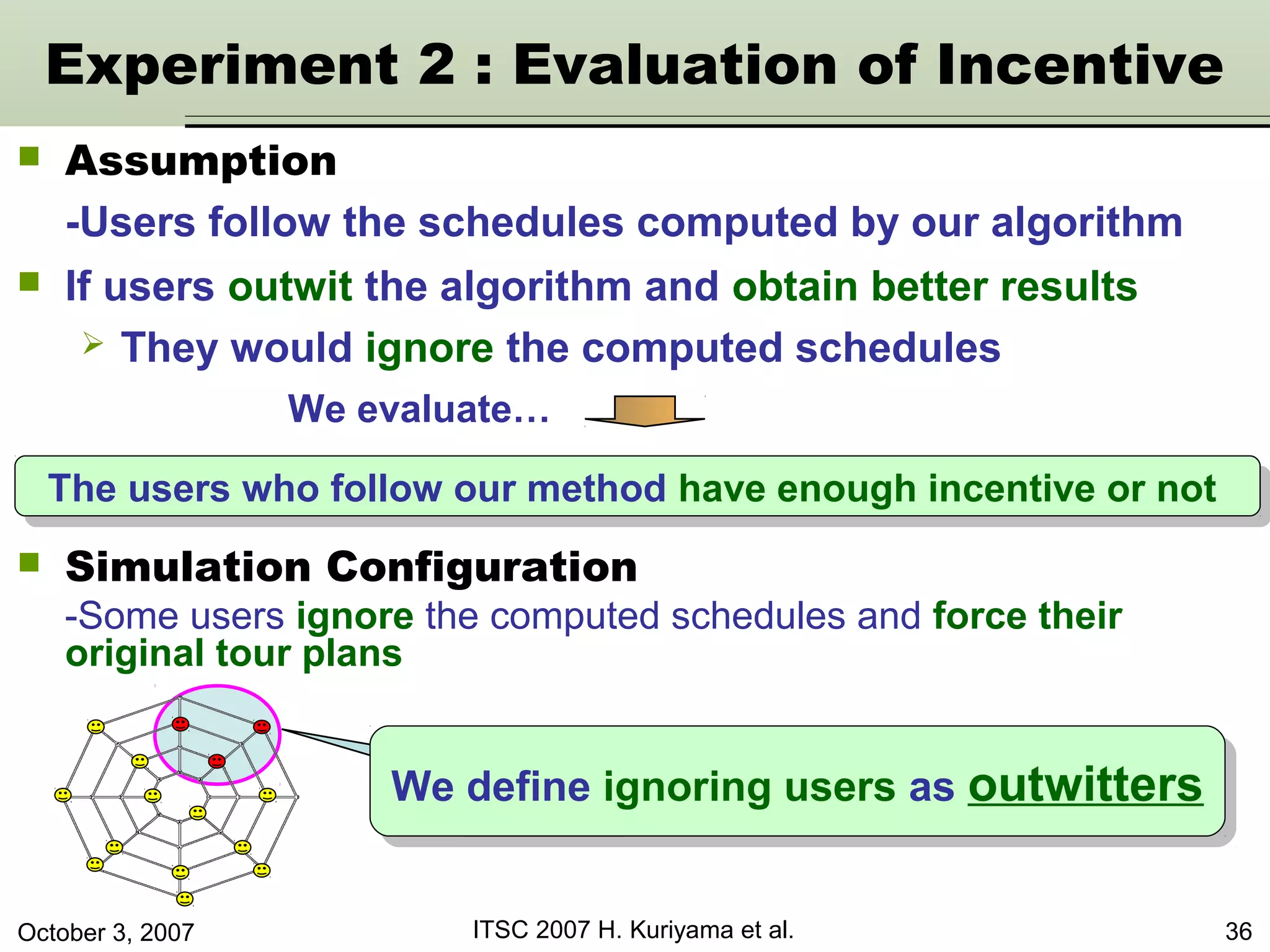
 Assumption
-Users follow the schedules computed by our algorithm
The users who follow our method have enough incentive or notThe users who follow our method have enough incentive or not
Experiment 2 : Evaluation of Incentive
 Simulation Configuration
-Some users ignore the computed schedules and force their
original tour plans
We define ignoring users as outwittersWe define ignoring users as outwitters
We evaluate…
 If users outwit the algorithm and obtain better results
 They would ignore the computed schedules
October 3, 2007 ITSC 2007 H. Kuriyama et al. 37
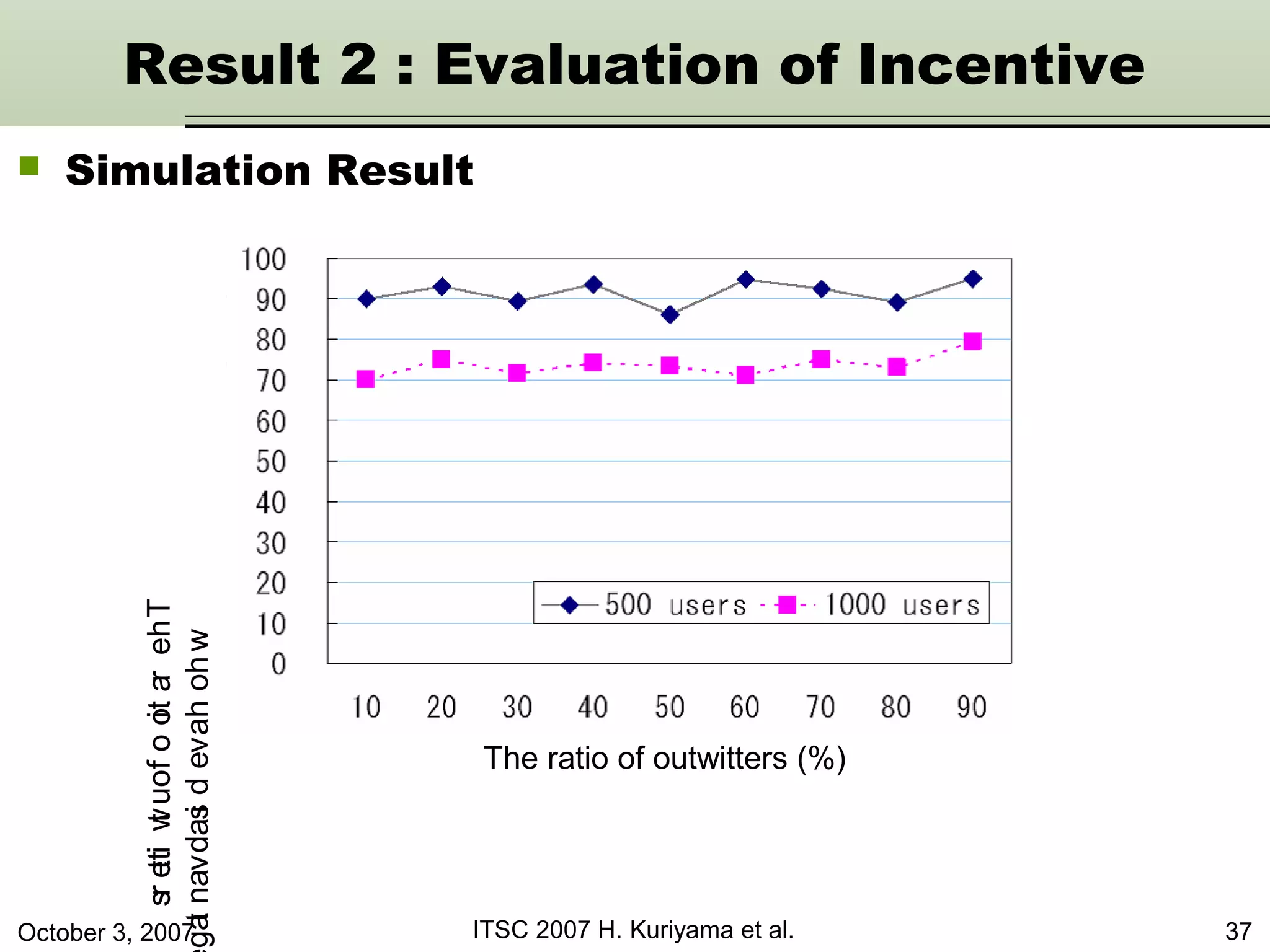
Result 2 : Evaluation of Incentive
 Simulation Result
The ratio of outwitters (%)
Theratioofoutwitters
whohavedisadvantag
October 3, 2007 ITSC 2007 H. Kuriyama et al. 38
Theratioofoutwitters
whohavedisadvantag
The ratio of outwitters (%)
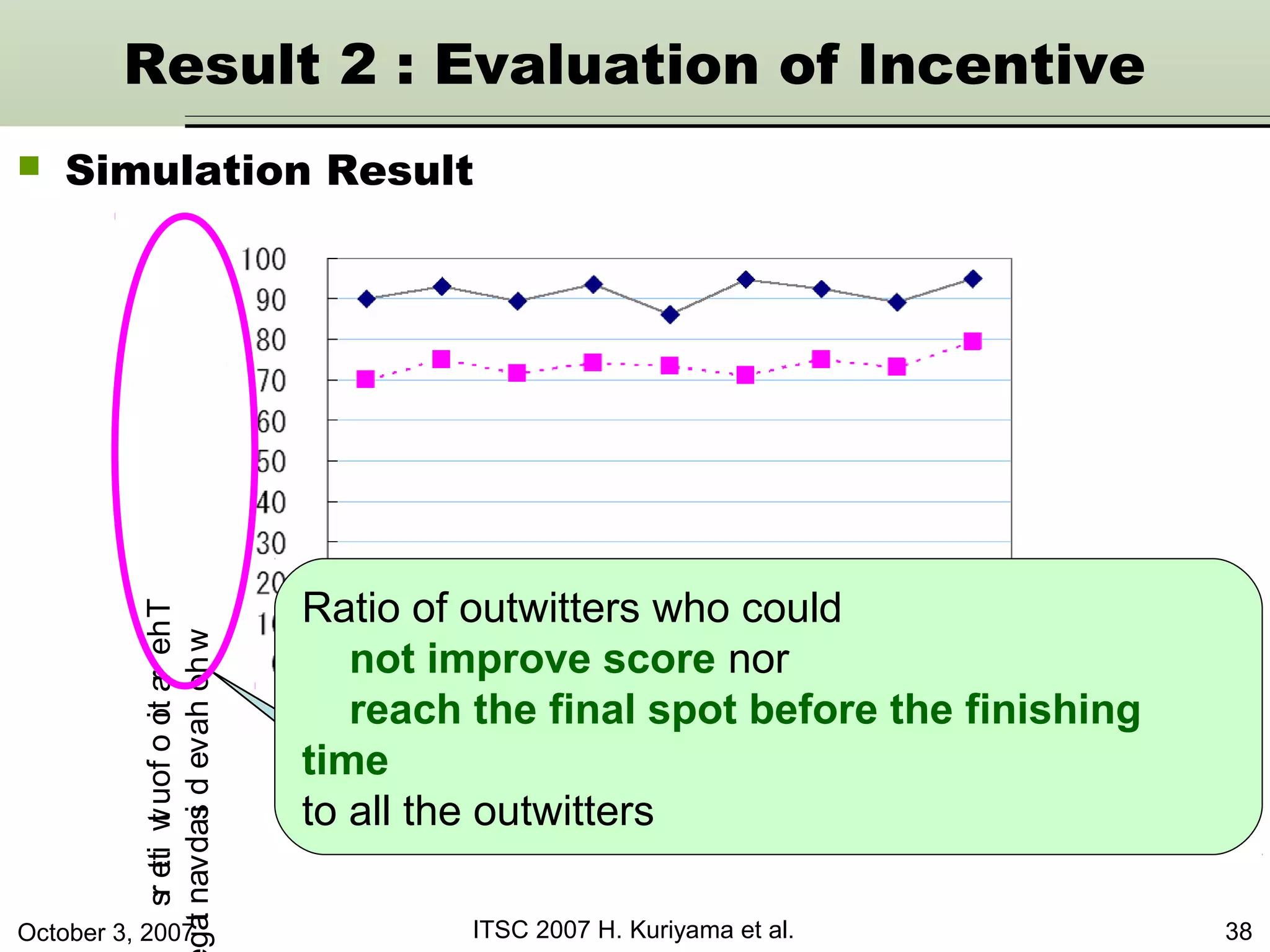
Ratio of outwitters who could
not improve score nor
reach the final spot before the finishing
time
to all the outwitters
Result 2 : Evaluation of Incentive
 Simulation Result
October 3, 2007 ITSC 2007 H. Kuriyama et al. 39
Result 2 : Evaluation of Incentive
 Simulation Result
The ratio of outwitters (%)
Theratioofoutwitters
whohavedisadvantag
 Most outwitters (over 70%) have disadvantage
 Our method should give users the motivation to follow
 Most outwitters (over 70%) have disadvantage
 Our method should give users the motivation to follow
October 3, 2007 ITSC 2007 H. Kuriyama et al. 40
 New users are added to random positions every 600 seconds
 When new users are added, all users using our method re-calculate schedules
(1) Some users use our method and the others use E-RIS
(2) New users are incrementally added on the road network
(1) Some users use our method and the others use E-RIS
(2) New users are incrementally added on the road network
Using our method
Using E-RIS
New users are incrementally
added on the road network
Experiment 3 : Evaluation of Tolerance
 Simulation Configuration
October 3, 2007 ITSC 2007 H. Kuriyama et al. 41
0
20
40
60
80
100
120
140
160
180
200
100 90 80 70 60 50 40 30 20 10 0
Our method E-RIS
0
10
20
30
40
50
60
70
80
90
100
100 90 80 70 60 50 40 30 20 10 0
Our method E-RIS
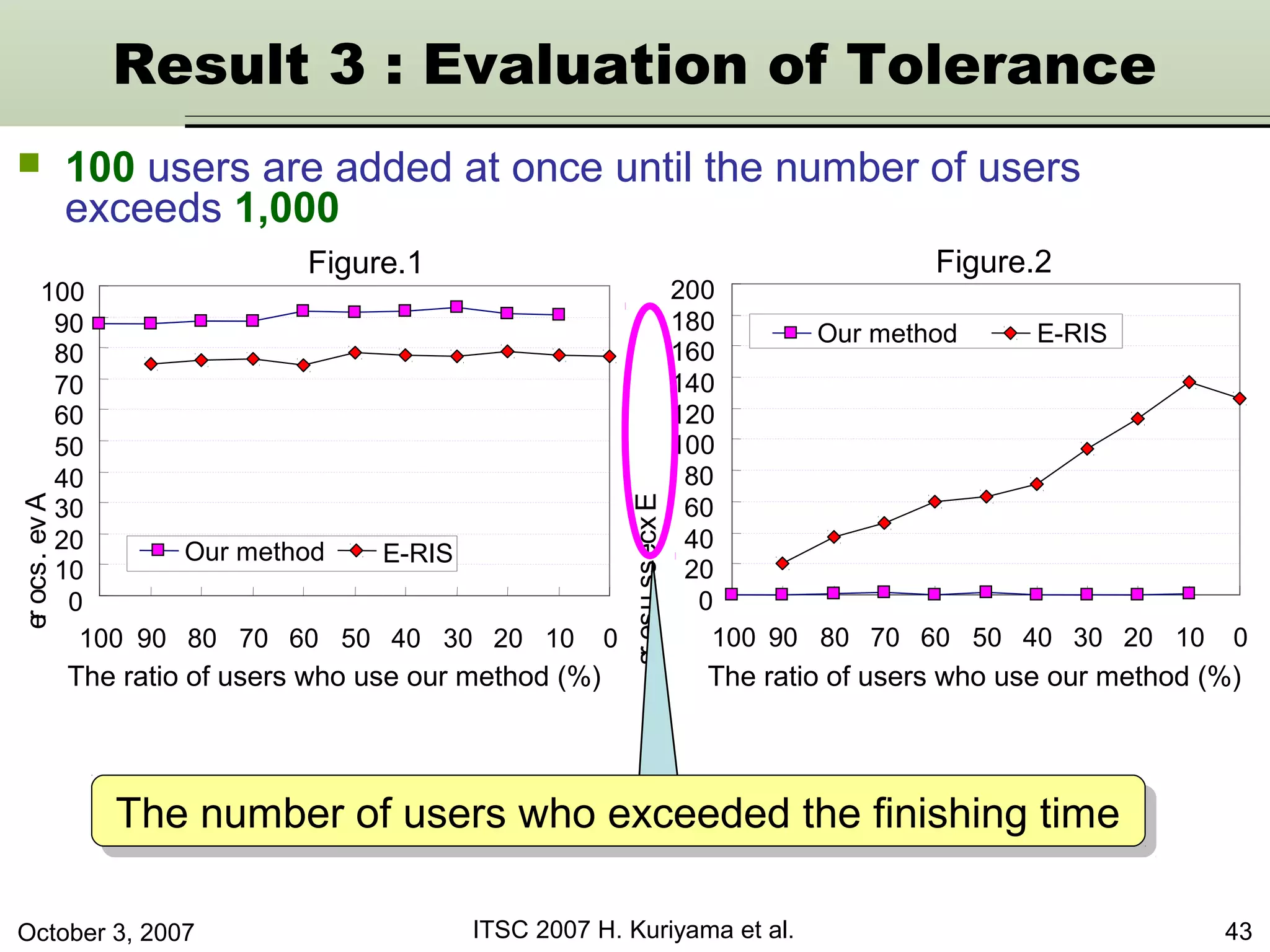
 100 users are added at once until the number of users
exceeds 1,000
Ave.score
Excessusers
The ratio of users who use our method (%) The ratio of users who use our method (%)
Figure.1 Figure.2
Result 3 : Evaluation of Tolerance
October 3, 2007 ITSC 2007 H. Kuriyama et al. 42
Result 3 : Evaluation of Tolerance
0
20
40
60
80
100
120
140
160
180
200
100 90 80 70 60 50 40 30 20 10 0
0
10
20
30
40
50
60
70
80
90
100
100 90 80 70 60 50 40 30 20 10 0 Excessusers
The ratio of users who use our method (%) The ratio of users who use our method (%)
Figure.1 Figure.2
Ave.score
The average score of all usersThe average score of all users
Our method E-RIS
Our method E-RIS
 100 users are added at once until the number of users
exceeds 1,000
October 3, 2007 ITSC 2007 H. Kuriyama et al. 43
Result 3 : Evaluation of Tolerance
0
20
40
60
80
100
120
140
160
180
200
100 90 80 70 60 50 40 30 20 10 0
0
10
20
30
40
50
60
70
80
90
100
100 90 80 70 60 50 40 30 20 10 0 Excessusers
The ratio of users who use our method (%) The ratio of users who use our method (%)
Figure.1 Figure.2
Ave.score
The number of users who exceeded the finishing timeThe number of users who exceeded the finishing time
Our method E-RIS
Our method E-RIS
 100 users are added at once until the number of users
exceeds 1,000
October 3, 2007 ITSC 2007 H. Kuriyama et al. 44
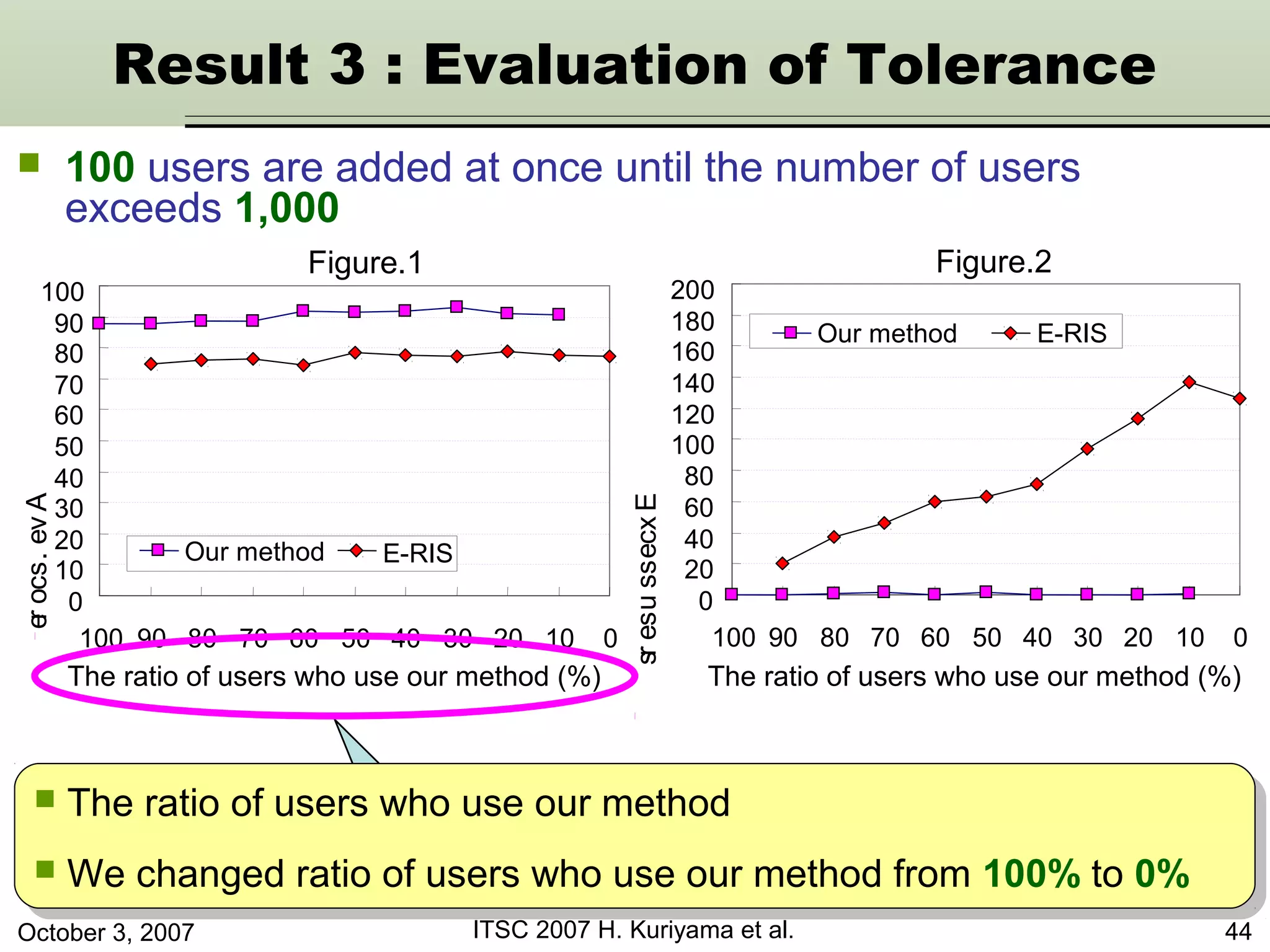
 The ratio of users who use our method
 We changed ratio of users who use our method from 100% to 0%
 The ratio of users who use our method
 We changed ratio of users who use our method from 100% to 0%
Result 3 : Evaluation of Tolerance
0
20
40
60
80
100
120
140
160
180
200
100 90 80 70 60 50 40 30 20 10 0
0
10
20
30
40
50
60
70
80
90
100
100 90 80 70 60 50 40 30 20 10 0 Excessusers
The ratio of users who use our method (%) The ratio of users who use our method (%)
Figure.1 Figure.2
Ave.score
Our method E-RIS
Our method E-RIS
 100 users are added at once until the number of users
exceeds 1,000
October 3, 2007 ITSC 2007 H. Kuriyama et al. 45
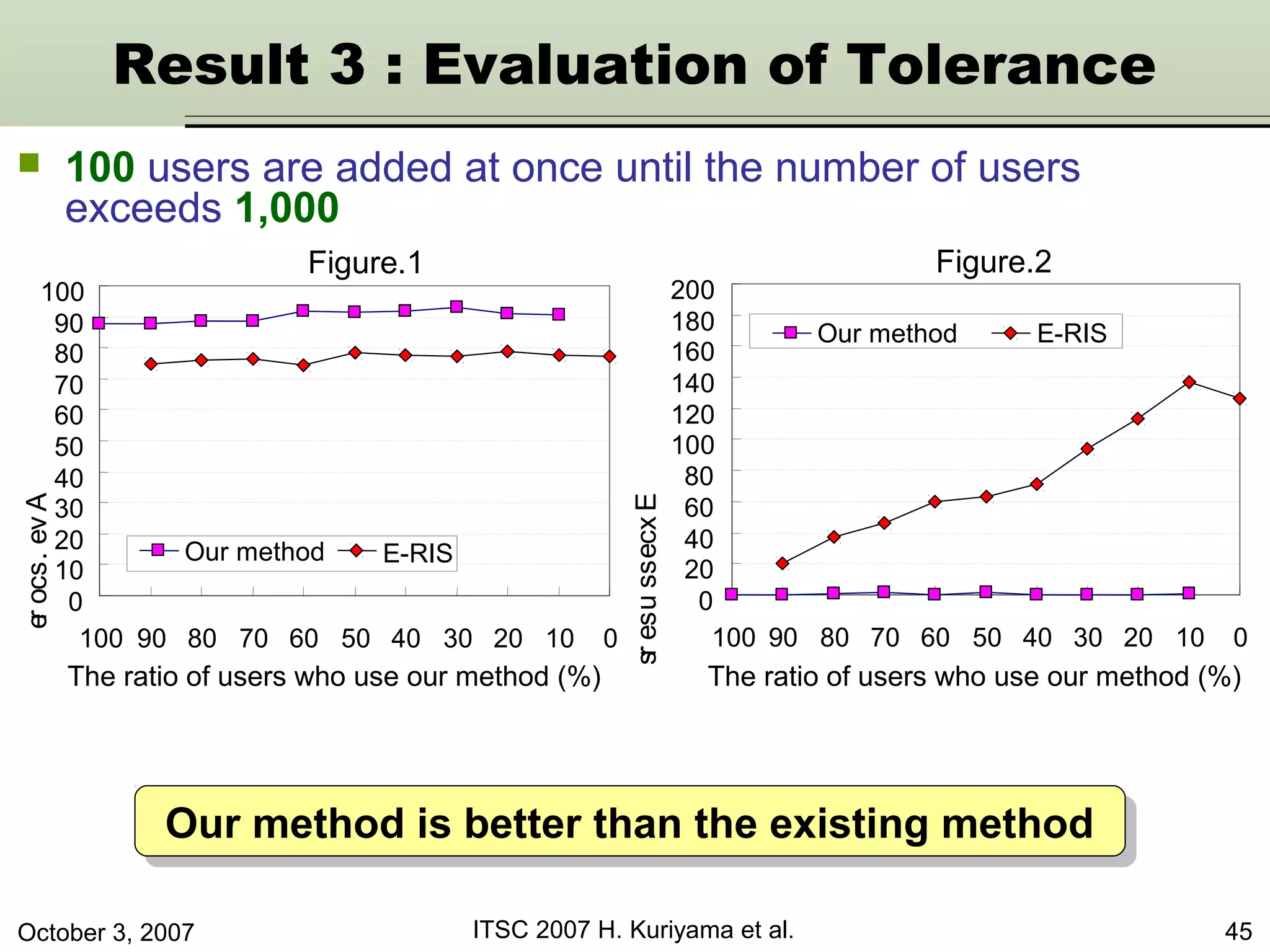
Our method is better than the existing methodOur method is better than the existing method
Result 3 : Evaluation of Tolerance
0
20
40
60
80
100
120
140
160
180
200
100 90 80 70 60 50 40 30 20 10 0
0
10
20
30
40
50
60
70
80
90
100
100 90 80 70 60 50 40 30 20 10 0 Excessusers
The ratio of users who use our method (%) The ratio of users who use our method (%)
Figure.1 Figure.2
Ave.score
Our method E-RIS
Our method E-RIS
 100 users are added at once until the number of users
exceeds 1,000
October 3, 2007 ITSC 2007 H. Kuriyama et al. 46
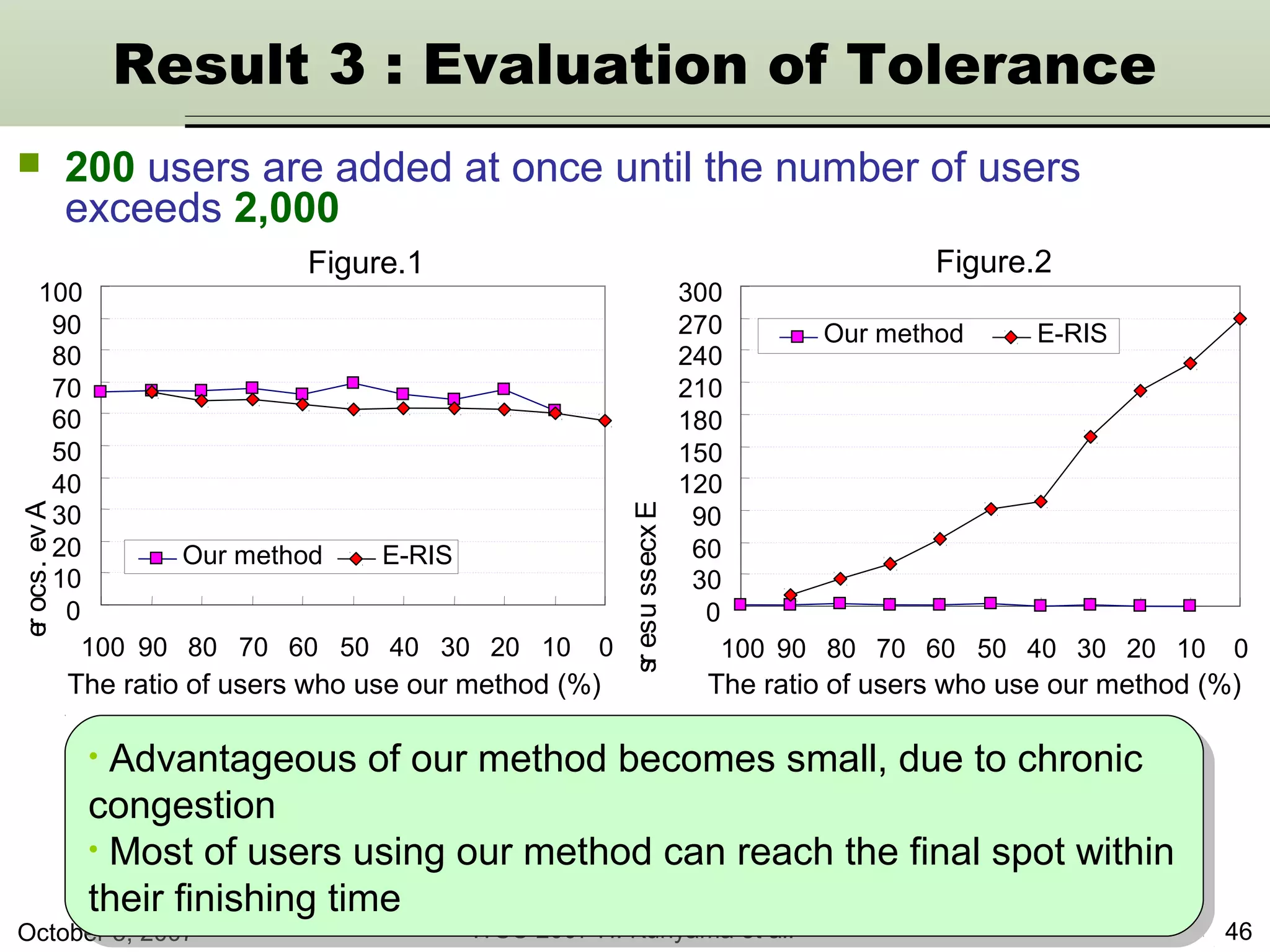
 200 users are added at once until the number of users
exceeds 2,000
• Advantageous of our method becomes small, due to chronic
congestion
• Most of users using our method can reach the final spot within
their finishing time
• Advantageous of our method becomes small, due to chronic
congestion
• Most of users using our method can reach the final spot within
their finishing time
Ave.score
Excessusers
The ratio of users who use our method (%) The ratio of users who use our method (%)
Figure.1 Figure.2
Result 3 : Evaluation of Tolerance
0
10
20
30
40
50
60
70
80
90
100
100 90 80 70 60 50 40 30 20 10 0
Our method E-RIS
0
30
60
90
120
150
180
210
240
270
300
100 90 80 70 60 50 40 30 20 10 0
Our method E-RIS
October 3, 2007 ITSC 2007 H. Kuriyama et al. 47
 We proposed a method for scheduling visits for
several thousands of users
-Our method’s advantage:
• Higher satisfaction degree
• Much Less excess users
• Incentive to use our method
• Tolerance for the case that some users do not utilize the method
or new users are incrementally added
 Future Work
-We are planning to Implement more practical and
accurate traffic cases and models
Conclusion
October 3, 2007 ITSC 2007 H. Kuriyama et al. 48
Kuriyama, H., Murata, Y., Shibata, N.,
Yasumoto, K. and Ito, M.: Congestion
Alleviation Scheduling Technique for Car
Drivers Based on Prediction of Future
Congestion on Roads and Spots, Proc. of
10th IEEE Int'l. Conf. on Intelligent
Transportation Systems (ITSC'07), pp. 910-915.
DOI:10.1109/ITSC.2007.4357704 [ PDF ]

Congestion Alleviation Scheduling Technique for Car Drivers Based on Prediction of Future Congestion on Roads and Spots

  • 1.
    Congestion Alleviation SchedulingTechniqueCongestion Alleviation Scheduling Technique for Car Drivers Based onfor Car Drivers Based on Prediction of Future Congestion on Roads andPrediction of Future Congestion on Roads and SpotsSpots Hisaka Kuriyama, Yoshihiro Murata, Naoki Shibata* , Keiichi Yasumoto, Minoru Ito  Nara Institute of Science and Technology  * Shiga University
  • 2.
    October 3, 2007ITSC 2007 H. Kuriyama et al. 2 1. Background 2. Proposed method 3. Experiment 4. Conclusion Outline
  • 3.
    October 3, 2007ITSC 2007 H. Kuriyama et al. 3  Background: -In sightseeing tours and parcel deliveries by cars • Each person visits multiple destinations • If many people concentrate on same route or service spot  These routes and spots will have congestion RouteRoute Service spotService spot These congestions impair social activities Background  We propose: – A method for finding schedules for massively many users by predicting congestions on both routes and spots – Make people disperse among different routes and spots
  • 4.
    October 3, 2007ITSC 2007 H. Kuriyama et al. 4  A method by T.Yamashita et al. [2]  distributes users over routes  RIS (Route Information Sharing) • Each user transmits route information to a server • Server estimates future traffic congestion using this information and feeds its estimate back to each user • Each user uses the estimation to re-plan their route [2] T. Yamashita, et al., "Smooth Traffic Flow with a Cooperative Car Navigation System", AAMAS(2005) [3] T. Kataoka, et al., "Distributed Visitors Coordination System in Theme Park Problem“ , MMAS(2004)  A method by T.Kataoka et al. [3]  distributes users over spots • Each user selects the least congested spot Server For distributing tourists over either routes or spotsFor distributing tourists over either routes or spots Existing Studies
  • 5.
    October 3, 2007ITSC 2007 H. Kuriyama et al. 5 Our method allows users to visit many spots satisfying time constraints Final spot Our Contribution  Each user selects the least congested routes or spots according to the situation  If a user has to reach the final spot before a specified time -The user may violate the time constraints
  • 6.
    October 3, 2007ITSC 2007 H. Kuriyama et al. 6 1. Background 2. Proposed method 3. Experiment 4. Conclusion Outline
  • 7.
    October 3, 2007ITSC 2007 H. Kuriyama et al. 7 Our Approach  Collecting users’ visiting spots and time constraints  Sending the set of all users’ schedules  Performing traffic simulation considering congestions on both routes and spots  Modifying tour of the user who violate the time constraints by removing some of the visiting spots
  • 8.
    October 3, 2007ITSC 2007 H. Kuriyama et al. 8 Problem Definition  Inputs: -Each user inputs: • starting spot and time • set of spots which the user wants to visit • importance degree  representing how important the spot is to visit • final spot and its importance degree • finishing time  representing the latest time when the user wants to reach the final spot  Objective: -Finding a set of users’ schedules which maximizes the total sum of the importance degrees  Output: -Set of all users’ schedules AM 8:00 Imp:30 Imp:10 Imp:20 Imp:5 PM 17:00
  • 9.
    October 3, 2007ITSC 2007 H. Kuriyama et al. 9 Algorithm for Modifying Schedules 1. Finding schedule -Find schedule for each user with the minimum distance to go through all the requested spots 2. Performing simulation -Perform simulation based on the routes generated by step 1. 3. Modifying schedule -Modify schedule by decreasing/increasing the number of spots 4. Iterating steps 2. to 3. -Repeat from step 2. until all users can reach the final spot no later than the finishing time OR the predetermined time expires  Outline of the Scheduling algorithm:
  • 10.
    October 3, 2007ITSC 2007 H. Kuriyama et al. 10 Users Explanation of Our Algorithm  We explain our method in case of 3 users
  • 11.
    October 3, 2007ITSC 2007 H. Kuriyama et al. 11  Find the schedule for each user which minimizes the total distance of movement to go through all the requested spots Finding Schedule (1/4)
  • 12.
    October 3, 2007ITSC 2007 H. Kuriyama et al. 12 Our system First user Finding Schedule (1/4)  Suppose, the first user’s schedule is set like this
  • 13.
    October 3, 2007ITSC 2007 H. Kuriyama et al. 13 Our system Second user Finding Schedule (1/4)  The second user’s schedule is set similarly
  • 14.
    October 3, 2007ITSC 2007 H. Kuriyama et al. 14 Our system Third user Finding Schedule (1/4)
  • 15.
    October 3, 2007ITSC 2007 H. Kuriyama et al. 15 Our system Performing Simulation (2/4)  The system performs traffic simulation -During the simulation, each user… • uses RIS to choose routes to their next spots • consumes some time to wait and/or receive services at spots
  • 16.
    October 3, 2007ITSC 2007 H. Kuriyama et al. 16  During simulation Performing Simulation (2/4) • If many users converge on the same service spot  They need to require more time to receive the service • If many users converge on the same road  They need to require more time to finish the movement
  • 17.
    October 3, 2007ITSC 2007 H. Kuriyama et al. 17  The system modifies user’s visiting spots  During simulation Performing Simulation (2/4) In this result, a user cannot reach the final spot by the finishing timeIn this result, a user cannot reach the final spot by the finishing time
  • 18.
    October 3, 2007ITSC 2007 H. Kuriyama et al. 18 Imp : 30 Imp : 35 Imp : 10 Imp : 25 Imp : 30 Imp : 35 Imp : 10 Imp : 25 Modifying Schedule (3/4)  The system chooses one spot to remove under the situations to minimize loss of importance degree
  • 19.
    October 3, 2007ITSC 2007 H. Kuriyama et al. 19 Our system Modifying Schedule (3/4)  The system changes the schedule based on new set
  • 20.
    October 3, 2007ITSC 2007 H. Kuriyama et al. 20 • Avoiding congestion • Meeting the finishing time Our system Performing Simulation (2/4) The user avoids congestion and returns before the finishing timeThe user avoids congestion and returns before the finishing time  The system performs simulation based on the recalculated schedules
  • 21.
    October 3, 2007ITSC 2007 H. Kuriyama et al. 21  If a user can reach the final spot within the finishing time The system adds the once removed spots again Imp : 30 Imp : 35 Imp : 10 Imp : 25 Imp : 30 Imp : 35 Imp : 10 Imp : 25 Modifying Schedule (3/4)  During the rescheduling  Each user changes the visiting spots  Congestion situations tend to be changed  Congestion of certain routes or spots may be alleviated
  • 22.
    October 3, 2007ITSC 2007 H. Kuriyama et al. 22 Iterating Steps 2. to 3. (4/4) Our system  The system repeats these procedures
  • 23.
    October 3, 2007ITSC 2007 H. Kuriyama et al. 23  With our method,  the schedules might not converge We use a tabu list to improve convergenceWe use a tabu list to improve convergence Avoiding Unnecessary Repeats Removing Adding Violating the finishing time
  • 24.
    October 3, 2007ITSC 2007 H. Kuriyama et al. 24  For each user, if the system repeats adding and removing the spot a predetermined number of times  This spot is added to the tabu list for the user Adding to tabu list We can stop the repetition of changing for a short timeWe can stop the repetition of changing for a short time Removing The spot will never be added Avoiding Unnecessary Repeats Adding Removing RemovingAdding Adding
  • 25.
    October 3, 2007ITSC 2007 H. Kuriyama et al. 25 Outline • Background • Proposed method • Experiment • Conclusion
  • 26.
    October 3, 2007ITSC 2007 H. Kuriyama et al. 26  Purpose of Experiment -To evaluate performance of our method, we compare it with existing method Experiment  Evaluation Metrics  1. Satisfaction degree  2. Incentive for users to follow the computed schedules  3. Tolerance • Some users do not use our method • New users are incrementally added on the road
  • 27.
    October 3, 2007ITSC 2007 H. Kuriyama et al. 27  Road Network used for Simulation  Each User’s behavior -Visiting 4 spots -Finally returning to the starting spot Number of spots 32 Number of roads 56 Total length of map 59.6 [km] Service time of each spot 600 -1,800 [sec] Capacity of each spot 10-30 [users] Number of users 500 or 1,000 Spot Road  Each User’s input data -Random Simulation Configuration These values are determined so that each user would have to wait for a while before receiving the service if 500 users are distributed evenly among all spots These values are determined so that each user would have to wait for a while before receiving the service if 500 users are distributed evenly among all spots
  • 28.
    October 3, 2007ITSC 2007 H. Kuriyama et al. 28  Existing studies -Only treating congestion either in route or service spot Configuration of Existing Methods Extended version of existing studies named E-RIS − For the baseline to evaluate the usefulness of our method Extended version of existing studies named E-RIS − For the baseline to evaluate the usefulness of our method  E-RIS -Using RIS algorithm between two spots -Selecting the spot where total necessary time of movement and stay is the smallest as a next destination  If the user may overrun the finishing time  Giving up visiting further spots and return to the final spot
  • 29.
    October 3, 2007ITSC 2007 H. Kuriyama et al. 29 Sum : 100  Importance degrees of spots • A user specifies different importance degrees for each spot • To keep fairness among users  We assume that each user has the same points Imp : 30 Imp : 35 Imp : 10 Imp : 25 Score Configuration
  • 30.
    October 3, 2007ITSC 2007 H. Kuriyama et al. 30  When each user receives the service at a spot • The user can obtain the score equal to the importance degree specified for that spot  If the service does not finish before his/her finishing time • The user does not obtain the score for the spot Score : 10 Total Score : 100 Total Score : 100  If the user visited all inputted spots by the finishing time Score Configuration Score : 0
  • 31.
    October 3, 2007ITSC 2007 H. Kuriyama et al. 31  Simulation Configuration  All users use the same algorithm (E-RIS or our method) Experiment 1 : Satisfaction Degree They start to move at the same time They start to move at the same time All users are set at the same time All users are set at the same time
  • 32.
    October 3, 2007ITSC 2007 H. Kuriyama et al. 32 Ave.score Excessusers 0 20 40 60 80 100 500 users 1,000 users E-RIS Our method 0 50 100 150 200 250 500 users 1,000 users E-RIS Our method Result 1 : Satisfaction Degree  Simulation Result Figure.1 Figure.2
  • 33.
    October 3, 2007ITSC 2007 H. Kuriyama et al. 33 Ave.score Excessusers The average score of all usersThe average score of all users 0 20 40 60 80 100 E-RIS Our method 0 50 100 150 200 250 E-RIS Our method Figure.1 Figure.2 500 users 1,000 users 500 users 1,000 users Result 1 : Satisfaction Degree  Simulation Result
  • 34.
    October 3, 2007ITSC 2007 H. Kuriyama et al. 34 Ave.score Excessusers The number of users who exceeded the finishing timeThe number of users who exceeded the finishing time 0 20 40 60 80 100 E-RIS Our method 0 50 100 150 200 250 E-RIS Our method Figure.1 Figure.2 500 users 1,000 users 500 users 1,000 users Result 1 : Satisfaction Degree  Simulation Result
  • 35.
    October 3, 2007ITSC 2007 H. Kuriyama et al. 35  Simulation Result *Computation time of our method : 4 minutes Ave.score Excessusers  Our method • 20-30% higher average score • Much less excess users  Our method • 20-30% higher average score • Much less excess users 0 20 40 60 80 100 E-RIS Our method 0 50 100 150 200 250 E-RIS Our method Figure.1 Figure.2 500 users 1,000 users 500 users 1,000 users Result 1 : Satisfaction Degree
  • 36.
    October 3, 2007ITSC 2007 H. Kuriyama et al. 36  Assumption -Users follow the schedules computed by our algorithm The users who follow our method have enough incentive or notThe users who follow our method have enough incentive or not Experiment 2 : Evaluation of Incentive  Simulation Configuration -Some users ignore the computed schedules and force their original tour plans We define ignoring users as outwittersWe define ignoring users as outwitters We evaluate…  If users outwit the algorithm and obtain better results  They would ignore the computed schedules
  • 37.
    October 3, 2007ITSC 2007 H. Kuriyama et al. 37 Result 2 : Evaluation of Incentive  Simulation Result The ratio of outwitters (%) Theratioofoutwitters whohavedisadvantag
  • 38.
    October 3, 2007ITSC 2007 H. Kuriyama et al. 38 Theratioofoutwitters whohavedisadvantag The ratio of outwitters (%) Ratio of outwitters who could not improve score nor reach the final spot before the finishing time to all the outwitters Result 2 : Evaluation of Incentive  Simulation Result
  • 39.
    October 3, 2007ITSC 2007 H. Kuriyama et al. 39 Result 2 : Evaluation of Incentive  Simulation Result The ratio of outwitters (%) Theratioofoutwitters whohavedisadvantag  Most outwitters (over 70%) have disadvantage  Our method should give users the motivation to follow  Most outwitters (over 70%) have disadvantage  Our method should give users the motivation to follow
  • 40.
    October 3, 2007ITSC 2007 H. Kuriyama et al. 40  New users are added to random positions every 600 seconds  When new users are added, all users using our method re-calculate schedules (1) Some users use our method and the others use E-RIS (2) New users are incrementally added on the road network (1) Some users use our method and the others use E-RIS (2) New users are incrementally added on the road network Using our method Using E-RIS New users are incrementally added on the road network Experiment 3 : Evaluation of Tolerance  Simulation Configuration
  • 41.
    October 3, 2007ITSC 2007 H. Kuriyama et al. 41 0 20 40 60 80 100 120 140 160 180 200 100 90 80 70 60 50 40 30 20 10 0 Our method E-RIS 0 10 20 30 40 50 60 70 80 90 100 100 90 80 70 60 50 40 30 20 10 0 Our method E-RIS  100 users are added at once until the number of users exceeds 1,000 Ave.score Excessusers The ratio of users who use our method (%) The ratio of users who use our method (%) Figure.1 Figure.2 Result 3 : Evaluation of Tolerance
  • 42.
    October 3, 2007ITSC 2007 H. Kuriyama et al. 42 Result 3 : Evaluation of Tolerance 0 20 40 60 80 100 120 140 160 180 200 100 90 80 70 60 50 40 30 20 10 0 0 10 20 30 40 50 60 70 80 90 100 100 90 80 70 60 50 40 30 20 10 0 Excessusers The ratio of users who use our method (%) The ratio of users who use our method (%) Figure.1 Figure.2 Ave.score The average score of all usersThe average score of all users Our method E-RIS Our method E-RIS  100 users are added at once until the number of users exceeds 1,000
  • 43.
    October 3, 2007ITSC 2007 H. Kuriyama et al. 43 Result 3 : Evaluation of Tolerance 0 20 40 60 80 100 120 140 160 180 200 100 90 80 70 60 50 40 30 20 10 0 0 10 20 30 40 50 60 70 80 90 100 100 90 80 70 60 50 40 30 20 10 0 Excessusers The ratio of users who use our method (%) The ratio of users who use our method (%) Figure.1 Figure.2 Ave.score The number of users who exceeded the finishing timeThe number of users who exceeded the finishing time Our method E-RIS Our method E-RIS  100 users are added at once until the number of users exceeds 1,000
  • 44.
    October 3, 2007ITSC 2007 H. Kuriyama et al. 44  The ratio of users who use our method  We changed ratio of users who use our method from 100% to 0%  The ratio of users who use our method  We changed ratio of users who use our method from 100% to 0% Result 3 : Evaluation of Tolerance 0 20 40 60 80 100 120 140 160 180 200 100 90 80 70 60 50 40 30 20 10 0 0 10 20 30 40 50 60 70 80 90 100 100 90 80 70 60 50 40 30 20 10 0 Excessusers The ratio of users who use our method (%) The ratio of users who use our method (%) Figure.1 Figure.2 Ave.score Our method E-RIS Our method E-RIS  100 users are added at once until the number of users exceeds 1,000
  • 45.
    October 3, 2007ITSC 2007 H. Kuriyama et al. 45 Our method is better than the existing methodOur method is better than the existing method Result 3 : Evaluation of Tolerance 0 20 40 60 80 100 120 140 160 180 200 100 90 80 70 60 50 40 30 20 10 0 0 10 20 30 40 50 60 70 80 90 100 100 90 80 70 60 50 40 30 20 10 0 Excessusers The ratio of users who use our method (%) The ratio of users who use our method (%) Figure.1 Figure.2 Ave.score Our method E-RIS Our method E-RIS  100 users are added at once until the number of users exceeds 1,000
  • 46.
    October 3, 2007ITSC 2007 H. Kuriyama et al. 46  200 users are added at once until the number of users exceeds 2,000 • Advantageous of our method becomes small, due to chronic congestion • Most of users using our method can reach the final spot within their finishing time • Advantageous of our method becomes small, due to chronic congestion • Most of users using our method can reach the final spot within their finishing time Ave.score Excessusers The ratio of users who use our method (%) The ratio of users who use our method (%) Figure.1 Figure.2 Result 3 : Evaluation of Tolerance 0 10 20 30 40 50 60 70 80 90 100 100 90 80 70 60 50 40 30 20 10 0 Our method E-RIS 0 30 60 90 120 150 180 210 240 270 300 100 90 80 70 60 50 40 30 20 10 0 Our method E-RIS
  • 47.
    October 3, 2007ITSC 2007 H. Kuriyama et al. 47  We proposed a method for scheduling visits for several thousands of users -Our method’s advantage: • Higher satisfaction degree • Much Less excess users • Incentive to use our method • Tolerance for the case that some users do not utilize the method or new users are incrementally added  Future Work -We are planning to Implement more practical and accurate traffic cases and models Conclusion
  • 48.
    October 3, 2007ITSC 2007 H. Kuriyama et al. 48 Kuriyama, H., Murata, Y., Shibata, N., Yasumoto, K. and Ito, M.: Congestion Alleviation Scheduling Technique for Car Drivers Based on Prediction of Future Congestion on Roads and Spots, Proc. of 10th IEEE Int'l. Conf. on Intelligent Transportation Systems (ITSC'07), pp. 910-915. DOI:10.1109/ITSC.2007.4357704 [ PDF ]

Editor's Notes

  • #2 I would like to have a talk titled Congestion Alleviation Scheduling Technique for Car Drivers Based on Prediction of Future Congestion on Roads and Spots.
  • #3 This is the outline of this presentation. First, I’d like to explain the research background.
  • #4 In sightseeing tours and parcel deliveries by cars. Each person visits multiple destinations. If many people concentrate on same route or service spot. These routes and spots will have congestion. And, these congestions impair social activities. So, in this research, we propose a method for finding schedules for massively many users by predicting congestions on both routes and spots. To do so, we make people disperse among (アマング ) different routes and spots.
  • #5 There are some existing studies for distributing tourists over either routes or spots. A method by T.Yamashita distributes users over routes. This method is called RIS. In this method, each user transmits route information to a server. Server estimates future traffic congestion using this information and feeds its estimate back to each vehicle. And, each user uses the estimation to re-plan their route And, a method by T.Kataoka distributes users over spots. In this method, Each user selects the least congested spot. In this result, user’s average waiting time can be decreased.
  • #6 However, in existing methods, each user selects the least congested routes or spots according to the situation. So, if we consider the time constrains such the user have to reach the final spot within specified time. Users may violate the time constraints. So, we proposed a method allows (アラウ) users to visit spots as much as possible and return to the final spot satisfying the time constraints.
  • #7 Next, I‘d like to explain our proposed method.
  • #8 In our approach, first, we collect each user’s visiting spots and time restrictions by using server system. Second, the system performs traffic simulation considering congestions on both routes and spots. Third, after simulation, the system modifies tour of the user who violate the time constraints by decreasing/increasing the number of spots. And ,finally, the system sends a set of all user’ schedules.
  • #9 Next, I will explain the problem, definition. Each user inputs the following items. the starting spot and time, the set of spots which the user wants to visit, the importance degree of spots, representing how important the spot is to visit, the final spot and it’s importance degree and the finishing time, representing the latest time when the user wants to reach the final spot. After the scheduling, the system outputs the set of all users’ schedules. And, our objective is to find a set of users’ schedules which maximizes the total sum of the importance degrees.
  • #10 This is the outline of our schedules algorithm. First, we find schedule for each user with the minimum distance to go through all the requested spots. Second, we perform simulation based on the routes generated by step 1. Third, we modify schedule by decreasing/increasing the number of spots. Forth, we repeat from step 2. until all users can reach the final spot no later than the finishing time or the predetermined time expires.
  • #11 Here, we explain our method in case of 3 users.
  • #12 At first, the system finds the tour for each user which minimizes the total distance of movement to go through all the requested spots.
  • #13 Suppose, the first user’s schedule is set like this.
  • #14 The second user’s schedule is set similarly.
  • #15 The third user’s schedule set similarly.
  • #16 Then, the system perform simulation assuming that users visit set of spots. During the simulation, each user uses RIS to choose routes to their next spots and consumes some time to wait and/or receive services at spots.
  • #17 During the simulation, If many users converge on the same road. They need to require more time to move. And, If many users converge on the same spot. They need to require more time to receive the service.
  • #18 In this result, they may violate the finishing time. If a user did not reach the final destination by the finishing time, the system changes user’s visiting spots.
  • #19 In this case, the system chooses one spot to remove under the situations to minimize a loss of the user’s important degree and calculates new routes.
  • #20 The system changes the schedule based on new set.
  • #21 Then the system performs simulation based on the recalculated plans. In this time, the user avoided congestion and returned before the finishing time.
  • #22 On the other hand, during the rescheduling, each user changes the visiting spots and congestion situations tend to be changed. And, congestion of certain routes or spots may be alleviated. If a user can reach the final destination within the finishing time, the system adds the once removed spot again.
  • #23 Then the system performs simulation based on the recalculated plans. The system repeats these procedures until all users can reach the final destination no later than the specified time.
  • #24 But, with our method, the schedules might not converge. Because, the user repeats adding and removing of spots. So, we use a taboo list to improve convergence.
  • #25 For each user, if the system repeats adding and removing the spot a predetermined number of times, this spot is added to the taboo list for the user. And, The spot on the taboo list will never be added. To do so, we can stop the repetition of changing for a short time.
  • #26 Next, I will talk about experiments and its results.
  • #27 The purpose of experiment is to evaluate performance of our method, we compared it with existing methods. And we have three evaluation metrics, First, satisfaction degree. Second, incentive for users to follow the computed schedules. Third, tolerance even when some users do not use our method and new users are incrementally added on the road network.
  • #28 These are configurations for the experiments. These values are determined so that each user would have to wait for a while before receiving the service if 500 users are distributed evenly among all spots.
  • #29 But existing methods only treat congestion either in routes or at service spots. So, we use the extended version of existing studies named E-RIS for the baseline to evaluate the usefulness of our proposed method. In E-RIS, each user uses RIS algorithm between two spots. And selects the spot where total necessary time of movement and stay is the smallest as a next destination. If the user may overrun the finishing time. He/she gives up visiting further spots and begins to return to the final spot.
  • #30 In our method, a user specifies different importance degrees for each spot. For keep fairness among users, we assume that each user has the same points.
  • #31 When each user receives the service at a spot. The user can obtains the score equal to the importance degree specified for that spot. If the service does not finish before his/her finishing time. The user does not obtain the score for the spot. So, in this experiment, if the user visited all inputted spots by the finishing time, the sum of score would be 100.
  • #32 Here, we explain the first experiment. In this situation, all users use the same algorithm. In this simulation, all users are set at the same time and they start to move at the same time.
  • #33 The figure shows that result of this experiments.
  • #34 In figure 1, Y axis shows the average score of all users.
  • #35 In figure 2, Y axis shows the number of users who exceeded their finishing time.
  • #36 These result show that our method achieves a 20-30% higher average, and has much less excess users.
  • #37 Here, we explain the second experiment. In our method, if users outwit the algorithm and obtain better results, they would ignore the computed schedules. So, we evaluated that the users who follow our method have enough incentive or not. In this simulation, we simulated situations that some of the users neglect the computed schedules and force their original tour plans by Using E-RIS.
  • #38 The figure shows that result of this experiments.
  • #39 In this figure, Y axis shows the ratio of ignoring users who could not improve score nor reach the final destination on or before the finishing time to all the ignoring users.
  • #40 In this result, most ignoring users (over 70%) have disadvantage. So, our method should give users the motivation to follow the computed schedule.
  • #41 Here, we explain the third experiment. In this experiment, we consider the model that some users use our method and the others use E-RIS and new users are incrementally added on the road network. In this simulation, new users are added to random positions every 600 seconds. And, when new users are added, all users using our method re-calculate schedules.
  • #42 These figures show the result of the case that 100 users are added at once unless the number of users exceeds 1000.
  • #43 In figure 1, Y axis shows the average score of all users.
  • #44 In figure 1, Y axis shows the number of users who exceeded the finishing time.
  • #45 And, X axis shows the ratio of users who use our method. We changed ratio of users who use our method from 100% to 0%.
  • #46 These result show that our method is superior to the existing method.
  • #47 These figures show the result of the case that 200 users are added at once unless the number of users exceeds 2000. The superiority of our method becomes small, due to chronic congestion at many spots. But, most of users using our method can reach the final spot within their finishing time.
  • #48 We proposed a congestion-aware scheduling method for scheduling visits for several thousands of users. The result shows that our method have 4 merits. For future work, we are planning to implement a more practical and accurate traffic model