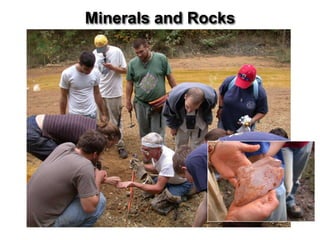
Minerals and Rocks


                     Chapter 5
Outline
• Minerals and rocks
   -What are minerals? Geologic definition, significance.
   -What are rocks? Geologic definition, 3 main types.

• Mineral structure
   -Crystalline structure, crystals, crystal lattice
   -Determining atom arrangement (XRD), atomic bonding
   -Polymorphs, crystal growth and packing of atoms

• Physical properties of minerals
   -Overview: common ones, less common ones
   -Color, streak, luster, hardness, specific gravity, crystal habit/form,
    fracture, and cleavage

• Mineral classes and silicates
   -Mineral classes, most importantly silicates
   -Silica tetrahedra building block
   -Silicate types: from individual tetrahedra to framework          Chapter 5 5
                                                                      Chapter
Minerals
•   The “building blocks” of rocks, and hence, of Earth.
•   -more than 4000 are known
•   -dozens of new minerals are discovered annually
•


                                                           Chapter 5
Minerals
•   Societies depend on mineral resources.
•   Metals: iron, copper, lead, zinc, nickel, aluminum, etc.
•   Non-metals: gypsum, limestone, clay


                                                          Chapter 5
Minerals
•   Economically important – Drive world economies.
•   Historically important – Dictated human history.
    •   Iron.
    •   Copper.
    •   Gold.
    •   Diamonds.
    •   Gems.


                                                       Chapter 5
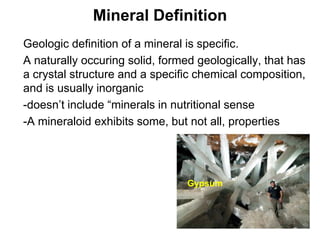
Mineral Definition
•   Geologic definition of a mineral is specific.
•   A naturally occuring solid, formed geologically, that has
    a crystal structure and a specific chemical composition,
    and is usually inorganic
•   -doesn’t include “minerals in nutritional sense
•   -A mineraloid exhibits some, but not all, properties


                                     Gypsum


                                                         Chapter 5
Rocks
•   Rocks are Earth materials made from minerals.
•   Most rocks have more than one kind of mineral.

•   -example: granite
•   -mineral(s)?
•   Potassium, quartz, hornblende
•   -some are mono-mineralic
•   Limestone (calcite), rock salt
•    (halite), glacial ice


                                                     Chapter 5
Rock Definition
•   Geologists definition: coherent, naturally occuring solid
    made up of an aggregate of minerals (or more


                                                          Chapter 5
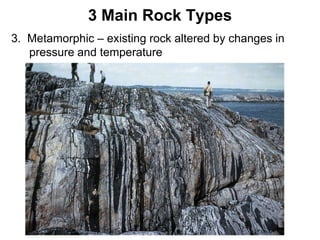
3 Main Rock Types
1. Igneous – solidified from molten rock or melt


                                                   Chapter 5
3 Main Rock Types
2.   Sedimentary
3.   -cemented/precipitated from rock fragments/solution


                                                      Chapter 5
3 Main Rock Types
3. Metamorphic – existing rock altered by changes in
   pressure and temperature


                                                       Chapter 5
Outline
• Minerals and rocks
   -What are minerals? Geologic definition, significance.
   -What are rocks? Geologic definition, 3 main types.

• Mineral structure
   -Crystalline structure, crystals, crystal lattice
   -Determining atom arrangement (XRD), atomic bonding
   -Polymorphs, crystal growth and packing of atoms

• Physical properties of minerals
   -Overview: common ones, less common ones
   -Color, streak, luster, hardness, specific gravity, crystal habit/form,
    fracture, and cleavage

• Mineral classes and silicates
   -Mineral classes, most importantly silicates
   -Silica tetrahedra building block
   -Silicate types: from individual tetrahedra to framework          Chapter 5 5
                                                                      Chapter
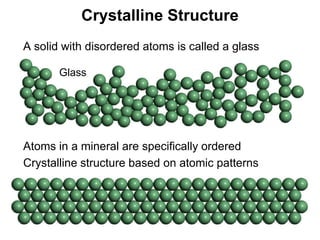
Crystalline Structure
•   A solid with disordered atoms is called a glass

           Glass


•   Atoms in a mineral are specifically ordered
•   Crystalline structure based on atomic patterns


                                                      Chapter 5
Crystals
•    Minerals displaying flat external faces (rare).
•    -crystal faces form best in open cavities
•    -crystals are often prized mineral specimens


    Beryl                                              Quartz
    Green, gem version -> emerald
                                                           Chapter 5
Crystals
•   Constancy of angles between crystal faces.
•   -same mineral always (ideal) has same crystal faces
•   -adjacent faces occur at regular (diagnostic) angle


•   Faces and angles reflect the atomic arrangement.


                                                       Chapter 5
Crystal Lattice
•   Ordered atoms in crystals form a lattice.
•   Lattices are patterns that repeat in 3D
•    This internal pattern controls mineral properties.
•   -crystal shape
•   -planes of symmetry
    •


                                                          Chapter 5
Determining Atom Arrangements
•   X-Ray Diffraction (XRD) probes crystal lattices.
•   Unique lattice spacing is used to ID minerals.


                                                       Chapter 5
Bonding of Atoms
•   Lattice atoms are held in place by atomic bonds.
     Bond characteristics govern mineral properties.
•   5 recognized types of bonds (Appendix A).
•   -covalent (gain/loose )
•   -metallic
•   -van


                                                        Chapter 5
Polymorphs (many + form)
•   Same composition but different crystal structure.
•   Polymorphs show the importance of bond type.
•   Diamond and graphite are carbon polymorphs (C)
•   -diamond: strong covalent bonds; hardest mineral
•   -graphite: weak van der waals bonds; softest mineral


                 Diamond


                               Graphite


                                                       Chapter 5
Crystal Growth
•   Crystals grow as atoms attach to mineral surfaces
•   -growth starts from a central seed crystal
•   -growth expands outward


                                                        Chapter 5
Crystal Growth
•   Outward crystal growth fills available space.
•   Resulting crystal shape governed by surroundings.
•   -open space: good crystal faces grow
•   -confined space: no crystal spaces


•   Crystals mostly grow by…
•   Solidification from a melt
•   Precipitation from solution


                                                        Chapter 5
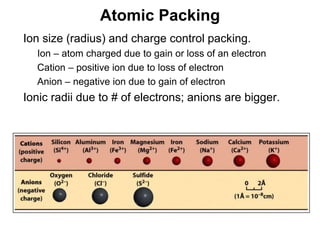
Atomic Packing
•   Ion size (radius) and charge control packing.
    •   Ion – atom charged due to gain or loss of an electron
    •   Cation – positive ion due to loss of electron
    •   Anion – negative ion due to gain of electron
•   Ionic radii due to # of electrons; anions are bigger.


                                                                Chapter 5
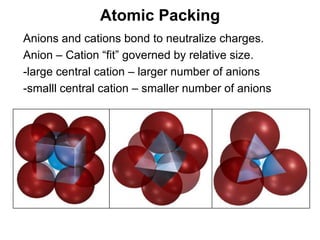
Atomic Packing
•   Anions and cations bond to neutralize charges.
•   Anion – Cation “fit” governed by relative size.
•   -large central cation – larger number of anions
•   -smalll central cation – smaller number of anions


                                                        Chapter 5
Outline
• Minerals and rocks
   -What are minerals? Geologic definition, significance.
   -What are rocks? Geologic definition, 3 main types.

• Mineral structure
   -Crystalline structure, crystals, crystal lattice
   -Determining atom arrangement (XRD), atomic bonding
   -Polymorphs, crystal growth and packing of atoms

• Physical properties of minerals
   -Overview: common ones, less common ones
   -Color, streak, luster, hardness, specific gravity, crystal habit/form,
    fracture, and cleavage

• Mineral classes and silicates
   -Mineral classes, most importantly silicates
   -Silica tetrahedra building block
   -Silicate types: from individual tetrahedra to framework          Chapter 5 5
                                                                      Chapter
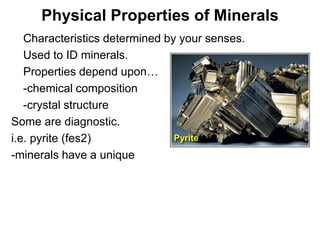
Physical Properties of Minerals
•  Characteristics determined by your senses.
• Used to ID minerals.
• Properties depend upon…
• -chemical composition
• -crystal structure
Some are diagnostic.
i.e. pyrite (fes2)              Pyrite
-minerals have a unique


                                                Chapter 5
Physical Properties

•   Common properties:
    •   Color.
    •   Streak.
    •   Luster.
    •   Hardness.
    •   Specific gravity.
    •   Crystal habit (ideal shape).
    •   Crystal form.
    •   Fracture.
    •   Cleavage.

                                       Needle-like crystal habit

                                                                   Chapter 5
Physical Properties
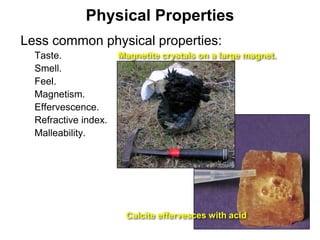
•   Less common physical properties:
    •   Taste.              Magnetite crystals on a large magnet.
    •   Smell.
    •   Feel.
    •   Magnetism.
    •   Effervescence.
    •   Refractive index.
    •   Malleability.


                             Calcite effervesces with acid

                                                                    Chapter 5
Color
• Color is diagnostic for some minerals.
• E.g. olivine/malachite is always green, azurite is always
  blue
Some minerals may exhibit a broad color range.
-quartz (clear, white, yellow, pink, purple
    Quartz – Many colors           Malachite – always green


                                                              Chapter 5
Streak
•   Color of a mineral struck across unglazed porcelain.
•   Streak is often a useful diagnostic property.
    • Congruent streak –streak color same as mineral
    • -magnetite: black mineral; black streak
    Incongruent streak – streak color different than mineral
    -chromite: black mineral; greenish-brown streak


                         Hematite – Red-brown streak


                                                               Chapter 5
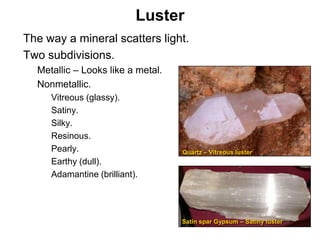
Luster
•   The way a mineral scatters light.
•   Two subdivisions.
    •   Metallic – Looks like a metal.
    •   Nonmetallic.
         •   Vitreous (glassy).
         •   Satiny.
         •   Silky.
         •   Resinous.
         •   Pearly.                     Quartz – Vitreous luster
         •   Earthy (dull).
         •   Adamantine (brilliant).


                                         Satin spar Gypsum – Satiny luster

                                                                             Chapter 5
Hardness
•   Scratching resistance of a mineral.
•   Hardness compared to Mohs Hardness Scale.
    1.    Talc, Graphite
    2.    Gypsum
                           Fingernail 2.5
    3.    Calcite
                           Copper Penny 3.5
    4.    Fluorite
    5.    Apatite
                           Glass - Steel 5.5
    6.    Orthoclase
                           Steel File 6.5
    7.    Quartz
    8.    Topaz
    9.    Corundum
    10.   Diamond


                                                Chapter 5
Specific Gravity
•   Related to density (mass per volume).
•   Mineral weight over weight of equal water volume.
•   Specific gravity is heft – how heavy it feels
•   -pyrite: heavy (sg 5.0)
•   -feldspar: light (sg 2.6)
•   -pyrite feels heavier


           Pyrite                    Potassium Feldspar
                                                          Chapter 5
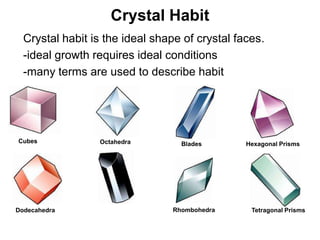
Crystal Habit
•     Crystal habit is the ideal shape of crystal faces.
•     -ideal growth requires ideal conditions
•     -many terms are used to describe habit


    Cubes            Octahedra         Blades       Hexagonal Prisms


    Dodecahedra                      Rhombohedra     Tetragonal Prisms


                                                                 Chapter 5
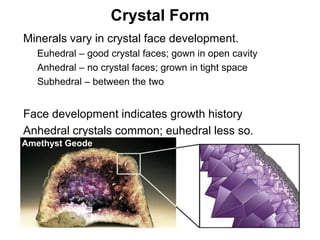
Crystal Form
•   Minerals vary in crystal face development.
     •   Euhedral – good crystal faces; gown in open cavity
     •   Anhedral – no crystal faces; grown in tight space
     •   Subhedral – between the two


•   Face development indicates growth history
•   Anhedral crystals common; euhedral less so.
    Amethyst Geode


                                                              Chapter 5
Fracture
•   Some minerals lack planes of weakness.
    •   Due to equal molecular bonds in all directions.
    •   These minerals fracture and hence don’t have cleavage.
         • Example: Quartz


                                 Obsidian


                                                                 Chapter 5
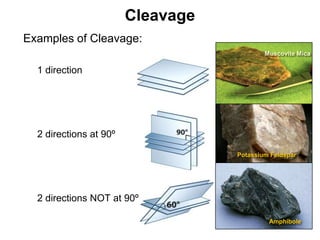
Cleavage
•   Tendency to break along planes of weakness.
•   Due to equal molecular bonds in all directions.
•   These minerals fracture and hence don’t have
    cleavage.
•   i.e. quartz displays conchoidal fracture
•   -shaped like inside of a clam shell
•   -breaks along smooth curved surfaces
•   -cleavage produces flat surfaces
•   -described by number of planes and their angles


•   Sometimes mistaken for crystal habit.             Chapter 5
Cleavage
•   Examples of Cleavage:
                                                 Muscovite Mica

    •   1 direction


    •   2 directions at 90º

                                         Potassium Feldspar


    •   2 directions NOT at 90º

                                                  Amphibole

                                                         Chapter 5
Outline
• Minerals and rocks
   -What are minerals? Geologic definition, significance.
   -What are rocks? Geologic definition, 3 main types.

• Mineral structure
   -Crystalline structure, crystals, crystal lattice
   -Determining atom arrangement (XRD), atomic bonding
   -Polymorphs, crystal growth and packing of atoms

• Physical properties of minerals
   -Overview: common ones, less common ones
   -Color, streak, luster, hardness, specific gravity, crystal habit/form,
    fracture, and cleavage

• Mineral classes and silicates
   -Mineral classes, most importantly silicates
   -Silica tetrahedra building block
   -Silicate types: from individual tetrahedra to framework          Chapter 5 5
                                                                      Chapter
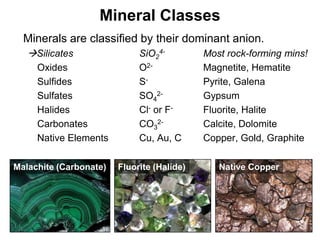
Mineral Classes
•   Minerals are classified by their dominant anion.
    Silicates                 SiO24-         Most rock-forming mins!
    •   Oxides                 O2-            Magnetite, Hematite
    •   Sulfides               S-             Pyrite, Galena
    •   Sulfates               SO42-          Gypsum
    •   Halides                Cl- or F-      Fluorite, Halite
    •   Carbonates             CO32-          Calcite, Dolomite
    •   Native Elements        Cu, Au, C      Copper, Gold, Graphite

Malachite (Carbonate)     Fluorite (Halide)      Native Copper


                                                                 Chapter 5
Silicate Minerals
•   Silicates are known as the rock-forming minerals.
•   They dominate the Earth’s crust.
•   Oxygen and silicon…
•   -94.7% of crustal volume
•   -74.3% of crustal mass


                                                        Chapter 5
Silicate Minerals
•   The building block (anion) unit is the silica tetrahedron.
    •   4 oxygen atoms are bonded to 1 silicon atom (SiO44-).
    •   -silicon is tiny; oxygen is huge
    •   -the silica tetrahedron has a net -4 ionic charge
    •   -the silicate unit can be depicted by…
    •   -spheres
    •   -ball and stick model
    •   -polyhedra


                                                                Chapter 5
Silicate Minerals
•   Silica tetrahedra link together by sharing oxygens.
•   More shared oxygen  higher Si:O ratio; governs…
•   -melting temp
•   -mineral structure and cations present
•   -susceptibility to chemical weathering
         Type of Silicate Structure   Formula   Si:O Ratio
     Independent Tetrahedra            SiO4        0.25

     Double Tetrahedra                 Si2O7       0.29

     Ring Silicates                    Si6O18      0.33

     Single Chains                     SiO3        0.33

     Double Chains                     Si4O11      0.36

     Sheet Silicates                   Si2O5       0.40

     Framework Silicates               SiO2        0.50

                                                             Chapter 5
Independent Tetrahedra
•   Tetrahedra share no oxygens - linked by cations.
    •   Olivine Group.
         • High temperature Fe-Mg silicate.
         • Small green crystals; no cleavage.
    •   Garnet Group.
         • Equant crystals with no cleavage.
         • Dodecahedral (12 sided) crystals.


Garnet


                                                       Chapter 5
Single-Chain Silicates
•   Single-chain structures bonded with Fe and Mg.
    •   Pyroxene Group.
         •   Black to green color.
         •   Two distinctive cleavages at nearly 90°.
         •   Stubby crystals.
         •   Augite is the most common pyroxene.


                          Pyroxene
                                                        Chapter 5
Double-Chain Silicates
•   Double chain of silica tetrahedra bonded together.
•   Contain a variety of cations.
    •   Amphiboles – two perfect cleavages
    •   Elongate crystals


Hornblende
                                                         Chapter 5
Sheet Silicates
•   2-dimensional sheets of linked tetrahedra.
•   Characterized by one direction of perfect cleavage.
    • Mica Group – botite (dark) and mucsovite (light)
    Clay Mineral Group – feldspar weathering residue; tiny


                   Muscovite (Mica)


                                                             Chapter 5
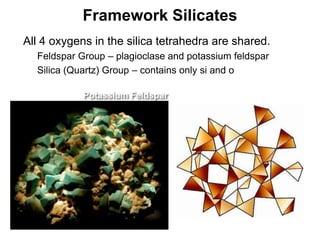
Framework Silicates
•   All 4 oxygens in the silica tetrahedra are shared.
    •   Feldspar Group – plagioclase and potassium feldspar
    •   Silica (Quartz) Group – contains only si and o

                  Potassium Feldspar


                                                              Chapter 5

06 minerals rocks_forstudents

  • 1.
  • 2.
    Outline • Minerals androcks -What are minerals? Geologic definition, significance. -What are rocks? Geologic definition, 3 main types. • Mineral structure -Crystalline structure, crystals, crystal lattice -Determining atom arrangement (XRD), atomic bonding -Polymorphs, crystal growth and packing of atoms • Physical properties of minerals -Overview: common ones, less common ones -Color, streak, luster, hardness, specific gravity, crystal habit/form, fracture, and cleavage • Mineral classes and silicates -Mineral classes, most importantly silicates -Silica tetrahedra building block -Silicate types: from individual tetrahedra to framework Chapter 5 5 Chapter
  • 3.
    Minerals • The “building blocks” of rocks, and hence, of Earth. • -more than 4000 are known • -dozens of new minerals are discovered annually • Chapter 5
  • 4.
    Minerals • Societies depend on mineral resources. • Metals: iron, copper, lead, zinc, nickel, aluminum, etc. • Non-metals: gypsum, limestone, clay Chapter 5
  • 5.
    Minerals • Economically important – Drive world economies. • Historically important – Dictated human history. • Iron. • Copper. • Gold. • Diamonds. • Gems. Chapter 5
  • 6.
    Mineral Definition • Geologic definition of a mineral is specific. • A naturally occuring solid, formed geologically, that has a crystal structure and a specific chemical composition, and is usually inorganic • -doesn’t include “minerals in nutritional sense • -A mineraloid exhibits some, but not all, properties Gypsum Chapter 5
  • 7.
    Rocks • Rocks are Earth materials made from minerals. • Most rocks have more than one kind of mineral. • -example: granite • -mineral(s)? • Potassium, quartz, hornblende • -some are mono-mineralic • Limestone (calcite), rock salt • (halite), glacial ice Chapter 5
  • 8.
    Rock Definition • Geologists definition: coherent, naturally occuring solid made up of an aggregate of minerals (or more Chapter 5
  • 9.
    3 Main RockTypes 1. Igneous – solidified from molten rock or melt Chapter 5
  • 10.
    3 Main RockTypes 2. Sedimentary 3. -cemented/precipitated from rock fragments/solution Chapter 5
  • 11.
    3 Main RockTypes 3. Metamorphic – existing rock altered by changes in pressure and temperature Chapter 5
  • 12.
    Outline • Minerals androcks -What are minerals? Geologic definition, significance. -What are rocks? Geologic definition, 3 main types. • Mineral structure -Crystalline structure, crystals, crystal lattice -Determining atom arrangement (XRD), atomic bonding -Polymorphs, crystal growth and packing of atoms • Physical properties of minerals -Overview: common ones, less common ones -Color, streak, luster, hardness, specific gravity, crystal habit/form, fracture, and cleavage • Mineral classes and silicates -Mineral classes, most importantly silicates -Silica tetrahedra building block -Silicate types: from individual tetrahedra to framework Chapter 5 5 Chapter
  • 13.
    Crystalline Structure • A solid with disordered atoms is called a glass Glass • Atoms in a mineral are specifically ordered • Crystalline structure based on atomic patterns Chapter 5
  • 14.
    Crystals • Minerals displaying flat external faces (rare). • -crystal faces form best in open cavities • -crystals are often prized mineral specimens Beryl Quartz Green, gem version -> emerald Chapter 5
  • 15.
    Crystals • Constancy of angles between crystal faces. • -same mineral always (ideal) has same crystal faces • -adjacent faces occur at regular (diagnostic) angle • Faces and angles reflect the atomic arrangement. Chapter 5
  • 16.
    Crystal Lattice • Ordered atoms in crystals form a lattice. • Lattices are patterns that repeat in 3D • This internal pattern controls mineral properties. • -crystal shape • -planes of symmetry • Chapter 5
  • 17.
    Determining Atom Arrangements • X-Ray Diffraction (XRD) probes crystal lattices. • Unique lattice spacing is used to ID minerals. Chapter 5
  • 18.
    Bonding of Atoms • Lattice atoms are held in place by atomic bonds.  Bond characteristics govern mineral properties. • 5 recognized types of bonds (Appendix A). • -covalent (gain/loose ) • -metallic • -van Chapter 5
  • 19.
    Polymorphs (many +form) • Same composition but different crystal structure. • Polymorphs show the importance of bond type. • Diamond and graphite are carbon polymorphs (C) • -diamond: strong covalent bonds; hardest mineral • -graphite: weak van der waals bonds; softest mineral Diamond Graphite Chapter 5
  • 20.
    Crystal Growth • Crystals grow as atoms attach to mineral surfaces • -growth starts from a central seed crystal • -growth expands outward Chapter 5
  • 21.
    Crystal Growth • Outward crystal growth fills available space. • Resulting crystal shape governed by surroundings. • -open space: good crystal faces grow • -confined space: no crystal spaces • Crystals mostly grow by… • Solidification from a melt • Precipitation from solution Chapter 5
  • 22.
    Atomic Packing • Ion size (radius) and charge control packing. • Ion – atom charged due to gain or loss of an electron • Cation – positive ion due to loss of electron • Anion – negative ion due to gain of electron • Ionic radii due to # of electrons; anions are bigger. Chapter 5
  • 23.
    Atomic Packing • Anions and cations bond to neutralize charges. • Anion – Cation “fit” governed by relative size. • -large central cation – larger number of anions • -smalll central cation – smaller number of anions Chapter 5
  • 24.
    Outline • Minerals androcks -What are minerals? Geologic definition, significance. -What are rocks? Geologic definition, 3 main types. • Mineral structure -Crystalline structure, crystals, crystal lattice -Determining atom arrangement (XRD), atomic bonding -Polymorphs, crystal growth and packing of atoms • Physical properties of minerals -Overview: common ones, less common ones -Color, streak, luster, hardness, specific gravity, crystal habit/form, fracture, and cleavage • Mineral classes and silicates -Mineral classes, most importantly silicates -Silica tetrahedra building block -Silicate types: from individual tetrahedra to framework Chapter 5 5 Chapter
  • 25.
    Physical Properties ofMinerals • Characteristics determined by your senses. • Used to ID minerals. • Properties depend upon… • -chemical composition • -crystal structure Some are diagnostic. i.e. pyrite (fes2) Pyrite -minerals have a unique Chapter 5
  • 26.
    Physical Properties • Common properties: • Color. • Streak. • Luster. • Hardness. • Specific gravity. • Crystal habit (ideal shape). • Crystal form. • Fracture. • Cleavage. Needle-like crystal habit Chapter 5
  • 27.
    Physical Properties • Less common physical properties: • Taste. Magnetite crystals on a large magnet. • Smell. • Feel. • Magnetism. • Effervescence. • Refractive index. • Malleability. Calcite effervesces with acid Chapter 5
  • 28.
    Color • Color isdiagnostic for some minerals. • E.g. olivine/malachite is always green, azurite is always blue Some minerals may exhibit a broad color range. -quartz (clear, white, yellow, pink, purple Quartz – Many colors Malachite – always green Chapter 5
  • 29.
    Streak • Color of a mineral struck across unglazed porcelain. • Streak is often a useful diagnostic property. • Congruent streak –streak color same as mineral • -magnetite: black mineral; black streak Incongruent streak – streak color different than mineral -chromite: black mineral; greenish-brown streak Hematite – Red-brown streak Chapter 5
  • 30.
    Luster • The way a mineral scatters light. • Two subdivisions. • Metallic – Looks like a metal. • Nonmetallic. • Vitreous (glassy). • Satiny. • Silky. • Resinous. • Pearly. Quartz – Vitreous luster • Earthy (dull). • Adamantine (brilliant). Satin spar Gypsum – Satiny luster Chapter 5
  • 31.
    Hardness • Scratching resistance of a mineral. • Hardness compared to Mohs Hardness Scale. 1. Talc, Graphite 2. Gypsum Fingernail 2.5 3. Calcite Copper Penny 3.5 4. Fluorite 5. Apatite Glass - Steel 5.5 6. Orthoclase Steel File 6.5 7. Quartz 8. Topaz 9. Corundum 10. Diamond Chapter 5
  • 32.
    Specific Gravity • Related to density (mass per volume). • Mineral weight over weight of equal water volume. • Specific gravity is heft – how heavy it feels • -pyrite: heavy (sg 5.0) • -feldspar: light (sg 2.6) • -pyrite feels heavier Pyrite Potassium Feldspar Chapter 5
  • 33.
    Crystal Habit • Crystal habit is the ideal shape of crystal faces. • -ideal growth requires ideal conditions • -many terms are used to describe habit Cubes Octahedra Blades Hexagonal Prisms Dodecahedra Rhombohedra Tetragonal Prisms Chapter 5
  • 34.
    Crystal Form • Minerals vary in crystal face development. • Euhedral – good crystal faces; gown in open cavity • Anhedral – no crystal faces; grown in tight space • Subhedral – between the two • Face development indicates growth history • Anhedral crystals common; euhedral less so. Amethyst Geode Chapter 5
  • 35.
    Fracture • Some minerals lack planes of weakness. • Due to equal molecular bonds in all directions. • These minerals fracture and hence don’t have cleavage. • Example: Quartz Obsidian Chapter 5
  • 36.
    Cleavage • Tendency to break along planes of weakness. • Due to equal molecular bonds in all directions. • These minerals fracture and hence don’t have cleavage. • i.e. quartz displays conchoidal fracture • -shaped like inside of a clam shell • -breaks along smooth curved surfaces • -cleavage produces flat surfaces • -described by number of planes and their angles • Sometimes mistaken for crystal habit. Chapter 5
  • 37.
    Cleavage • Examples of Cleavage: Muscovite Mica • 1 direction • 2 directions at 90º Potassium Feldspar • 2 directions NOT at 90º Amphibole Chapter 5
  • 38.
    Outline • Minerals androcks -What are minerals? Geologic definition, significance. -What are rocks? Geologic definition, 3 main types. • Mineral structure -Crystalline structure, crystals, crystal lattice -Determining atom arrangement (XRD), atomic bonding -Polymorphs, crystal growth and packing of atoms • Physical properties of minerals -Overview: common ones, less common ones -Color, streak, luster, hardness, specific gravity, crystal habit/form, fracture, and cleavage • Mineral classes and silicates -Mineral classes, most importantly silicates -Silica tetrahedra building block -Silicate types: from individual tetrahedra to framework Chapter 5 5 Chapter
  • 39.
    Mineral Classes • Minerals are classified by their dominant anion. Silicates SiO24- Most rock-forming mins! • Oxides O2- Magnetite, Hematite • Sulfides S- Pyrite, Galena • Sulfates SO42- Gypsum • Halides Cl- or F- Fluorite, Halite • Carbonates CO32- Calcite, Dolomite • Native Elements Cu, Au, C Copper, Gold, Graphite Malachite (Carbonate) Fluorite (Halide) Native Copper Chapter 5
  • 40.
    Silicate Minerals • Silicates are known as the rock-forming minerals. • They dominate the Earth’s crust. • Oxygen and silicon… • -94.7% of crustal volume • -74.3% of crustal mass Chapter 5
  • 41.
    Silicate Minerals • The building block (anion) unit is the silica tetrahedron. • 4 oxygen atoms are bonded to 1 silicon atom (SiO44-). • -silicon is tiny; oxygen is huge • -the silica tetrahedron has a net -4 ionic charge • -the silicate unit can be depicted by… • -spheres • -ball and stick model • -polyhedra Chapter 5
  • 42.
    Silicate Minerals • Silica tetrahedra link together by sharing oxygens. • More shared oxygen  higher Si:O ratio; governs… • -melting temp • -mineral structure and cations present • -susceptibility to chemical weathering Type of Silicate Structure Formula Si:O Ratio Independent Tetrahedra SiO4 0.25 Double Tetrahedra Si2O7 0.29 Ring Silicates Si6O18 0.33 Single Chains SiO3 0.33 Double Chains Si4O11 0.36 Sheet Silicates Si2O5 0.40 Framework Silicates SiO2 0.50 Chapter 5
  • 43.
    Independent Tetrahedra • Tetrahedra share no oxygens - linked by cations. • Olivine Group. • High temperature Fe-Mg silicate. • Small green crystals; no cleavage. • Garnet Group. • Equant crystals with no cleavage. • Dodecahedral (12 sided) crystals. Garnet Chapter 5
  • 44.
    Single-Chain Silicates • Single-chain structures bonded with Fe and Mg. • Pyroxene Group. • Black to green color. • Two distinctive cleavages at nearly 90°. • Stubby crystals. • Augite is the most common pyroxene. Pyroxene Chapter 5
  • 45.
    Double-Chain Silicates • Double chain of silica tetrahedra bonded together. • Contain a variety of cations. • Amphiboles – two perfect cleavages • Elongate crystals Hornblende Chapter 5
  • 46.
    Sheet Silicates • 2-dimensional sheets of linked tetrahedra. • Characterized by one direction of perfect cleavage. • Mica Group – botite (dark) and mucsovite (light) Clay Mineral Group – feldspar weathering residue; tiny Muscovite (Mica) Chapter 5
  • 47.
    Framework Silicates • All 4 oxygens in the silica tetrahedra are shared. • Feldspar Group – plagioclase and potassium feldspar • Silica (Quartz) Group – contains only si and o Potassium Feldspar Chapter 5