Weathering
True or False: The Earth’s surface has
stayed the same for thousands of years
True or False: The Earth’s surface has stayed the
same for thousands of years

The Earth’s surface is always changing!
Weathering
takes place as rocks are broken down into smaller
pieces over time by the effects of weather
What is Weathering?
•First step to forming soil and sedimentary
rock.
•It is the breakdown of rocks into smaller
pieces by physical and chemical
processes.
•No movement is involved in weathering.

•The smaller pieces do not move to a new
location until erosion carries them
away.
What is Mechanical Weathering?
• Breakdown of rock into smaller pieces
without any change in the chemical
composition of its minerals
– Sometimes called “physical” weathering
– Rock is torn apart by physical force, rather
than by chemical breakdown.
– breakdown of rock by
physical means
Mechanical Weathering
Ice wedging – water seeps into cracks in
rocks, freezes and expands, and
eventually cracks the rock
Ice Wedging
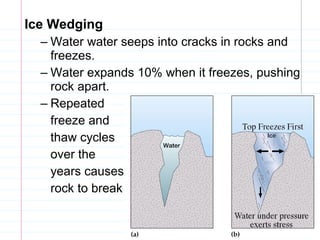
– Water water seeps into cracks in rocks and
freezes.
– Water expands 10% when it freezes, pushing
rock apart.
– Repeated
freeze and
thaw cycles
over the
years causes
rock to break
Ice causes weathering
Abrasion – grinding and wearing down of
rock surfaces by other rocks
Example: rock bump against each
other at the beach

Example: pebbles bump against each
other in a river bottom
Wind causes weathering

Why wasn’t
this mass of
land
weathered
away?
What evidence of
weathering do
you see in this
picture?
Mechanical - Biotic
Biotic – means life
– Weathering caused by living
organisms
– Plant roots act as a wedge
and widen cracks.
– Other causes of biotic
weathering:
•
•
•
•
•

burrowing animals
microscopic plants
animals
algae
fungi

http://commons.wikimedia.org/wiki/File:Wedge_Rock_Turkey_Run_SP,_IN.jpg
Plants –
roots can crack
rock
Mechanical Weathering –
breakdown of rock by physical means

Animals – human traffic or worms and other
animals digging
Exfoliation
• Exfoliation or unloading
-Rock breaks off into
sheets along joints which
are parallel to the surface.
-Caused by expansion of
rock due to uplift and
removal of surface material
that originally buried the
rock
http://commons.wikimedia.org/wiki/File:Exfoliation_and_mass
_movement.jpg
Thermal Expansion and Contraction
– Repeated daily heating and cooling of rock
– Heat causes expansion; cooling causes
contraction.
– Different minerals expand and contract at
different rates causing the rock to split.

http://commons.wikimedia.org/wiki/File:Penmaen_Dewi-St_David%27s_Head_-_geograph.org.uk__1097950.jpg
What is Chemical Weathering?
• Chemical reactions break down the bonds
holding the rocks together, causing them to
fall apart.
– Chemical weathering occurs in all types of
rock.
– Rock reacts with water, gases. and
solutions.
Chemical Weathering
•Chemical Reactions change rock composition.
They break down rock and minerals into
new substances.
•Chemical reactions happen
faster in warm,
wet conditions
Chemical Weathering -

breaks down rock and
. minerals into new
substances

4 Big Players
1. Water : will dissolve rock, but it takes
1000’s of years.
Big Bend National
Park, West Texas
Grand Canyon National Park, Arizona.
Water causes weathering

What evidence of
weathering do
you see in this
picture?
Chemical Weathering
2. Carbon Dioxide:
Dissolves in water
to form a weak
acid that reacts
with calcite,
limestone, and
marble
Ex. Acid precipitation
(acid rain) breaks down rock.
Carbonation – Carbon dioxide
(CO2) is dissolved in water making
carbonic acid

breaks down rock and
minerals into new
substances
Chemical Weathering

breaks down rock and minerals
into new substances

There are acids
in ground water
that dissolve rock
underground,
creating caves.

Limestone being eroded by water that is high in carbonic acid
(formed by carbon dioxide). Natural Bridge Caverns, San Antonio, TX.
Chemical Weathering
3. Organic matter decays,
makes water more
acidic and reactive.
Ex. Living things like algae, lichen, and

humans dissolve rock with the acids
they contain.
Chemical Weathering
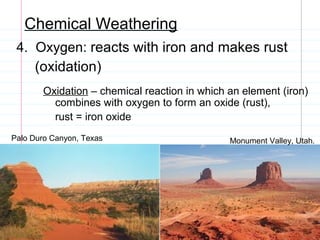
4. Oxygen: reacts with iron and makes rust
(oxidation)
Oxidation – chemical reaction in which an element (iron)
combines with oxygen to form an oxide (rust),
rust = iron oxide
Palo Duro Canyon, Texas

Monument Valley, Utah.

Weathering 2013

  • 1.
  • 2.
    True or False:The Earth’s surface has stayed the same for thousands of years
  • 3.
    True or False:The Earth’s surface has stayed the same for thousands of years The Earth’s surface is always changing!
  • 8.
    Weathering takes place asrocks are broken down into smaller pieces over time by the effects of weather
  • 9.
    What is Weathering? •Firststep to forming soil and sedimentary rock. •It is the breakdown of rocks into smaller pieces by physical and chemical processes. •No movement is involved in weathering. •The smaller pieces do not move to a new location until erosion carries them away.
  • 10.
    What is MechanicalWeathering? • Breakdown of rock into smaller pieces without any change in the chemical composition of its minerals – Sometimes called “physical” weathering – Rock is torn apart by physical force, rather than by chemical breakdown. – breakdown of rock by physical means
  • 11.
    Mechanical Weathering Ice wedging– water seeps into cracks in rocks, freezes and expands, and eventually cracks the rock
  • 12.
    Ice Wedging – Waterwater seeps into cracks in rocks and freezes. – Water expands 10% when it freezes, pushing rock apart. – Repeated freeze and thaw cycles over the years causes rock to break
  • 13.
  • 14.
    Abrasion – grindingand wearing down of rock surfaces by other rocks Example: rock bump against each other at the beach Example: pebbles bump against each other in a river bottom
  • 15.
    Wind causes weathering Whywasn’t this mass of land weathered away? What evidence of weathering do you see in this picture?
  • 16.
    Mechanical - Biotic Biotic– means life – Weathering caused by living organisms – Plant roots act as a wedge and widen cracks. – Other causes of biotic weathering: • • • • • burrowing animals microscopic plants animals algae fungi http://commons.wikimedia.org/wiki/File:Wedge_Rock_Turkey_Run_SP,_IN.jpg
  • 17.
  • 18.
    Mechanical Weathering – breakdownof rock by physical means Animals – human traffic or worms and other animals digging
  • 19.
    Exfoliation • Exfoliation orunloading -Rock breaks off into sheets along joints which are parallel to the surface. -Caused by expansion of rock due to uplift and removal of surface material that originally buried the rock http://commons.wikimedia.org/wiki/File:Exfoliation_and_mass _movement.jpg
  • 20.
    Thermal Expansion andContraction – Repeated daily heating and cooling of rock – Heat causes expansion; cooling causes contraction. – Different minerals expand and contract at different rates causing the rock to split. http://commons.wikimedia.org/wiki/File:Penmaen_Dewi-St_David%27s_Head_-_geograph.org.uk__1097950.jpg
  • 21.
    What is ChemicalWeathering? • Chemical reactions break down the bonds holding the rocks together, causing them to fall apart. – Chemical weathering occurs in all types of rock. – Rock reacts with water, gases. and solutions.
  • 22.
    Chemical Weathering •Chemical Reactionschange rock composition. They break down rock and minerals into new substances. •Chemical reactions happen faster in warm, wet conditions
  • 23.
    Chemical Weathering - breaksdown rock and . minerals into new substances 4 Big Players 1. Water : will dissolve rock, but it takes 1000’s of years. Big Bend National Park, West Texas Grand Canyon National Park, Arizona.
  • 24.
    Water causes weathering Whatevidence of weathering do you see in this picture?
  • 25.
    Chemical Weathering 2. CarbonDioxide: Dissolves in water to form a weak acid that reacts with calcite, limestone, and marble Ex. Acid precipitation (acid rain) breaks down rock. Carbonation – Carbon dioxide (CO2) is dissolved in water making carbonic acid breaks down rock and minerals into new substances
  • 26.
    Chemical Weathering breaks downrock and minerals into new substances There are acids in ground water that dissolve rock underground, creating caves. Limestone being eroded by water that is high in carbonic acid (formed by carbon dioxide). Natural Bridge Caverns, San Antonio, TX.
  • 27.
    Chemical Weathering 3. Organicmatter decays, makes water more acidic and reactive. Ex. Living things like algae, lichen, and humans dissolve rock with the acids they contain.
  • 28.
    Chemical Weathering 4. Oxygen:reacts with iron and makes rust (oxidation) Oxidation – chemical reaction in which an element (iron) combines with oxygen to form an oxide (rust), rust = iron oxide Palo Duro Canyon, Texas Monument Valley, Utah.