Digital Communication System
   7.1 and 7.2 (part)
   Source: sequence of digits
   Multiplexer: FDMA, TDMA, CDMA…
   Line Coder
    – Code chosen for use within a communications system for
      transmission purposes.
    – Baseband transmission
    – Twisted wire, cable, fiber communications
   Regenerative repeator
    – Detect incoming signals and regenerate new clean pulses


          EE 541/451 Fall 2006
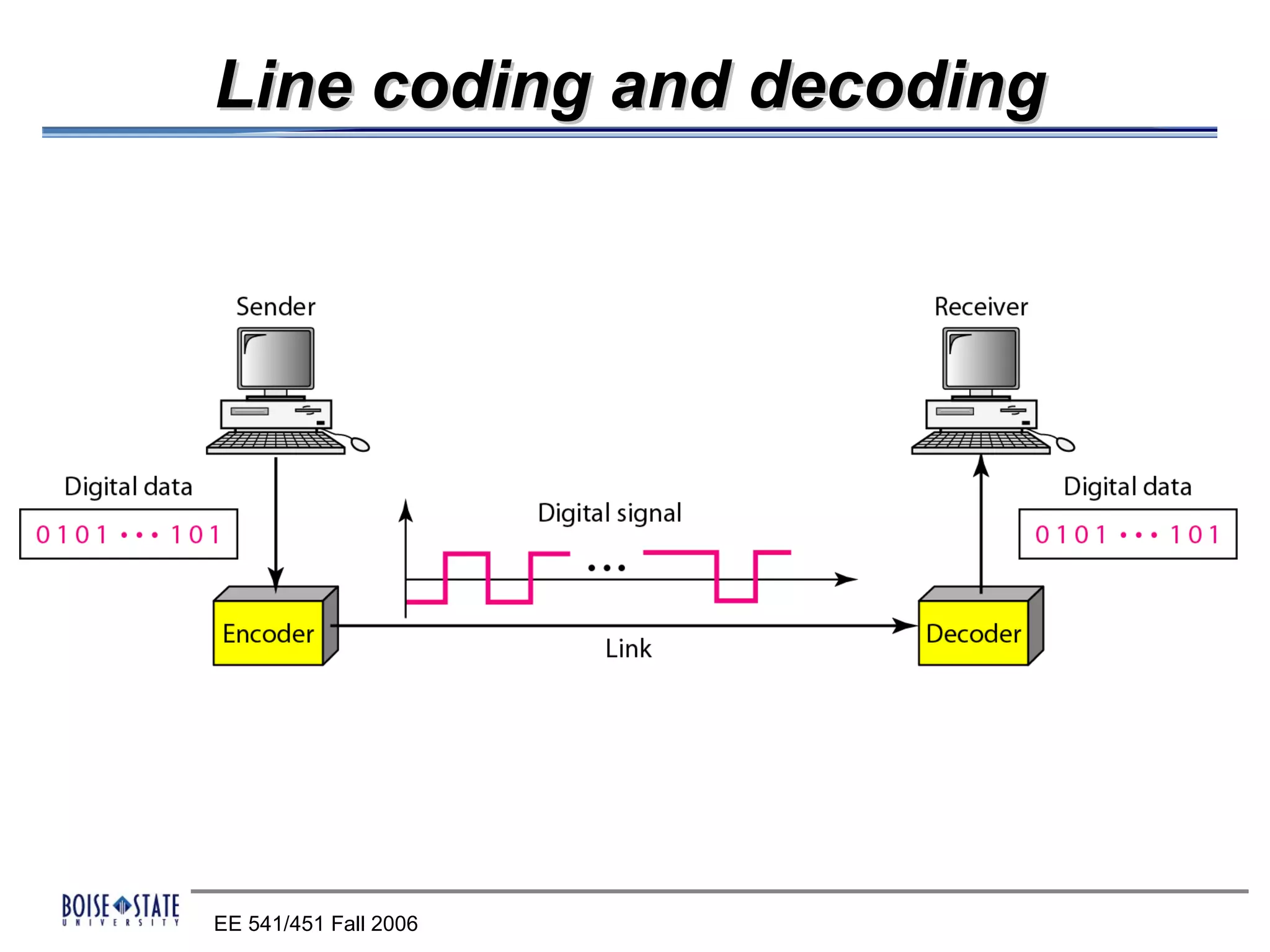
Line coding and decoding


EE 541/451 Fall 2006
Signal element versus data element


 EE 541/451 Fall 2006
Data Rate Vs. Signal Rate
   Data rate: the number of data elements (bits) sent in 1s (bps).
    It’s also called the bit rate
   Signal rate: the number of signal elements sent in 1s (baud).
    It’s also called the pulse rate, the modulation rate, or the baud
    rate.
   We wish to:
    –   increase the data rate (increase the speed of transmission)
    –   decrease the signal rate (decrease the bandwidth requirement)
    –   worst case, best case, and average case of r
    –   N bit rate
    –   c is a constant that depends on different line codes.
    –   S = c * N / r baud

          EE 541/451 Fall 2006
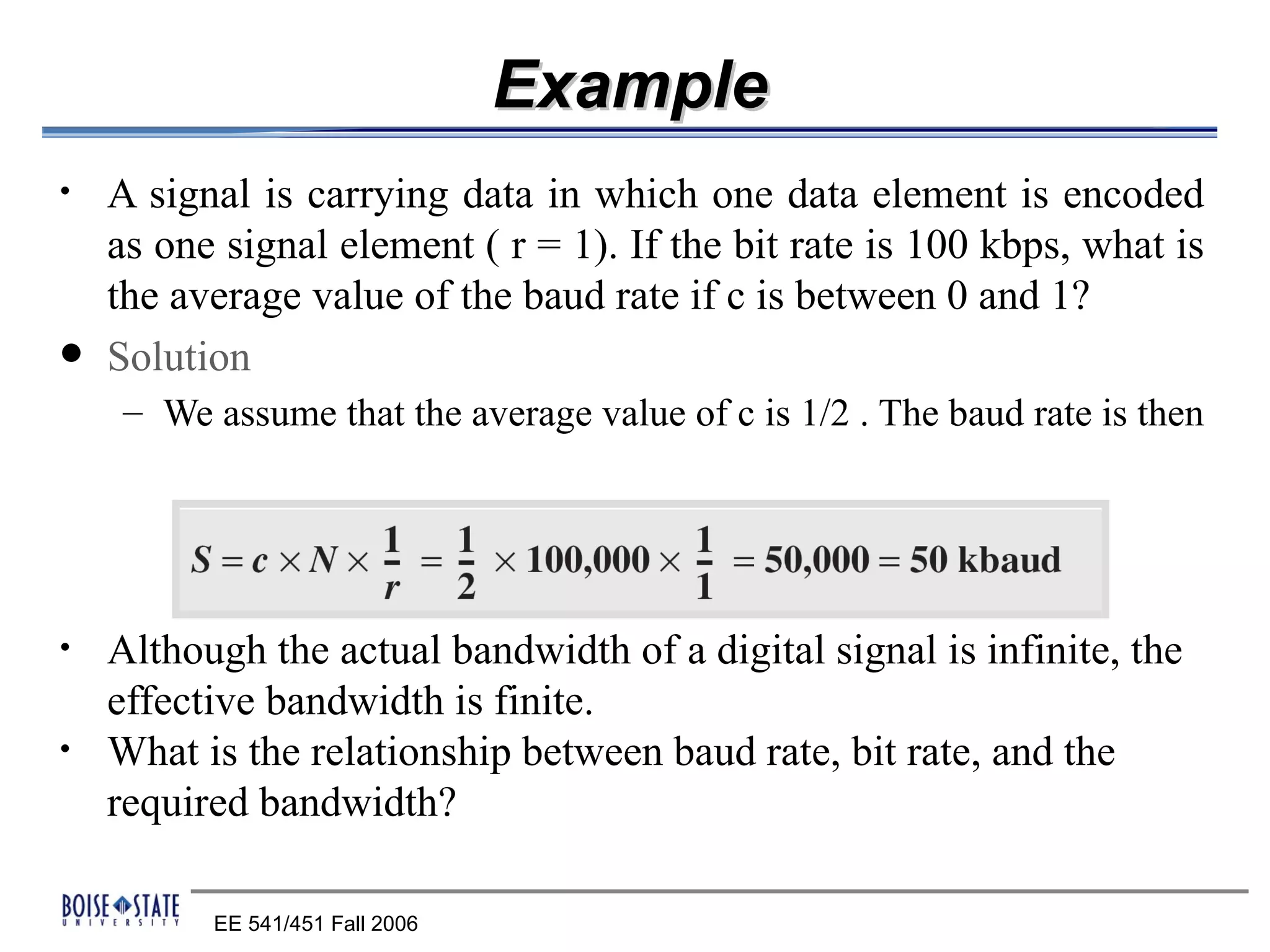
Example
•   A signal is carrying data in which one data element is encoded
    as one signal element ( r = 1). If the bit rate is 100 kbps, what is
    the average value of the baud rate if c is between 0 and 1?
   Solution
    – We assume that the average value of c is 1/2 . The baud rate is then


•   Although the actual bandwidth of a digital signal is infinite, the
    effective bandwidth is finite.
•   What is the relationship between baud rate, bit rate, and the
    required bandwidth?

          EE 541/451 Fall 2006
Self-synchronization
   Receiver Setting the clock matching the sender’s
   Effect of lack of synchronization


          EE 541/451 Fall 2006
Example
•   In a digital transmission, the receiver clock is 0.1 percent faster
    than the sender clock. How many extra bits per second does the
    receiver receive if the data rate is 1 kbps? How many if the data
    rate is 1 Mbps?
   Solution
    – At 1 kbps, the receiver receives 1001 bps instead of 1000 bps.


    – At 1 Mbps, the receiver receives 1,001,000 bps instead of
      1,000,000 bps.


          EE 541/451 Fall 2006
Other properties
   DC components
   Transmission bandwidth
   Power efficiency
   Error detection and correction capability
   Favorable power spectral density
   Adequate timing content
   Transparency


          EE 541/451 Fall 2006
Line coding schemes


EE 541/451 Fall 2006
Unipolar NRZ scheme


EE 541/451 Fall 2006
Polar NRZ-L and NRZ-I schemes
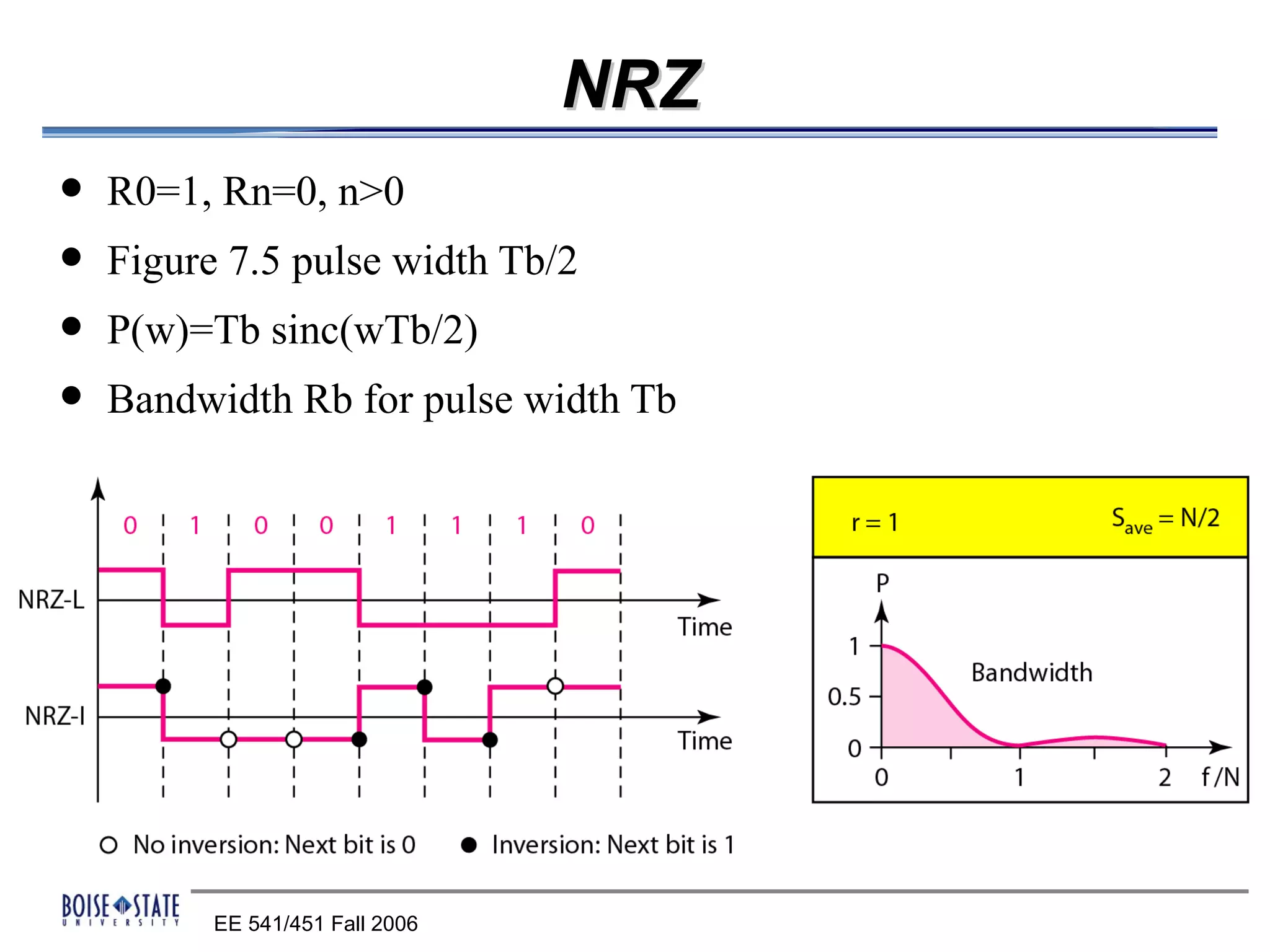
•   In NRZ-L, the level of the voltage determines the value of the bit.
    RS232.
•   In NRZ-I, the inversion or the lack of inversion determines the value
    of the bit. USB, Compact CD, and Fast-Ethernet.
•   NRZ-L and NRZ-I both have an average signal rate of N/2 Bd.
   NRZ-L and NRZ-I both have a DC component problem.


          EE 541/451 Fall 2006
RZ scheme
   Return to zero
   Self clocking


          EE 541/451 Fall 2006
Polar biphase: Manchester and differential Manchester schemes
    In Manchester and differential Manchester encoding, the transition at the
     middle of the bit is used for synchronization.
    The minimum bandwidth of Manchester and differential Manchester is 2
     times that of NRZ. 802.3 token bus and 802.4 Ethernet


            EE 541/451 Fall 2006
Bipolar schemes: AMI and pseudoternary
   In bipolar encoding, we use three levels: positive, zero, and negative.
   Pseudoternary:
     – 1 represented by absence of line signal
     – 0 represented by alternating positive and negative
   DS1, E1


           EE 541/451 Fall 2006
Basic steps for spectrum analysis
   Figure 7.3, 7.4
     – Basic pulse function and its spectrum P(w)
        x   For example, rect. function is sinc
     – Input x is the pulse function with different amplitude as
       figure 7.3c
        x   Carry different information with sign and amplitude
        x   Auto correlation is the spectrum of Sx(w)
                       Tb
            Rn = lim
                  T →∞ T
                            ∑a a
                              k
                                    k   k +n


                       1     ∞
                                                   1        ∞
                                                                           
                 ∑Re
            S x ( w) =
                       Tb   n =−∞
                                    n
                                        − jnwTb
                                                  =  R0 + 2∑ Rn e − jnwTb 
                                                   Tb      n =1           
     – Overall spectrum
                                                  2
              S y ( w) = P ( w) S y ( w)

            EE 541/451 Fall 2006
Line coding schemes

                       10 points in the finals


EE 541/451 Fall 2006
NRZ
   R0=1, Rn=0, n>0
   Figure 7.5 pulse width Tb/2
   P(w)=Tb sinc(wTb/2)
   Bandwidth Rb for pulse width Tb


          EE 541/451 Fall 2006
RZ scheme
   DC Nulling                                               ωT
                                                        sin 2
   Split phase                  r ( t ) ↔ R( ω ) = T         4
                                                           ωT
   Figure 7.6(a)                                           4


          EE 541/451 Fall 2006
Polar biphase: Manchester and differential Manchester schemes
    In Manchester and differential Manchester encoding, the transition at the
     middle of the bit is used for synchronization.
    The minimum bandwidth of Manchester and differential Manchester is 2
     times that of NRZ. 802.3 token bus and 802.4 Ethernet


            EE 541/451 Fall 2006
Bipolar schemes: AMI and pseudoternary
   R0=1/2, R1=-1/4, Rn=0,n>1, page 307 for reasons
   Figure 7.8
                        2
               P ( w)                           Tb          wT    2  wTb 
    S y ( w) =              [ 1 − cos wTb ] =      sin c 2  b     sin  2 
                2Tb                             4           4            

   Reason: the phase changes slower


            EE 541/451 Fall 2006
Multilevel: 2B1Q scheme
   NRZ with
amplitude
representing more
bits


         EE 541/451 Fall 2006
HDB3 (High Density Bipolar of order 3 code)
   Replacing series of four bits that are to equal to "0" with a code word
    "000V" or "B00V", where "V" is a pulse that violates the AMI law of
    alternate polarity and is rectangular or some other shape. The rules for using
    "000V" or "B00V" are as follows:

     – "B00V" is used when up to the previous pulse, the coded signal presents
       a DC component that is not null (the number of positive pulses is not
       compensated for by the number of negative pulses).
     – "000V" is used under the same conditions as above when up to the
       previous pulse the DC component is null.
     – The pulse "B" ("B" for balancing), which respects the AMI alternancy
       rule, has positive or negative polarity, ensuring that two successive V
       pulses will have different polarity.


   Used in E1

           EE 541/451 Fall 2006
HDB3
   The timing information is preserved by embedding it in the line
    signal even when long sequences of zeros are transmitted,
    which allows the clock to be recovered properly on reception.
   The DC component of a signal that is coded in HDB3 is null.


          EE 541/451 Fall 2006
Bipolar 8-Zero Substitution (B8ZS)
   Adds synchronization for long strings of 0s
   North American system
   Same working principle as AMI except for eight consecutive 0s
    10000000001  +000+-0-+01               in general   00000000000V(-V)0(-V)V
            1         0        0        0   0     0          0       0   0   0   1
Amplitude


                                                                                     Time


                            Violation                    Violation

   Evaluation
      – Adds synchronization without changing the DC balance
      – Error detection possible
   Used in T1/DS1
                EE 541/451 Fall 2006
Coded Mark Inversion (CMI)
   Another modification from AMI: Binary 0 is represented by a half period of
    negative voltage followed by a half period of positive voltage
   Advantages:
     – good clock recovery and no d.c. offset
     – simple circuitry for encoder and decoder − compared with HDB3
   Disadvantages: high bandwidth


           EE 541/451 Fall 2006
Multilevel: 2B1Q scheme
   Integrated
Services
Digital
Network
ISDN


           EE 541/451 Fall 2006
mBnL schemes
•   In mBnL schemes, a pattern of m data elements is encoded as a
    pattern of n signal elements in which 2^m ≤ L^n.
•   Multilevel: 8B6T scheme, T4


          EE 541/451 Fall 2006
8B6T code table (partial)


EE 541/451 Fall 2006
Multilevel: 4D-PAM5 scheme


EE 541/451 Fall 2006
Multitransition: MLT-3 scheme


EE 541/451 Fall 2006
PSD of various line codes


EE 541/451 Fall 2006
Clock Recovery
   A timing reference signal can be extracted from the received signal by
    differentiation and full-wave rectification − provided that the signal carries
    sufficient transitions.
   This timing reference signal is then used to fine tune the frequency and phase
    of a local oscillator. The receiver clock is then derived (e.g. add a phase
    shift) from this local oscillator.


           EE 541/451 Fall 2006
Clock Recovery
   Simple Circuit


   PLL


          EE 541/451 Fall 2006
Summary of line coding schemes


                Plus HDB3 and B8ZS

   EE 541/451 Fall 2006

Line coding

  • 1.
    Digital Communication System  7.1 and 7.2 (part)  Source: sequence of digits  Multiplexer: FDMA, TDMA, CDMA…  Line Coder – Code chosen for use within a communications system for transmission purposes. – Baseband transmission – Twisted wire, cable, fiber communications  Regenerative repeator – Detect incoming signals and regenerate new clean pulses EE 541/451 Fall 2006
  • 2.
    Line coding anddecoding EE 541/451 Fall 2006
  • 3.
    Signal element versusdata element EE 541/451 Fall 2006
  • 4.
    Data Rate Vs.Signal Rate  Data rate: the number of data elements (bits) sent in 1s (bps). It’s also called the bit rate  Signal rate: the number of signal elements sent in 1s (baud). It’s also called the pulse rate, the modulation rate, or the baud rate.  We wish to: – increase the data rate (increase the speed of transmission) – decrease the signal rate (decrease the bandwidth requirement) – worst case, best case, and average case of r – N bit rate – c is a constant that depends on different line codes. – S = c * N / r baud EE 541/451 Fall 2006
  • 5.
    Example • A signal is carrying data in which one data element is encoded as one signal element ( r = 1). If the bit rate is 100 kbps, what is the average value of the baud rate if c is between 0 and 1?  Solution – We assume that the average value of c is 1/2 . The baud rate is then • Although the actual bandwidth of a digital signal is infinite, the effective bandwidth is finite. • What is the relationship between baud rate, bit rate, and the required bandwidth? EE 541/451 Fall 2006
  • 6.
    Self-synchronization  Receiver Setting the clock matching the sender’s  Effect of lack of synchronization EE 541/451 Fall 2006
  • 7.
    Example • In a digital transmission, the receiver clock is 0.1 percent faster than the sender clock. How many extra bits per second does the receiver receive if the data rate is 1 kbps? How many if the data rate is 1 Mbps?  Solution – At 1 kbps, the receiver receives 1001 bps instead of 1000 bps. – At 1 Mbps, the receiver receives 1,001,000 bps instead of 1,000,000 bps. EE 541/451 Fall 2006
  • 8.
    Other properties  DC components  Transmission bandwidth  Power efficiency  Error detection and correction capability  Favorable power spectral density  Adequate timing content  Transparency EE 541/451 Fall 2006
  • 9.
    Line coding schemes EE541/451 Fall 2006
  • 10.
    Unipolar NRZ scheme EE541/451 Fall 2006
  • 11.
    Polar NRZ-L andNRZ-I schemes • In NRZ-L, the level of the voltage determines the value of the bit. RS232. • In NRZ-I, the inversion or the lack of inversion determines the value of the bit. USB, Compact CD, and Fast-Ethernet. • NRZ-L and NRZ-I both have an average signal rate of N/2 Bd.  NRZ-L and NRZ-I both have a DC component problem. EE 541/451 Fall 2006
  • 12.
    RZ scheme  Return to zero  Self clocking EE 541/451 Fall 2006
  • 13.
    Polar biphase: Manchesterand differential Manchester schemes  In Manchester and differential Manchester encoding, the transition at the middle of the bit is used for synchronization.  The minimum bandwidth of Manchester and differential Manchester is 2 times that of NRZ. 802.3 token bus and 802.4 Ethernet EE 541/451 Fall 2006
  • 14.
    Bipolar schemes: AMIand pseudoternary  In bipolar encoding, we use three levels: positive, zero, and negative.  Pseudoternary: – 1 represented by absence of line signal – 0 represented by alternating positive and negative  DS1, E1 EE 541/451 Fall 2006
  • 15.
    Basic steps forspectrum analysis  Figure 7.3, 7.4 – Basic pulse function and its spectrum P(w) x For example, rect. function is sinc – Input x is the pulse function with different amplitude as figure 7.3c x Carry different information with sign and amplitude x Auto correlation is the spectrum of Sx(w) Tb Rn = lim T →∞ T ∑a a k k k +n 1 ∞ 1 ∞  ∑Re S x ( w) = Tb n =−∞ n − jnwTb =  R0 + 2∑ Rn e − jnwTb  Tb  n =1  – Overall spectrum 2 S y ( w) = P ( w) S y ( w) EE 541/451 Fall 2006
  • 16.
    Line coding schemes 10 points in the finals EE 541/451 Fall 2006
  • 17.
    NRZ  R0=1, Rn=0, n>0  Figure 7.5 pulse width Tb/2  P(w)=Tb sinc(wTb/2)  Bandwidth Rb for pulse width Tb EE 541/451 Fall 2006
  • 18.
    RZ scheme  DC Nulling ωT sin 2  Split phase r ( t ) ↔ R( ω ) = T 4 ωT  Figure 7.6(a) 4 EE 541/451 Fall 2006
  • 19.
    Polar biphase: Manchesterand differential Manchester schemes  In Manchester and differential Manchester encoding, the transition at the middle of the bit is used for synchronization.  The minimum bandwidth of Manchester and differential Manchester is 2 times that of NRZ. 802.3 token bus and 802.4 Ethernet EE 541/451 Fall 2006
  • 20.
    Bipolar schemes: AMIand pseudoternary  R0=1/2, R1=-1/4, Rn=0,n>1, page 307 for reasons  Figure 7.8 2 P ( w) Tb  wT  2  wTb  S y ( w) = [ 1 − cos wTb ] = sin c 2  b  sin  2  2Tb 4  4     Reason: the phase changes slower EE 541/451 Fall 2006
  • 21.
    Multilevel: 2B1Q scheme  NRZ with amplitude representing more bits EE 541/451 Fall 2006
  • 22.
    HDB3 (High DensityBipolar of order 3 code)  Replacing series of four bits that are to equal to "0" with a code word "000V" or "B00V", where "V" is a pulse that violates the AMI law of alternate polarity and is rectangular or some other shape. The rules for using "000V" or "B00V" are as follows: – "B00V" is used when up to the previous pulse, the coded signal presents a DC component that is not null (the number of positive pulses is not compensated for by the number of negative pulses). – "000V" is used under the same conditions as above when up to the previous pulse the DC component is null. – The pulse "B" ("B" for balancing), which respects the AMI alternancy rule, has positive or negative polarity, ensuring that two successive V pulses will have different polarity.  Used in E1 EE 541/451 Fall 2006
  • 23.
    HDB3  The timing information is preserved by embedding it in the line signal even when long sequences of zeros are transmitted, which allows the clock to be recovered properly on reception.  The DC component of a signal that is coded in HDB3 is null. EE 541/451 Fall 2006
  • 24.
    Bipolar 8-Zero Substitution(B8ZS)  Adds synchronization for long strings of 0s  North American system  Same working principle as AMI except for eight consecutive 0s 10000000001  +000+-0-+01 in general 00000000000V(-V)0(-V)V 1 0 0 0 0 0 0 0 0 0 1 Amplitude Time Violation Violation  Evaluation – Adds synchronization without changing the DC balance – Error detection possible  Used in T1/DS1 EE 541/451 Fall 2006
  • 25.
    Coded Mark Inversion(CMI)  Another modification from AMI: Binary 0 is represented by a half period of negative voltage followed by a half period of positive voltage  Advantages: – good clock recovery and no d.c. offset – simple circuitry for encoder and decoder − compared with HDB3  Disadvantages: high bandwidth EE 541/451 Fall 2006
  • 26.
    Multilevel: 2B1Q scheme  Integrated Services Digital Network ISDN EE 541/451 Fall 2006
  • 27.
    mBnL schemes • In mBnL schemes, a pattern of m data elements is encoded as a pattern of n signal elements in which 2^m ≤ L^n. • Multilevel: 8B6T scheme, T4 EE 541/451 Fall 2006
  • 28.
    8B6T code table(partial) EE 541/451 Fall 2006
  • 29.
  • 30.
  • 31.
    PSD of variousline codes EE 541/451 Fall 2006
  • 32.
    Clock Recovery  A timing reference signal can be extracted from the received signal by differentiation and full-wave rectification − provided that the signal carries sufficient transitions.  This timing reference signal is then used to fine tune the frequency and phase of a local oscillator. The receiver clock is then derived (e.g. add a phase shift) from this local oscillator. EE 541/451 Fall 2006
  • 33.
    Clock Recovery  Simple Circuit  PLL EE 541/451 Fall 2006
  • 34.
    Summary of linecoding schemes Plus HDB3 and B8ZS EE 541/451 Fall 2006