Basic Functions
of Management
02- The Organizing Function
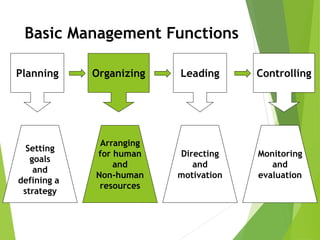
Basic Management Functions
Planning Organizing Leading Controlling
Arranging
for human
and
Non-human
resources
Setting
goals
and
defining a
strategy
Directing
and
motivation
Monitoring
and
evaluation
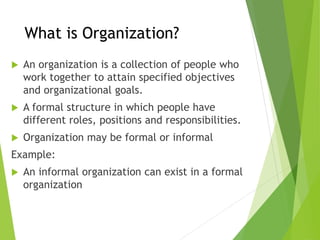
What is Organization?
 An organization is a collection of people who
work together to attain specified objectives
and organizational goals.
 A formal structure in which people have
different roles, positions and responsibilities.
 Organization may be formal or informal
Example:
 An informal organization can exist in a formal
organization
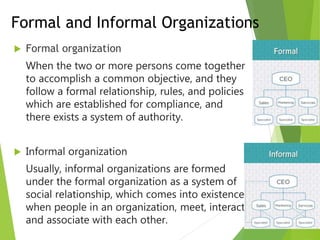
Formal and Informal Organizations
 Formal organization
When the two or more persons come together
to accomplish a common objective, and they
follow a formal relationship, rules, and policies
which are established for compliance, and
there exists a system of authority.
 Informal organization
Usually, informal organizations are formed
under the formal organization as a system of
social relationship, which comes into existence
when people in an organization, meet, interact
and associate with each other.
What is Organizing?
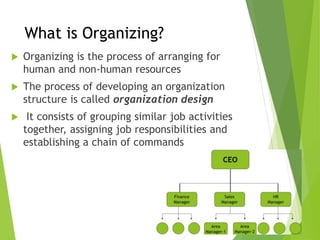
 Organizing is the process of arranging for
human and non-human resources
 The process of developing an organization
structure is called organization design
 It consists of grouping similar job activities
together, assigning job responsibilities and
establishing a chain of commands
Designing the Organization
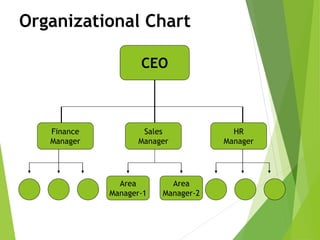
Organizational Chart:
A chart that shows the structure of the
organization including the title of each manager’s
position and, by means of connecting lines, who
is accountable to whom and who has authority for
each area.
Chain of Command:
The path that a directive or answer or request
should take through each level of an
organization; also called a scalar chain or the line
of authority.
CEO
HR
Manager
Finance
Manager
Sales
Manager
Area
Manager-2
Area
Manager-1
Organizational Chart
Span (area) of control
 The number of people who report to one
manager or supervisor
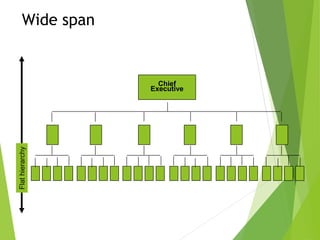
1. Wide Span of Control:
 when many employees are reporting to the
same manager or supervisor (Less no. of
managers)
 The organization is called a Flat organization
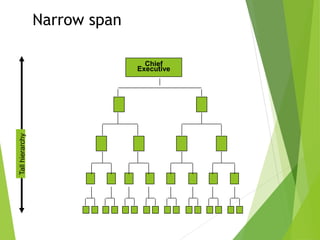
2. Narrow Span of Control:
 when a small number of employees is
reporting to the same manager or supervisor
(Large no. of managers)
 The organization is called a Tall organization
Narrow span
Chief
Executive
Tall
hierarchy
Wide span
Chief
Executive
Flat
hierarchy
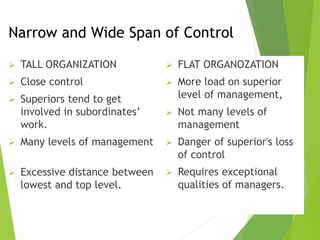
Narrow and Wide Span of Control
 TALL ORGANIZATION
 Close control
 Superiors tend to get
involved in subordinates’
work.
 Many levels of management
 Excessive distance between
lowest and top level.
 FLAT ORGANOZATION
 More load on superior
level of management,
 Not many levels of
management
 Danger of superior's loss
of control
 Requires exceptional
qualities of managers.
Authority, Responsibility and Accountability
Authority: The right to take action, to make
decisions, and to direct the work of
others.
Responsibility: is an employee’s duty to perform
the assigned task.
Accountability: is the manager’s expectation
that the employee will accept
credit or blame for his work.
Organizing: Concepts and Definitions
 Delegation: is the process of giving authority and
responsibility to a person to make decisions and
act in certain situations.
 Line Authority: authority following the chain of
command established by the formal hierarchy
 Staff Authority: the authority of supportive
departments like human resource, marketing
research, customers services etc.
Designing the Organization:
Departmentalization Methods:
1. Functional Departmentalization:
Grouped by skills & work; Internal
2. Product Departmentalization:
Grouped by products; External
3. Process Departmentalization:
Grouped by equipment
4. Customer Departmentalization:
Grouped by customers; External
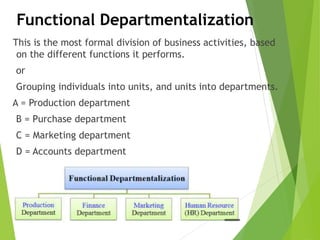
Functional Departmentalization
This is the most formal division of business activities, based
on the different functions it performs.
or
Grouping individuals into units, and units into departments.
A = Production department
B = Purchase department
C = Marketing department
D = Accounts department
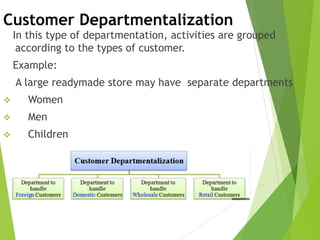
Customer Departmentalization
In this type of departmentation, activities are grouped
according to the types of customer.
Example:
A large readymade store may have separate departments
 Women
 Men
 Children
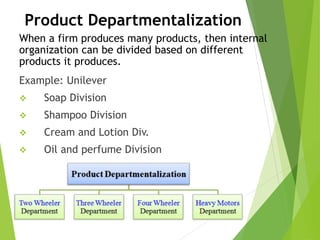
Product Departmentalization
Example: Unilever
 Soap Division
 Shampoo Division
 Cream and Lotion Div.
 Oil and perfume Division
When a firm produces many products, then internal
organization can be divided based on different
products it produces.
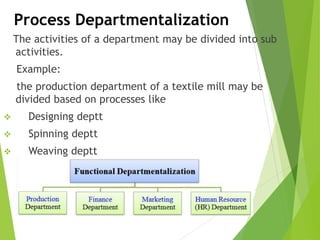
Process Departmentalization
The activities of a department may be divided into sub
activities.
Example:
the production department of a textile mill may be
divided based on processes like
 Designing deptt
 Spinning deptt
 Weaving deptt
Organizational culture
 Culture is the general patterns of behaviors,
shared believes and values that members
have in common.
 Culture can refer to what people say, do and
think within the organizational settings.
Example:
Google is known for being an excellent employer and its employees are a
hardworking, talented, and an enthusiastic bunch. For its employees, Google's
corporate culture is a treasure trove of bonuses. Free meals, employee
vacations and parties, cash bonuses, open speeches by high-level executives,
employee recognition, gyms, and a pet-friendly atmosphere are all available
at Google.
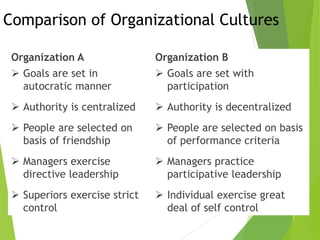
Comparison of Organizational Cultures
Organization A Organization B
 Goals are set in
autocratic manner
 Authority is centralized
 People are selected on
basis of friendship
 Managers exercise
directive leadership
 Superiors exercise strict
control
 Goals are set with
participation
 Authority is decentralized
 People are selected on basis
of performance criteria
 Managers practice
participative leadership
 Individual exercise great
deal of self control

05- The Organizing Function.ppt

  • 1.
    Basic Functions of Management 02-The Organizing Function
  • 2.
    Basic Management Functions PlanningOrganizing Leading Controlling Arranging for human and Non-human resources Setting goals and defining a strategy Directing and motivation Monitoring and evaluation
  • 3.
    What is Organization? An organization is a collection of people who work together to attain specified objectives and organizational goals.  A formal structure in which people have different roles, positions and responsibilities.  Organization may be formal or informal Example:  An informal organization can exist in a formal organization
  • 4.
    Formal and InformalOrganizations  Formal organization When the two or more persons come together to accomplish a common objective, and they follow a formal relationship, rules, and policies which are established for compliance, and there exists a system of authority.  Informal organization Usually, informal organizations are formed under the formal organization as a system of social relationship, which comes into existence when people in an organization, meet, interact and associate with each other.
  • 5.
    What is Organizing? Organizing is the process of arranging for human and non-human resources  The process of developing an organization structure is called organization design  It consists of grouping similar job activities together, assigning job responsibilities and establishing a chain of commands
  • 6.
    Designing the Organization OrganizationalChart: A chart that shows the structure of the organization including the title of each manager’s position and, by means of connecting lines, who is accountable to whom and who has authority for each area. Chain of Command: The path that a directive or answer or request should take through each level of an organization; also called a scalar chain or the line of authority.
  • 7.
  • 8.
    Span (area) ofcontrol  The number of people who report to one manager or supervisor 1. Wide Span of Control:  when many employees are reporting to the same manager or supervisor (Less no. of managers)  The organization is called a Flat organization 2. Narrow Span of Control:  when a small number of employees is reporting to the same manager or supervisor (Large no. of managers)  The organization is called a Tall organization
  • 9.
  • 10.
  • 11.
    Narrow and WideSpan of Control  TALL ORGANIZATION  Close control  Superiors tend to get involved in subordinates’ work.  Many levels of management  Excessive distance between lowest and top level.  FLAT ORGANOZATION  More load on superior level of management,  Not many levels of management  Danger of superior's loss of control  Requires exceptional qualities of managers.
  • 12.
    Authority, Responsibility andAccountability Authority: The right to take action, to make decisions, and to direct the work of others. Responsibility: is an employee’s duty to perform the assigned task. Accountability: is the manager’s expectation that the employee will accept credit or blame for his work.
  • 13.
    Organizing: Concepts andDefinitions  Delegation: is the process of giving authority and responsibility to a person to make decisions and act in certain situations.  Line Authority: authority following the chain of command established by the formal hierarchy  Staff Authority: the authority of supportive departments like human resource, marketing research, customers services etc.
  • 14.
    Designing the Organization: DepartmentalizationMethods: 1. Functional Departmentalization: Grouped by skills & work; Internal 2. Product Departmentalization: Grouped by products; External 3. Process Departmentalization: Grouped by equipment 4. Customer Departmentalization: Grouped by customers; External
  • 15.
    Functional Departmentalization This isthe most formal division of business activities, based on the different functions it performs. or Grouping individuals into units, and units into departments. A = Production department B = Purchase department C = Marketing department D = Accounts department
  • 16.
    Customer Departmentalization In thistype of departmentation, activities are grouped according to the types of customer. Example: A large readymade store may have separate departments  Women  Men  Children
  • 17.
    Product Departmentalization Example: Unilever Soap Division  Shampoo Division  Cream and Lotion Div.  Oil and perfume Division When a firm produces many products, then internal organization can be divided based on different products it produces.
  • 18.
    Process Departmentalization The activitiesof a department may be divided into sub activities. Example: the production department of a textile mill may be divided based on processes like  Designing deptt  Spinning deptt  Weaving deptt
  • 19.
    Organizational culture  Cultureis the general patterns of behaviors, shared believes and values that members have in common.  Culture can refer to what people say, do and think within the organizational settings. Example: Google is known for being an excellent employer and its employees are a hardworking, talented, and an enthusiastic bunch. For its employees, Google's corporate culture is a treasure trove of bonuses. Free meals, employee vacations and parties, cash bonuses, open speeches by high-level executives, employee recognition, gyms, and a pet-friendly atmosphere are all available at Google.
  • 20.
    Comparison of OrganizationalCultures Organization A Organization B  Goals are set in autocratic manner  Authority is centralized  People are selected on basis of friendship  Managers exercise directive leadership  Superiors exercise strict control  Goals are set with participation  Authority is decentralized  People are selected on basis of performance criteria  Managers practice participative leadership  Individual exercise great deal of self control