Part I: Money
Chapter 1
Nature and function of Money
Money & Banking
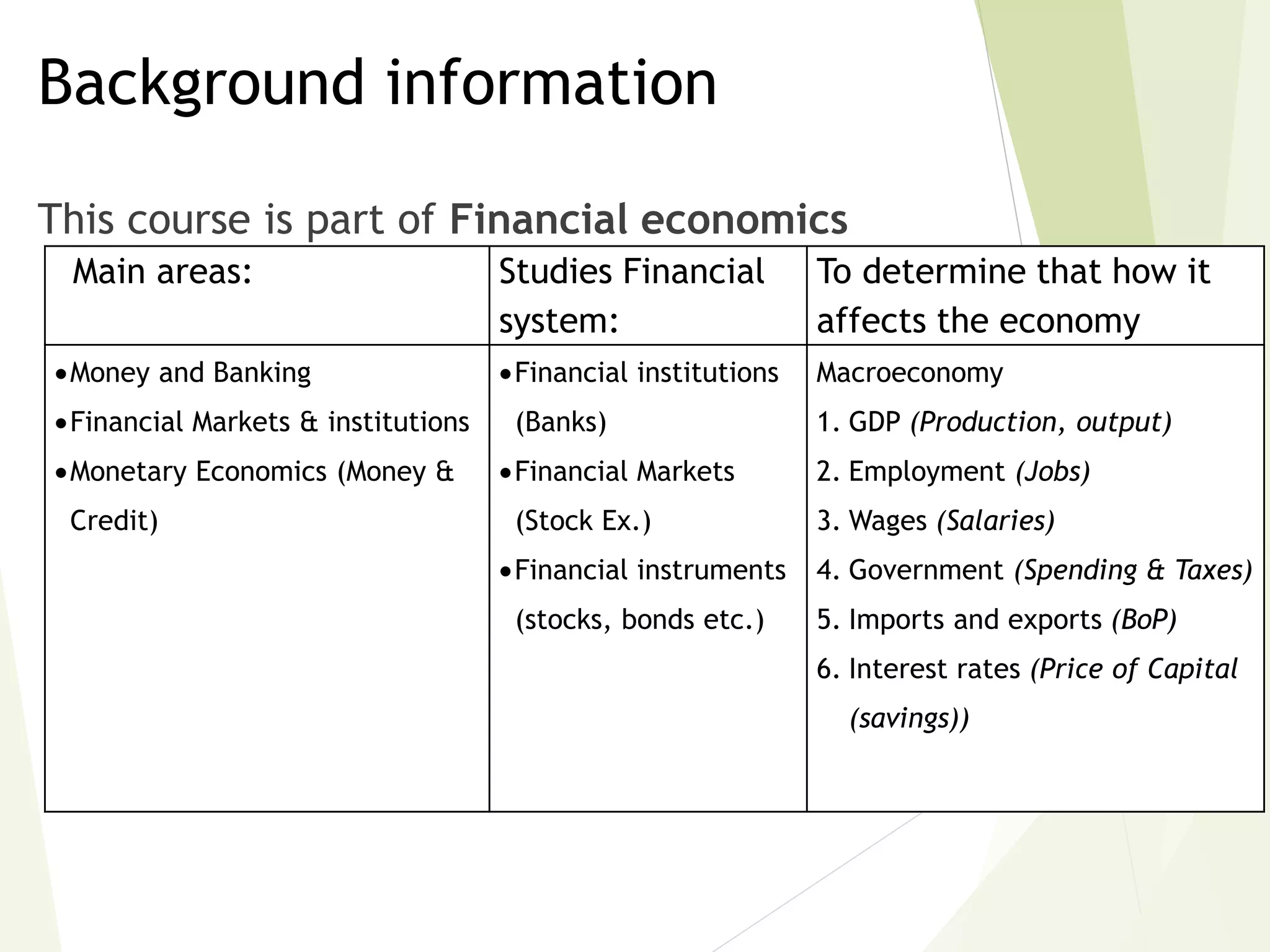
Background information
Main areas: Studies Financial
system:
To determine that how it
affects the economy
Money and Banking
Financial Markets & institutions
Monetary Economics (Money &
Credit)
Financial institutions
(Banks)
Financial Markets
(Stock Ex.)
Financial instruments
(stocks, bonds etc.)
Macroeconomy
1. GDP (Production, output)
2. Employment (Jobs)
3. Wages (Salaries)
4. Government (Spending & Taxes)
5. Imports and exports (BoP)
6. Interest rates (Price of Capital
(savings))
This course is part of Financial economics
1. Money
Imagine today’s world without
money, how do you find it?
Don’t you think the ‘Money’ is the
greatest invention of mankind?
Definitions:
 Descriptive.
 Legal.
 General acceptability.
1.1.Descriptive Definitions:
It mainly focus on the functions of money and not
what the money is.
 “Anything that is generally acceptable as a
means of exchange and acts as a measure and
store of value”. Crowther.
 “anything that is generally accepted in payment
for goods or services or in the repayment of
debts”. ROBERT E. WRIGHT
 “Money is anything that is widely used as mean
of payments and is generally acceptable in
settlement of debts”. Cole.
1.2.Legal Definitions
 Based on “The state theory of money (1905/1924)”.
 “Anything which is declared by the state as
money is money”. Professor Knap
 Professor Hartley believes that money should be
legal tender. It should be declared by the
government of a country as a mean of payment
and people should be forced to accept it for
purpose of money.
1.3.General acceptability definition:
1. Money is anything which is commonly used and
generally accepted as a medium of exchange or
as standard of value. Kent
2. Money is anything that is generally accepted in
payment for goods and services or in the
repayment of debts. S. Mishkin
3. Money is anything that is regularly used in
economic transactions and serves as a medium of
exchange, a unit of account and a store of value.
Advantages/Importance of money
1. It allows its users to complete much more work
in a given time (Economic efficiency & Specialization)
2. It facilitates trade by making it easier to buy and
sell goods compared to barter
3. It decreases the transaction cost. Time spent trying
to exchange goods or services is called a transaction cost.
4. It fulfills the mutual or double coincidence of
wants
5. It became a standard unit of account (money
helps us to answer the question, how much is that worth?)
Imagine, if the economy has only three goods-say,
apples, university lectures, and potatoes.
1.4. Money, Wealth and Income
Is there any difference between?
 The word “Money” doesn’t stand for the meaning of Wealth & Income.
1. Wealth= Scarce resources which are owned by an
individual or firm or a nation.
It includes physical goods and assets and financial assets, such as land,
property, shares money etc.
2. Income= Return on or addition to Wealth.
As a result, Wealth is a stock, but the income is flow of money
earnings per unit of time, a day, weak, month or year.
2. Stages in Development of Money
 Evolution of Money.
In the earlier stages of human civilization,
families were self-sufficient or consent with the
life-style and available resource.
But, later the trend changed …………….
Necessity is the mother of invention.
Exchanged goods directly for goods possessed
by others. (Barter system)
The earliest money that came into use through
Barter is known as Commodity Money.
2. Stages in Development of Money
(Continued….)
 Development in human civilization has
gradually developed money in different forms,
eventually evolved in today’s form from the
following stages:
2.1. Commodity Money
2.2. Metallic money
2.3. Paper Currency
2.4. Credit Money
2.5. Electronic Money (or Plastic money)
2.1. Commodity money
 A large number of commodities or items has
served as commodity money at different time
and places. Such as, cattle (goats, horses,
cows, sheep, etc.), salt, rice, wheat, animal
bones, metal and other precious items were
used as money.
 But these commodities created problems in
storing, transportability, durability and
divisibility of such items as money.
2.2. Metallic Money or coins
 Coinage. The use of gold and silver as commodity
money (uncoined metal) created problems in each
exchange of goods.
 To maintain quality and quantity of metals, the coins
were stamped on both sides by a competent authority
called coinage.
2.3. Paper Currency
 Made of paper and functions as medium of
exchange.
 Why people agreed to exchange their goods
for only papers in earliest?
 Initially, it carried promise that it was
convertible into a fixed quantity of precious
metallic gold and silver.
Paper Currency (Continued….)
 The practice of exchanging paper currency for
gold was eliminated after 1914 in England and in
1933 in America. Our today’s paper notes are
inconvertible notes (Fiat money).
 Fiat money is accepted as money because the
government says its money.
 It is issued by the government without any
backing of gold, silver or government securities.
Also known as token money by J. MI Keynes.
2.4.Credit Money or Bank Money
 As the name indicate, this money is
developed by the banking system.
 It is the use of cheques and drafts issued by
the banker to its account holders.
 Clearly when depositors deposits their money
in bank they generate liability (credit) on
bank, so the name credit money came in
existing.
 More convenient our currency, as it is easy to
carry for transactions of large amounts, easy
to transfer, and safer.
2.5.Electronic or Plastic Money
 Electronic banking is the modern system of
transferring funds using electronic
communications.
 They are account to account transfer and
payment for purchase transactions.
 ATM Cards, Debit Cards, Credit Cards, Smart
Cards etc are examples.
3.Functions of Money
1. Money as Medium of Exchange…
As a medium of exchange, it solves the “double
coincidence” of wants problem in barter
system….with a money a person can buy
anything he/she likes.
2. Money as a measure of value…
In money economy, value of all goods and
services are expressed in terms of price, like
(price for wheat in Kg and Cloth in meter etc).
Functions of Money (Continued...... )
3 . Standard of deferred payments.
In a money economy the contracts are made for
future payments in money terms, with a promise
to repay the loan in money.
4 . Money as a store of value.
Money acts as a store of value without loss in its
value over period of time. in barter system much
difficulty was faced in storing value in terms of
goods.
Functions of Money (Continued..... )
5 . Source of Government receipts.
Government can collect taxes from the people
with the help of money easily. On the other
hand, Government gives salaries and pensions to
the people without any difficulty.
6 . Money as unit of account.
We count the amount with the help of money.
Different countries have different unit of
account such as Afs for Afghanistan, USD for
America, Pond for UK, Yen for Japan, Rupee for
Pak, etc. in this way the figure of National
income, Wealth assets are expressed in terms of
money.
Qualities of a good money material
 General Acceptability
 Stability of value
 Transportabilityportability
 Storability
 Divisibility
 Homogeneity
 Recognisability
Thank you

Money & Banking_1.pptx

  • 1.
    Part I: Money Chapter1 Nature and function of Money Money & Banking
  • 2.
    Background information Main areas:Studies Financial system: To determine that how it affects the economy Money and Banking Financial Markets & institutions Monetary Economics (Money & Credit) Financial institutions (Banks) Financial Markets (Stock Ex.) Financial instruments (stocks, bonds etc.) Macroeconomy 1. GDP (Production, output) 2. Employment (Jobs) 3. Wages (Salaries) 4. Government (Spending & Taxes) 5. Imports and exports (BoP) 6. Interest rates (Price of Capital (savings)) This course is part of Financial economics
  • 3.
    1. Money Imagine today’sworld without money, how do you find it? Don’t you think the ‘Money’ is the greatest invention of mankind? Definitions:  Descriptive.  Legal.  General acceptability.
  • 4.
    1.1.Descriptive Definitions: It mainlyfocus on the functions of money and not what the money is.  “Anything that is generally acceptable as a means of exchange and acts as a measure and store of value”. Crowther.  “anything that is generally accepted in payment for goods or services or in the repayment of debts”. ROBERT E. WRIGHT  “Money is anything that is widely used as mean of payments and is generally acceptable in settlement of debts”. Cole.
  • 5.
    1.2.Legal Definitions  Basedon “The state theory of money (1905/1924)”.  “Anything which is declared by the state as money is money”. Professor Knap  Professor Hartley believes that money should be legal tender. It should be declared by the government of a country as a mean of payment and people should be forced to accept it for purpose of money.
  • 6.
    1.3.General acceptability definition: 1.Money is anything which is commonly used and generally accepted as a medium of exchange or as standard of value. Kent 2. Money is anything that is generally accepted in payment for goods and services or in the repayment of debts. S. Mishkin 3. Money is anything that is regularly used in economic transactions and serves as a medium of exchange, a unit of account and a store of value.
  • 7.
    Advantages/Importance of money 1.It allows its users to complete much more work in a given time (Economic efficiency & Specialization) 2. It facilitates trade by making it easier to buy and sell goods compared to barter 3. It decreases the transaction cost. Time spent trying to exchange goods or services is called a transaction cost. 4. It fulfills the mutual or double coincidence of wants 5. It became a standard unit of account (money helps us to answer the question, how much is that worth?) Imagine, if the economy has only three goods-say, apples, university lectures, and potatoes.
  • 8.
    1.4. Money, Wealthand Income Is there any difference between?  The word “Money” doesn’t stand for the meaning of Wealth & Income. 1. Wealth= Scarce resources which are owned by an individual or firm or a nation. It includes physical goods and assets and financial assets, such as land, property, shares money etc. 2. Income= Return on or addition to Wealth. As a result, Wealth is a stock, but the income is flow of money earnings per unit of time, a day, weak, month or year.
  • 9.
    2. Stages inDevelopment of Money  Evolution of Money. In the earlier stages of human civilization, families were self-sufficient or consent with the life-style and available resource. But, later the trend changed ……………. Necessity is the mother of invention. Exchanged goods directly for goods possessed by others. (Barter system) The earliest money that came into use through Barter is known as Commodity Money.
  • 10.
    2. Stages inDevelopment of Money (Continued….)  Development in human civilization has gradually developed money in different forms, eventually evolved in today’s form from the following stages: 2.1. Commodity Money 2.2. Metallic money 2.3. Paper Currency 2.4. Credit Money 2.5. Electronic Money (or Plastic money)
  • 11.
    2.1. Commodity money A large number of commodities or items has served as commodity money at different time and places. Such as, cattle (goats, horses, cows, sheep, etc.), salt, rice, wheat, animal bones, metal and other precious items were used as money.  But these commodities created problems in storing, transportability, durability and divisibility of such items as money.
  • 12.
    2.2. Metallic Moneyor coins  Coinage. The use of gold and silver as commodity money (uncoined metal) created problems in each exchange of goods.  To maintain quality and quantity of metals, the coins were stamped on both sides by a competent authority called coinage.
  • 13.
    2.3. Paper Currency Made of paper and functions as medium of exchange.  Why people agreed to exchange their goods for only papers in earliest?  Initially, it carried promise that it was convertible into a fixed quantity of precious metallic gold and silver.
  • 14.
    Paper Currency (Continued….) The practice of exchanging paper currency for gold was eliminated after 1914 in England and in 1933 in America. Our today’s paper notes are inconvertible notes (Fiat money).  Fiat money is accepted as money because the government says its money.  It is issued by the government without any backing of gold, silver or government securities. Also known as token money by J. MI Keynes.
  • 15.
    2.4.Credit Money orBank Money  As the name indicate, this money is developed by the banking system.  It is the use of cheques and drafts issued by the banker to its account holders.  Clearly when depositors deposits their money in bank they generate liability (credit) on bank, so the name credit money came in existing.  More convenient our currency, as it is easy to carry for transactions of large amounts, easy to transfer, and safer.
  • 16.
    2.5.Electronic or PlasticMoney  Electronic banking is the modern system of transferring funds using electronic communications.  They are account to account transfer and payment for purchase transactions.  ATM Cards, Debit Cards, Credit Cards, Smart Cards etc are examples.
  • 17.
    3.Functions of Money 1.Money as Medium of Exchange… As a medium of exchange, it solves the “double coincidence” of wants problem in barter system….with a money a person can buy anything he/she likes. 2. Money as a measure of value… In money economy, value of all goods and services are expressed in terms of price, like (price for wheat in Kg and Cloth in meter etc).
  • 18.
    Functions of Money(Continued...... ) 3 . Standard of deferred payments. In a money economy the contracts are made for future payments in money terms, with a promise to repay the loan in money. 4 . Money as a store of value. Money acts as a store of value without loss in its value over period of time. in barter system much difficulty was faced in storing value in terms of goods.
  • 19.
    Functions of Money(Continued..... ) 5 . Source of Government receipts. Government can collect taxes from the people with the help of money easily. On the other hand, Government gives salaries and pensions to the people without any difficulty. 6 . Money as unit of account. We count the amount with the help of money. Different countries have different unit of account such as Afs for Afghanistan, USD for America, Pond for UK, Yen for Japan, Rupee for Pak, etc. in this way the figure of National income, Wealth assets are expressed in terms of money.
  • 20.
    Qualities of agood money material  General Acceptability  Stability of value  Transportabilityportability  Storability  Divisibility  Homogeneity  Recognisability
  • 21.