Values-based Practice
(VBP)
Hirotaka Onishi, MD, MHPE, PhD
Dept of Medical Education for Int’l Cooperation
Int’l Research Center for Medical Education
Graduate School of Medicine, The University of Tokyo
The Story of My Aunt (1)
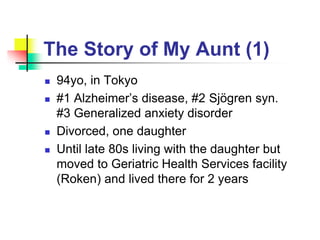
 94yo, in Tokyo
 #1 Alzheimer’s disease, #2 Sjögren syn.
#3 Generalized anxiety disorder
 Divorced, one daughter
 Until late 80s living with the daughter but
moved to Geriatric Health Services facility
(Roken) and lived there for 2 years
The Story of My Aunt (1)
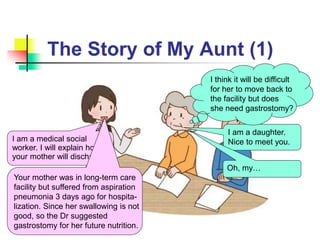
I am a medical social
worker. I will explain how
your mother will discharge
I am a daughter.
Nice to meet you.
Your mother was in long-term care
facility but suffered from aspiration
pneumonia 3 days ago for hospita-
lization. Since her swallowing is not
good, so the Dr suggested
gastrostomy for her future nutrition.
Oh, my…
I think it will be difficult
for her to move back to
the facility but does
she need gastrostomy?
The Story of My Aunt (2)
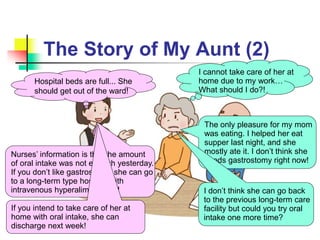
Hospital beds are full... She
should get out of the ward!
Nurses’ information is that the amount
of oral intake was not enough yesterday.
If you don’t like gastrostomy, she can go
to a long-term type hospital with
intravenous hyperalimentation!
The only pleasure for my mom
was eating. I helped her eat
supper last night, and she
mostly ate it. I don’t think she
needs gastrostomy right now!
If you intend to take care of her at
home with oral intake, she can
discharge next week!
I don’t think she can go back
to the previous long-term care
facility but could you try oral
intake one more time?
I cannot take care of her at
home due to my work…
What should I do?!
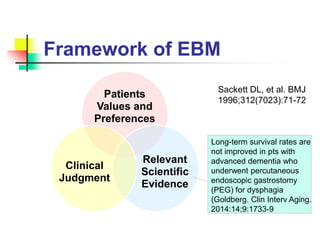
Framework of EBM
Patients
Values and
Preferences
Relevant
Scientific
Evidence
Clinical
Judgment
Sackett DL, et al. BMJ
1996;312(7023):71-72
Long-term survival rates are
not improved in pts with
advanced dementia who
underwent percutaneous
endoscopic gastrostomy
(PEG) for dysphagia
(Goldberg. Clin Interv Aging.
2014:14;9:1733-9
How Do We Make Clinical
Decisions?
 Information from History + Physical + Testing
 Diagnosis  Plan for therapy/Management
 EBM: Optimizing clinical decision making by
best available evidence from clinical studies
 Conference: Gather knowledge/experiences
from different members, professionals, etc.
 Shared decision making (SDM): Lead to
optimal decision making by sharing logic/
values between patient and healthcare sides.
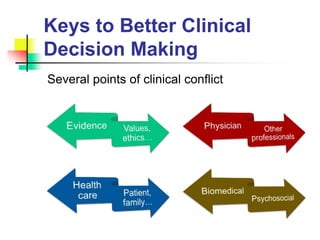
Keys to Better Clinical
Decision Making
Several points of clinical conflict
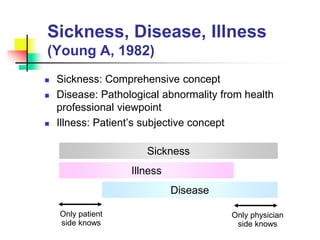
Sickness, Disease, Illness
(Young A, 1982)
 Sickness: Comprehensive concept
 Disease: Pathological abnormality from health
professional viewpoint
 Illness: Patient’s subjective concept
Sickness
Disease
Illness
Only patient
side knows
Only physician
side knows
What Is Value(s)?
 Oxford Dictionary: (Values) Principles or
standards of behaviour; one's judgement of
what is important in life.
 Cambridge Dictionary: The principles that
help you to decide what is right and wrong,
and how to act in various situations.
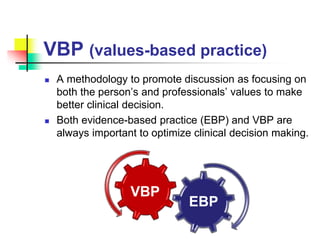
VBP (values-based practice)
 A methodology to promote discussion as focusing on
both the person’s and professionals’ values to make
better clinical decision.
 Both evidence-based practice (EBP) and VBP are
always important to optimize clinical decision making.
EBP
VBP
VBP is a Wider Framework
 Including all other frameworks, such as:
 Patient-centered medicine, biopsychosocial model
 Narrative-based medicine, open dialogue
 Clinical ethics, professionalism
 Interprofessional collaborative practice
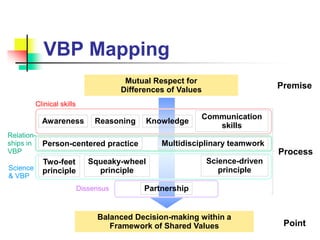
VBP Mapping
Mutual Respect for
Differences of Values
Balanced Decision-making within a
Framework of Shared Values Point
Process
Premise
Two-feet
principle
Person-centered practice
ReasoningAwareness Knowledge
Communication
skills
Multidisciplinary teamwork
Squeaky-wheel
principle
Science-driven
principle
Partnership
Clinical skills
Relation-
ships in
VBP
Science
& VBP
Dissensus
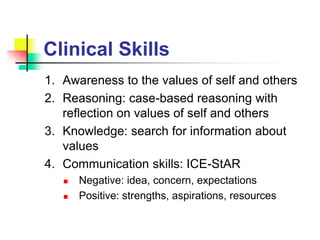
Clinical Skills
1. Awareness to the values of self and others
2. Reasoning: case-based reasoning with
reflection on values of self and others
3. Knowledge: search for information about
values
4. Communication skills: ICE-StAR
 Negative: idea, concern, expectations
 Positive: strengths, aspirations, resources
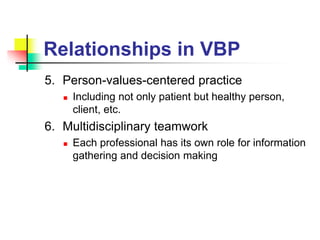
Relationships in VBP
5. Person-values-centered practice
 Including not only patient but healthy person,
client, etc.
6. Multidisciplinary teamwork
 Each professional has its own role for information
gathering and decision making
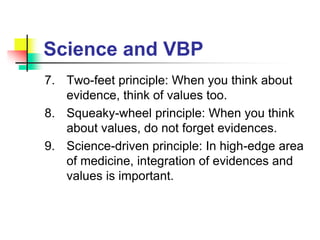
Science and VBP
7. Two-feet principle: When you think about
evidence, think of values too.
8. Squeaky-wheel principle: When you think
about values, do not forget evidences.
9. Science-driven principle: In high-edge area
of medicine, integration of evidences and
values is important.
Dissensus
10. Partnership
 Formulate partnership through “agreeing to
disagree”
 Dissensus: Do not pursue 100% agreement
for all the parties. Getting to “consensus”
might be a power game.
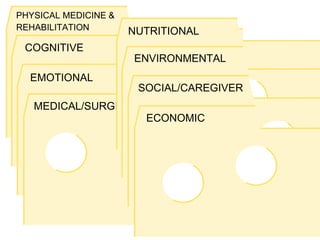
Geriatric Swiss Cheese Model
 A tool for case information gathering to
overview wide area of geriatrics
 Developed in Florida Univ. and utilized in
practicum in Geriatric Dept, Univ Hawaii
 Participants seek for the information for each
domain, analyze it, and list which information
they need further.
 Physical Medicine & Rehabilitation
 Cognitive
 Emotional
 Medical/Surgical
 Nutritional
 Environmental
 Social/Caregiver
 Economic
Eight Domaing
PHYSICAL MEDICINE &
REHABILITATION
COGNITIVE
EMOTIONAL
MEDICAL/SURGICAL
NUTRITIONAL
ENVIRONMENTAL
SOCIAL/CAREGIVER
ECONOMIC
Simulated Interprofessional
Conference (Tamai, et al, 2018)
 This educational strategy was used in home-care
physician development project in Univ. Tokyo
 Each professional is provided common and specific
scenarios. Discussion starts from information sharing
from each professional role. One who plays a role
different from daily work can behave like its
professional role sharing his/her own information.
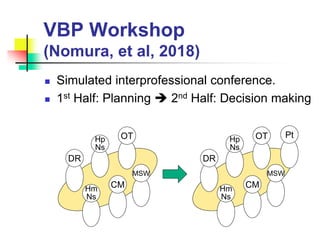
VBP Workshop
(Nomura, et al, 2018)
 Simulated interprofessional conference.
 1st Half: Planning  2nd Half: Decision making
DR
Hp
Ns
OT
Hm
Ns
CM
MSW
DR
Hp
Ns
OT
Hm
Ns
CM
MSW
Pt

Values-based practice

  • 1.
    Values-based Practice (VBP) Hirotaka Onishi,MD, MHPE, PhD Dept of Medical Education for Int’l Cooperation Int’l Research Center for Medical Education Graduate School of Medicine, The University of Tokyo
  • 2.
    The Story ofMy Aunt (1)  94yo, in Tokyo  #1 Alzheimer’s disease, #2 Sjögren syn. #3 Generalized anxiety disorder  Divorced, one daughter  Until late 80s living with the daughter but moved to Geriatric Health Services facility (Roken) and lived there for 2 years
  • 3.
    The Story ofMy Aunt (1) I am a medical social worker. I will explain how your mother will discharge I am a daughter. Nice to meet you. Your mother was in long-term care facility but suffered from aspiration pneumonia 3 days ago for hospita- lization. Since her swallowing is not good, so the Dr suggested gastrostomy for her future nutrition. Oh, my… I think it will be difficult for her to move back to the facility but does she need gastrostomy?
  • 4.
    The Story ofMy Aunt (2) Hospital beds are full... She should get out of the ward! Nurses’ information is that the amount of oral intake was not enough yesterday. If you don’t like gastrostomy, she can go to a long-term type hospital with intravenous hyperalimentation! The only pleasure for my mom was eating. I helped her eat supper last night, and she mostly ate it. I don’t think she needs gastrostomy right now! If you intend to take care of her at home with oral intake, she can discharge next week! I don’t think she can go back to the previous long-term care facility but could you try oral intake one more time? I cannot take care of her at home due to my work… What should I do?!
  • 5.
    Framework of EBM Patients Valuesand Preferences Relevant Scientific Evidence Clinical Judgment Sackett DL, et al. BMJ 1996;312(7023):71-72 Long-term survival rates are not improved in pts with advanced dementia who underwent percutaneous endoscopic gastrostomy (PEG) for dysphagia (Goldberg. Clin Interv Aging. 2014:14;9:1733-9
  • 6.
    How Do WeMake Clinical Decisions?  Information from History + Physical + Testing  Diagnosis  Plan for therapy/Management  EBM: Optimizing clinical decision making by best available evidence from clinical studies  Conference: Gather knowledge/experiences from different members, professionals, etc.  Shared decision making (SDM): Lead to optimal decision making by sharing logic/ values between patient and healthcare sides.
  • 7.
    Keys to BetterClinical Decision Making Several points of clinical conflict
  • 8.
    Sickness, Disease, Illness (YoungA, 1982)  Sickness: Comprehensive concept  Disease: Pathological abnormality from health professional viewpoint  Illness: Patient’s subjective concept Sickness Disease Illness Only patient side knows Only physician side knows
  • 9.
    What Is Value(s)? Oxford Dictionary: (Values) Principles or standards of behaviour; one's judgement of what is important in life.  Cambridge Dictionary: The principles that help you to decide what is right and wrong, and how to act in various situations.
  • 10.
    VBP (values-based practice) A methodology to promote discussion as focusing on both the person’s and professionals’ values to make better clinical decision.  Both evidence-based practice (EBP) and VBP are always important to optimize clinical decision making. EBP VBP
  • 11.
    VBP is aWider Framework  Including all other frameworks, such as:  Patient-centered medicine, biopsychosocial model  Narrative-based medicine, open dialogue  Clinical ethics, professionalism  Interprofessional collaborative practice
  • 12.
    VBP Mapping Mutual Respectfor Differences of Values Balanced Decision-making within a Framework of Shared Values Point Process Premise Two-feet principle Person-centered practice ReasoningAwareness Knowledge Communication skills Multidisciplinary teamwork Squeaky-wheel principle Science-driven principle Partnership Clinical skills Relation- ships in VBP Science & VBP Dissensus
  • 13.
    Clinical Skills 1. Awarenessto the values of self and others 2. Reasoning: case-based reasoning with reflection on values of self and others 3. Knowledge: search for information about values 4. Communication skills: ICE-StAR  Negative: idea, concern, expectations  Positive: strengths, aspirations, resources
  • 14.
    Relationships in VBP 5.Person-values-centered practice  Including not only patient but healthy person, client, etc. 6. Multidisciplinary teamwork  Each professional has its own role for information gathering and decision making
  • 15.
    Science and VBP 7.Two-feet principle: When you think about evidence, think of values too. 8. Squeaky-wheel principle: When you think about values, do not forget evidences. 9. Science-driven principle: In high-edge area of medicine, integration of evidences and values is important.
  • 16.
    Dissensus 10. Partnership  Formulatepartnership through “agreeing to disagree”  Dissensus: Do not pursue 100% agreement for all the parties. Getting to “consensus” might be a power game.
  • 17.
    Geriatric Swiss CheeseModel  A tool for case information gathering to overview wide area of geriatrics  Developed in Florida Univ. and utilized in practicum in Geriatric Dept, Univ Hawaii  Participants seek for the information for each domain, analyze it, and list which information they need further.
  • 18.
     Physical Medicine& Rehabilitation  Cognitive  Emotional  Medical/Surgical  Nutritional  Environmental  Social/Caregiver  Economic Eight Domaing PHYSICAL MEDICINE & REHABILITATION COGNITIVE EMOTIONAL MEDICAL/SURGICAL NUTRITIONAL ENVIRONMENTAL SOCIAL/CAREGIVER ECONOMIC
  • 19.
    Simulated Interprofessional Conference (Tamai,et al, 2018)  This educational strategy was used in home-care physician development project in Univ. Tokyo  Each professional is provided common and specific scenarios. Discussion starts from information sharing from each professional role. One who plays a role different from daily work can behave like its professional role sharing his/her own information.
  • 20.
    VBP Workshop (Nomura, etal, 2018)  Simulated interprofessional conference.  1st Half: Planning  2nd Half: Decision making DR Hp Ns OT Hm Ns CM MSW DR Hp Ns OT Hm Ns CM MSW Pt

Editor's Notes