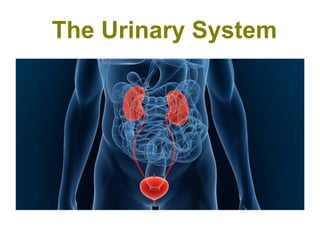
The Urinary System
Function
1. Remove nitrogenous wastes
2. Maintain electrolyte, acid-base,
and fluid balance of blood
3. Homeostatic organ
4. Acts as blood filter
5. Release hormones: calcitriol &
erythropoietin
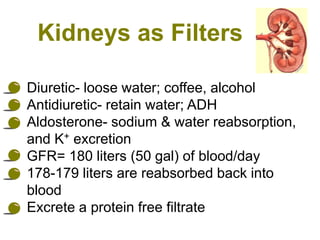
Kidneys as Filters
• Diuretic- loose water; coffee, alcohol
• Antidiuretic- retain water; ADH
• Aldosterone- sodium & water reabsorption,
and K+ excretion
• GFR= 180 liters (50 gal) of blood/day
• 178-179 liters are reabsorbed back into
blood
• Excrete a protein free filtrate
Organs
of the
Urinary
System
kidneys
ureters
urinary
bladder
urethra
A Kidney
Blood and waste enter
through renal artery
Filtered blood leaves
through renal vein
Excess water and toxic
waste leaves through ureter
as urine
The Urinary System
General Functioning of the Kidney
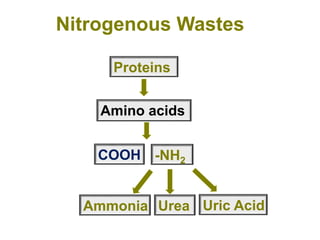
Nitrogenous Wastes
Proteins
Amino acids
COOH -NH2
Ammonia Urea Uric Acid
ureter
Kidney Anatomy
renal cortex
renal pelvisrenal medulla
renal pyramids
renal capsule
nephron
renal
cortex
renal
medulla
Each kidney contains over 1 million nephrons and thousands
of collecting ducts
Collecting duct
Loop of Henle
PCT
DCTGlomerulus
Glomerulus
To renal pelvis
Peritubular
capillaries
Collecting duct
PCT
Loop of Henle
DCT
Glomerular Filtration
afferent
arteriole glomerulus
efferent
arteriole
Bowman’s
capsule
Filters blood; proteins can’t pass through
Composition of
Glomerular Filtrate
• Water
• Small Soluble Organic
Molecules
• Mineral Ions
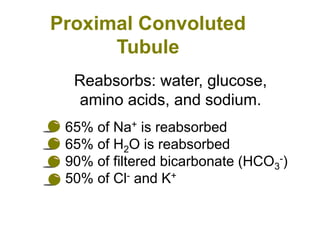
Proximal Convoluted
Tubule
Reabsorbs: water, glucose,
amino acids, and sodium.
• 65% of Na+ is reabsorbed
• 65% of H2O is reabsorbed
• 90% of filtered bicarbonate (HCO3
-)
• 50% of Cl- and K+
Loop of Henle
Creates a gradient of increasing
sodium ion concentration towards
the end of the loop within the
interstitial fluid of the renal pyramid.
• 25% Na+ is reabsorbed in the loop
• 15% water is reabsorbed in the loop
• 40% K is reabsorbed in the loop
Distal Convoluted
Tubule
Under the influence of the hormone
aldosterone, reabsorbs sodium and
secretes potassium. Also regulates
pH by secreting hydrogen ion when
pH of the plasma is low.
• only 10% of the filtered NaCl and 20% of water
remains
Collecting Duct
Allows for the osmotic
reabsorption of water.
ADH (antidiuretic hormone)- makes
collecting ducts more permeable to
water-- produce concentrated urine
From the original 1800 g NaCl, only 10 g appears in the urine
Urine
Water- 95%
Nitrogenous waste:
• urea
• uric acid
• creatinine
Ions:
• sodium
• potassium
• sulfate
• phosphate
Urinary Bladder
ureters
internal sphincters
external sphincters
urethra
When bladder fills with 200 ml of
urine, stretch receptors transmit
impulses to the CNS and produce a
reflex contraction of the bladder
(PNS)
Diuresis (Micturition)
When is incontinence normal?
Why do doctors ask for
a urine sample?
Urinalysis
characteristics:
• smell- ammonia-like
• pH- 4.5-8, ave 6.0
• specific gravity– more than 1.0;
~1.001-1.030
• color- affected by what we eat: salty
foods, vitamins
odor- normal is ammonia-like
diabetes mellitus- smells fruity
or acetone like due to elevated
ketone levels
diabetes insupidus- yucky
asparagus---
Odor
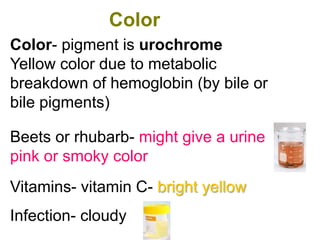
Color- pigment is urochrome
Yellow color due to metabolic
breakdown of hemoglobin (by bile or
bile pigments)
Beets or rhubarb- might give a urine
pink or smoky color
Vitamins- vitamin C- bright yellow
Infection- cloudy
Color
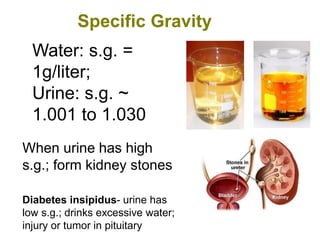
Water: s.g. =
1g/liter;
Urine: s.g. ~
1.001 to 1.030
Specific Gravity
When urine has high
s.g.; form kidney stones
Diabetes insipidus- urine has
low s.g.; drinks excessive water;
injury or tumor in pituitary
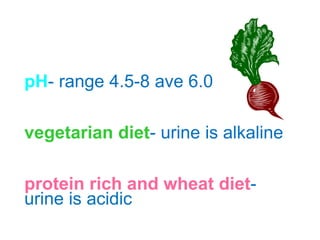
pH- range 4.5-8 ave 6.0
vegetarian diet- urine is alkaline
protein rich and wheat diet-
urine is acidic
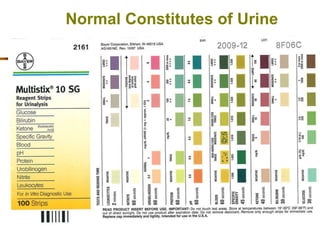
Normal Constitutes of Urine
Glucose
Indicative of:
• Excessive carbohydrate intake
• Stress
• Diabetes mellitus
Abnormal Constitutes of Urine
Albumin
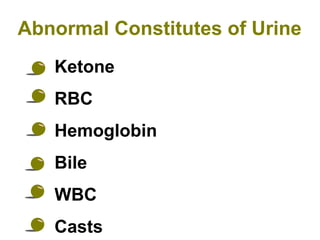
Abnormal Constitutes of Urine
• Ketone
• RBC
• Hemoglobin
• Bile
• WBC
• Casts
Abnormal Constitutes of Urine
INQUIRY
1. List several functions of the kidneys.
2. What does the glomerulus do?
3. What are several constitutes you should not
find in urine?
4. What is specific gravity?
5. What two hormones effect fluid volume and
sodium concentration in the urine?
6. Where are the pyramids located in the
kidney?
7. What vessel directs blood into the
glomerulus?
8. Where does most selective reabsorption occur
in the nephron?
Moment of Zen

Anatomy and physiology urinary system