CHAPTER I
INTRODUCTION
A. Background
The Urinary System is a group of organs in the body concerned with
filtering out excess fluid and other substances from the bloodstream. The
substances are filtered out from the body in the form of urine. Urine is a liquid
produced by the kidneys, collected in the bladder and excreted through the
urethra. Urine is used to extract excess minerals or vitamins as well as blood
corpuscles from the body. The Urinary organs include the kidneys, ureters,
bladder, and urethra. The Urinary system works with the other systems of the
body to help maintain homeostasis. The kidneys are the main organs of
homeostasis because they maintain the acid base balance and the water salt
balance of the blood.
One of the major functions of the Urinary system is the process of excretion.
Excretion is the process of eliminating, from an organism, waste products of
metabolism and other materials that are of no use. The urinary system maintains
an appropriate fluid volume by regulating the amount of water that is excreted
in the urine. Other aspects of its function include regulating the concentrations
of various electrolytes in the body fluids and maintaining normal pH of the
blood. Several body organs carry out excretion, but the kidneys are the most
important excretory organ.
The primary function of the kidneys is to maintain a stable internal
environment (homeostasis) for optimal cell and tissue metabolism. They do this
by separating urea, mineral salts, toxins, and other waste products from the
blood. They also do the job of conserving water, salts, and electrolytes. At least
one kidney must function properly for life to be maintained. Six important roles
of the kidneys are:Regulation of plasma ionic composition. Ions such as sodium,
potassium, calcium, magnesium, chloride, bicarbonate, and phosphates are
regulated by the amount that the kidney excretes.
Regulation of plasma osmolarity. The kidneys regulate osmolarity because they
have direct control over how many ions and how much water a person
excretes.Regulation of plasma volume. Your kidneys are so important they even
have an effect on your blood pressure. The kidneys control plasma volume by
controlling how much water a person excretes. The plasma volume has a direct
effect on the total blood volume, which has a direct effect on your blood pressure.
Salt(NaCl)will cause osmosis to happen; the diffusion of water into the blood.
Regulation of plasma hydrogen ion concentration (pH). The kidneys partner
up with the lungs and they together control the pH. The kidneys have a major role
because they control the amount of bicarbonate excreted or held onto. The kidneys
help maintain the blood Ph mainly by excreting hydrogen ions and reabsorbing
bicarbonate ions as needed.Removal of metabolic waste products and foreign
substances from the plasma. One of the most important things the kidneys excrete
is nitrogenous waste.
B. Purpose
1. To identify characteristics and component in normal urine
2. To identify disease kidney from urine obsevation
C. Benefit
1.To find out the component of urine and know the containing of urine
CHAPTER II
PREVIEW OF LITERATURE
One of the major functions of the urinary system is the process of excretion.
Excretion is the process of eliminating, from an organism, waste products of
metabolism and other materials that are of no use. The urinary system maintains an
appropriate fluid volume by regulating the amount of water that is excreted in the
urine. Other aspects of its function include regulating the concentrations of various
electrolytes in the body fluids and maintaining normal pH of the blood. Several
body organs carry out excretion, but the kidneys are the most important excretory
organ. The primary function of the kidneys is to maintain a stable internal
environment (homeostasis) for optimal cell and tissue metabolism. They do this by
separating urea, mineral salts, toxins, and other waste products from the blood. They
also do the job of conserving water, salts, and electrolytes. At least one kidney must
function properly for life to be maintained (Manalu dan Mu,nisa, 2012).
Accordimg to Riandari (2007), six important roles of the kidneys are:
Regulation of plasma ionic composition. Ions such as sodium, potassium, calcium,
magnesium, chloride, bicarbonate, and phosphates are regulated by the amount that
the kidney excretes.
1. Regulation of plasma osmolarity. The kidneys regulate osmolarity because they
have direct control over how many ions and how much water a person excretes.
2. Regulation of plasma volume. Your kidneys are so important they even have an
effect on your blood pressure. The kidneys control plasma volume by controlling
how much water a person excretes. The plasma volume has a direct effect on the
total blood volume, which has a direct effect on your blood pressure. Salt (NaCl)
will cause osmosis to happen; the diffusion of water into the blood.
3. Regulation of plasma hydrogen ion concentration (pH). The kidneys partner up
with the lungs and they together control the pH. The kidneys have a major role
because they control the amount of bicarbonate excreted or held onto. The
kidneys help maintain the blood Ph mainly by excreting hydrogen ions and
reabsorbing bicarbonate ions as needed.
4. Removal of metabolic waste products and foreign substances from the
plasma. One of the most important things the kidneys excrete is nitrogenous
waste. As the liver breaks down amino acids it also releases ammonia. The liver
then quickly combines that ammonia with carbon dioxide, creating urea which
is the primary nitrogenous end product of metabolism in humans. The liver turns
the ammonia into urea because it is much less toxic. We can also excrete some
ammonia, creatinine and uric acid. The creatinine comes from the metabolic
breakdown of creatine phospate (a high-energy phosphate in muscles). Uric
acid comes from the break down of nucleotides. Uric acid is insoluble and too
much uric acid in the blood will build up and form crystals that can collect in the
joints and cause gout.
5. Secretion of Hormones The endocrine system has assistance from the kidney's
when releasing hormones. Renin is released by the kidneys. Renin leads to the
secretion of aldosterone which is released from the adrenal cortex. Aldosterone
promotes the kidneys to reabsorb the sodium (Na+) ions. The kidneys also secrete
erythropoietin when the blood doesn't have the capacity to carry oxygen.
Erythropoietin stimulates red blood cell production. The Vitamin D from the
skin is also activated with help from the kidneys. Calcium (Ca+) absorption from
the digestive tract is promoted by vitamin D.
According Purba (2009), physical characteristics of normal urine. Volume
is one of the physical characteristics of urine. Other physical characteristics that can
apply to urine include colour, turbidity, smell, pH and density.
a. Colour
Typically yellow-amber but varies according to recent diet and the concentration
of the urine. Drinking more water generally tends to reduce the concentration of
urine, and therefore cause it to have a lighter colour.
b. Smell
The smell of urine may provide health information. For example, urine of
diabetics may have a sweet or fruity odour due to the presence of ketones.
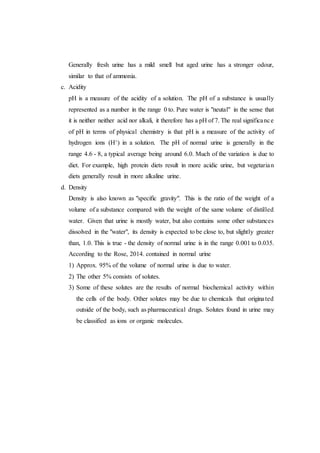
Generally fresh urine has a mild smell but aged urine has a stronger odour,
similar to that of ammonia.
c. Acidity
pH is a measure of the acidity of a solution. The pH of a substance is usually
represented as a number in the range 0 to. Pure water is "neutal" in the sense that
it is neither neither acid nor alkali, it therefore has a pH of 7. The real significance
of pH in terms of physical chemistry is that pH is a measure of the activity of
hydrogen ions (H+) in a solution. The pH of normal urine is generally in the
range 4.6 - 8, a typical average being around 6.0. Much of the variation is due to
diet. For example, high protein diets result in more acidic urine, but vegetarian
diets generally result in more alkaline urine.
d. Density
Density is also known as "specific gravity". This is the ratio of the weight of a
volume of a substance compared with the weight of the same volume of distilled
water. Given that urine is mostly water, but also contains some other substances
dissolved in the "water", its density is expected to be close to, but slightly greater
than, 1.0. This is true - the density of normal urine is in the range 0.001 to 0.035.
According to the Rose, 2014. contained in normal urine
1) Approx. 95% of the volume of normal urine is due to water.
2) The other 5% consists of solutes.
3) Some of these solutes are the results of normal biochemical activity within
the cells of the body. Other solutes may be due to chemicals that originated
outside of the body, such as pharmaceutical drugs. Solutes found in urine may
be classified as ions or organic molecules.
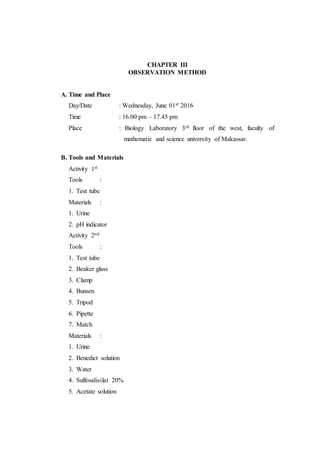
CHAPTER III
OBSERVATION METHOD
A. Time and Place
Day/Date : Wednesday, June 01st 2016
Time : 16.00 pm – 17.45 pm
Place : Biology Laboratory 3rd floor of the west, faculty of
mathematic and science university of Makassar.
B. Tools and Materials
Activity 1st
Tools :
1. Test tube
Materials :
1. Urine
2. pH indicator
Activity 2nd
Tools :
1. Test tube
2. Beaker glass
3. Clamp
4. Bunsen
5. Tripod
6. Pipette
7. Match
Materials :
1. Urine
2. Benedict solution
3. Water
4. Sulfosalisilat 20%
5. Acetate solution
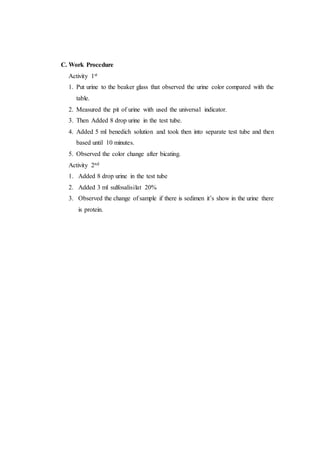
C. Work Procedure
Activity 1st
1. Put urine to the beaker glass that observed the urine color compared with the
table.
2. Measured the pit of urine with used the universal indicator.
3. Then Added 8 drop urine in the test tube.
4. Added 5 ml benedich solution and took then into separate test tube and then
based until 10 minutes.
5. Observed the color change after bicating.
Activity 2nd
1. Added 8 drop urine in the test tube
2. Added 3 ml sulfosalisilat 20%
3. Observed the change of sample if there is sedimen it’s show in the urine there
is protein.
CHAPTER IV
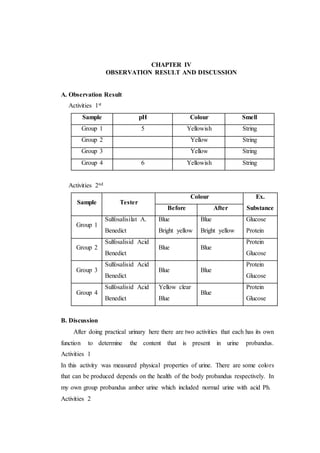
OBSERVATION RESULT AND DISCUSSION
A. Observation Result
Activities 1st
Sample pH Colour Smell
Group 1 5 Yellowish String
Group 2 Yellow String
Group 3 Yellow String
Group 4 6 Yellowish String
Activities 2nd
Sample Tester
Colour Ex.
SubstanceBefore After
Group 1
Sulfosalisilat A.
Benedict
Blue
Bright yellow
Blue
Bright yellow
Glucose
Protein
Group 2
Sulfosalisid Acid
Benedict
Blue Blue
Protein
Glucose
Group 3
Sulfosalisid Acid
Benedict
Blue Blue
Protein
Glucose
Group 4
Sulfosalisid Acid
Benedict
Yellow clear
Blue
Blue
Protein
Glucose
B. Discussion
After doing practical urinary here there are two activities that each has its own
function to determine the content that is present in urine probandus.
Activities 1
In this activity was measured physical properties of urine. There are some colors
that can be produced depends on the health of the body probandus respectively. In
my own group probandus amber urine which included normal urine with acid Ph.
Activities 2
In the second activity will dilakuakan trial mnegukur chemical analysis for glucose
and protein in the urine. In urine dimaukkan to the first test tube where dilakuakan
perlauan to the benedict Award glucose levels that get negative. In this case
probandus included in the category of unhealthy and excess sugar (diabetes). On
the second tube which was given treatment by adding acid sulfosalisilat results in
purplish urine get clear and there is no precipitate this proves that probandus in a
healthy state.
CHAPTER V
CLOSING
A. Conclussion
Based on the above observations, it can be concluded that the colour of the
urine fo healthy people ranging from neasly transparant to yellow.
B. Sugesstion
Based on observation that we have every weak. Apprentice should be carefully
to take a data or make explanation. In order we got the accurate data and detailed
explanation.
BIBLIOGRAPHY
Karmana, Oman. 2007. Cerdas Belajar Biologi. Bandung: Granfindo Media
Pratama.
Manalu W dan Mu,nisa, A. 2012. Fisiologi Hewan. Makassar: Universitas Negeri
Makassar.
Maryati, Sri dkk. 2007. Biologi. Jakarta. Erlangga.
Purba, Michael. 2009. Biologi Umum. Jakarta: Bumi Aksara.
Riandari, Henny. 2007. Biologi Umum. Solo : Tiga Serangkai.

Unit 8 (urinary)

  • 1.
    CHAPTER I INTRODUCTION A. Background TheUrinary System is a group of organs in the body concerned with filtering out excess fluid and other substances from the bloodstream. The substances are filtered out from the body in the form of urine. Urine is a liquid produced by the kidneys, collected in the bladder and excreted through the urethra. Urine is used to extract excess minerals or vitamins as well as blood corpuscles from the body. The Urinary organs include the kidneys, ureters, bladder, and urethra. The Urinary system works with the other systems of the body to help maintain homeostasis. The kidneys are the main organs of homeostasis because they maintain the acid base balance and the water salt balance of the blood. One of the major functions of the Urinary system is the process of excretion. Excretion is the process of eliminating, from an organism, waste products of metabolism and other materials that are of no use. The urinary system maintains an appropriate fluid volume by regulating the amount of water that is excreted in the urine. Other aspects of its function include regulating the concentrations of various electrolytes in the body fluids and maintaining normal pH of the blood. Several body organs carry out excretion, but the kidneys are the most important excretory organ. The primary function of the kidneys is to maintain a stable internal environment (homeostasis) for optimal cell and tissue metabolism. They do this by separating urea, mineral salts, toxins, and other waste products from the blood. They also do the job of conserving water, salts, and electrolytes. At least one kidney must function properly for life to be maintained. Six important roles of the kidneys are:Regulation of plasma ionic composition. Ions such as sodium, potassium, calcium, magnesium, chloride, bicarbonate, and phosphates are regulated by the amount that the kidney excretes.
  • 2.
    Regulation of plasmaosmolarity. The kidneys regulate osmolarity because they have direct control over how many ions and how much water a person excretes.Regulation of plasma volume. Your kidneys are so important they even have an effect on your blood pressure. The kidneys control plasma volume by controlling how much water a person excretes. The plasma volume has a direct effect on the total blood volume, which has a direct effect on your blood pressure. Salt(NaCl)will cause osmosis to happen; the diffusion of water into the blood. Regulation of plasma hydrogen ion concentration (pH). The kidneys partner up with the lungs and they together control the pH. The kidneys have a major role because they control the amount of bicarbonate excreted or held onto. The kidneys help maintain the blood Ph mainly by excreting hydrogen ions and reabsorbing bicarbonate ions as needed.Removal of metabolic waste products and foreign substances from the plasma. One of the most important things the kidneys excrete is nitrogenous waste. B. Purpose 1. To identify characteristics and component in normal urine 2. To identify disease kidney from urine obsevation C. Benefit 1.To find out the component of urine and know the containing of urine
  • 3.
    CHAPTER II PREVIEW OFLITERATURE One of the major functions of the urinary system is the process of excretion. Excretion is the process of eliminating, from an organism, waste products of metabolism and other materials that are of no use. The urinary system maintains an appropriate fluid volume by regulating the amount of water that is excreted in the urine. Other aspects of its function include regulating the concentrations of various electrolytes in the body fluids and maintaining normal pH of the blood. Several body organs carry out excretion, but the kidneys are the most important excretory organ. The primary function of the kidneys is to maintain a stable internal environment (homeostasis) for optimal cell and tissue metabolism. They do this by separating urea, mineral salts, toxins, and other waste products from the blood. They also do the job of conserving water, salts, and electrolytes. At least one kidney must function properly for life to be maintained (Manalu dan Mu,nisa, 2012). Accordimg to Riandari (2007), six important roles of the kidneys are: Regulation of plasma ionic composition. Ions such as sodium, potassium, calcium, magnesium, chloride, bicarbonate, and phosphates are regulated by the amount that the kidney excretes. 1. Regulation of plasma osmolarity. The kidneys regulate osmolarity because they have direct control over how many ions and how much water a person excretes. 2. Regulation of plasma volume. Your kidneys are so important they even have an effect on your blood pressure. The kidneys control plasma volume by controlling how much water a person excretes. The plasma volume has a direct effect on the total blood volume, which has a direct effect on your blood pressure. Salt (NaCl) will cause osmosis to happen; the diffusion of water into the blood. 3. Regulation of plasma hydrogen ion concentration (pH). The kidneys partner up with the lungs and they together control the pH. The kidneys have a major role because they control the amount of bicarbonate excreted or held onto. The kidneys help maintain the blood Ph mainly by excreting hydrogen ions and reabsorbing bicarbonate ions as needed.
  • 4.
    4. Removal ofmetabolic waste products and foreign substances from the plasma. One of the most important things the kidneys excrete is nitrogenous waste. As the liver breaks down amino acids it also releases ammonia. The liver then quickly combines that ammonia with carbon dioxide, creating urea which is the primary nitrogenous end product of metabolism in humans. The liver turns the ammonia into urea because it is much less toxic. We can also excrete some ammonia, creatinine and uric acid. The creatinine comes from the metabolic breakdown of creatine phospate (a high-energy phosphate in muscles). Uric acid comes from the break down of nucleotides. Uric acid is insoluble and too much uric acid in the blood will build up and form crystals that can collect in the joints and cause gout. 5. Secretion of Hormones The endocrine system has assistance from the kidney's when releasing hormones. Renin is released by the kidneys. Renin leads to the secretion of aldosterone which is released from the adrenal cortex. Aldosterone promotes the kidneys to reabsorb the sodium (Na+) ions. The kidneys also secrete erythropoietin when the blood doesn't have the capacity to carry oxygen. Erythropoietin stimulates red blood cell production. The Vitamin D from the skin is also activated with help from the kidneys. Calcium (Ca+) absorption from the digestive tract is promoted by vitamin D. According Purba (2009), physical characteristics of normal urine. Volume is one of the physical characteristics of urine. Other physical characteristics that can apply to urine include colour, turbidity, smell, pH and density. a. Colour Typically yellow-amber but varies according to recent diet and the concentration of the urine. Drinking more water generally tends to reduce the concentration of urine, and therefore cause it to have a lighter colour. b. Smell The smell of urine may provide health information. For example, urine of diabetics may have a sweet or fruity odour due to the presence of ketones.
  • 5.
    Generally fresh urinehas a mild smell but aged urine has a stronger odour, similar to that of ammonia. c. Acidity pH is a measure of the acidity of a solution. The pH of a substance is usually represented as a number in the range 0 to. Pure water is "neutal" in the sense that it is neither neither acid nor alkali, it therefore has a pH of 7. The real significance of pH in terms of physical chemistry is that pH is a measure of the activity of hydrogen ions (H+) in a solution. The pH of normal urine is generally in the range 4.6 - 8, a typical average being around 6.0. Much of the variation is due to diet. For example, high protein diets result in more acidic urine, but vegetarian diets generally result in more alkaline urine. d. Density Density is also known as "specific gravity". This is the ratio of the weight of a volume of a substance compared with the weight of the same volume of distilled water. Given that urine is mostly water, but also contains some other substances dissolved in the "water", its density is expected to be close to, but slightly greater than, 1.0. This is true - the density of normal urine is in the range 0.001 to 0.035. According to the Rose, 2014. contained in normal urine 1) Approx. 95% of the volume of normal urine is due to water. 2) The other 5% consists of solutes. 3) Some of these solutes are the results of normal biochemical activity within the cells of the body. Other solutes may be due to chemicals that originated outside of the body, such as pharmaceutical drugs. Solutes found in urine may be classified as ions or organic molecules.
  • 6.
    CHAPTER III OBSERVATION METHOD A.Time and Place Day/Date : Wednesday, June 01st 2016 Time : 16.00 pm – 17.45 pm Place : Biology Laboratory 3rd floor of the west, faculty of mathematic and science university of Makassar. B. Tools and Materials Activity 1st Tools : 1. Test tube Materials : 1. Urine 2. pH indicator Activity 2nd Tools : 1. Test tube 2. Beaker glass 3. Clamp 4. Bunsen 5. Tripod 6. Pipette 7. Match Materials : 1. Urine 2. Benedict solution 3. Water 4. Sulfosalisilat 20% 5. Acetate solution
  • 7.
    C. Work Procedure Activity1st 1. Put urine to the beaker glass that observed the urine color compared with the table. 2. Measured the pit of urine with used the universal indicator. 3. Then Added 8 drop urine in the test tube. 4. Added 5 ml benedich solution and took then into separate test tube and then based until 10 minutes. 5. Observed the color change after bicating. Activity 2nd 1. Added 8 drop urine in the test tube 2. Added 3 ml sulfosalisilat 20% 3. Observed the change of sample if there is sedimen it’s show in the urine there is protein.
  • 8.
    CHAPTER IV OBSERVATION RESULTAND DISCUSSION A. Observation Result Activities 1st Sample pH Colour Smell Group 1 5 Yellowish String Group 2 Yellow String Group 3 Yellow String Group 4 6 Yellowish String Activities 2nd Sample Tester Colour Ex. SubstanceBefore After Group 1 Sulfosalisilat A. Benedict Blue Bright yellow Blue Bright yellow Glucose Protein Group 2 Sulfosalisid Acid Benedict Blue Blue Protein Glucose Group 3 Sulfosalisid Acid Benedict Blue Blue Protein Glucose Group 4 Sulfosalisid Acid Benedict Yellow clear Blue Blue Protein Glucose B. Discussion After doing practical urinary here there are two activities that each has its own function to determine the content that is present in urine probandus. Activities 1 In this activity was measured physical properties of urine. There are some colors that can be produced depends on the health of the body probandus respectively. In my own group probandus amber urine which included normal urine with acid Ph. Activities 2
  • 9.
    In the secondactivity will dilakuakan trial mnegukur chemical analysis for glucose and protein in the urine. In urine dimaukkan to the first test tube where dilakuakan perlauan to the benedict Award glucose levels that get negative. In this case probandus included in the category of unhealthy and excess sugar (diabetes). On the second tube which was given treatment by adding acid sulfosalisilat results in purplish urine get clear and there is no precipitate this proves that probandus in a healthy state.
  • 10.
    CHAPTER V CLOSING A. Conclussion Basedon the above observations, it can be concluded that the colour of the urine fo healthy people ranging from neasly transparant to yellow. B. Sugesstion Based on observation that we have every weak. Apprentice should be carefully to take a data or make explanation. In order we got the accurate data and detailed explanation.
  • 11.
    BIBLIOGRAPHY Karmana, Oman. 2007.Cerdas Belajar Biologi. Bandung: Granfindo Media Pratama. Manalu W dan Mu,nisa, A. 2012. Fisiologi Hewan. Makassar: Universitas Negeri Makassar. Maryati, Sri dkk. 2007. Biologi. Jakarta. Erlangga. Purba, Michael. 2009. Biologi Umum. Jakarta: Bumi Aksara. Riandari, Henny. 2007. Biologi Umum. Solo : Tiga Serangkai.