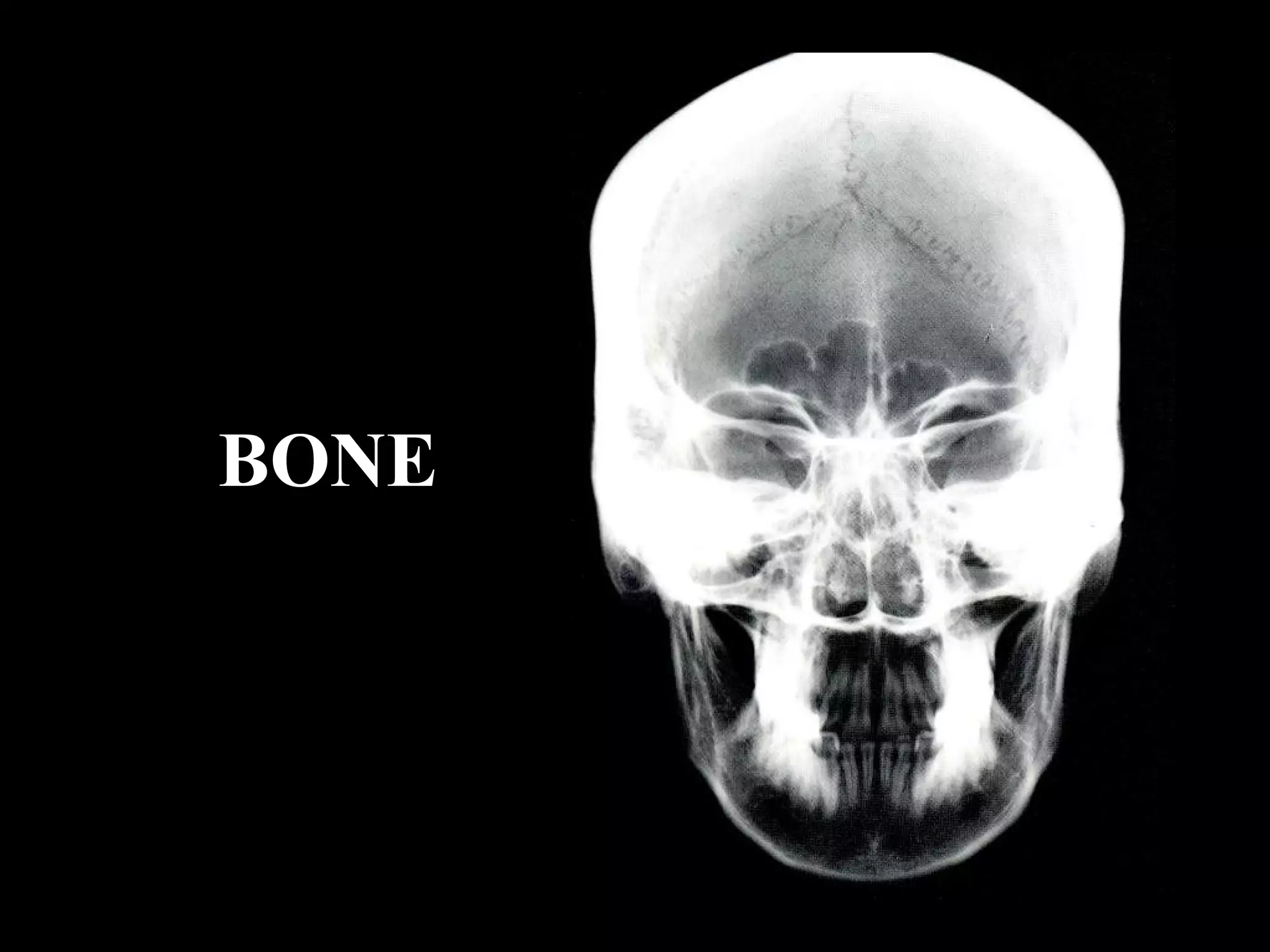
BONE
www.indiandentalacademy.com
Bones are the units of the
skeletal system.
www.indiandentalacademy.com
Classification of bone tissues
1. Shape of bones
• Long,short,flat,irregular,pneumatic,
sesamoid,supernumerary
2. Regions of long bone
• Epiphysis
• Diaphysis
• Metaphysis
3. Macroscopic appearance
• Compact bone
• Trabecular/cancellous/spongy bone
4. Developmental origin
• Intramembranous/dermal bone
• Intracartilaginous/endochondral bone
www.indiandentalacademy.com
Morphology of bones
www.indiandentalacademy.com
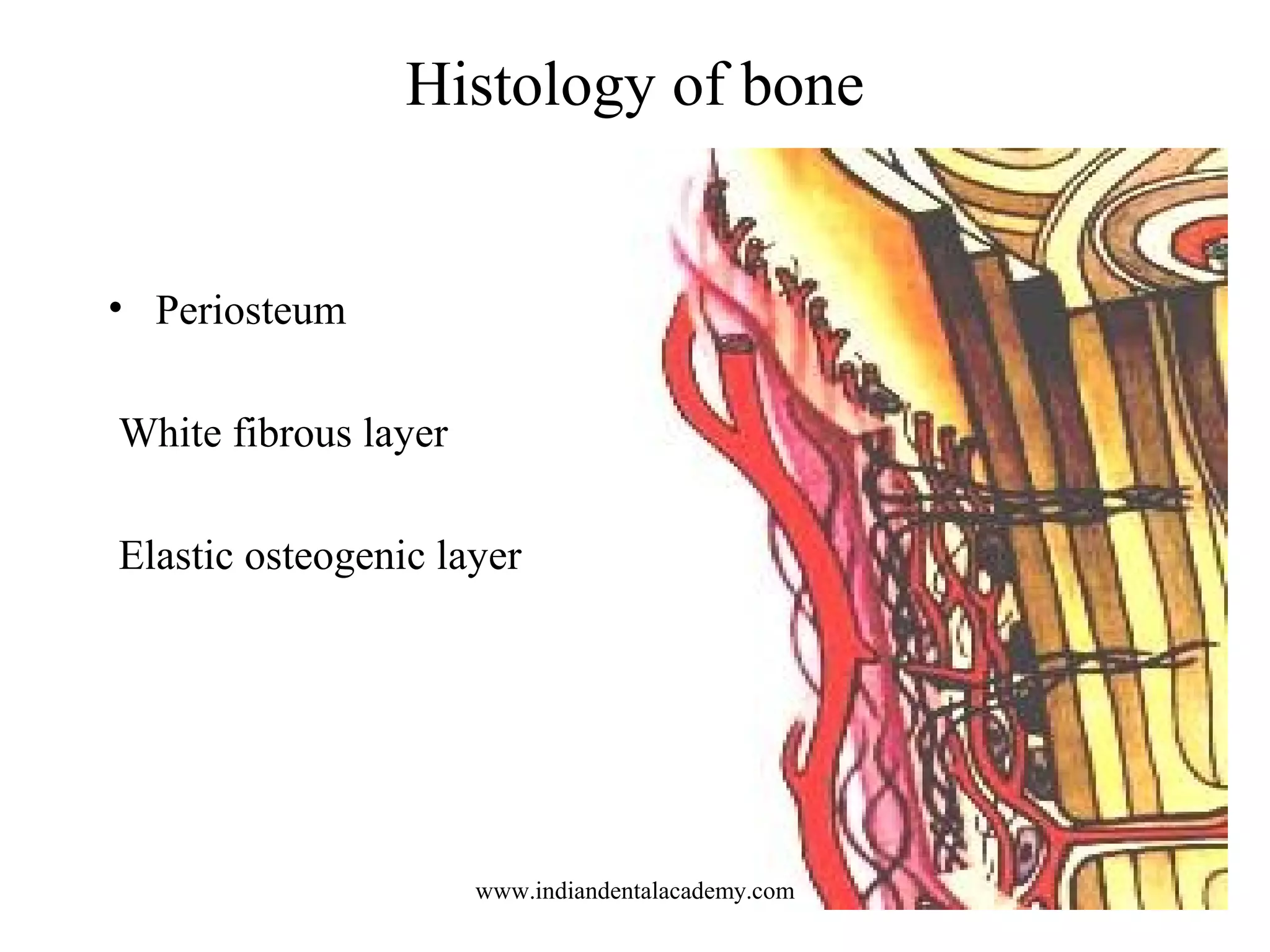
Histology of bone
• Periosteum
White fibrous layer
Elastic osteogenic layer
www.indiandentalacademy.com
Histology of bone
• Haversian system
Haversian canals
Volkmann’s canals
Lamellae
Lacunae
Canaliculli
www.indiandentalacademy.com
Histology of bone
• Types of lamellae:
Osteonic
Interstitial
Circumferential
www.indiandentalacademy.com
High power view of part of an osteon in transverse section seen with transmitted
light.
www.indiandentalacademy.com
Single osteon viewed with polarization optics to illustrate lamellar structurewww.indiandentalacademy.com
Histological sections of bone illustrating the various kinds of lamellaewww.indiandentalacademy.com
Osteocyte in lacuna.Arrow shows canalliculi.www.indiandentalacademy.com
Histogenesis of bone
• Intramembranous & Endochondral ossification.
• Histologically both bones are identical.
• Both are formed from mesenchymal tissue.
www.indiandentalacademy.com
Intramembranous bone formation
A. Condensation of
mesenchyme around
capillary network at
specific points-Centres of
ossification
B. Cells converted into
osteoblasts
• Open faced
• nucleus,prominent
nucleolus
• RER & Golgi bodies
• Lysosomes containing
alk.phos.
C. Matrix(osteoid)
production:collagen,proteo
glycans etc.
Osteoblasts,blood vessels line the
growing bone spicule which is full
of osteocytes.
matrix
www.indiandentalacademy.com
D. Calcification & woven
bone formation
www.indiandentalacademy.com
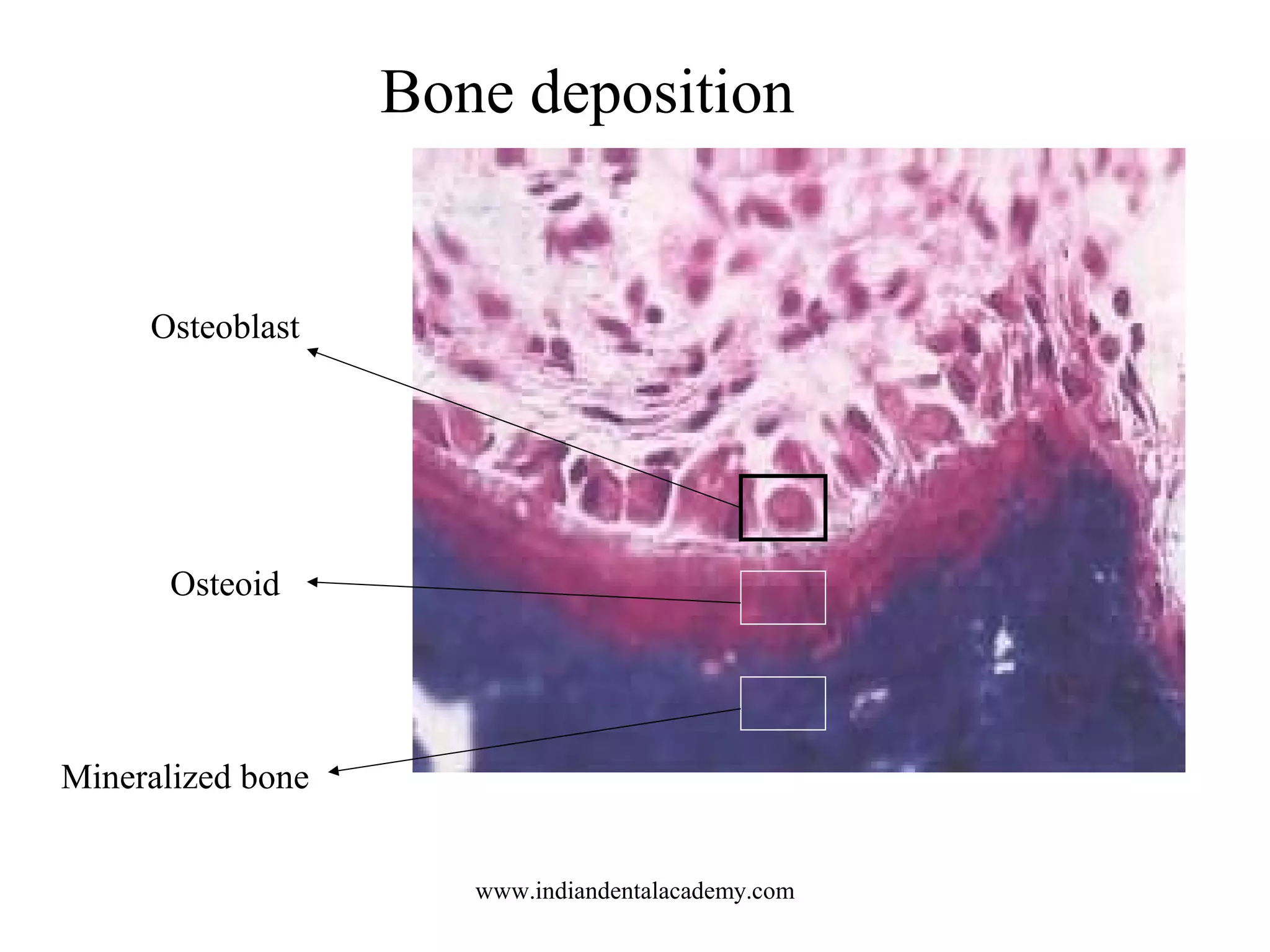
Bone deposition
Osteoblast
Osteoid
Mineralized bone
www.indiandentalacademy.com
Endochondral bone formation
A. Mesenchymal condensation
B. Cartilaginous model formed in
hyaline cartilage.
www.indiandentalacademy.com
• Cartilage cells
enlarge(beginning from
ossification centre)
• Surrounding cartilage matrix
calcifies
• Cartilage cells die
• Calcified matrix left
behind(primary areolae)
• Perichondrium forms.
www.indiandentalacademy.com
• Blood vessels invade from
perichondrium
• Perivascular cells
(OSTEOBLAST) and
OSTEOCLAST come along
with blood vessels.
• Osteoclast erode the primary
alveolae (secondary alveolae)
• Osteoblast form new bone
over secondary alveolae
• Woven bone formed.
www.indiandentalacademy.com
Endochondral bone formation.
OB=osteoblasts
BM=bone
matrix
CM=cartilage
matrix
CE=capillary
epithelium
www.indiandentalacademy.com
Development of cranium
www.indiandentalacademy.com
Development of cranium
www.indiandentalacademy.com
An alizarin stained & cleared
fetus of about 14 weeks in
utero.Note the degree of
progression of ossification
from primary centres.Sternum,
carpals, tarsals & secondary
ossification centres are yet to
ossify.
www.indiandentalacademy.com
Further development, growth & remodelling
All bone initially
formed is woven
bone(seen in infants,
alveolar bone in
which orthodontic
tooth movement has
recently occurred &
fracture repair sites)
www.indiandentalacademy.com
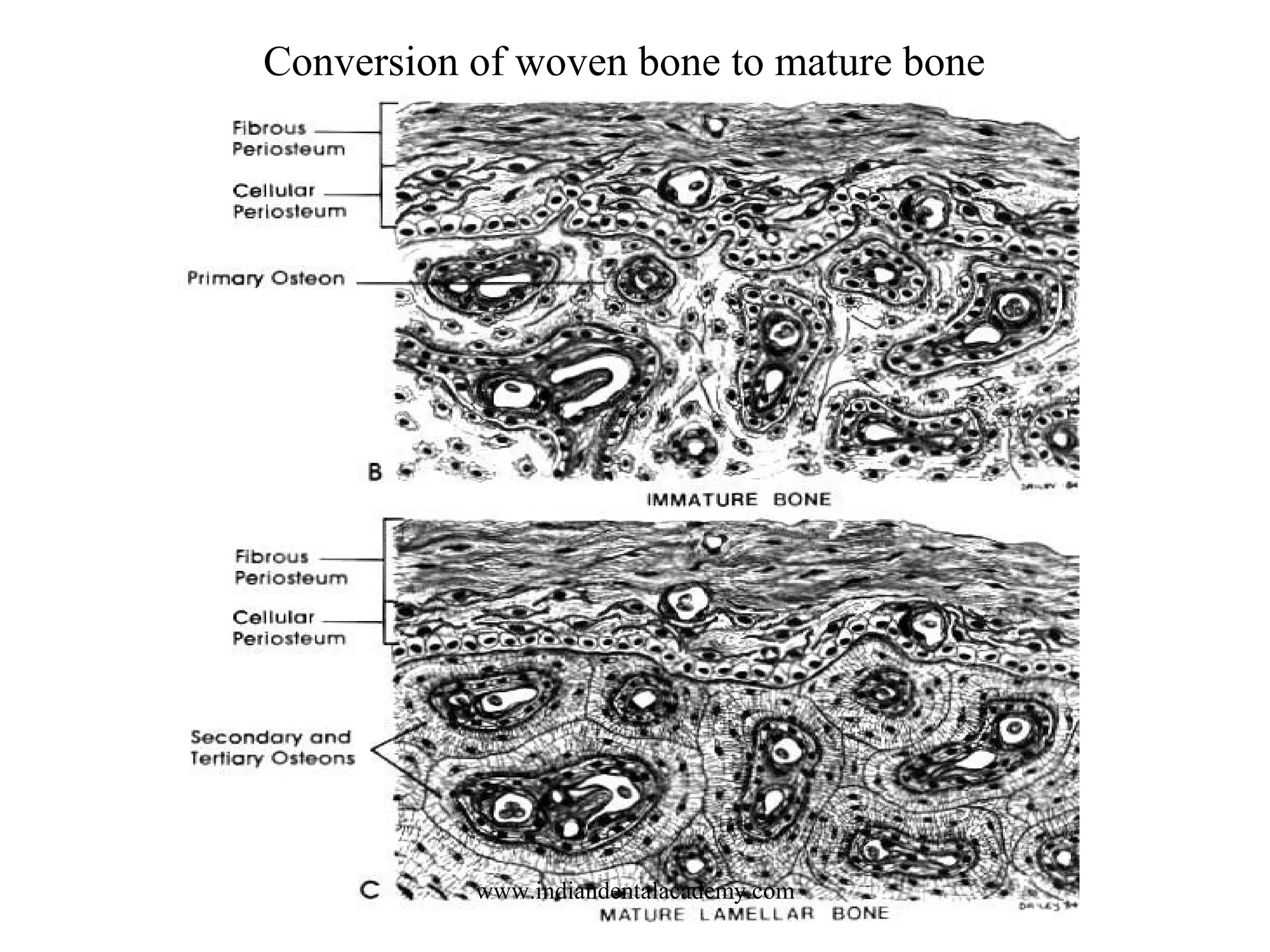
Conversion of woven bone to mature bone
www.indiandentalacademy.com
Bone remodelling = resorption + deposition
Old bone is being removed in segment A by osteoclasts,forming the cutting cone.In
segment B, osteoblasts begin to synthesize the osteoid(filling cone), the osteoid
mineralizes, becoming new bone.www.indiandentalacademy.com
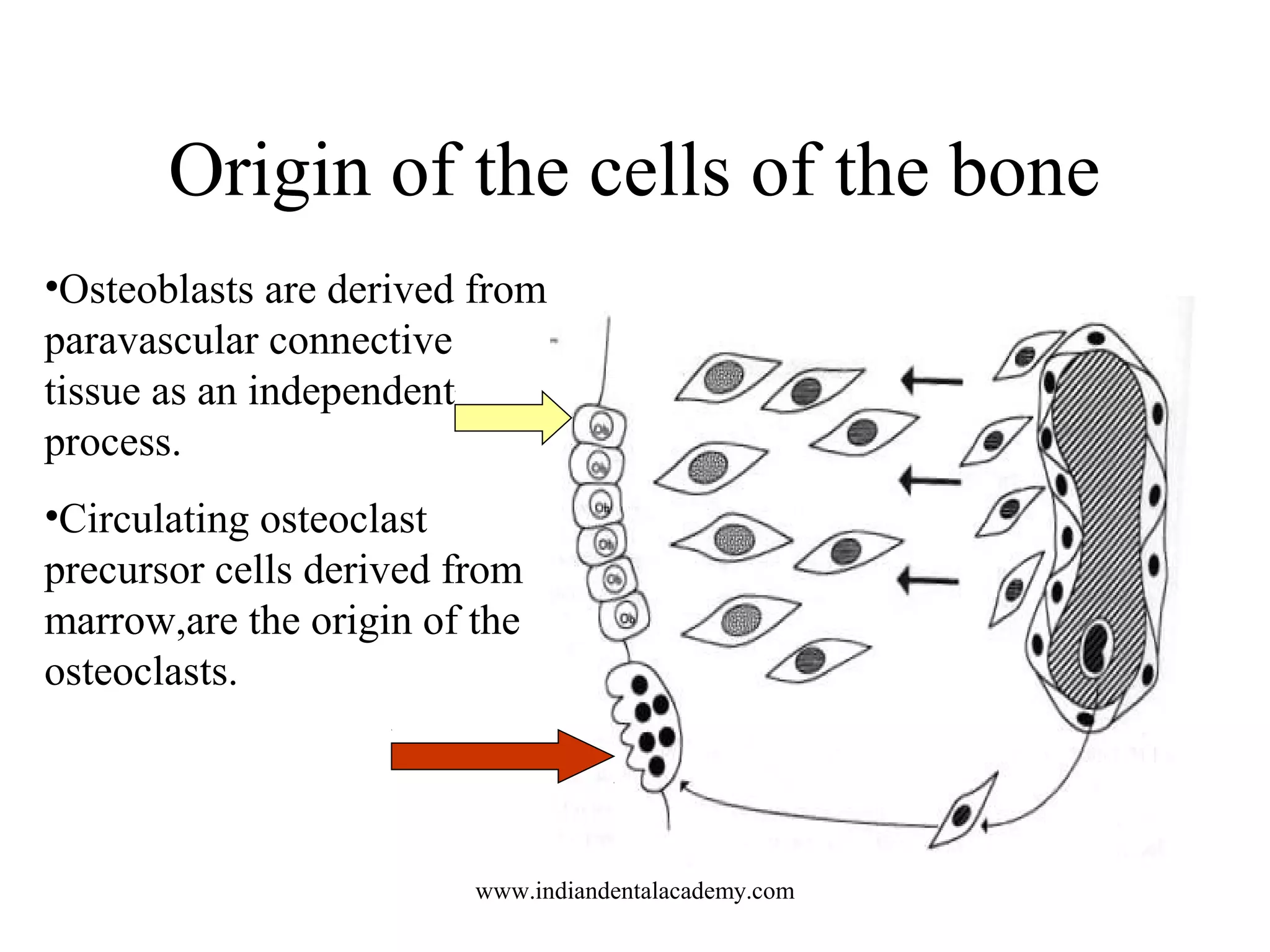
Origin of the cells of the bone
•Osteoblasts are derived from
paravascular connective
tissue as an independent
process.
•Circulating osteoclast
precursor cells derived from
marrow,are the origin of the
osteoclasts.
www.indiandentalacademy.com
Bone resorption
Classical features of a osteoclast:multinucleation, numerous
mitochondria(M), ruffled border(RF), golgi saccules(G)
www.indiandentalacademy.com
Re(modelling).
A schematic cross section
of cortical bone shows
surface modelling (M),
which is the process of
uncoupled resorption and
formation.
Remodelling(R) is the turn
over of existing bone.
www.indiandentalacademy.com
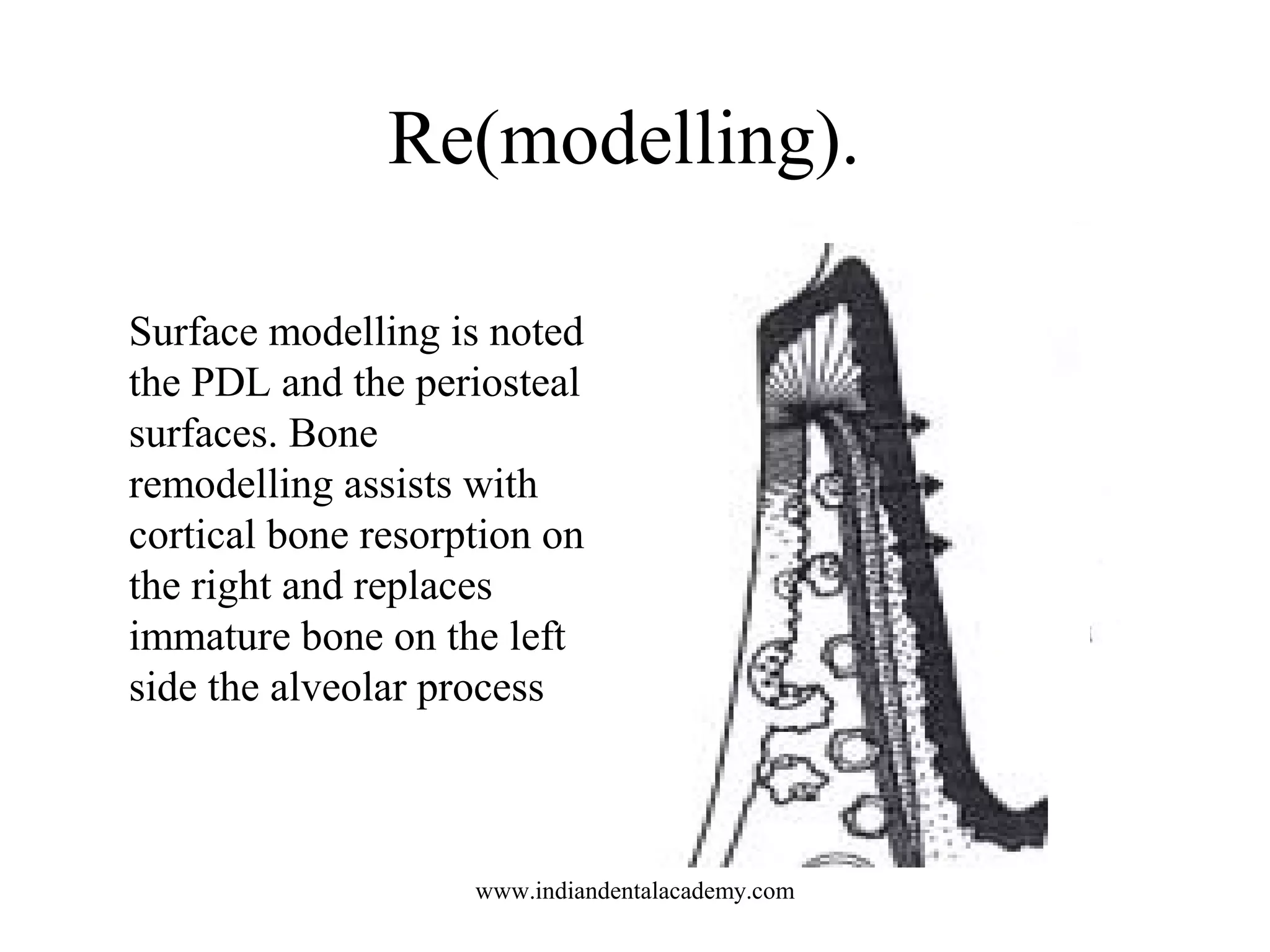
Re(modelling).
Surface modelling is noted
the PDL and the periosteal
surfaces. Bone
remodelling assists with
cortical bone resorption on
the right and replaces
immature bone on the left
side the alveolar process
www.indiandentalacademy.com
Bone growth & modelling
www.indiandentalacademy.com
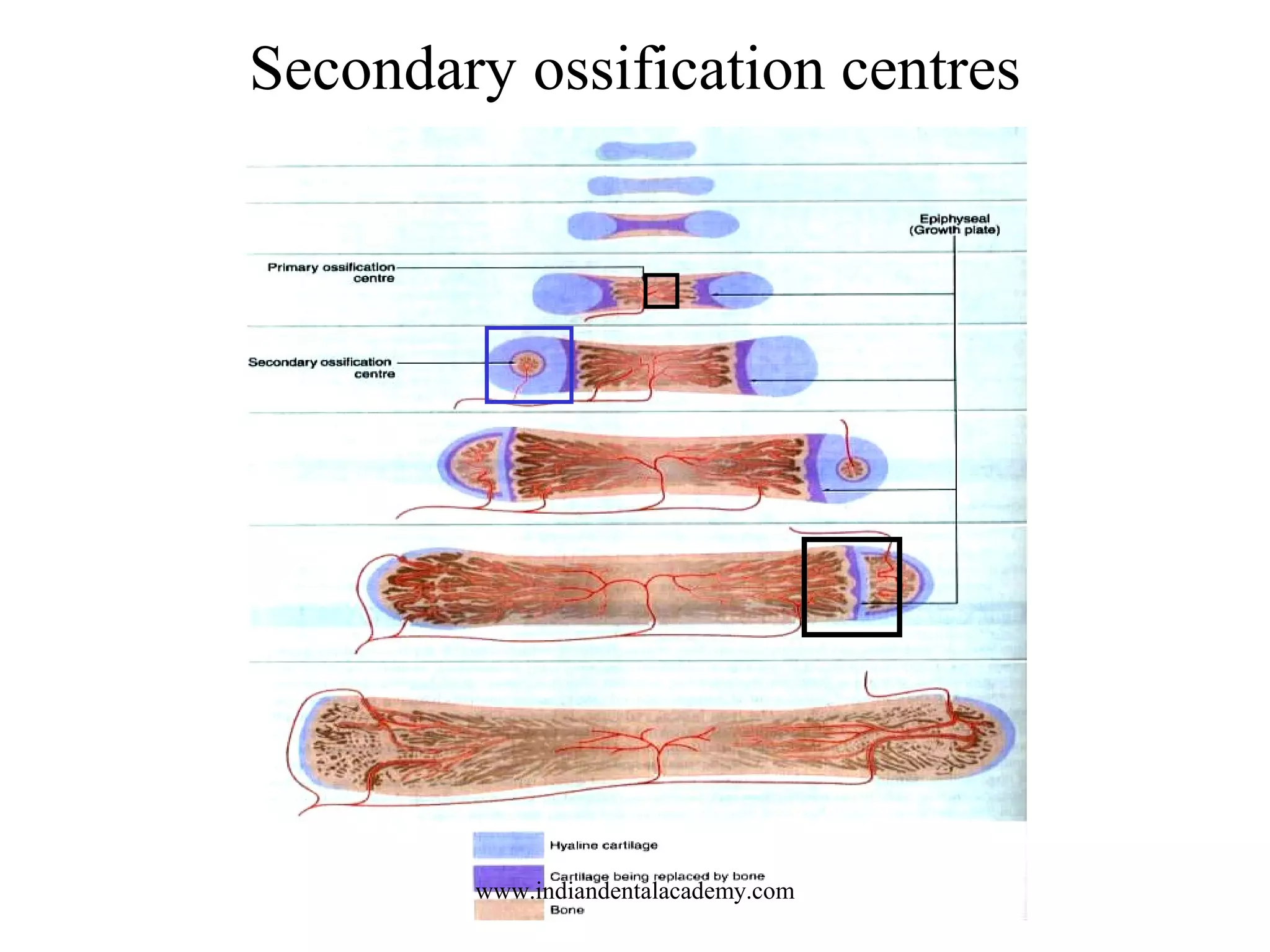
Secondary ossification centres
www.indiandentalacademy.com
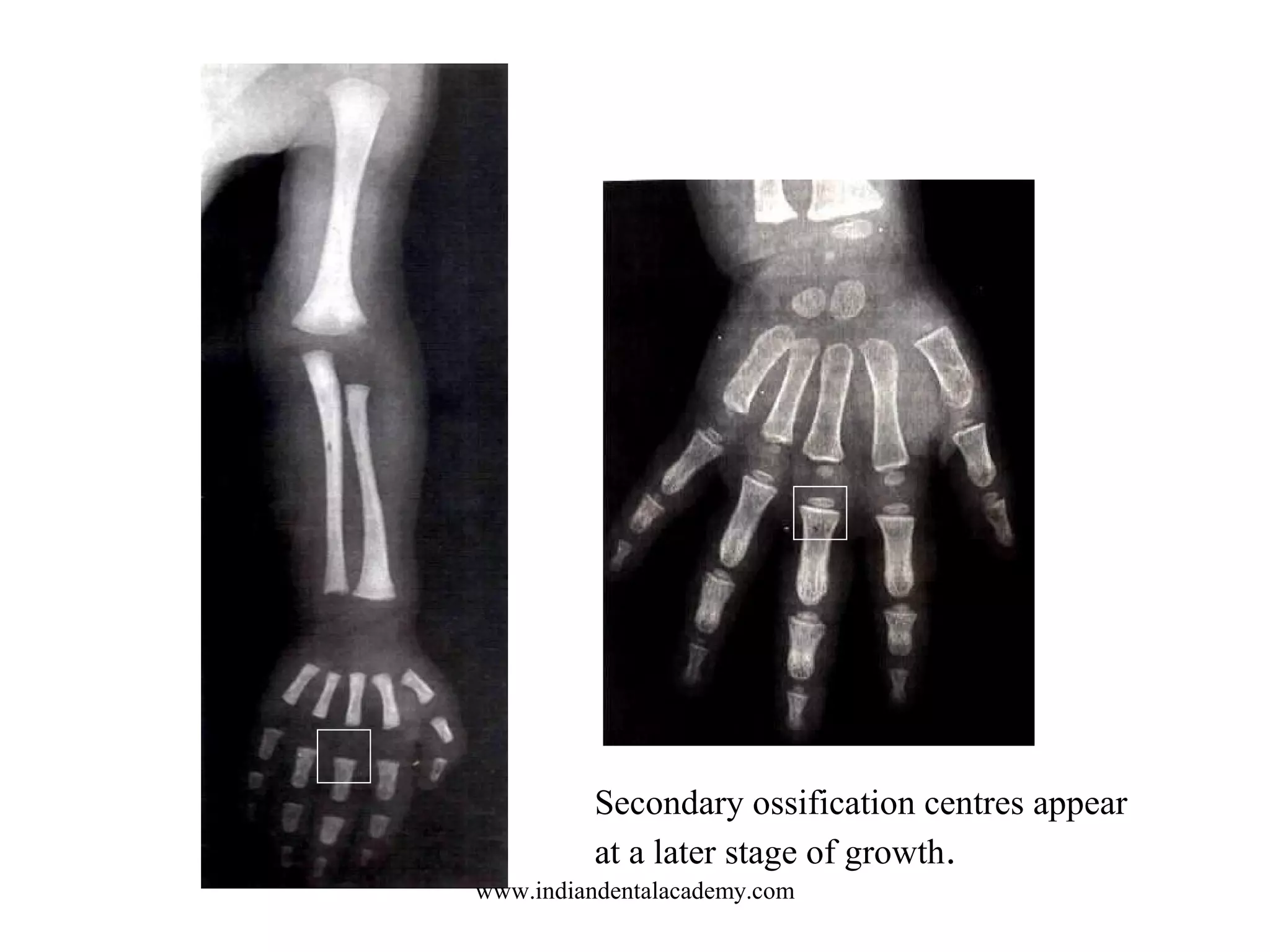
Secondary ossification centres appear
at a later stage of growth.
www.indiandentalacademy.com
Bone growth-the epiphysial growth plate
Hyaline cartilage
Zone of cell
multiplication
Zone of cell
hypertrophy
Matrix
calcification
Chondrolysis &
ossification
www.indiandentalacademy.com
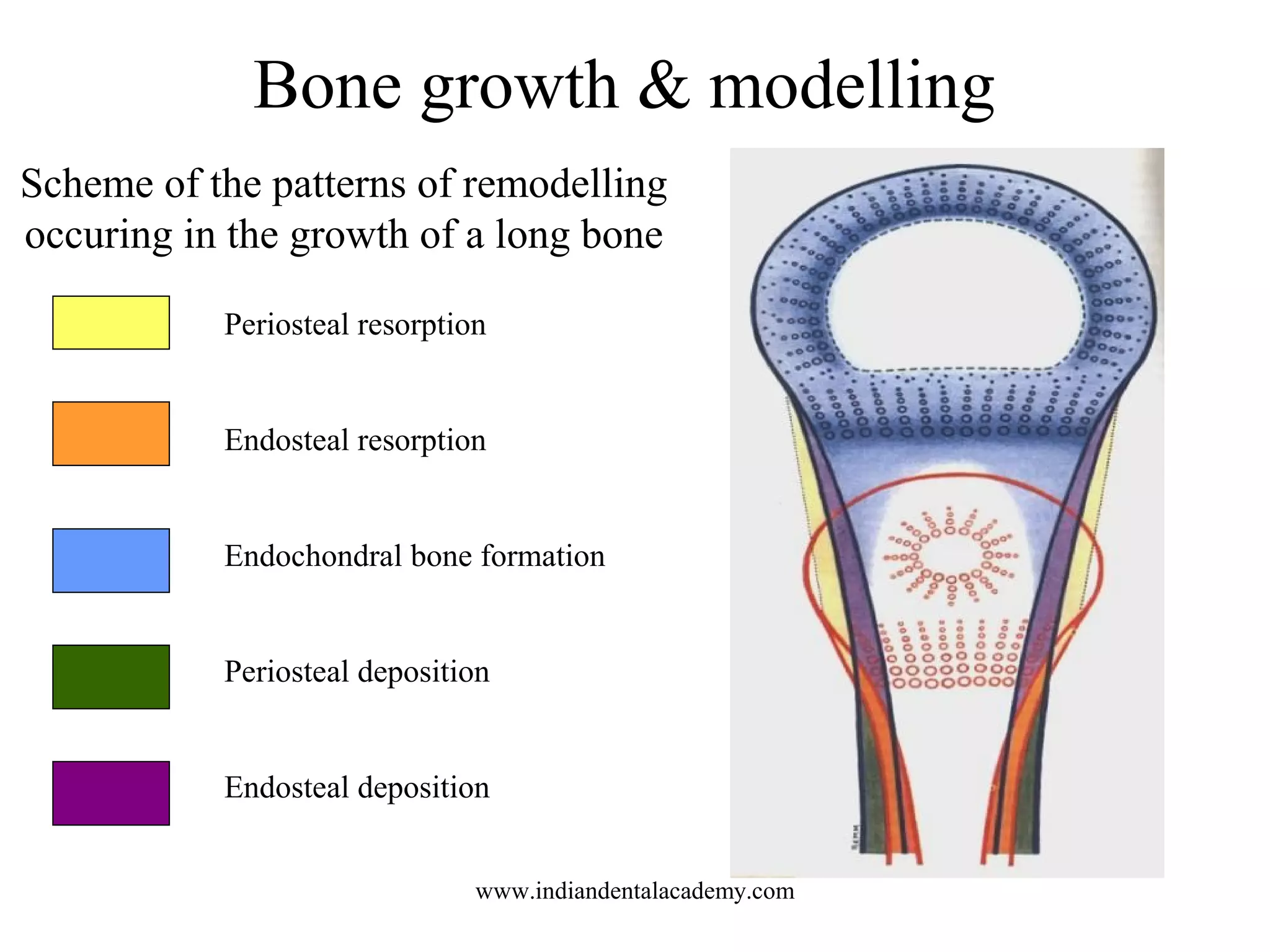
Bone growth & modelling
Scheme of the patterns of remodelling
occuring in the growth of a long bone
Periosteal resorption
Endosteal resorption
Endochondral bone formation
Periosteal deposition
Endosteal deposition
www.indiandentalacademy.com
Bones & their response to applied stresses
• 1867 Meyer(anatomist) &
Culman(mathematician): propounded the
Trajectorial theory of bone formation.Trabeculae
develop along lines of stresses calculated
mathematically that enable it to best resist stresses
to which it is subjected during function.
• 1870’s Julius Wollf: trabecular arrangement can
change with a change in intensity & direction of
forces.
www.indiandentalacademy.com
Trajectorial theory
www.indiandentalacademy.com
• 1925 Beninghoff:Studied architecture of cranial &
facial skeleton & so called stress trajectories. The
trajectories obeyed no bone limits but rather the
demands of the functional forces.
• 1955 Sicher: Pillars of trajectories.
Bones & their response to applied stresses
www.indiandentalacademy.com
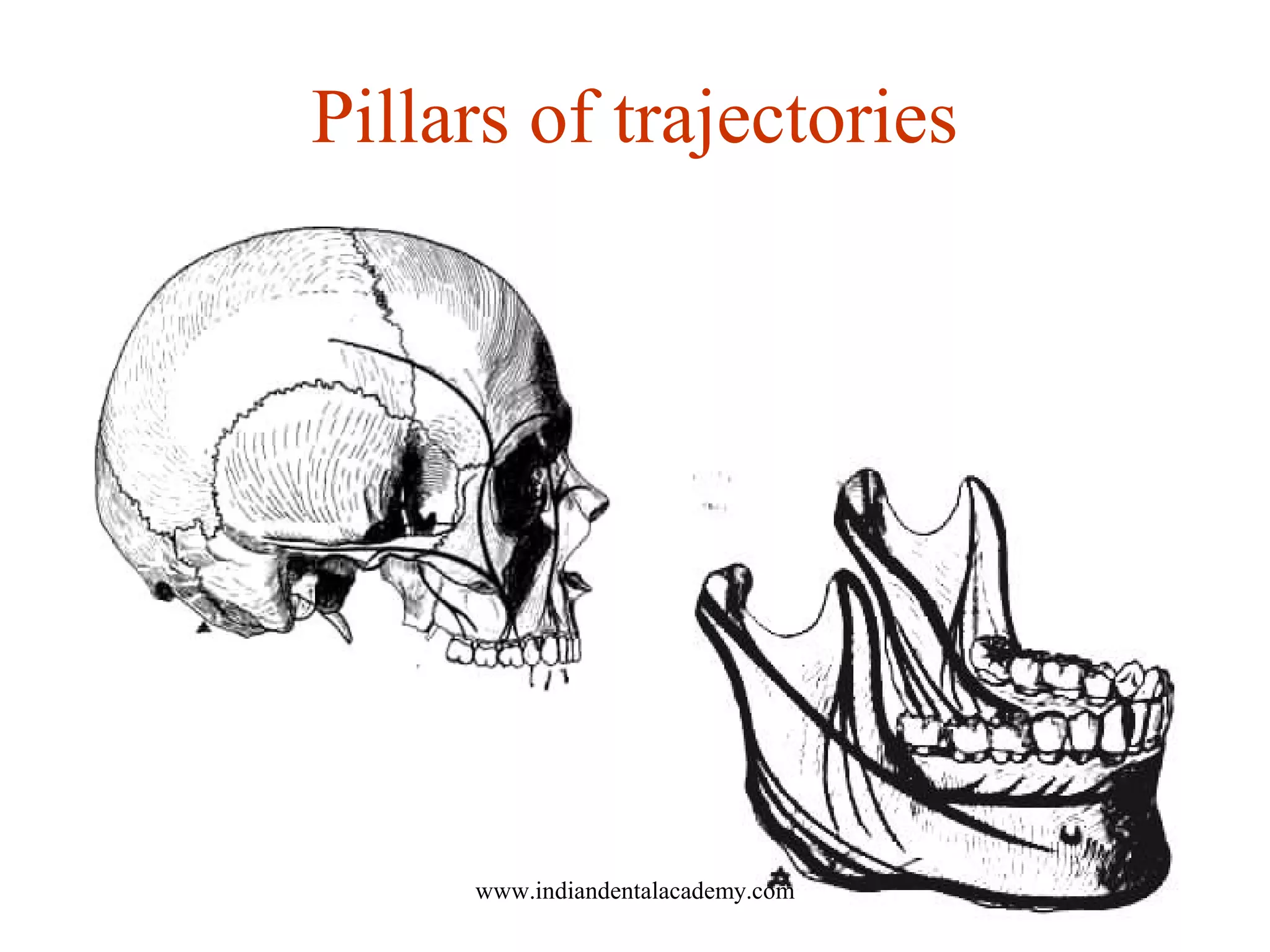
Pillars of trajectories
www.indiandentalacademy.com
Frontal section of the maxilla and the
mandible in the plane of the first
molars.Because it transmits masticatory
load to the entire cranium the maxilla has
thin cortices connected by fine
trabeculae.the mandible is however loaded
in bending and torsion;it therefore is
composed of thick cortical bone connected
by coarse oriented trabeculae.
Bones & their response to applied stresses
www.indiandentalacademy.com
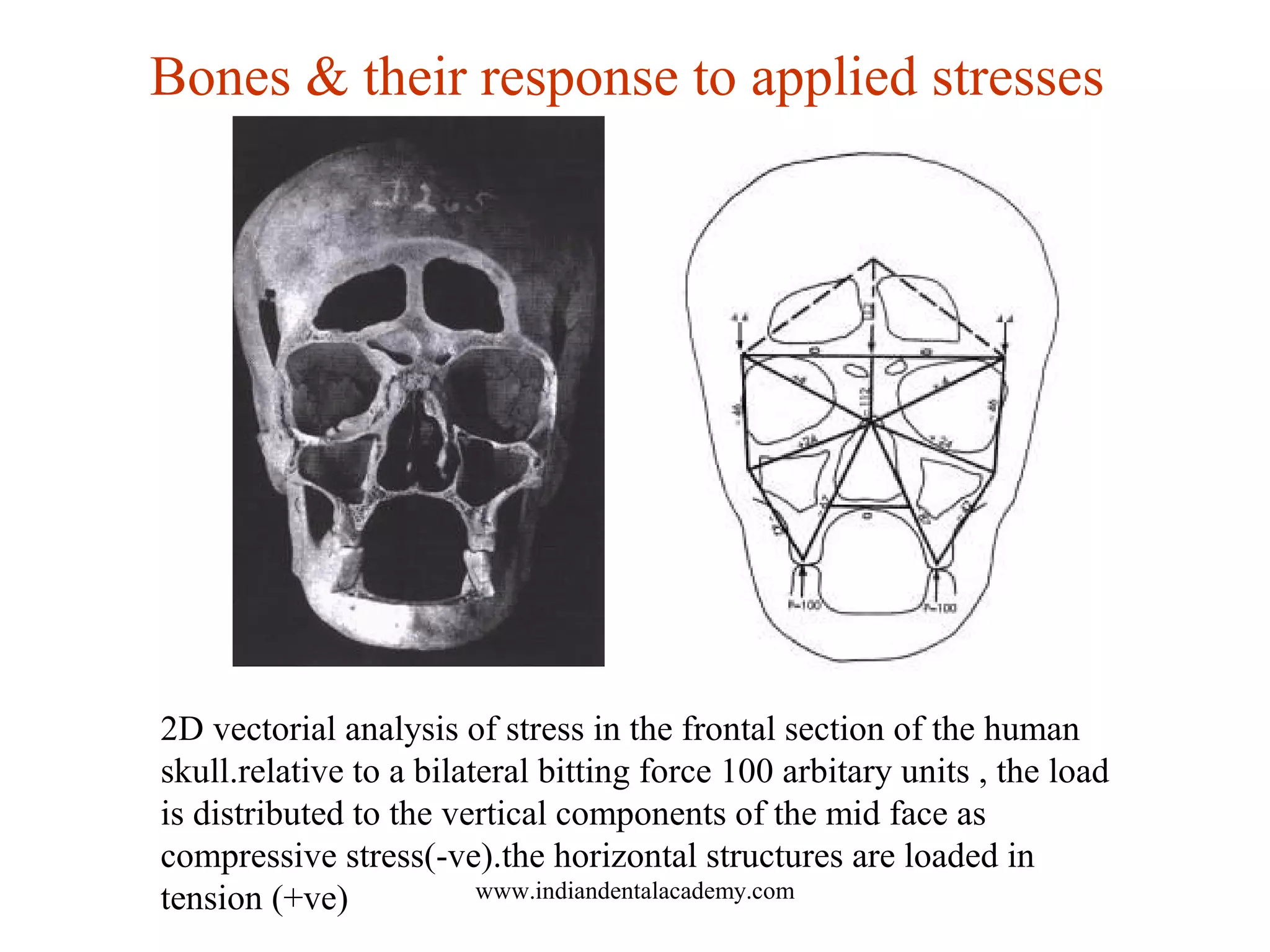
2D vectorial analysis of stress in the frontal section of the human
skull.relative to a bilateral bitting force 100 arbitary units , the load
is distributed to the vertical components of the mid face as
compressive stress(-ve).the horizontal structures are loaded in
tension (+ve)
Bones & their response to applied stresses
www.indiandentalacademy.com
• 1990 Frost : Mechanostat theory-Mechanical
loading is essential to skeletal health.Control of
most bone modelling & some remodelling process
is related to strain history.
The mechanostat provides a useful reference for
the hierarchy of biomechanical responses to
applied loads.
Bones & their response to applied stresses
www.indiandentalacademy.com
Mechanostat theory
Schematic drawing of the
Mechanostat concept of
Frost. Bone formation(F)
& resorption(R) are the
remodelling phenomena
that change the shape or
form (or both) of a
bone.The peak strain
history determines
whether atrophy,
maintenance, hypertrophy
or fatigue failure occurs.
uE= microstrain=
percent of deformation x
1/10000
www.indiandentalacademy.com
Joints of the cranium
• Temporomandibular joints
• Sutures
• Synchondroses
• Gomphoses
• Symphysis ?
www.indiandentalacademy.com
Sutures: Limited to the skull.
Bones are separated by
sutural ligament.growth
occurs by apposition by
cambial layer.
Finally obliterated 20’s
Joints of the cranium
www.indiandentalacademy.com
Types of sutures:
• Plane
• Serrate
• Denticulate
• Squamous
Joints of the
cranium
www.indiandentalacademy.com
Synchondrosis: temporary cartilaginous junctions between
the skull components developing in chondrocranium.
These are :
Spheno occipital: 13-15 years.
Spheno ethmoidal: 6 years
.
Intrasphenoidal & intraerthmoidal:
at birth.
Histologically:a two sided epiphysis.
Joints of the cranium
www.indiandentalacademy.com
Synchondroses
bone bone
Hyaline
cartilagewww.indiandentalacademy.com
Symphysis
bone bone
hyaline
cartilage
hyaline
cartilage
fibrous cartilagewww.indiandentalacademy.com
Is ‘symphysis menti’ a symphysis really?
The articulation between the two halves of the mandible is
usually described as a symphysis & the symphysis menti
does bear some resemblance histologically.It is rapidly
abolished during the 1st postnatal year 7 since it is
improbable that it is the site of any functionally significant
movement while present,it is of doubtful propriety to
assign it to this group of joints.
www.indiandentalacademy.com
Chemical composition of bone
www.indiandentalacademy.com
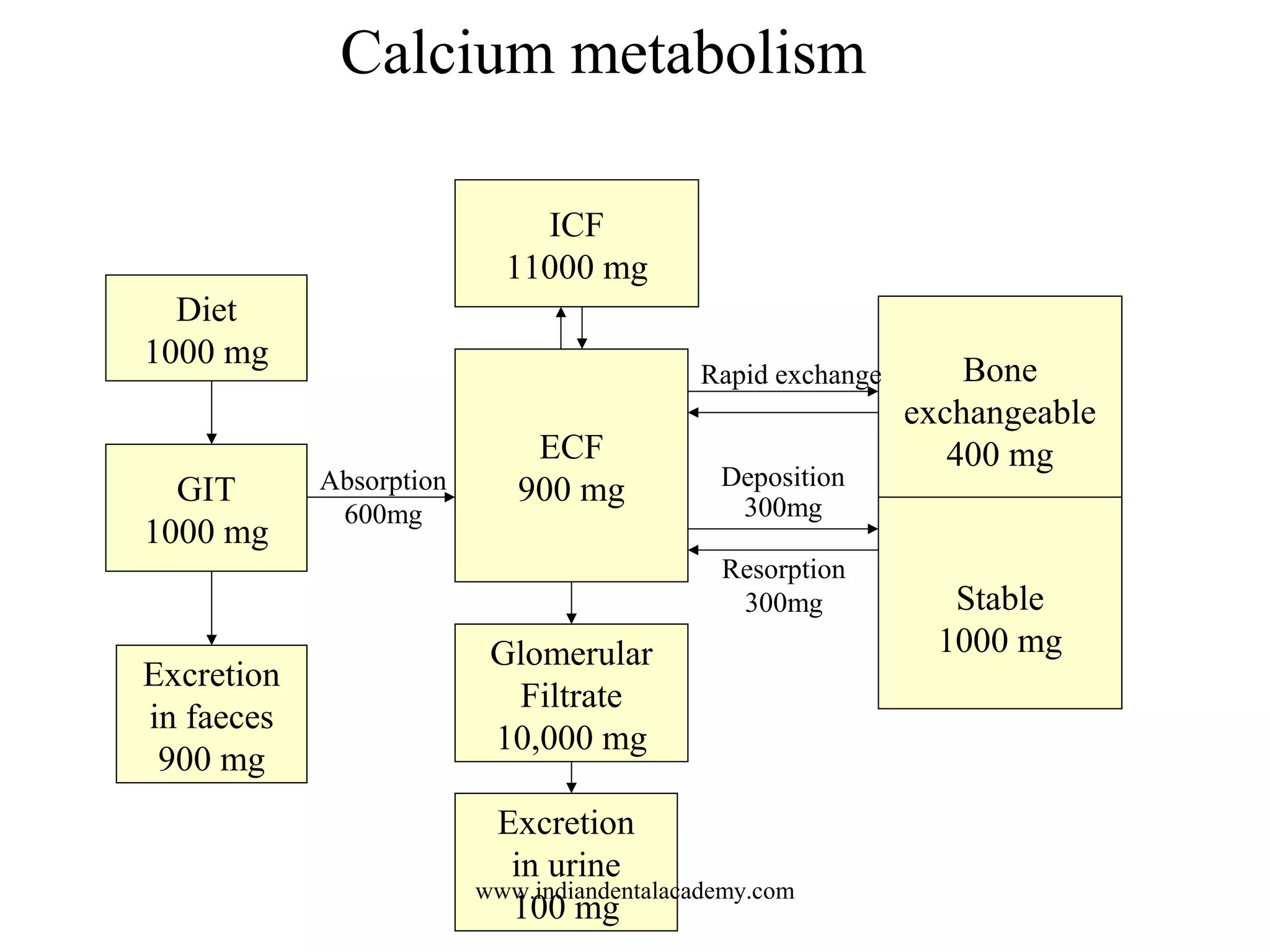
Calcium metabolism
ICF
11000 mg
ECF
900 mg
Glomerular
Filtrate
10,000 mg
Excretion
in urine
100 mg
Bone
exchangeable
400 mg
Stable
1000 mg
Diet
1000 mg
GIT
1000 mg
Excretion
in faeces
900 mg
Absorption
600mg
Rapid exchange
Resorption
300mg
Deposition
300mg
www.indiandentalacademy.com
Decreased blood Ca level
parathyroid kidney
parathormone Vitamin D
Bone
Increase in
resorption &
release of Ca
Intestine
Increase in
absorption of
Ca
Increased blood Ca level
thyroid
calcitonin
Bone
Inhibition of bone
resorption and
deposition of Ca
Normal calcium levelwww.indiandentalacademy.com
Factors affecting bone metabolism
Stimulation Inhibition
Bone formation GH
Calcitonin
Insulin
Testosterone
Estrogen
Cortisol
Mineralization Calcitonin
Insulin
Vit D
Cortisol
Bone resorption Parathormone
Thyroxine
Cortisol
Testosterone
www.indiandentalacademy.com
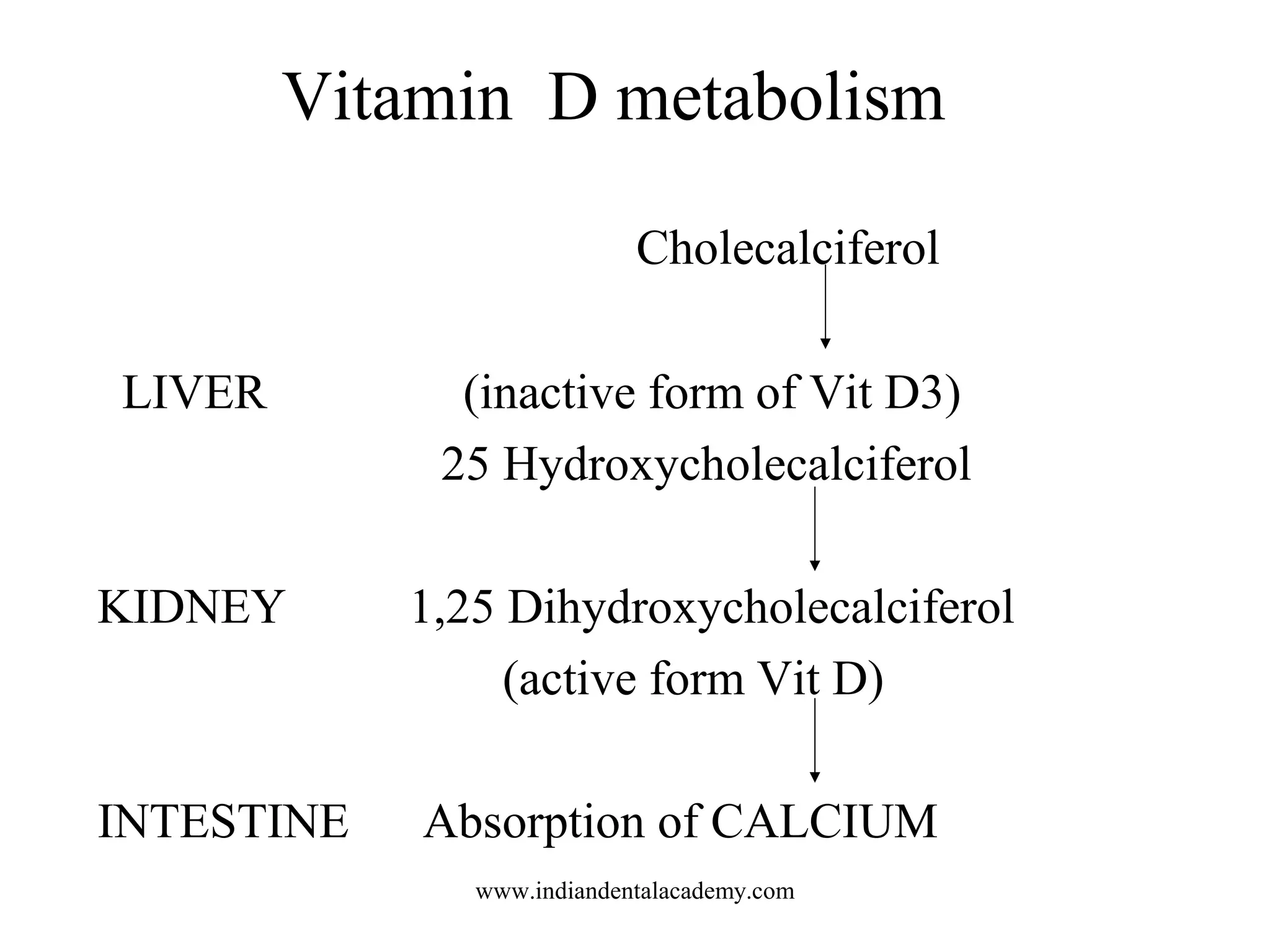
Cholecalciferol
LIVER (inactive form of Vit D3)
25 Hydroxycholecalciferol
KIDNEY 1,25 Dihydroxycholecalciferol
(active form Vit D)
INTESTINE Absorption of CALCIUM
Vitamin D metabolism
www.indiandentalacademy.com
Orthodontics is a bone manipulative therapy & favourable
calcium metabolism is an important consideration.
Because of the interaction of structure & metabolism,a
through understanding of the osseous structure & function
is fundamental to patient selection,risk
assessment,treatment planning & retention of desired
denofacial relationsips.
Orthodontics:current principles & technique
T.M. Graber & R.L.Vanarsdall
www.indiandentalacademy.com
However if the metabolic problems (particularly –ve calcium balance) are
resolved with medical treatment, these patients can be treated orthodontically
assuming sufficient skeletal structure remains.
No age limit is specified for orthodontic treatment; however the clinician must
carefully assess the probability of metabolic bone disease.In addition to
osteoporosis orthodontist must be particularly vigilant for osteomalacia and
renal osteodystrophy.
Orthodontics:Current principles & techniques
T.M. Graber & R.L. Vanarsdall;225,3rdEd
Orthodontics is contraindicated in patients with active metabolic bone
disease because of excessive resorption and poor bone formation.
www.indiandentalacademy.com
Osteoporosis: Generic term for low bone mass.
Risk factors:
• Age (after 3rd decade).
• Long term glucocorticoid therapy.
• Slight stature.
• Menopause.
• Excessive smoking,alcohol.
• Low physical activity.
• Low calcium,vit. D diet.
• Kidney failure,liver disease.
Features:
Low bone mass,low radiographic density of jaws, thin cortices, excessive
bone resorption
www.indiandentalacademy.com
Vitamin D deficient rickets
Any disorder in the vit.D-Calcium
phosphorus axis which results
in hypomineralized bone
matrix.
Cessation of calcification of
epiphysial growth plate
cartilage.However the cartilage
continues to grow.Since
unmineralized bone canot bear
weight they bow.
www.indiandentalacademy.com
Adult rickets
Seen in postmenopausal women with low calcium intake and little
exposure to UV light.
Features:softening,distortion,increased tendency towards fracture.
Stress bearing bones have asymmetric deformities & long bones
have hairline fracture.
www.indiandentalacademy.com
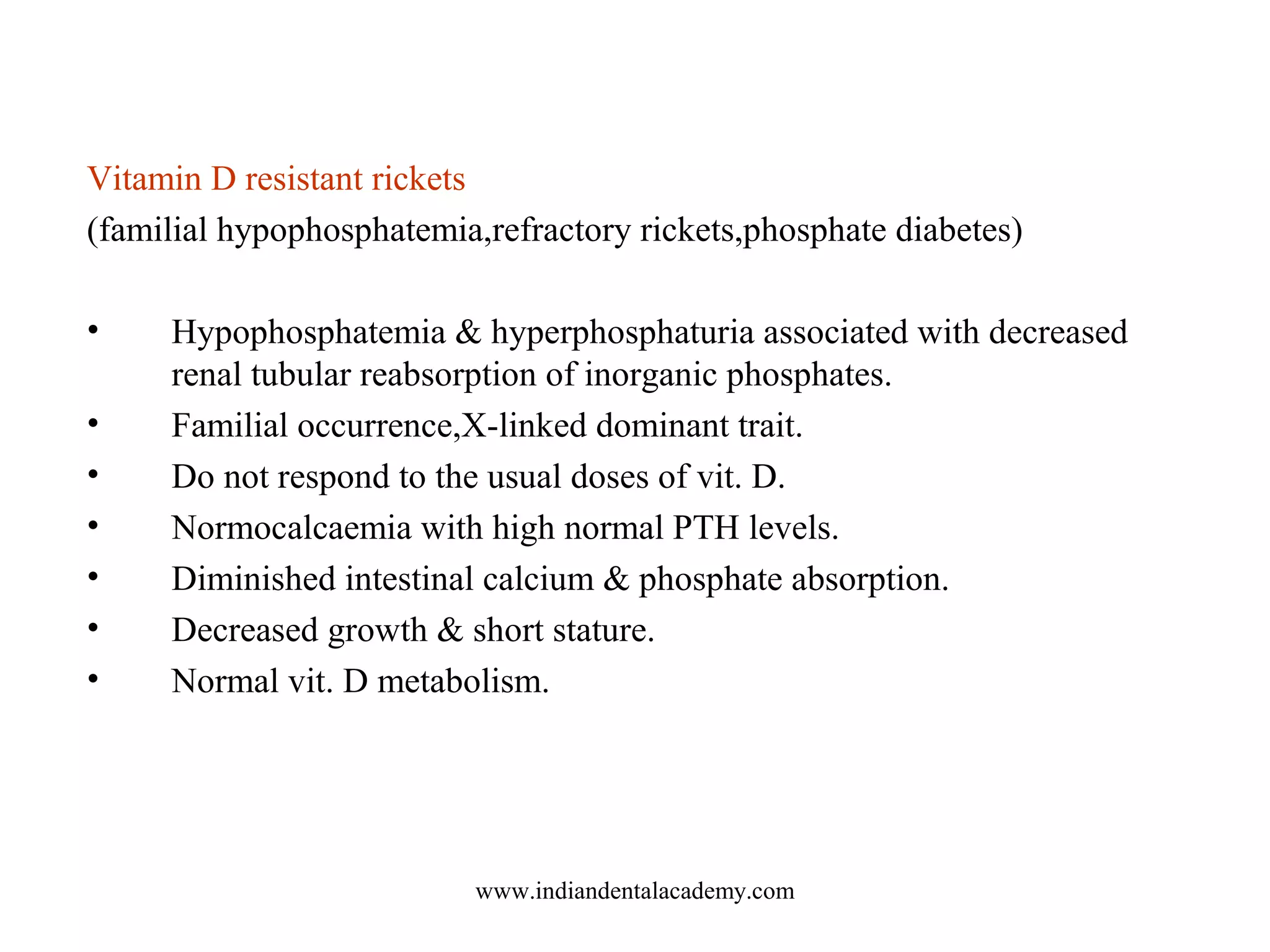
Vitamin D resistant rickets
(familial hypophosphatemia,refractory rickets,phosphate diabetes)
• Hypophosphatemia & hyperphosphaturia associated with decreased
renal tubular reabsorption of inorganic phosphates.
• Familial occurrence,X-linked dominant trait.
• Do not respond to the usual doses of vit. D.
• Normocalcaemia with high normal PTH levels.
• Diminished intestinal calcium & phosphate absorption.
• Decreased growth & short stature.
• Normal vit. D metabolism.
www.indiandentalacademy.com
Renal rickets(renal osteodystropy)
Common finding in patients with chronic renal disease.Results from the
inability of diseased kidneys to convert 25-hydroxy cholecalciferol to
the active form of vit.D.
Hypophosphatasia
Low alkaline phosphatase levels.Results in rachitic deformity.
www.indiandentalacademy.com
Vitamin C
It has a role in the hydroxylation of proline in collagen synthesis.
Vit C furthers the normal development of intercellular ground substance
in bone,dentin & connective tissue.
Effects on bone:
Osteoblasts fail to form osteoid.Calcified cartilage (scorbutic lattice) is
formed but no bone develops.The calcified cartilage is liable to
fracture (trummerfeld zone or zone of complete destruction).
www.indiandentalacademy.com
Hyperparathyroidism
Bone pain,pathologic fractures,gerneralized osteoporosis,giant cell
tumours of the jaw.
Histologically: The most characteristic change in bone is osteoclastic
resorption of the trabeculae of the spongiosa & along the blood vessels
in the haversian system of the cortex. Fibroblasts are found as a mass
in some areas.
www.indiandentalacademy.com
Clinical considerations
Is it easier to move teeth in younger patients?
The alveolar bone in young persons who comprise the majority of our
patients is not very dense. It contains large marrow spaces. Since tooth
movement is facilitated by the formation of resorptive cells,whose
number again increases according to the number of marrow spaces, the
anatomic condition can hardly be more favourable than in the
supporting structures of majority of the young orthodontic patients.
www.indiandentalacademy.com
Clinical Considerations
Is it easier to move teeth in younger patients?
www.indiandentalacademy.com
Clinical considerations
Why does cortical bone offer good anchorage?
The marrow space contains a large surface area for cellular activity which is
indispensable for tooth movement.On the other hand if bone involved in tooth
movement is of a compact character the surface area where the cellular reaction
can take place is greatly reduced.
When one is planning orthodontic treatment ,the tooth should remain in spongy
bone during movement.On the other hand when teeth are pitted against cortical
bone they can be used to our advantage to provide more anchorage.
www.indiandentalacademy.com
Clinical considerations
How soon after extraction can we start treatment ?
Extraction spaces contain tissue undergoing reconstruction which is rich in
cells & vascular supply.Such an area is ideally suitable for tooth
movement & due advantage should be taken of this by commencing
treatment as soon as possible following extraction. Thereby one avoids
atrophy & narrowing of the alveolar process,resulting in bone loss &
cortical bone formation at the extraction site.
www.indiandentalacademy.com
Clinical considerations
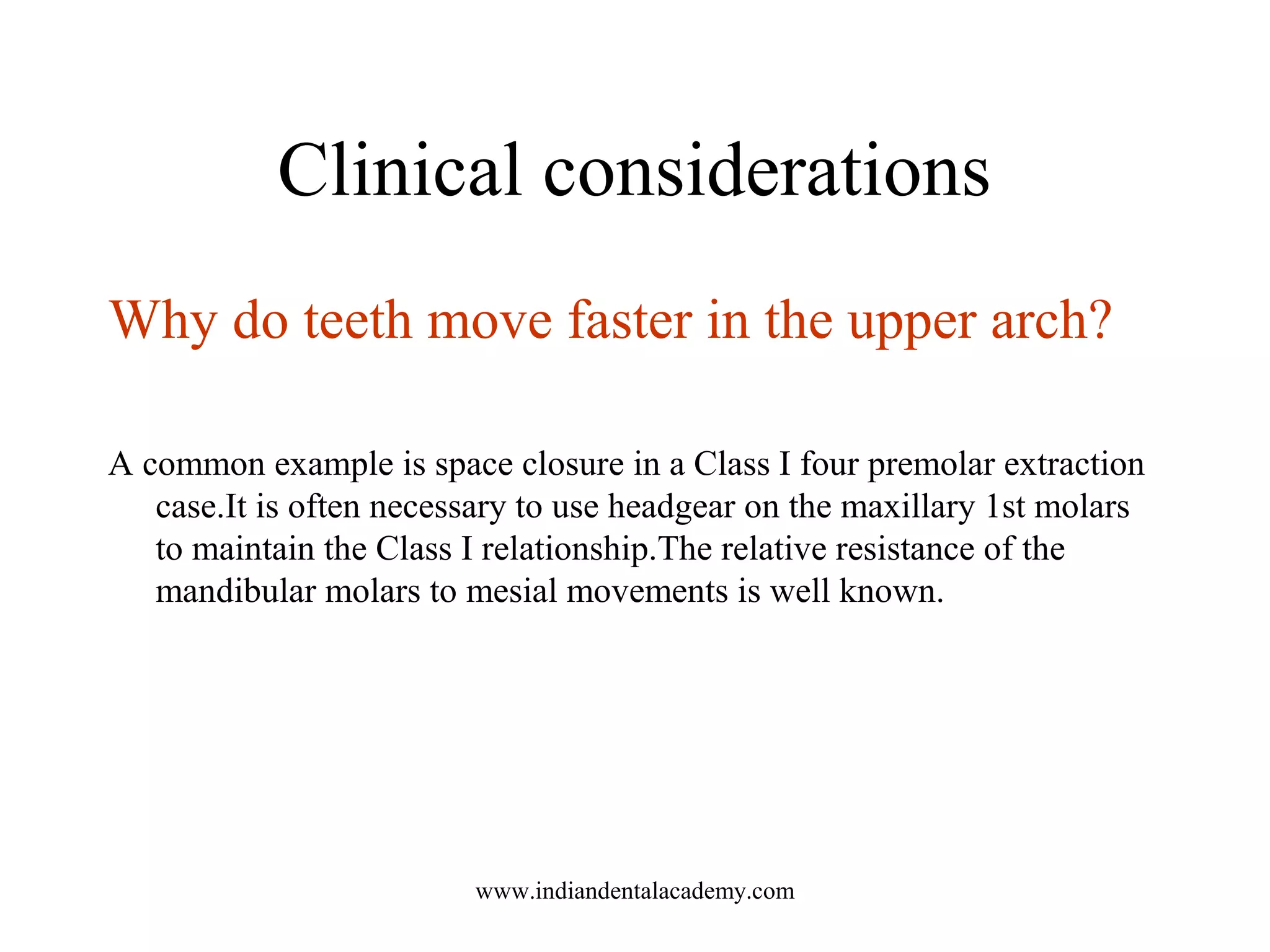
Why do teeth move faster in the upper arch?
A common example is space closure in a Class I four premolar extraction
case.It is often necessary to use headgear on the maxillary 1st molars
to maintain the Class I relationship.The relative resistance of the
mandibular molars to mesial movements is well known.
www.indiandentalacademy.com
Clinical considerations
Why do teeth move faster in the upper arch?
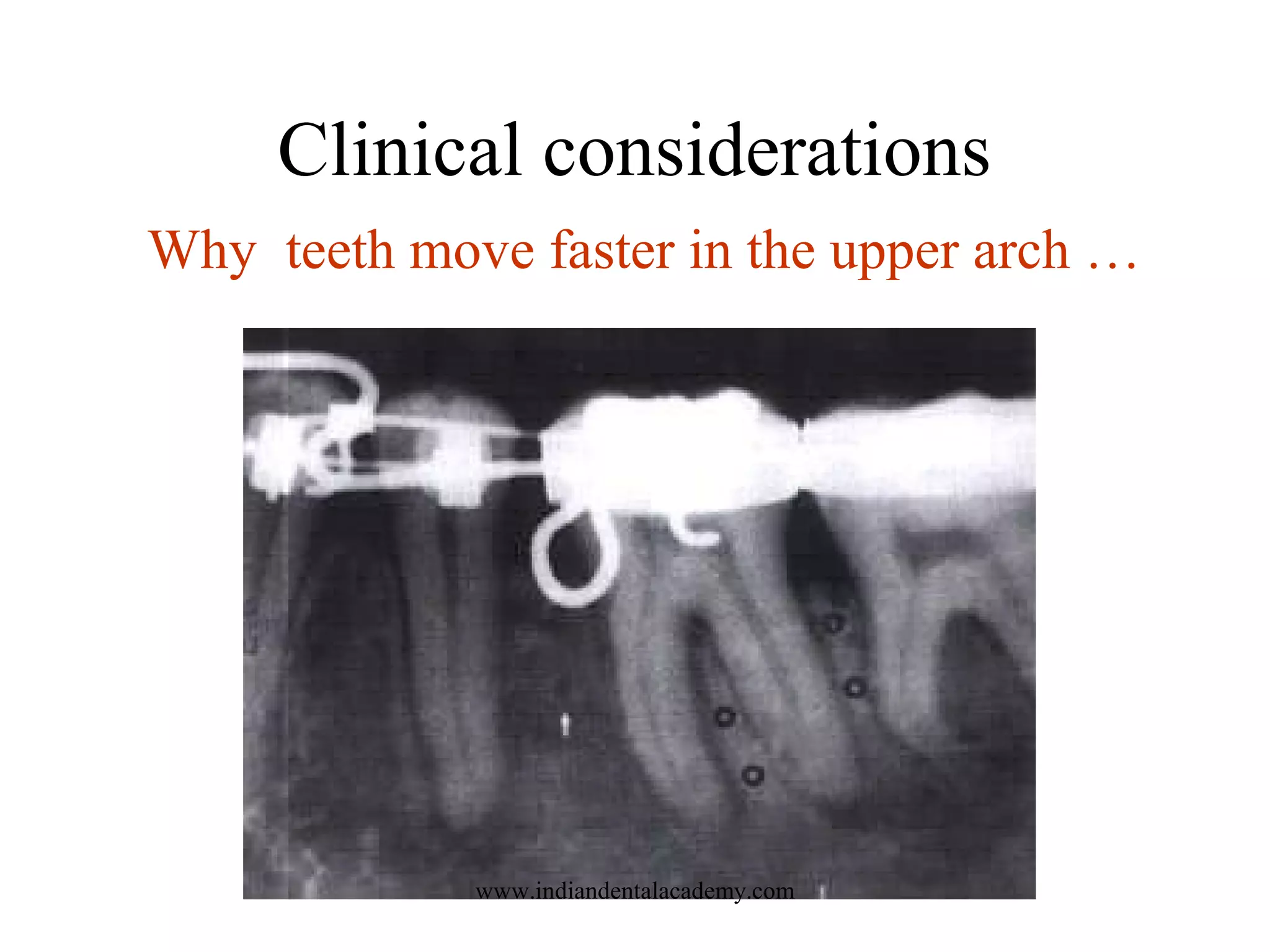
Why are mandibular molars more difficult to move mesially than
maxillary molars ?
2 physiologic factors hold the answer:
• Thin cortices & trabecular bone of the maxilla offer less resistance to
resorption than thick cortices & more coarse trabeculae of the
mandible.
• The leading root of mandibular molars being translated mesially
forms bone that is far more dense than the bone formed by translating
maxillary molars mesially.Why this occurs is not known.
www.indiandentalacademy.com
Clinical considerations
Why teeth move faster in the upper arch …
www.indiandentalacademy.com
Clinical considerations
Why do I have to be careful with cases suffering from
periodontitis?
Moving teeth when progressive periodontal disease is present
invites disaster.
Osteoclasts thrive in the diseased tissue environment.
On the other hand osteoblast histogenesis is suppressed
by inflammatory disease.
When teeth are moved in the presence of active periodontal disease resorption is
normal or even enhanced & bone formation inhibited.this may exacerbate the
disease process,resulting in a rapid loss of supporting bone.
www.indiandentalacademy.com
Clinical considerations
We need healthy bone for adequate retention..
Teeth that have been moved recently are surrounded by lightly calcified
woven bone.Thus the teeth are not adequately stabilized & have a
tendency to move to their original position.During retention phase the
bone matures.
www.indiandentalacademy.com
Thank you
www.indiandentalacademy.com

Bones

  • 1.
  • 2.
    Bones are theunits of the skeletal system. www.indiandentalacademy.com
  • 3.
    Classification of bonetissues 1. Shape of bones • Long,short,flat,irregular,pneumatic, sesamoid,supernumerary 2. Regions of long bone • Epiphysis • Diaphysis • Metaphysis 3. Macroscopic appearance • Compact bone • Trabecular/cancellous/spongy bone 4. Developmental origin • Intramembranous/dermal bone • Intracartilaginous/endochondral bone www.indiandentalacademy.com
  • 4.
  • 5.
    Histology of bone •Periosteum White fibrous layer Elastic osteogenic layer www.indiandentalacademy.com
  • 6.
    Histology of bone •Haversian system Haversian canals Volkmann’s canals Lamellae Lacunae Canaliculli www.indiandentalacademy.com
  • 7.
    Histology of bone •Types of lamellae: Osteonic Interstitial Circumferential www.indiandentalacademy.com
  • 8.
    High power viewof part of an osteon in transverse section seen with transmitted light. www.indiandentalacademy.com
  • 9.
    Single osteon viewedwith polarization optics to illustrate lamellar structurewww.indiandentalacademy.com
  • 10.
    Histological sections ofbone illustrating the various kinds of lamellaewww.indiandentalacademy.com
  • 11.
    Osteocyte in lacuna.Arrowshows canalliculi.www.indiandentalacademy.com
  • 12.
    Histogenesis of bone •Intramembranous & Endochondral ossification. • Histologically both bones are identical. • Both are formed from mesenchymal tissue. www.indiandentalacademy.com
  • 13.
    Intramembranous bone formation A.Condensation of mesenchyme around capillary network at specific points-Centres of ossification B. Cells converted into osteoblasts • Open faced • nucleus,prominent nucleolus • RER & Golgi bodies • Lysosomes containing alk.phos. C. Matrix(osteoid) production:collagen,proteo glycans etc. Osteoblasts,blood vessels line the growing bone spicule which is full of osteocytes. matrix www.indiandentalacademy.com
  • 14.
    D. Calcification &woven bone formation www.indiandentalacademy.com
  • 15.
  • 16.
    Endochondral bone formation A.Mesenchymal condensation B. Cartilaginous model formed in hyaline cartilage. www.indiandentalacademy.com
  • 17.
    • Cartilage cells enlarge(beginningfrom ossification centre) • Surrounding cartilage matrix calcifies • Cartilage cells die • Calcified matrix left behind(primary areolae) • Perichondrium forms. www.indiandentalacademy.com
  • 18.
    • Blood vesselsinvade from perichondrium • Perivascular cells (OSTEOBLAST) and OSTEOCLAST come along with blood vessels. • Osteoclast erode the primary alveolae (secondary alveolae) • Osteoblast form new bone over secondary alveolae • Woven bone formed. www.indiandentalacademy.com
  • 19.
  • 20.
  • 21.
  • 22.
    An alizarin stained& cleared fetus of about 14 weeks in utero.Note the degree of progression of ossification from primary centres.Sternum, carpals, tarsals & secondary ossification centres are yet to ossify. www.indiandentalacademy.com
  • 23.
    Further development, growth& remodelling All bone initially formed is woven bone(seen in infants, alveolar bone in which orthodontic tooth movement has recently occurred & fracture repair sites) www.indiandentalacademy.com
  • 24.
    Conversion of wovenbone to mature bone www.indiandentalacademy.com
  • 25.
    Bone remodelling =resorption + deposition Old bone is being removed in segment A by osteoclasts,forming the cutting cone.In segment B, osteoblasts begin to synthesize the osteoid(filling cone), the osteoid mineralizes, becoming new bone.www.indiandentalacademy.com
  • 26.
    Origin of thecells of the bone •Osteoblasts are derived from paravascular connective tissue as an independent process. •Circulating osteoclast precursor cells derived from marrow,are the origin of the osteoclasts. www.indiandentalacademy.com
  • 27.
    Bone resorption Classical featuresof a osteoclast:multinucleation, numerous mitochondria(M), ruffled border(RF), golgi saccules(G) www.indiandentalacademy.com
  • 28.
    Re(modelling). A schematic crosssection of cortical bone shows surface modelling (M), which is the process of uncoupled resorption and formation. Remodelling(R) is the turn over of existing bone. www.indiandentalacademy.com
  • 29.
    Re(modelling). Surface modelling isnoted the PDL and the periosteal surfaces. Bone remodelling assists with cortical bone resorption on the right and replaces immature bone on the left side the alveolar process www.indiandentalacademy.com
  • 30.
    Bone growth &modelling www.indiandentalacademy.com
  • 31.
  • 32.
    Secondary ossification centresappear at a later stage of growth. www.indiandentalacademy.com
  • 33.
    Bone growth-the epiphysialgrowth plate Hyaline cartilage Zone of cell multiplication Zone of cell hypertrophy Matrix calcification Chondrolysis & ossification www.indiandentalacademy.com
  • 34.
    Bone growth &modelling Scheme of the patterns of remodelling occuring in the growth of a long bone Periosteal resorption Endosteal resorption Endochondral bone formation Periosteal deposition Endosteal deposition www.indiandentalacademy.com
  • 35.
    Bones & theirresponse to applied stresses • 1867 Meyer(anatomist) & Culman(mathematician): propounded the Trajectorial theory of bone formation.Trabeculae develop along lines of stresses calculated mathematically that enable it to best resist stresses to which it is subjected during function. • 1870’s Julius Wollf: trabecular arrangement can change with a change in intensity & direction of forces. www.indiandentalacademy.com
  • 36.
  • 37.
    • 1925 Beninghoff:Studiedarchitecture of cranial & facial skeleton & so called stress trajectories. The trajectories obeyed no bone limits but rather the demands of the functional forces. • 1955 Sicher: Pillars of trajectories. Bones & their response to applied stresses www.indiandentalacademy.com
  • 38.
  • 39.
    Frontal section ofthe maxilla and the mandible in the plane of the first molars.Because it transmits masticatory load to the entire cranium the maxilla has thin cortices connected by fine trabeculae.the mandible is however loaded in bending and torsion;it therefore is composed of thick cortical bone connected by coarse oriented trabeculae. Bones & their response to applied stresses www.indiandentalacademy.com
  • 40.
    2D vectorial analysisof stress in the frontal section of the human skull.relative to a bilateral bitting force 100 arbitary units , the load is distributed to the vertical components of the mid face as compressive stress(-ve).the horizontal structures are loaded in tension (+ve) Bones & their response to applied stresses www.indiandentalacademy.com
  • 41.
    • 1990 Frost: Mechanostat theory-Mechanical loading is essential to skeletal health.Control of most bone modelling & some remodelling process is related to strain history. The mechanostat provides a useful reference for the hierarchy of biomechanical responses to applied loads. Bones & their response to applied stresses www.indiandentalacademy.com
  • 42.
    Mechanostat theory Schematic drawingof the Mechanostat concept of Frost. Bone formation(F) & resorption(R) are the remodelling phenomena that change the shape or form (or both) of a bone.The peak strain history determines whether atrophy, maintenance, hypertrophy or fatigue failure occurs. uE= microstrain= percent of deformation x 1/10000 www.indiandentalacademy.com
  • 43.
    Joints of thecranium • Temporomandibular joints • Sutures • Synchondroses • Gomphoses • Symphysis ? www.indiandentalacademy.com
  • 44.
    Sutures: Limited tothe skull. Bones are separated by sutural ligament.growth occurs by apposition by cambial layer. Finally obliterated 20’s Joints of the cranium www.indiandentalacademy.com
  • 45.
    Types of sutures: •Plane • Serrate • Denticulate • Squamous Joints of the cranium www.indiandentalacademy.com
  • 46.
    Synchondrosis: temporary cartilaginousjunctions between the skull components developing in chondrocranium. These are : Spheno occipital: 13-15 years. Spheno ethmoidal: 6 years . Intrasphenoidal & intraerthmoidal: at birth. Histologically:a two sided epiphysis. Joints of the cranium www.indiandentalacademy.com
  • 47.
  • 48.
  • 49.
    Is ‘symphysis menti’a symphysis really? The articulation between the two halves of the mandible is usually described as a symphysis & the symphysis menti does bear some resemblance histologically.It is rapidly abolished during the 1st postnatal year 7 since it is improbable that it is the site of any functionally significant movement while present,it is of doubtful propriety to assign it to this group of joints. www.indiandentalacademy.com
  • 50.
    Chemical composition ofbone www.indiandentalacademy.com
  • 51.
    Calcium metabolism ICF 11000 mg ECF 900mg Glomerular Filtrate 10,000 mg Excretion in urine 100 mg Bone exchangeable 400 mg Stable 1000 mg Diet 1000 mg GIT 1000 mg Excretion in faeces 900 mg Absorption 600mg Rapid exchange Resorption 300mg Deposition 300mg www.indiandentalacademy.com
  • 52.
    Decreased blood Calevel parathyroid kidney parathormone Vitamin D Bone Increase in resorption & release of Ca Intestine Increase in absorption of Ca Increased blood Ca level thyroid calcitonin Bone Inhibition of bone resorption and deposition of Ca Normal calcium levelwww.indiandentalacademy.com
  • 53.
    Factors affecting bonemetabolism Stimulation Inhibition Bone formation GH Calcitonin Insulin Testosterone Estrogen Cortisol Mineralization Calcitonin Insulin Vit D Cortisol Bone resorption Parathormone Thyroxine Cortisol Testosterone www.indiandentalacademy.com
  • 54.
    Cholecalciferol LIVER (inactive formof Vit D3) 25 Hydroxycholecalciferol KIDNEY 1,25 Dihydroxycholecalciferol (active form Vit D) INTESTINE Absorption of CALCIUM Vitamin D metabolism www.indiandentalacademy.com
  • 55.
    Orthodontics is abone manipulative therapy & favourable calcium metabolism is an important consideration. Because of the interaction of structure & metabolism,a through understanding of the osseous structure & function is fundamental to patient selection,risk assessment,treatment planning & retention of desired denofacial relationsips. Orthodontics:current principles & technique T.M. Graber & R.L.Vanarsdall www.indiandentalacademy.com
  • 56.
    However if themetabolic problems (particularly –ve calcium balance) are resolved with medical treatment, these patients can be treated orthodontically assuming sufficient skeletal structure remains. No age limit is specified for orthodontic treatment; however the clinician must carefully assess the probability of metabolic bone disease.In addition to osteoporosis orthodontist must be particularly vigilant for osteomalacia and renal osteodystrophy. Orthodontics:Current principles & techniques T.M. Graber & R.L. Vanarsdall;225,3rdEd Orthodontics is contraindicated in patients with active metabolic bone disease because of excessive resorption and poor bone formation. www.indiandentalacademy.com
  • 57.
    Osteoporosis: Generic termfor low bone mass. Risk factors: • Age (after 3rd decade). • Long term glucocorticoid therapy. • Slight stature. • Menopause. • Excessive smoking,alcohol. • Low physical activity. • Low calcium,vit. D diet. • Kidney failure,liver disease. Features: Low bone mass,low radiographic density of jaws, thin cortices, excessive bone resorption www.indiandentalacademy.com
  • 58.
    Vitamin D deficientrickets Any disorder in the vit.D-Calcium phosphorus axis which results in hypomineralized bone matrix. Cessation of calcification of epiphysial growth plate cartilage.However the cartilage continues to grow.Since unmineralized bone canot bear weight they bow. www.indiandentalacademy.com
  • 59.
    Adult rickets Seen inpostmenopausal women with low calcium intake and little exposure to UV light. Features:softening,distortion,increased tendency towards fracture. Stress bearing bones have asymmetric deformities & long bones have hairline fracture. www.indiandentalacademy.com
  • 60.
    Vitamin D resistantrickets (familial hypophosphatemia,refractory rickets,phosphate diabetes) • Hypophosphatemia & hyperphosphaturia associated with decreased renal tubular reabsorption of inorganic phosphates. • Familial occurrence,X-linked dominant trait. • Do not respond to the usual doses of vit. D. • Normocalcaemia with high normal PTH levels. • Diminished intestinal calcium & phosphate absorption. • Decreased growth & short stature. • Normal vit. D metabolism. www.indiandentalacademy.com
  • 61.
    Renal rickets(renal osteodystropy) Commonfinding in patients with chronic renal disease.Results from the inability of diseased kidneys to convert 25-hydroxy cholecalciferol to the active form of vit.D. Hypophosphatasia Low alkaline phosphatase levels.Results in rachitic deformity. www.indiandentalacademy.com
  • 62.
    Vitamin C It hasa role in the hydroxylation of proline in collagen synthesis. Vit C furthers the normal development of intercellular ground substance in bone,dentin & connective tissue. Effects on bone: Osteoblasts fail to form osteoid.Calcified cartilage (scorbutic lattice) is formed but no bone develops.The calcified cartilage is liable to fracture (trummerfeld zone or zone of complete destruction). www.indiandentalacademy.com
  • 63.
    Hyperparathyroidism Bone pain,pathologic fractures,gerneralizedosteoporosis,giant cell tumours of the jaw. Histologically: The most characteristic change in bone is osteoclastic resorption of the trabeculae of the spongiosa & along the blood vessels in the haversian system of the cortex. Fibroblasts are found as a mass in some areas. www.indiandentalacademy.com
  • 64.
    Clinical considerations Is iteasier to move teeth in younger patients? The alveolar bone in young persons who comprise the majority of our patients is not very dense. It contains large marrow spaces. Since tooth movement is facilitated by the formation of resorptive cells,whose number again increases according to the number of marrow spaces, the anatomic condition can hardly be more favourable than in the supporting structures of majority of the young orthodontic patients. www.indiandentalacademy.com
  • 65.
    Clinical Considerations Is iteasier to move teeth in younger patients? www.indiandentalacademy.com
  • 66.
    Clinical considerations Why doescortical bone offer good anchorage? The marrow space contains a large surface area for cellular activity which is indispensable for tooth movement.On the other hand if bone involved in tooth movement is of a compact character the surface area where the cellular reaction can take place is greatly reduced. When one is planning orthodontic treatment ,the tooth should remain in spongy bone during movement.On the other hand when teeth are pitted against cortical bone they can be used to our advantage to provide more anchorage. www.indiandentalacademy.com
  • 67.
    Clinical considerations How soonafter extraction can we start treatment ? Extraction spaces contain tissue undergoing reconstruction which is rich in cells & vascular supply.Such an area is ideally suitable for tooth movement & due advantage should be taken of this by commencing treatment as soon as possible following extraction. Thereby one avoids atrophy & narrowing of the alveolar process,resulting in bone loss & cortical bone formation at the extraction site. www.indiandentalacademy.com
  • 68.
    Clinical considerations Why doteeth move faster in the upper arch? A common example is space closure in a Class I four premolar extraction case.It is often necessary to use headgear on the maxillary 1st molars to maintain the Class I relationship.The relative resistance of the mandibular molars to mesial movements is well known. www.indiandentalacademy.com
  • 69.
    Clinical considerations Why doteeth move faster in the upper arch? Why are mandibular molars more difficult to move mesially than maxillary molars ? 2 physiologic factors hold the answer: • Thin cortices & trabecular bone of the maxilla offer less resistance to resorption than thick cortices & more coarse trabeculae of the mandible. • The leading root of mandibular molars being translated mesially forms bone that is far more dense than the bone formed by translating maxillary molars mesially.Why this occurs is not known. www.indiandentalacademy.com
  • 70.
    Clinical considerations Why teethmove faster in the upper arch … www.indiandentalacademy.com
  • 71.
    Clinical considerations Why doI have to be careful with cases suffering from periodontitis? Moving teeth when progressive periodontal disease is present invites disaster. Osteoclasts thrive in the diseased tissue environment. On the other hand osteoblast histogenesis is suppressed by inflammatory disease. When teeth are moved in the presence of active periodontal disease resorption is normal or even enhanced & bone formation inhibited.this may exacerbate the disease process,resulting in a rapid loss of supporting bone. www.indiandentalacademy.com
  • 72.
    Clinical considerations We needhealthy bone for adequate retention.. Teeth that have been moved recently are surrounded by lightly calcified woven bone.Thus the teeth are not adequately stabilized & have a tendency to move to their original position.During retention phase the bone matures. www.indiandentalacademy.com
  • 73.